
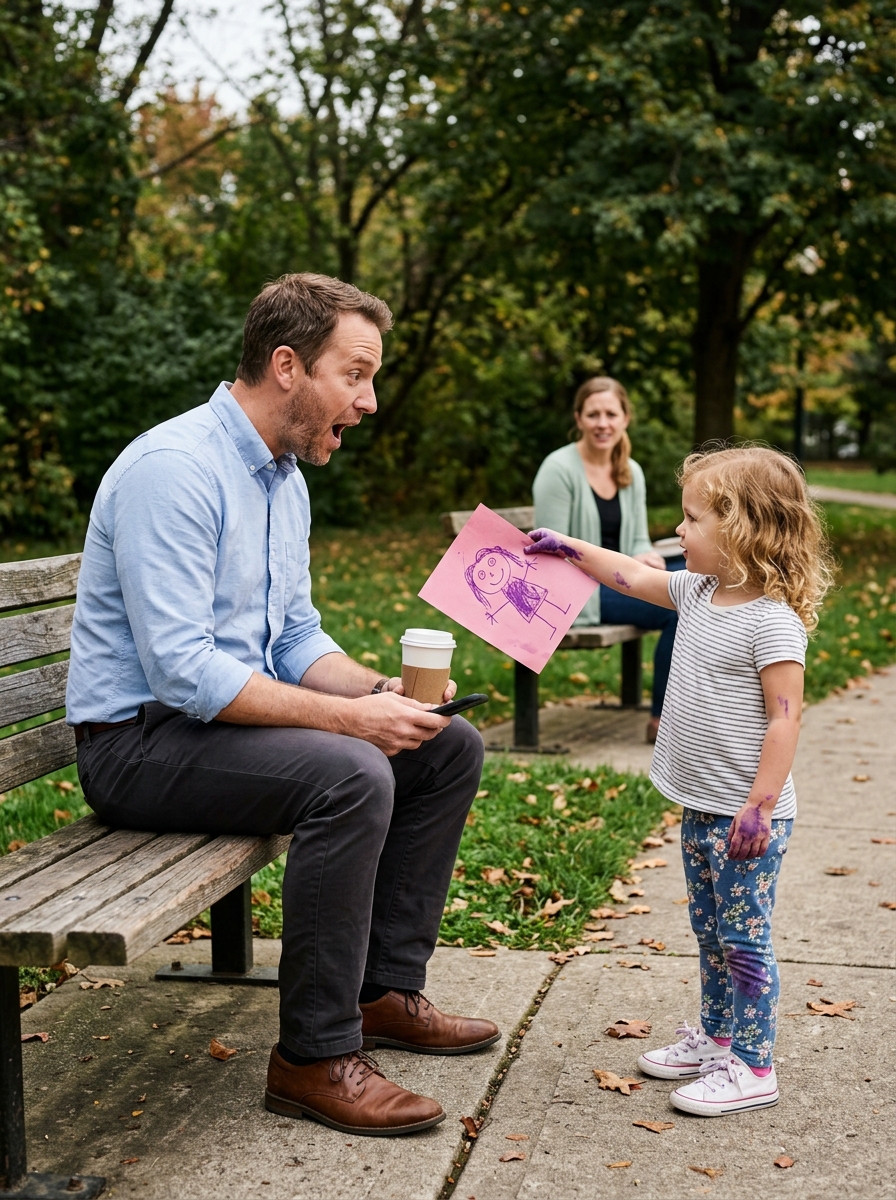
A Five-Year-Old Girl Handed a Burned-Out Executive a Homemade Birthday Invitation—Then Asked Him for One Small Favor That Quietly Changed All Three of Their Lives
“Excuse me, mister. Would you come to my birthday party?”
Mason Reed looked up from the untouched coffee in his hand and found a little girl standing beside the park bench, holding a stack of pink construction-paper envelopes against her chest.
She couldn’t have been more than five.
Her blond curls were uneven, like someone had tried to brush them and given up halfway through. One shoelace was loose. A purple marker streak ran across the side of her hand.
Mason stared at her for a second.
Not because the question was strange.
Because nobody had asked him to go anywhere in a long time.
Not really.
People invited Mason to meetings.
They scheduled lunches with him.
They sent calendar requests, spreadsheets, contracts, and messages marked urgent.
But nobody walked up to him with a homemade envelope covered in crooked butterfly stickers and simply asked him to come to a birthday party.
He glanced around the neighborhood park outside Nashville.
“Are you here by yourself?”
The girl shook her head quickly.
“My mom’s over there.”
She pointed toward another bench about thirty yards away.
A woman in her early thirties sat watching them. She wore jeans, a faded green cardigan, and her blond hair was tied back in a loose ponytail.
When Mason looked at her, she lifted one hand.
Not exactly a wave.
More like a cautious signal that said, Yes, I see you. She’s okay.
Mason nodded back.
The little girl relaxed.
“Mom said I could invite people,” she explained, “but I can’t go where she can’t see me, and I’m not supposed to bother anybody who looks busy.”
Mason looked down at the phone beside him.
Sixteen unread work messages.
Three missed calls.
A calendar packed through the following Wednesday.
“I’m not busy,” he said.
The words surprised him.
Technically, Mason Reed was always busy.
At thirty-eight, he ran the consulting business his father had started nearly twenty-five years earlier. Mason had spent more than a decade turning the small family firm into something much larger than his father had ever expected.
There had been awards.
New offices.
Big clients.
A bigger house.
Then another bigger house.
There had also been a marriage that slowly collapsed while Mason kept insisting he was only working this hard “for a few more years.”
His former wife had finally told him something he still heard sometimes when his house got too quiet.
“You keep building a life you never have time to live.”
At the time, Mason had been angry.
Two years later, sitting alone in a park on a Thursday afternoon because he had finally walked out of a meeting he couldn’t stand being in anymore, he was starting to wonder whether she had been right.
The little girl held out an envelope.
“I’m Lily Parker,” she said. “I’m five, but Saturday I’ll be six.”
Mason accepted the invitation carefully.
“I’m Mason.”
She frowned thoughtfully.
“Just Mason?”
“Mason Reed.”
“Okay. Mr. Mason.”
He almost smiled.
“Mr. Mason works.”
Lily brightened.
“My party starts at two.”
She pointed toward the envelope as if he might need help understanding it.
“I wrote that part myself.”
Mason looked at the front.
The letters were large, uneven, and written in purple crayon.
YOU ARE INVITED.
Several letters leaned in completely different directions.
“It looks very official,” Mason said.
Lily nodded seriously.
“It took forever.”
“I can tell.”
“There’s cake.”
“That’s important.”
“And games.”
“Also important.”
“And maybe balloons.”
“Sounds like a good party.”
Lily hesitated.
The excitement slipped slightly from her face.
“That’s why I’m inviting extra people.”
Mason looked at her.
“Extra people?”
She nodded.
“My friend Brooklyn had twenty-three people at her birthday.”
“That’s a lot.”
“And she had this giant rainbow thing you jump in.”
“A bounce house?”
“Yes.”
Lily sighed.
“We can’t get one.”
She said it without embarrassment.
Just fact.
“My mom says birthdays don’t have to be big to be good.”
“She’s right.”
“I know.”
Lily scuffed the toe of her sneaker against the sidewalk.
“But I still want it to feel big.”
Something about the way she said it made Mason put his phone facedown.
“What do you mean?”
Lily glanced toward her mother.
Then she stepped closer and lowered her voice.
“Mom’s been worried about money.”
Mason didn’t answer.
He simply listened.
Lily continued.
“The place where she worked closed, so now she works at home and sometimes another place, and she says we’re okay, but we have to be careful.”
Mason looked toward the woman on the bench again.
She was pretending not to watch too closely.
Lily spoke in that straightforward way children sometimes do when they understand more than adults realize.
“We moved to a smaller house.”
She held up one finger.
“But my room is still good.”
Another finger.
“And Mom says we have everything we need.”
Another finger.
“And we still get pizza sometimes.”
“That sounds pretty good.”
“It is.”
Then Lily’s voice became quieter.
“But Mom looked sad when I asked for a big birthday party.”
There it was.
Not anger.
Not disappointment.
Concern.
“She told me she was sorry,” Lily said. “And I told her she didn’t have to be sorry because I don’t need a giant party.”
Mason felt a strange pressure behind his ribs.
“So you decided to invite people from the park?”
Lily nodded proudly.
“Free people.”
Mason laughed before he could stop himself.
Lily looked pleased with her logic.
“People don’t cost money.”
“No,” Mason said. “Usually they don’t.”
“And if lots of people come, then the party feels big anyway.”
“That’s actually pretty smart.”
“Mom said it was creative problem-solving.”
Mason glanced over at Lily’s mother.
This time, the woman smiled.
Mason understood that smile.
She knew exactly what her daughter was telling him.
Lily began counting on her fingers.
“I invited eight people.”
“How’s it going?”
“Two yeses.”
She raised two fingers.
“Three nos.”
Three more.
“One maybe.”
She paused.
“And two people said they had to ask their wives.”
Mason laughed again.
“That happens.”
“So…”
Lily looked directly into his eyes.
“Will you come?”
Mason looked at the invitation.
There was an address written inside.
A small house in an older neighborhood about fifteen minutes from the park.
Saturday.
Two o’clock.
Under the address, Lily had drawn what looked like a cake with at least nineteen candles.
At the bottom, in adult handwriting, was one sentence.
No gifts needed. Just come celebrate with Lily.
Mason should have said maybe.
That was his normal answer to anything personal.
Maybe.
Let me check.
I’ll see what my schedule looks like.
Text me Friday.
He had used those phrases for years.
They were polite ways of saying work would probably win.
But Lily was standing there waiting.
And for some reason Mason suddenly couldn’t stand the thought of becoming another adult who promised a child something without meaning it.
“Yes,” he said.
Lily blinked.
“Yes?”
“I’ll come.”
“Really?”
“Really.”
Her entire face changed.
Mason had spent the past ten years negotiating contracts worth more money than he used to believe existed.
None of those victories had ever produced a reaction like that.
Lily bounced once on her heels.
Then she stopped herself.
“Oh.”
“What?”
“I forgot something.”
She leaned closer.
“When you come, can you do me a favor?”
Mason smiled.
“What kind of favor?”
“Can you look like you’re having fun?”
He stared at her.
Lily lowered her voice again.
“My mom keeps saying the party will still be nice even if it’s little.”
She looked toward the other bench.
“But she gets this face.”
“What face?”
Lily tried to imitate it.
Her eyebrows pulled together.
Her mouth tightened.
Mason recognized the expression instantly.
Guilt.
“She thinks I’m disappointed,” Lily said.
“Are you?”
Lily thought for a moment.
“A little.”
Mason appreciated the honesty.
“But I don’t want her to know that part.”
“Why?”
“Because then she’ll feel bad.”
Mason didn’t know what to say.
Lily continued before he had to.
“So if people are smiling, Mom will smile.”
She said this as though it were basic mathematics.
“If you look happy, she’ll know the party is good.”
Mason swallowed.
“So you want me to smile.”
“A lot.”
“I think I can do that.”
“Even during the games?”
“Especially during the games.”
Lily considered this.
“Okay.”
Then she gave him one last serious look.
“Don’t do a fake smile.”
Mason actually laughed.
“I’ll do my best.”
“Good.”
She turned and ran back toward her mother, ponying across the grass with the remaining invitations bouncing in her hands.
Mason watched her go.
He expected to return to his phone.
Instead he sat there.
Five minutes passed.
Then ten.
The coffee went cold.
Lily moved around the park under her mother’s careful watch, handing invitations to strangers.
Some people smiled.
Some shook their heads.
One older couple talked to her for several minutes.
A man walking a small dog accepted an envelope.
A woman pushing a stroller took one too.
Mason found himself watching the whole thing.
He had spent years believing he understood courage.
He had fired executives.
Walked into hostile negotiations.
Borrowed money to expand the company.
Taken risks that had kept him awake until sunrise.
But watching a five-year-old girl approach strangers with handmade invitations because she was trying to make her mother feel less guilty seemed like a completely different kind of bravery.
Eventually Lily and her mother left.
Mason remained on the bench.
His phone buzzed again.
He picked it up.
His operations director had sent a message.
Need your approval before six.
Mason stared at it.
Normally he would have responded immediately.
Instead he typed:
Handle it. I trust you.
Then he opened his calendar.
Saturday afternoon was blocked for work.
Quarterly review prep.
He deleted it.
For the first time in years, Mason Reed officially scheduled himself to attend a six-year-old’s birthday party.
The next morning, something even stranger happened.
Mason left the office before noon.
His assistant looked startled.
“Everything okay?”
“Yeah.”
“You have the afternoon call.”
“You can move it.”
She stared.
Mason almost laughed.
“Seriously. Move it.”
“Where are you going?”
Mason picked up his keys.
“A birthday party requires preparation.”
Her expression became even more confused.
He didn’t explain.
Mason started at a bakery.
Then a party-supply store.
Then a rental place that handled small events.
At first he told himself he was simply buying Lily a gift.
Then the cart got fuller.
Paper decorations.
Party hats.
Bubbles.
Sidewalk chalk.
Small activity kits.
A bright piñata shaped like a unicorn.
He stood in the aisle looking at it for almost a full minute.
Lily had never mentioned liking unicorns.
But it looked ridiculous in the best possible way.
He put it in the cart.
At the rental counter, he asked about a cotton-candy machine.
The employee explained how it worked.
Mason listened with the intense concentration he normally reserved for major presentations.
By Friday night, the trunk of his SUV looked like a children’s festival had exploded inside it.
Mason stood in his garage staring at everything.
Then doubt arrived.
What if he was overstepping?
Lily’s mother didn’t know him.
What if she felt embarrassed?
What if she thought he was trying to show off?
That possibility bothered him.
For years Mason had been surrounded by people who solved problems with money.
Dinner ran late?
Pay someone.
Need a better seat?
Pay more.
Forgot an anniversary?
Buy something expensive.
Mason had learned the hard way that money could fix inconvenience.
It could not fix meaning.
He didn’t want to walk into Lily’s house and turn her mother’s carefully planned birthday into a demonstration of what he could afford.
He nearly returned half of it.
Instead he made a decision.
He would ask first.
If Lily’s mother said no, he would respect it.
No argument.
Saturday afternoon, Mason drove to the address.
The house was smaller than he expected.
A single-story place with pale siding, a narrow front porch, and a little yard that had clearly been cleaned up for the party.
Colorful balloons were tied to the porch railing.
A handmade banner hung over the front window.
HAPPY 6TH BIRTHDAY LILY.
One side sagged slightly lower than the other.
Mason loved it immediately.
Children’s voices came from the backyard.
He checked the time.
1:54.
He suddenly felt nervous.
This was ridiculous.
Mason could give a presentation to two hundred executives without notes.
Yet knocking on this door made his palms damp.
He grabbed the bakery box but left everything else in the car.
Then he knocked.
A moment later the door opened.
Lily’s mother looked exactly like she had in the park, only more tired.
Up close, Mason noticed faint circles beneath her eyes and a small streak of frosting on one sleeve.
“You must be one of Lily’s park people.”
Mason smiled.
“I think that’s my official title.”
She laughed.
“I’m Hannah.”
“Mason.”
“I remember. Lily has mentioned Mr. Mason about seventeen times.”
“Only seventeen?”
“Since breakfast.”
That made him smile.
Hannah opened the door wider.
“Come in.”
Mason stepped inside.
The living room had been turned into party headquarters.
Paper plates.
Napkins.
A bowl of pretzels.
Two trays of homemade cupcakes.
Several grocery-store pizzas waiting to go into the oven.
There was nothing fancy about it.
But everything had been arranged carefully.
Love was everywhere.
Mason suddenly felt even more nervous about what was in his car.
“Before Lily sees me,” he said, “can I ask you something?”
Hannah’s expression changed.
“Sure.”
“I brought some things.”
“You brought a cake.”
“A cake is one thing.”
Hannah looked toward the driveway through the window.
“How many things?”
Mason rubbed the back of his neck.
“Potentially too many things.”
Her eyebrows rose.
“That sounds dangerous.”
“I promise there’s nothing dangerous.”
He paused.
“There is a unicorn.”
Hannah stared at him.
“A real one?”
“Unfortunately, no.”
She laughed despite herself.
Mason opened the front door.
“Can I show you?”
They walked outside.
He lifted the back hatch.
For several seconds Hannah said nothing.
Her hand slowly rose to cover her mouth.
Mason immediately spoke.
“I know.”
She looked at him.
“I know this looks like a lot.”
“Mason…”
“I don’t want to embarrass you.”
She kept staring into the vehicle.
“Mason.”
“And I definitely don’t want to take over Lily’s party.”
“Mason.”
“So if you say no, I’ll load everything back up, and Lily will never know.”
Hannah finally looked at him.
“Why?”
The question stopped him.
Not angry.
Not suspicious.
Just confused.
“Why would you do all this for people you met two days ago?”
Mason looked toward the backyard.
He could hear Lily laughing.
He thought about answering with something easy.
Because it’s her birthday.
Because I can afford it.
Because I wanted to help.
All true.
None complete.
“Your daughter caught me on a bad day,” he said.
Hannah’s expression softened slightly.
“She told me you looked sad.”
“That sounds like Lily.”
“She asked me to smile at the party.”
Hannah closed her eyes for a second.
“Oh, Lily.”
“She said if everybody looked happy, you’d stop worrying that the party wasn’t good enough.”
Hannah looked away.
Mason saw her jaw tighten.
“She shouldn’t be carrying that.”
“She’s not carrying it the way you think.”
Hannah looked back.
“She loves you.”
“That’s exactly why I worry.”
Mason nodded.
“I understand.”
He glanced at the trunk.
“I’m not trying to rescue anybody.”
That word seemed important.
“You don’t need rescuing. Your daughter doesn’t need rescuing. You already made a party. You already gave her what matters.”
Hannah’s eyes grew bright.
Mason continued.
“I just thought maybe I could add some stupid fun.”
She laughed through the emotion.
“Stupid fun?”
“I have a unicorn piñata.”
“That definitely qualifies.”
“And a cotton-candy machine.”
“You’re serious.”
“I watched three instructional videos.”
Hannah laughed again.
A real laugh this time.
Mason pointed toward the supplies.
“If this makes you uncomfortable, say no.”
Hannah stood quietly for several seconds.
Then she looked toward the house.
“I spent all week telling Lily the party didn’t have to look like somebody else’s party.”
“She believes you.”
“I know.”
“She just wants you to believe it too.”
That hit Hannah harder than Mason expected.
She pressed her lips together.
When she finally spoke, her voice was softer.
“I lost my full-time job four months ago.”
Mason listened.
“The little design office where I worked shut down. Nothing dramatic. Just business.”
She shrugged.
“I picked up some remote work. Some weekend work. We downsized. We’re okay.”
“You don’t have to explain.”
“I know.”
She looked at him.
“But I want to.”
Mason waited.
“The hard part isn’t having less money.”
Hannah glanced toward the banner in the window.
“The hard part is feeling like your child notices every single thing you can’t do anymore.”
Mason understood more than she realized.
Not the money part.
The disappointment part.
He had spent years buying everything while somehow giving the people around him less and less of himself.
Hannah sighed.
“When she asked for the big party, I felt awful.”
“She knows you love her.”
“I hope so.”
“She knows.”
Hannah smiled faintly.
“She told me you still get pizza sometimes.”
Hannah laughed.
“That’s her economic indicator.”
“Apparently.”
She looked into the trunk again.
Then at Mason.
“Okay.”
“Okay?”
“You can bring the stupid fun.”
Mason grinned.
“All of it?”
Hannah pointed at him.
“But one condition.”
“Name it.”
“You are not the host.”
“Agreed.”
“You do not start acting like this is your event.”
“Agreed.”
“And if you make me feel like some sad charity case, I will personally send that unicorn home with you.”
Mason raised both hands.
“Understood.”
Hannah smiled.
“Then bring it in.”
Mason had barely lifted the cake when the front door flew open.
“MR. MASON!”
Lily came running onto the porch wearing a purple birthday dress and mismatched socks.
She stopped when she saw the open trunk.
Her mouth dropped.
She looked at Mason.
Then Hannah.
Then the trunk.
Then back at Mason.
“Is that…”
She pointed.
Mason nodded solemnly.
“It is.”
“A unicorn?”
“A cardboard unicorn.”
Lily screamed with joy.
Not a frightened scream.
Not even a particularly dignified one.
Just pure six-year-old happiness.
She ran in a circle.
Hannah started laughing.
Mason laughed too.
Lily stopped suddenly.
“Wait.”
She squinted at him.
“You’re smiling.”
“You told me to.”
“That one looks real.”
“It is.”
Lily nodded with satisfaction.
“Good.”
The next half hour turned into cheerful chaos.
Mason carried supplies.
Hannah directed traffic.
Lily attempted to supervise both of them and was mostly ignored.
More guests arrived.
Three children from Lily’s school.
Four kids from the neighborhood.
A grandmother with her grandson.
The older couple Mason had seen Lily invite at the park.
The man with the little dog came too, though the dog stayed home.
By two-thirty, the backyard held fifteen children and several adults.
Hannah kept looking around as though she couldn’t quite believe it.
Neither could Mason.
Lily had done it.
She had built her own crowd one handmade invitation at a time.
Mason expected to feel awkward.
He didn’t know any of these people.
He didn’t usually spend Saturday afternoons in modest backyards with paper hats and children yelling over each other.
But within twenty minutes, he was running a beanbag-toss game.
Then he was helping refill lemonade.
Then he was operating the cotton-candy machine with the intense focus of a man performing heart surgery.
His first cotton-candy cone looked terrible.
Lily examined it.
“That looks like a cloud that got hurt.”
Mason stared at it.
“That’s harsh.”
“It’s true.”
His second attempt was better.
His third looked almost professional.
By the fifth, children were calling him the Cotton Candy Guy.
Mason Reed, president of a successful consulting firm, had never been prouder of a title.
At one point his phone buzzed in his pocket.
He ignored it.
Then it buzzed again.
He took it out.
A work message.
He stared at the screen.
Then turned the phone completely off.
That simple action felt almost rebellious.
For the first time in years, nobody from work could reach him.
The world did not collapse.
Nothing caught fire.
Nobody came running into the backyard to announce that the economy had stopped because Mason Reed had missed an email.
Instead Lily laughed.
A shy little boy asked Mason to help him draw a dinosaur with face paint.
Mason had absolutely no idea what he was doing.
The dinosaur looked more like a green potato with teeth.
The boy loved it.
Later came the piñata.
The children lined up.
Hannah covered her face with both hands every time someone swung wildly in the wrong direction.
Mason stayed far outside the circle and laughed so hard his stomach hurt.
When the unicorn finally broke open, wrapped candy scattered across the grass.
The children cheered.
Lily dropped to her knees and started collecting pieces.
Then she stopped.
She grabbed a handful and carried it to the older couple from the park.
“These are for you because grown-ups didn’t get turns.”
The woman looked touched.
“Thank you, sweetheart.”
Lily returned to the candy pile.
Mason watched Hannah watching her.
There it was.
The smile Lily had wanted.
Not polite.
Not forced.
Not worried.
Hannah looked completely happy.
Mason felt something loosen inside him.
He hadn’t realized how tense he’d been for the past several years until that moment.
When it was time for cake, everyone gathered around the folding table.
Six candles burned on top.
Lily stood behind them.
Hannah wrapped one arm around her daughter.
Mason stood near the back.
Everyone sang.
Lily closed her eyes dramatically before blowing out the candles.
The first try left two burning.
She laughed.
The second try got them.
People clapped.
Lily immediately turned toward Hannah.
Not toward the cake.
Not toward the presents.
Toward her mother.
“Did you have fun?”
Hannah stared at her daughter.
“So much fun.”
Lily beamed.
“I knew you would.”
Mason looked away for a second.
Something had gotten into his eyes.
Probably frosting.
Definitely frosting.
An hour later, the party slowly began winding down.
Parents collected children.
The older couple thanked Hannah.
The backyard became quieter.
Pieces of tissue paper and popped balloons dotted the grass.
Mason began packing the cotton-candy machine.
Hannah walked over carrying two cups of lemonade.
She handed him one.
“You stayed.”
Mason looked at her.
“I said I would.”
“No.”
She shook her head.
“I mean you stayed.”
Mason understood.
He hadn’t simply dropped off supplies.
He had not appeared for photographs and disappeared.
He had been there for every game.
Every spill.
Every piece of cake.
Every ridiculous cotton-candy request.
“I had fun.”
“I could tell.”
“Was my smile acceptable?”
Hannah laughed.
“Lily approved.”
“Good.”
They stood quietly.
Then Hannah said, “Can I ask you something personal?”
“Sure.”
“Why did she think you were sad?”
Mason looked toward Lily.
She was sitting on the porch steps with a plate of cake, carefully scraping frosting from one side to the other.
“I probably looked sad because I was sad.”
Hannah waited.
Mason rarely talked about himself outside of work.
He could discuss revenue.
Strategy.
Hiring.
Expansion.
Anything measurable.
But saying, “I’m lonely” felt harder than presenting a bad quarterly report to a room full of people.
Still, he said it.
“I built a life that looks good from the outside.”
Hannah listened.
“The business did well. Better than my father ever expected.”
“That sounds like something to be proud of.”
“It is.”
Mason stared into his lemonade.
“But I let it become everything.”
Hannah nodded slowly.
“My marriage ended two years ago.”
“I’m sorry.”
“I blamed the hours.”
He gave a small shrug.
“The truth is, hours don’t make choices. People do.”
Hannah said nothing.
“I kept telling myself I was almost done pushing so hard.”
Mason laughed quietly.
“For about ten years.”
“That’s a long almost.”
“Yeah.”
“My friends stopped calling because I usually canceled.”
He looked toward the house.
“I bought a bigger place.”
Then he smiled without humor.
“And made sure almost nobody ever came over.”
Hannah looked at him.
“So you left work and went to the park.”
“For the first time in months.”
“And Lily found you.”
“She did.”
Hannah smiled.
“She does that.”
“Invites strange men to birthday parties?”
“Finds people.”
Mason looked at her.
Hannah’s expression was serious now.
“She notices when someone needs something.”
“That can be dangerous.”
“I know.”
“I mean emotionally.”
“So do I.”
Hannah looked toward Lily.
“That’s why I keep trying to teach her she isn’t responsible for fixing everybody.”
Mason understood.
“But sometimes,” Hannah said, “she reminds people they can fix something themselves.”
Mason looked back at her.
He knew exactly what she meant.
Before he could answer, Lily ran toward them.
“Mr. Mason!”
“What?”
“You forgot cake.”
“I did not forget cake.”
“You didn’t eat cake.”
“That is different.”
Lily held up a plate.
A giant piece of cake sat on it.
There was so much frosting Mason could barely see the cake itself.
“I saved this.”
“For me?”
“Yes.”
“Why is there three inches of frosting?”
“Because you brought the unicorn.”
“That seems fair.”
Lily handed him the plate.
Then she looked at Hannah.
“Mom.”
“Yes?”
“You’re smiling.”
Hannah’s face changed.
Just slightly.
Lily pointed excitedly.
“I told him!”
“Told him what?”
“That if everybody was happy, you’d be happy.”
Hannah looked at Mason.
Mason looked at Lily.
Lily looked pleased with herself.
Hannah crouched and wrapped her arms around her daughter.
“You were right.”
Lily hugged her back.
Mason stood there holding an absurd slice of cake, feeling something inside him crack open.
Not dramatically.
Quietly.
Like a door that had been stuck for years finally moving.
He ate every bite.
Mason expected that to be the end of the story.
He had gone to a birthday party.
He had done something kind.
He had learned a lesson.
Life would return to normal.
Except normal suddenly felt unacceptable.
On Monday morning, Mason arrived at work at eight.
Not six-thirty.
His assistant noticed.
“Big weekend?”
“Very.”
“How was the birthday party?”
“Life-changing.”
She stared.
“You’re joking.”
“I don’t think I am.”
That week Mason did something his leadership team had been asking him to do for years.
He delegated.
Actually delegated.
Not the version where he assigned something, then watched every detail, then redid half of it himself.
He gave responsibility away.
He started leaving before dinner.
Not every night.
But often enough that people noticed.
The company kept running.
Better, in some areas.
That humbled him.
Two weeks after the party, Mason received a text from Hannah.
Thank-you card from Lily is apparently not enough. She insists you need pizza.
Mason smiled at his phone.
He wrote back:
Is this her economic indicator pizza?
Hannah responded almost immediately.
Exactly.
Dinner became another dinner.
Then a Saturday afternoon at the park.
Lily brought chalk.
Mason drew a terrible house.
Lily informed him that successful businessmen should know how to draw roofs.
He told her his company had people for that.
She told him that was cheating.
Hannah laughed so hard she nearly spilled her coffee.
Weeks passed.
Mason became part of their routine slowly.
Not because he forced it.
Because it happened.
Sometimes Hannah asked him to join them for dinner.
Sometimes Mason invited them to his house.
The first time Lily walked into his large, perfectly decorated living room, she turned in a circle.
“Where’s all your stuff?”
Mason looked confused.
“This is my stuff.”
“No.”
She pointed around.
“Your normal stuff.”
“What normal stuff?”
“Pictures.”
Mason looked at the walls.
Artwork.
No photographs.
“Kid stuff.”
“I don’t have kids.”
“Games.”
“I don’t really play games.”
Lily stared at him with genuine concern.
“What do you do here?”
Mason opened his mouth.
Then closed it.
Hannah tried not to laugh.
“I work sometimes.”
“At home too?”
“Yes.”
Lily shook her head.
“That’s too much work.”
Mason had no defense.
The next time they visited, Lily brought a framed picture from her birthday.
In it, Mason stood beside the cotton-candy machine wearing a paper party hat much too small for his head.
Lily placed it on his living-room shelf.
“There.”
Mason looked at it.
“What is this?”
“Normal stuff.”
He never moved it.
Months passed.
Mason came to Lily’s school performance.
He sat beside Hannah in a folding chair.
Lily played a tree.
She had no lines.
She waved from the stage anyway.
Mason waved back.
He attended a neighborhood cookout.
Helped Hannah carry a secondhand bookshelf into Lily’s room.
Learned that Hannah liked old movies and hated overly sweet coffee.
Learned that Lily refused to eat peas but somehow loved broccoli.
Learned that Hannah sometimes grew quiet when money came up because she was proud and didn’t want anyone assuming she needed to be taken care of.
Mason respected that.
He did not try to solve her life.
That mattered.
When Hannah needed help moving a desk, he helped move a desk.
When she found steadier work, he celebrated with her.
When Lily wanted someone to practice reading with, Mason listened to every painfully slow page about a talking frog without touching his phone.
He learned to show up without turning every problem into a project.
That lesson was harder than he expected.
At work, Mason changed too.
He stopped measuring good leadership by how many decisions required him.
He started mentoring younger managers.
He took lunches away from his desk.
When employees asked for reasonable time with their families, Mason no longer secretly judged them for lacking ambition.
He began to wonder how many good moments he had missed because he had confused exhaustion with importance.
His company still mattered.
He still cared about succeeding.
But success became smaller somehow.
Or maybe clearer.
It was no longer a giant number at the end of a report.
Sometimes it was leaving the office at five-thirty because Lily had a school project about bridges and had decided Mason was apparently an expert on glue.
Sometimes it was sitting on Hannah’s porch with cheap takeout while Lily chased lightning bugs in the yard.
Sometimes it was laughing so hard at nothing important that his face hurt.
One afternoon, nearly a year after the birthday party, Mason returned to the same neighborhood park.
He arrived first.
He sat on the same bench.
For a few minutes, he simply looked around.
He remembered the man who had sat there the year before.
Expensive suit.
Cold coffee.
Phone buzzing.
No idea what he was waiting for.
Mason almost felt sorry for him.
Then someone covered his eyes from behind.
“Guess who.”
Mason smiled.
“President Lincoln.”
“No.”
“An alligator.”
“No!”
“Cotton Candy Guy?”
Lily burst into laughter.
“You knew!”
She ran around the bench.
She was seven now.
One front tooth was missing.
Her hair was pulled into two uneven braids.
Hannah walked behind her carrying two coffees.
“You’re getting worse at guessing.”
“I panicked.”
Hannah handed him a cup.
Lily ran toward the swings.
“Can I go?”
“Where I can see you,” Hannah called.
“I know!”
Mason watched her climb onto a swing.
Hannah sat beside him.
For a while neither spoke.
They had become comfortable with silence.
That was new for Mason too.
He used to fill silence because it made him nervous.
Now he understood that sometimes silence meant nobody needed anything.
Hannah looked toward Lily.
“Do you ever think about that day?”
“All the time.”
“She talks about it less now.”
“Good.”
“Why good?”
“Because it means it became normal.”
Hannah looked at him.
“What became normal?”
“Me being around.”
She smiled.
Mason felt his heart speed up.
That had been happening around Hannah more often.
Their friendship had changed quietly.
There had been no dramatic confession.
No grand gesture.
Just hundreds of small moments.
Coffee.
School events.
Dinners.
Porch conversations.
A hand resting a second too long on his arm.
The way Hannah sometimes looked at him when Lily said something funny.
The way Mason caught himself wanting to tell Hannah things first.
Good news.
Bad news.
Ridiculous news.
It scared him.
Not because he didn’t understand what was happening.
Because he did.
Hannah looked at him.
“You know Lily thinks you’re magical.”
“I operated a cotton-candy machine.”
“Badly.”
“I improved.”
“She calls you her fairy godfather.”
“That sounds like a job I’m underqualified for.”
“She disagrees.”
Mason smiled.
Hannah nudged his shoulder.
“She wrote about you at school.”
“That concerns me.”
“The assignment was about someone who changed your life.”
Mason looked at her.
“What did she write?”
Hannah pulled out her phone.
“I took a picture.”
She read Lily’s words.
“Mr. Mason used to be sad, but then he came to my birthday. He brought a unicorn, but that is not why he is special. He always comes when he says he will come.”
Hannah stopped.
Mason looked down.
Fourteen words.
That was all it took.
He always comes when he says he will come.
For a man who had spent years canceling dinner plans, missing anniversaries, and promising “next time,” nothing could have hit harder.
Hannah watched him.
“You okay?”
Mason cleared his throat.
“Yeah.”
“You sure?”
“No.”
She smiled.
Mason looked at Lily on the swings.
“I used to think showing up was the minimum.”
“Sometimes it is.”
“And sometimes?”
“Sometimes it’s everything.”
Mason nodded.
Hannah reached over and took his hand.
Neither of them commented on it.
Her fingers simply stayed there.
Three months later, Mason asked Hannah to dinner without Lily.
Hannah raised one eyebrow.
“Is this business?”
“No.”
“Birthday planning?”
“No.”
“Cotton-candy emergency?”
“Very serious dinner.”
She smiled.
“Then yes.”
Their first official date was wonderfully ordinary.
A small restaurant.
No extravagant reservations.
No private room.
No giant flowers.
Mason had once believed romance required impressing someone.
Hannah taught him that attention was more impressive.
He listened.
She listened.
They laughed.
They talked until the employees began cleaning nearby tables.
When Mason walked her home, they stood on the porch.
“I’m nervous,” he admitted.
Hannah smiled.
“Good.”
“Good?”
“It means you’re not treating this like another thing you already know how to manage.”
“I definitely don’t know how to manage this.”
“Perfect.”
She kissed his cheek.
“Good night, Mr. Mason.”
He stood on the porch grinning like an idiot.
From an upstairs window, Lily’s voice shouted:
“DID YOU HAVE FUN?”
Hannah covered her face.
Mason laughed.
“Yes!”
“DID MOM SMILE?”
“Yes!”
“I KNEW IT!”
Hannah pointed toward the upstairs window.
“Bed!”
The curtain disappeared.
Mason laughed so hard he had to lean against the porch railing.
A year earlier, he would have hated being seen in such an unpolished moment.
Now he wanted more of them.
Mason and Hannah took things slowly.
Lily came first.
That was never questioned.
Mason never tried to become something before the relationship was ready.
He was just Mason.
The man who came to school events.
The man who knew how Lily liked her grilled cheese cut.
The man who had learned the names of her stuffed animals.
The man who once spent forty-five minutes searching the house for a missing library book only to discover Lily was sitting on it.
Eventually, without anyone announcing it, Lily began reaching for Mason’s hand when they crossed parking lots.
The first time it happened, Mason nearly stopped walking.
Hannah noticed.
She said nothing.
Later that night, she squeezed his hand.
He understood.
Mason’s father had died years earlier, but Mason sometimes thought about what he would have said.
His father had loved the company.
Had poured himself into it.
But he had also attended every one of Mason’s baseball games.
Every school ceremony.
Every terrible piano recital Mason had ever given.
Somewhere along the way, Mason had remembered only the business part of his father’s example.
He had forgotten the rest.
That realization changed something else.
Mason created a small private fund through his company.
Not a flashy charity with his name on it.
No giant event.
No photographs.
The fund helped employees cover ordinary family needs that could suddenly become overwhelming—school activity fees, transportation problems, temporary child-care gaps, little emergencies that rarely made headlines but could turn a normal week upside down.
Mason refused to attach his name to it.
His leadership team handled the details.
When someone asked why he wanted it anonymous, Mason answered simply.
“People deserve help without being turned into somebody else’s success story.”
He had learned that from Hannah.
Two years after Lily’s sixth birthday, Mason returned to the park again.
This time he carried something small in his coat pocket.
His hands would not stop sweating.
Hannah sat beside him on the bench.
Lily was nearby drawing with sidewalk chalk.
Mason had prepared a speech.
He had rehearsed it in the car.
Then Hannah looked at him and every sentence disappeared.
“What?” she asked.
“Nothing.”
“You’re acting weird.”
“I’m not.”
“You absolutely are.”
Mason reached into his pocket.
Hannah froze.
“Oh.”
“That’s not the speech.”
She started laughing.
Mason laughed too.
“Great beginning.”
“I’m sorry.”
“Don’t be.”
He looked at her.
Then the laughter faded.
“I spent most of my adult life thinking the right plan could protect me from regret.”
Hannah listened.
“It didn’t.”
Mason took her hand.
“Then your daughter walked up to me with a pink envelope.”
Hannah’s eyes filled.
“She invited me to a birthday party.”
Mason smiled.
“She asked me to smile.”
Hannah squeezed his hand.
“And somehow I’ve been smiling ever since.”
A small voice interrupted.
“NOW?”
Mason closed his eyes.
Hannah laughed through her tears.
Lily stood twenty feet away holding a tiny box.
“You were supposed to wait,” Mason called.
“I DID.”
“Not long enough.”
“You talk slow when you’re nervous.”
Hannah laughed harder.
Lily ran over.
She handed Mason the box.
Then she stood directly in front of them.
Mason opened it.
Inside was a ring.
Nothing enormous.
Nothing meant to impress strangers.
Just something he had chosen because it looked like Hannah.
Simple.
Warm.
Beautiful without needing attention.
Mason looked at her.
“Hannah Parker, I love the life we have.”
Her eyes filled completely.
“I love the loud parts.”
He glanced at Lily.
“And apparently there are many.”
“Correct,” Lily said.
Mason smiled.
“I love the quiet parts.”
He looked back at Hannah.
“And I don’t want to build another life that I’m too busy to live.”
Hannah covered her mouth.
“Will you marry me?”
She nodded before he finished.
“Yes.”
Lily jumped.
“YES!”
Hannah laughed.
“Yes.”
Mason slid the ring onto her finger.
Lily wrapped both arms around them.
For a moment, the three of them stayed tangled together beside the same bench where everything had begun.
No crowd.
No photographer.
No elaborate plan.
Just them.
Mason wouldn’t have changed a thing.
The wedding happened the following spring.
It was small.
That had been Hannah’s request.
Mason agreed immediately.
Years earlier, he would have wanted the best venue, the largest guest list, the most impressive dinner.
Now he understood that “best” and “largest” had never meant the same thing.
There were flowers from a local grower.
Simple food.
Music.
Family.
Friends.
People who actually knew them.
And, according to Lily, absolutely no cotton-candy machine.
“We already did that theme,” she explained.
At the reception, Lily gave a speech.
She was eight.
She wore a pale blue dress and stood behind the microphone with both hands gripping a folded piece of paper.
Mason sat beside Hannah.
Lily cleared her throat.
“When I was five and three-quarters…”
The room laughed.
Lily waited.
“I had a problem.”
She looked down at her paper.
“I wanted a big birthday party, but Mom said we needed to have a little one.”
Hannah smiled.
“So I decided to get more people for free.”
More laughter.
“I made invitations.”
Lily looked at Mason.
“And I went to the park.”
Mason already felt his throat tighten.
“I saw Mr. Mason sitting by himself.”
She paused.
“He looked sad.”
Several guests looked toward Mason.
He nodded.
Fair.
“I asked him to come to my birthday.”
Lily smiled.
“And he said yes.”
She looked down again.
“I didn’t know he was going to bring a unicorn.”
The room laughed.
“I didn’t know he was going to become my friend.”
Her voice became quieter.
“And I didn’t know he was going to love my mom.”
Mason reached for Hannah’s hand beneath the table.
Lily looked directly at him.
“But the most important thing is that he came.”
Mason swallowed.
“He said he would come, and then he did.”
Lily folded her paper.
“And after that, he kept coming.”
The room became completely quiet.
“He came to my school things.”
Her voice wobbled slightly.
“He came when I needed help with homework.”
She smiled.
“He came even when I was only a tree in the school play.”
People laughed softly.
“He came for pizza.”
Another pause.
“He came to the park.”
Lily looked at Hannah.
“He made Mom smile.”
Then she looked back at Mason.
“And now he’s going to be my dad.”
Mason had spent years being trained not to show too much emotion in professional settings.
That training became completely useless.
He wiped his eyes.
Lily smiled.
“So I think the best thing I ever did was invite a sad stranger to my birthday party.”
She thought for a moment.
“Mom says I should probably not make that a habit.”
The room burst into laughter.
Hannah covered her face.
Lily grinned.
“But this time it worked.”
She walked toward Mason.
He stood.
She hugged him around the waist.
Mason bent and hugged her back.
For several seconds, applause filled the room.
But Mason barely heard it.
He was thinking about a Thursday afternoon years earlier.
A park bench.
Cold coffee.
A phone that would not stop buzzing.
A man who had spent his entire adult life chasing the next thing because stopping felt too frightening.
Then a small voice.
Excuse me, mister.
Would you come to my birthday party?
Mason had once believed his life changed because he said yes.
Years later, he understood that wasn’t completely true.
His life changed because he kept saying yes afterward.
Yes to staying.
Yes to listening.
Yes to putting the phone away.
Yes to being needed for something that had nothing to do with money.
Yes to ordinary dinners.
Yes to school plays.
Yes to walks in the park.
Yes to love that could not be scheduled between meetings.
Yes to a little girl who had asked him for one strange favor.
Smile so my mom will smile.
Mason had promised he would.
He never expected the promise to last for the rest of his life.