
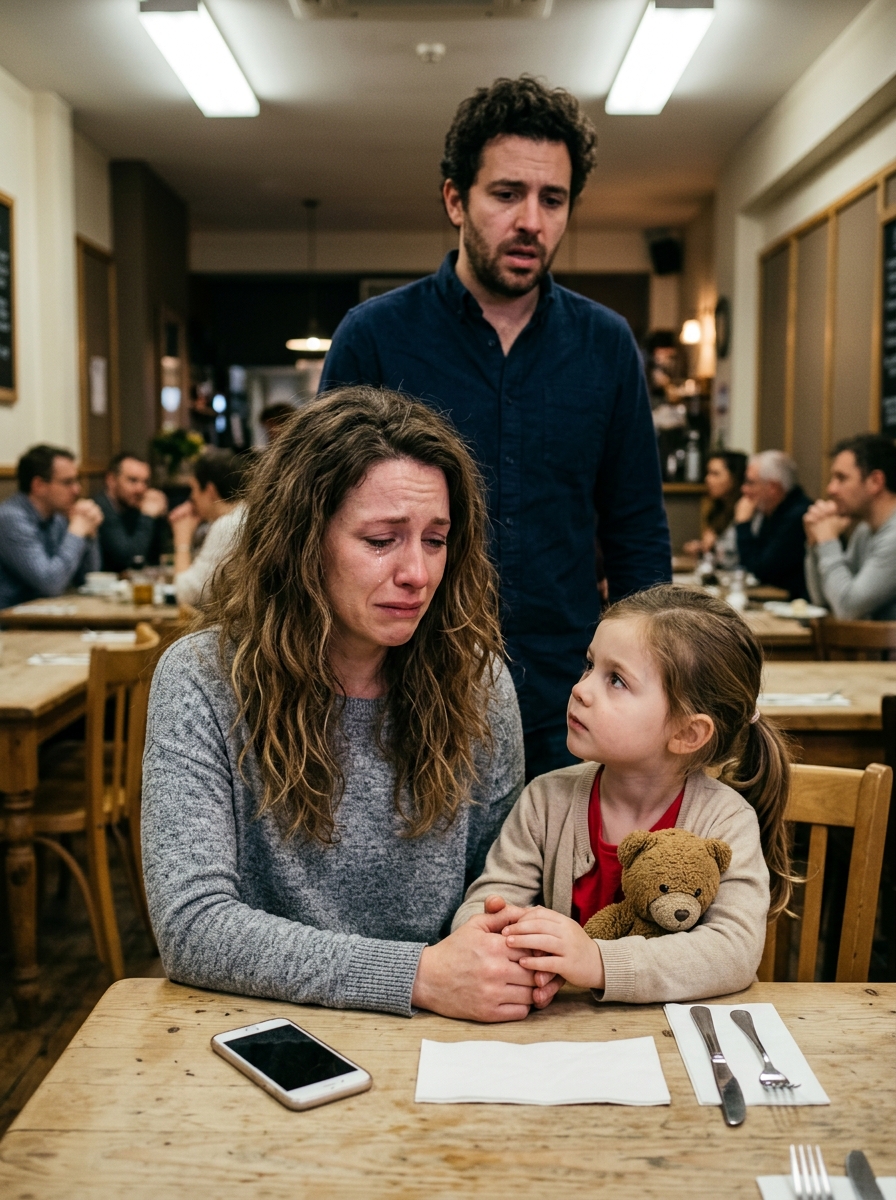
My Blind Date Rejected Me by Text Before We Ever Met—Then a Five-Year-Old Girl Walked Over, Took My Hand, and Asked If I Would Be Her New Mom
At 7:32 on a Friday night, I was sitting alone at a table set for two when my phone buzzed.
The man I was supposed to meet had never walked through the door.
His message was only four sentences long.
Rachel mentioned you were divorced. I’ve thought about it, and I’m really looking for someone with a simpler history. I don’t think we should waste each other’s time. Take care.
I read it twice.
Then a third time, because apparently humiliation becomes clearer when you study it closely enough.
My name is Lauren Mitchell. I was thirty-five years old, divorced for three years, and teaching first grade in a suburb outside Kansas City.
I had spent most of my adult life helping six-year-olds learn how to sound out difficult words, zip their coats, apologize after arguments, and remember that glue belonged on paper instead of their fingers.
Yet somehow, sitting in that restaurant, I felt less capable than any kid in my classroom.
The empty chair across from me seemed enormous.
A server came by and asked whether I wanted to order.
“Not yet,” I said.
She gave me the kind of smile people give when they know exactly what has happened but are too polite to say it.
My face burned.
I reached for my coat.
I had almost gotten one arm into the sleeve when a small voice beside me said, “Excuse me.”
I turned.
A little girl stood there holding a stuffed brown bear by one arm.
She looked about five. Her sandy-blond hair had been pulled into two crooked ponytails, and she wore a red dress under a cream cardigan.
One of her socks had slipped halfway down her ankle.
She stared at me with complete seriousness.
“Why do you look like you’re trying not to cry?”
That question hit harder than the text.
“I’m okay, sweetheart,” I said.
She frowned.
Children know when adults are lying about simple things.
“No, you’re not.”
I almost laughed.
“Maybe I’m a little sad.”
She climbed onto the empty chair across from me before I could stop her.
“Did somebody say something mean?”
“Chloe.”
A man was hurrying toward us.
He looked around thirty-nine, maybe forty, with dark hair that seemed to have lost an argument with his fingers. He wore a navy button-down shirt and a jacket that had been hung over one arm.
His expression was equal parts embarrassment and concern.
“Chloe Morgan,” he said. “What have we talked about?”
The little girl sighed.
“Not talking to strangers.”
“Exactly.”
“But she was sad.”
He closed his eyes for half a second.
Then he looked at me.
“I’m really sorry. She believes every problem in America can be solved by asking personal questions.”
“That’s not true,” Chloe said.
He glanced down.
“Most problems?”
“Yes.”
I laughed before I could stop myself.
It was the first real laugh I had managed all evening.
The man smiled.
“I’m Caleb.”
“Lauren.”
He held out his hand.
When I shook it, he noticed my coat, the untouched place setting across from me, and my phone lying faceup beside my water glass.
His expression changed.
Not pity.
Recognition.
“Someone stand you up?”
I should have said it was none of his business.
Instead, I heard myself say, “He didn’t even make it that far. He rejected me from somewhere else.”
Caleb winced.
“That is efficient.”
Another laugh escaped me.
“I suppose.”
Chloe leaned over the table.
“Why?”
“Chloe.”
“What? I’m trying to understand.”
I looked at her.
“He decided he didn’t like something about me.”
She seemed offended on my behalf.
“But he never met you.”
“Correct.”
“That doesn’t make sense.”
“Also correct.”
Caleb rubbed the back of his neck.
“I promise I usually have more control over this conversation.”
“No, you don’t,” Chloe said.
That made all three of us laugh.
I had been seconds from rushing home, throwing on old sweatpants, and spending the rest of the night pretending I didn’t care.
Instead, I was sitting across from a five-year-old relationship consultant.
Caleb glanced toward a table behind him.
An older couple sat there watching us.
The woman had silver hair cut to her chin and the warmest smile I had seen in months. The man beside her wore a paper birthday badge clearly handmade by Chloe.
Caleb lowered his voice.
“We’re having dinner with my parents. It’s my dad’s sixty-sixth birthday.”
“Sixty-six,” Chloe repeated gravely. “Very old.”
The older man called across the room, “I can hear you.”
Chloe grinned.
Caleb shook his head.
Then he surprised me.
“Would you like to join us?”
I stared at him.
He lifted both hands.
“I realize that sounds strange.”
“It sounds very strange.”
“My mother ordered enough appetizers to feed a football team. My dad likes talking to anyone who will listen. Chloe has apparently adopted you.”
“I have,” Chloe confirmed.
“And there’s chocolate cake coming.”
Chloe grabbed my hand.
“You can sit beside me.”
Every reasonable part of my brain told me to decline.
I didn’t know these people.
I was embarrassed.
My mascara was probably starting to betray me.
And there was something deeply pathetic about joining another family’s birthday dinner because my own evening had collapsed before appetizers.
Then I looked at Chloe.
There was no pity in her face.
She simply wanted me there.
When was the last time anyone had wanted my company without measuring me first?
Not my age.
Not my divorce.
Not whether I was “ready.”
Not whether I came with a past.
Just me.
“If your parents really don’t mind,” I said.
Caleb smiled.
“They won’t.”
Chloe hopped down.
“Come on.”
She took my hand again.
And just like that, I walked away from the table where I had been rejected and joined four people who had no reason at all to be kind to me.
Caleb’s parents were Linda and Tom Morgan.
Linda immediately moved her purse from the extra chair.
“No explanations needed,” she said. “Sit down before Chloe starts rearranging the entire restaurant.”
“I already did,” Chloe announced.
Tom shook my hand.
“Any friend Chloe brings home from three tables away is a friend of mine.”
“Dad.”
“What?”
Caleb looked embarrassed.
I was beginning to enjoy that expression on him.
Dinner should have been awkward.
It wasn’t.
Linda asked what I did.
When I told her I taught first grade, Chloe’s eyes widened.
“You have kids all day?”
“Twenty-one of them.”
Her mouth dropped open.
“That’s too many.”
“Sometimes.”
“Do they listen?”
I looked at Caleb.
“Do five-year-olds usually listen?”
He laughed.
“Fair point.”
Tom told terrible jokes.
Linda told stories about Caleb as a child, including one about him trying to build a treehouse from cardboard because he had misunderstood what his father meant by “using materials we already have.”
Caleb kept begging her to stop.
She did not.
And slowly, unbelievably, I relaxed.
My shoulders dropped.
I forgot to check my phone.
I stopped wondering whether the people at nearby tables knew I had been stood up.
At some point, I realized I was having a good time.
Then Chloe asked Caleb to cut her chicken.
The way he did it caught my attention.
He didn’t sigh.
He didn’t tell her she was old enough.
He simply leaned over, cut it into smaller pieces, then pushed the plate back while listening to a story she was telling about a girl in kindergarten who had put a crayon in her lunchbox.
There was patience in the small gesture.
The practiced kind.
“You’re doing this alone?” I asked quietly.
Caleb knew what I meant.
He looked at Chloe.
“My wife passed away a little over two years ago.”
I stopped.
“I’m sorry.”
“Thank you.”
He didn’t offer details, and I didn’t ask.
There was something in his face that told me the story still belonged to a place inside him that strangers should not enter.
“Chloe was three,” he continued. “Most days we do okay.”
Chloe was busy showing Linda how her stuffed bear could sit upright against a water glass.
Caleb lowered his voice.
“She remembers pieces. A song. The smell of a certain hand lotion. A bedtime story. Sometimes she asks questions I don’t know how to answer.”
I looked at him.
“That sounds hard.”
“It is.”
He paused.
“But she’s also the reason I get out of my own head.”
As if she knew we were talking about her, Chloe turned.
“Daddy falls asleep during books.”
Caleb sighed.
“Thank you for sharing.”
“He skips pages sometimes.”
“I do not skip pages.”
“You skipped a page in the dragon one.”
“The dragon one has ninety-seven pages.”
“It has thirty-two.”
Tom nearly choked laughing.
By the time the cake arrived, I felt as if I had stepped into someone else’s life for a few hours.
A warm life.
Not perfect.
Not polished.
Just full.
Chloe insisted I sit beside her while everyone sang to Tom.
Afterward, she pushed half her slice toward me.
“I told you I’d share.”
“You don’t have to.”
“I said I would.”
So we ate chocolate cake from the same plate.
Halfway through, she looked at me.
“Are you still sad?”
I thought about the message waiting on my phone.
“No.”
“Really?”
“Really.”
She nodded, satisfied.
Then she asked, “Do you have kids?”
The question landed quietly.
“No.”
“Do you want kids?”
Caleb froze.
Linda stopped lifting her coffee cup.
Tom became fascinated by his fork.
I could have dodged the question.
Adults do that when children wander into painful places.
But Chloe had been honest with me all evening.
So I decided to be honest with her.
“I always thought I would.”
She waited.
“My marriage ended because my husband and I eventually wanted different lives.”
I swallowed.
“He decided he didn’t want children. I did.”
Chloe considered this.
“That’s why you got divorced?”
“It was part of it.”
“Did it make you sad?”
“Yes.”
She nodded as if filing this away.
Then she turned toward her father.
“My daddy gets sad too.”
“Chloe,” Caleb said softly.
“He does.”
Her voice dropped into a stage whisper.
“Sometimes after I go to bed.”
Caleb’s cheeks reddened.
I felt strangely protective of him.
“Everybody gets sad sometimes,” I told her.
“I know.”
She put down her fork.
Then she looked directly into my eyes.
“My mommy isn’t here anymore.”
I nodded.
“Your daddy told me.”
“He tries really hard.”
“I can tell.”
“He makes pancakes.”
“That’s impressive.”
“They’re shaped weird.”
Caleb stared at the ceiling.
“Why is this becoming a performance review?”
Chloe ignored him.
She leaned closer.
“You like kids.”
“I do.”
“And you don’t have any.”
“That’s right.”
“My daddy doesn’t have a wife.”
Silence fell across the table.
I had enough time to realize where she was going.
Not enough time to stop her.
“Can you be my new mom?”
Caleb’s face turned bright red.
Linda covered her mouth.
Tom stared down at his plate with shoulders shaking because he was trying not to laugh.
And I—
I cried.
Not loudly.
Not dramatically.
Tears simply filled my eyes faster than I could stop them.
Because I had spent three years hearing all the ways I was wrong for people.
Divorced.
Thirty-five.
Too settled in my career.
Too cautious.
Too serious.
Too interested in building a family.
Too late.
Too much history.
And this tiny girl had looked at me for less than three hours and decided I belonged.
I knelt beside her chair.
“Chloe, being somebody’s mom is a very big thing.”
“I know.”
“It doesn’t happen because two people eat cake together.”
“Why not?”
“Because adults need time.”
She frowned.
“You and Daddy are adults.”
“Yes.”
“So take time.”
Tom made a sound suspiciously like a cough.
I glanced at Caleb.
He looked horrified.
“I am so sorry.”
“It’s okay.”
“No, this is not okay.”
Chloe crossed her arms.
“Daddy says I should ask for what I need.”
Caleb blinked.
“That statement is going to haunt me.”
“I need a mom.”
His expression softened instantly.
The humor left the table.
Chloe looked at me again.
“And you said you wanted kids.”
I felt my throat tighten.
“So it makes sense.”
Caleb leaned toward her.
“Honey, people aren’t puzzle pieces. You can’t just put two strangers together because the empty spaces look right.”
Chloe thought about that.
“Then stop being strangers.”
Nobody said anything.
She continued.
“You talk. Then you’re friends. Then maybe later.”
The child had apparently created a reasonable relationship plan in under thirty seconds.
I wiped my cheek.
“That part actually makes sense.”
Chloe smiled.
Caleb looked at me.
Something passed between us.
Not love.
Not even attraction, exactly.
Possibility.
A tiny opening where none had existed before.
Caleb cleared his throat.
“She has a family project at school right now. It’s made her very focused on what families are supposed to look like.”
“I understand.”
“She’s been asking a lot about her mom.”
“That makes sense too.”
“She doesn’t normally propose marriage arrangements to strangers.”
“Good to know.”
Chloe raised one finger.
“I didn’t say marriage.”
Caleb gave up.
When dinner finally ended, I expected the whole strange evening to remain exactly that.
A strange evening.
A story I would tell Rachel someday.
The night I got rejected by text and was recruited by a five-year-old at another table.
But Chloe stood beside me near the restaurant entrance while everyone put on coats.
“Can Lauren come to our house?”
Caleb closed his eyes.
“Chloe.”
“She can see my books.”
“We have discussed inviting yourself into other people’s schedules.”
“She can see my family project.”
I looked at Caleb.
He looked genuinely uncomfortable.
“You don’t have to do anything,” he said quickly. “Please don’t feel obligated because my daughter has turned tonight into some kind of negotiation.”
I smiled.
“What day?”
His eyebrows lifted.
“What?”
“What day would work?”
Chloe jumped.
“Saturday!”
“Chloe.”
“Saturday morning!”
I laughed.
“Saturday morning works.”
Her whole face changed.
Pure joy.
No caution.
No calculation.
She threw both arms around my waist.
I stood there with one hand resting on the back of a child I had met three hours earlier and felt something inside me move.
Not heal.
That would be too simple.
But move.
Outside, Linda pulled me aside while Caleb helped Chloe button her coat.
“Thank you,” she said.
“For what?”
“For staying.”
“I should thank you.”
She shook her head.
“I haven’t seen Caleb this relaxed with someone new in a long time.”
I glanced toward him.
He was pretending not to notice Chloe putting her stuffed bear inside his jacket.
Linda smiled.
“Whatever happens from here, don’t let tonight make you feel responsible for fixing anything.”
“I won’t.”
“Good.”
She squeezed my hand.
“But don’t assume you were invited out of pity either.”
That stayed with me all the way home.
So did Chloe’s impossible question.
Saturday arrived faster than I expected.
I nearly canceled three times.
Once while brushing my teeth.
Once while choosing a sweater.
And once while sitting in my car outside Caleb’s house.
His home was exactly what I expected from a single father with a kindergarten daughter.
A basketball hoop with no net stood beside the driveway.
A pink scooter leaned against the porch railing.
There were sidewalk-chalk stars near the steps and a small wooden sign hanging crookedly beside the door.
Before I could knock, Chloe opened it.
“You came!”
Caleb appeared behind her.
“You were supposed to wait for the doorbell.”
“I saw her through the window.”
He looked at me.
“Welcome to my extremely secure home.”
I held up a paper bag.
“I brought cinnamon rolls.”
Chloe gasped.
“You can definitely come inside.”
The morning was easy.
Suspiciously easy.
We ate at the kitchen table.
Chloe showed me her room, six dolls, nine stuffed animals, three picture books she considered “important,” and a shoebox where she stored shiny rocks.
Then she brought out the family project.
It was a large poster board with branches drawn in green marker.
Pictures had been glued onto most of them.
Caleb.
Chloe.
Linda.
Tom.
There was also a photograph of Chloe’s mother.
She was smiling, holding a much younger Chloe against her shoulder.
I looked at Caleb.
His face went still.
Chloe pointed.
“That’s my mommy.”
“She was beautiful.”
“She had yellow rain boots.”
I smiled.
“That is important information.”
“She wore them even when it wasn’t raining.”
Caleb’s mouth twitched.
“She did.”
Chloe studied the picture for a few seconds.
Then she asked, “Where do new people go?”
“What do you mean?” I said.
“On a family tree.”
Caleb pulled out a chair.
“Families aren’t always as simple as a tree, kiddo.”
“Mrs. Parker says families can grow.”
“They can.”
“So if somebody becomes family later, where do they go?”
He glanced at me.
I pretended to be very interested in a glue stick.
Caleb answered carefully.
“You make room.”
That became the rhythm of the next few weeks.
Making room.
I visited on Saturdays.
At first, only for an hour or two.
Then lunch stretched into afternoons.
Sometimes Linda and Tom stopped by.
Sometimes it was only the three of us.
Chloe wanted me to read.
She wanted me to help her sound out words.
She wanted me to judge coloring contests where both contestants were Chloe.
She wanted me to explain why teachers always seemed to know when someone had been whispering.
I told her we had special powers.
She believed me for nearly a week.
Caleb and I talked between all of it.
Real conversations.
Not the polished kind people have on first dates.
We talked while loading a dishwasher.
While picking up crayons.
While waiting for Chloe to find a missing shoe she insisted had “walked away.”
He worked as an architect for a midsize office downtown.
He liked old houses, diner coffee, baseball on the radio, and making lists he rarely finished.
He hated raisins.
He had an unreasonable number of flashlights.
He had been married for almost ten years.
I learned that last fact slowly.
He didn’t tell stories about his wife as though she had disappeared from the family.
He included her.
“That picture was Hannah’s favorite.”
“Hannah chose those curtains.”
“Hannah would have laughed at that.”
At first, I worried I was stepping into someone else’s place.
Then I realized there was no empty position waiting for a replacement.
There was history.
There was grief.
There was love that had existed before me.
If I ever became part of this family, I would have to become something new.
Not overwrite something old.
One afternoon, Chloe fell asleep on the couch during a movie.
Caleb covered her with a blanket.
Then he and I sat at the kitchen table with coffee.
He looked tired.
Not bad tired.
Parent tired.
The kind where you could still function but probably had no idea what day it was.
“Can I ask you something?” he said.
“Sure.”
“Why did you agree to come here?”
I looked toward the living room.
“Because your daughter is terrifying.”
He smiled.
“Fair.”
I wrapped both hands around my mug.
“And because going home that night felt worse.”
His smile faded.
I continued.
“My apartment is nice. My job is good. I have friends.”
I paused.
“But there’s a difference between being independent and being lonely.”
He nodded.
“I know.”
“For a long time I told myself I didn’t care anymore.”
“About marriage?”
“About all of it.”
I looked down.
“A partner. Kids. Sunday mornings with somebody making too much noise in the kitchen.”
He waited.
“My ex and I married young. We both talked about having children someday.”
I drew a circle on the table with my fingertip.
“But someday kept moving.”
Caleb listened without interrupting.
“Then one night he told me he had realized he didn’t want to be a father. Ever.”
“That must have been difficult.”
“It wasn’t one conversation.”
I shook my head.
“It was months of trying to convince ourselves that one of us would change.”
“Did either of you?”
“No.”
The word came out quieter than I expected.
“So we ended it.”
“I’m sorry.”
“The divorce wasn’t ugly. That almost made it harder.”
He raised an eyebrow.
“How?”
“There was nobody to blame.”
I looked at him.
“He wasn’t cruel. I wasn’t wrong. We simply wanted futures that couldn’t happen in the same house.”
Caleb leaned back.
“That can still break your heart.”
“Yes.”
For several seconds, neither of us spoke.
Then I admitted something I had rarely said aloud.
“I think I became even more invested in teaching after that.”
“Because of the kids?”
I nodded.
“I get twenty-one little people every year who need me.”
I smiled.
“I teach them to read. I tie shoes. I settle arguments over pencil colors.”
“But?”
“But at three o’clock, they go home.”
Caleb looked toward Chloe.
“That doesn’t make what you do less important.”
“I know.”
He reached across the table.
Not dramatically.
He simply put his hand over mine.
“You’re very good with her.”
Something in my chest tightened.
“She makes it easy.”
“No.”
He smiled.
“She makes nothing easy.”
I laughed.
Then he became serious.
“I’m glad you stayed that night.”
“So am I.”
His thumb moved once across my knuckles.
Neither of us pulled away.
That was the first moment I understood this was no longer only about Chloe.
The next week, Caleb asked me to dinner.
Just me.
No grandparents.
No five-year-old.
“A real date?” I asked.
He looked nervous.
“I think that’s the traditional name.”
“What does Chloe think?”
“She thinks we should skip directly to a wedding.”
I stared at him.
“I’m joking.”
“You’re not.”
“I’m mostly joking.”
I laughed.
“Dinner sounds good.”
He took me to a small neighborhood place with wooden booths and handwritten specials on a chalkboard.
Nothing fancy.
Perfect.
We talked for nearly three hours.
No child interrupted us.
No parents rescued us from silence.
And there was no silence to rescue.
Near the end, Caleb looked at me across the table.
“I’m scared of this.”
The honesty surprised me.
“Me too.”
“I haven’t dated seriously since Hannah.”
“You don’t need to apologize for that.”
“I’m not apologizing.”
He folded his hands.
“I just need you to know that I’m not looking for someone to fill a role.”
I understood immediately.
“Good.”
“And Chloe—”
“Is not the reason we should date.”
“Exactly.”
“She can be the reason we met.”
His shoulders relaxed.
“But not the reason we stay.”
“Yes.”
I looked at him.
“If this happens, Caleb, it needs to happen because you like me.”
“I do.”
“Not because I’m a teacher.”
“I like that about you.”
“Not because Chloe likes me.”
“She likes everybody who shares dessert.”
“That is not true.”
He smiled.
“You should have seen her with the neighbor who brought oatmeal cookies.”
I tried not to laugh.
Then he leaned forward.
“I like you because you’re patient until you’re not.”
“That sounds insulting.”
“It isn’t.”
“You’re bad at compliments.”
“I like that you laugh at my father’s terrible jokes.”
“That might indicate poor judgment.”
“I like that you listen.”
His voice softened.
“I like that you don’t act uncomfortable when we talk about Hannah.”
That stopped me.
“Why would I?”
“Some people do.”
“I’m not competing with her.”
He looked at me for a long time.
“No.”
“You loved her.”
“I did.”
“You probably always will.”
“I will.”
I nodded.
“That doesn’t scare me.”
It was the truth.
What scared me was how much I wanted a place in his future.
A week later, that fear finally caught up with me.
I was helping Chloe decorate paper ornaments at the kitchen table when she ran into the hallway for markers.
I heard her talking to Linda, who had just arrived.
“Lauren is going to live here someday.”
My hand stopped.
Linda said something too quietly for me to hear.
Chloe answered louder.
“She is. I know.”
I stood so quickly my chair scraped the floor.
Caleb looked up from the counter.
“You okay?”
“I need some air.”
His expression changed.
He followed me onto the front porch.
“What happened?”
I folded my arms.
“Chloe thinks I’m moving in.”
His face tightened.
“I’ll talk to her.”
“She thinks this is already decided.”
“She’s five.”
“I know how old she is.”
My voice came out sharper than I intended.
Caleb went quiet.
I rubbed my forehead.
“I’m sorry.”
“You don’t need to apologize.”
“Yes, I do.”
I looked at him.
“I care about her.”
“I know.”
“That’s the problem.”
His brow furrowed.
“Why is that a problem?”
“Because if you and I don’t work out, I’m not only walking away from you.”
The words hung between us.
His face softened.
I continued.
“I know exactly what I’m getting attached to.”
“The whole family.”
“Yes.”
Inside the house, we could hear Chloe laughing with Linda.
I swallowed.
“I don’t want to become another adult she thinks is staying forever and then disappear.”
Caleb leaned against the porch railing.
“I think about that too.”
“So maybe we’re moving too fast.”
He nodded slowly.
“Maybe.”
That answer hurt more than I expected.
A ridiculous part of me wanted him to argue.
Instead, he respected what I had said.
We agreed not to see each other for several days.
No dramatic breakup.
No slammed doors.
No angry speeches.
Just space.
It was awful.
My apartment had never felt so quiet.
On Monday evening, I graded spelling worksheets at the kitchen counter and kept looking toward my phone.
Tuesday was worse.
Wednesday, Rachel called.
She had been the one who arranged the original blind date.
“You sound miserable,” she said.
“I’m fine.”
“That was not believable.”
“I’m thinking.”
“About Caleb?”
“And Chloe.”
Rachel was quiet.
Then she said, “Are you afraid it won’t work?”
“Yes.”
“Or are you afraid it will?”
I hated that question.
“I have to go.”
“You’re welcome.”
I hung up.
Then I stared at the stack of papers in front of me without reading a single word.
The next afternoon, I found an envelope tucked under my apartment door.
No stamp.
My name was written across the front in large uneven letters.
LAUREN.
Inside was a drawing.
Three stick figures stood in front of a house.
One was tall with dark hair.
One was small with yellow ponytails.
One wore a blue dress.
Above them, in Chloe’s handwriting, were the words:
NO PRESSURE.
I laughed so hard I had to sit down.
Below it, in Caleb’s handwriting, was one sentence.
She heard us talking about giving people space and may not fully understand the concept.
I called him.
He answered immediately.
“Before you say anything, I did not authorize the drawing.”
“I know.”
“She made me drive her over.”
“That sounds like authorization.”
“I remained in the car.”
“Strong defense.”
He laughed softly.
Then neither of us spoke.
Finally, I said, “I miss you.”
His breath caught.
“We miss you too.”
I closed my eyes.
“Caleb.”
“Yeah?”
“I don’t want to run away because I’m scared of something that hasn’t happened.”
“Neither do I.”
“But we need to slow Chloe down.”
“Absolutely.”
“No more planning our household.”
“Agreed.”
“No wedding drawings.”
“I can attempt enforcement.”
“No asking if I’m her mom every forty-eight hours.”
There was a pause.
“I can attempt enforcement.”
I laughed.
“Saturday?”
“Saturday.”
This time, when I went back, we talked with Chloe together.
She sat on the couch between us with her stuffed bear.
Caleb explained that adults needed time to decide what kind of relationship they were building.
Chloe listened.
I told her I cared about her very much.
“But caring about somebody doesn’t mean we know exactly what will happen next.”
She frowned.
“Are you leaving?”
“No.”
The answer came quickly.
Too quickly to pretend it wasn’t important.
Her shoulders relaxed.
“Then that’s okay.”
Caleb looked at her.
“You really understand?”
“No.”
He laughed.
“At least you’re honest.”
She climbed into my lap.
“I can wait.”
“How long?” I asked suspiciously.
She thought.
“Until Christmas.”
It was early December.
Caleb covered his face.
I laughed until my eyes watered.
Christmas Eve arrived with the strange feeling that I had been part of the Morgan family much longer than a few weeks.
Linda and Tom came over after lunch.
The kitchen counters filled with cookie trays and bowls.
Chloe wore pajamas before dinner because she claimed holiday rules allowed it.
Nobody corrected her.
She gave each person a handmade ornament.
Tom’s said GRANDPA in letters of different sizes.
Linda’s had so much glitter that she carried it to the tree with both hands.
Caleb’s was a crooked cardboard house.
Mine was a green circle with a painted book.
Across the middle, Chloe had written:
MY FAVORITE TEACHER.
I stared at it.
“You made this for me?”
“You teach kids.”
“I know.”
“And you teach me.”
My eyes stung.
I crouched beside her.
“Thank you.”
“You can keep it forever.”
“I will.”
She studied me.
“You’re crying again.”
“I do that around you.”
“You should work on it.”
Caleb laughed from across the room.
After dinner, Chloe chose a book and climbed onto the couch beside me.
Halfway through, she leaned against my shoulder.
By the final page, she was asleep.
I sat completely still.
Her head rested against my chest.
One small hand held the corner of my sweater.
Caleb stood in the doorway.
He didn’t speak.
Neither did I.
He carefully lifted her.
She barely woke.
“Good night, Lauren,” she murmured.
“Good night, sweetheart.”
After he carried her upstairs, Linda hugged me before leaving.
Tom squeezed my shoulder.
Then suddenly the house was quiet.
Caleb returned from putting Chloe to bed.
We stood in the living room near the tree.
There were crayons under the coffee table.
A doll shoe sat beside my purse.
Two dishes waited in the sink.
It was the least elegant Christmas scene imaginable.
And I loved every inch of it.
Caleb sat beside me.
“She asks me about you every night.”
I looked at him.
“What does she ask?”
“If you’re staying.”
My heart began to pound.
“What do you tell her?”
“That people shouldn’t promise forever because they’re afraid of disappointing a five-year-old.”
“Good.”
“I tell her families grow slowly.”
I nodded.
“And?”
He smiled faintly.
“I tell her sometimes the right people show up in ways you never planned.”
For a moment, I couldn’t speak.
“I spent three years believing I missed my chance,” I finally said.
“At what?”
“This.”
I looked around the room.
“A family.”
Caleb’s expression softened.
“I thought there was a deadline nobody had told me about.”
“There isn’t.”
“I know that now.”
I looked at my hands.
“But that night at the restaurant, I didn’t.”
He moved closer.
“That man was an idiot.”
“No.”
Caleb raised an eyebrow.
“No?”
“He wasn’t right for me.”
I smiled.
“And apparently he had excellent timing.”
Caleb laughed.
Then he became serious.
“Lauren.”
“Yeah?”
“You fit here.”
My breath caught.
“I don’t mean because Chloe wants you here.”
He took my hand.
“I mean I want you here.”
I looked at him.
“You fit the messy mornings.”
He smiled.
“The unfinished coffee.”
“The books everywhere.”
“The weird pancakes.”
“That was unnecessary.”
I laughed.
Then his voice dropped.
“You fit the life I didn’t think I’d ever be brave enough to build again.”
My eyes filled.
“I’m scared.”
“Me too.”
“What if we get this wrong?”
“We might.”
“That isn’t comforting.”
“I know.”
He squeezed my hand.
“But I don’t think love becomes safer because we refuse to try.”
I stared at him.
Then I leaned forward.
He kissed me.
Softly.
Carefully.
Nothing dramatic.
Just the quiet kind of kiss that feels less like an explosion and more like a door opening.
When we separated, I laughed through tears.
“You know Chloe is going to be unbearable.”
“She can never know this happened.”
A voice came from the stairs.
“I know.”
We froze.
Chloe stood halfway down the staircase holding her bear.
Caleb stared at her.
“You are supposed to be asleep.”
“I needed water.”
“For ten minutes?”
She looked at me.
Then at him.
A giant smile spread across her face.
“Christmas worked.”
Caleb groaned.
I laughed so hard I had to cover my mouth.
The months that followed were not a fairy tale.
They were better.
They were ordinary.
Caleb and I argued about small things.
He liked planning weekends.
I liked deciding on Saturday morning.
I stacked dishes beside the sink.
He considered that a personal attack.
He bought groceries like he was preparing for a monthlong emergency.
I constantly forgot milk.
Chloe became deeply offended the first time I told her to clean her room.
“I thought you liked me.”
“I do.”
“Then why are you doing this?”
“Because your floor has disappeared.”
She looked at Caleb.
He raised his hands.
“I support Lauren.”
“Traitor.”
We laughed.
But there were hard conversations too.
We talked about Hannah.
We talked about my divorce.
We talked about what commitment meant.
We talked about Chloe’s expectations.
We talked about the difference between wanting a family and rushing one into existence.
Each time, I expected honesty to scare us apart.
Instead, it made the floor beneath us feel stronger.
In spring, Chloe brought home another school assignment.
This one was called “The People Who Help Me Grow.”
She spread it across the kitchen table.
There were boxes for parents, grandparents, teachers, friends, and other important adults.
I tried not to look at where she had put my name.
She had written it under OTHER IMPORTANT ADULTS.
I smiled.
“That seems accurate.”
Chloe frowned.
“What?”
“Important adult.”
She looked frustrated.
“But there wasn’t a box for maybe-mom.”
Caleb choked on his coffee.
I pressed my lips together.
“Schools really need to update their forms.”
“Exactly.”
A few weeks later, Caleb and I started talking about living together.
We did not tell Chloe.
That decision lasted approximately forty-eight hours.
She found a notepad on the counter.
On it, Caleb had written:
Office desk.
Bookshelf.
Lauren dresser.
Chloe marched into the living room carrying the evidence.
“What is this?”
Caleb looked guilty.
I looked at the ceiling.
She pointed at the words.
“Lauren dresser.”
“Well,” Caleb said.
Chloe screamed.
Not in fear.
In joy.
Then she ran three circles around the coffee table.
“We had a whole plan for how to tell you,” I said.
“You’re moving in!”
“In June.”
“That is forever away.”
“It’s six weeks.”
“Forever.”
Those six weeks became a countdown.
Chloe wrote numbers on a paper chain.
Every morning she tore one off.
Caleb pretended this was completely normal.
I began packing.
And with every box, old fear returned.
My apartment had been my safe place after the divorce.
I had chosen every piece of furniture.
I had learned to sleep alone.
Cook for one.
Fix things myself.
Spend Sundays without explaining where I was going.
Leaving that apartment meant more than moving.
It meant admitting I believed this new life might last.
The night before the move, I sat on the floor surrounded by boxes.
My phone buzzed.
Caleb.
“You okay?”
“Yes.”
“That was fast.”
“I’m sitting in the dark because I packed the lamps.”
“Excellent planning.”
“Thank you.”
There was a pause.
Then he said, “You can change your mind.”
I stared at a box labeled KITCHEN.
“What?”
“You can change your mind.”
My chest tightened.
“If this is too much, too fast, too complicated—”
“Caleb.”
“I need you to know that.”
I stood.
“Do you want me to change my mind?”
“No.”
The answer came instantly.
“I want you here so badly it scares me.”
I smiled.
“Good.”
“Good?”
“Because that’s exactly how I feel.”
Move-in day was chaos.
Tom arrived early with a hand truck.
Linda brought muffins.
Caleb had printed labels for rooms.
I made fun of him until I realized the labels were useful.
Chloe insisted on carrying the smallest boxes.
Each time, she marched through the front door and announced the contents.
“PILLOWS!”
“BOOKS!”
“WEIRD KITCHEN THINGS!”
At noon, I carried the final box upstairs.
Chloe followed.
Caleb’s bedroom—our bedroom now—looked strange with my things mixed among his.
My lamp beside his.
My books on the shelf.
My blue blanket folded across the bed.
Chloe stood in the doorway.
For once, she was quiet.
I turned.
“What’s wrong?”
She walked toward me.
“You’re really staying?”
I knelt.
“I’m really staying.”
“Not just for a sleepover?”
“No.”
“Not until school starts?”
“No.”
She looked into my face.
“Like family?”
My throat tightened.
“Like family.”
She fidgeted with the hem of her shirt.
Then she asked the question I had known was coming for months.
“Can I call you Mom now?”
Behind her, Caleb appeared in the doorway.
He didn’t interrupt.
I looked at Chloe.
At the child who had walked across a restaurant because a stranger looked sad.
The child who had made room for me long before I believed I deserved any.
The child who had never asked me to erase the mother she lost.
Only to love her too.
I took both her hands.
“If you want to call me Mom, I would be honored.”
Her eyes widened.
“Really?”
“Really.”
She threw herself against me.
I wrapped my arms around her.
“I knew it,” she said into my shoulder.
I laughed.
“You knew what?”
“That first night.”
“You absolutely did not.”
“Yes, I did.”
“You were five.”
“I’m smart.”
Caleb leaned against the doorframe.
“She has been waiting months to say that.”
Chloe pulled back.
“I told Daddy you were the one.”
“When?”
“In the restaurant.”
Caleb pointed at her.
“She also said our server should marry Grandpa’s neighbor.”
“That might still happen.”
Tom called from downstairs.
“Are we moving furniture or starting a family meeting?”
Chloe shouted, “LAUREN IS MOM NOW!”
Silence.
Then Linda yelled from below.
“I knew it!”
I covered my face.
Caleb laughed.
The rest of the afternoon became one long, messy celebration.
Not a formal one.
Nobody made a speech.
We ate sandwiches standing around the kitchen island.
Tom complained about his back after carrying exactly two boxes.
Linda reorganized my coffee mugs without permission.
Chloe kept testing her new word.
“Mom, where are the markers?”
“Mom, can I have lemonade?”
“Mom, Daddy says I have to put my shoes away.”
Every time she said it, I felt the same small jolt.
Not possession.
Not replacement.
Trust.
That night, after everyone left and Chloe finally went to bed, Caleb found me standing in the kitchen.
Most of the boxes were still unopened.
The refrigerator hummed.
A pile of packing paper covered half the floor.
He walked up behind me and put his arms around my waist.
“Overwhelmed?”
“A little.”
“Regret anything?”
I turned.
“The number of books you own.”
“Those are essential.”
“You have an entire shelf about bridges.”
“Bridges matter.”
“I’m reconsidering everything.”
He smiled.
Then he became quiet.
“Thank you.”
“For what?”
“For coming that Saturday.”
I shook my head.
“That wasn’t the beginning.”
“No?”
“The beginning was your daughter ignoring every rule you gave her about strangers.”
He laughed.
“Fair.”
“And you inviting a crying woman to your father’s birthday dinner.”
“You weren’t crying yet.”
“I was emotionally preparing.”
He brushed a strand of hair away from my face.
“Thank you for staying anyway.”
I looked at him.
“For what?”
“The awkwardness.”
He smiled.
“The questions.”
“The chaos.”
“The fact that my daughter interviewed you for motherhood before dessert.”
“That was aggressive.”
“Very.”
I rested my hands against his chest.
“You know what I think about sometimes?”
“What?”
“That text.”
His jaw tightened.
“The man from the restaurant?”
“Yes.”
“I still dislike him.”
I smiled.
“I don’t.”
“You’re a better person than I am.”
“No.”
I looked toward the hallway.
“I’m grateful.”
Caleb stared at me.
“If he had shown up, I might have spent two hours trying to impress a man who had already decided my past made me less valuable.”
I shook my head.
“Instead, I met Chloe.”
Caleb smiled.
“And me.”
“Eventually.”
“Eventually?”
“She made the first impression.”
“That is painfully accurate.”
I laughed.
Then my eyes filled again.
Caleb noticed.
“There it is.”
“What?”
“The crying.”
“Your daughter says I should work on it.”
“She’s right.”
I swatted his arm.
He pulled me closer.
“I spent years thinking rejection meant something was wrong with me,” I said.
Caleb didn’t answer.
He knew I wasn’t finished.
“Every bad date felt like evidence.”
I looked down.
“Every time someone heard the word divorced and became cautious, I thought maybe they were seeing something I couldn’t.”
“Lauren.”
“I know better now.”
He waited.
“I wasn’t too complicated.”
“No.”
“I wasn’t too late.”
“No.”
“I wasn’t carrying some terrible flaw because my first marriage ended.”
“No.”
I looked into his eyes.
“I was just trying doors that didn’t open.”
He smiled.
“And then?”
“A five-year-old opened one.”
From upstairs, Chloe shouted, “MOM!”
Caleb and I both looked toward the ceiling.
I laughed.
“Speaking of.”
We found her sitting up in bed.
“What happened?”
“I need water.”
“There is water beside you.”
She looked at the cup.
“Oh.”
Caleb folded his arms.
“Was there another reason you called?”
Chloe looked at me.
“Maybe.”
I sat on the edge of her bed.
“What?”
She smiled.
“I wanted to say it again.”
My heart nearly broke open.
“Say what?”
She whispered it.
“Mom.”
I kissed her forehead.
“Good night, Chloe.”
“Good night, Mom.”
Caleb turned off the lamp.
As we walked into the hallway, he reached for my hand.
And I understood something I had once been too afraid to believe.
Families do not always begin at the right time.
They do not always arrive in the expected order.
Sometimes you build one young.
Sometimes later.
Sometimes after plans change.
Sometimes after heartbreak.
Sometimes you walk into a restaurant expecting to meet one person and leave having met four people who will change your life.
Months later, we returned to that same restaurant for Tom’s next birthday.
Chloe was six now.
She insisted we sit near the table where I had been waiting that first night.
“That was your sad table,” she said.
Caleb groaned.
“We are not calling it that.”
“It was.”
Tom pointed across the room.
“And that was our table.”
Linda smiled at me.
“And then she marched over.”
Chloe looked proud.
“I helped.”
“You interfered,” Caleb said.
“I helped.”
“You interrogated a stranger.”
“I was friendly.”
“You asked her if she wanted children.”
“Important information.”
I nearly spit out my water laughing.
Tom raised his glass.
“To Chloe’s complete lack of boundaries.”
“Dad.”
“What? It worked.”
Linda lifted hers too.
“To Lauren.”
I shook my head.
“You really don’t need to toast me.”
“Yes, we do,” she said.
Her voice softened.
“To the woman who could have gone home.”
The table became quiet.
I looked at Linda.
She continued.
“You had every reason to leave that night.”
I glanced at the table where I had once sat alone.
The chair across from it was empty.
For the first time, it didn’t hurt to look at it.
Linda smiled.
“But you stayed.”
Caleb reached under the table and took my hand.
Chloe leaned against my arm.
Tom cleared his throat.
“And because apparently I cannot have a birthday without Lauren becoming emotional—”
“I am not emotional.”
Chloe looked up.
“You’re crying.”
“I am not.”
“You are.”
Caleb handed me a napkin.
“Traitors,” I said.
Everyone laughed.
The cake arrived.
Chocolate, of course.
Chloe pushed half her slice toward me.
“Want some?”
I looked at her.
“You still share?”
“With you.”
I took a bite.
She watched me.
Then she asked, “Are you sad?”
The same question.
A different life.
I looked at Caleb.
At Linda.
At Tom.
At this little girl sitting beside me.
“No,” I said.
“Not anymore.”
Chloe nodded.
“Good.”
She returned to her cake.
To her, the matter was settled.
Maybe it really was that simple.
Not the falling in love.
Not the grieving.
Not the learning to trust another person with your future.
Those things had taken time.
They had required patience.
Honesty.
Fear.
Difficult conversations.
They had required all three of us to understand that love could not be demanded into existence just because a child wanted it badly enough.
But maybe Chloe had understood the first step better than the adults.
Stop being strangers.
Talk.
Make room.
See what happens.
That night, after dinner, Caleb and I stood on our front porch while Chloe drew with chalk near the steps.
She was singing a song she had invented.
Most of the words did not rhyme.
Several verses involved pancakes.
I leaned against Caleb.
“Did you ever imagine this?”
“No.”
“Me neither.”
He kissed the top of my head.
“Better or worse than the plan?”
“What plan?”
“The one you had at thirty.”
I thought about it.
At thirty, I had imagined a husband I had known forever.
Children who looked like me.
A house we chose together.
A story that made sense when told in order.
Instead, I had a man who had loved someone before me.
A daughter I had not given birth to.
A house filled with another woman’s memories alongside mine.
A family tree with branches nobody could have predicted.
“Better,” I said.
Caleb looked at me.
“Really?”
“Much.”
Chloe ran toward us holding a piece of blue chalk.
“Mom, come look.”
I followed her down the steps.
She had drawn three figures on the driveway.
One tall.
One medium.
One small.
Above us, she had drawn an enormous heart.
Caleb stood behind me.
“What is it?” he asked.
Chloe looked offended.
“Our family.”
“I see.”
She pointed at the medium figure.
“That’s Mom.”
I stared at the chalk version of myself.
It had blue hair.
“Why is my hair blue?”
“I ran out of brown.”
“Reasonable.”
She pointed at Caleb.
“That’s Daddy.”
His stick figure had extremely large ears.
I laughed.
“What?”
“Nothing.”
He looked at the drawing.
“Why are my ears the size of dinner plates?”
“So you listen better.”
I turned away because I was laughing too hard.
He looked at Chloe.
“Your mother is encouraging this.”
The word mother caught me.
Not because it was new anymore.
Because it felt natural.
Chloe grabbed one of my hands.
Then one of Caleb’s.
She pulled us together over the chalk drawing.
“See?”
“See what?” I asked.
“It worked.”
Caleb raised an eyebrow.
“What worked?”
She looked at me like adults were exhausting.
“The restaurant.”
I smiled.
“You think you planned all this?”
“Yes.”
“You were five.”
“I was very smart at five.”
“You’re six now.”
“I’m even smarter.”
Caleb looked at me.
“We are in trouble.”
“Yes.”
Chloe squeezed our hands.
Then she ran back to her chalk.
I watched her kneel on the driveway, adding Linda and Tom to the drawing.
She added her mother too.
A fourth grown-up figure near the edge of the giant heart.
I felt Caleb become still beside me.
Chloe pointed at it.
“That’s Mommy Hannah.”
I looked at Caleb.
His eyes were bright.
Chloe smiled at us.
“Everybody fits.”
That sentence stayed with me.
Everybody fits.
The past did not have to disappear for me to belong.
Hannah’s place did not shrink because mine grew.
My divorce did not make me damaged.
Caleb’s old love did not threaten his new one.
Chloe did not have to choose between remembering one mother and loving another.
There was room.
Maybe that was what family really was.
Not a perfect tree with clean branches.
Not matching last names.
Not a story without loss or change.
Just people deciding, over and over, to make room.
I once believed the worst thing that could happen on a first date was being rejected before it began.
I was wrong.
That rejection was not the end of anything.
It was an empty chair.
And because that chair was empty, I noticed a little girl walking toward me.
Because I was hurting, she asked if I was okay.
Because she asked, her father came over.
Because he came over, a family invited me to sit down.
Because I sat down, I stayed for cake.
Because I stayed for cake, I agreed to Saturday.
Then another Saturday.
Then dinner.
Then Christmas.
Then spring.
Then moving boxes.
Then one small voice calling from upstairs.
“Mom.”
Some lives change with one enormous decision.
Mine changed because a five-year-old looked at a lonely stranger and decided she should not be sitting alone.
Years later, I still have the original text message.
Not because I reread it.
Not because it hurts.
I simply never deleted the conversation.
Sometimes I scroll past it when I am searching for something else.
The words that once made me feel defective now look almost funny.
I’m looking for someone with a simpler history.
I understand what he meant now.
My life is not simple.
There are school lunches and missing shoes.
There are family photos with people who came before me.
There are calendars on the refrigerator.
There are hard conversations.
There are memories that belong to Caleb and Chloe that I can honor but never fully share.
There are memories we have made together that belong only to us.
There are birthday dinners and messy kitchens.
There are disagreements.
There are ordinary Tuesday nights when nobody says anything profound at all.
There is a six-year-old who still believes she personally invented our family.
And maybe she did.
My history was never the problem.
It was simply the road that brought me to the right table.
The empty chair across from me that night did not prove I had been rejected by life.
It made room for someone else.
Someone much smaller.
Someone with crooked ponytails, one fallen sock, a stuffed bear, and absolutely no respect for polite boundaries.
“Why do you look so sad?” she had asked.
Then later:
“Can you be my new mom?”
The first question made me stay.
The second made me laugh and cry.
The months afterward taught me that love cannot be rushed just because we desperately want the ending.
But Chloe had been right about one thing from the start.
First you are strangers.
Then you talk.
Then you become friends.
Then, if you are very lucky, you keep making room.
Until one day you look around a noisy kitchen, or a cluttered living room, or a driveway covered in crooked chalk people, and realize you are no longer hoping to find home.
You are standing inside it.