
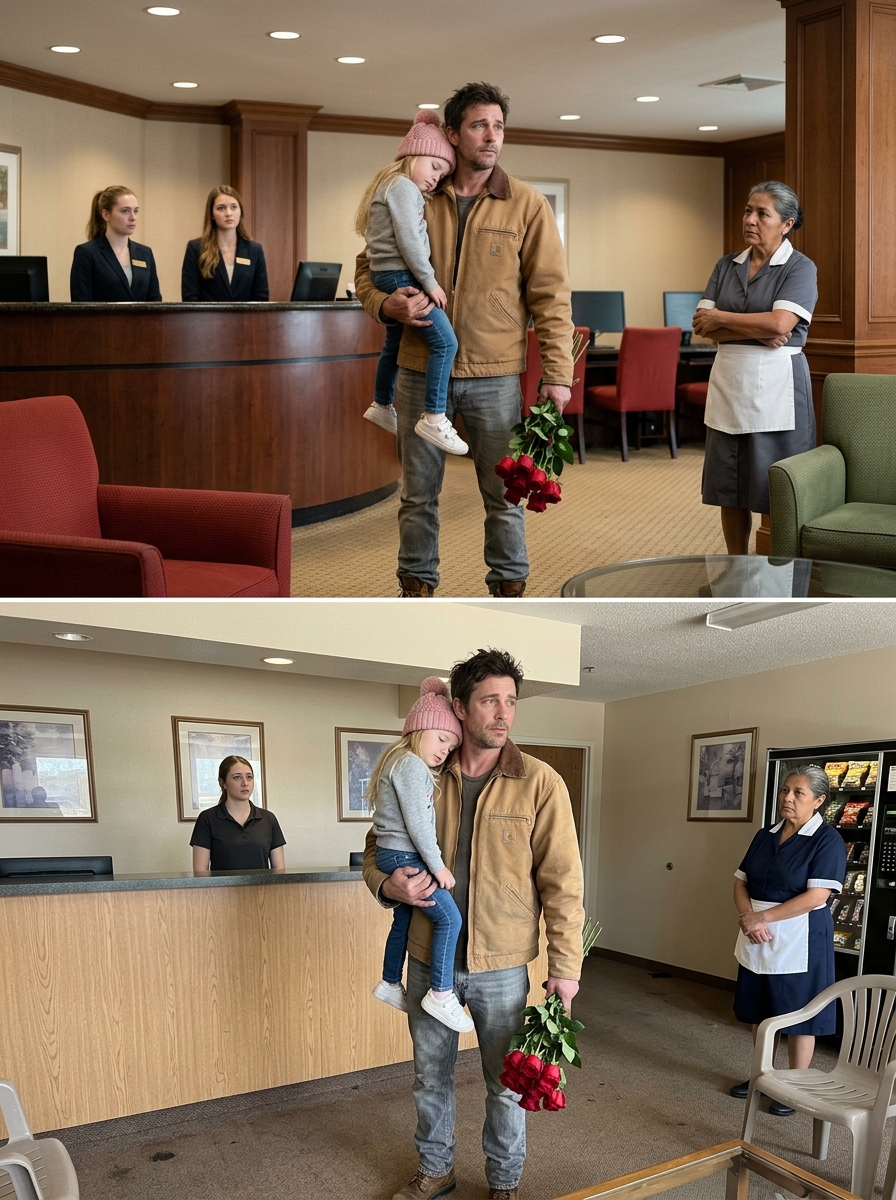
The Tired Dad Was Told the Hotel Had No Room—Then One Housekeeper Checked a Hidden Reservation Tab and Realized Who He Really Was
“Sir, I’ve already told you. We’re full.”
Evan Mercer shifted his sleeping six-year-old daughter higher against his shoulder and looked at the woman behind the front desk.
He had asked her twice to check his reservation.
She had barely looked once.
“I understand,” Evan said quietly. “But I booked the room three weeks ago. It may be under a corporate reservation.”
The clerk gave him the same tight smile.
“There’s nothing under Mercer.”
Beside her, another employee leaned against the counter and glanced at the crowded lobby.
“We have a conference upstairs,” she said. “Even if somebody made a mistake with your booking, there aren’t any rooms left.”
Evan looked down at his daughter, Lily.
Her cheek was pressed into the shoulder of his old brown jacket. One of her dark braids had nearly come undone during the flight, and she still had both arms wrapped around a faded stuffed rabbit she had owned since preschool.
In Evan’s free hand was a small bouquet of red roses.
They were not for a date.
They were not for a celebration.
And right then, he was too tired to explain them.
“All I’m asking,” he said, “is that you check one more place in the system.”
The first clerk, Rachel, let out a small breath through her nose.
Not quite a sigh.
Close enough.
“Mr. Mercer, I know traveling with children can be stressful, but I can’t create a room that doesn’t exist.”
The words landed harder than they should have.
Maybe it was because Evan had been awake since before sunrise.
Maybe it was because Lily had fallen asleep halfway through the flight and he had carried her from the plane, through baggage claim, into a rideshare, and across the hotel lobby without waking her.
Or maybe it was because he knew something Rachel did not.
There was a room.
There was absolutely a room.
He had reserved it himself.
In fact, he owned the hotel.
But Evan did not say that.
Not yet.
He stood in the polished lobby of the Heritage Row Hotel in downtown St. Louis looking nothing like the man whose photograph appeared in annual reports and management presentations.
That was partly intentional.
At forty-two, Evan had spent more than a decade building a small hospitality company from one struggling roadside property into eight independent hotels across the Midwest.
He did not come from hotel money.
He had started with one building outside Indianapolis that smelled faintly of old carpet and had a lobby vending machine that swallowed dollar bills.
He had slept in Room 114 during the first six months because he could not afford an apartment and repairs at the same time.
He had unclogged sinks.
He had folded towels.
He had checked in families at midnight and made coffee at five in the morning.
He knew exactly what a hotel looked like when viewed from an office.
He also knew what it felt like when viewed from the other side of the front desk.
That was why, several times a year, he visited his own properties without warning.
No executive assistant announcing him.
No management dinner.
No reserved parking spot.
He simply booked a room under his own name, traveled like any other guest, and paid attention.
He had never considered it a trap.
He hated the idea of “catching” employees.
He wanted to understand the place when nobody thought the owner was watching.
How did the lobby smell?
Were the hallways quiet?
Did the desk clerk look up when an older couple entered?
Did housekeeping employees receive the same respect as department managers?
Did someone help the exhausted parent?
Did anyone notice the guest who looked confused but was too embarrassed to ask?
Those tiny moments mattered to Evan more than polished reports.
Tonight, he was learning plenty.
Rachel clicked the mouse once, although Evan could tell from the screen reflected in the brass lamp beside her that she had not opened anything new.
“I checked again.”
“You didn’t,” he said.
It was the first time his voice changed.
Not louder.
Just firmer.
Rachel’s face stiffened.
“I’m sorry?”
“You didn’t check anything different.”
The second clerk, Madison, straightened.
“Sir, there’s no reason to speak to her that way.”
Evan almost laughed.
Not because anything was funny.
Because he was suddenly aware of how absurd the whole situation had become.
He was standing in a hotel he had purchased four years earlier, holding a sleeping child and roses for a woman who was no longer alive, while two people employed by his own company explained that he was being unreasonable for asking them to locate a reservation that existed.
Still, he kept his voice low.
“My daughter needs a bed. That’s all I’m trying to solve.”
Rachel glanced at Lily.
For perhaps half a second, something softer crossed her face.
Then it disappeared.
“We have couches in the sitting area if you need a few minutes to call somewhere else.”
Evan stared at her.
“Somewhere else?”
“There are other hotels nearby.”
“I booked this one.”
“I understand that.”
“No,” he said. “I don’t think you do.”
Lily stirred.
Evan immediately stopped talking.
She made a sleepy little sound against his shoulder and tightened her arm around the stuffed rabbit.
He rubbed her back once.
“Daddy?”
“I’m here.”
“Are we upstairs?”
“Not yet, sweetheart.”
Her eyes opened halfway.
She looked at the flowers.
“Mom’s roses?”
Evan swallowed.
“Yeah.”
Lily nodded as though that answered everything.
Then she closed her eyes again.
Rachel looked away.
Madison suddenly became very interested in rearranging pens beside the keyboard.
The roses were part of a tradition.
Three years earlier, Evan’s wife, Claire, had passed away after a long illness.
Evan rarely discussed that period with people he did not know.
He especially did not discuss it while checking into hotels.
But every year, on the anniversary, he and Lily bought red roses.
Claire had loved red roses even though she always claimed they were “too dramatic.”
She would say that while putting them in the center of the kitchen table anyway.
The first year after she was gone, Lily had been three.
She barely understood why her mother was not coming home.
Evan bought flowers because he had no idea what else to do.
Lily chose a blue glass vase from the kitchen cabinet.
They put the roses inside.
Then they ate pancakes for dinner because pancakes had been Claire’s favorite lazy-night meal.
The next year, Lily asked, “Are we doing Mommy’s flowers?”
So they did.
After that, it became theirs.
Tomorrow would be the anniversary.
They were supposed to be home by afternoon.
Evan had bought the roses at the airport because he knew Lily would want to wake up and see them.
He had not expected to spend twenty minutes holding them at a front desk.
“Can I speak with the manager?” he asked.
Rachel looked toward the elevators.
“He’s tied up with the conference.”
“I can wait.”
“It could be a while.”
“I’ll wait.”
Madison stepped closer.
“Mr. Mercer, there really isn’t anything the manager can do if we don’t have a room.”
Evan looked at both women.
Something inside him had become very calm.
He had learned long ago that anger often made people defend themselves.
Silence made them reveal themselves.
So he said nothing.
That was when a voice came from behind him.
“Is the little girl okay?”
Evan turned.
A woman around fifty-five stood beside a housekeeping cart near the hallway leading toward the service elevators.
She wore black pants, comfortable shoes, and the dark green vest used by housekeeping supervisors.
Silver streaks ran through her dark hair, which was pulled into a loose knot.
Her name tag read MARIA SANTOS.
She had been carrying folded pillowcases.
Now she had stopped.
Evan nodded.
“She’s just tired.”
Maria looked from Lily to the desk.
“Are you checking in?”
“Trying to.”
Rachel gave a short laugh.
“We already explained that his reservation isn’t here.”
Maria did not answer Rachel.
She looked at Evan.
“What name?”
“Mercer.”
Her eyes narrowed slightly.
“Evan Mercer?”
Rachel glanced at her.
Evan noticed.
“Yes.”
Maria looked toward the computer.
“Did you check executive bookings?”
Rachel’s expression changed.
Only a little.
But Evan saw it.
“What?”
“The executive booking screen,” Maria said. “Corporate reservations sometimes land there instead of the main guest list. It happened last month with those consultants from Kansas City.”
“I know how to search reservations.”
“I’m sure you do.”
Maria said it gently.
Somehow that made the room quieter.
“But did you check that screen?”
Rachel did not answer.
Maria stepped closer.
“Because if it’s a corporate reservation, that might be where it is.”
Madison folded her arms.
“We’re sold out anyway.”
Maria looked at her.
“The executive inventory isn’t always part of the normal room count.”
Evan almost smiled.
Maria knew the system better than the people standing behind it.
Rachel began clicking.
Once.
Twice.
Then a third time.
Her shoulders stopped moving.
Madison leaned toward the monitor.
Neither woman spoke.
Maria waited.
Evan waited.
Finally, Rachel cleared her throat.
“There is a reservation.”
Evan said nothing.
Rachel read from the screen.
“Mercer. Two nights. King suite with adjoining sitting room.”
Maria nodded.
“There we go.”
Rachel kept reading.
“It’s under executive hold.”
Her eyes moved to another part of the screen.
Then she looked at Evan.
Really looked at him.
For the first time all evening.
Her face lost color.
Evan knew exactly what she had seen.
OWNER ACCOUNT.
He had asked the corporate office years ago not to put his title in large letters on internal reservations.
Apparently somebody had ignored him.
Madison leaned closer.
Her mouth opened slightly.
Maria still did not seem to understand.
That told Evan something important.
She had not helped because she knew who he was.
She had helped because a tired man was standing in front of her holding a sleeping child.
That mattered far more.
Rachel’s voice became careful.
“Mr. Mercer…”
Evan raised one finger.
“Please don’t.”
She stopped.
“I don’t want the conversation to change because you read something on a screen.”
Nobody moved.
Evan looked at Maria.
“Thank you.”
She gave him a puzzled smile.
“For what?”
“For actually checking.”
Maria shrugged.
“It took thirty seconds.”
Exactly.
Thirty seconds.
That was the whole thing.
Thirty seconds had stood between Lily sleeping in a bed and Evan carrying her back outside to search for another hotel.
Thirty seconds had stood between being treated as an inconvenience and being treated as a guest.
Maria noticed the flowers in his hand.
“One of those stems is bent.”
Evan looked down.
A rose near the outside of the bouquet had folded near the top.
He had not noticed.
Maria reached toward it, then stopped.
“May I?”
“Sure.”
She gently shifted the stem so the flower rested against the others instead of hanging away from the bouquet.
“Better.”
“Thanks.”
“Do you need a vase?”
The question caught him off guard.
“I probably do.”
Maria smiled.
“We have extras in the banquet storage room. Nothing fancy, but clean.”
“That would be great.”
Rachel spoke quickly.
“We can have one sent to the suite.”
Maria looked at her.
“I’m already standing here.”
Then she turned back to Evan.
“I’ll get it.”
“You don’t have to.”
“I know.”
She walked away.
Evan watched her disappear around the corner.
That sentence stayed with him.
I know.
Not I have to.
Not policy says.
Not my supervisor asked.
I know.
She was doing it because she had decided it was worth doing.
Rachel began typing quickly.
“Your suite is ready.”
Evan nodded.
“Good.”
“And again, I’m extremely sorry about the confusion.”
He looked at her.
“Were you sorry five minutes ago?”
Rachel froze.
He did not say it harshly.
That almost made it worse.
“I’m asking because five minutes ago you told me there was nothing you could do.”
“I made an error.”
“You made a choice before you made an error.”
Madison looked down.
Evan shifted Lily again.
“My clothes didn’t look expensive enough. I had a sleepy kid. I was holding airport flowers. I looked tired. You decided I was a problem before you searched my name.”
Rachel’s eyes became shiny.
Evan immediately softened his tone.
He did not want humiliation.
He wanted honesty.
“I’m not trying to embarrass you.”
“I understand.”
“Do you?”
She nodded.
“I think so.”
He studied her face.
Maybe she did.
Maybe she was simply afraid.
He could not tell yet.
Maria returned carrying a plain glass vase wrapped in a white hand towel.
“I found one.”
She handed it to Evan.
Lily opened her eyes again.
This time she noticed Maria.
“Hi,” Maria whispered.
Lily stared at her sleepily.
“Hi.”
“Your dad has very pretty flowers.”
“They’re for my mommy.”
Maria glanced at Evan.
He gave a small nod.
Lily continued.
“My mommy isn’t here anymore, but we still get roses.”
Maria’s expression changed.
Not dramatically.
Just enough.
She crouched slightly so she was closer to Lily’s eye level.
“I think that’s a beautiful tradition.”
Lily looked at the crooked rose.
“That one got squished.”
“I fixed it a little.”
Lily studied Maria.
Then she smiled.
“Thank you.”
“You’re welcome.”
Lily put her head back on Evan’s shoulder.
Maria stood.
“I hope you both get some rest.”
Evan looked at her.
“Tomorrow is three years.”
Maria nodded slowly.
“I’m sorry.”
“Thank you.”
“My husband passed twelve years ago,” she said. “My kids were older than your daughter, but not by much.”
Evan looked at her more closely.
Maria gave a small, tired smile.
“You learn how to keep certain things going.”
“Yeah.”
“You do.”
Neither of them said anything else.
They did not need to.
Sometimes grief recognizes grief without requiring a speech.
The elevator doors opened across the lobby.
Before Evan walked toward them, he turned to Rachel.
“I still want to speak with Daniel.”
Daniel Brooks was the hotel’s general manager.
Rachel swallowed.
“I’ll call him.”
“Tell him I’m going upstairs first. My daughter needs to sleep.”
“Yes, sir.”
“And Rachel?”
“Yes?”
“Don’t call me sir because you know who I am now.”
She looked down.
“Okay.”
“Call me Evan.”
He stepped into the elevator.
Maria held the vase while he pressed the button for the ninth floor.
Just before the doors closed, Lily lifted one hand from Evan’s shoulder and waved at Maria.
Maria waved back.
In the suite, Evan placed Lily on the bed without waking her fully.
He removed her shoes.
Pulled the blanket over her.
Set the stuffed rabbit beside her.
Then he stood there for a moment.
He always did that.
There was something about watching his daughter sleep that made time feel temporary.
Claire used to stand in bedroom doorways the same way.
“Are you staring at the baby again?” she would whisper.
“She’s not a baby.”
“She’s two.”
“Exactly. Practically grown.”
Claire would roll her eyes.
Then she would stand beside him and stare too.
Evan turned away from the bed.
He filled Maria’s vase at the bathroom sink and placed the roses inside.
One flower still leaned slightly to the side.
He left it that way.
At 9:17 p.m., somebody knocked.
Evan opened the door.
Daniel Brooks stood outside.
Daniel was forty-eight, neatly dressed, and looked as though he had left an important dinner in the middle of the first course.
His tie was still straight.
His face was not.
“Evan.”
“Come in.”
Daniel entered quietly.
He immediately saw Lily asleep in the other room.
“I’m sorry.”
Evan closed the door.
“Sit down.”
Daniel sat in an armchair near the window.
Evan remained standing.
“I had no idea you were coming.”
“That was intentional.”
“I know.”
Daniel rubbed his palms together.
“Rachel called me.”
“I’m sure she did.”
“She’s extremely upset.”
Evan looked at him.
“Is that your first concern?”
Daniel stopped.
“No.”
“Good.”
“I meant she understands she made a serious mistake.”
Evan sat across from him.
“I’m not interested in somebody being terrified because she discovered the tired guy in the old jacket signs her paycheck.”
Daniel nodded.
“I understand.”
“I’m interested in who she was five minutes before she knew.”
Daniel said nothing.
Evan leaned back.
“Tell me about Rachel.”
“She’s been here two years.”
“Complaints?”
Daniel hesitated.
That hesitation answered the question.
Evan noticed.
“How many?”
“I’d need to check.”
“That means more than zero.”
“Yes.”
“What kind?”
“Mostly tone.”
“Meaning?”
Daniel looked uncomfortable.
“A few guests felt dismissed.”
“A few?”
“Maybe four.”
“In two years?”
Daniel nodded.
“And Madison?”
Daniel’s expression tightened.
“Similar.”
Evan glanced toward the roses.
“So this isn’t new.”
“We coached both of them.”
“What does coached mean?”
“We discussed guest communication.”
“Did anything change?”
Daniel did not answer immediately.
Evan felt disappointment more than anger.
That bothered him.
Daniel had always been a strong operator.
Numbers were good.
Turnover was manageable.
Housekeeping scores were solid.
But hospitality could not be measured only in spreadsheets.
“What happened downstairs wasn’t complicated,” Evan said.
Daniel nodded.
“No.”
“A man said he had a reservation. They couldn’t find it.”
“Yes.”
“Then he asked them to look again.”
“Yes.”
“And instead of becoming curious, they became annoyed.”
Daniel looked toward the bedroom doorway.
“I’m sorry Lily had to be involved.”
“She mostly slept.”
“That’s something.”
“No, Daniel.”
Evan’s voice stayed quiet.
“That isn’t something. We don’t get credit because a six-year-old slept through poor service.”
Daniel took that in.
Evan continued.
“I asked for a manager.”
“I heard.”
“I was told you were too busy.”
Daniel’s jaw tightened.
“I never told them guests couldn’t ask for me.”
“I know.”
“That conference was busy, but I would have come down.”
“I know.”
Daniel looked frustrated now.
Not with Evan.
With himself.
“I should have seen the pattern.”
“Yes.”
There was no reason to soften that.
Daniel nodded.
“You’re right.”
Evan looked toward the vase again.
“Then Maria walked over.”
Daniel’s expression changed.
“Maria Santos?”
“You know her?”
“Of course.”
“What do you know?”
Daniel smiled despite the tension.
“She knows everything.”
Evan almost laughed.
“That was my impression.”
“She’s been here eight years. Started in laundry. Then rooms. Now housekeeping supervisor.”
“Why isn’t she running something bigger?”
Daniel paused.
“That’s a fair question.”
“It wasn’t rhetorical.”
“She never applied for management.”
“Did anyone ask?”
Daniel looked at him.
“No.”
Evan nodded slowly.
“There it is.”
“What?”
“The thing I came here to find.”
Daniel frowned.
“I thought this was about Rachel and Madison.”
“It is.”
“But?”
“But they’re only half the story.”
Evan stood and walked toward the flowers.
“Two people with the correct titles looked at a guest and saw a problem.”
He touched the edge of the glass vase.
“One woman pushing a linen cart looked at the same guest and saw a tired father whose kid needed a bed.”
Daniel leaned forward.
“She’s good.”
“She’s more than good.”
“I agree.”
“Then why does she make housekeeping-supervisor pay?”
Daniel did not answer.
Evan turned.
“That’s not an accusation. I’m asking.”
“She was promoted twice.”
“From what?”
“Laundry attendant to room attendant. Then floor lead. Then supervisor.”
“So every time somebody finally noticed her, she moved up.”
Daniel looked thoughtful.
“Yes.”
“What did she do tonight?”
“Helped you.”
“No.”
Evan shook his head.
“She solved a reservation issue the desk didn’t solve. She protected the guest experience. She understood executive inventory. She noticed an emotional detail. She found a vase. She calmed the situation. She made my daughter feel welcome.”
Daniel stared at him.
“She did all of that in maybe three minutes.”
“Exactly.”
Evan sat again.
“And nobody told her to.”
The two men were quiet.
Daniel finally said, “What do you want me to do?”
“First, nothing tonight.”
Daniel looked surprised.
“Nothing?”
“No dramatic firing. No late-night confrontation. No speech in the lobby.”
“All right.”
“Tomorrow, pull every complaint involving Rachel and Madison from the last eighteen months.”
Daniel nodded.
“Then talk to their supervisors.”
“Okay.”
“Look at patterns. Look at coaching notes. Look at whether they were trained properly. Look at whether we ignored things because the numbers were good.”
“I will.”
“And talk to Maria.”
Daniel smiled slightly.
“About what?”
“Ask her what she thinks is wrong with the front desk.”
Daniel’s eyebrows rose.
“You already have an idea?”
“I have eight hotels. I have plenty of ideas. I want hers.”
The next morning, Lily woke before Evan.
He heard her small feet crossing the carpet.
Then she climbed onto his bed.
“Daddy.”
He opened one eye.
“What?”
“The roses are here.”
“They are.”
“You remembered.”
“I usually do.”
She looked offended.
“You always do.”
“That’s what I said.”
“No. You said usually.”
Evan smiled.
“My mistake.”
Lily jumped down.
“We need pancakes.”
“We’re in St. Louis.”
“So?”
“So I don’t know where to make pancakes.”
“We can buy pancakes.”
That sounded exactly like something Claire would have said.
Evan felt the familiar pinch in his chest.
Small.
Sharp.
Gone almost as soon as it arrived.
“Okay,” he said. “Pancakes.”
They ate breakfast in the hotel dining room.
Lily ordered chocolate-chip pancakes and carefully moved most of the chocolate chips into a pile before eating them separately.
Evan drank coffee.
At another table, three retirees were discussing baseball loudly enough for half the room to hear.
A family with two teenagers argued cheerfully about which museum to visit.
A businessman ate scrambled eggs while staring at his phone.
Normal people.
Normal morning.
That was what Evan liked about hotels.
Hundreds of stories passed through the same hallways without knowing each other.
After breakfast, Lily went upstairs with Evan’s longtime assistant, Jenna, who had arrived that morning from the regional office to spend a few hours with her while Evan worked.
Evan entered Daniel’s office at 9:30.
A folder was waiting.
It was thicker than he expected.
Daniel closed the door.
“I found nine complaints.”
“Nine?”
“Five involving Rachel. Four involving Madison.”
“Why didn’t I know?”
“They never rose above the property level.”
“That isn’t what I asked.”
Daniel looked down.
“I didn’t think they were serious enough.”
Evan sat.
“Read me one.”
Daniel opened the folder.
“Guest said front desk staff acted irritated when asked to explain parking.”
“Another.”
“Older couple reported they were told to ‘look at the signs’ when they asked where breakfast was served.”
“Another.”
“A mother said she felt rushed while trying to confirm connecting rooms.”
“Another.”
“Guest asked whether a package had arrived. Employee reportedly replied, ‘If it was here, we would have called you.’”
Evan rubbed his forehead.
None of the complaints were dramatic.
That was exactly the problem.
Nothing was dramatic enough to trigger an emergency.
Nothing was outrageous enough to reach corporate.
Each incident was simply a small moment when somebody asked for help and received impatience instead.
One paper cut at a time.
“How were these handled?” Evan asked.
“Coaching conversations.”
“Documented?”
“Mostly.”
“Any improvement plans?”
“One for Rachel.”
“Completed?”
“Yes.”
“And then?”
“Her complaint scores improved for a few months.”
Evan looked at Daniel.
“Then we stopped paying attention.”
Daniel nodded.
“Yes.”
Evan closed the folder.
“I don’t want two people losing their jobs because they failed to recognize me.”
“They wouldn’t.”
“I mean that.”
“I know.”
“If the only thing that happened was last night, I’d want retraining.”
Daniel nodded.
“But this folder changes it.”
“Yes.”
“What do you recommend?”
Daniel hesitated.
“I need to speak with HR.”
“Do that.”
“I also want to review staffing. The desk has been stretched during conferences.”
“Fair.”
“That doesn’t excuse the behavior.”
“No.”
“But it may explain why patience has been low.”
“Good. Keep looking.”
Daniel seemed surprised.
“You’re not angry?”
“I am.”
“You don’t sound angry.”
“I’ve been running hotels too long to believe anger fixes operations.”
Daniel smiled faintly.
“That sounds like something you’d put on a wall.”
“Please don’t.”
Daniel laughed for the first time.
Evan pointed at him.
“I mean it. If I walk into one of our properties and see that printed next to a stock photo of a sunrise, I’m selling the company.”
Daniel laughed harder.
The tension broke.
Then Evan asked, “Did you talk to Maria?”
Daniel stopped smiling.
“Yes.”
“And?”
“She thought she was in trouble.”
“Of course she did.”
“I told her she wasn’t.”
“What did she say about the desk?”
Daniel opened a notebook.
“She said the employees are trained to complete transactions but not to notice people.”
Evan stared at him.
Daniel continued.
“She said new desk staff learn the system, upgrade rules, check-in language, complaint procedures, and phone scripts.”
“All true.”
“She asked me when they’re taught to recognize when someone is overwhelmed.”
Evan leaned back.
“She said that?”
“Almost word for word.”
“What else?”
“She said, ‘Anybody can learn buttons. The hard part is seeing what the guest isn’t saying.’”
Evan smiled.
“There it is.”
Daniel nodded.
“I knew you’d like that.”
“I don’t like it.”
“You don’t?”
“I hate it.”
Daniel looked confused.
“Because she’s right, and we should already be teaching it.”
That afternoon, Evan found Maria in the basement housekeeping office.
She was eating turkey on wheat bread from a plastic container and reading something on her phone.
He knocked on the open door.
She nearly dropped the sandwich.
“Mr. Mercer.”
“Evan.”
She stood immediately.
“No, no. Please sit.”
“I’m fine.”
“Maria.”
She sat.
Evan pulled out a chair across from her.
“I owe you a thank-you.”
“You already thanked me.”
“I was tired.”
“So was I.”
He smiled.
“Then I owe you a better one.”
Maria folded the napkin beside her lunch.
“I really didn’t do anything special.”
“That worries me.”
She looked confused.
“Why?”
“Because everybody who does something special says that.”
Maria laughed softly.
Evan leaned forward.
“Daniel told me what you said about training.”
Her expression became cautious.
“I hope I didn’t overstep.”
“You didn’t.”
“I wasn’t criticizing.”
“You were.”
Maria’s eyes widened.
Evan smiled.
“And you were right.”
She relaxed.
“A front desk can be hard.”
“I know.”
“People get impatient.”
“I know.”
“Guests can be tired.”
“I know that too.”
Maria nodded.
“I figured.”
Evan glanced at the framed family photo on her desk.
Three grown children stood beside Maria at what looked like a backyard graduation party.
“You said last night you raised three kids.”
“I did.”
“By yourself?”
“For a long time.”
“That couldn’t have been easy.”
“No.”
She said it without drama.
Then she smiled.
“But they turned out pretty good.”
“I’m sure they did.”
Maria tapped the photograph.
“My oldest teaches middle school. My son fixes heating systems. My youngest works at a dental office.”
“You sound proud.”
“I am.”
“You should.”
Maria studied him.
“You came down here to ask me something.”
Evan laughed.
“Am I that obvious?”
“People who own eight hotels don’t usually come to the basement because they’re curious about my sandwich.”
“Fair point.”
He rested his hands on the table.
“I want to change our training.”
Maria said nothing.
“Not just here. Across the company.”
Still nothing.
“I think we’ve gotten too focused on process.”
“You need process.”
“Absolutely.”
“Otherwise everything becomes chaos.”
“Also true.”
“But?”
“But process without judgment becomes cold.”
Maria nodded.
Evan continued.
“I want our employees to know how to notice the guest in front of them.”
Maria’s mouth lifted slightly.
“That sounds simple.”
“It’s not.”
“No.”
“You know that.”
She looked down at her lunch.
“I’ve been doing hotel work a long time.”
“How long?”
“Twenty-six years.”
Evan blinked.
“Seriously?”
“Different places.”
“Why didn’t I know that?”
“You never asked.”
There was no accusation in her voice.
That made the sentence hit harder.
Evan sat back.
Maria continued.
“I started when my oldest was little. Nights were easier because my husband worked mornings. Later, after he passed, I took whatever shifts worked with the kids.”
“You’ve done laundry?”
“Yes.”
“Rooms?”
“Yes.”
“Breakfast?”
“For about eight months.”
“Front desk?”
She laughed.
“Three weeks.”
“What happened?”
“I hated standing still.”
Evan laughed.
“Fair.”
“I’ve done banquets too.”
“Of course you have.”
Maria shrugged.
“You stay in hotels long enough, you learn where everything breaks.”
Evan looked at her.
“That’s exactly why I’m here.”
She became cautious again.
“I’d like you to help build the new training program.”
Maria stared.
“Help how?”
“Tell us what we’re missing.”
“You have consultants.”
“I do.”
“You have managers.”
“Yes.”
“You have people with college degrees in hospitality.”
“I have several.”
“And you want me?”
“Yes.”
She laughed.
Evan did not.
Maria stopped.
“You’re serious.”
“Completely.”
“I supervise rooms.”
“You supervised the entire lobby last night without trying.”
“I found a reservation.”
“You found a guest.”
Maria looked away.
Evan continued.
“You saw my daughter was exhausted.”
“Anybody could see that.”
“Two people didn’t.”
“They saw her.”
“No. They looked at her.”
Maria was quiet.
“You saw the roses.”
“They were in your hand.”
“You saw one bent stem.”
Maria smiled.
“That was bothering me.”
“Exactly.”
“I don’t understand.”
“That tiny detail tells me more about how you think than any training certificate could.”
Maria shook her head.
“I’m not a corporate person.”
“Good.”
“I don’t like presenting.”
“Neither do half our executives. It hasn’t stopped them.”
She laughed.
“I’m serious.”
“So am I.”
“I wouldn’t know what to say.”
“Start with what you told Daniel.”
“What did I tell Daniel?”
“That anybody can learn buttons.”
Maria groaned.
“He wrote that down?”
“He did.”
“I shouldn’t talk so much.”
“I think you should talk more.”
She folded her arms.
“What exactly are you offering?”
“At first? A paid project assignment.”
Maria listened carefully.
“Two days a month with our regional training team. You keep your current role while we build the program.”
“That sounds safer.”
“It is.”
“And after that?”
“If it works, we create a permanent position.”
“For me?”
“If you want it and you’re good at it.”
Maria smiled.
“You don’t know if I’m good at it.”
“I know you taught two front-desk employees how to find my reservation without touching the computer.”
“That isn’t training.”
“It looked like training from where I was standing.”
She thought for a long moment.
Then she said, “I have to talk to my daughter.”
“Which one?”
“The oldest.”
“Why?”
“She tells me when I’m being ridiculous.”
Evan smiled.
“I like her already.”
Maria did not say yes that day.
Evan liked that too.
People who accepted important responsibilities instantly sometimes had not thought deeply enough about what they were accepting.
Maria went home.
She called her oldest daughter.
Then she called Daniel the next afternoon.
“I’ll try the project,” she said.
That was all.
No speech.
No dramatic announcement.
She would try.
Meanwhile, Daniel completed his employee review.
The result was not what Evan hoped for.
Rachel and Madison had both received repeated coaching.
Both had been given specific expectations.
Both had improved briefly.
Then both returned to the same pattern.
Other employees described similar behavior.
Not cruelty.
Not insults.
Not anything dramatic enough to become a scandal.
Just a steady habit of making people feel like inconveniences.
Daniel made the final decision.
Both women were dismissed the following week under normal company procedures.
Evan did not attend the meetings.
He did not celebrate.
He did not tell the story at executive gatherings as some kind of victory.
In fact, the experience bothered him.
He kept thinking about the nine complaint forms sitting unnoticed in a folder.
Nine people had already told the hotel something was wrong.
The system had listened just enough to record them.
Then continued exactly as before.
That failure belonged to management too.
Including him.
So Evan changed more than two jobs.
He changed how complaints were reviewed across all eight properties.
Repeated concerns about the same department could no longer disappear into individual files.
Managers had to discuss patterns during monthly operating meetings.
But Evan made one rule clear.
“This is not about creating fear.”
Nobody wanted employees terrified that one imperfect conversation would follow them forever.
Hotels were full of human beings.
Human beings had bad days.
They misunderstood.
They got tired.
They made mistakes.
The question was whether they cared enough to correct them.
The bigger change came from Maria.
Her first session with the regional training team almost did not happen.
She arrived fifteen minutes early carrying a yellow legal pad.
Evan found her sitting outside the conference room.
“You look like you’re waiting at the dentist.”
“I’d rather be at the dentist.”
“You’re nervous?”
“I clean hotel rooms.”
“You supervise forty-three people.”
“That’s different.”
“How?”
“They know me.”
“So?”
“So if I say something foolish, they already know I’m not foolish.”
Evan laughed.
“Come inside.”
The training team had prepared a presentation.
Thirty-seven slides.
Evan knew this because he counted them while becoming increasingly annoyed.
Slide four said:
GUEST-CENTERED ENGAGEMENT FRAMEWORK.
Maria stared at it.
Evan stared at Maria.
She leaned toward him.
“What does that mean?”
“I was hoping you knew.”
The training director cleared his throat.
“It means we teach employees how to place the guest at the center of the interaction.”
Maria looked at the slide again.
“Why don’t you just say that?”
Nobody answered.
Evan smiled.
“Maria gets one point.”
The next slide read:
PROACTIVE EMPATHY TOUCHPOINTS.
Maria slowly turned toward Evan.
He held up both hands.
“I didn’t make this.”
By slide eleven, she had stopped being nervous.
By slide fourteen, she was interrupting.
By slide nineteen, the presentation was abandoned completely.
Maria stood at the whiteboard.
“Here’s the problem,” she said.
Eight executives looked at her.
“When you teach people too many sentences, they start waiting for the sentence instead of listening.”
The training director frowned thoughtfully.
“Explain.”
“If a guest says, ‘My room isn’t ready and my husband is exhausted,’ the employee starts thinking, What script am I supposed to use?”
Maria wrote one word on the board.
WHY?
“They should be thinking, Why is he exhausted?”
She wrote another.
WHAT?
“What does this family need right now?”
Then another.
SMALL.
“What is one small thing I can do before I solve the big thing?”
The room became quiet.
Maria continued.
“Maybe the room still isn’t ready.”
She pointed toward the imaginary guest.
“You can’t change that.”
Then she pointed toward an imaginary chair.
“But maybe you can find him somewhere comfortable to sit.”
Another imaginary spot.
“Maybe you get water.”
Another.
“Maybe you check whether housekeeping can prioritize the room.”
She shrugged.
“Sometimes people aren’t asking you to perform a miracle. They’re asking you to notice that they’re having a hard time.”
Evan looked around the room.
Nobody was checking email anymore.
Nobody was looking at the slides.
They were listening.
Maria looked toward him.
“Like your roses.”
He smiled.
“Here we go.”
“You didn’t ask me to fix the roses.”
“No.”
“You probably didn’t care that much.”
“I cared a little.”
“You cared after I fixed them.”
“True.”
She smiled.
“But I noticed.”
The training director nodded slowly.
“That is the hospitality moment.”
Maria shook her head.
“No.”
Everyone looked at her.
“That’s just being decent.”
Evan wrote that sentence down.
The new training program took four months to build.
They called it “Notice First.”
Maria hated the name.
Evan liked it.
Maria lost the argument.
Instead of beginning with computer systems, the program began with scenarios.
An older guest enters carrying three bags and keeps looking toward the elevator.
A parent is checking in while two children argue behind her.
A couple asks the same question twice.
A guest says, “It’s fine,” but clearly looks confused.
A traveler arrives late and keeps checking his phone while giving short answers.
Employees were taught to ask themselves three questions.
What am I seeing?
What might this person need?
What small thing can I do right now?
Not everything required an upgrade.
Not everything required money.
Sometimes the answer was a chair.
Sometimes directions written clearly on paper.
Sometimes patience.
Sometimes checking one more screen.
The program spread.
Managers began reporting stories back to the regional office.
A desk clerk in Des Moines noticed an elderly guest struggling to hear instructions over lobby music and moved the conversation somewhere quieter.
A breakfast attendant near Milwaukee saw a mother balancing plates while helping a toddler and carried the tray to her table.
A night clerk in Louisville noticed a man staring at a dead phone and offered a charger before the guest asked.
Nothing earth-shattering.
That was the point.
Hospitality was built from ordinary moments.
Maria became very good at teaching them.
Better than good.
She had a way of telling employees what they were doing wrong without making them defensive.
She used stories instead of lectures.
She never pretended the job was easy.
She talked openly about tired feet, difficult shifts, broken machines, late buses, crowded weekends, and guests who sometimes had no patience left.
Then she would say:
“You still get to choose what kind of person you are for the next thirty seconds.”
People remembered that.
Within a year, Evan created a new position.
Regional Guest Experience Training Coordinator.
Maria read the job description twice.
Then she called him.
“This sounds like somebody important.”
“It is.”
“I don’t own a blazer.”
“We’ll survive.”
“I’m serious.”
“So am I.”
“I don’t want to become one of those people who talks in phrases nobody understands.”
“That is actually written into your contract.”
She laughed.
“What?”
“Section fourteen. No proactive empathy touchpoints.”
“You’re making that up.”
“I wish I weren’t.”
Maria accepted the job.
Her salary increased.
She stopped cleaning rooms every day, although she still visited housekeeping departments first whenever she traveled.
She said they knew everything before management did.
Evan believed her.
A few months later, he walked into one of his hotels in Omaha and found Maria helping a laundry attendant fold fitted sheets.
“You know you’re a regional coordinator now.”
“I know.”
“You have meetings.”
“I canceled one.”
“Why?”
“The meeting was about housekeeping.”
Evan stared at her.
“So you came down here.”
“Yes.”
“To ask housekeeping.”
“Yes.”
He smiled.
“I may have created a problem.”
“You definitely did.”
Lily remembered Maria too.
Not clearly.
Children rarely preserve the parts adults think they will.
She did not remember Rachel.
She did not remember waiting at the desk.
She did not remember the missing reservation.
She remembered a woman with silver in her hair fixing a red rose.
Months later, Lily drew a picture at school.
Three people stood beside a table covered with flowers.
One was Evan.
One was Lily.
One was a woman wearing green.
At the top, Lily had written in uneven first-grade letters:
THE LADY WHO HELPED DADDY.
Evan took a picture of it.
He sent it to Maria.
Maria called him five minutes later.
“I’m framing this.”
“You don’t have to.”
“I already printed it.”
“I thought you’d frame some award.”
“No.”
“Employee certificate?”
“No.”
“Professional headshot?”
“Absolutely not.”
The drawing went onto her office wall.
Next to it, she eventually placed a photograph.
It showed the original glass vase from that night.
Inside were red roses.
The photograph had been taken by Evan the morning after the check-in.
He had sent it to her with a handwritten card.
The message was simple.
Thank you for seeing us before you knew who we were.
Years passed.
The company grew slowly.
Evan never wanted fifty hotels.
He liked knowing the managers.
He liked walking properties.
He liked recognizing the names of longtime employees.
He still visited without announcements.
Sometimes staff recognized him anyway.
That happened more often as the company grew.
But not always.
One afternoon in Wisconsin, a new desk clerk asked Evan to move his truck because he had accidentally parked in the delivery zone.
He moved it.
Later, the manager nearly panicked when he found out.
Evan laughed.
“She was right. I parked in the wrong place.”
The clerk kept her job.
Maria loved that story.
“See?” she said. “Rules are fine when people use them fairly.”
“That should be our next training program.”
“No.”
“Fairness First.”
“No.”
“Rules With Maria.”
“Absolutely not.”
Lily grew.
The stuffed rabbit eventually moved from her bed to a shelf.
The roses continued every year.
Sometimes Lily chose red.
Once, at age ten, she insisted on yellow because she said her mother probably would not care after so many years.
Evan laughed so hard he had to sit down.
Claire would have loved that.
By the time Lily was thirteen, she understood much more about the night in St. Louis.
She knew Evan owned the hotel.
She knew he had not told the desk employees.
She knew Maria had helped without knowing.
One evening, Lily asked him something while they were eating takeout at the kitchen counter.
“Were you trying to test them?”
“No.”
“You kind of were.”
“No.”
“You went there without telling anybody.”
“That isn’t the same thing.”
“It sounds like a test.”
Evan thought about it.
“Okay. Maybe a little.”
Lily smiled.
“I knew it.”
“But I wasn’t hoping anyone failed.”
“That makes it a weird test.”
“It was.”
“What would have happened if everything went perfectly?”
“I would’ve slept, attended my meetings, and gone home.”
“And Maria wouldn’t have gotten promoted.”
Evan stopped eating.
He had never thought about it exactly that way.
“No.”
“So something bad had to happen for something good to happen.”
“I don’t know if I’d put it that way.”
“I would.”
“Of course you would.”
Lily leaned on the counter.
“Do you ever think about Rachel and Madison?”
The question surprised him.
“Sometimes.”
“Do you hate them?”
“No.”
“Not even a little?”
“No.”
“Why?”
Evan looked at his daughter.
Because she deserved a real answer, he gave her one.
“Because people are bigger than the worst twenty minutes I ever see from them.”
Lily thought about that.
“But you still let them get fired.”
“Daniel made that decision after reviewing a long pattern.”
“You agreed.”
“I did.”
“So you can think somebody should lose a job without thinking they’re a bad person?”
“Yes.”
“That seems complicated.”
“It is.”
“Adults make everything complicated.”
“Mostly because everything is.”
Lily looked toward the vase of roses on the dining table.
“So what do you remember most?”
“About that night?”
“Yeah.”
Evan did not answer immediately.
He could have said the reservation.
He could have said the embarrassment.
He could have said Daniel’s folder of complaints.
He could have said Maria’s promotion.
Instead, he saw one small moment.
A tired lobby.
A sleeping child.
A woman in a housekeeping vest.
A bent rose.
“The flower,” he said.
Lily laughed.
“That’s it?”
“That’s it.”
“Why?”
“Because Maria noticed it.”
“So?”
“Nobody asked her to.”
Lily waited.
Evan continued.
“That’s the part people miss about kindness.”
“What?”
“The best kind usually happens before anybody thinks there’s a reward.”
Lily looked toward the flowers.
“That sounds like something you’d put on a hotel wall.”
Evan stared at her.
Then she started laughing.
He laughed too.
“Don’t you dare.”
“I’m telling Maria.”
“She’ll stop you.”
“No, she won’t.”
She was right.
Maria thought it was hilarious.
But she never put it on a hotel wall.
She believed some things became weaker when printed in large letters.
Better to live them.
Years after that first night, Maria stood in front of a new group of hotel employees during orientation.
Twenty-three people sat in the room.
Front desk.
Housekeeping.
Maintenance.
Breakfast.
Management.
Maria held up a photograph of the glass vase.
“I want to tell you about a man who came into a hotel carrying a sleeping little girl and some beat-up roses.”
Several people smiled.
Maria continued.
“The front desk thought his problem was a missing reservation.”
She paused.
“It wasn’t.”
She pointed at the photo.
“His problem was that he was tired.”
Another pause.
“His daughter was tired.”
Another.
“And the next day was important to them.”
Nobody moved.
“The computer problem took thirty seconds to solve.”
She lowered the photograph.
“The people problem took noticing.”
At the back of the room, Evan stood quietly beside the door.
He had heard the story many times.
He still listened.
Maria never told the employees that the tired man owned the hotel until the very end.
When she finally did, there were always surprised faces.
Then she would smile.
“And if that changes the lesson for you, you missed the lesson.”
That was usually where the room became silent.
“The point is not that you should treat somebody well because they might secretly be important.”
She looked around.
“The point is that they already are.”
Evan never found a better way to say it.
Maybe that was why the story stayed with him.
Not because two employees made a mistake.
Mistakes happen every day.
Not because the owner of a hotel was almost turned away from his own building.
That made a funny story later, but it was not what mattered.
Not even because Maria eventually received a new career.
That mattered greatly, but it came afterward.
What remained was the moment before anybody knew who anybody was.
A tired father looked ordinary.
A sleeping little girl looked ordinary.
A bouquet from an airport shop looked ordinary.
Maria looked ordinary too.
No one in that lobby had a reason to believe anything important was happening.
And maybe that was the lesson.
Most important moments do not look important while they are happening.
They look like somebody asking you to check again.
They look like a child asleep on a shoulder.
They look like an older couple needing directions.
They look like a mother trying to carry too many plates.
They look like a man staring at a phone with no battery.
They look like a bent flower stem.
The world rarely announces, “This is the moment that will show what kind of person you are.”
It simply puts another human being in front of you.
Then gives you a few seconds.
Rachel had those seconds.
Madison had them.
Maria had them too.
Only Maria understood what they were worth.
Not because she had the highest title.
She did not.
Not because she had attended the best training.
She had not.
Not because she knew the man standing in front of her owned eight hotels.
She had no idea.
She simply looked a little closer.
And sometimes, that is the entire difference between being ignored and being seen.
Between doing a job and caring about the person in front of you.
Between a forgettable evening and a story a family remembers for years.
Evan kept visiting his hotels.
Maria kept teaching.
Lily kept choosing the vase.
And every year, when red roses appeared on Evan’s kitchen table, one flower always seemed to lean a little differently from the others.
He never straightened it.
Neither did Lily.
Some traditions survive because we repeat them.
Others survive because, once upon a time, somebody noticed something small and decided it mattered.