
A Billionaire Found Two Little Girls Thanking His Son at a Grave—Then Their Mother Handed Him a Folder That Exposed a Five-Year Family Secret
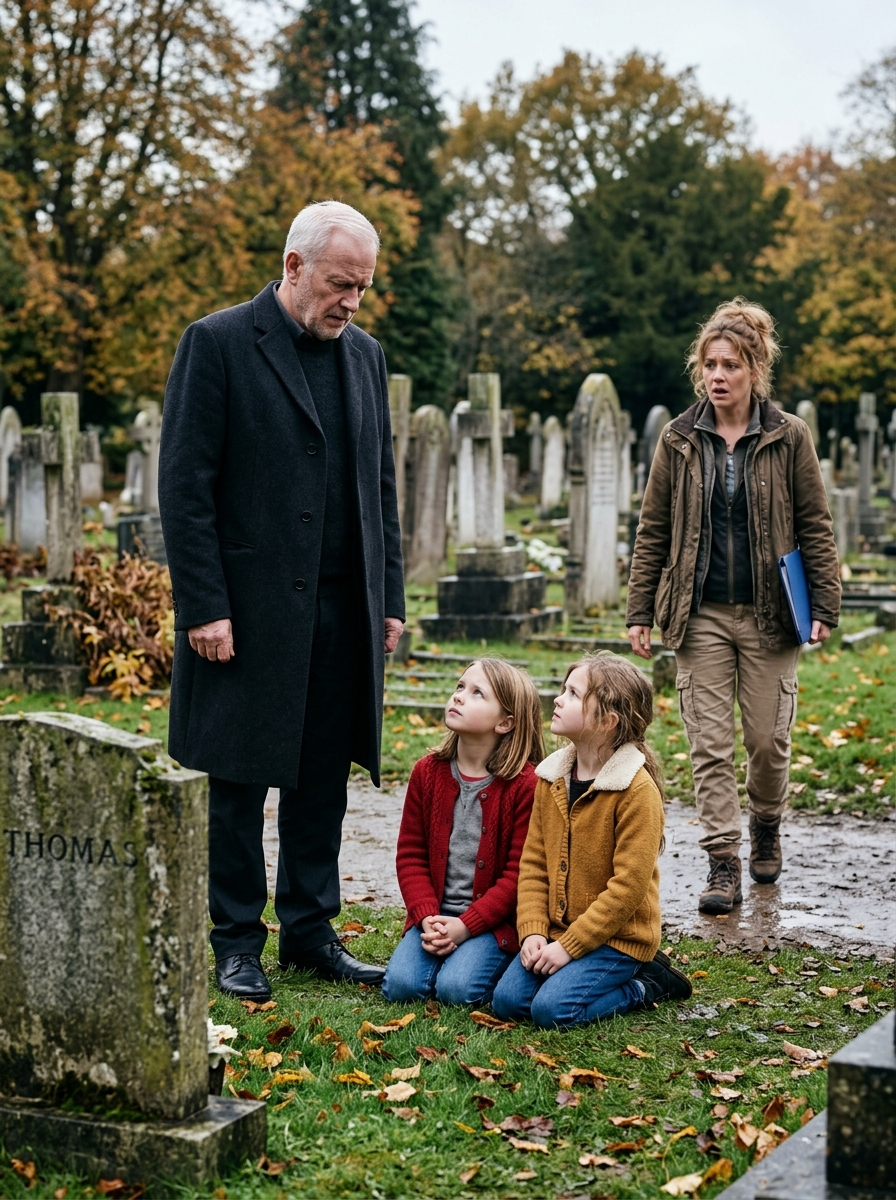
Gerald Whitaker stopped ten feet from his son’s grave when he heard two little girls speaking his name.
Not Gerald’s name.
His son’s.
“Thank you, Matthew,” they whispered together. “Thank you for giving us a chance.”
Gerald’s hand tightened around the small bunch of flowers he carried every Sunday.
For five years, nobody had stood at Matthew’s grave with him.
Nobody had ever told Gerald that his son had given two children anything.
He stared at the girls.
They looked about eight years old, maybe nine. Identical twins. Dark ponytails. Matching sneakers. One wore a red cardigan. The other wore yellow.
They were kneeling beside the polished gray stone as if they had done this before.
One placed a folded piece of paper near Matthew’s name.
The other touched the top of the stone with her fingertips.
“We wish we could’ve known you longer,” she said softly.
Gerald felt something cold move through his chest.
Longer?
That word hit harder than all the others.
He stepped forward.
The girls turned at the same time.
Neither screamed. Neither ran.
They simply looked up at the tall, white-haired man in the dark coat and waited.
Gerald had spent most of his adult life in rooms where people became nervous when he entered.
He had built companies, bought properties, made deals worth more money than most families would see in generations.
At sixty-eight, his personal fortune was estimated at nearly four billion dollars.
But standing in Maple Grove Memorial Park outside Raleigh, North Carolina, none of that mattered.
He felt like a confused old father.
“Who are you?” he asked.
The girl in red looked at her sister.
Then back at him.
“I’m Sophie.”
“I’m Bella,” the other girl said.
Gerald swallowed.
“And how did you know Matthew Whitaker?”
Their expressions changed.
“You knew him?” Sophie asked.
Gerald stared at her.
“He was my son.”
The girls froze.
For several seconds, nobody spoke.
Then Bella slowly stood.
“You’re Matthew’s dad?”
“Yes.”
Sophie got to her feet too.
Her eyes were suddenly wet.
Gerald’s voice became rough.
“What did you mean when you thanked him?”
The twins looked at each other again.
It was the kind of look only siblings who had spent their entire lives together could understand.
Finally Sophie said, “He helped our mom keep us.”
Gerald blinked.
“Keep you?”
Bella nodded.
“He said families shouldn’t get pulled apart just because they’re having a hard year.”
Gerald felt the ground under him become strangely uncertain.
Matthew had never told him about these girls.
Matthew had barely told Gerald anything during the final year of his life.
Father and son had loved each other fiercely.
They had also ended up on opposite sides of a disagreement neither had known how to fix.
Gerald had replayed their last real argument thousands of times.
Matthew had been thirty-one.
Gerald had been standing behind the enormous desk in his home office.
Matthew stood by the door holding a cardboard box filled with papers from his job at the family investment office.
“You’re walking away from everything,” Gerald had said.
“I’m walking toward something.”
“Toward what?”
“Work that matters to me.”
Gerald remembered laughing.
Not because it was funny.
Because he was angry.
“You think what I built doesn’t matter?”
“That’s not what I said.”
“It’s what you meant.”
Matthew had closed his eyes.
Even now, Gerald could see the exhaustion on his son’s face.
“I don’t want to spend my life moving numbers around so rich people can become richer.”
“And you think handing out grocery cards at some community office is a life plan?”
Matthew’s jaw had tightened.
“That community office helped more families last month than you’ve met personally in ten years.”
Gerald had pointed toward the door.
“If you hate this life so much, stop using everything this life gave you.”
Matthew had looked at him for a long time.
Then he said something Gerald had never forgotten.
“Maybe I need to find out who I am without your shadow.”
He walked out.
They spoke again after that, but only briefly.
Birthdays.
A holiday dinner that ended early.
Two uncomfortable phone calls.
A text Gerald answered three days too late.
Then Matthew passed away unexpectedly the following year.
There had been no final conversation.
No dramatic reconciliation.
No moment when father and son admitted they had both been stubborn.
Gerald was left with silence.
And five years of regret.
Now two little girls were standing beside Matthew’s grave telling him his son had somehow changed their family.
Gerald looked at the folded paper near the stone.
“What exactly did he do?”
Sophie hesitated.
“Mama explains it better.”
“Where is your mother?”
Bella pointed toward the path.
“She’s coming.”
Gerald turned.
A woman was walking quickly toward them.
She looked to be in her late thirties. Brown hair pulled into a loose knot. Simple jeans. A cardigan. A canvas tote bag over one shoulder.
The moment she saw Gerald’s face, she stopped.
Gerald knew that look.
Recognition.
The woman knew exactly who he was.
“Sophie?” she called carefully. “Bella?”
The girls rushed toward her.
“Mama, it’s him.”
The woman looked at Gerald.
“It’s Matthew’s dad.”
All the color seemed to leave her face.
Gerald stepped closer.
“You know me?”
She gripped the strap of her bag.
“Mr. Whitaker.”
“You know my name.”
“Yes.”
“How?”
The woman glanced toward Matthew’s grave.
Then she looked directly at Gerald.
“Because your son talked about you.”
Gerald’s throat tightened.
“My name is Elena Ramirez.”
She extended a hand, then seemed to think better of it.
Gerald took it anyway.
Her hand was trembling.
“I’ve thought about this moment for years,” Elena said.
“What moment?”
“Meeting you.”
Gerald stared at her.
“Then why didn’t you?”
Elena looked down.
“Because Matthew asked me not to.”
That sentence landed like a hammer.
Gerald’s shoulders stiffened.
“My son told you not to contact me?”
“No. Not exactly.”
“Then what exactly did he say?”
Elena took a slow breath.
“He said if anything ever happened to him, I should respect your space unless you reached out first.”
Gerald almost laughed from disbelief.
“How was I supposed to reach out to someone I didn’t know existed?”
“You weren’t.”
The answer was simple.
That made it hurt more.
Gerald glanced at Sophie and Bella.
They had moved back toward the grave.
They stood shoulder to shoulder, watching the adults.
“Elena,” Gerald said, “I need you to explain why your daughters are thanking my son.”
She pressed her lips together.
Then she opened her canvas bag.
Inside was a thick blue folder.
Gerald noticed immediately that it was old.
The corners were bent. The surface was scratched. Several sticky notes were attached to the side.
Elena held it with both hands.
“I bring this every year.”
“To a cemetery?”
“To Matthew.”
Gerald stared at the folder.
“What’s in it?”
“Everything.”
Gerald almost reached for it.
Then stopped.
He suddenly felt afraid.
He had not felt afraid in a boardroom in forty years.
He had negotiated through recessions, lawsuits, failed projects, hostile partners, collapsing deals, and family disputes.
He had never been afraid of paper.
Until that moment.
“Elena.”
“Yes?”
“Tell me before I open it.”
She nodded.
Five years earlier, Elena had been raising three-year-old twins alone.
She worked full-time as an office manager at a small elementary school.
She wasn’t destitute.
She wasn’t irresponsible.
She wasn’t looking for someone to rescue her.
She was simply caught in one of those stretches of life where every ordinary problem arrived at once.
Her lease had ended.
Childcare costs had increased.
Her old car needed constant repairs.
The twins were supposed to start a new preschool program that required transportation Elena couldn’t always arrange.
Then the owner of the duplex she rented decided to sell it.
Elena had sixty days to move.
She found another apartment.
The deposit was more than she had.
She found a cheaper place.
It was too far from her job and the girls’ preschool.
She considered moving in with her older aunt two counties away, but that would mean leaving her job.
Everything had a consequence.
Every solution created another problem.
“I wasn’t in danger,” Elena said. “I want to be clear about that.”
Gerald nodded.
“We had food. We were safe. But I couldn’t see how to keep all the pieces together.”
Sophie reached for her mother’s hand.
Elena squeezed it.
“At the school where I worked, a counselor told me about a small family resource office downtown.”
Gerald knew which one.
Matthew had worked there.
Elena saw recognition in his face.
“Yes,” she said. “That’s where I met him.”
Gerald looked away.
Matthew had tried to tell him about the place.
Gerald had refused to listen.
He had called it “that little office.”
He had never visited.
Elena continued.
“I expected somebody to hand me a list of phone numbers.”
“Matthew didn’t?”
“No.”
A small smile appeared on her face.
“He gave me coffee.”
Gerald almost smiled too.
“That sounds like him.”
“He sat across from me for nearly an hour. He asked questions. He took notes. Every time I apologized for talking too much, he told me to keep going.”
Gerald looked toward the grave.
He could hear Matthew saying that.
Keep going.
The phrase felt painfully familiar.
Elena said Matthew discovered there was nothing dramatically wrong with her finances.
There was no giant debt.
No single problem that could be solved with one check.
She simply needed a bridge.
Three or four months of breathing room.
Enough time to move without leaving her job.
Enough help with childcare to keep the twins in the same preschool.
Enough stability to stop making every decision under pressure.
Matthew came back the next day with a proposal.
He had been developing a private pilot program through the community office.
A small family stability fund.
Not charity in the way Gerald understood charity.
There would be no public ceremonies.
No giant checks.
No photographs.
No donor names on buildings.
The program would provide short-term support to working parents who were caught between systems.
People earning too much for certain assistance programs but not enough to absorb a sudden expense.
Elena became the first person Matthew asked to participate.
“I said no,” she told Gerald.
“You said no?”
“Three times.”
“Why?”
“Pride.”
Gerald nodded slowly.
He understood pride.
It had cost him plenty.
Elena smiled sadly.
“Matthew didn’t push. He just said something I still remember.”
Gerald waited.
“He said, ‘Accepting a bridge doesn’t mean you forgot how to walk.’”
Gerald closed his eyes.
That was Matthew.
Simple.
Direct.
Never interested in making people feel small.
“What happened?” Gerald asked.
“The fund covered my new apartment deposit. Three months of childcare. A used-car repair. That was it.”
“That was enough?”
“It changed everything.”
Elena’s voice cracked slightly.
“I stayed in my job. The girls stayed in their preschool. We moved ten minutes away instead of two counties away.”
Sophie looked up at Gerald.
“That was the yellow apartment.”
Bella nodded.
“We had stars on the bedroom wall.”
“You remember it?” Gerald asked.
“Mostly the stars.”
Elena laughed softly.
“Matthew came by after we moved.”
Gerald stared at her.
“He visited your home?”
“Once.”
“Why?”
“To bring a secondhand bookshelf.”
Something happened inside Gerald then.
A tiny memory.
Matthew, age twelve, building a crooked wooden shelf in the garage.
Gerald had criticized every uneven edge.
His wife had put the shelf in Matthew’s bedroom anyway.
Matthew kept it until college.
“Was it crooked?” Gerald asked.
Elena looked surprised.
“Yes.”
Gerald laughed.
It came out once, sharply.
Then his eyes filled.
“Of course it was.”
Sophie smiled.
“We still have it.”
Gerald turned toward her.
“You do?”
“In our room.”
Bella added, “Mama says we’re never throwing it away.”
Elena opened the blue folder.
The first page was a photograph.
Matthew stood beside the crooked bookshelf.
He was thinner than Gerald remembered.
His sleeves were rolled up.
Sophie and Bella, only three years old, sat on the floor surrounded by children’s books.
Matthew was laughing at something outside the frame.
Gerald stopped breathing for a second.
He had not seen that photograph.
He had never seen his son inside Elena’s apartment.
Never seen those little girls.
Never known that while Gerald was sitting in his mansion convinced that Matthew was wasting his education, Matthew was building bookshelves for children.
Gerald touched the edge of the photograph.
“You knew him well.”
Elena shook her head.
“Not as well as you think.”
“He came to your home.”
“Matthew came into a lot of people’s lives.”
That sentence caught Gerald’s attention.
“A lot?”
Elena looked at the folder.
“Do you really not know?”
“Know what?”
She stared at him.
“Mr. Whitaker, Sophie and Bella weren’t the only family.”
Gerald’s heartbeat seemed to move into his ears.
“How many?”
“At the beginning? Twelve.”
“At the beginning?”
Elena nodded.
“The program grew.”
Gerald looked from Elena to the folder.
“How big?”
“Before Matthew died, he had quietly helped forty-seven families.”
Gerald’s mouth opened.
Nothing came out.
Forty-seven.
He had known his son changed jobs.
He had known Matthew earned far less money.
He had known Matthew sold his expensive car and started driving an old pickup.
Gerald assumed it was a performance.
A rebellion.
A phase designed to prove some point.
He had never asked where the money went.
Elena turned another page.
There were spreadsheets.
Handwritten notes.
Copies of thank-you cards.
Children’s drawings.
Rent receipts.
Childcare invoices.
Letters from parents.
Every page carried Matthew’s handwriting somewhere in the margin.
Gerald recognized the slanted capital M.
His son’s handwriting.
He felt as if Matthew had walked out of the grave and placed a hand on his shoulder.
“Where did he get the money?”
Elena did not answer immediately.
That scared Gerald more than anything else.
“Elena.”
She pulled a single document from the back of the folder.
“I think this is the part you don’t know.”
Gerald took it.
He read the first line.
Then the second.
Then he stopped.
It was a transfer record.
Five years old.
The amount was substantial.
Not billions.
Not even tens of millions.
But enough to make Gerald understand immediately.
Matthew had sold nearly everything his mother had left him personally.
A small investment account.
A lake cabin.
A collection of antique watches.
Several other assets.
Gerald had assumed Matthew still owned them.
He had never checked.
“Why?” Gerald whispered.
“To fund the program.”
Gerald kept reading.
Matthew had placed the money into a private trust.
No family company involvement.
No Whitaker office.
No press release.
No tax-planning discussion with Gerald’s advisers.
Nothing.
Just Matthew.
His own property.
His own decision.
Gerald sat down on the nearby stone bench.
The flowers were still in his hand.
He had forgotten about them.
“I told him,” Gerald said.
Elena waited.
“I told him he’d never built anything.”
His voice sounded distant even to himself.
“I said he only knew how to spend what other people created.”
Sophie and Bella became very still.
Elena sat beside him.
“You were angry.”
“That doesn’t erase the words.”
“No.”
Gerald appreciated that she didn’t pretend otherwise.
He looked at Matthew’s name carved into the stone.
“I thought he was trying to punish me.”
“Maybe part of him was angry with you.”
Gerald looked at her.
“He was.”
Elena gave a tiny shrug.
“He complained about you sometimes.”
That almost made Gerald smile.
“What did he say?”
“You really want to know?”
“Yes.”
“He said you could turn ordering lunch into a quarterly earnings meeting.”
Gerald stared at her.
Then he laughed.
A real laugh.
The girls laughed too.
Even Elena smiled.
Gerald wiped his eyes with the back of his hand.
“That is unfortunately accurate.”
Elena’s smile faded.
“He also said you were the hardest-working man he’d ever known.”
Gerald looked down.
“He said you taught him that promises mattered.”
Gerald said nothing.
“He said you never missed one of his baseball games when he was a kid, even when you had to arrive in a suit and leave during the final inning.”
Gerald closed his eyes.
“He remembered that?”
“He remembered everything.”
Gerald looked at the folder.
“Then why didn’t he come home?”
Elena’s eyes softened.
“Because he was stubborn.”
“So was I.”
“He said that too.”
Gerald almost laughed again.
Instead, he whispered, “I kept waiting for him to apologize.”
Elena nodded.
“He kept waiting for you.”
There it was.
Five years of grief reduced to one brutal little truth.
Two men who loved each other.
Two men waiting.
Neither willing to cross the room first.
Gerald leaned forward and put his face in his hands.
No one touched him.
He was grateful for that.
He didn’t want comfort yet.
He wanted the truth.
All of it.
After a minute, he sat upright again.
“Why did the program stop?”
“It didn’t.”
Gerald stared at Elena.
“What?”
She reached deeper into the folder.
Another document.
Then another.
Matthew had left instructions.
If anything happened to him, the remaining trust funds would continue supporting families for as long as the money lasted.
A small volunteer committee had followed those instructions.
Elena had joined it.
The fund had continued quietly.
Very quietly.
“How many families now?” Gerald asked.
Elena looked at him.
“One hundred and eighteen.”
Gerald stared at her.
“One hundred and eighteen?”
“Yes.”
“And nobody told me?”
“Matthew’s instructions were very specific.”
“What instructions?”
“He didn’t want the program tied to your money or your name.”
That hurt.
Gerald did not hide it.
Elena noticed.
“He wasn’t trying to erase you.”
“It certainly sounds like it.”
“No. He was trying to prove to himself that he could build something without you.”
Gerald looked at Matthew’s grave.
“I made him feel like he couldn’t.”
Elena didn’t answer.
The silence was answer enough.
Bella walked toward Gerald.
She held out the folded paper the girls had placed near the stone.
Gerald looked at it.
“What is that?”
“Our letter.”
“To Matthew?”
She nodded.
“You can read it.”
“Are you sure?”
Sophie joined her.
“We write one every year.”
Gerald unfolded the paper.
The handwriting was large and uneven.
The letter thanked Matthew for helping their mother.
It told him Sophie had made the honor roll.
It told him Bella had finally learned to ride a bike without stopping every few feet.
It told him their mother had been promoted at the elementary school.
It told him the crooked bookshelf was still standing.
Then Gerald reached the final lines.
We know you helped us when we were too little to understand.
Mama says you gave us stability.
We think that means you gave us time to grow up without being scared about moving again.
We hope you know we are doing good with the chance you gave us.
Gerald read the lines twice.
Then a third time.
His son had not saved them from some dramatic danger.
There had been no headline.
No television camera.
No heroic public moment.
Matthew had simply stepped into a difficult season in one family’s life and made it easier.
And because of that, two little girls still came to his grave five years later.
Gerald had spent decades measuring impact in millions.
Matthew had measured it in people.
“Tell me everything,” Gerald said.
Elena looked at him.
“Everything?”
“About the program. About Matthew. About the families. All of it.”
So they sat there.
The billionaire.
The school office manager.
The twins.
And the son who was missing from the bench but somehow present in every sentence.
Elena told Gerald that Matthew had been terrible at paperwork at first.
He forgot to date forms.
He spilled coffee on files.
He once accidentally scheduled three families for the same appointment.
“He was not organized?” Gerald asked.
“Not even a little.”
Gerald smiled.
“He got that from his mother.”
Elena told him Matthew learned.
He created simple rules for the fund.
Help had to preserve dignity.
Families were never to be photographed for publicity unless they specifically wanted it.
Children’s names were private.
Nobody had to write public thank-you letters.
Parents were treated like adults making temporary adjustments, not people who had failed.
Gerald listened carefully.
Those rules sounded exactly like Matthew.
Then Elena told him something Gerald had never expected.
Matthew had been planning to call him.
“When?”
“The week before he passed.”
Gerald’s head snapped toward her.
“How do you know?”
“Because he practiced the conversation with me.”
Gerald’s voice fell.
“What did he say?”
Elena hesitated.
“He wanted to invite you to see the office.”
Gerald stared at her.
“He said he was tired of being angry.”
Gerald looked down at his hands.
“He wanted to show you the records. The families. The system he’d built.”
“Why didn’t he call?”
“He kept saying, ‘Tomorrow.’”
Gerald let out a breath that sounded almost like a broken laugh.
“Of course.”
Elena studied him.
“You did the same thing, didn’t you?”
Gerald nodded.
“I had his number open on my phone the night before.”
Sophie frowned.
“You almost called him?”
“Yes.”
“Why didn’t you?”
Gerald thought about giving her an easy answer.
Children usually received easy answers from adults.
But Sophie had carried gratitude to his son’s grave for five years.
She deserved the truth.
“Because I wanted him to call me first.”
Sophie thought about that.
Then she said, “That seems silly.”
Gerald smiled sadly.
“It was.”
Bella sat beside him.
“Grown-ups do silly things too.”
“More than you know.”
They stayed until the conversation had lasted nearly two hours.
Before leaving, Elena gave Gerald a copy of one document.
It was not a financial statement.
Not a list of beneficiaries.
Not a legal form.
It was a handwritten note from Matthew.
The paper was yellowed slightly at the edges.
At the top, Matthew had written:
WHY THIS MATTERS.
Below that were six short paragraphs.
Gerald read only the first one at the cemetery.
I grew up believing security was normal because Dad worked every day to make sure I had it. I didn’t understand until I was older that security itself is a gift. This program is my attempt to give a little of that feeling to families who need time to get back on their feet.
Gerald had to stop reading.
He folded the page carefully.
Matthew had not rejected everything Gerald gave him.
He had taken the best part of it and passed it forward.
That realization followed Gerald home.
His house sat on several acres outside the city.
It had twelve bedrooms.
Gerald used three rooms.
The silence inside had become normal.
For years, he had walked past Matthew’s old bedroom without entering.
That night, he opened the door.
Everything was almost exactly as it had been.
A guitar case stood beside the desk.
Books lined the shelves.
A faded baseball cap hung from a bedpost.
Gerald sat in the desk chair.
He remembered buying Matthew his first suit.
Teaching him to drive.
Standing beside him at his college graduation.
Arguing over ridiculous things.
Laughing at even more ridiculous things.
He remembered Matthew at sixteen, eating cereal at midnight.
Matthew at twenty-two, calling Gerald because he had locked himself out of his apartment.
Matthew at twenty-nine, insisting they take the same fishing trip they had taken every summer when he was a boy.
Gerald had stopped thinking about those memories.
The final argument had swallowed everything that came before it.
Now Elena’s folder had cracked something open.
Gerald pulled out the handwritten note.
He read every word.
Matthew wrote about his father with admiration.
And frustration.
He wrote that Gerald could be generous but often wanted generosity measured, tracked, and explained.
Matthew wanted to help people without making their hardest season part of a donor’s success story.
He wrote about his mother.
He wrote about the twins.
He wrote about an older warehouse worker who needed two months of transportation help after his car failed.
He wrote about a grandmother caring for a teenage grandson while her daughter completed job training.
He wrote about a married couple working opposite shifts because childcare had become too expensive.
Ordinary people.
Ordinary problems.
Gerald read until almost midnight.
Then he found the final paragraph.
If Dad ever reads this, I hope he understands I wasn’t trying to reject what he built. I was trying to figure out what I could build with what he taught me.
Gerald put the paper down.
He cried quietly.
Not with the crushing hopelessness he had carried for five years.
This was different.
There was grief in it.
But there was pride too.
And shame.
A lot of shame.
The following Sunday, Gerald arrived early at Matthew’s grave.
Sophie and Bella were already there.
“You again,” Sophie said.
Gerald raised an eyebrow.
“You sound disappointed.”
She grinned.
Elena arrived a few minutes later carrying coffee.
She handed Gerald a cup.
“I guessed plain black.”
“You guessed correctly.”
Matthew had taken his coffee the same way.
The four of them sat on the bench.
Gerald had brought the handwritten note.
“I want to see the office,” he said.
Elena nearly dropped her cup.
“The resource office?”
“The program.”
She stared at him.
“Why?”
“Because Matthew wanted to show me.”
Elena’s eyes filled.
“Then yes.”
Two days later, Gerald walked into the little downtown office he had mocked without ever seeing.
The building was modest.
The carpet was worn.
The chairs did not match.
A copier in the corner made a strange grinding sound every few minutes.
Gerald loved it immediately.
Matthew’s desk was still there.
Nobody had wanted to move it.
A coffee ring marked one corner.
A drawer handle was loose.
On the wall hung a bulletin board covered with drawings from children.
Gerald stood in front of it for a long time.
One picture showed four stick figures beneath a huge purple sun.
Another showed a house with twelve windows.
Another contained only two words in a child’s handwriting.
THANK YOU.
Gerald pointed.
“Who made this?”
Elena smiled.
“Sophie.”
“When?”
“She was four.”
Gerald took out his phone.
“May I?”
“Of course.”
He photographed it.
Then Elena showed him the records.
Names had been removed from the copies Gerald saw.
Matthew’s privacy rules were still followed.
Gerald did not ask to change them.
He saw how modest the assistance often was.
A few weeks of transportation.
A deposit.
Childcare.
School supplies.
Temporary after-school programs.
Work uniforms.
Small practical things that created breathing room.
Gerald had spent more on one conference-room table than some families had needed to stabilize an entire month.
The realization embarrassed him.
“What is the fund balance?” he asked.
Elena told him.
Gerald frowned.
“That’s all?”
“Yes.”
“How long will it last?”
“Maybe another year.”
Gerald stared at the spreadsheet.
“And then?”
Elena shrugged.
“We’re hoping to find new donors.”
Gerald looked at her.
She immediately shook her head.
“No.”
“I haven’t said anything.”
“I know that face.”
“What face?”
“The billionaire face.”
Gerald almost laughed.
“I have a billionaire face?”
“You absolutely have a billionaire face.”
“What does it look like?”
“Like you’re about to solve a human problem with a wire transfer.”
Sophie and Bella, who were coloring at another desk, began giggling.
Gerald looked at Elena.
“That is an efficient way to solve some problems.”
“Matthew wanted this to be different.”
Gerald’s smile disappeared.
“I know.”
Elena softened.
“I’m not saying money wouldn’t help.”
“Then what are you saying?”
“I’m saying if you come in and turn this into another giant operation with your name on the building, you’ll erase part of what Matthew was trying to protect.”
Gerald’s first instinct was defensive.
He felt it rise immediately.
The old Gerald.
The man who had spent decades assuming objections were simply problems waiting to be defeated.
Then he looked at Matthew’s desk.
He sat down.
“What would he want?”
Elena took the chair across from him.
“He’d want it to grow.”
“Good.”
“But carefully.”
Gerald nodded.
“No donor photos.”
“Agreed.”
“No families used in advertising.”
“Agreed.”
“No Whitaker name.”
Gerald hesitated.
Elena watched him.
Finally he said, “Agreed.”
“No executive office with furniture worth more than this entire building.”
Gerald looked around.
“Can I at least replace the copier?”
Elena laughed.
“Yes.”
“Good. Because I think that thing is preparing to retire.”
That became the beginning.
Not a giant announcement.
Not a press conference.
Not a dramatic check.
A conversation.
For the next six months, Gerald showed up every Wednesday afternoon.
At first, everyone treated him strangely.
Some volunteers called him Mr. Whitaker.
Gerald repeatedly asked them not to.
One retired teacher refused.
“You’re sixty-eight,” she told him. “I’m seventy-four. I’ll decide what to call you.”
Gerald accepted defeat.
He learned how the application process worked.
He learned why some families needed help for only two weeks while others needed six months.
He learned that the most important part of the office was sometimes not money at all.
Sometimes people needed somebody to sit down and untangle a schedule.
Sometimes a parent needed a list of affordable after-school programs.
Sometimes somebody needed help writing an email to a landlord about a routine maintenance issue.
Sometimes people simply needed a calm person across the desk saying, “Here are the next three things. Start with one.”
Gerald had spent his whole life solving large problems.
Matthew had understood the power of making a small problem feel manageable.
Gerald began to understand it too.
He also became part of Elena’s family.
That part happened without planning.
One Friday, Bella had a school art show.
She invited him.
Gerald arrived twenty minutes early.
Elena stared at him.
“You know parents usually arrive late to these things.”
“I don’t.”
“You’re wearing a tie.”
“I came from work.”
“You’re carrying flowers.”
“They’re for Bella.”
“She painted a turtle.”
“Then I’m here to honor the turtle.”
Bella heard him and nearly collapsed laughing.
Gerald stayed for two hours.
He examined every painting.
He took Bella’s turtle extremely seriously.
When Sophie had a small music recital a month later, Gerald sat in the second row.
She played guitar.
Not well.
Gerald applauded as if she had performed in a concert hall.
Afterward, Sophie found him near the exit.
“Matthew played guitar, right?”
Gerald nodded.
“How do you know?”
“Mama told me.”
“He loved it.”
“Can I see his guitar?”
Gerald’s answer caught in his throat.
Nobody had touched Matthew’s guitar in five years.
“Maybe someday.”
Sophie nodded.
She did not pressure him.
That made Gerald want to show her even more.
Two weeks later, Elena brought the twins to his house for dinner.
Gerald’s housekeeper had prepared enough food for ten people.
Elena stared at the table.
“Are you expecting a football team?”
“I wasn’t sure what children eat.”
“Food.”
“I understand that part.”
Sophie whispered loudly to Bella, “He’s nervous.”
Gerald heard her.
“I am not nervous.”
“You have three kinds of potatoes.”
Gerald looked at the table.
“That may be excessive.”
Dinner started awkwardly.
Then Bella spilled water.
Sophie laughed.
Elena apologized.
Gerald grabbed a towel.
Something about the small accident changed the room.
The house stopped feeling formal.
After dinner, Gerald took them upstairs.
He opened Matthew’s bedroom.
Sophie stood at the doorway.
“So this was his room?”
“Yes.”
Bella looked around.
“Did he keep it this clean?”
Gerald almost smiled.
“Absolutely not.”
He opened the guitar case.
The instrument rested inside.
Sophie stared at it.
Gerald lifted it carefully.
“My wife bought this for him when he was fourteen.”
“Can I touch it?”
Gerald nodded.
Sophie placed one finger on the wood.
She did not strum.
She did not grab it.
She simply touched it.
Gerald surprised himself.
“Would you like to learn on it?”
Sophie’s eyes widened.
“On Matthew’s guitar?”
“Yes.”
Elena immediately spoke.
“Gerald, you don’t have to—”
“I know.”
He looked at Sophie.
“An instrument shouldn’t live in a case forever.”
Sophie’s eyes filled.
“I’ll be careful.”
“I know.”
That evening, after Elena and the girls left, Gerald stood in the doorway of Matthew’s room.
The empty guitar case rested on the bed.
For the first time in five years, the missing object did not feel like another loss.
It felt like movement.
Life had entered the room again.
A month later, Gerald finally told Elena how much money he intended to contribute to the program.
She stared at the number on the paper.
Then stared at him.
“No.”
Gerald frowned.
“We already had this discussion.”
“We discussed support.”
“That is support.”
“That is enough money to support the office for decades.”
“Yes.”
“No.”
“Elena.”
“No.”
Gerald folded his arms.
“You’re becoming difficult.”
“I learned from Matthew.”
He gave her a hard look.
She smiled.
Gerald did too.
Then she became serious.
“If you do this, we need structure.”
“Of course.”
“We need independent oversight.”
“Agreed.”
“We need to protect Matthew’s rules.”
“Agreed.”
“We need to make sure families aren’t treated differently because of who knows you.”
“Agreed.”
“And you don’t get to control everything.”
Gerald stared at her.
That one took longer.
“How much do I get to control?”
Elena laughed.
“That question is exactly why you don’t get to control everything.”
Gerald leaned back.
“Fine.”
“Fine?”
“Fine.”
She narrowed her eyes.
“That was suspiciously easy.”
“It wasn’t easy.”
Gerald looked toward the office Matthew once used.
“I spent five years wishing I could change one conversation with my son.”
Elena’s expression softened.
“I can’t.”
He tapped the paper.
“But I can listen now.”
That was how the Matthew Whitaker Family Stability Project was born.
Gerald argued against using the full Whitaker name.
Elena argued for Matthew’s name.
“Your son should get credit for what he started,” she said.
Gerald finally agreed.
The public materials were simple.
No giant portrait of Matthew.
No luxury office.
No dramatic claims about saving people.
The mission was clear.
Help working families through temporary periods of instability so one difficult season did not become a permanent setback.
Elena became the director.
She resisted at first.
“I already have a job.”
“You’re already doing this job twenty hours a week for free.”
“That is not the point.”
“It is exactly the point.”
“I like my school.”
“Then stay connected to it.”
“I don’t have an executive degree.”
“Neither did Matthew.”
Elena looked at him.
Gerald shrugged.
“He had a crooked bookshelf.”
She laughed.
Eventually she accepted.
Gerald did not run the project.
That surprised everyone who knew him.
He attended meetings.
He asked difficult questions.
He challenged budgets.
He insisted on clear records.
But when Elena made a decision within her authority, Gerald did not overrule her.
Sometimes he wanted to.
He learned not to.
Matthew had wanted to build something outside his father’s shadow.
Gerald decided the least he could do was not place that shadow over it after Matthew was gone.
The twins grew attached to him quickly.
At first they called him Mr. Whitaker.
Then Gerald.
Then, during a weekend trip to a science museum, Bella accidentally called him Grandpa.
The word stopped all four of them.
Bella’s face went red.
“Sorry.”
Gerald looked at her.
“For what?”
“I didn’t mean to.”
Elena watched carefully.
Gerald felt pressure behind his eyes.
“You can call me that.”
Bella blinked.
“Really?”
“If you want.”
Sophie immediately said, “Grandpa Gerald sounds better.”
Gerald laughed.
“Then Grandpa Gerald it is.”
Elena looked away, wiping one eye.
Gerald pretended not to notice.
They were not replacing Matthew.
Nobody ever spoke that way.
Sophie and Bella had their own father, who lived in another state and remained in occasional contact with them.
Gerald was not replacing him either.
The relationship simply became what it became.
A lonely older man.
A hardworking mother.
Two funny little girls.
Four people connected by someone who was no longer sitting at the table.
Gerald attended birthdays.
He learned that children’s birthday parties were louder than corporate retreats.
He learned that glitter could appear in places no reasonable person could explain.
He learned Sophie hated tomatoes.
He learned Bella secretly loved spelling tests.
He learned Elena became quiet whenever she was worried about something.
He learned to ask once, then wait.
Elena learned Gerald kept chocolate in the second drawer of his home office.
She learned he pretended not to like reality cooking shows and somehow knew every contestant.
She learned he still spoke to Matthew when he visited the grave.
She never teased him about that.
One evening, nearly a year after their first meeting, Gerald and Elena sat on his back porch after dinner.
The twins were inside doing homework.
Gerald held a stack of papers.
“We helped two hundred and eleven families this year.”
Elena nodded.
“Matthew would be stunned.”
“He’d complain the reporting format is too complicated.”
“He’d be right.”
Gerald smiled.
Then he became quiet.
“Elena.”
“Yes?”
“Do you think he forgave me?”
She looked at him.
“For what?”
“For that argument.”
“You’re asking the wrong person.”
“I know.”
Elena leaned back.
“But I can tell you what he said about you.”
Gerald waited.
“He was furious with you.”
Gerald nodded.
“He thought you were controlling.”
Another nod.
“He thought you judged his choices too quickly.”
Gerald looked at the papers.
“He wasn’t wrong.”
“But he loved you.”
Gerald’s eyes rose.
Elena continued.
“He talked about you constantly.”
“Even when he was angry?”
“Especially when he was angry.”
Gerald smiled faintly.
“That sounds like us.”
“The week before he died, he told me he wanted to stop wasting time.”
Gerald’s face changed.
“He said, ‘My dad and I are too much alike. One of us has to be smarter first.’”
Gerald laughed through sudden tears.
“And he thought he was going to be the smarter one?”
“Absolutely.”
Gerald shook his head.
“Typical Matthew.”
Elena placed a hand over his.
“He was coming back to you.”
Gerald stared at their hands.
“I wish he had.”
“I know.”
“I wish I had gone to him.”
“I know.”
Gerald looked toward the windows where Sophie and Bella sat at the kitchen table.
Then he looked at the folder in his lap.
“I can’t change it.”
“No.”
“But maybe I can stop living inside it.”
Elena squeezed his hand.
“I think that’s what you’ve been doing.”
The project continued to grow.
Not explosively.
Gerald refused every consultant who suggested rapid expansion.
That surprised people in his business circle.
Gerald had spent his career believing growth was almost always good.
Matthew’s project taught him something different.
Sometimes growing carefully was more respectful than growing quickly.
The organization opened two additional small offices over the next three years.
Each location followed Matthew’s rules.
No luxury furniture.
No giant donor walls.
No public ranking of families.
No turning someone’s difficult month into entertainment.
The project provided practical short-term support, referrals, childcare grants, transportation assistance, school-related help, and employment-transition support.
Gerald never gave personal financial advice.
He didn’t pretend to understand every family’s situation.
He asked the staff to listen.
Then he funded the systems that allowed them to do their work.
Behind the main office, they created a small garden.
Elena suggested it.
Gerald paid for it.
The families designed it.
There were benches.
Trees.
A winding path.
At the center stood a modest plaque.
MATTHEW WHITAKER
HE BELIEVED A HARD SEASON SHOULD NOT DEFINE AN ENTIRE LIFE.
Gerald stood in front of it the day it was installed.
He read the sentence several times.
“Too much?” Elena asked.
“No.”
“Too sentimental?”
“No.”
“Too long?”
Gerald looked at her.
“Stop asking.”
She smiled.
“You like it.”
“I love it.”
Sophie, now eleven, walked over carrying Matthew’s guitar.
She had become good.
Not extraordinary.
Gerald liked that.
There was something comforting about her being simply a kid who loved music.
She sat on the bench and played a few chords.
Bella came from the office carrying a stack of colored index cards.
“What are those?” Gerald asked.
“Messages.”
“For who?”
“For the garden.”
Families had written small notes.
Not names.
Not personal details.
Just sentences.
Thank you for giving us time.
We stayed in our home.
I kept my job.
My daughter finished the school year with her friends.
We made it through.
Gerald read every card.
He understood now why Matthew had been obsessed with the word stability.
Matthew never claimed he could fix someone’s life.
He wanted to give people enough breathing room to fix their own.
That distinction mattered.
On the fifth anniversary of Gerald’s first meeting with Sophie and Bella, the four of them returned to Maple Grove Memorial Park.
The twins were thirteen now.
They no longer wore matching clothes.
Sophie had grown taller than Bella.
Bella insisted the difference was temporary.
Gerald had turned seventy-three.
He walked more slowly.
The girls noticed.
They never commented.
A small group gathered near Matthew’s grave.
Not hundreds.
Gerald had refused that idea.
“This is not a publicity event,” he told Elena.
So they invited only families and volunteers who had personally known Matthew or had been part of the project during its early years.
Still, nearly sixty people came.
Gerald recognized some faces.
Others he did not.
That moved him most.
Matthew’s kindness had traveled farther than his father’s memory could follow.
A man Gerald had never met approached him.
“Your son helped my family.”
Gerald shook his hand.
“What did he do?”
“He listened.”
Gerald waited for more.
The man smiled.
“That was what we needed.”
A woman in her fifties came next.
“Matthew helped my daughter stay in her college program when our family went through a rough patch.”
Gerald nodded.
“He would be happy to hear how she’s doing.”
“She teaches fourth grade now.”
Gerald smiled.
“That would make him very happy.”
There were dozens of stories.
None dramatic enough for a movie.
All important enough to change a life.
Gerald finally understood that was Matthew’s gift.
He noticed ordinary pressure before it became overwhelming.
He acted early.
Quietly.
Without demanding gratitude.
Sophie and Bella stood near the grave holding the guitar.
They had written a song.
Gerald had heard them practice once.
They had immediately kicked him out of the room.
“No spoilers,” Bella said.
Now Sophie sat on a folding chair and rested Matthew’s guitar across her knee.
Bella stood beside her.
Elena came to Gerald.
“You ready?”
“No.”
“Good.”
“What does that mean?”
“It means you’re normal.”
Gerald looked at her.
“I have spent seventy-three years avoiding that.”
Elena laughed.
The girls began.
The song was simple.
It was about bridges.
About doors opening at the right moment.
About people entering your life for reasons you sometimes understood only years later.
There were no dramatic promises.
No grand statements.
Just two young voices singing about gratitude.
Gerald watched Sophie’s fingers move across Matthew’s guitar.
For a moment, he saw his son at fourteen.
Then twenty.
Then thirty.
Not frozen in one painful memory.
Alive across decades in Gerald’s mind.
Laughing.
Arguing.
Growing.
Trying.
Failing.
Trying again.
The final chord faded.
Nobody spoke for a second.
Then everyone applauded.
Gerald looked down.
His hands were shaking.
Bella came directly to him.
“Are you okay, Grandpa?”
Gerald laughed softly.
“I’m more than okay.”
“You’re crying.”
“I can be okay and cry.”
“That sounds suspicious.”
“It’s true.”
Sophie joined them, still holding the guitar.
“Did you like it?”
Gerald stared at her.
“No.”
Her face fell.
He smiled.
“I loved it.”
“That was mean.”
“I know.”
Bella rolled her eyes.
“He thinks he’s funny now.”
Gerald looked at Matthew’s grave.
“I blame your mother.”
Elena called from behind them, “Leave me out of this.”
They laughed.
After the crowd began to thin, Gerald remained near the stone.
Sophie stood on one side.
Bella stood on the other.
For years, Gerald had come there carrying flowers and regret.
Now he came carrying stories.
He told Matthew about the girls.
About the project.
About Elena.
About the broken copier they had finally replaced.
About the new office.
About Sophie nearly dropping his guitar during rehearsal and pretending she had everything under control.
“I did have it under control,” Sophie protested.
“You screamed.”
“I was surprised.”
“You screamed for eight full seconds.”
Bella laughed.
Sophie shoved her gently with one shoulder.
Gerald smiled.
Then his expression changed.
“I’m sorry,” he said quietly.
The girls stopped.
He kept his eyes on Matthew’s name.
“I spent a long time saying that every Sunday.”
Sophie slipped her hand into his.
Gerald continued.
“I’m sorry I didn’t listen sooner.”
His voice trembled.
“I’m sorry I made being right more important than being close.”
Elena stood several feet away.
She did not interrupt.
“I’m sorry we both wasted time.”
Gerald paused.
“But I’m proud of you.”
He looked at the grave.
“More proud than I knew how to say when you were here.”
Bella leaned against his arm.
Gerald took a breath.
“And I understand now.”
Sophie looked up.
“Understand what?”
Gerald smiled.
“What he was building.”
That evening, they returned to Gerald’s house for dinner.
The girls argued about dessert.
Elena complained about Gerald’s habit of buying too much food.
Gerald ignored her.
After everyone left, he walked into his study.
Two photographs stood on the desk.
The first was Matthew at twenty-eight, laughing beside a fishing boat.
Gerald had kept the photograph hidden in a drawer for years because looking at it hurt too much.
Now it stood where he could see it every morning.
Beside it was another picture.
Gerald.
Elena.
Sophie.
Bella.
The four of them standing behind the little downtown resource office on the day the garden opened.
Gerald sat down.
He opened a leather journal.
He had started writing again after meeting the girls.
At first, the entries were mostly about Matthew.
Then they became about the project.
The families.
Elena.
The twins.
Gerald had learned grief did not disappear when life became full again.
It simply stopped occupying every chair in the room.
He turned to a blank page.
Five years ago today, I found two little girls standing at your grave.
He paused.
Then continued.
I thought I had already learned everything there was to learn about losing you.
I was wrong.
That day, I learned how little I understood about the years when we were angry with each other.
I thought you walked away from what I built.
You were actually taking the best parts of it with you.
Discipline.
Security.
Promises.
Responsibility.
Then you added something I had forgotten.
Patience.
Gerald stopped writing.
He looked at Matthew’s photograph.
“I was hard on you,” he whispered.
The room remained silent.
Gerald smiled.
“You were hard on me too.”
He returned to the journal.
Sophie plays your guitar now.
She still rushes the difficult parts.
You did the same thing.
Bella reads every application story she is allowed to read and keeps asking Elena how organizations decide what programs to create.
I suspect she will run all of us someday.
Elena still tells me no at least twice a week.
You would enjoy that immensely.
Gerald smiled again.
The next line took longer.
I used to think legacy meant what remained after a man was gone.
Buildings.
Money.
A name.
You taught me something else.
Legacy is what keeps moving.
It is the confidence Sophie carried onto that little stage today.
It is the family that got through one difficult semester.
It is the parent who kept a job because someone covered a temporary gap.
It is a crooked bookshelf still standing in two girls’ bedroom.
It is a guitar that no longer sits silent in a case.
It is people doing something good because somebody once did something good for them.
Gerald’s eyes filled.
He continued.
I spent years believing our final argument was the last chapter of our story.
It wasn’t.
I just hadn’t found the rest of the pages yet.
Two little girls brought them to me in a blue folder.
Across town, Sophie was sitting on her bed with Matthew’s guitar beside her.
Bella lay on the floor doing homework.
Elena was downstairs packing lunches for the next day.
“Do you think Grandpa Gerald is lonely tonight?” Sophie asked.
Bella looked up.
“He has like fifty rooms.”
“That’s not what I mean.”
Bella thought about it.
“Maybe a little.”
Sophie reached for her phone.
She sent Gerald a message.
DINNER TOMORROW?
His response arrived less than a minute later.
ONLY IF YOUR MOTHER STOPS COMPLAINING ABOUT MY POTATO SELECTION.
Sophie laughed.
Bella crawled over.
“What did he say?”
Sophie showed her.
Bella immediately typed another message.
THREE POTATOES IS TOO MANY.
Gerald replied.
THIS FAMILY HAS NO RESPECT FOR TRADITION.
The girls laughed so loudly Elena called upstairs.
“What is happening?”
“Grandpa Gerald is being dramatic!”
Elena sighed.
“Then everything is normal.”
Gerald sat at his desk smiling at his phone.
Normal.
There had been a time when that word would have seemed insulting.
Gerald Whitaker had never wanted a normal life.
He wanted achievement.
Scale.
Influence.
He wanted bigger offices.
Bigger numbers.
Bigger deals.
Matthew had wanted something else.
A life where enough mattered.
Enough stability.
Enough time.
Enough kindness.
Enough people willing to help before a small problem became a huge one.
Gerald finally understood that enough could be enormous.
He looked again at Matthew’s photograph.
Then he wrote the final lines in his journal.
Thank you, son.
Thank you for building something I was too stubborn to see.
Thank you for Sophie and Bella.
Thank you for Elena.
Thank you for teaching an old man that winning an argument can sometimes cost far more than losing one.
I cannot get our lost time back.
I will always wish I could.
But I can use the time I have.
Your work is still growing.
Your guitar is still playing.
Your ridiculous bookshelf is still standing.
Your family is bigger than either of us knew.
And every Sunday, two girls still remember the young man who gave their mother a bridge when she needed one.
Gerald closed the journal.
For the first time in years, he did not feel the urge to reopen it and add something more.
The story no longer felt unfinished.
Not because everything had been fixed.
Some things could not be fixed.
Some words could not be unsaid.
Some missed phone calls could never be made.
But love had found another route.
Through a folder.
Through two children.
Through a woman who had kept records because she believed gratitude deserved to be remembered.
Through a small office Gerald had once dismissed without entering.
Through a son who had spent his final years quietly proving that a person did not need billions of dollars to create something valuable.
Gerald turned off the desk lamp.
Before leaving the study, he looked once more at the two photographs.
Matthew in one.
His new family in the other.
For years, Gerald believed those pictures represented two separate lives.
Before Matthew.
After Matthew.
Now he understood.
They belonged to the same story.
And somewhere between them was a blue folder filled with proof that love had been moving forward the entire time, even when Gerald had been too hurt to notice.