
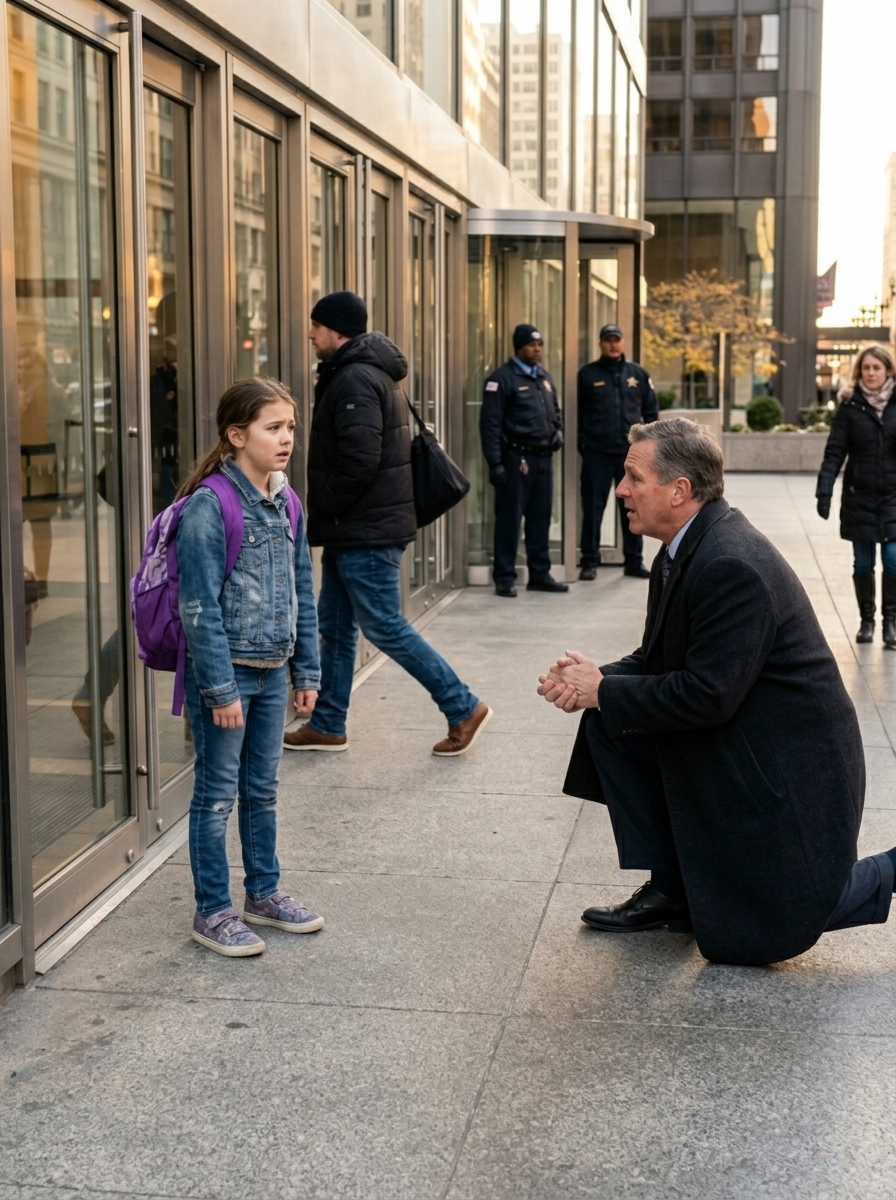
A Six-Year-Old Girl Stopped a Wealthy Executive Outside His Office and Whispered, “My Mom Never Came Home”—What He Found Hours Later Changed the Way He Ran His Entire Life
“My mom didn’t come home last night.”
Ethan Mercer stopped so fast that the man behind him nearly walked into his shoulder.
The little girl standing near the front steps of his downtown Chicago office building couldn’t have been more than six. She had a purple backpack at her feet, both hands wrapped tightly around the straps of a small lunch bag, and the kind of frightened eyes that made every other sound on the sidewalk seem to disappear.
Ethan looked behind her.
No parent.
No teacher.
No adult calling her name.
Just people moving past them, heads down, carrying briefcases, grocery bags, coffee cups, and the weight of their own evenings.
“What did you say?” Ethan asked.
The girl swallowed.
“My mom didn’t come home.”
That sentence landed harder than anything Ethan had heard in the twelve hours he’d just spent inside conference rooms.
He was forty-three years old and ran the commercial development company his father had started decades earlier. Most days were numbers, contracts, schedules, presentations, calls, and people waiting for him to make decisions.
He was good at making decisions.
People told him that constantly.
But standing there in his dark overcoat, with his phone vibrating in his pocket and a driver waiting somewhere in traffic, Ethan had no idea what the right decision was.
He lowered himself slightly so he wasn’t towering over her.
“What’s your name?”
“Molly.”
“Molly what?”
“Molly Reed.”
“Okay, Molly. I’m Ethan.”
She stared at him without answering.
That was when he noticed her eyes were wet.
Not the loud crying of a child who had scraped a knee or lost a toy.
This was quieter.
She looked like she had already spent all day trying not to cry.
“Are you waiting for somebody here?” Ethan asked.
She shook her head.
“I was trying to go home.”
“Do you know where home is?”
“Maplewood Avenue.”
Ethan knew the street. It wasn’t far, but it wasn’t somewhere a six-year-old should be trying to find alone in downtown Chicago either.
“Why are you here?”
“I think I went the wrong way.”
Her voice cracked on the last word.
Ethan looked toward the building entrance behind him.
His executive assistant had already left. The lobby staff was still inside, and Ethan could easily have walked Molly back into the warm lobby, called somebody, and handed the situation to another adult.
That would have been reasonable.
Efficient.
Responsible.
It was also exactly how Ethan had handled nearly everything in his life.
Find the proper person.
Delegate.
Move on.
But Molly looked at him and whispered, “My mom always comes home.”
Ethan forgot about his phone.
“Tell me what happened.”
Molly took a shaky breath.
“My mom went to work yesterday morning. She said she’d be home for dinner.”
“What does your mom do?”
“She’s a nurse.”
“At a hospital?”
Molly nodded.
“She helps people.”
The answer came with a little pride.
“What’s her name?”
“Sarah Reed.”
“And she never came home?”
“No.”
“Who stayed with you last night?”
“Mrs. Daley from downstairs.”
That gave Ethan a small amount of relief.
“Mrs. Daley is your neighbor?”
“Yes.”
“Did she know your mom hadn’t come home?”
Molly nodded again.
“She said maybe Mom had to work extra.”
“Did your mom ever do that before?”
“Sometimes.”
“But she called you?”
“Always.”
That word came quickly.
Firmly.
“Always.”
Ethan studied her face.
Children could misunderstand things. Adults could forget to explain things. Schedules changed. Phones died. Work emergencies happened.
He knew all of that.
But Molly wasn’t confused about this part.
Her mother called.
Every time.
“What happened this morning?” Ethan asked.
“Mrs. Daley made me toast.”
“Okay.”
“Then she had to go to work.”
“And you went to school?”
Molly nodded.
“She said Mom would probably be home tonight.”
“Did you tell your teacher?”
Molly looked down.
“No.”
“Why not?”
“Because I thought Mom would be home.”
There was no logic Ethan could argue with.
A six-year-old had been given the simplest possible explanation by an adult she trusted, so she had carried it with her all day like a rule.
Mom would be home.
Go to school.
Keep going.
At the end of the school day, Molly had tried to do what she normally did.
Get home.
Only she and her mother had moved to the neighborhood barely two months earlier, and the after-school arrangement that usually brought Molly home had changed that afternoon.
There had been confusion.
Molly had remembered that Maplewood Avenue was “near the tall buildings.”
So she had followed the tall buildings.
And ended up outside Ethan’s office.
Ethan stood and looked at the hundreds of adults moving around them.
Someone could have noticed Molly ten minutes earlier.
Someone probably had noticed her.
That was the uncomfortable part.
Noticing and stopping were different things.
“Molly, do you have your mom’s phone number?”
She nodded.
“Do you know it?”
Another nod.
“Would you like to call her from my phone?”
Molly’s face changed instantly.
Hope.
Pure, immediate hope.
Ethan unlocked the phone and handed it to her.
She carefully pressed each number.
Then she held the phone with both hands.
Ethan watched.
One ring.
Two.
Three.
Four.
Then voicemail.
Molly’s shoulders dropped.
She didn’t leave a message.
She ended the call and handed the phone back.
“She always answers me.”
Ethan felt something tighten inside him.
“Do you know the hospital where she works?”
“Yes.”
“Which one?”
Molly named a large hospital not far from the neighborhood.
Ethan knew the area.
He also knew better than to assume somebody at a hospital would simply give personal information to a stranger calling from the sidewalk.
So he made the next decision carefully.
“Here’s what I think we should do,” he said. “We go somewhere safe first. Then we contact the people who know your mom.”
Molly stared at him.
“My apartment?”
“We can go there, but I don’t want you going alone.”
“Mom says I’m not supposed to go inside when she’s not there.”
“That’s a smart rule.”
“I have a key for emergencies.”
Ethan almost smiled.
“I think this counts as something we need grown-up help with.”
She studied him suspiciously.
“Are you a grown-up?”
Ethan glanced down at his tailored coat.
“I’m definitely old enough.”
That got the smallest flicker of a smile.
Then it disappeared.
“I mean a good grown-up.”
Ethan wasn’t prepared for that question.
He could have answered automatically.
Of course.
Sure.
Absolutely.
Instead, he said, “I’m trying to be.”
Molly considered that.
Then she nodded once.
“Okay.”
Ethan texted his driver that he wouldn’t need the car.
A response came immediately.
Everything okay?
Ethan typed back:
I think somebody needs me more.
He put the phone away.
“Molly, before we leave, I want the people inside this building to know where we’re going. All right?”
She nodded.
They went into the lobby.
Ethan spoke with the evening security manager, a gray-haired man named Dennis who had worked in the building for years.
Dennis’s expression changed the moment he understood.
He offered Molly a chair and a bottle of water.
Then he crouched a few feet away from her.
“Hey, kiddo. I’m Dennis. Mr. Mercer works upstairs.”
Molly looked at Ethan.
“You’re Mr. Mercer?”
“Unfortunately.”
Dennis laughed.
Molly didn’t.
She was still watching Ethan.
“You said Ethan.”
“My first name is Ethan.”
“Mom says adults who make kids call them Mister are usually teachers.”
Dennis coughed into his hand to hide a laugh.
Ethan nodded seriously.
“Then Ethan is fine.”
Dennis asked Molly a few basic questions.
Her full name.
Her address.
Her mother’s name.
The neighbor’s name.
Everything matched what she had told Ethan.
Dennis wrote the information down and kept it at the desk.
“If anyone comes looking for her, we call you immediately,” he told Ethan.
“Exactly.”
“And keep me updated.”
“I will.”
Molly picked up her backpack.
“Can we go now?”
Ethan looked at her.
“Yes.”
The walk to Maplewood Avenue took longer than Ethan expected because Molly kept stopping to look at every woman coming toward them.
Every dark-haired woman.
Every hospital employee wearing scrubs beneath a coat.
Every person around her mother’s age.
Her head would lift.
Her pace would quicken.
Then she would realize it wasn’t Sarah.
And keep walking.
Ethan stopped asking questions for a while.
He let her look.
After two blocks, Molly said, “My mom makes pancakes shaped like animals.”
Ethan glanced down at her.
“What kind?”
“Mostly bears.”
“Why bears?”
“Because circles are easy.”
Ethan smiled.
“That’s pretty smart.”
“She tried to make a giraffe once.”
“How did that go?”
“It looked like a hammer.”
Ethan laughed.
Molly finally did too.
Only for a second.
Then she said, “She promised pancakes Saturday.”
“We’re going to find out where she is.”
Molly nodded.
“She doesn’t break promises.”
Ethan believed her.
He couldn’t explain why.
Maybe because Molly said everything about Sarah with complete certainty.
Her mother called.
Her mother came home.
Her mother read two pages even when she was tired.
Her mother cut sandwiches diagonally because “they taste better that way.”
Her mother remembered library day.
Her mother left notes in Molly’s lunch bag.
Her mother did not disappear without saying something.
There was something almost painful in the confidence Molly had in one person.
Ethan had never known that kind of certainty.
His own childhood had been comfortable.
More than comfortable.
He had grown up in a large suburban house with clean rooms, expensive furniture, carefully planned vacations, and almost anything a child could reasonably ask for.
Except time.
His father had worked constantly.
His mother had been involved in every committee, board, event, and social obligation imaginable.
No one had been cruel.
That almost made it harder to explain.
They had simply been busy.
Always.
Ethan had learned early that being easy made adults happy.
So he had become easy.
Good grades.
No trouble.
No dramatic needs.
No interruptions.
By fourteen, he could sit alone in a house for an entire evening without considering it unusual.
By sixteen, he had stopped expecting his father at school events.
By eighteen, he had convinced himself that independence was strength.
Now he was forty-three.
Successful.
Respected.
And so independent that sometimes an entire weekend passed without anyone asking where he was.
Molly interrupted his thoughts.
“My dad lives in Arizona.”
Ethan looked down.
“You see him?”
“Sometimes.”
She said it matter-of-factly.
“Mom says grown-ups can care about you even when they live somewhere else.”
“That sounds true.”
“He sent me a science kit.”
“What kind?”
“Rocks.”
“That sounds dangerous.”
Molly looked alarmed.
Ethan quickly added, “I’m kidding.”
“Oh.”
A beat passed.
Then Molly smiled.
“You’re not very funny.”
“I’ve been told that.”
They reached Maplewood Avenue.
The buildings there were older brick walk-ups, squeezed between a laundromat, a corner market, and a tiny diner with a handwritten pie special taped inside the window.
Molly pointed ahead.
“The blue door.”
Ethan saw it.
A narrow three-story building with a faded blue entrance.
Molly slowed.
The closer they got, the quieter she became.
At the front steps, she stopped completely.
“What if she’s not there?”
Ethan didn’t answer with a promise he couldn’t guarantee.
“Then we keep looking.”
“What if she is?”
“Then I’m guessing you’re going to hug her very hard.”
Molly nodded.
“Very hard.”
Inside the building, she led Ethan up one flight.
Apartment 2B.
She reached underneath her sweater and pulled out a key attached to a bright plastic cord.
“Emergency key,” she explained.
“I remember.”
“Mom said I’m only supposed to use it if I really need it.”
Ethan looked at the door.
Then at Molly.
“I think you really need it.”
She unlocked the deadbolt.
The apartment was quiet.
“MOM?”
Molly’s voice filled the small living room.
No answer.
She dropped her backpack.
“Mom?”
She hurried toward the kitchen.
Ethan stayed near the entrance, not wanting to move farther into someone else’s home than necessary.
“MOM?”
Molly came back.
Her face told him before she said anything.
“She’s not here.”
Ethan stepped farther inside.
The apartment wasn’t fancy.
A small couch.
A thrift-store coffee table.
A narrow kitchen.
Two mismatched chairs.
A stack of mail held down by a ceramic apple.
But it felt lived in.
Loved.
There were drawings taped to the refrigerator with alphabet magnets.
Molly wearing a crown.
A crooked purple cat.
Two stick figures holding hands beneath the words MOM + ME.
A school calendar covered in circles and notes.
A photo of Molly missing one front tooth.
A photo of Sarah laughing beside her at what looked like a county fair.
A small framed picture of the three of them—Sarah, Molly, and a man Ethan assumed was Molly’s father—taken years earlier.
No grand design.
No expensive furniture.
No polished surfaces.
Yet Ethan had never seen an apartment look more like a home.
Molly picked up a stuffed rabbit from the couch.
It had one floppy ear and faded pink fabric.
She held it against her chest.
“Mom fixed this twice.”
“Looks important.”
“Her name is Daisy.”
“Good name.”
Molly sat.
Ethan pulled out his phone.
“Let’s call your mom again.”
Same result.
Voicemail.
This time Molly spoke.
“Mom, it’s me. I’m home. I’m okay. Ethan is here. He’s a grown-up from a big building. Please call me.”
She paused.
Then added softly, “I love you.”
Ethan looked away.
After the call ended, he asked, “Do you know Mrs. Daley’s apartment?”
“Downstairs.”
They knocked.
No answer.
Molly said Mrs. Daley worked evenings at a grocery store.
“Do you know her phone number?”
“No.”
Ethan looked around the apartment again.
There had to be something.
An emergency contact list.
A work number.
A note.
He wasn’t going to rummage through drawers, but the refrigerator was covered with the ordinary paper trail of family life.
School notices.
A dentist appointment card.
A takeout menu.
A library reminder.
And there, partly hidden under a drawing of a rainbow, was a printed sheet titled:
MOLLY — IMPORTANT NUMBERS
Sarah’s cell.
Molly’s school.
Mrs. Daley.
Her father in Arizona.
Sarah’s workplace.
Ethan pointed.
“Can we use this?”
Molly nodded eagerly.
“That’s for emergencies.”
“This definitely qualifies.”
He called Sarah’s work number.
A main hospital switchboard answered.
Ethan explained carefully.
“My name is Ethan Mercer. I’m with Sarah Reed’s six-year-old daughter. Sarah didn’t return home yesterday, and her daughter is trying to reach her.”
There was a pause.
Then the woman’s tone became more serious.
“I can’t provide private information, sir.”
“I understand.”
“But I can try to connect you with the nursing unit where Ms. Reed works.”
“That would help.”
He was transferred.
Then transferred again.
Then put on hold.
Molly sat on the couch holding Daisy.
Ethan paced three steps in one direction and three steps back.
A woman finally answered.
He repeated the story.
Again, the answer was cautious.
“I can’t discuss an employee’s personal information with you.”
“I understand.”
“Can you put Molly on the phone?”
Ethan handed it over.
Molly pressed the phone to her ear.
“Hello?”
She listened.
“Yes.”
Another pause.
“My birthday is March fifth.”
She listened again.
“Yes, my teacher is Mrs. Harmon.”
Ethan couldn’t hear the other side.
Then Molly said, “Is my mom there?”
Her face froze.
“What?”
Ethan stepped closer.
Molly looked up at him.
“She says Mom came to work yesterday.”
Ethan crouched beside her.
“Ask if you can talk to her.”
Molly did.
The waiting began again.
One minute.
Then another.
Then another.
Molly stared at the phone.
Finally, a different voice came through.
Ethan could hear only enough to know it was gentle.
Molly listened.
Her mouth opened.
Then she said, “She is?”
Another pause.
“Can I see her?”
Ethan watched tears fill Molly’s eyes.
But this time she was smiling.
“She’s there,” Molly whispered.
Ethan closed his eyes for half a second.
Relief moved through him so quickly that his knees almost felt weak.
He took the phone.
A nursing supervisor introduced herself.
She kept the details simple.
Sarah had become unexpectedly ill during her shift the day before.
Because she worked in the same hospital where she had been evaluated, everything had happened quickly.
She had been kept there overnight for observation and rest.
She was doing better.
She was awake.
She had been asking about Molly repeatedly.
“What happened with the emergency contact?” Ethan asked.
The supervisor hesitated.
“There seems to have been a problem reaching the person listed.”
“Mrs. Daley?”
“Yes.”
“Her number is right here on Sarah’s refrigerator.”
Another pause.
“The number in our system appears to be different.”
Ethan looked at the sheet again.
One wrong digit.
That was all it took.
One digit somewhere in a computer.
One number entered months or years earlier.
A call going nowhere.
Then another.
Sarah assuming someone had reached Molly.
Mrs. Daley assuming Sarah had simply been held at work.
Molly assuming her mother would be home after school.
Every adult holding one piece of the situation.
No adult holding the whole thing.
“Can Molly visit her?” Ethan asked.
“Yes.”
Molly was already putting on her backpack.
“Now?”
Ethan looked at her.
“Yes. Now.”
She grabbed his hand.
It happened so naturally that Ethan didn’t react at first.
Her fingers were tiny.
Warm now.
Trusting.
On the way downstairs, Molly nearly skipped a step.
“She’s okay.”
“Yes.”
“She didn’t forget me.”
“No.”
“I knew it.”
“I know you did.”
At the front door, Molly stopped.
“I told you she always calls.”
Ethan nodded.
“You were right.”
He ordered a car.
While they waited inside the building entrance, Molly kept talking.
Not because she suddenly had nothing to worry about.
Because now all the things she had been holding inside finally had somewhere to go.
“She probably thinks I’m mad.”
“Are you?”
“No.”
“She’ll be glad to hear that.”
“I was scared.”
“You can tell her that too.”
“She’ll cry.”
“Maybe.”
“I’ll cry.”
“Probably.”
Molly looked at him.
“Will you?”
Ethan almost laughed.
“I have an excellent reputation to maintain.”
She frowned.
“What does that mean?”
“It means probably.”
The car arrived.
They sat in the back.
Molly kept Daisy tucked under one arm.
Three times she asked Ethan the same question.
“She’s really okay?”
And three times he gave the same answer.
“She’s really there, she’s awake, and she wants to see you.”
The fourth time, Molly didn’t ask.
She leaned against the seat and whispered, “Good.”
Ethan checked his phone.
Twenty-three unread emails.
Six missed calls.
Two messages marked urgent.
One from a board member.
One from his chief financial officer.
One from his assistant asking whether he needed the morning agenda changed.
Normally Ethan would have answered before the car reached the next light.
Instead, he turned the phone face down.
Molly noticed.
“Aren’t you going to answer?”
“Not right now.”
“What if it’s important?”
Ethan looked at her.
“This is important.”
She seemed satisfied.
At the hospital, the front desk had already been told they were coming.
A staff member met them and walked them toward Sarah’s room.
Molly squeezed Ethan’s hand tighter with every hallway.
Then she saw the room number.
She let go.
“MOM!”
Sarah Reed was sitting upright in bed.
She looked tired.
Her hair was pulled back loosely, and she wore a plain hospital gown under a blanket.
But the second she saw Molly, her entire face changed.
“Molly.”
The girl ran forward.
Sarah opened both arms.
Molly climbed carefully onto the edge of the bed and buried her face against her mother.
For several seconds, neither of them said anything understandable.
Just names.
Half sentences.
Crying.
Relieved laughter.
“Mom.”
“Baby.”
“I thought—”
“I know.”
“You weren’t home.”
“I know.”
“I called.”
“I know, honey.”
“You didn’t answer.”
“I’m so sorry.”
Ethan turned toward the window.
It felt wrong to stare.
He had been in rooms with investors discussing nine-figure projects.
He had faced angry partners.
Demanding clients.
Hard negotiations.
Unexpected losses.
Nothing had ever made him feel as exposed as listening to a mother say, “I was trying to get to you,” while her daughter kept repeating, “I knew you didn’t forget.”
Finally, Sarah noticed him.
Her expression changed.
The tenderness remained, but caution entered immediately.
“Who are you?”
Molly answered before Ethan could.
“This is Ethan.”
Sarah looked from Molly to him.
“Ethan?”
“He found me.”
Sarah’s arms tightened around her daughter.
“You found her?”
Ethan stepped closer but kept a respectful distance.
“She was outside my office building. She was trying to get home.”
Sarah’s face went pale.
“Outside your office?”
“Molly had gotten turned around after school.”
Sarah closed her eyes.
Molly touched her cheek.
“I’m okay.”
Sarah opened her eyes again.
“You were alone?”
“Not for long.”
The words didn’t seem to help.
Sarah looked at Ethan.
“What happened?”
He explained.
Slowly.
No dramatic language.
No judgment.
Mrs. Daley had stayed with Molly overnight.
She had gone to school.
After school, a change in routine had left Molly trying to remember the way home.
She had ended up downtown.
Ethan had seen her.
They had gone to the apartment.
They had called.
They had found the emergency number list.
Sarah listened without interrupting.
Then she looked down at Molly.
“I am so sorry.”
Molly shook her head.
“You got sick.”
“I still should have found a way to reach you.”
“You tried.”
Sarah looked back at Ethan.
“They told me they were calling my emergency contact.”
“They did.”
“Then what happened?”
Ethan hesitated.
“There was a wrong number in the hospital system.”
Sarah stared.
“What?”
“One digit seems to have been entered incorrectly.”
Sarah looked stunned.
“My paperwork?”
“I don’t know how or when it happened. The staff is checking.”
Sarah leaned back against the pillow.
For a moment, she simply stared at the blanket.
“One digit.”
“That’s what it looks like.”
“I updated that information when we moved.”
Ethan didn’t answer.
He had spent his entire career around systems.
Forms.
Databases.
Procedures.
Layers of process designed to prevent things from falling through cracks.
And yet life had just shown him how wide one crack could become.
Sarah let out a slow breath.
“I kept asking if Molly had been reached.”
Molly snuggled against her.
“I’m here.”
“I know.”
“And Mrs. Daley gave me toast.”
Sarah laughed through tears.
“Of course she did.”
“It was burned.”
“That also sounds like Mrs. Daley.”
Molly smiled.
Then Sarah looked at Ethan again.
“You walked her home?”
“Yes.”
“You stayed with her?”
“Yes.”
“You found me?”
“We found you.”
Sarah shook her head.
“I don’t even know what to say.”
“You don’t have to say anything.”
“No.”
Her voice became firmer.
“I do.”
Ethan waited.
“Thank you.”
He nodded.
“I’m glad you’re okay.”
“That’s not enough.”
“Really, it is.”
“You could have kept walking.”
Ethan said nothing.
Sarah looked at him for a long moment.
“Most people would have assumed somebody else was handling it.”
That sentence bothered Ethan.
Because it was true.
Not about most people.
About him.
He thought of all the times he had passed responsibility to the next person because there was a process for it.
A department.
A manager.
A committee.
A vendor.
A building supervisor.
A community organization.
Someone.
Anyone.
There was always someone else.
Sarah seemed to read something in his face.
“I’m not criticizing people,” she said quietly. “Everybody is busy.”
“I know.”
“But you stopped.”
Molly interrupted.
“I told him he had kind eyes.”
Sarah looked at Ethan.
“Did you?”
“Yes.”
“She also asked whether I was a good grown-up.”
Sarah’s mouth twitched.
“That sounds like her.”
“I gave a very cautious answer.”
“What did you say?”
“I said I was trying.”
Sarah nodded.
“That might be the best answer.”
A nurse came in to check on Sarah.
Ethan stepped back.
The nurse spoke warmly to Molly, then asked Sarah a few routine questions.
Nothing sounded alarming.
Sarah was improving.
She was tired and needed more time there.
That was all Ethan needed to know.
No complicated explanation.
No dramatic prognosis.
No frightening language.
Just time.
Rest.
Observation.
Molly sat beside her mother and held Daisy between them.
When the nurse left, Sarah looked down at Molly.
“Where are you sleeping tonight?”
Molly blinked.
“With you.”
Sarah gave Ethan a helpless look.
“I don’t know if they allow that.”
“We can ask,” Ethan said.
“You don’t need to solve everything.”
The words stopped him.
No one had said that to Ethan in years.
Maybe ever.
His whole adult life had been built around solving things.
Fix the schedule.
Fix the budget.
Fix the deal.
Fix the project.
Fix the conflict.
Make the call.
Create the plan.
Move.
Sarah’s tone wasn’t harsh.
She simply sounded tired.
“You’ve already done more than enough,” she said.
Ethan nodded.
“You’re right.”
Molly looked alarmed.
“So I can’t stay?”
“I didn’t say that,” Sarah told her.
“We’ll ask,” Ethan said.
Sarah smiled faintly.
“We’ll ask.”
That one change in wording seemed ridiculously small.
But Ethan noticed it.
Not I’ll arrange it.
Not I’ll handle it.
We’ll ask.
A nurse returned a few minutes later with a simple solution.
Molly could remain for a while, and the staff would help Sarah make an appropriate plan for the night.
Mrs. Daley was also being contacted with the correct number.
Molly’s father had been reached too.
He was worried but relieved.
Everything that had felt scattered was slowly reconnecting.
Person by person.
Call by call.
Sarah leaned back.
For the first time since Ethan entered the room, she seemed able to breathe normally.
“Molly?”
“Yes?”
“Come here.”
“I’m already here.”
“Closer.”
Molly scooted against her.
Sarah kissed the top of her head.
“I need you to know something.”
“What?”
“If I’m ever late and you don’t know why, you tell a teacher. Or the school office. Or another grown-up you know.”
Molly nodded.
“You don’t carry it alone.”
“I thought you were coming home.”
“I know.”
“I didn’t want anybody to think you forgot.”
Sarah’s face folded with emotion.
“Oh, honey.”
“I knew you didn’t.”
Sarah hugged her.
Ethan looked down.
That sentence struck deeper than he expected.
I didn’t want anybody to think you forgot.
A six-year-old had spent an entire day protecting her mother’s character.
Not because Sarah needed protecting.
Because Molly loved her enough to defend what she knew to be true.
Sarah didn’t forget her.
Sarah didn’t break promises.
Something had happened.
Simple as that.
Ethan wondered if anyone had ever believed in him that completely.
Then another thought came.
Had he ever given anyone a reason to?
His phone vibrated again.
This time he checked it.
A message from his assistant, Claire.
Board call moved to 7:30 a.m. tomorrow. Confirm?
Ethan stared at the screen.
He had scheduled the call himself.
Three weeks earlier.
It involved a major project.
People were flying in.
Documents were prepared.
Every instinct told him to type:
Confirmed.
Instead, he typed:
Move it to 10:00 if possible. Family matter came up.
He paused.
Family matter.
That wasn’t technically true.
He almost deleted it.
Then Sarah said, “You have somewhere you need to be?”
Ethan looked up.
“Not anymore.”
“You should go if you do.”
“I don’t.”
“Ethan.”
It was the first time she used his name.
“You found my daughter. You brought her here. You don’t have to sit in a hospital room with strangers all night because you feel responsible for us.”
“I don’t feel responsible.”
“Then why are you still here?”
Molly looked between them.
Ethan opened his mouth.
Nothing came out.
He could have given the obvious answer.
Because Molly needs help.
Because you’re here.
Because it’s the decent thing to do.
But Sarah had already rejected those answers.
So Ethan sat in the visitor chair.
“I think,” he said slowly, “because I don’t remember the last time I was somewhere that mattered more than where I was supposed to be.”
Sarah said nothing.
Ethan continued.
“I spent twelve hours today talking about buildings.”
Molly looked interested.
“You build buildings?”
“My company does.”
“Like houses?”
“Sometimes.”
“Schools?”
“Not usually.”
“Libraries?”
“A few.”
“Do you use Legos?”
Sarah laughed.
Ethan smiled.
“Unfortunately, no.”
Molly looked disappointed.
“That would be better.”
“I agree.”
Sarah shook her head.
“You were saying?”
Ethan leaned back.
“I spent twelve hours talking about projects, schedules, returns, permits, deadlines. Everyone treated every issue like it was urgent.”
He glanced at Molly.
“Then I walked outside and met someone who actually had an urgent problem.”
Sarah listened.
“And I realized,” Ethan said, “that I’m not very good anymore at knowing the difference.”
The room became quiet.
Molly began fixing Daisy’s crooked ear.
Sarah finally said, “That happens.”
“To everyone?”
“To adults.”
“That’s reassuring.”
“It shouldn’t be.”
Ethan laughed softly.
Sarah smiled.
Then she asked, “Do you have kids?”
“No.”
“Married?”
“No.”
“Family nearby?”
“My mother lives in Florida now.”
“Your dad?”
“He passed the company to me years ago. He’s retired out west.”
“So you go home to…”
“An apartment.”
“That wasn’t my question.”
Ethan knew it.
“No one.”
Sarah immediately looked uncomfortable.
“I’m sorry. That was personal.”
“It’s fine.”
“I didn’t mean—”
“It’s true.”
Molly looked up.
“You live alone?”
“Yes.”
“Don’t you get bored?”
“Often.”
“Get a hamster.”
Sarah covered her mouth.
Ethan stared at Molly.
“A hamster?”
“They’re small.”
“I’ve heard.”
“And they don’t need pancakes.”
“Useful.”
Molly nodded seriously.
“I’ll consider it.”
Sarah laughed.
It was a tired laugh.
But it filled the room.
Ethan realized he liked the sound.
Not romantically.
Not in the way cheap stories tried to turn every connection between a man and woman into something else.
He liked it because an hour earlier Sarah’s daughter had looked terrified.
Now Molly was arguing for hamster ownership while Sarah laughed.
That was enough.
More than enough.
A staff member came in and explained that Mrs. Daley had been reached.
She had been frantic when she realized Molly had not gone straight home with the usual after-school arrangement.
The school had believed Molly was leaving with the approved plan.
Mrs. Daley had believed Sarah would be home.
Sarah had believed the hospital had reached Mrs. Daley.
The hospital had called an incorrect number.
Four separate assumptions.
No bad intentions.
No villain.
No crime.
Just people moving through busy lives, each believing someone else had the next piece.
Ethan found that more unsettling than a dramatic explanation would have been.
Systems failed quietly.
So did people.
Usually not because they didn’t care.
Because they thought care had already been assigned.
Sarah pressed her fingers against her forehead.
“So everybody thought somebody else had her.”
“Yes,” the staff member said gently.
Sarah looked at Molly.
“And you just kept going.”
Molly shrugged.
“You told me not to miss school.”
Sarah laughed once.
Then cried again.
“I did.”
Molly hugged her.
“Don’t cry.”
“I’m okay.”
“Adults say that when they’re crying.”
Ethan almost choked trying not to laugh.
Sarah pointed at her daughter.
“You have been listening too closely.”
Molly looked pleased.
The staff member left.
Ethan stood.
“I think I should give you two some time.”
Molly immediately said, “No.”
Sarah looked at her.
“Molly.”
“He can stay.”
Ethan smiled.
“I’ll stay a little longer.”
Molly settled.
Sarah watched him.
“You really don’t know why you’re doing this, do you?”
Ethan considered the question.
“I know part of it.”
“What part?”
“My father used to say a successful person is someone people call when the decision is difficult.”
Sarah waited.
“I built my whole life around being that person.”
“Sounds exhausting.”
“It is.”
“But tonight a six-year-old called you.”
“She didn’t call me.”
“She stopped you.”
“She didn’t even do that.”
Molly looked up.
“You stopped yourself.”
Ethan stared at her.
Sarah smiled.
“She does that.”
“Does what?”
“Says the thing everyone else takes ten minutes to explain.”
Molly looked confused.
“I was just standing there.”
“Exactly,” Ethan said.
Sarah became serious again.
“What’s the other part?”
Ethan looked toward the hallway.
“My parents weren’t bad people.”
Sarah didn’t interrupt.
“They gave me every material thing I needed. Great schools. Vacations. Opportunities. But they were always working.”
He shrugged.
“I thought that was what successful families looked like.”
Sarah watched him.
“And now?”
“Now I’m not sure we were much of a family.”
Molly frowned.
“Did your mom read you stories?”
“Sometimes.”
“Your dad?”
“Not really.”
“Who made pancakes?”
“We had a housekeeper.”
Molly looked horrified.
“She made pancakes?”
“Yes.”
“Animal ones?”
“No.”
Molly shook her head.
“That’s sad.”
Ethan laughed.
Sarah did too.
But Molly remained serious.
“Really sad.”
“You might be right.”
Sarah leaned her head against the pillow.
“What happened when you got older?”
“I worked.”
“Of course.”
“I joined my father’s company.”
“And worked.”
“Yes.”
“Then what?”
“That’s basically it.”
Sarah stared at him.
“That cannot be the whole story of your adult life.”
“It has chapters.”
“Are the chapters also work?”
“Mostly.”
She shook her head.
“That’s not success.”
Ethan raised an eyebrow.
“You say that very confidently.”
“I’m exhausted, wearing a hospital gown, and my daughter had the worst day of her little life because a phone number was wrong.”
She looked down at Molly.
“And I still know exactly what the best part of my life is.”
Ethan followed her gaze.
Molly was making Daisy bow.
Sarah continued quietly.
“If you have everything except somebody you’d drop everything for, what exactly did you win?”
Ethan didn’t answer.
Because there was nothing to say.
He thought of his condo overlooking the city.
The kitchen he barely used.
The dining table with six chairs that had never seated six people.
The guest room no guest had slept in for almost two years.
The wine glasses still wrapped from when he moved.
The refrigerator full of bottled water, takeout containers, and expensive groceries that expired because he wasn’t home.
He had called it freedom.
Maybe it was.
But freedom and emptiness could apparently share an address.
Molly yawned.
Sarah noticed immediately.
“You’re tired.”
“No.”
“You just yawned.”
“I breathed big.”
“You breathed big with your eyes closed.”
Molly curled closer.
Sarah stroked her hair.
Ethan watched.
That small motion.
Fingers through a child’s hair.
Nothing dramatic.
Nothing expensive.
Nothing measurable.
And somehow it seemed richer than half the things Ethan had spent his career chasing.
Sarah looked over.
“You’re doing it again.”
“What?”
“Thinking too hard.”
“I’m good at that.”
“Clearly.”
Molly’s eyes were closing.
Sarah lowered her voice.
“What are you going to do tomorrow?”
“Go to work.”
“Of course.”
“But maybe differently.”
“How?”
Ethan didn’t know yet.
“I have a meeting with our HR team.”
“You already planned one?”
“I’m planning it now.”
Sarah looked amused.
“There he is.”
“Who?”
“The man who solves everything.”
“I thought you didn’t like that guy.”
“I didn’t say I didn’t like him. I said he doesn’t have to solve everything.”
“Fair.”
Ethan took out his phone.
He opened a message to Claire.
Then stopped.
Sarah said, “See?”
“What?”
“You’re about to create something.”
“Yes.”
“Because of tonight?”
“Yes.”
“What?”
Ethan thought about the hundreds of people working for his company.
Receptionists.
Project managers.
Accountants.
Maintenance crews.
Assistants.
Designers.
Parents.
Caregivers.
People whose lives continued after they left the office, whether leadership noticed or not.
“How many single parents work for us?” he asked.
Sarah blinked.
“I have no idea.”
“Neither do I.”
“That seems normal.”
“How many employees have backup care if something unexpected happens?”
“Ethan.”
“How many people have emergency contacts that haven’t been updated?”
She understood now.
“How many people are afraid to leave work when family calls because they think it makes them look unreliable?”
Sarah grew quiet.
Ethan typed:
Please move tomorrow’s first meeting. I want HR in at 8:30. I need a review of our family emergency policies, backup care resources, emergency contact update process, and manager expectations around family crises. No presentation. Just facts.
He showed Sarah.
She read it.
“That’s a lot for 8:30.”
“They’re used to me.”
“Poor people.”
“I pay them well.”
Sarah smiled.
“That is exactly what a boss would say.”
Ethan added another line.
Also, nobody gets blamed for gaps. I want to know what isn’t working, not who to punish.
Sarah noticed.
“That part matters.”
“I know.”
“How?”
“Because I’ve spent years watching people hide problems until they become expensive.”
Sarah nodded.
“And sometimes problems are people being scared.”
Ethan looked at Molly.
“Exactly.”
He sent the message.
A reply arrived almost instantly.
Understood. Is everything okay?
Ethan typed:
Yes. I just learned something important.
He put the phone away.
Sarah watched him.
“You really mean it.”
“Yes.”
“Most people have emotional evenings and wake up normal again.”
“I’m hoping to avoid that.”
She smiled.
Molly’s eyes opened halfway.
“Did you get a hamster?”
“No.”
She closed them again.
“You should.”
Within minutes, Molly was asleep.
Her head rested against Sarah.
Daisy was trapped beneath one arm.
Sarah looked down at her daughter for a long time.
Then she whispered, “She was so scared.”
Ethan said nothing.
“I keep thinking about her sitting in school all day.”
“She believed you were coming home.”
“That almost makes it worse.”
“No.”
Sarah looked at him.
“It means she trusts you.”
Her eyes filled again.
“I don’t ever want her to lose that.”
“Then don’t make tonight bigger than it is.”
“What do you mean?”
“A bad chain of communication happened.”
Sarah listened.
“You didn’t choose not to call her.”
“No.”
“Mrs. Daley didn’t choose to abandon her.”
“No.”
“The school didn’t knowingly send her somewhere unsafe.”
“No.”
“And Molly didn’t do anything wrong.”
Sarah nodded.
“So don’t turn one awful day into a story where everyone failed her.”
Sarah looked at him for several seconds.
“That’s surprisingly wise.”
“I run meetings.”
“That is not where wisdom comes from.”
“It’s all I have.”
She smiled.
Then her expression softened.
“You know what she’ll remember?”
“What?”
“You stopping.”
Ethan looked down.
“I hope she remembers finding you.”
“She expected to find me.”
“Exactly.”
Sarah gently adjusted the blanket around Molly.
“What she didn’t expect was you.”
The sentence stayed with Ethan.
He remained another forty minutes.
Not because there was anything left to do.
That was new for him.
He simply sat.
Sarah told him about Molly’s school.
About the apartment.
About their move.
About her schedule.
About how she and Molly’s father had separated years earlier but worked hard to keep things steady for their daughter.
There was no dramatic betrayal.
No secret cruelty.
No ugly custody battle.
Two adults had simply discovered they were better parents apart than partners together.
Molly’s father had moved to Arizona for work.
He called regularly.
He visited when he could.
Sarah carried most of the daily routine.
“I don’t like calling myself a single mom,” she said.
“Why?”
“Because it sounds like I do everything alone.”
“Don’t you?”
“No.”
She pointed toward the hallway.
“Mrs. Daley helps. Molly’s teacher helps. Her dad helps from far away. The woman at the diner downstairs lets Molly sit in a booth when I’m running ten minutes late.”
Sarah smiled.
“The librarian knows which books she likes. The crossing guard knows her name.”
Ethan thought about that.
“A network.”
“A messy one.”
“Still a network.”
“Exactly.”
Then Sarah looked at him.
“Tonight you were part of it.”
Ethan had received awards with his name engraved on them.
He had appeared in business magazines.
He had stood on stages while people applauded.
Nothing had ever made him feel as proud as those seven words.
Tonight you were part of it.
Eventually a staff member told Sarah she needed quiet.
Ethan stood.
Molly stirred.
“Ethan?”
“I’m here.”
“You leaving?”
“For tonight.”
She opened one eye.
“You coming back?”
Ethan looked at Sarah.
Sarah said nothing.
The question belonged to him.
“I’ll check on you tomorrow.”
Molly considered that.
“Bring pancakes.”
Sarah laughed.
Ethan nodded.
“Animal shaped?”
“Obviously.”
“I make no promises about quality.”
“Bear.”
“A bear?”
“Circles are easy.”
Ethan smiled.
“I’ve heard that.”
Molly closed her eyes again.
Sarah held out her hand.
Ethan took it.
“Thank you,” she said.
This time he didn’t brush it away.
“You’re welcome.”
“Seriously.”
“I know.”
“You changed tonight for us.”
Ethan looked at Molly.
“I think she changed it for me too.”
Sarah squeezed his hand once.
“Good night, Ethan.”
“Good night.”
He left the room.
The hallway felt strangely quiet after the intensity of the previous few hours.
His driver texted asking whether to come get him.
Ethan almost said yes.
Instead, he walked to a small twenty-four-hour diner across from the hospital.
He ordered coffee.
Then changed his mind and ordered food too.
He couldn’t remember the last time he had eaten somewhere alone without opening his laptop.
The waitress placed a plate in front of him.
“Long night?”
Ethan looked at the empty booth across from him.
“Important one.”
She nodded as though that answer made perfect sense.
He ate slowly.
No emails.
No calls.
No spreadsheets.
Around him, ordinary America carried on.
A tired couple shared fries.
Two hospital workers drank coffee.
A delivery driver ate pie at the counter.
An older man read a newspaper.
No one knew Ethan.
No one needed anything from him.
For once, he found that comforting.
He thought about a wrong phone number.
He thought about Molly standing outside his office.
He thought about how close he had come to doing what he usually did.
Walk inside.
Tell security.
Make a call.
Delegate.
Continue.
Would that have been wrong?
Probably not.
That was what disturbed him.
A person could do nothing technically wrong and still miss the human thing entirely.
Ethan had built a career on efficiency.
Efficiency asked:
Who owns this problem?
Compassion asked:
Who needs me right now?
Those questions were not always the same.
At 10:17 p.m., Claire texted.
HR confirmed for 8:30. I moved the board call. Also, for what it’s worth, I hope your family matter is okay.
Ethan stared at the words.
Then typed:
They’re okay.
He paused.
And Claire?
Yes?
Go home if you’re still working.
Three dots appeared.
Are you feeling all right?
Ethan laughed out loud.
The waitress looked over.
He typed:
Apparently not like myself.
Claire answered:
Noted. Going home before you recover.
Ethan smiled.
The next morning, he arrived at the office at eight.
That alone shocked people.
Ethan was usually there by 6:45.
Claire stood when he entered.
“Should I be concerned?”
“No.”
“You moved a board call.”
“Yes.”
“You told me to stop working.”
“Yes.”
“You are carrying a paper bag that smells like pancakes.”
“Yes.”
Claire narrowed her eyes.
“Who are you?”
Ethan handed her a coffee.
“Sit down.”
She did.
He told her what happened.
Not every personal detail.
Just enough.
Molly.
Sarah.
The wrong number.
The assumptions.
The hospital.
Claire listened.
When he finished, she said, “That could happen anywhere.”
“I know.”
“That’s what scares you.”
“Yes.”
At 8:30, Ethan walked into the HR meeting.
Four people were waiting with laptops open.
One had prepared slides despite his instruction.
Ethan looked at the screen.
“Turn that off.”
Everyone froze.
“I’m not angry.”
That did not make them less nervous.
Ethan sat.
“I don’t want polished answers today.”
The head of HR closed her laptop.
“Okay.”
“I want to know what happens when one of our employees has a family emergency at two in the afternoon.”
A manager began explaining the written policy.
Ethan stopped him.
“No. Not the policy.”
He leaned forward.
“What actually happens?”
That changed the room.
The answers came slowly.
It depended on the manager.
Some were flexible.
Some were not.
Some employees used paid time.
Some quietly made up hours.
Some worried about appearing unreliable.
Some didn’t know what help existed.
Emergency contacts were collected when employees were hired but not always reviewed.
Backup care resources existed in limited form, but awareness was low.
The company had policies.
It did not always have clarity.
For two hours, Ethan listened.
That might have been the most unusual thing he did all morning.
He didn’t interrupt every problem with a solution.
He didn’t ask who had failed.
He didn’t demand a perfect program by Friday.
He kept asking one question.
“What would make this easier for a normal person having a bad day?”
By the end of the meeting, they had a list.
Annual emergency contact reminders.
Clear family emergency leave communication.
A backup childcare partnership through vetted local providers.
Manager training around urgent family situations.
A simple internal emergency resource page.
A review of whether hourly workers had equal access to practical support.
Nothing flashy.
Nothing designed for a press release.
No giant charitable initiative with Ethan’s name on it.
Just fewer cracks.
When the meeting ended, the HR director stayed behind.
“Can I ask what happened?”
Ethan gave her the short version.
She listened.
Then said, “You know this is not going to prevent every problem.”
“I know.”
“Things will still go wrong.”
“I know.”
“People will still forget to update numbers.”
“I know.”
She smiled slightly.
“You’re taking this better than usual.”
Ethan leaned back.
“I’m trying to be a good grown-up.”
The HR director stared at him.
“I’m not asking.”
“That’s fair.”
At 10:15, Ethan left the office carrying the pancake bag.
He had found a diner willing to make three pancake bears.
The result was questionable.
One looked like a mouse.
One looked like a melted snowman.
The third resembled a bear if viewed with optimism.
Molly was awake when he reached Sarah’s room.
She saw the bag.
“You came back!”
“I said I would.”
Sarah looked better.
Still tired.
But brighter.
“You brought pancakes?”
“I was given instructions.”
Molly opened the container.
She stared.
Ethan waited.
“Well?”
She pointed at the first pancake.
“What is that?”
“A bear.”
“No.”
“It absolutely is.”
Sarah leaned over.
“That might be a rabbit.”
“It has round ears.”
“Those are ears?”
Ethan looked offended.
“The diner did its best.”
Molly pointed to the second.
“That one looks like Texas.”
Sarah laughed so hard she had to cover her face.
Ethan stared at the pancake.
“It does not.”
“It does.”
He looked again.
It did.
Molly took a bite.
“Still good.”
“Thank you.”
Sarah looked at him.
“How was work?”
“Different.”
He told her about the meeting.
Again, no grand claims.
No promises that he had fixed working life in America before lunch.
He simply explained what they were reviewing.
Sarah listened.
“You did all that because of us?”
“Because of what I noticed because of you.”
“That’s different.”
“It is.”
Molly held up a pancake ear.
“Can your company make pancakes?”
“No.”
“Then I don’t understand your job.”
“Neither do I anymore.”
Sarah smiled.
A staff member came in with good news.
Sarah would likely be able to go home later that day once her routine discharge arrangements were complete.
Molly cheered.
Sarah closed her eyes in relief.
Ethan stood.
“Then I’ll get out of your way.”
Sarah looked at him.
“You always leave when things get emotional?”
“Usually before.”
“That explains some things.”
Molly swallowed a bite of pancake.
“Come for Saturday pancakes.”
Ethan blinked.
Sarah looked at her daughter.
“Molly.”
“What?”
“You cannot invite random executives to breakfast.”
“He’s not random.”
Ethan tried not to smile.
Sarah looked at him.
“You don’t have to.”
“I know.”
Molly waited.
Sarah sighed.
“Saturday. Ten o’clock. If you want.”
Ethan thought about his calendar.
Saturday morning usually meant gym, emails, a long work session, maybe a late lunch alone.
“I’d like that.”
Molly pointed at him.
“Mom makes the bears.”
“I’m looking forward to seeing the professional version.”
That Saturday, Ethan showed up at 9:58 with flowers for Sarah and a science book for Molly.
He almost brought something expensive.
Then stopped himself.
Molly didn’t need expensive.
She needed someone who remembered she liked rocks.
Sarah opened the door.
“You’re early.”
“Two minutes.”
“That counts.”
“I’ve been told punctuality is a virtue.”
“By people who work for you?”
“Mostly.”
Molly shouted from the kitchen.
“ETHAN!”
He walked in.
The apartment felt different now.
Not because anything had changed.
Because he knew the people inside it.
Daisy sat at the table in her own chair.
Molly had arranged three plates.
Sarah stood at the stove.
“Watch carefully,” she said.
“This is advanced work.”
She poured three circles of batter.
One large.
Two small.
Ethan nodded.
“I see.”
“Head. Ears.”
“Revolutionary.”
“Respect the craft.”
Molly climbed onto her chair.
“Don’t make a giraffe.”
Sarah pointed the spatula at her.
“We agreed never to discuss the giraffe.”
They ate pancakes.
They talked.
Nothing extraordinary happened.
And Ethan would later remember that morning more clearly than dozens of luxury dinners and formal events.
Because nobody wanted anything from him.
Molly wanted to know whether he had bought a hamster.
Sarah wanted to know whether his company had survived his new personality.
Ethan wanted another pancake.
That was it.
Weeks passed.
Ethan kept his promise to check in.
But he was careful.
He did not try to become Sarah and Molly’s savior.
He did not pay their bills.
He did not sweep into their lives with a list of expensive solutions.
Sarah would never have accepted that anyway.
Instead, he became what she had called him.
Part of the network.
If Molly had a school fundraiser, he bought wrapping paper.
If Sarah’s schedule changed unexpectedly, he might pick up dinner and leave it at the door if she asked.
If Ethan had a Saturday with no plans, Molly occasionally convinced him to visit the library with them.
In return, Sarah did something few people in Ethan’s life did.
She told him no.
Often.
“No, you do not need to order a new couch because ours squeaks.”
“No, Molly does not need a tablet that costs more than my first car.”
“No, you cannot turn her lemonade stand into a marketing operation.”
“I was creating signage.”
“You made a revenue forecast.”
“She asked how much she might earn.”
“She is six.”
“Seven next month.”
“Go home, Ethan.”
Molly adored these conversations.
At work, changes began slowly.
Employees updated emergency contacts.
Managers received clearer guidance.
A family support resource page launched.
Backup care options expanded.
The company added a simple annual reminder asking employees to review their emergency information.
Ethan refused to let communications turn it into a story about him.
“No founder message.”
“You’re the CEO,” Claire reminded him.
“Even worse.”
“Employees might appreciate knowing why you care.”
“Tell them we reviewed our systems and found places to improve.”
“That’s not very inspirational.”
“It’s accurate.”
Claire smiled.
“Molly would approve.”
Ethan looked at her.
“You’ve never met Molly.”
“I feel like the entire company has met Molly.”
That was probably true.
Not by name.
Ethan protected Sarah and Molly’s privacy.
But people noticed the difference in him.
He still worked hard.
He still expected preparation.
He still challenged weak thinking.
He still cared about deadlines.
He simply stopped treating every deadline as more important than every human being.
One afternoon, a project manager approached him before a major meeting.
“My daughter’s school just called.”
The man looked embarrassed.
“She’s okay, but I need to pick her up. My wife is out of town.”
Ethan looked at him.
“Then why are you still standing here?”
The manager hesitated.
“The client presentation.”
“Go.”
“I can join by phone later.”
“No.”
“But—”
“Your daughter called.”
The man stared.
Ethan smiled.
“Somebody else can present slides.”
The project manager left.
Claire, who had overheard, said, “Three months ago you would have had a nervous breakdown.”
“Three months ago I was an idiot.”
“I wouldn’t go that far.”
“I would.”
At seven that evening, Ethan walked out of the office.
He stopped near the same place where he had first seen Molly.
For months, he had avoided thinking about how easily he might have missed her.
Now he let himself think about it.
He had been looking at his phone.
His driver had been late.
He had been annoyed.
Another minute and he might have stepped back inside.
Another person might have stopped.
Maybe.
Maybe not.
Life sometimes changed through enormous decisions.
A job accepted.
A marriage.
A move.
A business launched.
But sometimes it changed because you looked up.
That was all.
Look up.
Notice.
Stay.
Molly turned seven in March.
Her party was held in the community room of Sarah’s apartment building.
Nothing fancy.
Paper decorations.
Pizza.
Cupcakes.
A folding table covered with craft supplies.
Children running everywhere.
Ethan arrived wearing jeans and carrying a rock-polishing kit.
Molly opened it.
Her mouth dropped.
“THIS IS THE BEST THING I HAVE EVER SEEN.”
Sarah crossed her arms.
“You checked whether it was age appropriate?”
“Yes.”
“You did not buy the industrial version?”
“There was an industrial version?”
“Ethan.”
“I’m kidding.”
Sarah narrowed her eyes.
“You’re getting better at jokes.”
“I’ve been practicing.”
Later, Molly handed him a folded piece of construction paper.
“What’s this?”
“Your card.”
He opened it.
Inside was a drawing.
Three figures.
Molly.
Sarah.
Ethan.
Daisy the rabbit appeared beside them, almost as large as Ethan.
At the top, in purple marker, Molly had written:
GOOD GROWN-UPS STOP.
Ethan stared at the words.
Sarah came up beside him.
“She did that herself.”
“I can tell.”
“Spelling is improving.”
“It’s perfect.”
Molly looked up.
“Do you like it?”
Ethan crouched.
“I love it.”
“You can put it in your office.”
“I will.”
“Where people see it.”
“Definitely.”
“Not in a drawer.”
“I promise.”
Molly held up one finger.
“You said promises matter.”
Ethan nodded.
“They do.”
On Monday morning, he framed the picture.
Claire walked into his office and stopped.
The handmade drawing sat on the shelf directly behind Ethan’s desk.
Between two industry awards.
Claire looked at it.
Then at him.
“Good grown-ups stop?”
“Yes.”
“Corporate strategy?”
“Personal strategy.”
“I like it.”
“So do I.”
Years later, Ethan would still have that picture.
The paper faded.
The purple marker softened.
The corner bent slightly despite the frame.
The company grew.
Markets changed.
Projects opened.
Projects failed.
Employees came and went.
Ethan’s father eventually asked him why he had become so interested in family support policies.
Ethan told him the story.
His father listened quietly.
Then said something Ethan never expected.
“I wish I’d stopped more.”
Ethan looked at him.
His father stared down at his coffee.
“When you were little.”
Ethan didn’t know what to say.
His father continued.
“I thought providing for you was the same thing as being there for you.”
For once, Ethan did not rush to make the conversation easier.
He let the silence stay.
His father looked up.
“I know now it wasn’t.”
Ethan felt forty-three years of complicated feelings press into one moment.
There was no dramatic confrontation.
No accusation.
No shouting.
Just two men sitting at a kitchen table, finally talking about something they should have talked about decades earlier.
“I know you loved me,” Ethan said.
His father nodded.
“I did.”
“I just didn’t always know where to find you.”
His father’s eyes lowered.
“That’s fair.”
Ethan thought of Molly.
My mom always comes home.
One child’s certainty had revealed the shape of his own childhood more clearly than years of pretending it didn’t matter.
His father said, “Can I do better now?”
Ethan smiled.
“You can stop more.”
His father laughed.
“I can try.”
“That’s what I told Molly.”
“What?”
“She once asked whether I was a good grown-up.”
His father smiled.
“What did you say?”
“I’m trying.”
His father nodded.
“That’s probably all any of us can say.”
Ethan’s life did not transform into a fairy tale.
He did not abandon his company.
He did not become perfect.
He still worked too late sometimes.
He still forgot birthdays until Claire reminded him.
He still checked email during dinner and occasionally caught Sarah staring at him until he put the phone away.
Yes, Sarah remained in his life.
As a friend.
A close one.
There was no rushed romance.
No magical leap from strangers to soulmates.
Their connection was built from ordinary things.
Breakfasts.
Phone calls.
School events.
Arguments about whether Ethan was allowed to buy Molly a telescope.
He lost that argument.
Then Molly presented a handwritten proposal titled WHY A TELESCOPE IS EDUCATIONAL.
Sarah accused Ethan of coaching her.
He denied it.
Poorly.
Eventually, Sarah allowed a modest telescope.
Molly spent three nights looking mostly at neighboring rooftops.
Ethan considered that a victory.
The strongest part of the story was never whether Ethan found love.
It was that he found connection.
He became the person Molly called when she had a school project about buildings.
The person Sarah called when her car battery died and she needed a ride—not because Ethan had money, but because he answered.
Sarah became the person who told Ethan when he was disappearing into work again.
Claire became the person who occasionally shut his office door at six and said, “Good grown-ups stop.”
His father started calling on Sundays.
Ethan started answering.
One small encounter had not fixed everybody.
It had simply made them more available to one another.
And maybe that was the real change.
Two years after Ethan first met Molly, he attended a company town hall.
An employee stood during the question period.
She worked in accounting.
Ethan recognized her face but not her name.
“I just wanted to say something about the family emergency changes.”
Ethan nodded.
She continued.
“My mother needed unexpected help last month. I was able to leave without feeling like I had to choose between being a good employee and being a good daughter.”
The room became quiet.
“I came back the next day,” she said. “My work was waiting. Nothing collapsed.”
A few people laughed.
She smiled.
“I just wanted leadership to know that policies can look small on paper and feel very big when you’re the person who needs them.”
Ethan thanked her.
Then he looked toward Claire, standing at the side of the room.
She knew.
Neither of them mentioned Molly.
They didn’t need to.
That evening, Ethan called Sarah.
“How was your day?” she asked.
“Someone told me something.”
He explained.
Sarah was quiet for a moment.
Then she said, “You should tell Molly.”
“Why?”
“Because she’ll take credit.”
Ethan laughed.
“She’ll absolutely take credit.”
“Correctly.”
He called Molly into the conversation.
She was nine now.
Older.
More confident.
Still brutally direct.
Ethan told her what the employee had said.
Molly listened.
“So your company is nicer because you met me?”
Sarah groaned.
Ethan smiled.
“Basically.”
“I knew it.”
“Molly.”
“What?”
Ethan said, “She’s not wrong.”
Sarah sighed.
“I have created monsters.”
Molly said, “Can the nice company buy me a horse?”
“No,” both adults answered.
Molly hung up dramatically.
Ethan laughed harder than he had all week.
Much later that night, he stood in his office before leaving.
Most of the floor was empty.
The city lights stretched beyond the windows.
On the shelf behind his desk sat Molly’s picture.
GOOD GROWN-UPS STOP.
Ethan picked it up.
He thought about the man he had been before Molly.
Not a bad man.
That mattered.
He had not been cruel.
He had donated money.
He had treated employees reasonably.
He had helped friends when asked.
He had followed rules.
He had done what respectable people were supposed to do.
But he had lived at a distance from almost everything.
He solved problems without entering them.
He cared through checks, emails, approvals, and delegated plans.
Then a little girl with a purple backpack had looked at him and said her mother hadn’t come home.
No dramatic villain had caused the problem.
No terrible secret had been uncovered.
A phone number was wrong.
A neighbor made an assumption.
A school routine changed.
A hospital believed a call had reached the right person.
A mother believed her child was safe.
A child believed her mother would return.
And one busy man happened to look up.
That was all.
Yet that was enough.
Enough to bring Molly back to Sarah.
Enough to force Ethan to examine a life he had mistaken for complete.
Enough to make a company rethink the difference between having policies and supporting people.
Enough to bring a father and son to a kitchen table years after they should have had an honest conversation.
Enough to turn strangers into part of the same messy human network.
Ethan returned the drawing to the shelf.
His phone buzzed.
A new email.
Marked urgent.
He looked at the clock.
6:14 p.m.
Then another notification appeared.
A text from Molly.
Pancakes Saturday. Mom says 10. I say 9 because I’m hungry.
Ethan smiled.
He closed his laptop.
Put on his coat.
And walked out.
Because success had once meant being the last person in the office.
Now he understood something far simpler.
Sometimes the most important thing a person can do is notice who is standing right in front of them.
And stop.