
Part 1 – My Niece Whispered Three Words I Couldn’t Ignore
The phone rang at 12:17 in the morning, and I almost let it go to voicemail. I was exhausted, already halfway asleep, and I assumed it was another late-night call that could wait until morning.
Then I heard the voice on the other end.
“Aunt Natalie, please help me.”
My eyes opened immediately.
It was Lizzy.
My six-year-old niece did not sound like a child asking for a favor or trying to get someone’s attention. Her voice was small, shaky and filled with a fear that made me sit up before I even understood what was happening.
“Lizzy? Where are you?”
There was silence for a moment.
Then she whispered:
“I’m locked in.”
My entire body went cold.
“What do you mean you’re locked in? Where are you?”
“I don’t know.”
Her breathing became uneven.
“I’m hungry. I’m scared.”
Before I could ask anything else, the call ended.
I called her back immediately.
No answer.
Again.
Nothing.
I stared at the phone, waiting for it to ring, waiting for her little voice to come back and tell me everything was okay.
But deep down, I already knew something was wrong.
I knew Lizzy.
I knew the difference between a child having a bad dream and a child desperately trying to reach someone.
I woke my husband Adam and told him what happened. At first, he wondered if there had been some misunderstanding because children sometimes described situations differently than adults.
But I could not forget the way Lizzy sounded.
She was not asking for a toy.
She was not upset because she was being punished.
She was asking me to find her.
My parents, Gloria and Walt, had guardianship of Lizzy while my brother Ian was away receiving treatment. They had always told everyone that Lizzy was doing well and that they were taking good care of her.
Whenever someone asked questions, they had the same answers.
“She’s sensitive.”
“She’s a picky eater.”
“She needs extra patience.”
They made caring for Lizzy sound difficult, but manageable.
And for a long time, I believed them.
I wanted to believe them.
They were my parents.
They were the people who were supposed to protect my niece when her own father could not be there.
But suddenly every explanation sounded different.
“She’s picky.”
“She’s difficult.”
“She’s fine.”
What if those words were not explanations?
What if they were ways to stop people from asking more questions?
I grabbed my keys.
Adam followed me downstairs.
“The weather is terrible. Are you sure you want to drive now?”
I looked at him.
“Lizzy called me because she thought I would come.”
That was all I needed to know.
The drive to my parents’ house felt endless. Rain covered the windshield, and my hands tightened around the steering wheel while one thought repeated over and over.
Something was wrong.
And every minute mattered.
When I arrived, the house was completely dark.
I ran to the front door and knocked.
“Mom! Dad! Open the door!”
No response.
I called their phones.
Nothing.
The silence felt unnatural.
I walked around the house looking for another way inside. After finding a side entrance that would not open, Adam helped me force the door.
The moment I stepped inside, I knew this was not a normal night.
The house was cold.
The air was stale.
And there was no sign that anyone had been caring for a child.
“Lizzy?”
For several seconds, I heard only the storm outside.
Then came a sound.
A small sob.
I followed it upstairs to the end of the hallway.
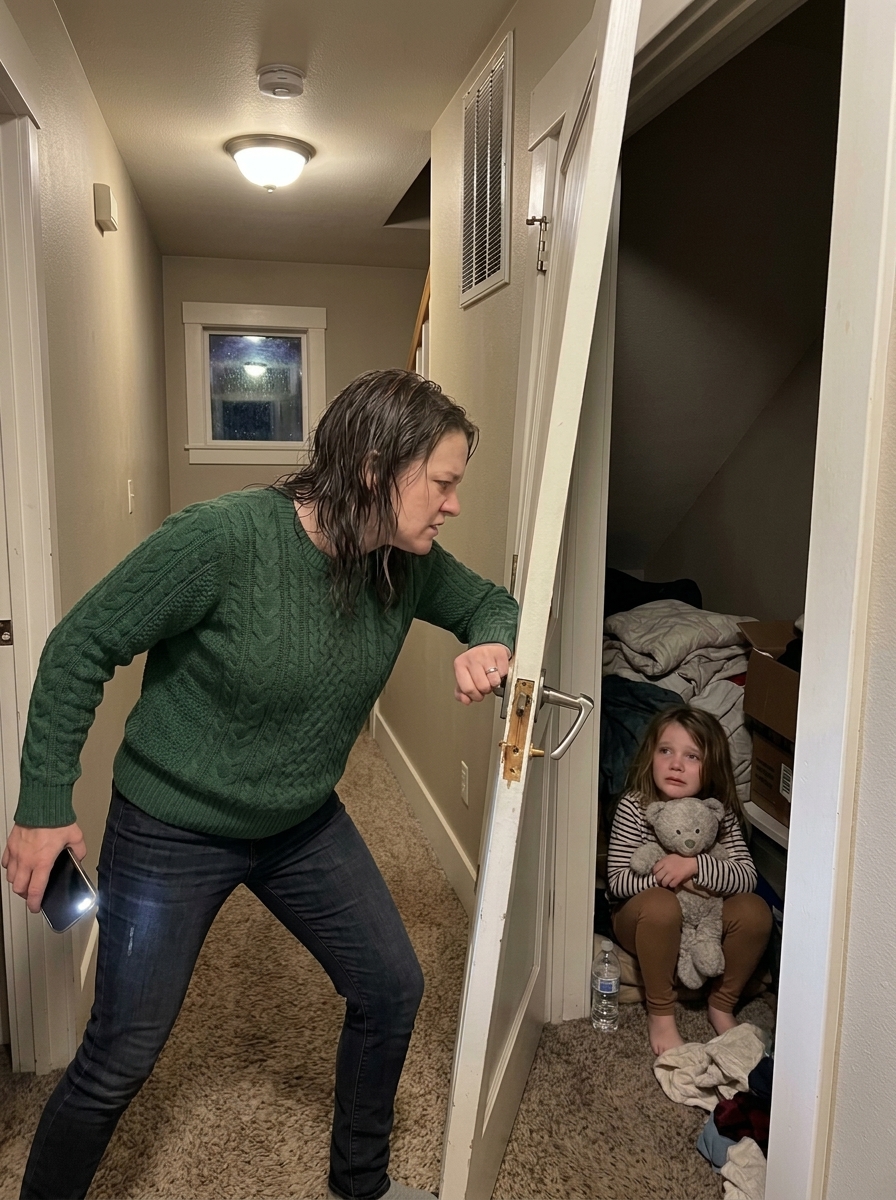
A storage closet.
My flashlight moved toward the door.
Then I saw it.
The latch was attached from the outside.
My heart dropped.
“Lizzy?”
A tiny voice answered.
“Auntie?”
I grabbed the handle.
“It’s okay. I’m here.”
The door would not open.
I pulled harder.
Nothing.
Then I hit the latch until it finally broke.
The door opened.
My flashlight found Lizzy curled up on the floor, holding her stuffed bear against her chest.
An empty bottle sat beside her.
She looked exhausted.
But when she saw me, she did not ask for food.
She did not ask why I was there.
She only whispered the words I would never forget.
“You came.”
I dropped beside her and wrapped my arms around my niece.
At that moment, I stopped thinking like a daughter confronting her parents.
I stopped thinking about family arguments.
I was only thinking about one thing.
A little girl needed someone to believe her.
And I promised her before we left that house:
“No one is locking you away again.”
Part 2 – The Words Everyone Used to Explain Lizzy Started Sounding Like Excuses
I carried Lizzy out of that closet while Adam grabbed a blanket from the living room. She was so light in my arms that it scared me, and I could not stop thinking about how long she had been sitting there waiting for someone to find her.
The entire drive to the hospital, Lizzy barely spoke. She held her stuffed bear against her chest and kept looking toward the back window as if she was afraid someone would follow us.
“Are they coming?”
I looked at her through the mirror.
“Who?”
She lowered her voice.
“Grandma and Grandpa.”
I reached back and held her hand.
“No one is taking you back there tonight.”
She nodded, but she still looked afraid.
That was the moment I realized this was not only about what happened in that closet.
Lizzy was scared of what would happen after someone found out.
At the hospital, the doctors immediately started checking her condition. They asked simple questions about when she last ate, when she last drank water and how long she had been alone.
Lizzy answered quietly.
Sometimes she looked at me before speaking, as if she needed permission to tell the truth.
The doctor later explained that she was severely dehydrated and not receiving the nutrition a child her age needed. She would need to stay while they evaluated her health and contacted the appropriate services.
I sat beside her hospital bed, watching her sleep.
Her stuffed bear rested beside her pillow.
Her tiny wrist had a hospital band around it.
And suddenly every explanation my parents had given me over the years sounded different.
“She’s picky.”
“She’s sensitive.”
“She’s difficult.”
I had always thought those were descriptions of Lizzy’s personality.
Now I wondered if they were excuses adults used when they did not want to admit they were failing her.
The next morning, I went back to my parents’ house.
Not because I wanted a confrontation.
Not because I wanted to scream at them.
I needed answers.
If I walked in angry, Gloria and Walt could turn everything into a fight about me accusing them. They could make themselves the victims and avoid the one person who mattered.
Lizzy.
I started looking for records.
The first thing I checked was the money that was supposed to support her care. Since my brother Ian was away receiving treatment, there had been regular payments meant for Lizzy’s needs.
I expected to see groceries, school supplies, clothes and medical expenses.
Instead, I found something else.
Restaurant bills.
Online shopping.
Electronics.
Weekend trips.
Personal purchases that had nothing to do with caring for a six-year-old child.
I photographed everything.
Then I searched for school information.
The next call confirmed my worst fear.
Lizzy had missed most of the days she was supposed to attend school.
When I asked whether anyone had contacted the family, the answer was yes.
The school had reached out multiple times.
Nobody had fixed the problem.
Nobody had explained why.
This was no longer about one terrible night.
It was a pattern.
A child had been trying to disappear because the adults around her had made her believe being quiet was easier than asking for help.
That afternoon, my mother finally contacted me.
The first message was simple.
Where is Lizzy?
I stared at the screen.
Not:
Is she okay?
Not:
How badly is she hurt?
Just:
Where is Lizzy?
Then another message arrived.
You ruined everything.
I looked at the evidence spread across the table.
The financial records.
The school reports.
The dates.
The missing care.
I had spent my whole life believing my parents were people who protected children.
Now I was looking at proof that they might have been protecting themselves.
Then I noticed something unusual.
One withdrawal from the account stood out.
The date matched the exact night Lizzy called me from the closet.
I zoomed in on the document.
There were two signatures.
I stared at the names attached to the transaction.
Because for years, Gloria and Walt had presented themselves as one voice.
One story.
One explanation.
But that piece of paper suggested something else.
Maybe they had not been hiding the truth together.
Maybe one of them had been trying to hide what the other had done.
Part 3 – My Father Finally Admitted He Had Seen the Warning Signs
I returned to the hospital with a folder full of evidence and a feeling that became harder to ignore with every passing hour. What happened to Lizzy was no longer just about one locked closet or one terrible night; it was about every moment when adults noticed something was wrong and decided not to ask more questions.
Lizzy was awake when I entered the room. She was sitting against the pillows with her stuffed bear tucked under one arm, slowly drinking water while watching the hallway outside.
The moment she saw me, her expression changed.
“Are they coming?”
I sat beside her and held her hand.
“Who?”
“Grandma and Grandpa.”
I could hear the fear behind the question. She was not asking because she missed them; she was asking because she was afraid they would take her back.
“No one is taking you anywhere tonight.”
She looked down at her blanket.
“Grandma will be angry because I told you.”
Those words hurt more than anything else she had said.
A six-year-old child believed asking for help was something she could be punished for.
I moved closer and tried to keep my voice calm.
“Lizzy, you did the right thing. You were scared, and you called someone who loves you.”
She hugged her bear tighter.
“But Grandma said families don’t tell people bad things.”
I looked at her for a moment.
“Families are supposed to protect each other. Telling the truth when you need help is not wrong.”
For the first time since I found her, her shoulders relaxed slightly.
Later that evening, my phone rang.
It was my father.
I almost let it go unanswered.
For years, Walt had always stood beside Gloria. Whenever my mother made a decision that upset someone, he was usually the person who explained it, defended her or asked everyone else to be patient.
But this time, his voice sounded different.
“Your mother is looking for the guardianship documents.”
I sat up.
“Why?”
“She thinks she can prove she was taking care of Lizzy.”
I looked toward my niece’s hospital bed.
“Dad, what aren’t you telling me?”
There was a long silence.
Then he finally admitted something I had not expected.
“I knew things weren’t right.”
My chest tightened.
“How long?”
“Months.”
He explained that he had noticed Lizzy becoming quieter. She stopped asking for things, stopped getting excited when they came home and often stayed alone in her room.
He had seen that she was eating less and becoming afraid to speak.
“Then why didn’t you tell me?”
His answer was almost a whisper.
“Because your mother kept saying Lizzy was difficult.”
I closed my eyes.
That word again.
Difficult.
It was the same word they had used every time someone noticed Lizzy needed more care.
My father admitted he had also seen money from Lizzy’s care account being used for things unrelated to her. At first, he convinced himself they were small mistakes, but eventually he realized there was a pattern.
“Did you sign those withdrawals?”
He did not answer immediately.
That silence told me enough.
“Dad.”
“I thought I could fix it.”
I looked at the documents on the table beside me.
The receipts.
The withdrawals.
The records showing Lizzy had missed school.
“You didn’t fix it.”
“I know.”
His voice broke.
“I was afraid of what would happen if I went against her.”
I understood then.
My father had not been unaware.
He had been afraid.
But fear did not change what happened to Lizzy.
While adults worried about arguments and consequences, a little girl had been sitting behind a locked door waiting for someone to believe her.
After we ended the call, I looked again at the withdrawal record I had photographed.
Two signatures were attached.
Gloria.
And Walt.
I had spent the entire day wondering whether my mother had acted alone.
Now I had another question.
How long had my father known exactly what was happening, and how much had he helped hide?
Before I could find the answer, my phone lit up again.
This time, it was a message from Gloria.
You need to bring Lizzy home.
A second message appeared immediately after.
You don’t understand what you’re doing.
I looked over at my niece sleeping peacefully for the first time in days.
Then I looked back at the screen.
Because I finally understood something.
This was no longer about proving what happened.
It was about making sure Lizzy never had to beg someone to come find her again.
Part 4 – I Realized Lizzy Was Not the Only One Who Had Been Silenced
I did not answer my mother’s messages immediately because I knew Gloria’s greatest strength was making people react emotionally before they had time to think clearly. For years, every concern about Lizzy had been redirected into explanations about how difficult things were, how much pressure my parents were under, or how everyone needed to be patient with them.
This time was different because I no longer had only suspicion. I had hospital records showing Lizzy’s condition, school reports showing her absences, financial documents showing where the care money had gone, and most importantly, I had Lizzy’s own words explaining what she had been afraid to say.
The child protection worker who spoke with me at the hospital asked about everything that happened, from the phone call in the middle of the night to the moment I found Lizzy behind the locked closet door. When she asked whether I had noticed any warning signs before that night, I realized there had been many moments I had ignored because I trusted my parents more than I trusted my own instincts.
After Lizzy moved in with Gloria and Walt, she became quieter. She stopped asking to visit as often, stopped talking excitedly about her days, and sometimes seemed nervous whenever someone mentioned going back to my parents’ house. Every time I asked Gloria if something was wrong, she had the same explanations ready.
“She’s adjusting.”
“She misses Ian.”
“She’s always been sensitive.”
I believed those answers because they came from my mother. Looking back, I realized I had been listening to the person explaining Lizzy’s behavior instead of listening to the child who was trying to show me she was unhappy.
The worker asked if Lizzy had ever tried to tell me something before, and that question stayed with me because I suddenly remembered a phone call from months earlier. Lizzy had asked if she could spend the weekend at my house, and when I asked why, she became quiet and simply said that Grandma told her she needed to be grateful.
At the time, I thought she was just missing her father.
Now I wondered if she had been trying to ask for help.
That evening, my father came to the hospital. He looked exhausted, and instead of immediately explaining himself, he sat beside Lizzy’s bed and watched her sleep for several minutes before quietly admitting that he should have spoken sooner.
“I knew something wasn’t right.”
I looked at him.
“Then why didn’t you tell me?”
He looked down at his hands and admitted that Gloria had convinced him Lizzy was simply difficult and that she was doing her best. He had noticed Lizzy eating less, becoming quieter and spending more time alone, but every time he considered confronting Gloria, he convinced himself that keeping peace was better than creating another family conflict.
I asked him about the withdrawals from Lizzy’s care account.
His silence answered before his words did.
He admitted Gloria told him she was borrowing the money temporarily because she was struggling financially and promised she would replace it before anyone noticed. He said he wanted to believe her, but the truth was that he had allowed his fear of confronting my mother to become more important than protecting Lizzy.
That was the part I struggled with the most.
My father was not someone who knew nothing.
He was someone who saw warning signs and chose to wait.
Later that night, my attorney reviewed the documents and explained that the evidence showed a pattern rather than one isolated incident. The missed school days, the financial records and Lizzy’s condition all pointed to a child whose needs had repeatedly been ignored while the adults around her focused on protecting themselves.
Then my phone received another message from Gloria.
Your father is lying to you.
Before I could respond, another message appeared.
He knew more than I did.
I looked at the hospital bed where Lizzy was sleeping peacefully for the first time in days. Both of my parents were now blaming each other, but neither message was about how to help the little girl they were supposed to protect.
They were not fighting because they wanted Lizzy safe.
They were fighting because they were afraid of who would be held responsible.
Then my father sent me one final message.
It contained a photograph of a document I had never seen before.
I zoomed in on the signatures.
At the bottom was Gloria’s name.
But above hers was another signature.
Ian.
And suddenly, I realized this story involved someone else I had not even considered.
Part 5 – Lizzy Finally Had Someone Who Believed Her
The document my father sent changed the way I looked at everything. At first, I thought Ian’s signature meant he had been involved in the decisions surrounding Lizzy’s care, but after reviewing the paperwork carefully, I realized the truth was more complicated than I expected.
The document was an authorization form Gloria had used to manage certain aspects of Lizzy’s care while Ian was away receiving treatment. Ian had signed it months earlier because he believed his daughter was safe with his parents. He had trusted the same people I had trusted.
He had no idea what was happening inside that house.
I called Ian immediately.
For a moment, neither of us spoke.
Then I heard his voice.
“How bad is it?”
That question told me everything.
He already knew something was wrong.
I explained what I found, the locked closet, the hospital evaluation, the missing school days and the financial records. I expected him to defend Gloria and Walt because they were his parents too.
Instead, there was silence.
Then he whispered:
“I should have known.”
I told him that blaming himself would not help Lizzy, but he admitted that he had noticed changes during his treatment. Gloria had always told him that Lizzy was struggling because she missed him, and every time he asked for more details, she reassured him that everything was under control.
“I thought I was doing the right thing by letting them help.”
His voice cracked.
“I trusted them with my daughter.”
That was the hardest part of this entire situation.
Everyone involved had trusted the wrong person.
Ian trusted his parents.
My father trusted my mother.
I trusted the explanations I was given.
And while the adults were trying to believe everything was fine, Lizzy was learning that asking for help could make things worse.
When I returned to the hospital room, Lizzy was awake and drawing pictures beside her bed. She looked up when I entered and smiled slightly.
“Are we staying here?”
I sat beside her.
“For a little while.”
She looked relieved.
That relief hurt.
A child should not feel safer in a hospital than in her own home.
Over the next few days, the investigation continued. The evidence showed that Lizzy’s situation had been building over time, not caused by one single night. The locked closet was the moment everything became impossible to ignore, but the missed school, the lack of proper care and the misuse of money showed a much larger failure.
Gloria continued insisting that everyone misunderstood her.
She said she was overwhelmed.
She said she had sacrificed everything.
She said nobody appreciated how difficult raising Lizzy had been.
But every time she explained herself, she avoided the same question.
Why had Lizzy been afraid to call for help?
Why had a six-year-old child believed she needed to whisper from behind a locked door?
Eventually, legal decisions were made regarding Lizzy’s care. She would not be returning to Gloria and Walt’s home, and arrangements were made for her to stay somewhere safe while the family situation was reviewed.
The first night Lizzy stayed with me, she woke up crying.
I rushed into the room.
“What happened?”
She looked embarrassed.
“I thought I was back there.”
I sat beside her and held her until she calmed down.
“You’re safe.”
She looked at me.
“Really?”
“Yes.”
“No one is locking you away.”
She hugged her bear.
Then she asked something that broke my heart.
“Did I do something bad?”
I held her face gently.
“No, Lizzy. You needed help. That is all.”
Months later, Lizzy was still healing. Some things improved quickly, like her appetite and her willingness to talk. Other things took longer, like trusting adults to keep their promises.
But every day, she learned something new.
That her feelings mattered.
That asking questions was okay.
That needing help did not make her difficult.
Looking back, the phone call at 12:17 in the morning was the moment everything changed.
I used to think families were protected by keeping problems quiet.
I was wrong.
Families are protected when someone is brave enough to listen when a child says something is wrong.
Lizzy did not need someone to fix everything in one night.
She only needed one person to believe her.
And when she whispered, “Aunt Natalie, please help me,” I am grateful that I answered.