
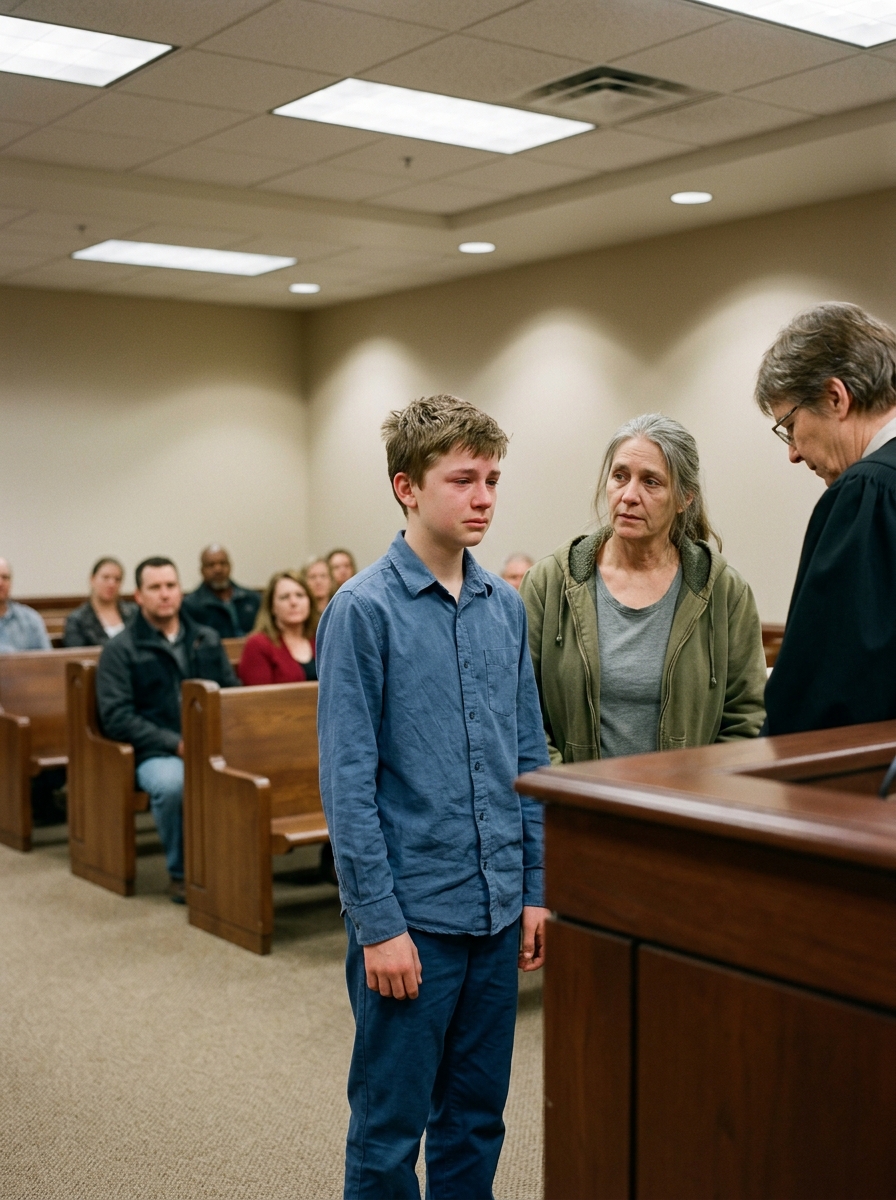
The Silent Foster Boy Sat Through Four Years Without Saying a Word—Then the Judge Asked If He Wanted to Be Adopted, and What Came Out of His Mouth Broke Every Heart in That Courtroom
“I’m not sending him back.”
My voice came out sharper than I meant it to.
The social worker across from me blinked and set her folder down on my kitchen table like she was afraid I might change my mind if she moved too fast.
“He’s nine,” she said carefully. “And he hasn’t spoken to anyone. Not in foster care. Not at school. Not in therapy. Most people pass.”
“I’m not most people.”
That part was true.
By then, I knew what a quiet house could do to a person.
Mine had been quiet for years.
Not peaceful quiet.
The kind that sits in corners.
The kind that follows you from room to room.
The kind that comes after too much loss.
My marriage had ended one tired Tuesday night at the kitchen counter, with my ex-husband staring into a mug of cold coffee and admitting he couldn’t keep living inside disappointment. Three miscarriages had taken everything out of us. He left with his duffel bag, his guilt, and whatever hope he had left.
I stayed.
I stayed with the little ranch house outside Dayton, Ohio.
I stayed with the empty second bedroom.
I stayed with love I still had no place to put.
I didn’t wake up one morning suddenly wanting to foster.
It happened slower than that.
Helping at the church pantry.
Volunteering at the library’s after-school reading hour.
Driving canned food to older folks who couldn’t make it out in winter.
One afternoon, I found a little boy’s forgotten hoodie hanging over a folding chair at the community center. I picked it up, held it against my chest, and for one stupid second, I couldn’t breathe.
That was when I knew.
So I filled out the papers.
Stacks of them.
Medical forms, background checks, home visits, training classes in fluorescent rooms with bad coffee and metal chairs.
I did all of it.
And months later, they called me about a boy named Eli.
“He comes with very little,” the caseworker told me over the phone. “One backpack. A few clothes. No behavior problems, really. He just… doesn’t speak.”
“Okay,” I said.
“He may never.”
“Okay.”
There was a pause.
Then she said, softer this time, “You really mean that.”
“I do.”
When Eli came to my house, he stood on the porch like he was expecting a trap.
He was small for nine. Thin wrists. Big eyes. A faded jacket that had seen too many winters. He held the straps of that old backpack so tightly his knuckles looked white.
“Hey, Eli,” I said. “I’m Nora.”
He looked at me.
Not friendly.
Not angry.
Just careful.
Like he was taking inventory.
I stepped aside and let him walk in first.
He didn’t ask for anything.
Didn’t say hello.
Didn’t even look around much.
He just stood in the middle of my living room, silent and alert, like a stray dog that had learned not to trust a hand too quickly.
“I made hot chocolate,” I said. “And I bought those frosted sugar cookies from the grocery store bakery. The soft kind.”
No response.
But ten minutes later, one cookie was gone.
That was enough for day one.
That first night, I showed him his room.
Nothing fancy.
A twin bed. Blue quilt. Lamp on the nightstand. A couple of books on the shelf. Clean socks in the dresser. A little desk by the window.
He set his backpack on the floor and stood by the bed.
“If you need anything,” I said, “my room’s across the hall.”
He gave one tiny nod.
I almost cried over that nod.
But I didn’t let myself.
I’d already learned something in those first few hours.
This boy did not need a woman breaking apart in front of him because he blinked in her direction.
He needed steadiness.
So that’s what I gave him.
Steady mornings.
Steady dinners.
Steady rides to school.
Steady reminders that there was cereal in the pantry, extra blankets in the hall closet, and a porch light that would always be on if he ever looked out the window at night.
I didn’t demand words.
I talked enough for both of us.
I talked while making spaghetti.
I talked while folding laundry.
I talked while scraping frost off the windshield.
I told him stories about my childhood in Indiana, about my mother burning grilled cheese sandwiches because she insisted reading mystery novels while cooking was a reasonable life choice.
I told him about the old hound dog I had when I was ten.
I told him about the time I got a flat tire in a drive-thru and cried because I thought that meant adulthood had officially defeated me.
Sometimes I thought I saw the corner of his mouth twitch.
That was enough.
I packed his school lunches every morning.
Turkey sandwich. Apple slices. Chips. Sometimes a brownie if I’d baked.
And I started slipping little notes inside.
Nothing dramatic.
Just things a kid should hear.
Hope today feels easy.
You’re doing better than you think.
Glad you’re here.
Rooting for you.
At first, the notes came back crumpled in the lunch bag.
Then one day, one didn’t come back at all.
A few weeks later, I found one folded neatly in the top drawer of his dresser while putting away clean socks.
He’d kept it.
I sat on the edge of his bed and cried into a pile of T-shirts like an idiot.
Life with Eli was made of tiny things.
He started sitting on the other end of the couch when I watched old game shows after dinner.
Then he sat a little closer.
Then one snowy Sunday, he fell asleep with his sock feet tucked under him and his head tilted in my direction.
Not on my shoulder.
Not yet.
But close enough that I could feel the warmth of him there.
At Christmas, he stood by while I untangled lights and handed me the bulbs without being asked.
In spring, he followed me out to the porch and sat on the steps while I planted marigolds.
In summer, he started waiting by the front window around five-thirty, right around when I got home from work at the insurance office.
He’d hear my old sedan pull in the driveway and be at the door before I got my key in.
Still silent.
Still watchful.
But there.
And after a while, “there” became everything.
People didn’t get it.
Some asked with pity.
Some with judgment.
“He still doesn’t talk?”
“No.”
“Has a specialist ruled out everything?”
“Yes.”
“Do you think he ever will?”
“I think he will if he wants to.”
“And if he never does?”
That question made my blood run cold every time.
I’d look them dead in the face and say, “Then he never does.”
Because I was not going to make that boy feel like love in my house came with performance requirements.
He didn’t owe me sound.
He didn’t owe me a breakthrough.
He didn’t owe me anything except honesty in whatever form he could manage.
And somehow, over the years, he gave me more than plenty.
When I caught the flu one winter and could barely get out of bed, I woke up to a glass of water on my nightstand, a sleeve of crackers, and a thermometer laid neatly beside them.
Underneath was a piece of notebook paper.
In blocky handwriting, it said:
Take medicine.
That was the first full sentence he ever gave me.
Not spoken.
Written.
But I stared at it like it was a miracle.
I carried that note in my wallet for years.
By the time Eli was thirteen, he was taller than me.
His face had changed shape.
The baby softness was gone.
He had strong shoulders, serious eyes, and that same habit of scanning every room when he walked in.
But at home, he softened.
At home, he hummed under his breath sometimes while drying dishes.
At home, he rolled his eyes when I sang along badly to old radio songs.
At home, he smiled.
Not often.
But real.
I started the adoption paperwork when he was almost fourteen.
I didn’t make some big speech out of it.
I’d learned by then that heavy moments went better when handled lightly.
So one night after dinner, I set the papers on the kitchen table and sat across from him.
“If this is something you want,” I said, “you can just nod. You don’t have to talk.”
He looked at the papers.
Then at me.
Then he nodded once.
That nod hit me harder than any shouted speech ever could have.
I put my hand over my mouth and laughed through tears.
“Okay,” I said. “Okay. Then let’s do it.”
The hearing was scheduled for a Thursday morning in October.
I barely slept the night before.
Eli came downstairs in the button-up shirt I’d bought him from the department store, sleeves a little too long because he kept growing like a weed. He looked pale.
He kept folding and unfolding a paper napkin at breakfast until it tore in half.
I reached across the table and took the pieces from his hands.
“You’re okay,” I said softly. “This is not a test.”
He stared at me.
“You hear me?” I said. “Nobody’s sending you anywhere. This day doesn’t decide whether we’re family. It only puts it on paper.”
His eyes looked shiny for a second.
Then he nodded.
The courthouse was colder than I expected.
Everything echoed.
Shoes on tile. Distant voices. The rustle of paperwork. A cough from somewhere down the hall.
The social worker who’d first brought him to me was there too. Denise. Older now. More silver in her hair.
She squeezed my arm and whispered, “I’m so glad it’s you two.”
I couldn’t answer.
My throat was too tight.
When we walked into the courtroom, Eli stayed close beside me.
Not clinging.
Just close.
The judge was an older woman with kind eyes and reading glasses low on her nose. She smiled when we approached, but it was the careful smile of someone who knew this mattered.
We sat.
She reviewed the file.
Asked a few routine questions.
How long had Eli been placed with me?
Nearly five years.
Had there been any disruptions?
No.
Was the home stable?
Yes.
Was the child doing well in school?
Yes.
Then she looked at Eli.
Her whole face softened.
“Eli,” she said gently, “you do not have to speak today. I want you to know that. You can nod or shake your head if that feels better. Do you understand?”
He nodded.
She smiled.
“All right. I just have one question, then.”
I reached for the edge of my seat without realizing it.
The room went so quiet I could hear the air vent hum.
The judge folded her hands and asked, “Do you want Nora Bennett to adopt you and become your legal mother?”
Eli froze.
Not the usual kind of stillness.
Something bigger.
His shoulders locked.
His throat moved.
And for one terrible second, I thought maybe we had pushed him too far just by bringing him there.
I wanted to stand up and tell the judge never mind.
I wanted to say forget the papers, forget the hearing, forget all of it, let’s go home.
But then Eli took a breath.
A rough, shaky breath that sounded like something being pulled up from deep underwater.
And he spoke.
“Before I answer,” he said, voice cracked and thin from disuse, “I want to say something.”
I swear every person in that courtroom stopped breathing.
My hand flew to my mouth.
Denise started crying instantly.
The judge leaned forward, stunned, but nodded.
Eli looked down at his hands first.
Then up at the judge.
“When I was seven,” he said slowly, “my mom left me at a grocery store.”
His voice trembled on the word mom.
“She told me to wait by the claw machine. She said she was coming back.”
My heart broke so hard I felt it in my ribs.
“She didn’t come back.”
He swallowed and kept going.
“I waited a long time. Then a worker asked if I was lost. Then police came. Then everything kept changing.”
He took another breath.
“I went to different homes. Different schools. People always said I was quiet. Or weird. Or too old to start over with. Some were nice at first, but nobody stayed.”
There were tears on my face by then. I didn’t even remember them starting.
Eli turned and looked at me.
Not past me.
At me.
“When I came to Nora’s house, I thought she’d get tired too.”
His voice wobbled.
“I thought if I said the wrong thing, she’d send me away. I thought if I got too attached, that would be stupid.”
A small sound came out of me then. Half sob, half prayer.
He kept going.
“But she made me hot chocolate the first night.”
The courtroom let out this tiny broken laugh through tears.
“She put notes in my lunch. She read out loud even when I never answered. She kept the porch light on. She learned how I liked my grilled cheese. She never made me talk.”
His hands were shaking now.
“So I stayed quiet. Because being quiet felt safer.”
Then his face crumpled just a little, and he said the words that shattered me:
“But she stayed anyway.”
Nobody moved.
Nobody dared.
Eli’s chin lifted.
And with more strength than I had ever heard from him, he said, “Yes. I want her to adopt me. Because she’s already my mom.”
I started crying so hard I couldn’t see.
Denise was openly sobbing.
Even the court clerk was wiping her eyes.
The judge took off her glasses and pressed her fingers to the bridge of her nose before smiling through tears.
“Well,” she said softly, voice thick, “I think that is the clearest answer I’ve heard in this courtroom in a very long time.”
Then she signed the order.
Just like that.
Five years of waiting.
Five years of quiet love.
Five years of choosing each other in a thousand small ways.
Made official with the scratch of a pen.
Outside the courthouse, my hands were trembling so badly I dropped my keys in the parking lot.
Eli bent, picked them up, and pressed them into my palm.
I looked at him.
Really looked at him.
My son.
Mine.
Legally, finally, fully mine.
“Thank you,” I whispered.
He gave the smallest shrug, like maybe this was no big thing.
Then he said, in that rough beautiful voice I would have known anywhere, “You’re welcome, Mom.”
Mom.
I had dreamed about that word.
Begged God for it.
Mourned it.
Made peace with never hearing it.
And there it was, standing in a courthouse parking lot beside a row of dented sedans and pickup trucks.
Simple as sunlight.
That night, we ordered takeout from the little diner off Main Street because neither of us had the energy to cook.
He got a bacon cheeseburger and fries.
I got grilled chicken I barely touched because I was still too emotional to function like a normal person.
We ate at the coffee table in our socks.
No big party.
No balloons.
No dramatic celebration.
Just us.
The way it had always been.
At bedtime, I reached automatically for the novel I’d been reading aloud to him in bits and pieces for weeks.
He looked at the book, then at me.
“Can I read tonight?” he asked.
My chest tightened so fast I had to steady myself on the dresser.
I handed him the book.
He opened it and started reading, slow and rough in places, voice catching now and then like it was still learning how to belong in the room.
I sat beside him and listened.
Not because the words on the page mattered.
But because his did.
Years ago, I thought motherhood might come to me through birth.
Then I thought maybe it wouldn’t come at all.
I was wrong on both counts.
Sometimes love doesn’t arrive screaming.
Sometimes it comes in with one worn backpack and scared eyes.
Sometimes it sits at your table and says nothing for years.
Sometimes it watches from the hallway, waits by the front door, leaves you water when you’re sick, and keeps your lunch notes in a drawer.
Sometimes it chooses you quietly.
And when it finally speaks, it says what your heart has known all along.