**A Volunteer Firefighter Could Only Save A Family’s Old Dog As Their House Burned To Ash. What The 8-Year-Old Girl Said Next Changed His Life Forever.**
The heat was blistering, radiating so intensely that I could feel it right through my thick turnout gear. The roof of the two-story farmhouse groaned, a terrible, agonizing sound of twisting wood and snapping beams that every firefighter dreads.
Standing in the dirt driveway in rural eastern Washington, there was nothing more my crew and I could do for the structure. The fire had won. Now, it was just about containment.
I turned to look at the family huddled by the bumper of our engine. A mother, a father, and a little girl in a torn pink nightgown, watching their entire life dissolve into smoke and orange embers.
They were shivering despite the oppressive heat of the summer night. I recognized that blank, hollow stare on the father’s face. It was the exact same look I saw in the mirror five years ago.
I’m forty-seven years old, and I’ve been a volunteer firefighter for a long time. But five years ago, I wasn’t the one holding the hose. I was the one standing in the street, watching a wildfire swallow my own home whole.
Since that night, I’ve carried a heavy, bitter weight in my chest. I told anyone who asked that I had “lost everything.” I let that loss define me, walking through life like a man who was already entirely empty.
My thoughts were violently interrupted by a piercing, frantic scream.
“Where is he? Where is he!” the little girl cried out, breaking away from her mother’s grip. She pointed a trembling finger toward the blazing house. “Buster! Buster is still in there!”
The parents looked around in sudden panic, realizing their old golden retriever hadn’t followed them across the lawn. The mother covered her mouth, letting out a muffled sob.
The father took a step toward the inferno, but I grabbed his shoulder. “Don’t,” I yelled over the roar of the flames. “It’s too far gone. I’ll look.”
I pulled my helmet tight and jogged toward the structure, the heat pushing against me like a physical wall. The front of the house was a total loss, the windows shattered and blowing thick, black smoke into the night sky.
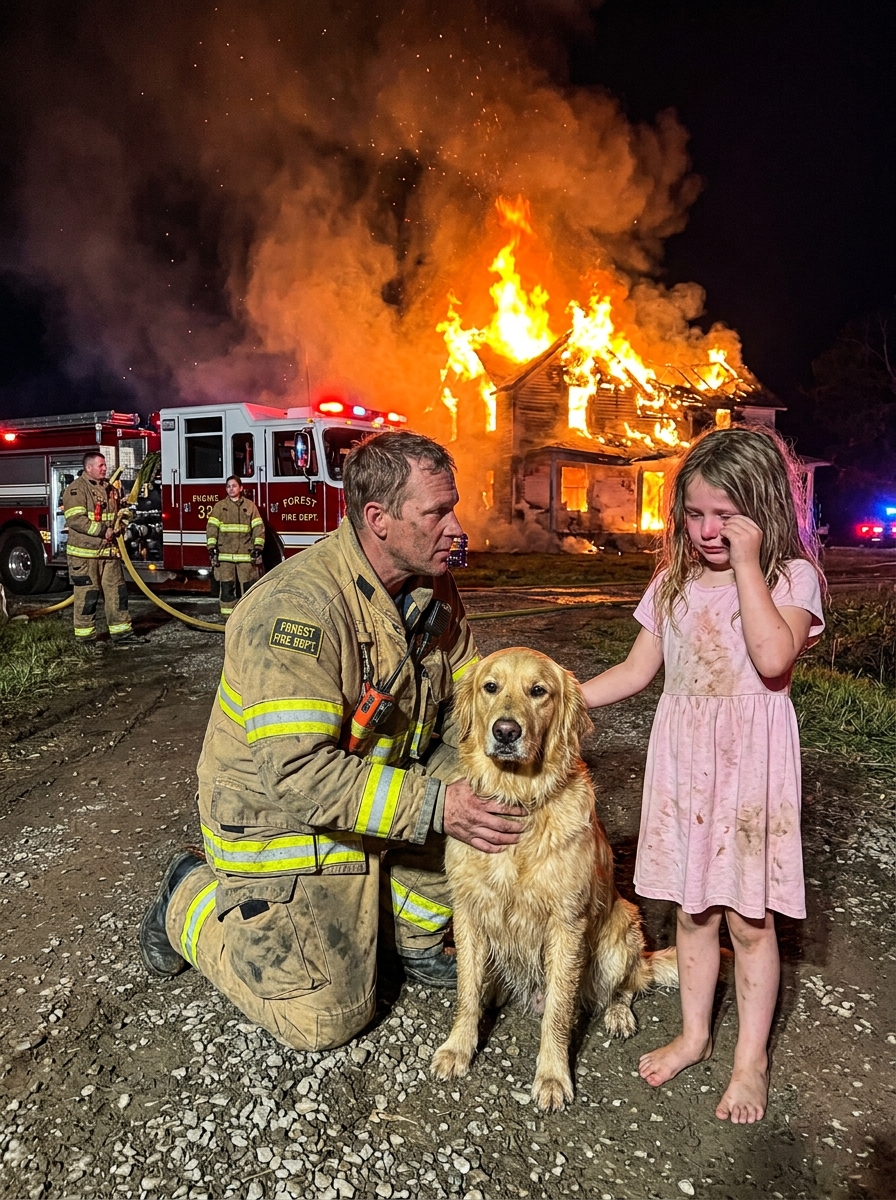
I didn’t have to go far. Tucked into the darkest corner of the wrap-around porch, paralyzed by fear and confusion, was an old, gray-muzzled dog. He was pressed flat against the floorboards, whining pitifully as the wood above him began to blister.
“Come here, buddy,” I choked out, dropping to one knee. He was too terrified to walk. I scooped his heavy, shaking body into my arms, the smell of singed fur filling my nose.
As soon as my boots hit the dirt driveway again, a deafening crack echoed through the valley. The front porch collapsed inward, swallowed instantly by a sudden rush of roaring flames. We had made it out by seconds.
I carried the old dog over to the engine and gently set him down in the wet grass. The little girl didn’t hesitate. She threw herself onto the ground, wrapping her small arms around the dog’s thick neck, burying her tear-stained face in his fur.
Buster let out a tired sigh, licking her cheek as if to tell her he was okay.
I stood back, peeling off my gloves, and watched the scene unfold. The parents dropped to their knees, wrapping their arms around their daughter and the dog. They were a tangled pile of soot, tears, and shaking bodies.
Behind them, the roof of the farmhouse finally caved in. A massive plume of sparks shot up into the dark sky, swirling like angry fireflies. Everything they owned—their photographs, their clothing, their family heirlooms, their memories—was gone forever.
I walked over to the father, my heart aching with that familiar, hollow pain. I knew exactly what was running through his mind. I knew the devastating mountain of insurance calls, temporary housing, and donated clothes that awaited them.
“I am so incredibly sorry,” I said, my voice thick with emotion. “We tried. We just couldn’t save the house.”
The father looked up at me, his eyes red and exhausted. He opened his mouth to speak, but it was the little girl who answered.
She looked up from Buster’s gray fur, her face streaked with black soot, and smiled a small, genuine smile.
“It’s okay,” she said, her voice steady and clear over the crackle of the dying fire. “We still have everybody.”
Those five words hit me harder than the backdraft of any fire I’ve ever fought.
*We still have everybody.*
I stood frozen in the wet grass, staring down at this eight-year-old child who possessed more wisdom in her little pink nightgown than I had found in the last five years of my life.
She wasn’t looking at the burning house. She wasn’t thinking about her toys, or her bed, or her television. She was looking at her mother, her father, and her dog. To her, the house was just a building. Her home was sitting right there in the grass with her.
Tears pricked the corners of my eyes, mixing with the sweat and soot on my face. For half a decade, I had been telling myself a lie.
Every time I woke up to the phantom smell of smoke, every time I looked at a photo from before the wildfire, I told myself that I was a man who had lost everything. I had let the loss of wood, drywall, and possessions turn me into a victim.
But as I looked at my own hands in the flashing red lights of the fire engine, the truth washed over me. I didn’t lose everything that night five years ago.
My wife made it out. My two sons made it out. We drove away from that roaring mountain of fire with nothing but the clothes on our backs, but we drove away together.
I had lost a house. But I had survived with my family.
The next morning, as the sun came up over the blackened, smoking foundation of the farmhouse, I helped the family sift through the ashes. We didn’t find much. A few scorched coffee mugs, some warped metal tools, a partially melted picture frame.
But there was a strange sense of peace among them. They were battered and exhausted, but they walked close together, their hands brushing, leaning on each other for quiet strength. Buster the old golden retriever followed at their heels, wagging his tail slowly.
When I finally got back to my own house later that afternoon, I didn’t go to sleep. Even though my muscles ached and my eyes burned, I walked straight into the kitchen where my wife was pouring a cup of coffee.
I wrapped my arms around her, pulling her close, and buried my face in her shoulder. I held her tighter than I had in years. I listened to the sound of my teenage sons arguing over a video game in the living room, a sound that used to annoy me, but today sounded like an absolute miracle.
Life is incredibly fragile. We spend so much time working, saving, and building our lives around the things we own. We polish our cars, we upgrade our kitchens, we fill our closets with things we think will bring us happiness and security.
But when the flames come—whether they are literal fires, sudden illness, financial ruin, or unexpected tragedy—none of those things matter.
A house can be rebuilt in a few months. Furniture can be bought at a local store. Clothes can be replaced. But the people you love? They are the only things in this world that are truly irreplaceable.
We get so caught up in mourning what we have lost that we forget to be profoundly grateful for what we still have.
That little girl in the soot-stained nightgown taught me that true wealth isn’t measured by what’s inside your walls. True wealth is measured by who is standing beside you when the walls come crashing down.
Things can burn, fade, and rust away into the earth. But love outlasts the fire.
Some people don’t need a physical house to be home. They simply find shelter in each other.