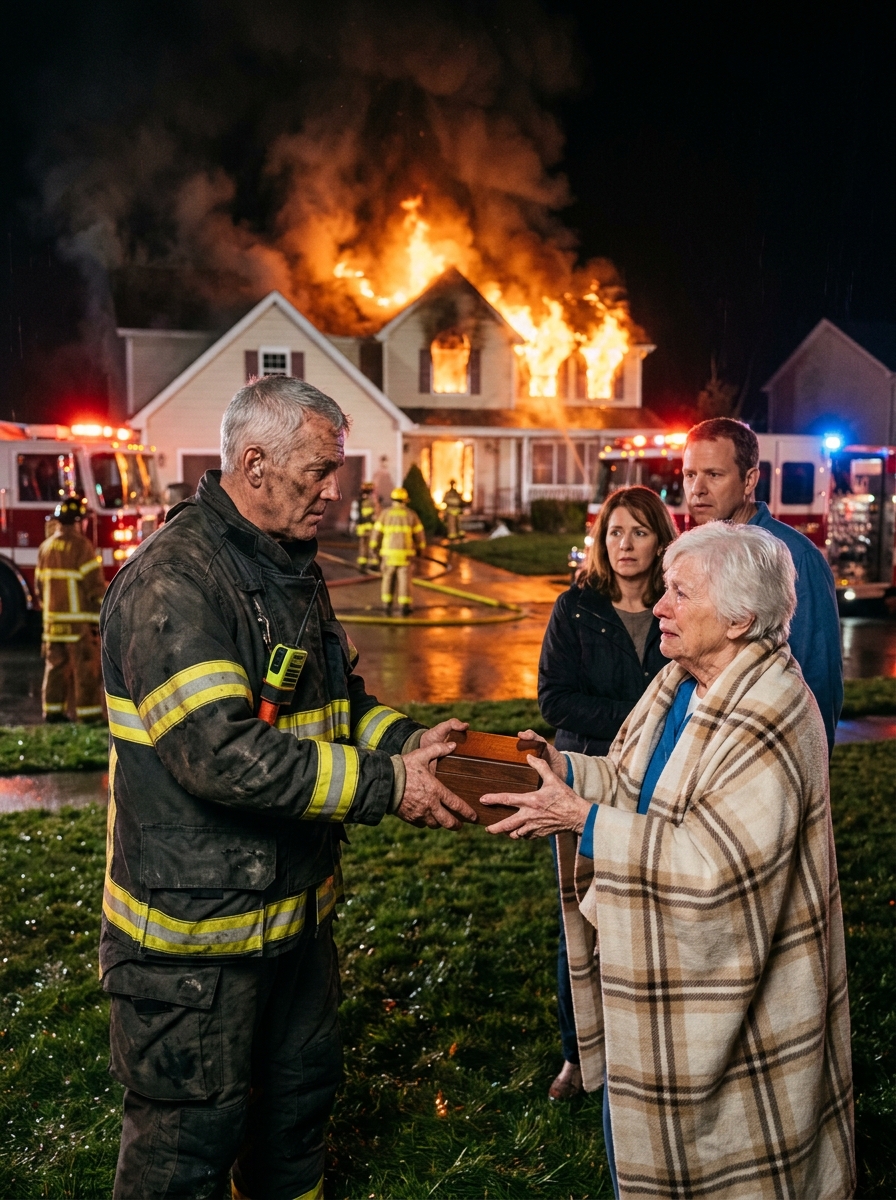
The Firefighter Had Already Saved Everyone—Then an Elderly Woman Begged Him to Go Back for a Wooden Box
“Please,” the old woman cried, grabbing Gordon Pike’s sleeve with both hands. “My husband is still in there.”
Gordon’s stomach dropped.
Behind them, orange flames rolled through the upstairs windows of the little two-story house while smoke poured into the cold Oregon evening.
Every person in the family had been accounted for.
A mother.
Her teenage son.
Two younger grandchildren.
And the elderly woman now standing barefoot on the wet lawn in a borrowed blanket.
“No, ma’am,” Gordon said carefully. “Everyone is out.”
She shook her head so hard her gray hair came loose around her face.
“You don’t understand.”
Then she pointed toward the burning house.
“His letters are upstairs.”
For a second, Gordon didn’t know what to say.
He was 57 years old and had been a volunteer firefighter long enough to know the rule that mattered more than all the others:
People first.
Property second.
Always.
A chair could be replaced.
A television could be replaced.
A wedding dress, a watch, a photograph, even an heirloom passed through generations—painful as it was—could never be worth a firefighter’s life.
Gordon knew that better than most.
Six years earlier, a wildfire had swept through the rural road where he and his wife had lived for nearly three decades.
They had escaped with what they were wearing, two dogs, and the old pickup parked in the driveway.
Everything else was gone by sunrise.
The kitchen table where his kids had done homework.
His father’s tools.
His wife’s Christmas ornaments.
Boxes of birthday cards.
His children’s baby pictures.
His mother’s handwritten recipes.
Gone.
For months afterward, people tried to comfort him by saying the same thing.
“At least you’re alive.”
And Gordon agreed.
Of course he agreed.
But there was something people who had never lost everything sometimes didn’t understand.
Objects were only objects until they were all you had left of someone.
Gordon still carried proof of that in his wallet.
One photograph had survived because he happened to have it tucked behind his driver’s license.
It showed his wife years earlier, standing on their porch with their two children when they were small.
The photo was faded and bent through the middle.
To anyone else, it was a damaged piece of paper.
To Gordon, it was home.
The elderly woman’s name was Evelyn Mercer.
She was 81.
Her daughter held her shoulders while firefighters worked around them.
“The box is at the top of the stairs,” Evelyn said through tears. “Wooden box. Dark brown. He made it himself.”
Her daughter whispered, “Mom, please.”
But Evelyn kept staring at Gordon.
“My husband wrote me one letter every week when he was overseas.”
Her voice trembled.
“Forty-seven letters.”
Gordon looked back at the house.
The incident commander was already preparing everyone to pull farther back.
The fire had spread into the upper hallway.
The structure was becoming less stable by the minute.
There would be no reckless rescue for a box.
There couldn’t be.
Gordon knew that.
Evelyn seemed to know it too.
Her hands fell from his sleeve.
“I’m sorry,” she whispered.
Then she looked down.
“I know they’re only papers.”
That sentence stayed with him.
Only papers.
Six years earlier, Gordon had stood beside the smoking foundation of his own house and listened to people describe everything he had lost as “stuff.”
He had understood what they meant.
But it had still hurt.
A few minutes later, Gordon was ordered inside with another firefighter for one final defensive check of the lower staircase area before crews withdrew.
It was not a mission for Evelyn’s box.
No one was risking a life for letters.
The instructions were clear.
Check the accessible area.
Confirm no one remained.
Get out.
Smoke pressed low inside the hallway.
The heat was building.
Water ran across the floor beneath Gordon’s boots while plaster cracked somewhere overhead.
He moved quickly.
Living room clear.
Hall clear.
Stairwell—
Then his flashlight passed over something dark near the landing.
A small wooden box.
It was sitting beside the wall only a few steps above him.
Not deep inside a bedroom.
Not beyond the flames.
Right there.
Accessible.
For perhaps two seconds, Gordon simply stared at it.
Then his partner saw it too.
“That it?”
Gordon nodded.
Neither man needed a speech.
The route was still safe.
The exit was only yards away.
Gordon climbed the few steps, grabbed the box by its brass handle, tucked it tightly against his side, and headed back out.
Less than a minute later, he stepped through the front door.
Evelyn saw the box before she saw him.
She made a sound Gordon would remember for the rest of his life.
Not a scream.
Not quite a cry.
It sounded like someone finding a person they had already buried.
“Oh, Robert.”
She walked toward Gordon on shaking legs.
The box was blackened on one corner and wet from the hose water, but it was intact.
Gordon handed it to her.
Evelyn lowered herself onto the back step of an ambulance and opened the lid with trembling fingers.
Inside were bundles of yellowed envelopes tied with faded blue ribbon.
The handwriting on the top envelope was still visible.
Mrs. Evelyn Mercer.
She pressed the letter against her chest.
Her daughter began crying beside her.
Gordon looked away.
Sometimes firefighters learn to give people privacy even when they are standing only three feet away.
After a while, Evelyn called him back.
“My husband died nine years ago,” she said.
Gordon nodded.
“He was never much of a talker when he came home.”
A faint smile crossed her face.
“Different generation, I suppose. He could rebuild an engine, fix a roof, raise three children, and somehow go an entire dinner without saying more than six words.”
Gordon smiled too.
Evelyn looked down at the letters.
“But when he was away, he wrote everything.”
She opened the top envelope carefully.
“He wrote about being scared. About missing my cooking. About the house we would someday buy. About the children we hadn’t even had yet.”
Her fingers traced the handwriting.
“After he died, sometimes I’d read one just to hear him again.”
Gordon swallowed hard.
Evelyn looked up at him.
“You didn’t save papers.”
She held the letter against her heart.
“You saved the last place where I can still hear my husband’s voice.”
Gordon didn’t know how to answer that.
So he sat beside her for a moment.
Two tired people on the edge of a terrible night.
One holding a wooden box.
The other remembering a photograph in his wallet.
The house was badly damaged.
Much of the upstairs was eventually lost.
The family spent months rebuilding their lives.
But the letters survived.
A few weeks later, Gordon received a plain envelope at the volunteer station.
Inside was a photograph of Evelyn and Robert taken when they were young.
Robert wore his uniform.
Evelyn stood beside him in a simple summer dress.
On the back, she had written:
“Now you know the face that belonged to the voice you saved.”
Gordon put the picture in his locker.
It stayed there beside his helmet for years.
When younger firefighters joined the department, Gordon taught them the same rule he had always followed.
Lives came first.
No possession was worth becoming another victim.
But he also taught them something else.
Never laugh when someone grieving asks about a photograph, a wedding ring, a child’s drawing, an old coat, or a box of letters.
You may not be able to save it.
Sometimes you absolutely should not try.
But you should understand what they are really asking.
Because human beings leave pieces of themselves behind in ordinary things.
A recipe written in a mother’s handwriting.
A father’s pocketknife.
A grandmother’s quilt.
A voicemail nobody can bring themselves to delete.
A stack of letters tied with ribbon.
We spend years calling them clutter.
Then one day, the person is gone.
And suddenly they become priceless.
Gordon still carries that faded family photograph in his wallet.
The crease is deeper now.
The colors have almost disappeared.
But whenever he looks at it, he remembers Evelyn sitting beneath the flashing emergency lights, holding forty-seven old letters against her chest.
And he remembers that sometimes the smallest thing in a burning house can contain an entire lifetime.
Some things are not valuable because of what they are. They are valuable because of who is still alive inside them.