
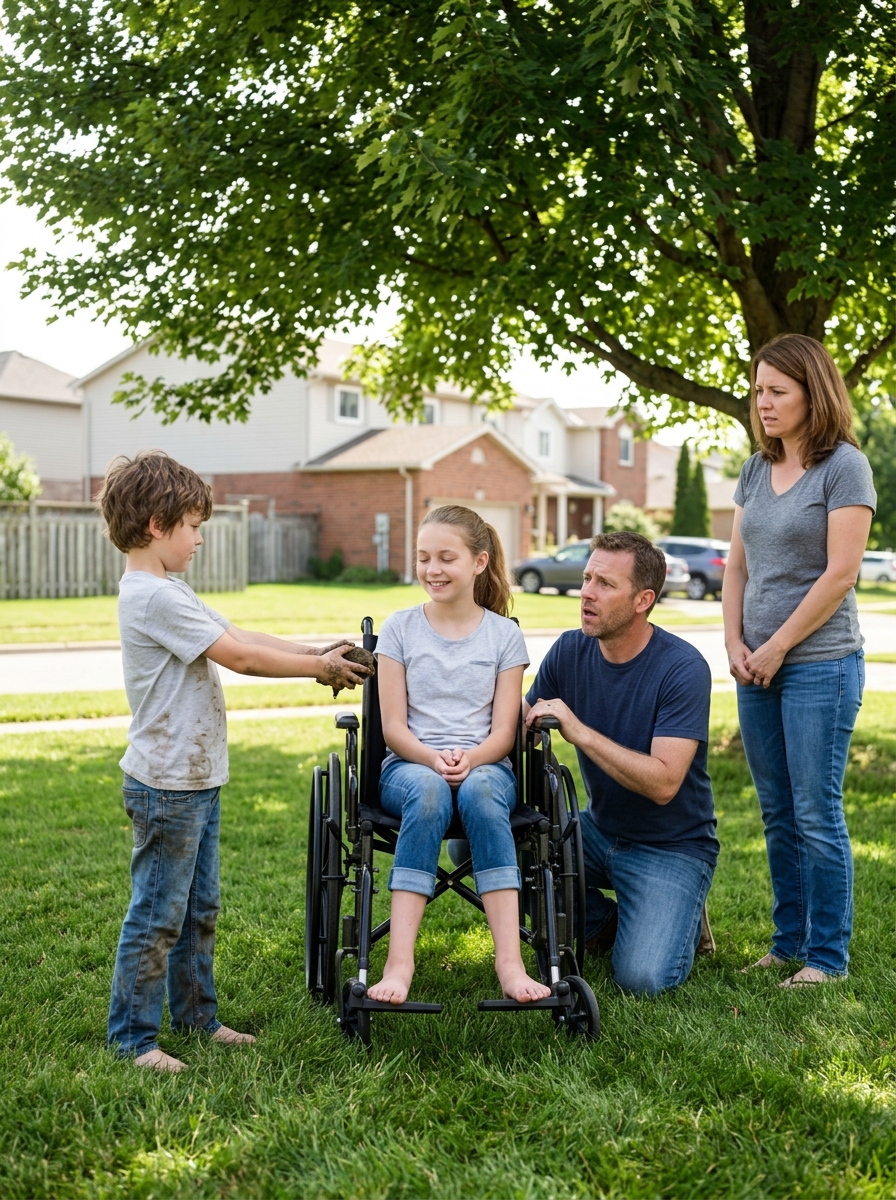
“Please, sir. Just let me try.”
Wesley Hart turned so fast his coffee nearly slipped from his hand.
The voice did not belong to a surgeon.
Did not belong to a specialist.
Did not belong to anyone who had ever stepped inside the private medical wing he had practically built for his daughter.
It came from a thin barefoot boy standing at the edge of the backyard garden, dirt on his hands, knees grass-stained, staring straight at the wheelchair under the big maple tree.
His daughter, Abby, sat there motionless.
She was seventeen.
Blind.
And since the crash, unable to stand on her own.
Wesley had heard every possible version of the same sentence.
No meaningful improvement expected.
Permanent damage.
You need to prepare for a different life.
He was sick of hearing it.
Sick of hopeful voices turning careful.
Sick of experts lowering their eyes.
Sick of spending fortune after fortune only to be told that love, money, and effort still were not enough to bring his little girl back.
The staff had learned to stay quiet around him.
In the distance, someone was trimming hedges.
Someone else was wiping down patio furniture.
Inside the house, dishes clinked softly in the kitchen.
And near the flower beds stood Marisol, the family’s longtime housekeeper, looking like she wanted the ground to open up and swallow her whole.
“I am so sorry, sir,” she said, rushing forward. “He shouldn’t have said anything. I’ll take him right now.”
But Abby lifted her chin.
“Dad?”
Her voice was faint, but it cut through everything.
“Let him stay.”
Wesley stared at the boy.
The kid could not have been older than eleven.
His T-shirt was faded.
His jeans were worn thin at the knees.
His hair looked like he had tried to smooth it down with wet hands and given up halfway through.
And still, he stood there like he was not scared.
“What exactly,” Wesley said, each word clipped and cold, “do you think you’re doing?”
The boy swallowed.
“I want to put mud on her eyes,” he said. “And I think she might see again.”
Silence.
Even the workers nearby seemed to freeze.
Wesley let out a hard, bitter breath that was almost a laugh.
Mud.
He had flown Abby to rehab centers in Boston, Denver, and San Diego.
He had paid for consultations from neurologists, trauma specialists, vision experts, physical recovery teams, and private therapists.
He had bought equipment most people had never even heard of.
And now a child in bare feet wanted to fix her with backyard mud.
“You have any idea how many doctors have seen my daughter?” Wesley asked.
The boy nodded.
“My mom told me.”
“And you still think dirt is the answer?”
The boy looked down at his hands, then back up.
“I think maybe not everything broken starts where people think it does.”
Wesley’s face hardened.
“That’s enough.”
Marisol grabbed her son gently by the shoulder. “Nico, come on.”
But Abby turned her face toward the sound of his voice.
“Please,” she whispered.
Wesley looked at her.
Really looked.
At the way her hands rested too still in her lap.
At the way she listened harder now than she had listened to any doctor in months.
At the tiny spark in her expression that he barely recognized anymore.
Hope had become dangerous in that house.
Every time it appeared, it ended up bleeding.
He hated the boy for bringing it back.
But he hated himself a little more for wanting to hear him out.
“You have five minutes,” Wesley said at last. “That’s it.”
Marisol looked horrified. “Sir—”
“It’s fine,” Abby said softly.
Nico walked closer.
He did not rush.
Did not smile.
Did not act like this was magic.
He knelt by the garden bed, scooped a little clean soil from beneath the top layer, then asked one of the groundskeepers for bottled water. The man looked at Wesley first. Wesley gave one stiff nod.
The boy mixed the dirt in a small clay planter tray with slow, careful fingers until it became cool brown paste.
Wesley folded his arms.
“This some kind of folk cure?” he asked sharply.
Nico shook his head.
“My grandma used to say it helped her remember.”
“Remember what?”
“The light.”
That answer made Wesley’s jaw tighten.
Nico looked at Abby, not at Wesley.
“My grandma lost her sight after she fell down porch steps when my mom was little,” he said. “Everybody thought it was just her eyes. But one doctor told her the fear got stuck inside her too. He said sometimes the brain keeps holding on to the dark even when it doesn’t need to.”
Wesley said nothing.
Because for the first time in weeks, maybe months, someone was saying something that did not sound rehearsed.
Nico dipped two fingers into the mud.
“If you want me to stop, I stop,” he told Abby.
“I don’t want you to stop.”
His hands were gentle.
He spread the cool mud over her closed eyelids, careful like he was handling something sacred. Not curing. Not performing. Just trying.
“Don’t think about seeing everything,” he whispered. “Just think about one thing. A porch light. A window. Your dad’s shirt. Anything bright.”
Wesley almost told him to quit.
Almost said this had gone far enough.
Almost ended it before Abby got hurt all over again.
Then Abby inhaled sharply.
Not a polite breath.
Not a little gasp.
A real one.
Like someone had reached inside her and pulled a wire tight.
“Dad.”
Wesley stepped forward so fast his chair scraped the stone patio.
“What?”
Her fingers were trembling.
“I…”
She swallowed hard.
“I think I see something.”
Nobody moved.
Nobody breathed.
Abby’s face twisted with effort.
“It’s not clear,” she whispered. “It’s like… gray shapes. Light behind something. I don’t know—”
Wesley dropped to his knees beside her wheelchair.
“Abby. Abby, look at me.”
“I can’t really look,” she said, voice shaking now. “But I know you’re there.”
Marisol covered her mouth with both hands.
Nico stayed very still.
Wesley’s whole body went cold.
He wanted to believe it.
He was terrified to believe it.
Doctors were back at the house within hours.
Then more doctors.
Then scans.
Then tests.
Then consultations that stretched late into the night in his home office while Abby rested upstairs with nurses checking on her every half hour.
The conclusion, when it came, sounded nothing like a miracle.
One neurologist explained that Abby’s blindness had likely been tied not only to physical injury but to severe trauma. Her brain had shut down pathways after the accident in ways that were more complex than earlier teams had realized.
A senior specialist from a rehabilitation center sat back in stunned silence after reviewing the scans twice.
“We may be seeing partial reversal,” he said.
Wesley stared at him.
“From mud?”
The doctor shook his head carefully.
“Not from mud alone. From stimulation. Emotion. memory. sensory interruption. Suggestion. Belief. Sometimes the body begins healing before the mind agrees to come with it. Sometimes the mind has to be reached from another door.”
Another door.
Wesley kept hearing that phrase.
Because that was the part that tore him open.
He had spent millions kicking in the front entrance.
And some little boy had quietly tried the side door.
Over the next several weeks, Abby improved.
Slowly.
Painfully.
Imperfectly.
But undeniably.
First she could make out contrast.
Then movement.
Then outlines.
She cried the first time she saw the soft shape of her father standing in her bedroom doorway.
Not fully.
Not sharply.
But enough to know him.
Enough to say, “I forgot how tall you looked when you were trying not to cry.”
That was the moment Wesley broke.
Not in public.
Not in front of the doctors.
Just alone in the hallway outside her room, one hand over his mouth, shoulders shaking like a man who had finally run out of strength to pretend.
Later, needing to understand how this had happened, he went digging through old records from a healthcare foundation his company had once overseen.
He found something buried in the paperwork.
Years earlier, a small trauma rehabilitation program in western Pennsylvania had lost its funding after a board review. The notes called it difficult to measure, emotionally driven, and not cost efficient enough for expansion.
One of the consultants attached to that program had specialized in sensory recovery after trauma-related vision loss.
The same doctor Nico had heard about from his grandmother.
Wesley sat at his desk long after everyone else had gone to sleep, staring at the file.
He had not signed that exact recommendation himself.
But his company had built the culture that killed it.
If something did not move fast enough, scale fast enough, or produce numbers that looked impressive enough, it got cut loose.
Human stories never survived those meetings.
He called Marisol and Nico into his office the next afternoon.
Marisol looked terrified again, as if she expected bad news whenever she was summoned into that room.
Nico stood beside her, hands clasped in front of him.
Wesley came around from behind the desk.
No dramatic speech.
No polished voice.
Just the truth.
“I judged you,” he said.
Marisol lowered her eyes.
“I judged both of you before either of you even spoke. And I was wrong.”
Nico looked up at him but did not say anything.
Wesley’s voice thickened.
“You gave my daughter something nobody else could give her.”
“I didn’t fix her,” Nico said quietly.
“No,” Wesley replied. “You reminded her there was still a reason to try.”
That landed harder than anything.
Marisol started crying first.
Small, embarrassed tears she tried to wipe away quickly.
Wesley shook his head. “No. Don’t do that. Don’t apologize for this.”
By the end of that month, he restored funding to the rehabilitation program.
Then expanded it.
He brought in specialists who worked with trauma patients others had written off.
He reopened doors that had been closed because someone in a suit had decided certain people were too expensive to keep hoping for.
And he made sure families without money would not be shoved aside.
Not anymore.
Abby still had a long road ahead.
She still needed therapy.
Still needed help walking.
Still had days where frustration hit her so hard she threw pillows and told everyone to leave her alone.
But she laughed again too.
And sometimes, in the late afternoon, Wesley would find her out under the maple tree with Nico beside her, both of them barefoot in the grass, talking about absolutely nothing important.
Those were his favorite moments.
Because once, he had looked at that boy and seen dirt, silence, and poverty.
Now he saw the person who had brought light back into his house.
Wesley Hart still had his money.
Still had his estate.
Still had the cars, the staff, the private offices, the carefully controlled life.
But the thing that changed him did not come from one of his executives, one of his specialists, or one of the powerful people who used to fill his phone.
It came from a child the world barely noticed.
A child who stood in his backyard with mud on his hands and hope in his voice.
And that was the day Wesley learned something that hit harder than grief and deeper than pride:
Sometimes the people we overlook are the very ones holding the piece we need most.
Sometimes healing does not come from power.
Sometimes it comes from the ones we failed to see.