
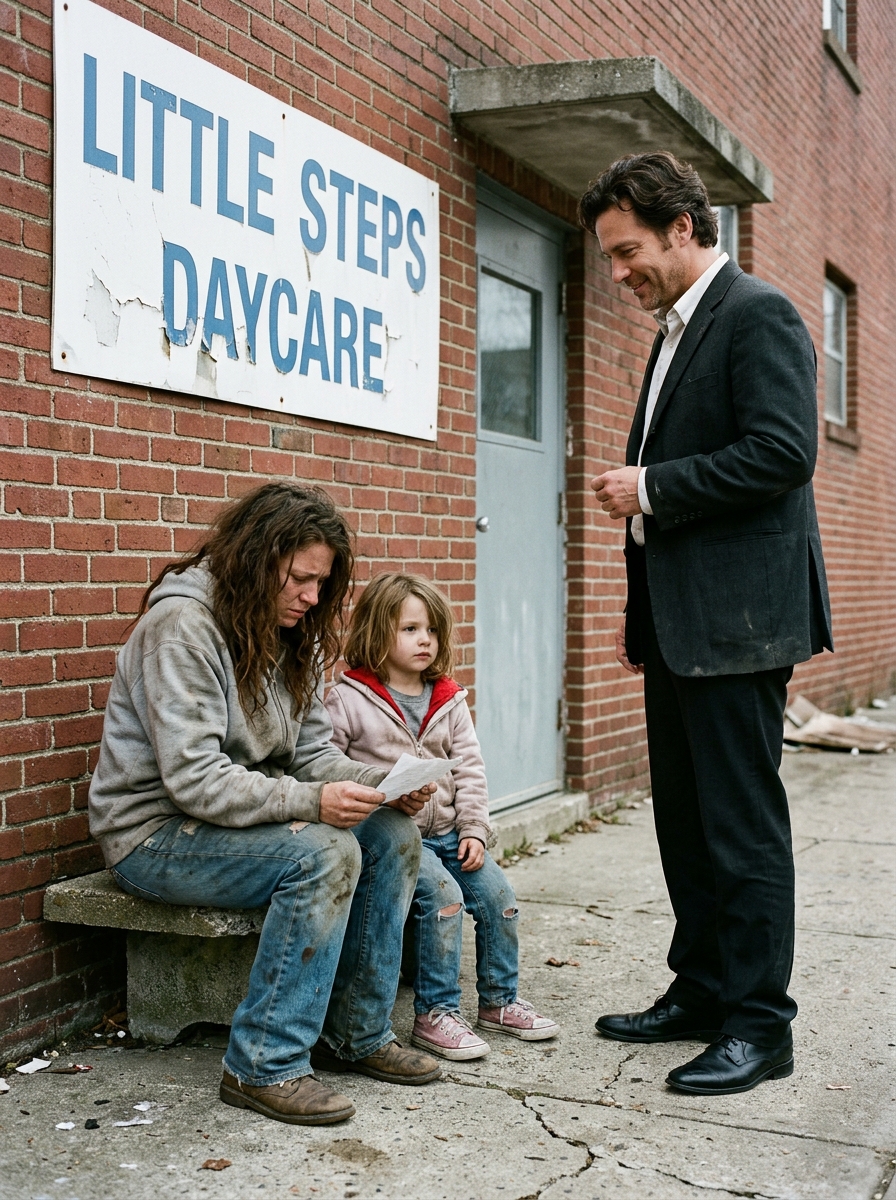
Grace Bennett had already checked the envelope three times, as if seventy dollars might somehow appear between two folded sheets of paper.
It didn’t.
Her three-year-old daughter, Maya, sat beside her on the concrete bench outside the child care center, swinging one small sneaker back and forth.
“Mommy, are we going home now?”
“In a minute, sweetheart.”
Grace hated how steady her voice sounded.
Inside, she was coming apart.
The notice in her lap was simple.
Balance due before Monday: $70.
If Grace paid it, Maya could keep her child care spot.
If she didn’t, the spot would be released to another family on the waiting list.
Seventy dollars.
For some people, it was dinner out.
A tank of gas and a few groceries.
A number they might barely notice on a monthly statement.
For Grace, it was the difference between keeping her job and missing enough shifts to lose it.
She folded the notice again.
Then unfolded it.
Maya leaned against her arm.
“Did the lady say I can come back Monday?”
Grace swallowed.
“We’re figuring it out.”
That was the phrase she had been using for everything lately.
Rent?
We’re figuring it out.
Groceries?
We’re figuring it out.
The car making that strange clicking sound?
We’re figuring it out.
Her schedule changing again at the diner?
We’re figuring it out.
At twenty-nine, Grace had become very good at saying those three words while having absolutely no idea what came next.
Eighteen months earlier, Maya’s father had left.
There had been no dramatic scene.
No screaming on the front lawn.
No shattered dishes.
He simply decided he wanted a different life.
He packed two suitcases, promised he would “still be there for Maya,” and slowly became someone Grace mostly knew through short text messages.
At first, he called every few days.
Then once a week.
Then whenever he remembered.
Grace stopped expecting anything.
Expectation hurt more than exhaustion.
She worked breakfast shifts at one diner and evening shifts at another small restaurant three nights a week.
Neither job was glamorous.
Neither paid especially well.
But the tips kept groceries in the apartment, and the changing schedules allowed her to patch together enough hours to survive.
Child care made all of it possible.
Without Maya’s spot, Grace couldn’t work breakfast.
Without breakfast shifts, she couldn’t make rent.
Without rent, there was nowhere for them to go.
Everything depended on everything else.
One loose thread could unravel the whole thing.
That morning, Grace had walked into the center expecting to drop Maya off like usual.
Instead, the receptionist had quietly asked her to step aside.
There had been a paperwork problem with Grace’s child care assistance.
A routine review had temporarily reduced the amount applied to her account.
Grace now owed seventy dollars.
The receptionist had been kind.
That almost made it worse.
“I’m sorry,” she had said. “I know this is frustrating.”
Grace stared at the notice.
“When do I have to pay it?”
“Before Monday morning.”
Grace had actually laughed once.
Not because it was funny.
Because sometimes your body makes a strange sound when your brain has nowhere else to put panic.
“I get paid Tuesday.”
The receptionist looked genuinely uncomfortable.
“There’s an assistance coordinator who sometimes works with families in situations like this.”
“Great. Can I talk to her?”
“She’s not here today.”
Grace stopped smiling.
“When will she be back?”
“Monday.”
Grace looked at the paper again.
“The payment is due before Monday.”
“I know.”
For a few seconds, neither woman spoke.
Finally the receptionist printed several pages and slid them across the counter.
“These are some community resources.”
Grace looked at the forms.
Applications.
Income verification.
Processing periods.
Phone numbers.
Instructions.
One program required a recent pay stub.
Another required a scheduled appointment.
One said applications could take up to two weeks to review.
Grace wanted to ask which part of “Monday morning” anyone was missing.
Instead, she thanked the receptionist.
Because Grace always thanked people.
Even when she wanted to sit on the floor and cry.
Especially then.
She took Maya by the hand and walked outside.
Then she sat on the bench.
Twenty-eight minutes later, she was still sitting there.
She had called both diners.
The breakfast manager said he couldn’t advance her pay.
The evening manager said she could maybe pick up an extra shift Sunday night, but that wouldn’t put money in her hand before Monday.
She checked her bank balance.
Twenty-three dollars and eleven cents.
She needed that for groceries.
Her rent was due in six days.
She had already borrowed forty dollars from a coworker two weeks earlier when Maya needed new shoes.
There was nobody left to call without saying words Grace could barely force herself to think.
I need help.
Maya climbed onto the bench and tucked one leg beneath herself.
“Mommy?”
“Yes?”
“Did I do something bad?”
Grace turned so fast the papers nearly slid off her lap.
“What? No. Of course not.”
“Then why can’t I come Monday?”
Grace stared at her daughter.
Maya had big brown eyes and a serious little face that made her look older whenever she was worried.
“You didn’t do anything wrong.”
“Is it because I spilled my milk yesterday?”
“No.”
“Because I didn’t nap?”
“No, baby.”
Maya thought about that.
“Because you don’t have enough money?”
Grace felt the words land in her chest.
Three years old.
That was how old her daughter was.
Three-year-olds were supposed to worry about crayons and crackers.
They were not supposed to understand that their mother’s wallet controlled whether they could return to a familiar classroom.
Grace pulled Maya against her.
“This is grown-up stuff.”
“But you look sad.”
“I’m just thinking.”
“About money?”
Grace closed her eyes.
“Yes.”
Maya rested her head against Grace’s shoulder.
“I have money in my piggy.”
That nearly did it.
Grace pressed her lips together.
“You keep your piggy-bank money.”
“But you can have it.”
“I know.”
“There’s lots.”
There was probably six dollars in quarters and pennies inside a pink ceramic pig sitting on Maya’s dresser.
To Maya, it was a fortune.
To Grace, the offer was worth more than anything she had ever been given.
She kissed the top of her daughter’s head.
“Thank you.”
A shadow moved across the papers in her lap.
Grace looked up.
A man stood a few feet away.
Early forties, maybe.
Dark suit.
White shirt.
No tie.
Polished shoes.
A watch Grace guessed cost more than everything inside her apartment except the refrigerator.
He carried a leather folder in one hand and a paper coffee cup in the other.
He had the unmistakable look of someone who never had to calculate whether ordering cheese on a sandwich would throw off the grocery budget.
“Excuse me,” he said.
Grace straightened automatically.
“Yes?”
“I don’t mean to bother you.”
That usually meant someone was about to bother you.
Grace gathered the papers.
“We’re leaving.”
“You don’t have to.”
“We were just going.”
The man hesitated.
Then he looked at Maya.
Not in the quick way strangers sometimes looked at children.
He noticed her little backpack.
The sticker on her sleeve.
The way she was gripping Grace’s hand.
Then he looked at the notice.
Grace folded it immediately.
His eyes returned to her face.
“Are you waiting for someone?”
“We’re fine.”
His expression didn’t change.
“I didn’t ask if you were fine.”
Grace stared at him.
He seemed to realize how that sounded.
“I’m sorry. That came out wrong.”
“Yes, it did.”
A tiny smile crossed his face.
“Fair enough.”
He gestured toward the opposite end of the bench.
“May I sit?”
Grace almost said no.
She didn’t want conversation.
She didn’t want pity.
She especially didn’t want the curious concern of a man whose suit looked like it belonged in a conference room.
But it was a public bench.
She shifted Maya closer.
“It’s not mine.”
The man sat several feet away.
For a moment, he said nothing.
Grace appreciated that more than she wanted to admit.
Maya stared openly at him.
Children had no concept of subtlety.
The man noticed.
“Hi.”
Maya leaned into Grace.
Then she whispered, “Hi.”
“I’m Michael.”
“Maya.”
“Nice to meet you, Maya.”
“I’m three.”
Michael nodded seriously.
“That’s a good age.”
Maya considered him suspiciously.
“How old are you?”
Grace closed her eyes.
“Maya.”
Michael laughed.
“Forty-three.”
Maya looked impressed.
“That’s a lot.”
“It feels like a lot some mornings.”
Grace almost smiled.
Almost.
Michael glanced toward the entrance.
“Does Maya come here?”
Grace’s guard went back up.
“Why?”
“I work with the centers.”
Of course he did.
Probably corporate office.
Finance.
Executive management.
Someone who looked at columns on spreadsheets and called them families.
“Then maybe you can explain something,” Grace said.
The bitterness escaped before she could stop it.
Michael turned toward her.
“I can try.”
Grace held up the notice.
“How does a working parent owe seventy dollars on Friday and have until Monday morning to fix it when the person who handles assistance won’t be here until Monday?”
Michael’s face changed.
Not dramatically.
But enough.
“Can I see that?”
Grace almost refused.
Then she handed him the paper.
He read it once.
Then again.
“Did they give you these?”
He nodded toward the pages in her lap.
“Community resources.”
“Did anyone walk through them with you?”
“No.”
“Did anyone make calls?”
“No.”
“Did anyone ask whether paying this balance would create a problem somewhere else?”
Grace laughed again.
That strange, tired laugh.
“What do you mean, somewhere else?”
“Rent. Food. Utilities.”
Grace looked at him.
“No.”
Michael handed the notice back.
“Would it?”
She stared at him for several seconds.
“I’m sorry?”
“If you paid the seventy dollars today, would it mean falling behind somewhere else?”
Grace hated the question.
Not because it was rude.
Because it was accurate.
“We’ll manage.”
Michael nodded slowly.
“How?”
There it was.
A simple word.
One Grace had been avoiding all morning.
How?
How would she manage?
How would she work without child care?
How would she pay child care without work?
How would she protect Maya from knowing just how close everything was to falling apart?
“I said we’ll manage.”
“I heard you.”
“Then why are you asking?”
“Because sometimes ‘we’ll manage’ means ‘I have a plan.’”
His voice remained calm.
“And sometimes it means ‘I’m terrified and I don’t want a stranger to know.’”
Grace felt her face grow warm.
Michael immediately looked away.
“I’m not trying to embarrass you.”
“You’re doing a pretty good job.”
“You’re right.”
He started to stand.
“I’m sorry.”
Something inside Grace cracked.
Maybe it was exhaustion.
Maybe it was the seventy-dollar notice.
Maybe it was Maya’s six-dollar piggy bank sitting at home.
“Twenty-three dollars.”
Michael stopped.
Grace looked at the ground.
“That’s what I have.”
He slowly sat back down.
“Twenty-three dollars and eleven cents, actually.”
Her voice was shaking now.
“I get paid Tuesday. Rent is due Thursday. I’ve already asked for extra shifts. I’ve already borrowed from somebody at work.”
She tightened her grip on the folded paper.
“If I lose Maya’s spot, I lose my morning shifts.”
Michael listened.
No interruption.
No quick solution.
No awkward “I’m sure it’ll work out.”
So Grace kept going.
“I’m not asking for free child care.”
Her words came faster.
“I work. I pay what I’m supposed to pay. I show up. Maya shows up. I filled out every form they gave me.”
“I believe you.”
“But one review changed something in the system, and now I owe seventy dollars by Monday.”
Her eyes stung.
“I don’t have seventy dollars.”
Maya pressed against her side.
Grace lowered her voice.
“I have twenty-three.”
Michael remained very still.
Grace hated herself for telling him.
A stranger.
A man in a suit.
Someone who could go home tonight and forget the woman on the bench.
She looked away.
“There. Now you know.”
Michael reached into his coat.
Grace immediately stiffened.
“I don’t want your money.”
He paused.
“I was getting my phone.”
“I still don’t want your money.”
“I understand.”
“No, I mean it.”
“I believe you.”
Michael unlocked his phone.
“Then let me do something different.”
He tapped a contact.
Grace stared at him.
“What are you doing?”
“Fixing the problem.”
He raised the phone to his ear.
“Jennifer? It’s Michael.”
Grace froze.
“Yes, I’m outside the Westbrook center.”
He listened.
“I need you to pull the account for Maya Bennett.”
Grace grabbed his sleeve before she could stop herself.
“Wait.”
Michael looked at her.
She immediately let go.
“You can’t just get into my account.”
“I’m not accessing it personally.”
He covered the phone.
“My assistant is checking the administrative side. If you want me to stop, I will.”
Grace looked at Maya.
Then at the notice.
Then at Michael.
“Why?”
“I’ll explain.”
He returned to the call.
“Yes. Grace Bennett is her mother.”
He waited.
“Correct.”
Another pause.
Michael’s jaw tightened slightly.
“The review created a temporary balance?”
He listened.
“And the support coordinator is unavailable until Monday?”
Another pause.
“No. Don’t release the spot.”
Grace stared.
Michael continued.
“Put a temporary hold on the balance.”
He listened.
“Yes.”
Then he said something Grace would remember for years.
“If the system creates a deadline that the system itself makes impossible to solve, that is our problem. Not the parent’s.”
Grace stopped breathing for a second.
Michael looked toward the building.
“Also, remove the Monday deadline until a coordinator reviews the file with Grace personally.”
Another pause.
“No exceptions discussion right now. I’m authorizing it.”
He ended the call.
Grace looked at him.
“What just happened?”
“Maya still has her spot Monday.”
Grace blinked.
“What?”
“She still has her spot.”
“For how long?”
“Until somebody sits down with you, explains exactly why the balance appeared, reviews the assistance paperwork, and gives you a reasonable path forward.”
Grace shook her head.
“You can do that?”
“Yes.”
“Who are you?”
Michael put the phone away.
“I told you. Michael.”
“You know what I mean.”
He looked slightly uncomfortable now.
“I’m Michael Hartford.”
That meant nothing to Grace.
He seemed to notice.
“I’m the executive director.”
Grace stared.
“Of this center?”
“Of the group that operates it and several others in the county.”
For several seconds, Grace said nothing.
Then she looked at his suit.
His shoes.
His watch.
The phone call.
Everything clicked.
“Oh.”
Michael nodded.
“Yeah.”
Grace stood abruptly.
Maya slid off the bench.
“I’m sorry.”
Michael frowned.
“For what?”
“For everything I just said.”
“Why?”
“I was rude.”
“You were frustrated.”
“I basically yelled at you.”
“You didn’t.”
“I wanted to.”
Michael smiled.
“That part I believe.”
Grace didn’t smile back.
She felt exposed.
Worse than exposed.
Seen.
There was a difference.
Being exposed made you want to hide.
Being seen made hiding impossible.
“I don’t understand why you stopped.”
Michael looked at Maya.
Then he looked past them toward the center entrance.
His expression went quiet.
“When I was seven,” he said, “my mother sat on a bench outside a child care center with me and my little sister.”
Grace slowly sat down again.
Michael kept his eyes on the building.
“My dad had left about six months earlier.”
Grace said nothing.
“She worked the front desk at a small motel during the day and cleaned office buildings at night.”
Michael rubbed his thumb against the edge of his coffee cup.
“She needed child care more than she needed almost anything else because without it she couldn’t work.”
Grace understood immediately.
“One month, there was a problem with her assistance paperwork.”
Michael gave a small humorless laugh.
“Apparently some things survive generations.”
“What happened?”
“She suddenly owed money she didn’t have.”
“How much?”
“I don’t remember.”
Michael looked at her.
“But I remember my mother crying.”
Grace glanced at Maya.
Michael noticed.
“She tried to hide it from us.”
His voice softened.
“Parents always think children don’t know.”
Grace felt that sentence settle heavily inside her.
“We knew.”
Michael continued.
“We knew when the lights stayed off in rooms we weren’t using. We knew when Mom said she wasn’t hungry but watched us eat.”
Grace swallowed hard.
“We knew when she counted bills at the kitchen table after she thought we were asleep.”
He paused.
“And we definitely knew when she sat outside that center trying not to cry because she thought she was going to lose her job.”
“What did she do?”
“A man came outside.”
Michael smiled faintly.
“He was the director of the center.”
Grace looked at him.
Michael nodded.
“His name was Robert Ellis. He was probably around fifty then.”
“What did he do?”
“He sat down.”
Grace waited.
“That was the first thing.”
Michael looked at her.
“He sat down.”
Something about the simplicity of it hit Grace harder than she expected.
“He didn’t stand over my mother. Didn’t tell her she should have planned better. Didn’t hand her another stack of papers and walk away.”
Michael’s voice remained steady.
“He sat beside her and asked what happened.”
Maya had gone quiet.
She was now tracing circles on Grace’s palm with one finger.
“My mother told him.”
Michael continued.
“And Mr. Ellis made a few calls. He found the mistake. He helped correct it.”
“Just like you did.”
“Not quite.”
Michael smiled.
“He did more.”
The next week, Robert Ellis connected Michael’s mother with an administrative opening at one of the organization’s centers.
She had no college degree.
She had never worked in an office like that.
She nearly refused to apply.
But Robert saw something she couldn’t see in herself.
“She had spent years organizing schedules, handling difficult guests, keeping track of payments, solving problems, and getting two kids where they needed to be.”
Michael shrugged.
“He told her those were skills.”
Grace looked down.
“What happened?”
“She got the job.”
Michael’s smile became warmer.
“For the first time in years, she had steady hours.”
His mother eventually became a site coordinator.
Later, she helped train new staff.
She stayed with the organization for more than twenty years.
“And Mr. Ellis?” Grace asked.
“He became my mentor.”
Michael finally took a sip from the coffee he had been holding.
“When I was in high school, he gave me a summer job stacking supplies and cleaning classrooms.”
He smiled.
“I was terrible at both.”
Grace laughed softly.
“When I went to college, he wrote one of my recommendation letters.”
Michael looked at Maya.
“He taught me that child care isn’t just a place where parents leave children while they work.”
“It’s what lets them work,” Grace said.
“Exactly.”
His eyes met hers.
“It holds entire families together.”
Grace looked at the notice again.
The seventy-dollar balance suddenly felt different.
Still frightening.
But no longer like evidence that she had failed.
“So you stopped because of your mother.”
“I stopped because of you.”
Grace frowned.
Michael corrected himself.
“I recognized the situation because of my mother.”
He nodded toward the bench.
“But you were sitting here today.”
Grace’s eyes filled.
She looked away quickly.
“I don’t want pity.”
“I’m not offering pity.”
“Then what is this?”
“Recognition.”
Grace looked back at him.
Michael’s expression was serious.
“You’re working.”
He counted quietly.
“You’re caring for your daughter. You’re trying to keep a roof over her head. You followed the process.”
He tapped the paperwork lightly.
“Then our process created a problem and gave you no realistic way to solve it before the deadline.”
Grace breathed out.
“That doesn’t make you irresponsible.”
He paused.
“It makes our process inadequate.”
Nobody had said anything like that to Grace in a very long time.
Most problems in her life arrived carrying the same message.
You should have done more.
Worked more.
Saved more.
Planned better.
Chosen better.
Needed less.
Grace had absorbed so much of it that she no longer needed anyone else to say it.
She said it to herself.
Michael glanced at his watch.
“I have a meeting.”
Grace immediately stood.
“Of course. I’ve kept you—”
“You didn’t keep me.”
He pulled a business card from his folder.
“My direct office number is on this.”
Grace stared at it.
“I’m not calling the executive director every time I have a problem.”
“Good.”
He held it out.
“Call when you have a problem nobody else will solve.”
Grace hesitated.
Then took the card.
“Jennifer will contact you this afternoon.”
“For what?”
“To set up a meeting with our family support coordinator.”
Grace tensed.
“I don’t need some kind of special charity.”
Michael shook his head.
“Then don’t call it charity.”
“What do I call it?”
“A program.”
“That sounds nicer.”
“It’s also accurate.”
He smiled slightly.
“We have assistance funds for working families.”
Grace looked at him skeptically.
“Then why didn’t anyone tell me?”
Michael’s smile disappeared.
“That is a very good question.”
He picked up his folder.
“And I intend to ask it.”
Maya tugged his jacket.
Michael looked down.
“Thank you for letting me come Monday.”
He crouched so he was closer to her height.
“You’re welcome.”
“I like Monday.”
“Why?”
“We have pancakes.”
Michael nodded solemnly.
“Then Monday is clearly important.”
Maya smiled.
Grace watched them.
For the first time that day, the tight band around her chest loosened.
Not disappeared.
Loosened.
Michael stood.
“You okay getting home?”
Grace’s guard flickered back.
“Yes.”
He nodded.
No insistence.
No overreach.
“Jennifer will call.”
Then he walked toward the entrance.
Grace watched him until the doors closed behind him.
Maya climbed back onto the bench.
“Mommy?”
“Yes?”
“Is he the boss?”
Grace looked at the business card.
“I think he’s a very big boss.”
Maya nodded thoughtfully.
“He doesn’t look bossy.”
Grace laughed.
A real laugh this time.
“No.”
She wiped her eyes.
“He doesn’t.”
Jennifer called two hours later.
Grace nearly ignored the unfamiliar number.
Then she remembered the business card.
“Grace Bennett?”
“Yes.”
“My name is Jennifer. I work with Michael Hartford.”
Grace sat down at her kitchen table.
Maya was coloring beside her.
“Mr. Hartford asked me to help make sure you’re connected with the right person.”
Grace tightened her grip on the phone.
“I don’t want him paying anything personally.”
Jennifer paused.
“He told me you’d say that.”
Grace almost smiled.
“Then he listens.”
“He does.”
Jennifer explained that the seventy-dollar balance had resulted from a routine assistance review and a missing verification form.
Grace had never received the form.
The center’s electronic system showed it as “sent.”
Her account automatically adjusted when it wasn’t returned.
“So I missed something I never got.”
“That’s what it looks like.”
Grace closed her eyes.
Jennifer continued.
“The balance has been frozen while we review it.”
“Does that mean I still owe it?”
“Not necessarily.”
Jennifer was careful.
“We’re going to review the account with you rather than make assumptions.”
That sentence felt almost unfamiliar.
Rather than make assumptions.
Grace spent much of her life feeling like systems were built from assumptions about people like her.
If you didn’t return paperwork, you were careless.
If you were late, you didn’t respect other people’s time.
If you struggled, you must have made poor choices.
Nobody ever asked whether the letter went to the wrong apartment mailbox.
Whether the bus was late.
Whether your manager changed your shift.
Whether the person watching your child canceled.
Whether a seventy-dollar surprise could knock over five other things.
On Monday, Grace met the support coordinator.
The meeting lasted forty minutes.
Nobody lectured her.
Nobody made her feel small.
They found the missing form.
Grace completed it.
The temporary balance disappeared.
Then the coordinator told her about a sliding-scale assistance program she had never known existed.
Grace qualified.
Her weekly payment dropped enough that she could finally breathe without calculating every single dollar first.
She cried in the parking lot afterward.
Not because everything was suddenly perfect.
It wasn’t.
She still had rent.
Groceries.
Laundry.
Bus fare when her old car refused to cooperate.
Maya still outgrew shoes at unbelievable speed.
The diner still changed schedules with almost no warning.
Life remained life.
But for the first time in months, Grace could see more than three days ahead.
Michael didn’t call.
That surprised her.
Part of her expected him to check in.
Another part was relieved he didn’t.
His kindness hadn’t come with a requirement that she perform gratitude.
He had opened a door.
Then let her walk through it herself.
Two weeks later, Jennifer called.
“Michael asked if you’d be willing to come by his office.”
Grace immediately assumed something was wrong.
“Is it the assistance?”
“No.”
“Did I fill something out incorrectly?”
“No.”
“Is Maya’s spot—”
“Grace.”
Jennifer laughed softly.
“Nothing is wrong.”
That did not calm Grace down.
In Grace’s experience, people rarely invited waitresses to executive offices because everything was going wonderfully.
She arrived the following Tuesday in the nicest clothes she owned.
Black pants.
A blue blouse.
Simple flats.
She had spent twenty minutes wondering whether the blouse looked professional enough.
Then another ten being angry with herself for caring.
Michael’s office surprised her.
It wasn’t enormous.
No dramatic wall of windows.
No giant desk designed to make visitors feel small.
There were framed children’s drawings on one wall.
A faded photograph of Michael standing beside an older woman sat on a shelf.
Grace recognized the woman immediately.
“Your mother?”
Michael followed her gaze.
“Yes.”
“She looks proud.”
“She usually is.”
He smiled.
“Sometimes aggressively.”
Grace laughed.
“That sounds like a mom.”
Michael gestured toward a chair.
“I asked you here because Jennifer told me something.”
Grace sat.
“Good or bad?”
“Depends how much you like job interviews.”
Grace stared at him.
“What?”
Michael slid a folder across the desk.
Inside was a job description.
Family Support Assistant.
Grace looked up.
“I don’t understand.”
“We’re adding two positions.”
“You called me here about a job?”
“Yes.”
“Why?”
“Because I think you should apply.”
Grace actually looked behind herself.
There was nobody there.
“You mean me?”
“Yes.”
“I’m a waitress.”
“I know.”
“I finished high school.”
“I know.”
“I’ve never worked in child care.”
“I know.”
Grace pushed the folder back.
“Then I’m confused.”
Michael didn’t touch it.
“What do you think a family support assistant does?”
“I have no idea.”
“Listens to parents.”
Grace stayed quiet.
“Helps them understand forms.”
He continued.
“Connects them with the right staff. Follows up when something doesn’t make sense.”
Grace looked at the folder.
“Notices when someone is sitting outside for half an hour because they’re too embarrassed to walk back in.”
Grace looked at him.
“That feels very specific.”
“It is.”
Michael leaned back.
“I walked past the lobby that morning.”
He spoke more quietly.
“I saw you talking to the receptionist.”
Grace hadn’t known that.
“I went upstairs.”
He continued.
“Had a meeting. Came back down almost an hour later.”
His face tightened.
“You were outside.”
“So?”
“So I started asking questions.”
Grace waited.
“Our system showed your issue as handled.”
Michael tapped one finger on the desk.
“You had been given resource sheets.”
Grace nodded.
“Technically, somebody completed the task.”
“But nothing was solved.”
“Exactly.”
Michael leaned forward.
“That bothers me.”
Grace glanced at the job description again.
“But why me?”
“Because when Jennifer helped you complete your assistance paperwork, you kept asking questions.”
Grace frowned.
“What questions?”
“Why certain forms are written the way they are.”
Michael counted them off.
“Why parents have to submit the same information twice. Why the help phone number is at the bottom of page four instead of page one.”
Grace remembered.
“I was irritated.”
“Good.”
“That’s a qualification?”
“For this job, sometimes.”
Grace laughed nervously.
“Michael.”
His expression became serious.
“I’m not offering you a job because I feel sorry for you.”
“Then why?”
“Because you notice problems.”
He nodded toward the folder.
“And because you care whether the next parent has the same problem.”
Grace looked down.
There was a salary listed.
Not enormous.
But steady.
More than she was reliably making.
Then she saw the hours.
Monday through Friday.
Daytime.
Then the benefits.
Grace read that section twice.
“This has paid time off?”
“Yes.”
“And I wouldn’t work nights?”
“Occasionally there are evening events, but not regular evening shifts.”
Grace looked at him.
“And Maya?”
“She already attends one of our centers.”
Grace’s throat tightened.
“You planned this.”
“I posted a position.”
“That’s not what I mean.”
“I know.”
Michael smiled.
“But I am not hiring you today.”
Grace blinked.
“You said—”
“I said I want you to apply.”
His tone remained warm.
“You’ll interview with the department manager, not me.”
Grace stared at him.
“If somebody else is better qualified, they get the job?”
“Yes.”
For some reason, that made Grace want it more.
It wasn’t rescue.
It was opportunity.
There was a difference.
She took the folder home.
Then she left it unopened on the kitchen table for three hours.
She cleaned.
Made Maya dinner.
Washed dishes.
Folded laundry.
Every time she passed the table, the folder seemed to stare back at her.
Finally, after Maya was asleep, Grace opened it.
She read every line.
Then she read it again.
The next morning, she called Michael.
“I’m applying.”
“Good.”
“I’m still not sure I’m qualified.”
“That’s for the hiring manager to decide.”
Grace smiled despite herself.
“And if I embarrass myself in the interview?”
“Then you’ll survive.”
“That’s encouraging.”
“You’ve survived worse than an interview.”
Grace knew he was right.
The interview was the following week.
Grace was terrified.
She sat across from a woman named Denise, who managed family services.
Denise asked ordinary questions.
Why did Grace want the job?
How did she handle upset people?
What did she do when she didn’t know an answer?
Grace tried to say what she thought professional people were supposed to say.
Halfway through, she stopped.
“I’m sorry.”
Denise lifted an eyebrow.
“For what?”
“I’m trying to sound like somebody who belongs in an office.”
Denise smiled.
“How’s that going?”
“Badly.”
They both laughed.
Grace took a breath.
Then she answered honestly.
“I know what it feels like to need help and feel ashamed of it.”
Denise’s smile faded into attention.
“I know what it feels like when somebody gives you a page full of phone numbers because they don’t know what else to do.”
Grace continued.
“And I know how hard it is to ask the same question twice when you already feel like everyone thinks you’re difficult.”
Denise leaned forward.
“What would you have wanted somebody to do?”
“Sit down.”
The words came instantly.
“Look at the whole problem.”
Grace thought of Michael on the bench.
“Not just finish the task.”
Denise was quiet.
Grace continued.
“If a mother tells me she can’t pay seventy dollars, I don’t want to hand her an application that takes two weeks and congratulate myself for helping.”
She swallowed.
“I want to know what happens Monday.”
Denise stared at her for a moment.
Then she wrote something down.
Grace left convinced she had ruined the interview.
Three days later, Denise offered her the job.
Grace sat on the edge of her bed with the phone against her ear.
“Are you sure?”
Denise laughed.
“Yes.”
“You don’t have to check with Michael?”
“I already did.”
Grace’s heart sank.
Then Denise added, “He wasn’t part of the final decision.”
Grace blinked.
“He wasn’t?”
“No.”
Denise sounded amused.
“He was very annoying about making sure he wasn’t.”
Grace laughed so loudly Maya came running from the hallway.
“Mommy?”
Grace held out her hand.
Maya climbed beside her.
“I got a new job.”
Maya’s eyes widened.
“Do you get pancakes?”
Grace laughed again.
“No.”
Maya looked disappointed.
“But I get to be closer to you.”
That seemed acceptable.
“Okay.”
Grace started the following month.
The first week was humbling.
She learned new software.
Forgot passwords.
Clicked the wrong menu twice.
Used a copier that seemed personally offended by her existence.
She carried a notebook everywhere.
At night, after Maya went to sleep, Grace reviewed her notes at the kitchen table.
She refused to fail.
By the third week, something changed.
A father came in holding a letter he didn’t understand.
Grace understood it.
A grandmother called because her paperwork showed the wrong household size.
Grace knew who could fix it.
A mother whispered that she was three days behind on a fee and was terrified someone would shame her at pickup.
Grace knew that feeling immediately.
“Sit down,” she said.
The woman hesitated.
“I don’t want to be difficult.”
“You’re not.”
“I just need a few days.”
“We’ll figure out what happened first.”
Grace heard the words after she said them.
We’ll figure it out.
The phrase that once meant panic had become a promise.
That evening, Grace sat in her car for several minutes before driving home.
She cried.
Quietly.
Not from sadness.
From the strange shock of realizing the worst day of your life could someday become something useful.
Months passed.
Grace became good at the job.
Not polished.
Good.
There was a difference.
She never used ten words when three would do.
She never called parents “cases.”
She remembered children’s names.
When somebody said, “It’s fine,” while obviously fighting tears, Grace rarely accepted the first answer.
She knew what “fine” could mean.
She also knew when to give someone space.
Michael noticed.
So did Denise.
A year after the afternoon on the bench, the organization held an annual community fundraiser.
Grace helped plan it.
The goal was to expand the emergency family assistance fund so small, sudden costs wouldn’t push working parents into impossible choices.
No speeches had been planned for Grace.
She preferred it that way.
Then Michael called her two days before the event.
“I need a favor.”
“No.”
He laughed.
“You don’t even know what it is.”
“You’re going to ask me to talk.”
“I am.”
“No.”
“Five minutes.”
“No.”
“Three.”
“Michael.”
“Two and a half?”
Grace sighed.
“I hate you.”
“No, you don’t.”
“I strongly dislike you until after the fundraiser.”
“Fair.”
Grace agreed to speak.
She wrote twelve pages.
Then tore them up.
She wrote six.
Tore those up too.
On the evening of the fundraiser, she stood behind the curtain with sweaty palms and a dry mouth.
Maya, now four, sat near the front with Jennifer.
Michael found Grace before she went on.
“You okay?”
“No.”
“Good.”
Grace glared at him.
“How is that good?”
“Means you care.”
“That is something people say when they are not the ones speaking.”
Michael smiled.
“There’s somebody I want you to meet first.”
An older man stood a few feet behind him.
Silver hair.
Gentle face.
Simple navy jacket.
Michael’s expression changed when he introduced him.
“Grace, this is Robert Ellis.”
Grace stopped moving.
The name took a second to land.
Then she understood.
“The bench.”
Robert smiled.
“I’ve been called worse.”
Grace covered her mouth.
“You helped Michael’s mother.”
“I did a little paperwork.”
Michael shook his head.
“He always says that.”
Robert shrugged.
“It was paperwork.”
“No,” Grace said.
Her voice trembled.
“It wasn’t.”
Robert looked at her.
Grace thought of her own bench.
Her seventy-dollar notice.
Her daughter offering six dollars from a piggy bank.
“You stopped.”
Robert’s expression softened.
“Yes.”
“That mattered.”
“I suppose it did.”
“You don’t suppose.”
Grace’s eyes filled.
“You changed their lives.”
Robert glanced toward Michael.
“He did most of that himself.”
Michael laughed softly.
“See what I dealt with growing up?”
Robert ignored him.
“Michael tells me you’re doing wonderful work.”
Grace shook her head.
“I’m doing what somebody did for me.”
Robert nodded.
“That’s usually how it starts.”
Grace looked at the retired director.
“Did you know?”
“Know what?”
“That helping his mother would lead to this?”
Robert looked around the event hall.
Families.
Staff.
Children’s artwork.
Tables covered with silent-auction baskets donated by local businesses.
“No.”
He shook his head.
“Not even close.”
Michael folded his arms.
“That’s the thing.”
Grace looked at him.
“You rarely know what kindness becomes.”
Michael nodded toward Robert.
“He sat beside my mother for half an hour.”
Then toward Grace.
“I sat beside you.”
Grace looked out at the crowd.
“And now?”
“Now you sit beside everybody.”
Grace went onstage without her twelve pages.
Or six.
Or any notes at all.
She walked to the microphone.
For a second, she could hear her own heartbeat.
Then she saw Maya.
Her daughter waved.
Grace smiled.
“One year ago,” she began, “I sat outside one of our centers with twenty-three dollars and eleven cents in my bank account.”
The room became silent.
“I remember the eleven cents because when you don’t have much money, you remember every cent.”
A few people smiled.
“I owed seventy dollars.”
Grace looked toward Michael.
“I thought that seventy dollars was going to cost me my child care.”
She paused.
“And without child care, I thought I would lose my job.”
Her throat tightened.
“I thought one piece of paper was about to knock over my whole life.”
Grace told them about the resource sheets.
The deadline.
The closed office.
The calls she made.
The piggy bank Maya offered.
Then she told them about the man in the suit.
“He asked me how I was going to manage.”
Grace smiled faintly.
“I did not appreciate the question.”
Laughter moved through the room.
“I told him we’d manage.”
She glanced at Michael.
“He asked me again.”
Michael shrugged from his table.
More laughter.
Grace’s voice softened.
“And eventually, I told the truth.”
The room quieted.
“I didn’t know.”
Grace looked at Maya.
“I had no plan.”
She inhaled.
“I was embarrassed.”
Her fingers tightened around the microphone.
“I thought needing help meant I had failed.”
Robert watched from beside Michael.
“Michael didn’t treat me like a failure.”
Grace continued.
“He treated the problem like a problem.”
She looked around the room.
“There’s a difference.”
Grace explained how the paperwork was fixed.
How she learned about assistance she had never known existed.
How Michael encouraged her to apply for a job.
Then she said something she had never told him.
“I almost didn’t apply.”
Michael looked surprised.
“I thought people like me didn’t work in places like this.”
Grace smiled.
“I thought offices were for people who knew the right words.”
She looked toward Denise.
“Turns out, they occasionally let waitresses in.”
Denise laughed.
Grace continued.
“My old job taught me how to remember six orders while a coffee machine beeped, a toddler cried in booth four, and somebody asked where their toast was.”
She shrugged.
“Apparently that translates pretty well to family support.”
The room laughed again.
Then Grace’s face grew serious.
“But the most important thing I brought with me was something I used to be ashamed of.”
She paused.
“I knew what that bench felt like.”
Nobody moved.
“I knew what it was like to sit somewhere public and hope nobody noticed you were falling apart.”
Grace’s eyes filled.
“And I knew what it was like when somebody noticed anyway.”
She looked directly at Michael.
“Thank you for noticing.”
Michael’s eyes dropped for a second.
Grace turned toward Robert.
“And thank you for noticing his mother first.”
Robert blinked hard.
“This is how it works.”
Grace looked at the audience.
“One person stops.”
Her voice remained simple.
“They help another person stand.”
“That person remembers.”
Grace glanced at the families scattered through the room.
“Then one day, somebody else needs a chair beside them.”
She stepped back from the microphone.
“That’s all I wanted to say.”
The room stood.
Grace hated standing ovations.
She cried anyway.
The fundraiser exceeded its goal.
The expanded fund helped families with short-term child care gaps, sudden schedule changes, transportation problems, and administrative delays.
Grace never knew most of their names.
That was fine with her.
The point wasn’t being thanked.
The point was that fewer parents ended up on benches holding impossible notices.
After the event, Grace found Michael standing alone near a window overlooking the center courtyard.
She joined him.
“You survived,” he said.
“Barely.”
“You were good.”
“Never asking me again.”
“Absolutely.”
She looked at him.
“You’re lying.”
“Completely.”
Grace smiled.
For a moment, neither spoke.
Then Grace noticed the bench outside.
Not the exact one from the year before.
That building was across town.
But it looked almost identical.
A mother sat there while a little boy played with the zipper on his backpack.
Grace watched them.
“How many do we miss?”
Michael didn’t ask what she meant.
“Too many.”
“How many people say they’re fine because they don’t want anyone to know?”
“A lot.”
Grace folded her arms.
“I did.”
“I know.”
“I was ashamed.”
“I know.”
“I thought if I admitted I couldn’t handle seventy dollars, people would decide I was irresponsible.”
Michael turned toward her.
“Do you still think that?”
Grace considered the question.
“Sometimes.”
“Why?”
“Because shame is stubborn.”
Michael nodded.
“Fair.”
Grace looked back outside.
“You know what changed?”
“What?”
“I used to think strong people never needed help.”
Michael waited.
“Now I think strong people sometimes say, ‘I don’t know what to do next.’”
He smiled.
“That sounds healthier.”
“Don’t make it weird.”
“Sorry.”
Grace laughed.
Three years after their first conversation, Grace became director of family support and community outreach.
She argued against the title.
She lost.
Her department grew from four people to twelve.
She changed one rule immediately.
Whenever an account automatically generated a deadline that could affect a child’s placement, a real person had to review it before the family received a final notice.
Grace also redesigned the assistance packet.
The old version had been eight pages.
The new one was three.
The help number went at the top.
In large print.
Jennifer framed the first copy.
“You’re ridiculous,” Grace told her.
“This,” Jennifer replied, tapping the frame, “is art.”
Maya was six by then.
She sometimes came to the office after school and colored at the small table beside Grace’s desk.
To Maya, the organization had always been part of life.
She barely remembered the bench.
She didn’t remember the seventy-dollar notice.
She didn’t remember offering her piggy bank.
Grace remembered all of it.
She kept Michael’s business card in the back of her desk drawer.
The edges had softened.
The ink had faded slightly.
She never needed the number anymore.
Michael’s office was two floors away.
But Grace kept the card because it reminded her how quickly a stranger could become part of the story of your life.
One afternoon, Maya pulled open the drawer looking for tape.
She found the card.
“What’s this?”
Grace glanced over.
“That’s Mr. Hartford’s old card.”
“Why do you keep it?”
Grace leaned back.
“Because he gave it to me on an important day.”
“What day?”
“The day I met him.”
Maya studied the card.
“Was he your boss?”
“Not yet.”
“Was he your friend?”
Grace smiled.
“Not yet.”
“What was he?”
Grace thought about the question.
“A stranger who stopped.”
Maya frowned.
“That’s weird.”
Grace laughed.
“A little.”
Maya climbed into the chair across from her.
“Tell me.”
Grace had told the story before.
But Maya was old enough now to understand more of it.
So Grace told her about the seventy dollars.
The deadline.
The bench.
The papers.
She told her about Michael asking how they would manage.
Then she told Maya something she had almost forgotten.
“You offered me your piggy-bank money.”
Maya’s mouth dropped open.
“I did?”
“You did.”
“How much was in it?”
“About six dollars.”
Maya looked deeply offended by her younger self’s finances.
“That’s not very much.”
“It felt like a million.”
“Why?”
Grace reached across the desk.
“Because you wanted to give me everything you had.”
Maya thought about that.
Then she smiled.
“Did you take it?”
“No.”
“Good.”
Grace laughed.
Maya looked around the office.
“So you work here because of that day?”
“Partly.”
“And Mr. Hartford works here because somebody helped his mom?”
“Pretty much.”
“And that old man from the fundraiser helped his mom?”
“Yes.”
Maya became quiet.
Grace knew that look.
Her daughter was arranging the pieces in her head.
Finally she said, “So it keeps going.”
Grace felt her throat tighten.
“Yes.”
“That’s cool.”
“It is.”
Maya slid off the chair and went back to looking for tape.
Then she stopped.
“Mom?”
“Yeah?”
“When I’m big, can I help people too?”
Grace smiled.
“You don’t have to wait until you’re big.”
Maya considered that.
Then she nodded.
“Okay.”
She found the tape and hurried back to her coloring.
Grace turned toward her computer.
There were emails waiting.
Forms.
Phone calls.
A father needed help understanding a schedule change.
A grandmother was missing one document.
A mother had left a message saying everything was “probably fine,” which Grace knew meant she should call her back.
Ordinary work.
That was what it looked like now.
Nothing dramatic.
No grand rescue.
Mostly people sitting down with other people and asking one more question.
Grace opened the first file.
Before typing, she glanced once at the old business card.
She thought about the woman Michael had described years earlier.
His mother on a bench.
Robert Ellis choosing not to walk past.
Michael growing up remembering that moment.
Michael seeing Grace outside another building decades later.
Grace seeing frightened parents differently because she had once been one of them.
And Maya, now six, already understanding the lesson better than most adults.
So it keeps going.
Grace smiled.
That was exactly right.
The most important thing Michael had given her was never seventy dollars.
He hadn’t even paid the seventy dollars.
He gave her something harder to measure.
He interrupted the moment when Grace had started believing that one bad week defined who she was.
He made her see that a person could be responsible, hardworking, loving, and still reach a point where the numbers didn’t work.
He showed her that being helped did not turn someone into a helpless person.
And years later, Grace passed that same truth across a desk again and again.
Sometimes to parents.
Sometimes to grandparents.
Sometimes to employees who felt embarrassed about asking questions.
Sometimes to herself.
Whenever a new staff member joined her department, Grace gave them one instruction before anything else.
“Never solve the paper and forget the person.”
She would point toward the chairs beside their desks.
“If someone is confused, invite them to sit.”
Then she would smile.
“You’d be surprised what can change when somebody sits down.”
Most new employees assumed it was just one of Grace’s sayings.
That was fine.
They didn’t need the entire story.
They didn’t need to know about twenty-three dollars and eleven cents.
They didn’t need to know about a little pink piggy bank.
They didn’t need to know about the man in the suit who had almost walked into a meeting but stopped instead.
They only needed to understand the point.
People remember being seen.
They remember the person who stayed five minutes longer.
The person who made one extra phone call.
The person who asked, “What happens Monday?” instead of saying, “Here’s a number you can try.”
Small moments rarely look important while they are happening.
That bench hadn’t looked important.
It was just concrete outside a child care center.
That seventy-dollar paper hadn’t looked historic.
It was an automated notice.
Michael hadn’t known he was changing a life.
Grace certainly hadn’t known hers was changing.
She thought she was having one of the worst Fridays she could remember.
Years later, that Friday became the story Maya asked to hear again.
The story Michael told new managers.
The story Robert Ellis smiled through every time someone insisted he had “started everything.”
And the story Grace carried silently every time she walked through a waiting room and noticed someone trying very hard not to be noticed.
Because Grace never forgot what it felt like to sit on a bench believing the whole world had walked past.
She also never forgot what happened when one person didn’t.