The Janitor Thought Nobody Remembered His 32 Years of Quiet Kindness—Until He Turned the Corner on His Final Walk Through School
Darnell Mercer stopped his mop cart in the middle of the hallway and stared at the folded certificate lying on top of it.
Thirty-two years.
That was what his life at the little rural Missouri school had been reduced to.
A certificate with his name printed in the wrong font, a quick handshake from an assistant administrator, and a sheet cake in the teachers’ lounge that somebody had already started cutting before he arrived.
“Congratulations on retirement, Mr. Mercer,” the administrator had said, glancing at his watch. “We really appreciate everything.”
Then he hurried away to a meeting.
Darnell smiled anyway.
He had gotten good at smiling when something hurt.
At sixty-eight, he moved slower than he used to. Six months earlier, a serious heart attack had put him in the hospital and scared his daughter half to death.
She had begged him not to return to work.
“Dad, you almost died.”
“I know.”
“You have to rest.”
“I know that too.”
But the hospital bills kept arriving.
One after another.
Darnell had spent most of the savings he planned to retire on, so he returned to the school as soon as he was able, pushing the same gray cart down the same waxed floors he had cleaned since the early 1990s.
The children noticed the difference.
He no longer carried two trash bags at once.
He rested halfway up the stairs.
Sometimes he pressed his palm against the wall when his chest felt tight from exhaustion.
But he still showed up before sunrise.
Still unlocked the side doors.
Still fixed the paper towel dispensers.
Still picked gum from beneath cafeteria tables.
Still called every nervous sixth grader “champ” until they stopped looking so nervous.
That morning was supposed to be his last.
Darnell had imagined retirement differently when he was younger.
He thought there would be speeches.
Maybe a few old teachers would come back.
Maybe someone would tell one of the stories he had forgotten.
Like the winter a little girl missed her bus and Darnell sat with her on the front steps for nearly two hours because her mother couldn’t leave work.
Or the boy who hid in the restroom after classmates laughed at his secondhand shoes.
Darnell never told the boy to “toughen up.”
He sat on the closed toilet lid in the next stall and said, “Shoes only tell people where you’ve walked. They don’t tell anybody where you’re going.”
The boy came out eventually.
Darnell never knew whether he remembered that conversation.
There were hundreds of moments like that.
A forgotten lunchbox returned.
A broken locker repaired before someone got embarrassed.
A coat quietly pulled from lost-and-found for a child who had none.
A ride home arranged for a teenager whose father had forgotten to pick him up.
Small things.
Darnell’s wife, Ruth, used to tell him that he cared too much.
“You’re supposed to clean the school,” she’d tease. “Not raise everybody in it.”
Darnell would grin.
“Somebody’s got to keep the place standing.”
Ruth died seven years before his retirement.
After that, the school became more than his job.
It became the place where people still said his name.
The place where children still needed something from him.
The place where the silence didn’t feel so heavy.
So when retirement finally came, Darnell thought maybe the school would feel the loss too.
Instead, the little ceremony lasted eleven minutes.
Four teachers attended.
The principal thanked him.
Someone took a photograph.
Then everyone went back to work.
Darnell returned to his cart.
He tucked the certificate beneath a rag so it wouldn’t get wet.
Then he began cleaning his hallway one final time.
Room 104.
Room 106.
The old drinking fountain that had leaked since 2003.
The trophy case he had polished through three principals, six superintendents, and more graduating classes than he could count.
At the end of the hallway, Darnell stopped in front of a row of lockers.
One still had a dent near the handle.
He remembered the kid who made it.
Terrence.
Angry boy.
Hard home.
Always getting suspended.
One afternoon, Terrence had kicked that locker so hard the metal buckled.
Darnell found him sitting behind the gym afterward, trying not to cry.
He hadn’t reported him.
Instead, Darnell handed him a wrench and said, “If you’re strong enough to break something, you’re strong enough to help fix it.”
They worked on that locker for almost an hour.
Darnell smiled at the memory.
“Wonder what happened to you, kid,” he whispered.
Then he pushed the cart around the corner.
And stopped.
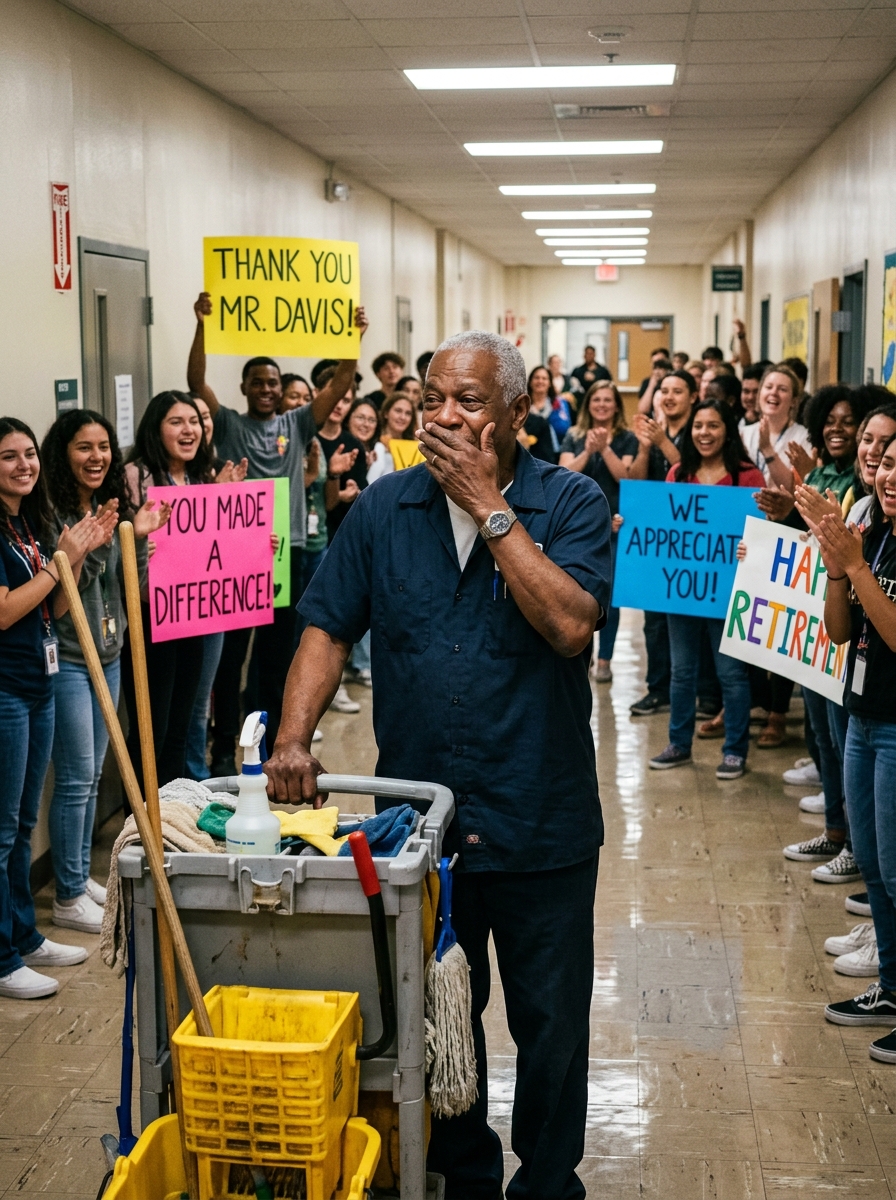
There were people everywhere.
At first, Darnell thought there must be some kind of assembly.
Men in work boots.
Women holding babies.
A young soldier in uniform.
A nurse still wearing scrubs.
A mechanic with grease under his fingernails.
Parents with teenagers.
Grandparents.
Former students he hadn’t seen in ten, twenty, even thirty years.
They lined both sides of the hallway from the gym doors all the way to the main entrance.
Hundreds of them.
And every single person held a piece of paper.
Darnell gripped the handle of his mop cart.
“What is this?”
A woman stepped forward.
He recognized her slowly.
“Melissa?”
She laughed through tears.
“You remembered.”
“You used to lose your lunchbox every Tuesday.”
The hallway erupted in laughter.
Melissa handed him her note.
On the front were four handwritten words:
**You waited with me.**
“I was nine,” she said. “My mom forgot to pick me up. You stayed until almost seven even though you weren’t getting paid.”
Another person stepped forward.
A tall man with a beard.
**You fixed my coat zipper.**
“I told everybody I wasn’t cold,” he said. “Truth was, we couldn’t afford another coat.”
Another.
**You taught me to change a tire.**
Another.
**You stopped the bullies without embarrassing me.**
Another.
**You gave me lunch money and told me I could pay you back when I became president.**
Someone shouted from the crowd, “He still owes you!”
Everybody laughed again.
Darnell covered his mouth.
Then a man near the back stepped forward.
Forty-something now.
Broad shoulders.
Work shirt.
Tears already running down his face.
Darnell stared at him.
“Terrence?”
Terrence nodded.
In his hands was a piece of notebook paper.
**If you’re strong enough to break something, you’re strong enough to fix it.**
Darnell’s knees nearly gave out.
Terrence hugged him.
“I own a repair shop now,” he whispered. “Got twelve employees. Every kid who comes to me looking for work hears that sentence.”
Darnell couldn’t answer.
Terrence pulled back.
“You thought you were fixing a locker that day.”
He shook his head.
“You were fixing me.”
That was when Darnell started crying.
Not politely.
Not the kind of tears a man wipes away before anyone notices.
He cried so hard that one of the teachers brought him a chair.
The hallway blurred.
Then the crowd began placing their notes inside the bucket of his mop cart.
One after another.
Hundreds of scraps of paper.
Different handwriting.
Different lives.
Different decades.
All carrying pieces of moments Darnell had barely remembered giving away.
By the time the last note dropped into the bucket, it was overflowing.
Someone had even taped a handwritten sign to the front of his cart.
**MR. MERCER’S LAST HALLWAY.**
Darnell sat there for a long time.
Then he looked toward the principal.
“How did you get all these people here?”
The principal smiled.
“We didn’t.”
A young teacher stepped forward.
She had posted a simple message online two weeks earlier asking former students if they had any memories of Mr. Mercer.
She expected a few replies.
She received hundreds.
People drove from three states away.
Some took the day off work.
One former student flew in that morning.
Because apparently, thirty-two years of quiet kindness had traveled much farther than Darnell ever knew.
His daughter arrived near the end.
She wrapped her arms around him and whispered, “Dad, you always said you didn’t leave much behind.”
Darnell looked at the hallway.
At the mechanic.
The nurse.
The soldier.
The mothers and fathers.
The nervous children who had grown into adults.
At an old mop bucket overflowing with handwritten proof that ordinary kindness is rarely ordinary to the person receiving it.
He shook his head.
“I guess I was wrong.”
That night, Darnell carried the notes home in a cardboard box.
He didn’t frame the retirement certificate.
He put it in a drawer.
But the notes went on his kitchen table.
For weeks, he read a few every morning with his coffee.
Some made him laugh.
Some made him cry.
And some described moments he couldn’t remember at all.
That may have been the greatest lesson of his life.
We spend so much time wondering whether anybody notices what we do.
Whether the rides matter.
Whether the extra five minutes matter.
Whether checking on someone matters.
Whether choosing patience instead of anger matters.
Most of the time, nobody applauds.
Nobody gives us a certificate.
Nobody tells us we changed anything.
But somewhere, years later, a grown man may still remember the person who sat beside him when he was ashamed.
A woman may remember who waited when nobody came for her.
A child may grow up repeating words you don’t even remember saying.
Darnell Mercer spent thirty-two years cleaning fingerprints from school hallways.
Only on his final day did he discover that kindness leaves fingerprints of its own.
The good we do quietly may be the part of us that echoes the longest.