
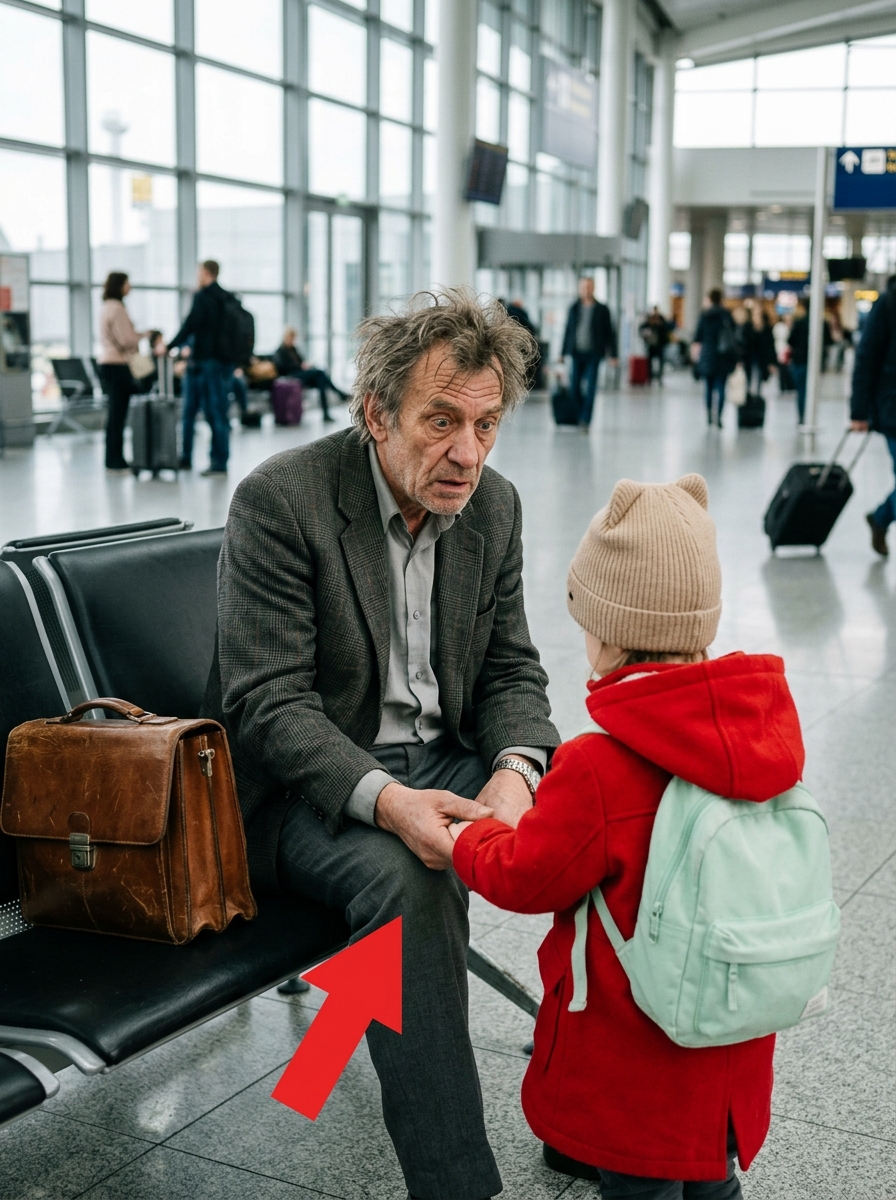
“Are you lost too, mister?”
Michael Warren looked down.
A little girl stood beside his airport chair with tears shining in her eyes.
She couldn’t have been more than four.
Michael had been staring at his phone, pretending to read an email from the corporate office. In reality, he had read the same three lines at least six times.
His divorce had become final three weeks earlier.
His daughter Sarah hadn’t returned one of his calls in six months.
And in forty-five minutes, Michael was supposed to board a flight to Seattle for what his business partners kept calling “the most important meeting of the year.”
He was fifty-seven years old.
Gray had started showing above his ears, though he still paid too much for haircuts meant to hide it.
His charcoal suit fit perfectly.
His shoes were polished.
His leather briefcase sat beside him.
Anyone looking at Michael would have assumed he had somewhere important to be.
The little girl apparently saw something different.
“Are you?” she asked again.
Michael slowly put his phone down.
She wore a red coat that looked one size too big and a tan knit hat with little cat ears on top. A pale green backpack hung from both shoulders.
Her lower lip trembled.
Michael glanced around the crowded terminal.
“Lost how, sweetheart?”
The girl pointed behind herself.
“I can’t find my mommy.”
Michael stood so quickly that his boarding pass slid from his lap.
“Okay.”
The girl flinched at the urgency in his voice, so Michael softened it.
“Okay. We’re going to figure this out.”
She looked up at him.
“You won’t leave?”
Something about those three words hit him harder than they should have.
You won’t leave?
Michael had spent thirty years leaving.
Leaving breakfast early because of meetings.
Leaving school programs before they ended.
Leaving family dinners to answer calls.
Leaving vacations two days early because somebody at the office had created what they called an emergency.
Leaving Sarah sitting on the front steps with her overnight bag because he had promised a father-daughter weekend and then changed the plan.
Again.
“I won’t leave,” he said.
The girl studied his face as if deciding whether adults could be trusted.
Then she slipped her tiny hand into his.
Michael froze.
Her fingers barely wrapped around two of his.
He couldn’t remember the last time someone had reached for him that simply.
“What’s your name?” he asked.
“Emma.”
“I’m Michael.”
She nodded seriously.
“My mommy says I’m not supposed to go with strangers.”
“Your mommy is right.”
Emma looked worried.
Michael almost smiled.
“So we’re not going anywhere private. We’re going right over there to the information desk where lots of people can see us.”
Emma looked toward the desk.
“That’s okay?”
“That’s exactly what we should do.”
She nodded.
They started walking.
Michael automatically moved at the fast pace he used in airports.
Emma’s arm stretched.
Her feet hurried.
He stopped.
“Sorry.”
He slowed down.
For the first time in years, Michael Warren matched his pace to someone else’s.
It was such a small thing that it almost embarrassed him.
Emma held his hand tightly.
“Do you fly on airplanes a lot?”
“A lot.”
“Why?”
“Work.”
She thought about that.
“Do you like work?”
Michael nearly gave his usual answer.
Of course.
I built something.
I’m proud of what I do.
It gave my family a good life.
He had said those sentences so many times they came out without thought.
But Emma was four.
She wasn’t impressed by job titles.
She wasn’t going to ask what his quarterly numbers looked like.
So Michael told her the truth.
“Not as much as I used to.”
Emma swung their joined hands.
“My mommy doesn’t like airports.”
“Why not?”
“She says everybody walks too fast.”
Michael looked around.
Hundreds of people moved past them with coffee cups, carry-ons, headphones, rolling bags, and faces aimed toward whatever came next.
He had always liked that about airports.
Nobody expected you to stay.
Nobody expected you to know anyone.
You could sit beside a stranger for two hours and never exchange names.
Lately, Michael had begun to wonder if he had built his whole life that way.
Always moving.
Always leaving.
Never staying long enough for anybody to need him.
“Your mom may have a point,” he said.
Emma squeezed his hand.
“She says people miss things when they hurry.”
Michael almost stopped walking.
Sarah had once said almost the same thing.
She had been thirteen.
They were driving home after one of her school concerts, and Michael had spent most of the drive checking messages at red lights.
“You miss everything,” she had muttered.
He had assumed she meant the music.
Years later, he finally understood she had meant more than that.
They reached the information counter.
Before Michael could speak, Emma suddenly turned.
“Mommy!”
A woman hurried toward them from across the terminal.
Her brown hair was pulled into a loose ponytail. Her blue sweater was wrinkled, one shoelace had come untied, and her face held the wild mix of fear and relief that appeared when someone found the thing they had been most afraid of losing.
“Emma!”
The girl released Michael’s hand.
Her mother dropped to her knees and wrapped both arms around her.
“I told you to stay beside the seats.”
“I was looking for you.”
“I was getting the boarding passes.”
“I couldn’t see you.”
“I know.”
The woman closed her eyes.
For several seconds she just held her daughter.
Michael stepped back.
This part had nothing to do with him.
Emma was safe.
His job was finished.
He could return to Gate 22, check his email, review the meeting notes, and become Michael Warren again.
He turned.
“Wait.”
The woman stood.
“Please.”
Michael faced her.
She was still holding Emma’s hand.
“I’m Jennifer Foster.”
“Michael.”
Jennifer gave a nervous little laugh.
“I’m sorry. My brain isn’t working right now.”
“You don’t need to apologize.”
“I turned around for maybe a minute. Maybe less. I thought she was standing right behind me.”
Emma looked down.
“I saw the cat picture.”
Jennifer closed her eyes.
“What cat picture?”
“On the lady’s suitcase.”
Michael pressed his lips together to keep from laughing.
Jennifer looked at her daughter.
“You followed a suitcase?”
Emma nodded.
“It was a really good cat.”
Jennifer stared at her.
Then she laughed.
Not because anything was funny.
It sounded more like her body had finally decided it could release some of the fear.
Michael laughed too.
Emma looked between them.
“It was orange.”
“That explains everything,” Michael said.
Emma smiled.
Jennifer brushed loose hair from her face.
“I don’t know how to thank you.”
“You don’t have to.”
“Yes, I do.”
“You found her thirty seconds after we reached the desk.”
“That thirty seconds matters.”
Michael didn’t know what to say.
Jennifer looked toward the gate behind her.
“We’re flying to Phoenix.”
“Family visit?”
“My mother.”
Jennifer exhaled.
“She’s selling the house I grew up in.”
Michael waited.
Jennifer gave an embarrassed shrug.
“That sounds silly compared to losing a child in an airport.”
“It doesn’t sound silly.”
“She’s seventy-two. She says the house is too much work now, and I understand. I really do.”
Emma leaned against her mother’s leg.
“But she raised me there.”
Jennifer’s voice became quieter.
“My dad built the back porch himself. Emma learned to walk in that living room. Every Christmas, every birthday, every ordinary Sunday dinner I can remember happened in that house.”
Michael understood ordinary places becoming important after it was too late.
The house he and his former wife had sold during the divorce had meant nothing to him when he was rarely home.
Then he had walked through it empty.
No sofa.
No photographs.
No shoes by the door.
And for the first time, he had noticed the pencil marks inside the laundry-room doorway where Sarah’s height had been recorded every birthday.
Age six.
Age seven.
Age eight.
By age nine, several dates were written in his wife’s handwriting instead of his.
By age twelve, all of them were.
Michael had stood there alone with his hand pressed against those marks.
He hadn’t cried.
That would have required admitting exactly what they meant.
He had simply walked outside and called the realtor.
“I understand,” Michael said.
Jennifer smiled weakly.
“We’re supposed to help her pack this weekend. I was already worried about keeping Emma entertained and getting boxes sorted and not turning every old coffee mug into a family discussion.”
“I like Grandma’s coffee mugs,” Emma announced.
“I know you do.”
“They have birds.”
“I know.”
“And one says—”
“No reading Grandma’s mugs to strangers.”
Emma looked disappointed.
Michael laughed again.
It felt unfamiliar.
Jennifer seemed to notice.
“So,” she said, “where are you headed?”
“Seattle.”
“Work?”
He looked down at his suit.
“That obvious?”
“A little.”
Michael checked his watch.
Forty minutes.
His normal airport routine was carefully organized.
Twenty minutes in the lounge.
Ten minutes answering messages.
Board as soon as his group was called.
Sit down.
Laptop open.
Work until takeoff.
He could still do all of it.
Emma tugged on his sleeve.
“You said you were lost too.”
Jennifer looked at him.
Michael felt heat rise in his face.
“I didn’t exactly say that.”
Emma frowned.
“You said maybe.”
Jennifer raised one eyebrow.
Michael gave a helpless shrug.
“She asked.”
“And?”
“I told her maybe.”
Emma looked satisfied.
Jennifer smiled.
“I’m guessing she meant physically lost.”
“I’m not sure she did.”
Emma climbed onto a nearby chair.
“I asked because he looked sad.”
Michael looked at her.
“I looked sad?”
“Yes.”
“I was working.”
“You looked sad while working.”
Jennifer covered her mouth.
Michael stared at the four-year-old.
“Well.”
He sat in the chair across from Emma.
“That’s fairly direct.”
“My mom says I’m practicing manners.”
“You’re doing great.”
Jennifer laughed.
Then the announcement system called for passengers on their flight to wait near another gate because boarding had been pushed back.
Jennifer looked toward it.
“Great.”
“How long?”
“Thirty minutes.”
Michael pointed to the empty chair beside Emma.
“You might as well sit.”
Jennifer hesitated.
“You have your own flight.”
“Not yet.”
She sat down.
Emma immediately climbed into the seat between them.
Michael should have opened his laptop.
Instead, he put his phone facedown.
Jennifer noticed that too.
“I haven’t seen anyone do that in an airport in years.”
“Do what?”
“Put a phone down.”
“It might be the bravest thing I do today.”
Emma kicked her feet.
“You can talk to us.”
Apparently he could.
For a while, Emma did most of the talking.
She told Michael about kindergarten.
She told him that her grandmother owned seven bird mugs, not six.
She told him about a gray cat named Whiskers that had been named by someone who, according to Emma, “did not try very hard.”
She could count to thirty, but sometimes skipped twenty-seven because she didn’t like it.
Michael asked why.
“It feels too close to thirty.”
He nodded.
“Fair.”
Jennifer watched them.
“You’re good with kids.”
Michael looked down at his hands.
“No.”
“I think you are.”
“I used to have practice.”
“Used to?”
“I have a daughter.”
Jennifer waited.
Michael felt the old reflex rise.
Change the subject.
Ask about her job.
Look at his phone.
Make a joke.
Anything except open that door.
But Emma was leaning against his arm.
And Jennifer had told him about the house.
So Michael said it.
“Sarah’s twenty-four.”
“Where does she live?”
“Boston.”
“That’s a long way from here.”
“Yes.”
“Do you see her much?”
Michael rubbed his thumb against the edge of his watch.
“No.”
Jennifer didn’t push.
That made it worse.
“She hasn’t spoken to me in six months.”
Emma stopped kicking her feet.
“Why?”
Jennifer touched her daughter’s shoulder.
“Emma.”
“It’s okay.”
Michael stared toward the windows.
“There isn’t one reason.”
That was what he had told himself for years.
Relationships were complicated.
His marriage had failed for many reasons.
Sarah had become distant because adult children become independent.
Work had been demanding.
His former wife had become resentful.
Everybody had made mistakes.
All technically true.
All very convenient.
Michael had spent most of his life being good with language.
He knew how to explain a failure without admitting fault.
That skill had made him valuable in conference rooms.
It had made him unbearable at home.
“I missed things,” he said.
Jennifer nodded.
“What kind of things?”
Michael almost answered lightly.
Then he remembered Emma saying people miss things when they hurry.
“Everything.”
He looked at Jennifer.
“Not every single event. That would almost have been easier to explain.”
He leaned back.
“I showed up just often enough to convince myself I was involved.”
Sarah’s fifth-grade play.
He arrived during the final applause.
Her twelfth birthday.
He came home after everybody had left and gave her an expensive camera she hadn’t asked for.
The first day she got her driver’s license.
He texted congratulations from another city.
Her high school graduation.
He was there.
He spent half the afternoon taking calls in the parking lot.
College move-in day.
His assistant handled the hotel because Michael was coming directly from a meeting.
When his flight was delayed, he told Sarah and her mother to go without him.
He arrived the following morning.
By then, Sarah’s roommate’s father had already helped assemble the desk Michael had promised they would build together.
“She stopped expecting me,” he said.
Jennifer’s expression changed.
Not judgment.
Something worse.
Understanding.
Michael continued.
“That’s what I didn’t see.”
Emma looked up at him.
“Expecting you where?”
“Places I told her I would be.”
“Why didn’t you go?”
Michael swallowed.
“Because I kept thinking my work was more important.”
Emma frowned.
“Was it?”
“No.”
The answer came immediately.
It surprised him.
“No,” Michael repeated. “It wasn’t.”
Jennifer spoke softly.
“What finally happened between you?”
Michael looked toward his gate.
Thirty-two minutes.
The meeting in Seattle was supposed to close a partnership his team had pursued for nearly a year.
People were waiting.
Documents had been prepared.
A dinner reservation had been made.
Somewhere in the back of his mind, the old Michael was tapping his watch.
But the rest of him was tired of running from the question.
“Her graduation from college.”
Jennifer remained quiet.
“I promised her six months in advance.”
Michael could still see Sarah standing in his kitchen.
She had pointed at him.
“No meetings.”
“No meetings,” he had promised.
“No calls during the ceremony.”
“No calls.”
“No sending Mom by herself and saying you’ll meet us later.”
“I’ll be there.”
She had narrowed her eyes.
“Promise?”
“I promise.”
Michael had believed himself when he said it.
That was the worst part.
Two days before graduation, a client moved an important meeting.
Michael could have said no.
Instead, he told himself the meeting would be finished in plenty of time.
It wasn’t.
His flight was delayed.
He landed after the ceremony.
He called Sarah repeatedly.
No answer.
He sent flowers.
No response.
He went to the graduation dinner and found one empty chair waiting at the table.
His chair.
Sarah had already left.
Three days later she finally called.
She didn’t yell.
Michael almost wished she had.
She said, “Dad, I’m done building special days around the possibility that you might show up.”
Then she hung up.
He told himself she needed time.
A week became a month.
A month became three.
Three became six.
And every time Michael called, he left a message that sounded almost identical.
Hey, Sarah. Just checking in. Hope you’re doing well. Call me when you get a chance.
Never the one thing he actually needed to say.
I failed you.
“I kept thinking she’d calm down,” Michael admitted.
Jennifer winced slightly.
Michael noticed.
“That sounded bad.”
“It sounded familiar.”
“With your mother?”
“With me.”
Jennifer folded her hands.
“My dad and I didn’t talk for almost a year when I was in my twenties.”
“What happened?”
“I wanted him to admit he had hurt me.”
She shrugged.
“He wanted me to stop being hurt before he apologized.”
Michael stared at her.
“That’s uncomfortable.”
“Sorry.”
“No. It should be.”
Jennifer smiled.
“My father and I eventually figured it out. But only when he stopped explaining himself.”
Michael looked away.
Explanations were his specialty.
“I have a lot of explanations.”
“I guessed.”
“I worked because I wanted my family to have security.”
“I believe you.”
“I wanted Sarah to have opportunities I didn’t have.”
“I believe that too.”
“My own father worried about every bill. I remember hearing my parents whisper at the kitchen table. I promised myself my family would never live like that.”
Jennifer nodded.
Michael waited for her to tell him that made everything understandable.
She didn’t.
Finally he said, “You’re not going to let me off the hook, are you?”
“I don’t know you well enough to put you on one.”
That made him smile.
Jennifer continued.
“But good intentions and good results aren’t always the same thing.”
Michael looked at Emma.
She had grown quiet.
Her head rested against his arm.
“You can love somebody and still disappoint them,” Jennifer said.
Michael swallowed.
“You can also be sorry and still have to give them time.”
“That sounds less encouraging.”
“It’s more honest.”
Michael nodded.
Honesty.
He had spent thirty years negotiating.
Find the angle.
Control the room.
Know what the other side wants.
Never show more uncertainty than necessary.
No wonder calling Sarah terrified him.
There was nothing to negotiate.
No strategy guaranteed success.
Jennifer looked at him.
“Have you ever actually told her all that?”
“All what?”
“What you just told me.”
Michael thought.
“I’ve told her I was sorry.”
“What did you say?”
“I said, ‘I’m sorry things got so strained between us.’”
Jennifer tilted her head.
“That’s different.”
He knew it.
“I said I wished graduation had worked out differently.”
“That’s different too.”
Michael rubbed his face.
“I sound terrible.”
“No.”
Jennifer shook her head.
“You sound scared.”
That landed harder.
Michael lowered his hand.
“Scared of what?”
“That if you say exactly what you did wrong, you can’t hide from it anymore.”
Michael said nothing.
Emma yawned.
She leaned farther against him.
Within minutes, the child who had been crying alone in an airport had fallen asleep with her cheek against the sleeve of Michael’s expensive suit.
He barely moved.
Jennifer smiled.
“I’m sorry.”
“Don’t be.”
“You’ll have a tiny hat imprint on your arm.”
“I’ve survived worse.”
For several minutes, neither adult spoke.
Michael watched travelers hurry past.
He saw a father carrying a sleeping boy on one shoulder while pulling a suitcase with his free hand.
An older couple shared a bag of pretzels.
A teenager sat cross-legged on the floor beside her mother, both laughing at something on a phone.
Ordinary moments.
Michael used to think important moments announced themselves.
Graduations.
Birthdays.
Promotions.
Anniversaries.
He had missed so many ordinary moments because he was saving himself for the important ones.
Now he wondered if the ordinary moments had been the important ones all along.
Sarah eating cereal at the kitchen counter.
Sarah asking him to look at a drawing.
Sarah waiting in the driveway.
Sarah wanting him to watch an old movie with her on a Sunday afternoon.
Sarah calling during college just to tell him about a professor she liked.
He had answered that call.
He had also said, after four minutes, “Sweetheart, can I call you tonight? I’m heading into something.”
He never called.
The memory was so small he had almost forgotten it.
Maybe Sarah hadn’t.
“Jennifer?”
“Yeah?”
“What if she doesn’t forgive me?”
Jennifer looked down at her sleeping daughter.
“Then you respect that.”
Michael nodded slowly.
“And you keep becoming the person you should have been anyway.”
He looked at her.
“For what purpose?”
“For yours.”
She glanced at him.
“And maybe someday she notices.”
Michael had expected a neat answer.
Apologize.
She forgives you.
Happy ending.
Jennifer wasn’t offering one.
That made him trust her more.
“You don’t repair twenty years in one phone call,” she said.
Michael looked at his watch.
Twenty-seven minutes.
“I don’t know what to say.”
“You do.”
“No. I really don’t.”
Jennifer smiled.
“Start with her name.”
Michael laughed under his breath.
“Then what?”
“Don’t tell her what you meant to do.”
He nodded.
“Tell her what you did.”
His smile disappeared.
“Tell her you understand why she stopped answering.”
Michael stared at the floor.
“That’s the hard part.”
“Probably.”
“I keep wanting her to understand my side.”
“Maybe she already does.”
Michael looked up.
Jennifer’s voice remained gentle.
“Kids understand more than parents think. She may completely understand why you worked so much.”
“Then why—”
“Understanding why somebody hurt you doesn’t make the hurt disappear.”
Michael went quiet.
Nobody had ever said it to him like that.
His former wife had tried.
Sarah had tried.
Counselors had probably tried.
But he had always been preparing his answer instead of listening.
Now, in an airport beside a stranger and a sleeping four-year-old, he finally heard it.
An announcement came over the speakers.
Michael’s flight.
Pre-boarding would begin soon.
His stomach tightened.
He picked up his phone.
Nine unread messages.
Three from his assistant.
Two from a business partner.
One subject line read:
SEATTLE — FINAL DETAILS.
Michael opened it.
A schedule filled the screen.
Arrival.
Car service.
Pre-meeting review.
Dinner.
Morning follow-up.
His entire day had been decided in fifteen-minute pieces.
He stared at it.
Jennifer noticed.
“You should probably go.”
“Yes.”
But Michael didn’t stand.
“You have an important meeting.”
“Yes.”
Emma stirred.
Her eyes opened halfway.
“Michael?”
“I’m still here.”
She blinked at him.
“Did you call your daughter?”
Michael looked at Jennifer.
Jennifer raised both hands.
“I didn’t tell her to ask.”
Michael smiled.
“No, Emma.”
“Why?”
“I haven’t figured out what to say.”
Emma sat upright.
Her cat-eared hat was crooked.
“You say hi first.”
Jennifer laughed.
Michael nodded.
“Your mother just gave me the same advice.”
“Then we’re both right.”
“Probably.”
Emma thought for a moment.
“Then you say you love her.”
Michael’s smile faded.
“That simple?”
“My mommy tells me every day.”
Jennifer looked at her daughter.
Emma continued.
“Even when she’s mad.”
“That happens frequently,” Jennifer said.
“Yesterday I colored on a receipt.”
“An important receipt.”
“I made flowers.”
“You made many flowers.”
Michael looked between them.
Something tightened in his chest.
“When did you last tell Sarah you loved her?” Jennifer asked.
Michael opened his mouth.
Closed it.
Christmas?
Maybe.
He had mailed a gift and written Love, Dad on the card.
Did that count?
The previous summer?
He couldn’t remember.
That frightened him more than any business deal ever had.
Emma climbed down.
Her boarding announcement had begun.
Jennifer gathered their bags.
Michael stood too.
“Well,” Jennifer said, “looks like that’s us.”
Emma put on her backpack.
Then she wrapped both arms around Michael’s legs.
He looked startled.
Jennifer smiled.
“Emma hugs.”
“So I see.”
Emma looked up.
“Don’t be lost anymore.”
Michael’s throat tightened.
“I’m working on it.”
“You know where Sarah lives?”
“Yes.”
“Then you’re not lost.”
Jennifer and Michael exchanged a look.
Adults spent years making things complicated.
Children had no patience for that.
Jennifer extended her hand.
“Thank you.”
Michael shook it.
“For Emma?”
“For everything.”
Michael looked at her.
“I think I should be thanking you.”
“You found my daughter.”
“And somehow the two of you found something I’ve been avoiding for years.”
Jennifer squeezed his hand.
“Call her.”
Michael nodded.
Jennifer and Emma started toward their gate.
Emma turned around.
“Michael!”
“Yes?”
“Hi first!”
He laughed.
“Hi first.”
Then they disappeared into the line.
Michael stood alone.
His airport suddenly felt different.
His phone buzzed.
A message from his assistant.
CAR CONFIRMED IN SEATTLE. SEE YOU THERE.
Michael looked at his boarding pass.
Then he looked at Sarah’s name on his phone.
He had called fourteen times over the past six months.
Fourteen careful voicemails.
Fourteen messages designed to avoid saying anything uncomfortable.
His thumb hovered over the screen.
He could call tomorrow.
After Seattle.
When he had more time.
When he had thought through his wording.
When he felt less emotional.
When Sarah might be in a better mood.
Michael suddenly saw the pattern.
Tomorrow had been his favorite word for twenty-five years.
Tomorrow I’ll leave work early.
Tomorrow we’ll have dinner.
Tomorrow we’ll talk.
Tomorrow I’ll make it up to you.
Tomorrow I’ll be different.
There was always another tomorrow.
Until one day your daughter stopped answering.
Michael pressed CALL.
One ring.
He nearly ended it.
Two rings.
His chest tightened.
Three.
He stood up.
Four.
Then—
“Dad?”
Michael stopped breathing.
Sarah.
Her voice.
Not voicemail.
Not an old recording.
Her.
“Sarah.”
Silence.
He remembered Emma.
Hi first.
“Hi.”
Another silence.
“Hi, Dad.”
Her voice was careful.
Not warm.
Not angry.
Careful.
Somehow that hurt more.
Michael started walking away from the boarding line.
“I know you probably don’t want to talk.”
“I have a few minutes.”
A few minutes.
The old Michael might have been offended.
He was her father.
Surely he deserved more than a few minutes.
The new thought came immediately afterward.
She had given him years.
“Thank you.”
Sarah said nothing.
Michael closed his eyes.
Do not explain.
Tell her what you did.
“I’m sorry.”
Sarah exhaled.
“Dad—”
“No.”
His voice cracked.
“I mean, you can stop me whenever you want. But I need to say this differently than I’ve been saying it.”
Silence.
Michael continued.
“I keep telling you I’m sorry things became strained.”
His hand was trembling.
“That isn’t an apology.”
Sarah still didn’t speak.
“I keep saying I’m sorry I missed graduation because my flight was delayed.”
Michael swallowed.
“The flight being delayed wasn’t the problem.”
He looked down at the boarding pass.
“The problem was that I scheduled the meeting.”
Sarah breathed in sharply.
“I could have said no.”
Michael felt his face grow hot.
“I didn’t.”
Around him, passengers began lining up.
His group number was called.
Michael walked farther away.
“I promised you I would be there, and I chose work anyway.”
He heard a sound on Sarah’s end.
Maybe movement.
Maybe a door closing.
“I did that your whole life.”
“Dad.”
“I know.”
“No, you don’t.”
The words were quiet.
Michael stopped.
Sarah’s voice changed.
“You don’t know.”
He pressed the phone tighter to his ear.
“Then tell me.”
A long silence.
Michael waited.
For once, he didn’t fill it.
Finally Sarah spoke.
“You remember my sixteenth birthday?”
Michael searched his memory.
Restaurant.
Cake.
A silver necklace.
“Yes.”
“Do you remember leaving?”
Michael’s stomach dropped.
“I got called back to the office.”
“You left before they brought the cake.”
“I remember.”
“I told everybody you were parking the car.”
Michael closed his eyes.
“I didn’t want my friends to know you had left.”
Sarah laughed once, but there was no humor in it.
“I sat there telling people you’d be right back.”
Michael could see it now.
Sixteen-year-old Sarah.
Her friends.
An empty chair.
“I’m sorry.”
“You sent the necklace with Mom.”
“I know.”
“I didn’t want a necklace.”
“I know that now.”
“No.”
Her voice sharpened.
“You keep saying that. ‘I know now.’”
Michael said nothing.
“I wanted you to stay.”
His throat closed.
“I know.”
Sarah breathed out.
“Do you remember the college tour?”
Michael’s stomach tightened again.
“No.”
“Exactly.”
He closed his eyes.
“I was seventeen.”
She continued.
“You told me you’d spend the whole Saturday with me.”
Michael remembered now.
A university two hours from home.
A campus visit.
He had sent his wife instead.
“I had a meeting.”
“Yes.”
“I’m sorry.”
“Mom drove me.”
Sarah’s voice softened.
“I had a good day with her.”
Michael stared at the terminal floor.
“But every other girl there seemed to have her dad carrying brochures and making terrible jokes.”
She paused.
“And I kept looking at them.”
Michael’s eyes filled.
He turned toward the wall so strangers wouldn’t see his face.
“I’m sorry, Sarah.”
She sniffed.
“And then I hated myself for caring because I knew you were working for us.”
There it was.
Jennifer had been right.
She understood.
That had never made it hurt less.
“You bought everything,” Sarah continued.
“My laptop. My first car. College. Trips.”
She paused.
“I know how lucky I was.”
“You didn’t owe me gratitude for being absent.”
Silence.
Michael had never said anything like that before.
Sarah seemed equally surprised.
“Dad…”
“I thought providing for you was the same as being there.”
He rubbed his eyes.
“It wasn’t.”
Passengers walked past him.
Some hurried.
Some argued about boarding groups.
Michael barely noticed.
“I thought if I gave you enough, eventually you’d understand why I missed things.”
He took a breath.
“That was selfish.”
Sarah was crying now.
He could hear it.
Michael’s own voice shook.
“You shouldn’t have had to make my excuses for me.”
She didn’t answer.
“You shouldn’t have had to tell your friends I was parking the car.”
Michael covered his mouth.
“You were sixteen.”
Years of excuses collapsed in one sentence.
“You were sixteen, and you were protecting me from looking bad.”
“Dad…”
“I’m so sorry.”
His voice broke.
“I’m so sorry I made you do that.”
Neither spoke for several seconds.
The final boarding call for Michael’s flight sounded behind him.
Sarah heard it.
“Are you at the airport?”
“Yes.”
“Where are you going?”
“Seattle.”
“For work?”
“Yes.”
She gave a tired little laugh.
“Of course.”
Michael looked toward the gate.
People were disappearing down the jet bridge.
The agent glanced his way.
He had perhaps two minutes.
Michael stared at the boarding pass.
A year of work.
Important people waiting.
A major contract.
His partners would be furious.
He thought about sixteenth-birthday cake.
A college tour he had forgotten.
A graduation chair left empty.
Then Emma’s voice returned to him.
You know where Sarah lives?
Then you’re not lost.
“Actually,” Michael said, “I don’t think I’m going to Seattle.”
Sarah stopped crying.
“What?”
“I said I don’t think I’m going.”
“Because of this call?”
“Because I finally understand something I should have understood years ago.”
“Dad, don’t do something dramatic.”
He almost smiled.
“That sounds exactly like your mother.”
“I’m serious.”
“So am I.”
He watched the gate door close.
His flight was gone.
Michael waited for panic.
For his pulse to race.
For the old voice inside his head to scream about contracts and reputation and consequences.
Instead, he felt strangely calm.
“Sarah?”
“Yes?”
“Would you let me come see you?”
She didn’t respond.
“Not to fix everything.”
Michael hurried to clarify.
“Not to force a big conversation. Not to make you forgive me.”
Still nothing.
“I could fly to Boston.”
“Today?”
“Yes.”
“Dad.”
“I know.”
“That’s a little much.”
“You’re right.”
He forced himself not to argue.
“What would feel okay?”
Sarah sniffed.
That question seemed to surprise her.
“I don’t know.”
“That’s fair.”
Another silence.
Finally she said, “Coffee.”
Michael smiled.
“Coffee.”
“One coffee.”
“One coffee.”
“At the diner near my apartment.”
“Okay.”
“Tomorrow morning.”
His instinct was to say he could be there tonight.
He stopped himself.
“Tomorrow morning.”
“And Dad?”
“Yes?”
“I’m not promising anything.”
“I know.”
“I’m still angry.”
“You should be.”
“I’m not ready to pretend everything is okay because you made one phone call.”
“I don’t want you to.”
Sarah took a shaky breath.
“Okay.”
Michael could barely speak.
“Okay.”
“Ten o’clock.”
“I’ll be there.”
Sarah started to hang up.
“Sarah?”
“What?”
He hesitated.
Emma’s voice again.
Then you say you love her.
“I love you.”
Silence.
Michael’s heart pounded.
“I should have said that more.”
Still silence.
“And shown it better.”
Michael wiped his face.
“I’m not asking you to say anything back.”
Sarah breathed out.
Then, very quietly, she said, “I love you too, Dad.”
The call ended.
Michael stood against the airport wall holding his phone.
He didn’t move.
His Seattle flight was gone.
The meeting schedule was useless.
His assistant had sent three new messages.
He opened none of them.
Instead, Michael sat down.
For maybe five minutes, the fifty-seven-year-old man who had once believed he could manage every problem simply sat in an airport chair and cried quietly.
Not dramatic tears.
Not movie tears.
Just the tired tears of someone finally admitting how much time he had wasted.
Then he bought a ticket to Boston.
His phone rang immediately afterward.
His business partner.
Michael answered.
“Where are you?”
“At the airport.”
“The plane left.”
“I know.”
“You missed it?”
“Yes.”
Silence.
“Michael, the meeting.”
“I know.”
“What happened?”
Michael looked at the new boarding pass in his hand.
“Something personal came up.”
“Can you get the next flight?”
“Not to Seattle.”
Another silence.
“What does that mean?”
“It means I won’t be at the meeting.”
The voice on the other end tightened.
Michael listened.
There were consequences.
Disappointment.
Questions.
A year ago, even an hour ago, Michael would have rushed to solve all of them.
Now he simply said, “I understand.”
He didn’t blame the airport.
He didn’t invent an emergency.
He didn’t pretend he had no choice.
He had a choice.
That was the whole point.
When the call ended, Michael felt terrible.
And relieved.
Both things could be true.
His new flight didn’t leave for three hours.
Normally, Michael would have gone to the lounge.
Instead, he walked through the terminal.
Slowly.
He passed the information desk where he had taken Emma.
The woman working there looked up.
“Everything okay?”
Michael smiled.
“I think so.”
He bought a plain turkey sandwich and sat near the windows.
No laptop.
No email.
He watched people.
He wondered where Emma and Jennifer were.
Maybe they had reached Phoenix.
Maybe Emma was already telling her grandmother about the lost man she found at the airport.
The thought made him smile.
Then his smile disappeared.
Because he suddenly realized something.
He didn’t know Sarah anymore.
Not really.
He knew where she lived.
He knew she worked for a small publishing office.
He knew she had changed apartments the previous year.
He knew facts.
But he didn’t know the name of her closest friend.
He didn’t know what she did on Sunday mornings.
He didn’t know whether she still loved old black-and-white movies.
He didn’t know what she ordered in coffee shops.
He didn’t know what made her laugh now.
He remembered Sarah at eight better than Sarah at twenty-four.
That frightened him.
For years, Michael had thought reconciliation meant Sarah returning to him.
Now he understood that he was the one who needed to make the journey.
The flight to Boston felt longer than any flight he could remember.
He didn’t work.
He wrote instead.
Not an email to Sarah.
A list.
Things I Need to Stop Saying.
At the top, he wrote:
I was busy.
I did it for the family.
You know I loved you.
Your mother understood.
I couldn’t control the schedule.
Then he added:
Things I Need to Start Doing.
Listen.
Show up when I say I will.
Don’t make her manage my feelings.
Don’t expect quick forgiveness.
Ask about her life.
Remember the answers.
He stared at the final line for a long time.
Then wrote:
Stay.
Michael had always been good at arriving.
Staying was the part he needed to learn.
The next morning, he reached the diner at 9:35.
He almost laughed when he saw the time.
Twenty-five minutes early.
He had spent Sarah’s childhood arriving late.
Now he was terrified to be even one minute behind.
The diner sat on the corner of a quiet neighborhood street.
Nothing fancy.
Red vinyl booths.
A long counter.
Coffee cups stacked behind the register.
A handwritten specials board.
Michael chose a booth near the back.
Then he changed his mind.
What if Sarah preferred the counter?
He moved.
Then he decided moving looked nervous.
He returned to the booth.
At 9:48, he checked the door.
At 9:51, again.
9:53.
9:57.
At 10:02, Michael’s stomach tightened.
Maybe she had changed her mind.
At 10:04, the door opened.
Sarah walked in.
Michael stopped breathing.
She wore jeans, a green sweater, and white sneakers.
Her brown hair was shorter than the last time he had seen her.
That alone hurt.
When had she cut it?
How long had it been that way?
Sarah saw him.
She stopped.
For a second, neither moved.
Michael started to stand.
Sarah raised one hand.
“Don’t make it weird.”
He sat back down.
“Okay.”
She reached the booth.
“Hi.”
“Hi.”
Emma would have approved.
Sarah sat across from him.
A server brought coffee.
Michael remembered Sarah used to put two sugars in hers.
He almost reached for them.
Then stopped.
“How do you take your coffee now?”
Sarah looked at him.
“Black.”
Michael nodded.
“Black.”
A tiny thing.
A fact he no longer knew.
They sat in silence.
Michael resisted every instinct to fill it.
Sarah finally spoke.
“So you really missed the meeting?”
“Yes.”
“Were they angry?”
“Yes.”
“Is that bad?”
“It’s complicated.”
Sarah looked down.
“I don’t want you blaming me later.”
“I won’t.”
“You say that now.”
Michael nodded.
“You’re right to worry about that.”
She looked up, surprised.
“I made the choice.”
He stirred his coffee.
“You didn’t ask me to miss anything.”
“No.”
“So it belongs to me.”
Sarah studied him.
“You sound different.”
“I met a four-year-old.”
That earned the smallest smile.
“I’m serious.”
“I know. That’s why it’s funny.”
Michael told her about Emma.
The red coat.
The cat hat.
The orange-cat suitcase.
The information desk.
He told her how Emma had asked if he was lost.
Sarah listened.
When he finished, she shook her head.
“So a preschooler finally got through to you.”
“Apparently.”
“I spent twenty years trying.”
“I know.”
Her smile vanished.
Michael leaned forward.
“And I’m sorry it took a stranger.”
Sarah looked toward the window.
“Mom tried too.”
“I know.”
“No. I don’t think you do.”
Michael waited.
“She used to defend you.”
Sarah’s fingers tightened around her coffee cup.
“All the time.”
Michael looked down.
“She’d say, ‘Your father loves you. He’s working hard.’”
Sarah swallowed.
“Then eventually she stopped saying it.”
Michael felt a familiar urge to defend himself.
Their marriage had problems on both sides.
His former wife had made mistakes.
He could list them.
He said none of it.
Sarah continued.
“That’s when I knew she was tired too.”
Michael’s eyes burned.
“I’m sorry.”
“She wanted you home.”
“I know.”
“She didn’t want the bigger house.”
Michael froze.
“What?”
Sarah looked directly at him.
“She told you that.”
Michael remembered a conversation.
Vaguely.
His wife standing in their old kitchen.
They were discussing moving to a larger house after one of Michael’s promotions.
She had said, “I don’t care about another bedroom. I want you to eat dinner here.”
Michael had laughed.
Not cruelly.
He had kissed her forehead and said she would love the new place once she saw the backyard.
They moved six months later.
Michael stared into his coffee.
“She did tell me.”
Sarah nodded.
“That’s what hurts.”
“What?”
“You heard everybody.”
Her eyes filled.
“You just always decided you knew better.”
Michael had no answer.
Sarah wiped her cheek.
“I don’t want to spend this whole breakfast attacking you.”
“You’re not.”
“It feels like it.”
“You’re telling me what happened.”
She looked at him.
“And I need to hear it.”
Sarah’s expression softened slightly.
Michael continued.
“I spent years thinking you and your mother didn’t understand me.”
He gave a sad smile.
“I’m starting to think I was the one who didn’t understand either of you.”
The server returned.
Sarah ordered scrambled eggs and toast.
Michael ordered the same without thinking.
Sarah noticed.
“You hate scrambled eggs.”
Michael blinked.
“I do?”
“You always did.”
He looked at the server.
“Actually, could I get them fried?”
Sarah laughed.
A real laugh.
Small.
Brief.
But real.
Michael smiled.
“There she is.”
Sarah’s face immediately closed.
Michael regretted the words.
“Sorry.”
She looked down.
“No, it’s okay.”
“I shouldn’t act like everything’s normal because you laughed once.”
Sarah glanced up.
“You really have been thinking about this.”
“Nonstop.”
Their food arrived.
For a while, they talked about ordinary things.
Sarah’s apartment.
Her job.
A coworker who kept leaving mystery snacks in the break room.
A used bookstore she liked.
Michael listened.
Actually listened.
He asked follow-up questions.
Not because some counselor had told him to.
Because he realized he wanted to know.
Sarah noticed.
At one point she stopped mid-sentence.
“What?”
Michael looked confused.
“You’re not checking your phone.”
His phone was in his coat pocket.
“I turned it off.”
Sarah stared at him.
“Off?”
“Yes.”
“You know phones have a silent setting, right?”
“I was afraid I’d look.”
Sarah smiled.
Michael smiled back.
“I know myself.”
After breakfast, they walked outside.
Michael didn’t know what happened next.
Was there supposed to be a hug?
A plan?
Sarah stood with her hands inside her sweater sleeves.
“Thank you for coming.”
“Thank you for letting me.”
She nodded.
Michael waited.
Sarah looked uncomfortable.
“I’m not ready for everything.”
“I know.”
“I don’t want daily phone calls.”
“Okay.”
“And don’t start sending huge gifts.”
Michael winced.
“I do that.”
“Yes.”
“I won’t.”
“And please don’t call Mom and tell her we fixed things.”
“We didn’t.”
Sarah looked relieved.
“We had breakfast.”
Michael nodded.
“We had breakfast.”
“That was good.”
His chest tightened.
“It was very good.”
Sarah glanced down the sidewalk.
“Maybe we could do it again.”
Michael tried not to react too strongly.
“When?”
“I don’t know.”
“Whenever you’re ready.”
She nodded.
“And Dad?”
“Yes?”
“Don’t fly across the country every time.”
He smiled.
“That seems fair.”
“You can call.”
Michael’s eyes filled.
“Really?”
Sarah laughed.
“You don’t have to look so shocked.”
“I’m trying not to.”
She took a step toward him.
Then stopped.
Michael remained exactly where he was.
Sarah stepped forward again and hugged him.
It lasted maybe three seconds.
Michael did not squeeze too hard.
He did not say anything dramatic.
He simply closed his eyes.
When Sarah pulled away, she pointed at him.
“Three seconds.”
“That was at least four.”
“Don’t push it.”
Michael laughed.
She smiled.
Then she walked away.
Michael watched until she turned the corner.
For once, he did not immediately pull out his phone.
He stood there.
He let the moment finish.
Over the next few months, nothing magical happened.
That was important.
Michael did not become the perfect father because a little girl found him in an airport.
Sarah did not forget twenty years of disappointment.
Some phone calls were awkward.
One ended after four minutes.
Once, Michael forgot Sarah had told him about an important presentation at work.
When he asked three days later how it went, she said, “I told you about that.”
Michael felt terrible.
His old instinct was to defend himself.
Instead he said, “You did. I forgot. I’m sorry.”
Another time, Sarah canceled dinner because she was tired.
Michael almost said, “But I cleared my whole evening.”
He caught himself.
“That’s okay. Another day.”
Sarah became quiet.
“What?”
“Nothing.”
“No, tell me.”
She hesitated.
“Old you would’ve made me feel guilty.”
Michael closed his eyes.
“I’m sorry.”
“You didn’t do it this time.”
“That doesn’t erase the other times.”
“No.”
She paused.
“But it matters.”
Michael held on to that.
It matters.
Not fixed.
Not forgotten.
Not erased.
But mattered.
He also changed at work.
Not dramatically.
He didn’t quit.
He didn’t throw away his career.
He simply began saying no sometimes.
At first, people acted as if the building might collapse.
Michael Warren?
Unavailable after six?
Michael Warren?
Taking Friday afternoon off?
Michael Warren?
Declining a dinner because he already had plans with his daughter?
He discovered something shocking.
The company survived.
Meetings happened without him.
Problems were solved.
People adapted.
He had spent years believing everything depended on his presence.
The painful truth was that his family had needed his presence far more than his office ever had.
One Friday evening, Sarah called.
“Are you busy?”
Michael looked at his laptop.
“Yes.”
He closed it.
“But I can stop.”
Silence.
Then Sarah said, “I found something.”
“What?”
“A box from the old house.”
Michael sat straighter.
“Mom gave it to me after the divorce.”
“What’s in it?”
“Pictures.”
His stomach tightened.
“Good ones?”
“Some.”
He heard paper moving.
“There’s one of us at the lake.”
Michael smiled.
Sarah was nine.
She had worn an oversized life vest and spent half the weekend trying to catch tiny fish with a plastic net.
“I remember.”
“You’re wearing that horrible yellow shirt.”
“It was fashionable.”
“It absolutely was not.”
Michael laughed.
“What else?”
More paper.
“You carrying me on your shoulders.”
He remembered.
“That was before my knees became fifty-seven years old.”
Sarah laughed.
Then went quiet.
“Dad?”
“Yeah?”
“You were around sometimes.”
Michael swallowed.
“Sometimes.”
“I don’t want you to think every memory is bad.”
His eyes filled.
“Thank you.”
“I was angry for a long time.”
“You had a right to be.”
“I still am sometimes.”
“I know.”
“But…”
She stopped.
Michael waited.
“I know you loved me.”
He covered his eyes.
“I did.”
“I just wish you had known how to show it.”
“So do I.”
Neither spoke for a moment.
Then Sarah said, “I’m putting this lake picture on my fridge.”
Michael smiled through tears.
“The yellow shirt deserves to be remembered.”
“Don’t ruin the moment.”
“Yes, ma’am.”
Months later, Michael passed through the same airport again.
He wasn’t looking for Emma.
He knew the chances of ever seeing her again were almost zero.
Still, when he passed the information desk, he slowed down.
The memory returned immediately.
A red coat.
A crooked cat hat.
A tiny hand inside his.
Are you lost too, mister?
Michael stopped walking.
He smiled.
His phone buzzed.
He looked down.
A message from Sarah.
Dinner Sunday? My place. I’m trying that pasta recipe again. Last one was terrible, so lower your expectations.
Michael typed back.
Wouldn’t miss it.
He stared at those words.
Years ago, he would have written the same thing casually.
Wouldn’t miss it.
Then something important would appear on his calendar, and he would decide dinner could move.
Not anymore.
Michael opened his schedule.
Sunday dinner was already there.
He had added it the previous week.
Under location, instead of Sarah’s address, he had typed one word.
Home.
Michael put his phone away.
Then he walked through the airport more slowly than he used to.
He noticed people.
A grandmother waiting with a handmade sign.
A little boy pressing his face against the window.
A tired mother sharing crackers with her daughter.
An older man standing alone near the arrivals board until someone came running toward him.
For most of Michael’s adult life, he had thought a successful life was something you built.
A career.
A house.
A reputation.
A calendar full of important meetings.
He had been wrong.
A life was also the person waiting for you at a diner.
The phone call you finally made.
The promise you kept after breaking too many.
The coffee order you learned again.
The Sunday dinner you protected.
The apology that didn’t ask for anything in return.
The ordinary moment you chose not to hurry through.
Michael never learned what became of Emma.
He hoped she had enjoyed those last weeks in her grandmother’s old house.
He hoped she remembered the bird mugs.
He hoped somebody had finally explained why twenty-seven was no worse than any other number.
Maybe she forgot him completely.
She was four.
That was okay.
Michael would remember enough for both of them.
Because one afternoon in a crowded American airport, a small girl who had lost sight of her mother looked at a man in an expensive suit and somehow saw the truth before he did.
He had known exactly where his gate was.
He had known exactly where his hotel was.
He had known exactly where he needed to be for every meeting on his calendar.
And he had still been completely lost.
Emma hadn’t shown him some secret road back.
She had simply reminded him that he already knew the address.
Boston.
A neighborhood diner.
A daughter sitting across from him with black coffee.
A second chance that did not look like instant forgiveness.
It looked like another breakfast.
Then another phone call.
Then Sunday dinner.
Then showing up again.
And again.
And again.
That was how Michael Warren finally found his way home.
Not by making one grand decision.
Not by missing one flight.
Not even by saying he was sorry.
He found his way home by doing the thing he should have done years earlier.
He stopped rushing toward everything that could wait.
And he stayed for the people who couldn’t.