
Part 1: The Detail Everyone Dismissed
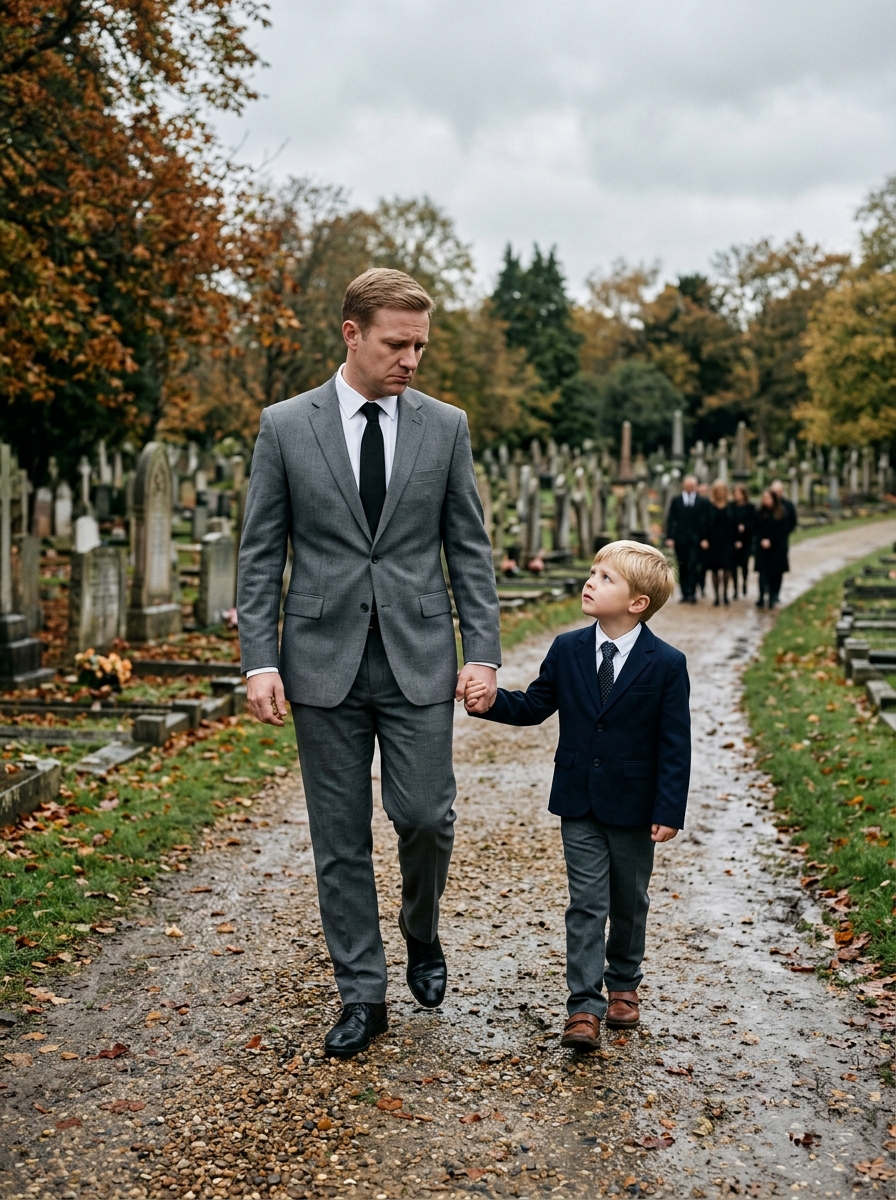
I was still standing beside the fresh grave when my seven-year-old son pulled on my hand. Most of the mourners had begun walking toward their cars, but Noah remained fixed on the place where we had just buried my wife.
“Dad, that wasn’t Mom.”
For several seconds, I could not answer. Claire had died four days earlier in a multi-vehicle accident, and I assumed our son was searching for a way to believe she could still come home.
I crouched beside him and said grief could make impossible things feel true. Noah shook his head and told me he was not talking about a dream or pretending his mother was alive.
“The lady in the coffin didn’t have Mom’s broken tooth.”
The night before the accident, Claire had chipped the edge of her right front tooth while biting into a hard piece of candy. She laughed when she showed us the damage, telling Noah she finally had an excuse to stop postponing her dentist appointment.
The following morning, Noah watched her smile while she packed his school lunch. That was the final time either of us saw her before she left the house.
During the private viewing, the funeral home had done its best to restore the woman’s face after the accident. Her lips were slightly parted, and Noah had stood near the coffin longer than I did.
I remembered noticing her face only in brief pieces. Every time I looked too closely, my mind pulled me back toward the sound of Claire laughing in our kitchen, so I focused on her necklace, folded hands and blue dress instead.
Noah had looked directly at her teeth. The woman in the coffin had two even front teeth without the fresh chip he remembered.
Several relatives heard our conversation and gathered around us. Megan, Claire’s younger sister, said Noah was exhausted and that the funeral had been too much for him.
She reminded me that the body had been formally released under Claire’s name. The hospital, medical examiner and funeral home had all handled the arrangements, making the possibility of a mistake seem almost impossible.
I wanted to accept that explanation. Believing Noah meant reopening the worst four days of my life and questioning decisions made while I could barely remember to eat.
However, my son did not embellish the story or change it when adults challenged him. He kept returning to the same ordinary detail—the chipped tooth Claire had shown us at breakfast.
I had spent seven years telling Noah to come to me whenever something felt wrong. I could not decide that promise applied only when what he said was easy to hear.
I took him to my car and asked my brother to remain with him. Then I called the funeral director and explained exactly what Noah had noticed.
Mr. Sanders did not dismiss me, but he also said he could not reopen or remove the coffin based on a telephone request. Because the burial had been completed, the cemetery would need authorization from the medical examiner or a court before taking further action.
I asked whether the funeral home had independently confirmed Claire’s identity. He explained that they received the body from the county under her name and relied on the release documents provided with it.
That answer frightened me because it meant the funeral home had accepted the same identification everyone else had trusted. I called Detective Laura Bennett, the officer who had contacted me after the accident.
She initially spoke carefully, warning that trauma, preparation of the body and lighting could make small dental details appear different. When I told her Claire had chipped the tooth less than twenty-four hours before the crash, she became quieter.
The damage was too recent to appear in Claire’s existing dental records. Still, Detective Bennett agreed that it was specific enough to justify reviewing the identification process before dismissing Noah’s concern.
She asked who had formally identified the body. I gave her Megan’s name because my sister-in-law had gone to the medical examiner’s office while I stayed home with Noah.
Megan had told me she recognized Claire’s silver necklace, navy coat and leather purse. Until that moment, I had never asked whether she had seen Claire’s full face.
When I approached Megan in the cemetery parking lot, she immediately understood what I wanted to know. Her expression changed before I finished asking the question.
“The injuries were serious,” she said. “They advised me not to look longer than necessary.”
“Did you identify her face?”
Megan admitted she had seen only part of it. She recognized the coat Claire wore almost every day, the necklace their mother had given her and the purse containing Claire’s driver’s license.
She believed those things were enough because a property bag carrying Claire’s name had arrived with the body. The medical examiner never asked Megan to check a scar, fingerprints or a dental feature.
Detective Bennett called again less than an hour later. She had reviewed the preliminary file and confirmed that no DNA comparison had been conducted because the body was considered visually identified.
Fingerprints had been collected at the morgue but had not been compared with Claire’s employment records. The county had also received several victims from the same chaotic accident scene, including one unidentified woman transferred to another hospital.
I asked how Claire’s possessions had been connected to the woman we buried. Detective Bennett paused before reading from the emergency intake report.
“The purse, necklace and coat were not found on the body,” she said. “They were collected from the roadway and placed into a property bag nearby.”
No medical test had established that the deceased woman was my wife. Every decision made afterward had begun with a bag of belongings found beside the wrong person.
Part 2: The Identification No One Verified
Detective Bennett asked me not to question Noah further about the viewing. She wanted to preserve his original memory without allowing my suspicions or Megan’s guilt to influence what he believed he had seen.
A child specialist spoke with Noah at the funeral home while I waited outside. He repeated the same account: his mother had smiled at breakfast with a chipped right front tooth, but the woman in the coffin had two unbroken teeth.
Noah did not claim he had seen Claire after the accident. He did not offer theories about where she might be or who the deceased woman was.
His statement concerned only the smile. That consistency made Detective Bennett treat the discrepancy as evidence requiring verification rather than a child’s attempt to deny his mother’s death.
Meanwhile, the county medical examiner reviewed the release file. The woman had been brought from the crash scene wearing no jewelry and carrying no identification directly on her body.
Claire’s coat, necklace and purse were delivered in a separate property bag bearing the same temporary incident number. At some point during triage, that number became attached to both the belongings and the unidentified woman.
The crash had involved eleven vehicles during heavy rain. Several occupants were thrown from their cars or found away from their personal possessions, while ambulances transported patients to three hospitals across two counties.
Two women of similar age, height and hair color had been found within several yards of Claire’s damaged car. One was pronounced dead after reaching the hospital, while the other underwent emergency surgery without any identification.
The deceased woman was transferred to the county morgue. Because Claire’s driver’s license arrived in the property bag and Megan later recognized the accompanying belongings, the temporary identification was converted into Claire’s legal name.
Each person who handled the case relied on the decision made before them. The hospital trusted the emergency property number, the morgue trusted the hospital and the funeral home trusted the county release.
Megan sat beside me while Detective Bennett explained the sequence. She kept rubbing the place on her wrist where she wore a bracelet matching the one Claire had given her.
“I should have looked at her face,” she said.
I wanted someone to blame because anger felt easier than uncertainty. However, Megan had entered a room where professionals told her they had already identified her sister and asked only whether she recognized the belongings.
She saw their mother’s necklace and Claire’s purse containing family photographs. In that moment, questioning the name on the paperwork had seemed far less reasonable than accepting that the worst had happened.
The medical examiner requested emergency authorization to open the grave and perform DNA testing. Detective Bennett warned that the cemetery could not act until the order was approved and the exhumation was properly documented.
The process would not happen in front of our family. The coffin would be transferred privately, and samples would be compared with DNA provided by Noah and Claire’s medical records where possible.
I explained the delay to my son without telling him that his mother might be alive. We did not yet know whether the woman in the coffin was Claire, and I refused to replace one certainty with another before evidence supported it.
Noah asked whether the broken tooth meant he had been right. I told him it meant adults were checking carefully because he had noticed something important.
My brother took Noah home while Megan and I accompanied Detective Bennett to review the belongings returned after the accident. Claire’s purse contained her license, telephone and a receipt from the grocery store she had visited that morning.
Her necklace was inside a small evidence envelope rather than listed as having been removed from the deceased woman. The navy coat carried traces of road debris, but there was no record stating who had been wearing it when rescuers arrived.
Another item appeared on the inventory: a hospital identification band labeled Jane Doe 47. It had been collected near Claire’s coat but never connected to the unidentified patient transferred for surgery.
Detective Bennett contacted the regional trauma center that had received Jane Doe 47. Hospital staff confirmed that an unidentified woman from the crash had remained unconscious in intensive care for four days.
She carried no telephone, jewelry or identification. Her facial swelling prevented a usable photograph from being circulated immediately, while her fingerprints had not matched any criminal database.
The hospital had issued a public notice describing her general appearance, but the alert received little attention during coverage of the larger accident. Our family never saw it because we had already been told Claire was dead.
Detective Bennett requested that the hospital preserve the patient’s records and compare her fingerprints with those Claire had provided for a previous school-district background check. Until that comparison was completed, the hospital could not tell me whether the patient was my wife.
I returned home shortly after sunset. Noah had fallen asleep on the sofa with Claire’s framed photograph pressed against his chest, while my brother sat nearby waiting for news.
My phone rang before I could remove my coat. The number belonged to the regional trauma center more than forty miles from the cemetery.
A nurse identified herself and confirmed my full name, Claire’s date of birth and several details from her emergency contact file. She then said Jane Doe 47 had regained consciousness and provided a telephone number from memory.
I gripped the edge of the kitchen counter. Before the nurse could continue, I heard a weak voice in the background asking for the phone.
“Ethan?” the woman whispered. “Where is Noah?”
Part 3: The Woman in the Other Hospital
I did not tell Noah about the call until I knew more. My brother stayed with him while Megan, Detective Bennett and I drove to the regional trauma center.
A physician met us outside the intensive care unit. He explained that the unidentified woman had suffered a head injury, several fractures and internal complications requiring emergency surgery, but her condition had improved enough for brief conversations.
The hospital still needed formal identification. Detective Bennett had arranged an expedited comparison with fingerprints Claire previously provided for a school-district background check, while a DNA sample would provide additional confirmation.
I entered the room with the physician beside me. The woman’s face was swollen and bruised, but I recognized the curve of her eyebrows, the small scar below her left ear and the way she pressed her thumb against her palm when she was anxious.
Then she opened her mouth to say my name. The chipped edge of her right front tooth was exactly where Noah said it would be.
Claire remembered our address, our anniversary and the green dinosaur Noah had insisted on wearing to school for picture day. She also knew that I kept an emergency key inside an empty flowerpot even though she had asked me several times to find a safer hiding place.
Those details were not medical proof, but I no longer needed them to know my wife was lying in front of me. I held her hand carefully and tried to explain why I had not found her sooner.
Claire remembered leaving the grocery store and driving into heavy rain. After traffic slowed, another vehicle struck the rear of her car and pushed it into a chain of collisions.
She recalled crawling away from the road with another injured woman nearby. Both had dark hair and navy outerwear, but Claire remembered little after a second impact caused her to lose consciousness.
The physician stopped the conversation when she became tired. I did not immediately tell Claire that we had buried someone under her name because she was still medically fragile and needed the information delivered with support.
The fingerprint comparison arrived that evening. Jane Doe 47 was formally identified as Claire Parker, and the hospital corrected her records before notifying the medical examiner in the other county.
I called Noah with a child-life specialist beside me. I told him the woman at the hospital appeared to be his mother and that the fingerprints confirmed what he had noticed at the funeral.
He did not celebrate immediately. He asked why everyone had said she was dead and whether I might be wrong again.
I admitted that adults had made a serious mistake. This time, however, we had checked her fingerprints, her medical history and several physical features instead of relying on a bag of possessions.
Noah met Claire the following afternoon after her doctor approved a short visit. A nurse prepared him for the medical equipment and explained that his mother might look different while she healed.
He stopped several feet from the bed and stared at her face. Claire managed a small smile, revealing the chipped tooth that had started everything.
“That’s Mom,” Noah said.
Claire began crying and reached toward him. Noah climbed carefully onto the chair beside her and placed his hand inside hers without touching any of the medical lines.
Later, a counselor helped me tell Claire about the funeral. She listened in silence as I explained that another woman had been released under her name and buried by our family.
Claire did not blame Megan or me. She asked whether the other woman’s family knew where she was, and I had no answer.
The exhumation occurred privately the next morning after the court approved the medical examiner’s request. Noah was not present, and our family was asked to remain away from the cemetery.
DNA testing confirmed that the deceased woman was not related to Noah. The medical examiner then compared her fingerprints with missing-person databases and reports filed after the crash.
Investigators returned to the impound lot and searched the damaged vehicles again. Beneath a collapsed passenger seat, they found a wallet belonging to a woman named Danielle Ruiz.
Danielle was thirty-six and had been driving home from a late shift when she became caught in the same collision. Her navy jacket was nearly identical to Claire’s, while rescuers had found both women on the roadway between their vehicles.
The fingerprint comparison confirmed that the woman buried under Claire’s name was Danielle. Her belongings had remained trapped inside her car while Claire’s purse and necklace were mistakenly attached to Danielle’s temporary incident number.
Detective Bennett told me Danielle had been reported missing by her fifteen-year-old daughter, Sofia. The girl had spent four days calling hospitals and searching online while authorities believed her mother might have left the crash scene before receiving treatment.
I looked at Claire sleeping beneath a hospital blanket and felt relief so powerful it almost became painful. Then I thought about another child waiting for her mother to walk through the door.
Noah’s observation had brought Claire back to us. It had also forced investigators to find Danielle, and somewhere across the city, a fifteen-year-old girl was about to receive the news our family had already mourned once.
Part 4: The Other Family Waiting for an Answer
Detective Bennett did not ask me to contact Sofia. A victim-services counselor and Danielle’s older sister went to the girl’s home together so she would not receive the news from a stranger or through social media.
Danielle’s sister, Elena, had been caring for Sofia since the crash. They had called every hospital listed in the news reports, but no one connected Danielle’s missing-person case to the woman released under Claire’s name.
The medical examiner issued a corrected identification and arranged for Danielle to be transferred to a funeral home chosen by her family. Claire’s death certificate was withdrawn, while hospital and county records were amended to show she had survived.
Those corrections did not make the situation feel clean or complete. One family had been given the wrong body, while another had been denied the chance to know where their mother was for nearly a week.
Megan struggled most visibly with guilt. She repeatedly said that if she had looked more carefully, Danielle would have been identified before the first funeral.
The investigators did not excuse her mistake, but they explained that the system had placed too much responsibility on a grieving relative. Megan had been asked to confirm an identification professionals already presented as nearly certain.
The official review found that the first error occurred at the crash scene. In heavy rain and poor visibility, temporary tags for Claire and Danielle were attached to property bags collected from the same section of roadway.
Claire was transported for emergency surgery under a Jane Doe number. Danielle’s body traveled to another hospital with Claire’s property number, and the two records continued moving through different counties without being compared.
No single person intentionally switched their identities. The failure came from several separate decisions made without a second form of verification.
The county had fingerprints from Danielle’s body but did not immediately compare them with missing-person records because Megan’s identification appeared to resolve the case. The funeral home then relied on the county release rather than repeating work it believed had already been completed.
I hired an attorney to help our family obtain the full records, while Elena did the same for Sofia. Neither family wanted the investigation reduced to a private apology that allowed every organization to blame the previous one.
Claire remained in the hospital for another two weeks. She began physical therapy for her injuries and worked with a counselor after waking into a life where she had been declared dead, buried and suddenly returned.
Noah visited only when her doctors approved. At home, he began asking questions about Danielle and whether the other girl knew her mother had been inside Claire’s coffin.
I answered honestly without describing details he did not need. Sofia knew her mother had died, but adults were helping her arrange a proper funeral.
Noah became quiet and asked whether Danielle would still be buried under our family’s flowers if he had never mentioned Claire’s tooth. The question revealed a burden I had not realized he was carrying.
“You did not cause Danielle’s death,” I told him. “You helped people find out who she was.”
He said Sofia might hate him because his mother came home while hers did not. I explained that two truths could exist together: we could be grateful Claire survived and deeply sorry that Danielle had not.
A child counselor continued that conversation with him over several sessions. Noah needed to understand that noticing an adult mistake did not make him responsible for repairing every consequence.
As Claire’s memory became clearer, she recalled lying on the wet roadway beside another woman after the first collision. The woman had been conscious briefly and kept trying to move despite being badly hurt.
Claire remembered reaching for her hand. The stranger repeatedly said one name before emergency crews separated them.
“Sofia,” Claire told me. “She kept saying Sofia.”
Among the unidentified property from Claire’s hospital room was a small silver bracelet. It did not belong to Claire and carried two engraved initials: D.R.
Detective Bennett showed a photograph to Elena, who confirmed Danielle wore the bracelet every day. It had likely come loose while the two women were lying near each other and was mistakenly transported with Claire.
Claire asked the detective whether she could return it personally. She also wanted Sofia to know that her mother had been thinking about her during the final moments Claire could remember.
I worried that meeting us might cause Sofia additional pain. Claire agreed that the decision had to belong entirely to the girl and her family.
Through the victim-services counselor, she wrote a short note without asking for a response. She explained that she had been beside Danielle after the crash and possessed something that should return to her daughter.
Several days passed without an answer. We assumed Sofia either was not ready or never wanted contact, and Claire accepted that silence as her right.
The evening before Danielle’s memorial, Elena called our attorney. Sofia had read the letter and wanted to meet Claire privately before deciding whether our family should attend.
Claire was still using a wheelchair and had not left the hospital except for medical testing. Even so, she asked her doctor whether a supervised visit could be arranged.
When I asked if she was certain, Claire closed her hand around Danielle’s bracelet. She said Sofia deserved to receive more than an official report describing tags, property bags and administrative failures.
“She deserves to know her mother wasn’t alone,” Claire said.
Part 5: The Smile That Brought Her Home
The hospital arranged the meeting in a private family room with a victim-services counselor present. Claire sat in a wheelchair beside me while Sofia entered with her aunt, Elena.
Sofia looked older than fifteen until she saw the bracelet in Claire’s hand. Then her expression changed into that of a child recognizing something her mother had worn every day.
Claire did not begin with the investigation or explain how the bracelet reached the wrong hospital. She simply held it out and said Danielle had been beside her after the crash.
Sofia accepted the bracelet but did not immediately put it on. She asked whether her mother had spoken and whether Claire remembered her final words.
Claire answered carefully because she did not want to fill the gaps in her memory with comforting details that might not be true. She remembered Danielle squeezing her hand and repeating Sofia’s name, but nothing more certain.
“She was thinking about you,” Claire said. “That is the clearest thing I remember.”
Sofia began crying, and Elena moved closer to her. Claire did not attempt to embrace the girl or claim a connection Danielle had never chosen.
She remained quiet until Sofia asked why Claire had been found with her mother’s bracelet. Claire explained that both women had been lying near each other and that emergency crews probably collected the item with the wrong patient.
Sofia said she had spent days believing Danielle might have walked away from the crash and chosen not to call. Learning that her mother had been there all along was painful, but it ended a different kind of fear.
Before leaving, Sofia invited our family to Danielle’s memorial. Claire was not medically strong enough to attend, while Noah’s counselor advised that another funeral so soon could overwhelm him.
We sent flowers and a letter instead. Several months later, after both families had more time, we attended a smaller remembrance organized by Danielle’s coworkers and relatives.
No one described the meeting as fate or suggested Danielle’s death had occurred so Claire could survive. One mother came home, another did not, and respecting both truths was the only honest way to speak about the accident.
The official review continued for nearly eight months. Investigators found no evidence that anyone intentionally exchanged the women’s identities, but they documented failures at the crash scene, hospitals, medical examiner’s office and funeral home.
The agencies adopted new procedures for mass-casualty incidents. Property bags could no longer serve as the primary basis for identifying a patient, and uncertain cases required a second method such as fingerprints, dental comparison or DNA before remains were released.
Hospitals across the two counties also created a shared process for comparing unidentified patients with missing-person reports. The changes came too late for Danielle, but Elena said they might prevent another family from burying the wrong person.
Our attorney helped correct Claire’s insurance, employment and government records. Reversing a death on paper required months of forms because systems designed to record death were not prepared to undo it quickly.
Claire returned home after three weeks in the hospital. She needed help walking, managing pain and completing ordinary tasks that had once required no thought.
I had imagined her discharge would end the nightmare, but recovery introduced different challenges. Claire struggled with anxiety whenever she heard traffic in heavy rain, while I checked her breathing at night more often than I admitted.
We began counseling together. I had to address the guilt of accepting the identification, and Claire had to process waking to discover that her family had mourned someone else under her name.
Noah received his own support. He repeatedly asked whether adults would have found Claire if he had forgotten about the tooth, and his counselor helped him understand that identification was never supposed to depend on a seven-year-old.
We thanked him for speaking up without turning vigilance into his responsibility. Noah was allowed to be our son, not the person expected to monitor every adult decision for mistakes.
Megan also remained part of our family. Claire did not blame her for believing the professionals, although rebuilding Megan’s trust in her own judgment took time.
Six months after the accident, Claire could walk short distances without assistance. She returned to Noah’s school for a small family event, where several parents became emotional after seeing her.
That afternoon, a photographer offered to take our first family portrait since she came home. Claire sat between Noah and me, still wearing a light brace beneath her sleeve.
She had postponed repairing the chipped tooth because other medical appointments were more urgent. When the photographer asked us to smile, Claire instinctively kept her lips closed.
Noah reached up and touched her cheek. He asked her to show the smile she had given him on the final morning before the crash.
Claire smiled fully, revealing the small uneven edge that dozens of adults had overlooked. Noah studied it for one second before smiling back.
“That’s Mom,” he said.
The photograph now hangs in our living room beside a smaller memorial card carrying Danielle’s correct name. One image represents the woman who returned to us, while the other reminds us that another family deserved the truth just as much.
A chipped tooth did not save Claire by itself. Noah saved us from accepting an error because he noticed, spoke and continued speaking when every adult around him believed the matter was already settled.
I had promised my son that I would listen whenever something felt wrong. The day after Claire’s funeral, he taught me what that promise actually required.