
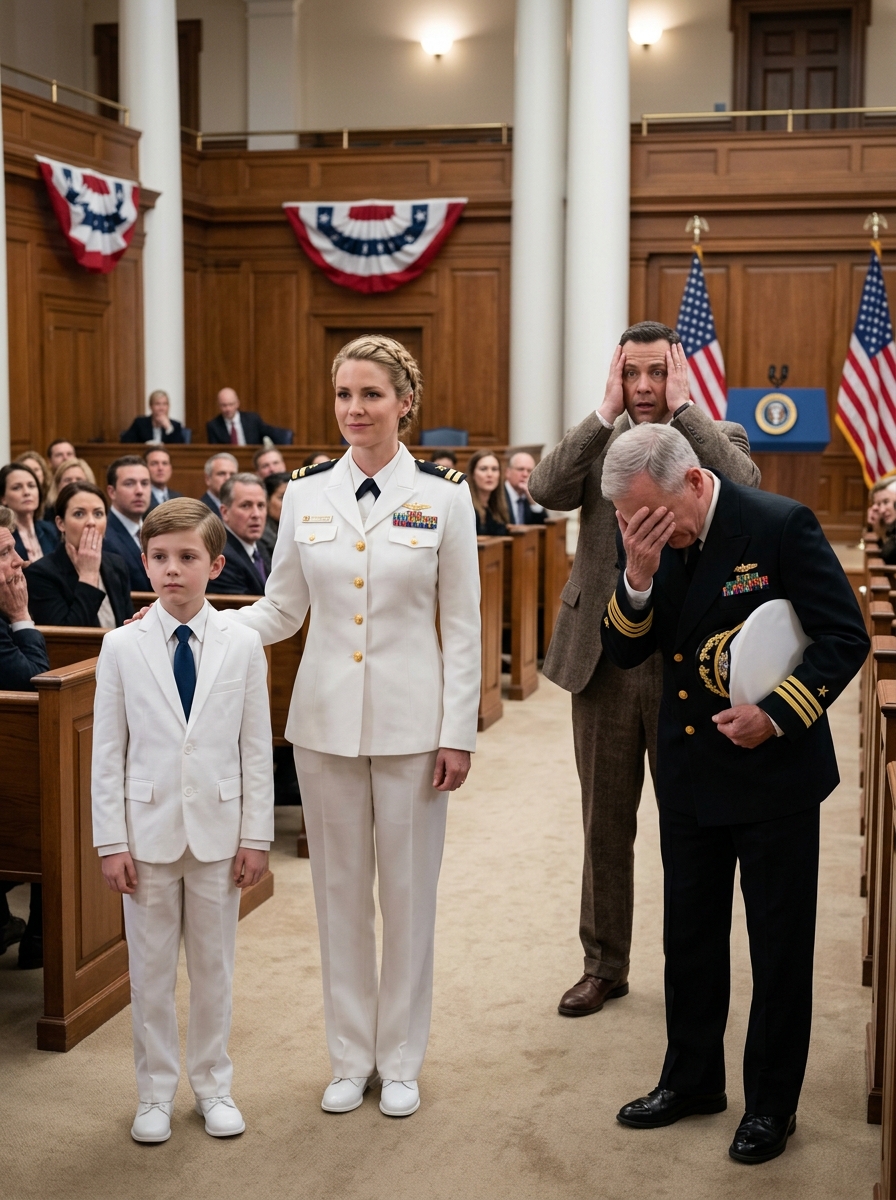
PART 1: The Day My Teacher Called Me a Liar
My teacher called me a liar in front of the whole class because I said my mother commanded Special Forces.
My name is Ethan Carter, and my mother, Colonel Rebecca Carter, served more than twenty years in the United States Army. She earned decorations I still didn’t fully understand and led elite personnel on missions she almost never discussed. But at home, she was just Mom.
She didn’t hang medals in the living room.
She didn’t tell war stories at dinner.
And she had one rule for me.
“Never use my career to make yourself look important.”
So when Northwood High announced Heroes’ Week, I brought only one photograph. It showed Mom on a dusty military base in uniform, standing with other soldiers.
Nothing dramatic.
Just her.
When it was my turn, I stood at the front of class and held up the picture.
“My hero is my mom,” I said. “Her name is Rebecca Carter. She’s a colonel in the United States Army, and she commanded a Special Forces unit.”
Mr. Harris stared at me.
Then he smiled.
Not kindly.
“Your mother commanded Special Forces?”
“Yes, sir.”
He leaned against his desk.
“Ethan, stop lying.”
The room erupted.
Someone whispered, “No way.”
Another kid laughed. “His mom’s probably in accounting.”
My face burned. I wanted to shout every piece of truth I knew, but I remembered what Mom once told me.
“When people refuse to believe your words, don’t waste your dignity begging them. Let the truth arrive on its own.”
So I folded my paper, walked back to my desk, and sat down.
For the rest of the morning, the whispers followed me.
Liar.
Fake.
Attention seeker.
Hours later, the school gathered in the auditorium for the Heroes’ Week assembly. Parents, veterans, local officials, and senior military guests filled the front rows.
Onstage sat Admiral Thomas Blake, the guest Mr. Harris had talked about all week.
The admiral opened the program and began reading names.
Then he stopped.
His eyes stayed on one line.
Ethan Carter.
Something changed in his face.
The auditorium doors opened behind us.
Hundreds of heads turned.
Standing there was my mother in full dress uniform.
Silver eagles on her shoulders.
Rows of decorations on her chest.
And behind me, Mr. Harris whispered, “No…”
PART 2: The Truth Walks In
Admiral Blake stood from the stage as Mom walked down the aisle.
She moved the same way she always did—steady, calm, never rushing, never performing.
That morning, I had wanted proof. I wanted something huge to happen so everyone would know I had told the truth.
But now that proof was walking toward me, I felt embarrassed by how badly I had wanted everyone else to feel ashamed.
Admiral Blake stepped down and shook her hand.
“Rebecca.”
“Thomas.”
They spoke like old colleagues.
Then the admiral faced the room.
“For those who haven’t had the privilege, Colonel Rebecca Carter has served the United States Army for more than two decades in roles requiring unusual judgment, discipline, and leadership.”
Mom gave him a look.
He smiled.
“That is probably more than she would prefer I say.”
The room relaxed slightly.
Then he called my name.
“Ethan Carter, would you join us?”
I walked to the stage, feeling every stare.
The admiral said, “Ethan chose his mother as his hero. I believe he planned to say a few words today.”
I looked at Mom.
She gave one small nod.
It didn’t mean say something impressive.
It meant, you’re okay.
So I stepped to the microphone.
“My mom told me not to use her job to make myself important,” I said. “She says what she does belongs to the people she does it with. Not to me.”
Nobody laughed now.
“I don’t think she’s my hero because she’s a colonel. She’s my hero because she calls when she says she will, leaves notes in my lunch before tests, teaches me practical things, and admits when she doesn’t know something.”
I paused.
“That’s rare for adults.”
This time, people laughed gently.
Even the admiral.
Mom finally smiled.
The applause came slowly, then filled the room.
Mom squeezed my shoulder.
“Good job,” she whispered.
Those two words mattered more than the applause.
PART 3: The Apology
After the assembly, Mr. Harris approached us.
“Colonel Carter.”
Mom turned. “Mr. Harris.”
He looked surprised. “You know who I am?”
“Ethan has mentioned you.”
That sentence could have meant anything.
Mr. Harris understood that.
He looked at me.
“Ethan, I owe you an apology. I should not have accused you of lying, especially in front of the class.”
I had imagined this moment all day.
In my head, I always said something brilliant—something that made him feel exactly how I had felt.
But standing there, none of those lines seemed useful.
So I said, “Okay.”
He nodded. “I understand if that isn’t enough.”
Mom spoke calmly.
“An apology doesn’t erase a mistake. But it tells us what someone intends to do after making one.”
Then she looked at me.
“Ethan?”
I knew she was asking whether I wanted to say anything else.
So I asked, “Why didn’t you believe me?”
Mr. Harris could have said the photo looked ordinary or the claim sounded unusual.
Instead, he answered honestly.
“Because I thought I knew what someone like your mother would look like. I expected stories, medals, recognition—something loud. When you didn’t have those things, I decided the missing evidence meant the story was false.”
“That doesn’t make much sense,” I said.
“No,” he replied. “It doesn’t.”
He asked if he could apologize to the class the next day.
Not make me stand.
Not create a show.
Just correct what happened.
I looked at Mom.
She did not answer for me.
“Okay,” I said.
PART 4: Borrowed Importance
That night, Mom and I made dinner.
Important conversations in our house rarely began with, “We need to talk.”
They usually began with chopping vegetables.
I told her everything: the photograph, Mr. Harris, the laughter, the whispers, and the kid who said she was probably in accounting.
Mom stirred the pan.
“There is nothing wrong with accounting.”
“I know.”
“You were offended on behalf of the truth.”
“Yes.”
“Different problem.”
After dinner, I asked why she had never told me more about her career.
She gave me an answer I didn’t expect.
“Because I wanted you to know me before you knew my résumé.”
She explained that titles become shortcuts. If people hear “colonel,” they may decide she is impressive before knowing whether she is kind. If they hear “Special Operations,” they may invent stories that are not true.
“I wanted you to decide who I was from living with me.”
Then she used a phrase I remembered from the admiral.
“Borrowed importance.”
She told me some people confuse being close to something admired—rank, money, fame, a family name—with earning it themselves.
“If you used my rank every time someone challenged you,” she said, “you might start thinking my career made you right.”
“But it did make me right today.”
Mom smiled.
“The facts made you right.”
Later, she brought out a cardboard box from the top shelf of her closet. Inside were ribbons, certificates, photographs, coins, patches, and old letters.
It looked like a junk drawer.
She called it organized.
Then I found a photograph of Mom standing beside a man named Major Daniel Reed.
Underneath it was an envelope.
Across the front were three words:
FOR REBECCA CARTER.
When I asked to read it, Mom shook her head.
“That one isn’t mine to share.”
PART 5: The Man From the Photograph
The next day, Mr. Harris apologized to the class.
He didn’t make a speech. He didn’t ask anyone to clap. He simply said he had accused me without evidence and set the wrong example.
I appreciated that more than I expected.
A week later, he asked if Mom would speak to the class about leadership and privacy.
Mom’s first answer was no.
Three days later, she agreed—with conditions.
No uniform.
No medals.
No specific operations.
No long introduction.
She arrived wearing dark pants, a blue blouse, and the old watch she always wore. Half the class looked disappointed because they expected the woman from the auditorium.
Instead, they got my mother.
Which was the point.
The questions started awkwardly, then became better.
Were you ever scared?
“Yes.”
Why act anyway?
“Because being afraid and being unable to act are different things.”
How do you know who to trust?
“Trust is built in boring moments. Ordinary consistency matters more than dramatic promises.”
After school, we walked to the parking lot.
Then someone called her name.
“Rebecca Carter?”
Mom froze.
A man stood near the visitor spaces, gray at the temples, holding a folded paper.
I recognized him from the photograph.
Major Daniel Reed.
Older now.
But unmistakable.
Mom closed the car door slowly.
“Daniel.”
He gave a cautious smile.
“It’s been a long time.”
“Thirteen years,” she said.
He looked at me.
“You must be Ethan.”
Then he said something that made the parking lot feel suddenly silent.
“I knew your father.”
PART 6: The Box of Letters
Daniel had found something while clearing his late brother’s house.
A box.
Letters, mostly.
My father’s letters.
Dad had died when I was seven from a heart condition no one had caught in time. He existed in our house through photographs, stories, and habits—like the coffee Mom still bought even though she didn’t drink it.
Daniel brought the box the next day at noon.
Mom made coffee first because apparently family secrets required proper beverages.
The gray plastic storage box had a cracked blue lid. On one side, in faded marker, was my father’s name.
David.
Daniel explained that Dad had asked him to keep the letters.
“For the right time,” he said.
Mom’s face tightened.
“And you decided today was the right time?”
“No,” Daniel admitted. “I found them six months ago.”
He had waited.
Mom did not forgive that immediately.
But she opened the box.
The first letters were ordinary: me refusing peas, the washing machine breaking, Dad learning to braid hair, buying too much bread when Mom was deployed.
They were not dramatic secrets.
They were life.
Then Mom found a letter about a decision I never knew existed.
She had almost left the Army when I was five.
Dad had written:
Sarah thinks I want her to leave. I don’t. I want her to stop believing she has to choose between being good at her work and being good at home. Those are not the same question.
Mom stared at the table.
“Dad understood you,” I said.
“Yes,” she whispered.
PART 7: My Father’s Rule
The box held more letters.
Some were addressed to Daniel, and those he read aloud.
Dad had asked him how to support a woman who believed responsibility meant never needing help. He asked how to know when Mom was exhausted, especially when she insisted she was fine.
At one point, Daniel said softly, “David admired you. But he worried you believed love had to be earned the same way respect was.”
Mom did not answer.
For once, there was no next step.
Just something true she had never fully considered.
Later, Mom found a thicker envelope marked:
For later.
One page was for me.
The first line read:
For Ethan, when he is old enough to understand that parents are mostly guessing.
I smiled because that sounded like Dad.
The letter was not a goodbye. He had not known he would die. He wrote about hoping I would work hard, care about something real, and learn not to confuse admiration with values.
Then one line made my throat tighten.
If you ever feel pressured to prove who you are by telling people who your parents are, don’t. Borrowed light still leaves you in the dark when the person carrying it walks away.
I looked at Mom.
“Did your rule come from Dad?”
“No,” she said.
“But he wrote almost the same thing.”
“Yes.”
“Then where did you get it?”
She was quiet for a long time.
“From making the opposite mistake.”
PART 8: The Trip Dad Never Took
Mom admitted that when she was young, her father’s reputation in the military world opened doors for her.
At first, she liked it.
Then an instructor told her, “Your father’s record got you noticed. Your record will determine whether anyone keeps looking.”
That stayed with her.
So when she raised me, she wanted me to build something of my own.
That night, Daniel left after apologizing for keeping the letters too long. Mom said he had kept Dad’s promise too literally.
Then she hugged him.
It was stiff at first.
Then real.
Later, Mom and I returned to the box alone.
One letter mentioned a trip Dad had wanted to take to Maine. A lighthouse, a harbor, a bookstore, a small inn.
Nothing extraordinary.
Just a trip they thought they would take later.
But later had run out.
“We could go,” I said.
Mom almost laughed.
“Lucas.”
“Why not?”
“School. Work. Planning.”
“You love planning.”
Months later, I found plane reservations on the kitchen table.
Boston first.
Then Maine.
At the bottom was a reservation at the same coastal town Dad had written about.
“Are you okay going without Dad?” I asked.
Mom paused.
“No,” she said. “But I think I’m okay going because of him.”
There was a difference.
I understood it.
PART 9: The Quiet Heroes
In March, we went to Maine.
The coast was colder than Dad probably imagined. Mom complained about the wind, and I reminded her she had once jumped from an airplane.
“That was also unpleasant,” she said.
We visited the lighthouse, the harbor, and the bookstore, which had moved two streets over but still existed.
At the inn, Mom and I stood on a balcony facing the water. She carried Dad’s letter in her coat pocket.
I asked if she wished he had given her the letters himself.
“Yes.”
If she wished Daniel had brought them sooner.
“Yes.”
If she wished she had left the Army.
This time, she took longer.
“No,” she said finally. “Because I spent years thinking the choice was between family and work. David understood before I did that the real choice was how honestly I would live inside both.”
Months later, Heroes’ Week returned to Northwood High with a new theme:
Quiet Influence.
Students chose neighbors, grandparents, coaches, siblings, teachers—people who changed their lives through ordinary actions.
No one needed medals.
No one needed an extraordinary biography.
Mr. Harris said last year had reminded him that people can become so interested in impressive stories that they stop listening to the person telling them.
Mom sat beside me in jeans and an old Army sweatshirt, drinking terrible auditorium coffee.
No uniform.
No admiral.
No decorations.
And somehow, that felt exactly right.
PART 10: What Stayed With Me
After the assembly, I looked at the same photograph I had brought the year before.
Dusty base.
Combat uniform.
Soldiers around Mom.
For a long time, I thought the picture proved something.
That my mother was important.
That I told the truth.
That Mr. Harris was wrong.
Now I understood it differently.
A photograph can prove where someone stood for one second.
It cannot show who they are.
It cannot show lunch notes, late phone calls, nervous cookbook organizing, or a father writing letters because he loved quietly.
It cannot show an old friend keeping a promise too long.
It cannot show a teacher turning an apology into a changed classroom.
It cannot show a family learning that privacy and honesty are not opposites.
You need time for that.
Ordinary days.
Conversations.
Mistakes.
Second chances.
Sometimes, a cardboard box full of letters.
Mom opened the driver’s door.
“You coming?”
“In a second.”
I slipped the photograph into my backpack.
I didn’t need to hold it up anymore.
I didn’t need anyone to believe me.
The truth had arrived on its own.
But what stayed with me was not the moment the auditorium went silent.
It was what came afterward.
The apology that changed a teacher.
The letters that changed how I understood my parents.
The trip my father never took but somehow still helped us make.
And the rule I once thought was only about staying humble.
Never use someone else’s career to make yourself important.
Years later, I understood it differently.
Mom had not been telling me to make myself smaller.
She had been telling me to build something that was mine.
And for the first time, I understood why she never needed medals on the wall.
She already knew who she was.
Now it was my turn.