
Nine years is a long time to visit a room that smells like floor wax and old cabbage.
For three thousand two hundred and eighty-five days, I walked down the second-floor hallway of Pine View Manor, past the blue vinyl chairs and the humming vending machines, to sit with Mama for an hour on Tuesday afternoons. I brought her lemon drops because she liked the tartness of them, and I listened while she told me the same three stories about her childhood garden in Eminence.
I thought I was being a good daughter. I thought I was doing the heavy, wrenching work of watching a mind slowly unravel like a cheap sweater pulled at the cuff.
Arthur, my stepfather, always told me how hard it was on him, too. He would sit in his leather recliner back at the house on Maple Street, shaking his head and sighing about the cost of care, reminding me that the monthly bill was nine thousand two hundred dollars even after the insurance adjustments. He was the one who handled the checks. He was the one who managed the paperwork while Mama sat in her room staring at the bird feeder outside the window.
I never questioned a single bit of it. Not the bills, not the doctors, not the quiet way Mama stopped asking when she could come home.
Then came a Tuesday in October that smelled like wet oak leaves and woodsmoke from the chimney of the house across the lane, the kind of sharp autumn smell that always made my chest feel tight.
Evelyn Miller was standing by the nurses’ station with a cardboard box full of plastic paper trays and a framed photograph of a calico cat. She had worked that floor for twenty-three years, ever since the place first opened its doors back when the linoleum was still shiny.
She saw me coming down the hall and she didn’t smile the way she usually did. Instead, she set her box down on the counter, looked up and down the corridor to make sure nobody was listening, and motioned me over with a quick crook of her finger.
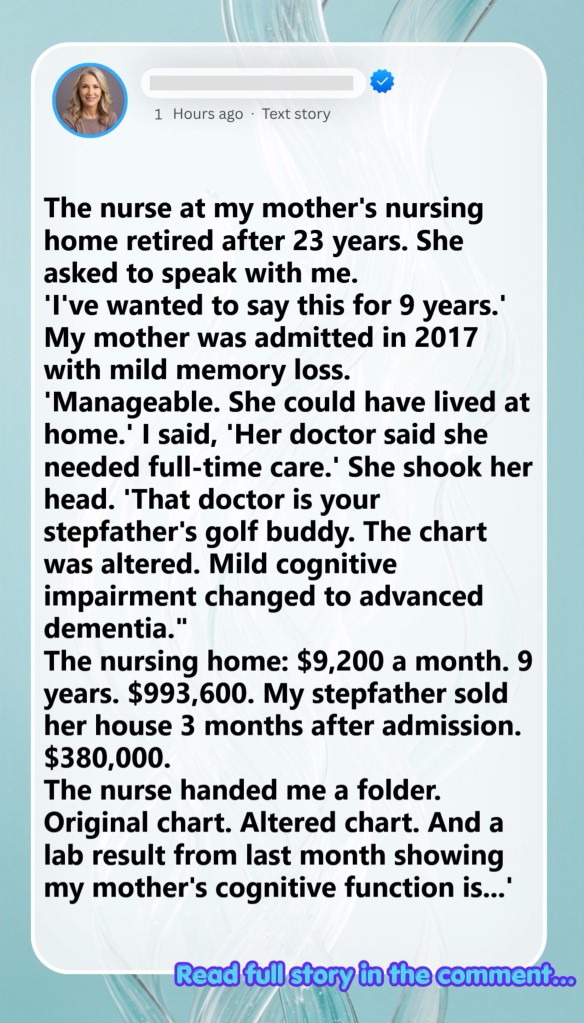
“I’ve wanted to say this for nine years,” Evelyn said. Her voice was too quiet, raspy around the edges like she had been holding it back for a very long time.
I stopped right there by the water fountain, my purse strap slipping down my shoulder. I asked her what she meant, thinking maybe there was some problem with Mama’s insurance or a change in the medication schedule that Arthur hadn’t told me about.
Evelyn just shook her head, her gray curls bobbing against her collar. She reached under the counter and pulled out a thick Manila folder held together with a fat rubber band. She didn’t hand it to me right away. She held onto it with both hands, her knuckles white.
“Your mother was admitted in 2017 with mild memory loss,” Evelyn said, her eyes fixed on mine. “Manageable. She could have lived at home with just a little help on the groceries and the bills. I told the intake coordinator that myself.”
I told her I knew that, or at least I thought I did. I said her doctor had told us she needed full-time care because her memory was getting worse by the month.
Evelyn let out a short, bitter breath through her nose. “That doctor is your stepfather’s golf buddy. The chart was altered. Mild cognitive impairment changed to advanced dementia.”
The water fountain down the hall hummed a low, steady note that seemed to vibrate right up through the soles of my shoes. I stood there staring at her, waiting for her to laugh or tell me it was some kind of grim joke about retirement paperwork, but her face stayed completely flat and serious.
She pushed the folder across the counter toward me. “Take it. My shift ended ten minutes ago, and my pension cleared this morning. They can’t touch me now.”
I took the folder because my hands moved before my brain could catch up with what she was telling me. I tucked it under my arm, thanked her in a voice that sounded like it belonged to a stranger, and walked into Mama’s room without knocking.
Mama was sitting in the armchair by the window, wearing the blue cardigan I had bought her for her birthday. She was looking out at the parking lot, her fingers tapping a slow, even rhythm against the armrest. When I came in, she turned her head and smiled that same sweet, soft smile she had given me every Tuesday for nearly a decade.
“You’re late today, honey,” Mama said. “Did you get caught behind the tractor on the highway again?”
The words hit me right behind the breastbone. It wasn’t a random question. It was a Tuesday routine we had kept up for years before she went into the home, back when she still lived in the house on Maple Street and I used to drive out from town after finishing my shift at the clinic. She remembered the tractor. She remembered the exact traffic pattern that always jammed up Route 7 during harvest season.
I sat down on the edge of the bed and looked at her, really looked at her, without the filter of what the doctors and Arthur had told me to expect. Her eyes were clear. Her hands were steady. She didn’t repeat herself three times the way she usually did when she was tired.
“Mama,” I said, my voice shaking just a little bit. “Do you know what year it is?”
She tilted her head, giving me that look she always gave me when I asked foolish questions. “It’s 2026, Evie. Don’t go getting simple on me now. The corn is already in, and the frost will be hitting the pumpkins by the weekend.”
She was right down to the year. She had been right about the year the whole time, while I sat there nodding along to whatever Arthur told me about her living in a fog where time didn’t exist.
I didn’t open the folder until I got back to my car out in the gravel lot. I locked the doors, pulled the visor down so nobody from the front desk could see me through the windshield, and slipped the rubber band off.
Inside was a mess of papers that told a story so cold it made my teeth ache. There was the original intake assessment from October 2017, filled out in Evelyn’s neat handwriting, noting mild forgetfulness and a score that showed independent functioning with minor prompts. Behind it was a second assessment dated two weeks later, bearing the signature of Dr. Robert Vance, Arthur’s regular partner down at the country club. That second form had whole paragraphs crossed out in red ink, with new notes scrawled in the margins changing her diagnosis to progressive degenerative dementia with severe executive dysfunction.
And at the very back of the folder was a single sheet of paper dated just last month. It was the routine triennial cognitive reassessment that the state required the facility to keep on file.
Her score on the Montreal Cognitive Assessment was twenty-six out of thirty.
Twenty-six out of thirty is normal aging. It is mild cognitive impairment at worst. It is a score that means you can balance your checkbook, drive to the grocery store, and live entirely on your own without anybody telling you when to go to bed or what television show you are allowed to watch.
My hands started to shake so hard I dropped the papers onto the passenger seat. Nine years. Nine years of nine thousand two hundred dollars a month. That came out to nearly a million dollars drained out of Mama’s accounts, paid directly to a facility where she was kept prisoner behind a locked double door while Arthur sat out on the back patio of her old house drinking iced tea and playing eighteen holes every Thursday morning.
I thought about the house on Maple Street, the brick rambler with the big dogwood tree in the front yard that Mama and Daddy had built back in nineteen-seventy-eight. Three months after Mama was admitted to Pine View Manor, Arthur had called me to say he had to sell the place to cover the mounting care costs. He told me it broke his heart to let it go, but you couldn’t put a price on keeping her safe. He sold it for three hundred and eighty thousand dollars cash, and he put every single penny of it into an account that my name wasn’t anywhere near.
I didn’t go home to my husband, Ray, right away. I drove out to the old neighborhood, parking three houses down from where Mama’s house used to be. The dogwood tree was still there, but the new owners had painted the front door a bright, aggressive shade of turquoise that looked all wrong against the red brick. The porch swing where Mama used to sit shelling butter beans on hot August afternoons was gone, replaced by a pair of modern metal chairs that looked like they belonged in a dentist’s office.
Arthur had taken everything she worked for, and he had used the medical establishment as a crowbar to pry her fingers loose from her own life.
The next three days were a blur of phone calls and closed doors. I didn’t call Arthur. I didn’t go to the house. Instead, I drove thirty miles over to the county seat and sat across a scarred oak desk from an elder-law attorney named Colleen Mercer, who listened to my story without interrupting once, her fingers steepled under her chin while I laid Evelyn’s folder out between us like a confession.
“If this recent cognitive test is authentic and we can get an independent neurologist to verify it today, your stepfather is in very deep trouble,” Colleen said, tapping a yellow legal pad with her pen. “He used a fraudulent medical determination to secure plenary guardianship and power of attorney. That’s not just a civil matter. That’s grand larceny dressed up in a white coat.”
By Thursday morning, we had an appointment with a court-certified neurologist named Dr. Henderson, who operated completely outside the network of local country club doctors. Colleen and I managed to get Mama out of Pine View Manor under the pretext of a family birthday lunch off-site, something the facility allowed once a month if you filled out the right green slips in triplicate.
Dr. Henderson spent forty minutes with Mama in a quiet examination room that smelled of rubbing alcohol and fresh coffee. He tested her memory, her spatial awareness, and her capacity to manage her own affairs. When he came out to the waiting room where I was sitting with my hands clenched together in my lap, he looked slightly bewildered.
“Your mother has age-related memory decline, Mrs. Gable,” he said, taking off his wire-rimmed glasses and cleaning them with a handkerchief. “She is remarkably sharp for eighty-two. I wouldn’t even classify her as mildly impaired in terms of daily functioning. She certainly does not belong in a locked memory care facility, and she hasn’t for the last decade.”
I didn’t cry when he said it. I just felt a cold, heavy anger settle down deep into my bones, settling right where the grief used to live.
We took Mama back to my house instead of returning her to Pine View Manor. We didn’t ask permission. We just loaded her small suitcase, the gray one with the zipper that always stuck, into the trunk of my sedan, and we drove straight to my place on the edge of town. Ray was standing on the back porch when we pulled up, holding a garden hose he wasn’t using, watching us with a worried look on his face.
“What’s going on, honey?” Ray asked, coming down the steps as I opened Mama’s door.
“Mama’s coming home with us, Ray,” I said, reaching out to help her down the gravel path. “For good.”
We put Mama in the guest bedroom that used to be our daughter’s room before she moved out to Denver. It was a bright room with yellow curtains and a view of the hydrangeas by the fence. Within an hour, she was sitting at our kitchen table, drinking sweet tea out of a jelly jar and telling Ray about how much she missed the old cast-iron skillet she used to have before Arthur gave it away to the thrift store.
The real reckoning came on Saturday afternoon.
I drove out to the house on Maple Street, the one Arthur still lived in, though it was technically bought with the proceeds of Mama’s stolen property. The silver Ford pickup he liked to drive was parked in the driveway, right behind his lawnmower trailer.
When I knocked on the front door, it took him a full minute to answer. He opened it wearing a faded golf shirt and a pair of khaki shorts, holding a half-empty glass of iced tea in his hand. His face went through three distinct changes in about two seconds, surprise, annoyance, and then that smooth, practiced look of patient martyrdom he always wore when he thought I was being difficult about nursing home bills.
“Evie,” Arthur said, leaning against the doorframe. “Is everything all right? They didn’t call you about the facility fees again, did they? I told them I’d drop off the check by Monday.”
I didn’t wait for him to invite me in. I pushed past him into the entryway, my boots clicking hard against the hardwood floor he had refinished with Mama’s money. I dropped the thick Manila folder right onto the small cherrywood table by the mirror where he used to keep his golf tees.
Arthur blinked, looking down at the folder and then back up at me. “What’s this about?”
“Open it, Arthur,” I said. My voice wasn’t loud, but it didn’t shake either. It was flat and cold, like winter water.
He reached down slowly, sliding his finger under the flap and pulling out the papers. He looked at the 2017 intake notes first. Then his eyes dropped to the red-inked alterations signed by Dr. Robert Vance. And finally, he stared at the triennial assessment from last month showing a score of twenty-six out of thirty.
The color didn’t drain out of his face all at once; it seemed to leach out of him in patches, his cheeks turning a dull, grayish white while his mouth stayed slightly open.
“Where did you get this?” he muttered, his hand trembling just enough to make the papers rustle against the wood.
“Evelyn retired on Tuesday,” I said, stepping closer to him so he couldn’t look away from my eyes. “She kept the real file for nine years because she knew what you and your golf buddy were doing. She waited until her pension was safe, and then she handed it to me.”
Arthur tried to straighten up, puffing out his chest the way men do when they’re cornered and trying to find a scrap of authority that isn’t there anymore. “Now hold on just a minute, Evie. You don’t understand how difficult things were back then. Your mother was confused. She was wandering off. I was only trying to protect her, and the cost of care, “
“The cost of care was nine thousand two hundred dollars a month,” I interrupted, my voice rising just enough to fill the hallway. “Paid out of her accounts while you sold her house for three hundred and eighty thousand dollars and pocketed the difference in an LLC you set up in your brother’s name. You locked her up so you could live in her house and spend her money like it was an allowance.”
“That’s a lie,” he snapped, his face flushing dark red now. “You can’t prove a single, “
“Dr. Henderson examined her on Thursday,” I said, cutting him off completely. “Her MoCa score is twenty-six out of thirty. She has the mind of a woman ten years younger than she is. She has never had advanced dementia. She never needed to be in that place. And as of ten o’clock this morning, Colleen Mercer has filed an emergency injunction freezing all of your joint accounts, revoking your medical and financial power of attorney, and submitting a full criminal referral for elder financial exploitation to the state attorney general and the medical board.”
Arthur stood there in the foyer of the house he thought he had stolen fair and square, his iced tea glass slipping slightly in his grip until a cube of ice fell out onto the hardwood floor and skittered across the planks. He didn’t have anything else to say. The practiced sorrow and the righteous husband routine had nowhere to go against a twenty-six out of thirty and a twenty-three-year nursing career that ended with a manila folder.
I didn’t stay to watch him try to recover his footing. I turned around on my heel, walked back out through the front door, and pulled it shut behind me with a solid, satisfying click that echoed off the brickwork.
That was three weeks ago.
The legal work is still grinding away through the county courts, slow and heavy like a stone wheel turning in the mud, but Colleen says the asset recovery is already locked down tight. Arthur hasn’t called once, and Dr. Vance has reportedly taken an early, unannounced leave of absence from his practice while the medical board reviews his signature on a dozen different institutional admissions from the last decade.
Back at my house, the sun comes through the kitchen window every morning around eight o’clock, hitting the old yellow linoleum just right.
Mama sits at the table every single day, wearing her blue cardigan, pouring tea from her own heirloom ceramic pot that we went back and retrieved from storage last Tuesday. She has her reading glasses pushed up on top of her head, and she spends an hour every morning working her way through the daily crossword puzzle in the county paper with a steady, unhurried hand, filling in the boxes one by one until the page is completely finished.