
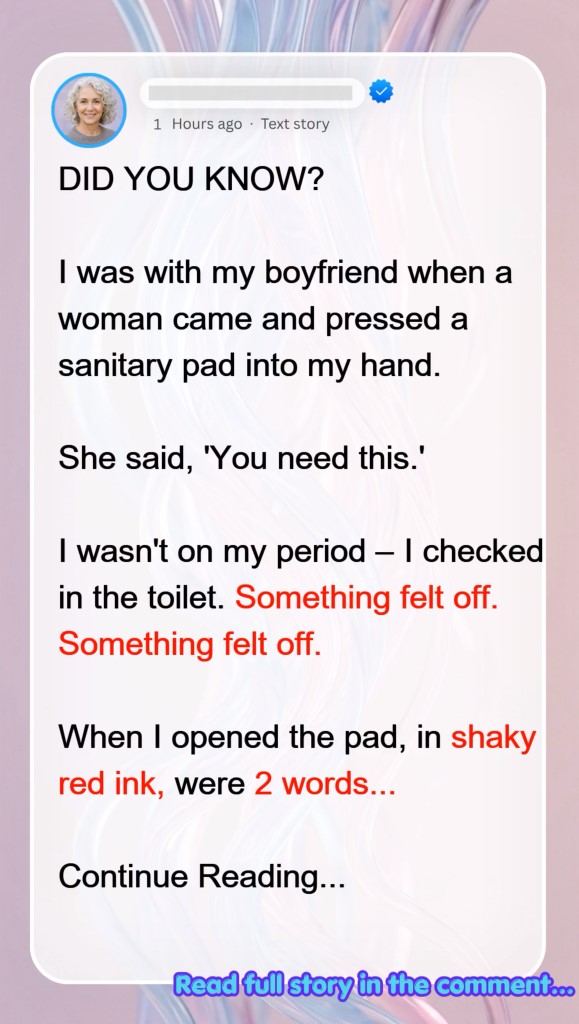
I was standing by the beverage coolers at a highway service station outside Knoxville with my fiancé, Colton, when an anxious woman in a denim jacket bumped hard against my shoulder. Before I could apologize, she grabbed my wrist, shoved a sealed, individually wrapped sanitary pad into my palm, and whispered with desperate intensity: “You need this right now. Go check.”
I wasn’t on my period. Confused and unsettled by her frantic eyes, I walked toward the back restrooms while Colton stayed at the register paying for fuel.
Inside the locked stall, I peeled back the adhesive wrapper.
Written directly across the cotton lining in shaky, smudged red ink were two words:
*DON’T DRINK.*
My breath seized in my throat. Tucked beneath the cotton flap was a tiny, folded passport photo and a pharmacy slip dated from three days ago—bearing the name of a missing girl from North Carolina, and my fiancé’s private signature at the bottom. PART 1
The hum of the interstate at midnight had lulled me into a quiet sense of security as we drove west along Interstate 40 through the mountains of eastern Tennessee.
I was twenty-seven years old, a freelance graphic designer based in Asheville, North Carolina. In the passenger seat beside me was Colton Vance—thirty, charming, a successful independent timber broker with an easy laugh and a disarming southern drawl. We had been engaged for barely six months. To my friends and family, Colton seemed like the steady, protective rock I had waited my entire life to find. He planned our weekend trips, took care of my car maintenance, and insisted on driving whenever we traveled.
It was nearly 11:30 PM when Colton pulled his dark pickup truck beneath the buzzing amber canopy of a Pilot Travel Center near Newport.
“I’m parched, sweetheart,” Colton said, leaning across the console to brush a stray lock of hair from my cheek. “Let’s stretch our legs, grab some cold drinks, and hit the road again. We’ve still got two hours before Nashville.”
Before we stepped out of the cab, Colton reached into the side door pocket and handed me a glass bottle of blackberry iced tea he had purchased at our previous stop in Black Mountain.
“Take a sip of this first, babe,” he said with a warm smile. “It’ll cool you down.”
“I’ll open it inside,” I smiled back, slipping the cool bottle into the deep pocket of my olive utility jacket.
The convenience store was bright, humming with the low drone of refrigeration compressors and commercial coffee machines. A lone cashier stood behind the counter, while a few long-haul truck drivers moved through the snack aisles. Colton walked toward the register to prepay the diesel pump, leaving me browsing the refrigerated beverage wall near the back corner.
I was reaching for a bottle of sparkling water when someone collided violently against my left side.
“Excuse me—” I began, catching my balance against the metal shelf.
Standing in front of me was a woman in her early thirties, dressed in a faded denim jacket and dark boots. Her blonde hair was pulled into a frantic, untidy ponytail, and her face was glistening with a fine sheen of nervous sweat. Her eyes darted wildly toward the front counter where Colton stood with his back turned, chatting easily with the cashier.
Before I could speak, the woman grabbed my right wrist with cold, trembling fingers.
With a swift, practiced motion, she shoved an individually wrapped, sealed sanitary pad into my palm, folding my fingers tightly over it.
“You need this,” she whispered, her voice a ragged, desperate rasp that sounded like it had been scraped through gravel. “Go into the ladies’ room right now. Lock the door. Do not let him see you.”
“Wait, I’m not on my—” I started, my voice catching in confusion.
“Check the lining!” she hissed, her fingernails digging through the fabric of my sleeve for a split second before she turned abruptly, pulling her hood up, and slipped out through the side emergency exit into the dark rain.
My heart began to hammer against my ribs with sudden, unexpected force.
I looked down at the clean plastic wrapper in my hand. It was an ordinary, branded sanitary pad, completely standard in appearance. But the sheer terror in the stranger’s eyes had felt visceral, real, and bone-chilling.
I glanced across the store. Colton was still laughing with the cashier, his wallet in his hand.
Instinct took over. Instead of walking toward the register, I pushed through the heavy wooden door into the women’s restroom.
The room was empty, echoing with the drip of an automatic faucet. I stepped into the farthest handicapped stall, slid the heavy stainless-steel deadbolt into its bracket, and stood with my back pressed against the partition.
My fingers shook as I peeled the plastic tab and opened the folded paper wrapping.
The white cotton pad unfolded into my palm.
Written directly across the absorbent lining, scrawled in thick, uneven red permanent marker, were two words:
*DON’T DRINK.*
A cold, electric shock raced from the base of my skull down my spine.
Tucked into the adhesive backing beneath the cotton layer was a small, laminated state identification card and a carbon-copy pharmacy receipt from a compounding clinic in Waynesville, North Carolina, dated three days ago.
I picked up the ID card. The photograph showed the smiling face of a thirty-one-year-old woman named Megan Clark.
The pharmacy slip was for a concentrated veterinary-grade liquid benzodiazepine.
At the bottom of the pickup receipt, written in bold, confident black ink, was the authorized signature of the prescribing timber buyer:
*Colton J. Vance.* PART 2
The air inside the stall turned suffocatingly thin.
My hands trembled so violently that the laminated card slipped from my fingers, clattering softly against the ceramic tile floor.
I dropped to one knee, snatching it back.
*Megan Clark.*
The name ignited a sudden, terrifying memory. Two weeks ago, my mother had mentioned a missing person notice posted on the local Asheville community board—a dental hygienist named Megan who had vanished from a hiking cabin outside Maggie Valley after spending the weekend with her fiancé. The police had found her car abandoned near a river turnout, with no sign of a struggle and her bank accounts untouched.
I pulled the glass bottle of blackberry iced tea from the deep pocket of my jacket.
I held it directly beneath the harsh fluorescent tube above the sink.
The plastic safety seal appeared completely intact around the rim. But when I leaned close and tilted the glass against the light, I saw it: a microscopic, puncture hole along the underside of the plastic cap, sealed with a tiny dab of clear, hardened jeweler’s wax.
Colton hadn’t offered me a refreshing drink to be thoughtful.
He had dosed the bottle before we left North Carolina. He had waited until we were sixty miles across the state line, on a deserted stretch of mountain highway in the dead of night, where there were no witnesses and no phone signal.
A heavy, deliberate knock rattled the outer door of the restroom.
“Hannah?” Colton’s familiar, cheerful voice echoed through the tiles. “You alright in there, babe? The pump’s finished. We’re burning daylight.”
Every muscle in my body locked into absolute paralysis.
I shoved the pad, the pharmacy slip, and Megan Clark’s identification card deep into my front jeans pocket, buttoning my coat over the front.
“I’m… I’m just feeling a little car sick, Colton!” I forced my voice to sound casual, though my vocal cords felt like dry twine. “Give me two minutes to wash my face!”
“Alright, sweetheart,” Colton replied, his voice pausing just a second too long on the other side of the wood. “I’ll leave the truck running by the curb. Don’t forget your tea.”
His footsteps receded down the corridor.
I leaned over the porcelain sink, splashing cold water against my cheeks to stop my teeth from chattering.
The woman in the denim jacket hadn’t been a random stranger experiencing a mental health crisis.
She had escaped him. Or she was someone connected to Megan who had been tracking him, waiting for the moment he stopped in a public place with another victim in his passenger seat.
I pulled out my smartphone.
The top bar showed **NO SERVICE**. The thick steel roof and cinderblock construction of the highway plaza completely blocked the regional cellular tower.
If I walked out that front door and refused to get into the truck, Colton was six-foot-two, two hundred and ten pounds, and kept a heavy utility wrench behind the driver’s seat. He could claim I was experiencing a panic attack, force me into the cab, and drive off before the sleepy cashier could even dial 911.
I looked at the bathroom window above the baby-changing station.
It was a narrow, frosted hopper window secured by an iron swivel latch, positioned six feet off the floor.
I dragged the plastic trash receptacle beneath the sill, stepped onto the rim, and unlatched the frosted glass.
A rush of cold, wet night air hit my face. The opening was barely eighteen inches wide, looking out onto the dark, unlit gravel lot behind the service station, where commercial diesel fuel tanks were fenced in with barbed wire.
Behind me, the outer bathroom door swung open with a sharp creak.
“Hannah?” Colton’s voice wasn’t warm anymore. It had dropped into a flat, cold, menacing whisper. “Why haven’t you unlocked the stall?” PART 3
The bathroom deadbolt rattled as Colton shoved his shoulder hard against the outer panel of the handicapped stall.
“Hannah. Open the door right now,” Colton said, the charm completely stripped away, replaced by an icy, calculated fury. “I saw the woman who slipped out of the snack aisle. What did she hand you?”
I didn’t answer.
I kicked off my sneakers, squeezed my shoulders through the narrow hopper window, and wriggled my torso out into the freezing rain.
The metal frame tore into my ribs, but the surge of pure, adrenaline-fueled survival erased the pain. I dropped four feet down, landing on my hands and knees in the wet gravel and diesel slush behind the station.
Inside, the sound of the wooden stall door splintering echoed through the bathroom glass.
“Hannah!” Colton roared.
I scrambled to my feet in my stocking feet, sprinting around the rear of the fuel tankers into the shadows of the truck parking row.
Dozens of massive semi-trucks sat idling, their diesel engines rumbling in a deafening, continuous roar that masked the sound of my ragged gasps. The rain was coming down in heavy sheets, soaking my clothes and freezing my skin.
Near the southern edge of the lot, fifty yards away, sat an old green Subaru wagon parked beneath the shadow of a highway billboard. Its headlights were off, but the interior dome light was on.
Sitting behind the wheel, staring frantically through the rain-streaked windshield toward the travel center doors, was the woman in the denim jacket.
I sprinted through the gravel, throwing myself against the passenger door handle.
The door was locked.
I slammed both palms against the glass. “Let me in! Please! It’s Hannah!”
The woman gasped, reached across the console, and unlocked the latch.
I tumbled into the passenger seat, slamming the door shut and locking it behind me just as Colton burst around the corner of the maintenance shed, a heavy steel tire iron swinging in his right hand, his eyes scanning the truck rows like a hunting dog.
“Get down!” the woman barked, throwing her jacket over my head while stepping on the accelerator.
The Subaru lurched forward in reverse, swinging around the trailer of an eighteen-wheeler, before tires gripped the asphalt of the service road and sped south toward the highway on-ramp without headlights.
I sat up, gasping for breath, clutching my bruised ribs as the taillights of the pilot plaza disappeared into the mountain fog.
The woman behind the wheel was breathing heavily, her knuckles white on the steering wheel. Her left eyebrow was scarred, and her face was lined with the exhaustion of someone who hadn’t slept in weeks.
“My name is Sarah Clark,” she said, her voice shaking as she finally switched on the low beams once we hit the highway. “Megan was my younger sister.”
Tears spilled freely down my cheeks as I reached into my pocket, pulling out the folded pad, the pharmacy slip, and Megan’s ID card.
“Where is she, Sarah?” I whispered, dread clamping around my heart. “Where is your sister?”
Sarah didn’t look over. A single, silent tear carved a path through the rainwater on her cheek.
“We found her phone in his cabin incinerator ten days ago, Hannah,” Sarah answered, her voice breaking into a quiet sob. “The police told us there wasn’t enough physical evidence to get a search warrant for his mountain acreage in Cocke County. So I bought a burner phone, tracked his truck GPS from his lumber yard, and followed him for three days waiting for him to make a move.”
Sarah reached into the center console and pulled out a small police scanner and an active emergency radio.
“He targeted women with independent savings and no immediate family in the state,” Sarah said, glancing at me in the dashboard glow. “He took out joint commercial lease policies on both of you. Megan’s life insurance was approved two weeks before she vanished. And forty-eight hours ago, he added a two-hundred-and-fifty-thousand-dollar travel rider to your engagement papers.”
She clicked the emergency radio on, handing me the microphone.
“We’re three miles from the Cocke County Sheriff’s outpost in Newport, Hannah. You hold the certified prescription receipt and the poisoned bottle. Call it in.” ENDING
The arrest of Colton Vance took place forty minutes later at a highway roadblock outside Dandridge.
When state troopers surrounded his truck, Colton attempted to reverse down the highway shoulder, but spike strips deployed by county deputies shredded his tires. Inside the cab of his vehicle, investigators recovered three additional sealed glass drink bottles, an unregistered syringe kit, and two forged spousal life insurance policies naming his private holding firm as the sole beneficiary.
The subsequent search of Colton’s sixty-acre timber property in the mountains of Cocke County uncovered the horrifying extent of his double life.
Forensic teams discovered the personal belongings, identification papers, and bank registers of Megan Clark, alongside evidence linking Colton to two other unexplained disappearances dating back five years across the Great Smoky Mountains region.
Faced with the incontrovertible physical evidence—the compounded sedative lab records, the altered bottle caps, and the eyewitness testimonies of both Sarah and me—Colton’s defense crumbled completely.
During his preliminary grand jury hearing in Knox County, Colton accepted a plea agreement to avoid capital murder charges, pleading guilty to aggravated kidnapping, felony chemical assault, and multiple counts of grand insurance fraud. He received three consecutive life sentences without the possibility of parole, ensuring he will spend the rest of his natural life behind the concrete walls of the Riverbend Maximum Security Institution.
Sarah and I did not remain strangers.
The shared trauma that had collided in that Pilot Travel Center forged an unbreakable, lifelong sisterhood.
Over the following year, I helped Sarah establish the *Megan Clark Advocacy Initiative*—a non-profit organization that provides emergency investigative support, private digital tracking resources, and legal assistance to families searching for missing loved ones in rural Appalachian communities where county resources are stretched thin.
I sold my rental in Asheville, returned my engagement ring to the county evidence vault, and moved closer to my parents in North Carolina, rebuilding my life with fierce, deliberate care.
It is early autumn now in the Blue Ridge Mountains.
The morning sun rises warm and amber over the ridges, burning away the mist from the valleys where the sourwood and maple trees are turning deep crimson and gold.
Yesterday afternoon, Sarah drove up to my new home for coffee. We sat on the front porch together, listening to the birds in the hemlocks and watching the clouds drift peacefully across the distant peaks.
On the small wooden table between us rested a framed photograph of Megan Clark, smiling radiant and free on a mountain overlook, her memory finally delivered from the shadows into the clean, untarnished light of justice.
Sarah reached across the table, taking my hand with a quiet, steady warmth that carried no fear.
“You listened to the warning, Hannah,” Sarah murmured softly, a tender smile touching her eyes. “Most people would have thrown it in the trash.”
I looked down at our clasped hands, feeling the crisp mountain breeze against my face, wrapped in an overwhelming, unbreakable sense of gratitude.
I had spent my youth believing that love was defined by easy words, expensive promises, and handsome smiles that never wavered in public.
That rainy night in Tennessee taught me the deepest truth of all: that real protection does not come from the people who claim to own your future—it comes from the quiet courage of ordinary people who look into the dark, refuse to walk away from a stranger’s danger, and risk everything they have to bring the innocent safely home forever.