
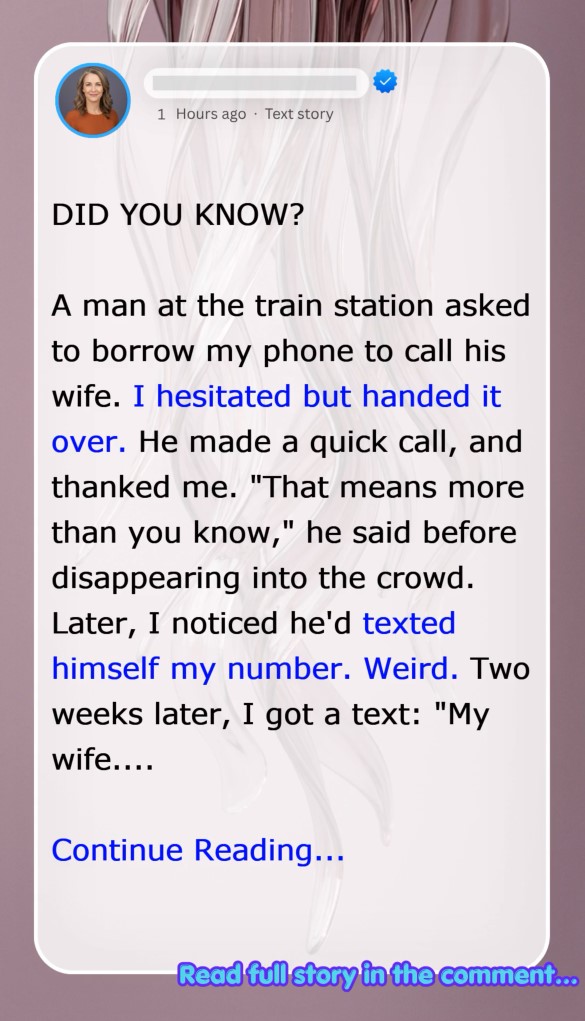
PART 1
The Friday evening rush at Philadelphia’s 30th Street Station was a blur of blaring intercom announcements, squealing brakes, and damp commuter coats.
I was thirty-four years old, working as an independent architectural draftsperson in Center City, waiting for the 6:15 PM commuter train back to Chester County. My laptop bag felt heavy against my shoulder, and I was checking an email on my phone when a man approached me near the ticket kiosk.
He was in his late fifties, dressed in a faded corduroy jacket with fraying cuffs. His hair was windswept, his breath came in short, uneven rasps, and his eyes darted nervously between the departure monitors and the station exit.
“Excuse me, ma’am,” he said, his voice cracking with embarrassment and anxiety. “I am so sorry to bother you. My phone died about an hour ago, and my wife is circling the south parking garage waiting to pick me up. Could I please borrow your phone for thirty seconds just to tell her I made it?”
I hesitated. Working in the city teaches you to be cautious with your personal belongings, and handing an unlocked smartphone to an agitated stranger goes against every instinct.
Yet when I looked at his face, I didn’t see malice or deception. I saw sheer, suffocating desperation—the look of a man barely holding himself together.
“Thirty seconds,” I said, dialing the keypad to unlock the screen and handing it over. “Speakerphone off, please.”
“Thank you, God bless you,” he whispered, his hands trembling violently as he pressed the glass.
He dialed a ten-digit number from memory. He brought the phone to his ear, waiting through three rings before speaking in a rushed, hushed tone.
“It’s me,” he whispered into the receiver. “I’m on an open line. The transfer is set for the fifteenth. Don’t sign anything until Arthur reviews the secondary deed. I’m coming.”
He tapped the screen to disconnect, took a ragged breath, and handed the phone back to me. His eyes were moist, rimmed with deep red exhaustion.
“That means more than you know,” he said, his voice shaking with profound intensity.
Before I could reply, he turned and disappeared into the stream of passengers heading toward the concourse stairs.
I boarded my train, found a window seat, and settled in for the forty-minute ride. Out of casual habit, I opened my messaging app to text my partner that I was on my way home.
Right at the top of the message log was a sent text, sent exactly three minutes earlier to the number he had just dialed.
The message contained only my own phone number: *610-555-0194*.
A knot of unease tightened in my stomach. Why would a man claiming to call his wife text himself my number? Was it a scam to harvest active phone lines? Was he going to sell my contact information to telemarketers?
I debated blocking the number, but life quickly took over. Between client drafting deadlines, kitchen renovations, and family visits, the brief encounter at the train station faded into the background.
Exactly fourteen days later, on a quiet Thursday night at 11:42 PM, I was sitting at my kitchen island with a mug of herbal tea, reviewing floor plans.
My phone vibrated twice against the countertop.
The screen lit up with an incoming text from the exact number the stranger had dialed two weeks prior.
I tapped the notification, and the text loaded onto my screen:
*”My wife never met me at the station. Her name is Clara Holloway. She’s been kept under involuntary chemical sedation in Room 304 of Oakridge Care Facility for two years. The call I made from your phone was the only outside, unmonitored call logged into their internal switchboard this year. If you don’t bring this timestamped phone record to Room 2B of the Chester County Courthouse tomorrow at 9:00 AM, my brother will finalize a permanent medical conservatorship that strips Clara of everything.”*
Taped below the message was an image attachment of an official county court docket.
I stared at the name on the screen, and the air froze in my lungs.
Clara Holloway had been my high school AP English teacher—the woman who had spent four years encouraging my passion for design and who had mysteriously vanished from our small community two years ago following a reported “private medical retirement.”
PART 2
I couldn’t sleep a single minute that night.
Sitting in my home office with the blinds drawn, I pulled up the public docket for the Chester County Court of Common Pleas.
Case No. 2024-CV-0891: *In Re: Conservatorship and Estate of Clara Vance Holloway.*
The petition had been filed by Philip Holloway—a prominent, well-connected regional real estate developer and the younger brother of Clara’s husband, Julian Holloway.
Julian Holloway was the man from the train station.
I dug through digital newspaper archives from our county over the last three years.
Clara Holloway had inherited her family’s historic two-hundred-acre equestrian estate in Chester Springs five years ago. Two years later, local papers published a brief announcement stating that Mrs. Holloway had suffered an acute neurological breakdown following a severe stroke, prompting her family to place her in a private residential medical clinic for specialized long-term rehabilitation.
Julian, her husband of twenty-eight years, had been quietly pushed out of the family residence. According to a brief local article from eighteen months ago, Julian had filed multiple emergency petitions alleging financial fraud and unlawful confinement, but the courts had dismissed them due to a lack of independent evidence and an active restraining order secured by Philip Holloway’s legal team.
Philip Holloway claimed that Julian was unstable, disruptive to Clara’s medical care, and attempting to interfere with court-ordered medical treatment.
Now, Philip had filed a final motion for permanent fiduciary liquidation—a petition that would allow him to sell Clara’s multi-million-dollar land trust to a commercial warehousing conglomerate, claiming the proceeds were necessary to pay for her ongoing, lifetime care at Oakridge Manor.
The court hearing was scheduled for 9:00 AM this morning.
I checked my phone’s cellular billing account online.
Because I had an itemized business plan, my account generated precise, certified digital records of every incoming and outgoing transmission, down to the exact second, tower location, and routing node.
The record proved that at 5:48 PM on October 14th, my phone had connected directly to the direct internal nursing line of Oakridge Manor’s third-floor administrative desk—a private extension that Philip Holloway’s legal filings swore had been completely disabled and inaccessible to patients.
More importantly, the transmission logs from that evening proved that Julian had not been “harassing the facility from an unauthorized burner phone” as Philip’s latest emergency contempt motion alleged; he had made a single thirty-second call from a stranger’s verified public phone.
At 7:30 AM, I got dressed in a dark blazer, printed three copies of the certified carrier records, and drove straight to the Chester County Justice Center in West Chester.
The morning sun was cold and gray as I walked through the security checkpoints and took the elevator to the second floor.
Outside Courtroom 2B, the marble corridor was almost empty.
Sitting on a wooden bench at the far end of the hallway was Julian Holloway.
He was wearing the same worn corduroy jacket, his head buried in his hands, trembling with exhaustion and defeat. Beside him sat no high-powered attorneys—only a battered canvas briefcase filled with dog-eared medical notebooks.
Standing twenty feet away near the courtroom double doors was Philip Holloway, flanked by two attorneys in bespoke suits and an administrator with an Oakridge Manor identification badge. Philip was laughing softly, sipping coffee from a paper cup, completely confident in the outcome of the morning.
I walked down the long corridor, the sound of my heels echoing off the marble floor.
Julian looked up.
When his bloodshot eyes locked onto mine, his mouth fell open in breathless, disbelieving shock.
“You came…” Julian whispered, his voice catching in his throat as he struggled to stand. “I didn’t think… I didn’t know if you would even read it.”
“Clara Holloway taught me how to believe in my own future fifteen years ago, Mr. Holloway,” I said, opening my leather portfolio and pulling out the certified telecommunications dossier. “Now let’s show this judge what they’ve been hiding.”
PART 3
At 9:05 AM, the bailiff opened the doors to Courtroom 2B.
Judge Martha Reynolds took the bench. She was a stern, veteran jurist known for running an efficient courtroom and having zero patience for procedural delays.
Philip Holloway’s senior counsel, a silver-haired litigator named Caldwell, stood up immediately.
“Your Honor,” Caldwell began with smooth, practiced authority. “We are here this morning for the final confirmation of the conservatorship sale of the Chester Springs parcel. Mrs. Clara Holloway remains in an advanced, non-communicative cognitive state under round-the-clock medical supervision at Oakridge Manor. The monthly care costs exceed eighteen thousand dollars, and the estate requires immediate liquidation to sustain her treatment.”
Caldwell gestured dismissively toward Julian, who was seated alone at the respondent’s table.
“Mr. Julian Holloway has repeatedly violated protective orders, alleging absurd conspiracies about his wife’s condition,” Caldwell continued. “In fact, two weeks ago, facility staff reported an unauthorized threatening call made directly to the third-floor nurse’s station from an unregistered line, further proving Mr. Holloway’s erratic and dangerous behavior. We ask that the conservatorship be finalized and that Mr. Holloway’s parental and spousal visitation rights be permanently terminated.”
Judge Reynolds adjusted her glasses, looking down at Julian. “Mr. Holloway, do you have legal counsel present today?”
Julian stood up, his hands resting flat against the wooden table to steady his trembling frame.
“I do not have counsel, Your Honor,” Julian said, his voice quiet but gaining strength with every word. “Because every time I hire an attorney, my brother’s firm files procedural motions to freeze our joint accounts. But I have an independent witness and certified carrier records that prove the entire narrative before this court is built on perjury.”
Judge Reynolds frowned. “Explain yourself, Mr. Holloway.”
Julian turned toward the gallery. “I call Maya Vance.”
Philip Holloway’s attorneys turned in surprise as I stepped through the swinging wooden gate, carrying my leather portfolio.
I approached the witness stand, was sworn in by the clerk, and took my seat.
“State your name and occupation for the record,” Judge Reynolds instructed.
“My name is Maya Vance. I am a licensed architectural draftsperson in Center City, Philadelphia,” I stated clearly. “I have no financial or personal stake in the Holloway estate.”
I handed my certified carrier documents to the bailiff, who delivered them directly to the judge’s bench.
“Two weeks ago at 30th Street Station, Julian Holloway asked to borrow my cell phone for thirty seconds,” I explained, looking directly at Philip’s defense team. “He placed a call to the third-floor nursing station at Oakridge Manor. That call was made from my registered, verified mobile account—not a burner phone, and not an unauthorized device.”
I pointed to the second exhibit on Judge Reynolds’ desk.
“Attached to those records is an audio recording timestamped to that exact thirty-second window,” I continued. “Because my business phone uses an automatic client transcription and recording application, the entire exchange between Mr. Holloway and the floor nurse was captured.”
A sudden, dead silence descended over the courtroom.
Philip Holloway’s face drained of color. He leaned forward, frantically whispering into his attorney’s ear.
“Your Honor, this is completely unvetted, ambush evidence!” Caldwell objected loudly, rising from his chair.
“Sit down, Mr. Caldwell,” Judge Reynolds ordered sharply.
The judge plugged her private headphones into the bench terminal and pressed play on the recording.
For two full minutes, the only sound in the courtroom was the faint hum of the fluorescent lights.
On the recording, the voice of the supervising floor nurse at Oakridge Manor could be heard clearly:
*”Julian? She’s awake. Clara’s cognitive tests were completely clear last Tuesday. Dr. Mercer told Philip that her stroke damage was minor and that she can speak, but Philip ordered her medication increased to keep her from attending the October hearing. They’re keeping her under heavy sedative protocols, Julian. You have to get an outside order before Friday.”*
Judge Reynolds removed her headphones.
Her face was as dark and cold as thunder. She looked over the bench directly into the pale, sweating face of Philip Holloway and the administrator from Oakridge Manor.
“Mr. Caldwell,” Judge Reynolds said, her voice dropping into a dangerous, razor-sharp whisper. “Did your client just attempt to use this court to liquidate a four-million-dollar land trust while actively concealing the medical competence of the property owner?”
ENDING
The collapse of Philip Holloway’s conservatorship scheme was immediate and devastating.
Judge Reynolds did not merely dismiss the petition to liquidate the family land trust; she issued an emergency court order appointing an independent state guardian and dispatched county sheriff’s deputies directly to Oakridge Manor to execute an immediate medical welfare check.
Within three hours, Clara Holloway was removed from the private facility and transported to the neurological trauma center at the Hospital of the University of Pennsylvania in Philadelphia.
Independent medical evaluations confirmed that Clara’s physical stroke had been minor and that her prolonged cognitive impairment was the direct result of medically unnecessary, high-dosage chemical sedatives administered under fraudulent orders orchestrated by Philip and a corrupt clinic director.
Once the sedatives cleared her system, Clara was fully coherent, alert, and able to speak for herself.
The legal consequences followed with unrelenting force.
The Chester County District Attorney’s Office opened a sweeping criminal investigation into Philip Holloway, Caldwell’s law firm, and the administrative board of Oakridge Manor.
Within six months, Philip Holloway was indicted on multiple felony counts of healthcare fraud, unlawful restraint, forgery, and grand financial exploitation. His commercial development assets were placed into judicial receivership, and the private medical wing of Oakridge Manor was permanently closed by state licensing authorities.
Julian and Clara Holloway were reunited in early winter.
They returned to their historic stone farmhouse on the Chester Springs equestrian property—the land Clara’s family had farmed for four generations, preserved whole and unencumbered.
Three months after the court hearing, on a crisp, sunlit Saturday afternoon in early spring, I drove out to Chester Springs.
The long gravel driveway wound through rolling green pastures where two horses grazed peacefully beside the wooden fences.
Clara Holloway was sitting on the front porch in a rocking chair, wrapped in a knitted wool blanket, sipping tea with Julian by her side. Though her hands still bore the faint tremor of her ordeal, her eyes were sharp, bright, and filled with the familiar, brilliant warmth I remembered from high school.
When I stepped out of my car, Clara pushed herself up from the chair and walked down the porch steps to meet me.
She took both of my hands in hers, her fingers warm and strong, tears glistening in her eyes.
“Maya,” Clara whispered softly, pulling me into a long, trembling embrace. “You listened to a stranger in a crowd when the whole world was looking away. You gave me back my life, my home, and my husband.”
Julian stood beside us, smiling through his tears, placing a gentle hand on his wife’s shoulder.
We spent the afternoon on the sunlit porch, talking about architecture, literature, and the gardens Clara was preparing to plant for the summer.
It is mid-spring now in Pennsylvania.
The dogwood trees across Chester County are bursting into white and pink blooms, their petals drifting gently over the green meadows.
I keep my phone on my desk at work, just as I always have.
Whenever I look at the small glass screen, I am reminded of that damp, noisy evening on the train platform at 30th Street Station.
I had believed that day that I was simply doing a minor, inconvenient favor for an anxious commuter whose battery had died.
That encounter taught me the deepest truth of all: that an act of quiet, ordinary kindness is never small. It can become the key that unlocks a cage, the light that shatters the darkest deception, and the bridge that brings the innocent safely home to the truth forever.