
George looked like he was about to check my pulse right there between the pastry tray and the juice machine.
The morning sun over the Palm Haven Resort dining room had barely cleared the glass atrium when Arthur walked through the swinging brass doors, his silver hair neatly combed and his posture straight as a surveyor’s rod. He was whistling something jaunty and old-fashioned, the kind of tune from a 1950s radio serial that nobody under seventy remembers. He dropped two bran muffins onto his china plate alongside a half-dozen strawberries, looking remarkably refreshed for a man who had just tied the knot the afternoon before with a woman barely old enough to rent a car without paying the surcharge.
George, who had served as the best man and had spent the entire rehearsal dinner sweating through his collar while muttering dire warnings about cardiac arrest and predatory gold-diggers, intercepted him before he could reach the butter. George grabbed Arthur by the sleeve of his blazer, his knuckles pale against the navy wool, and pulled him hard toward the corner near the ice machine where the clatter of silverware could drown out what he was about to say.
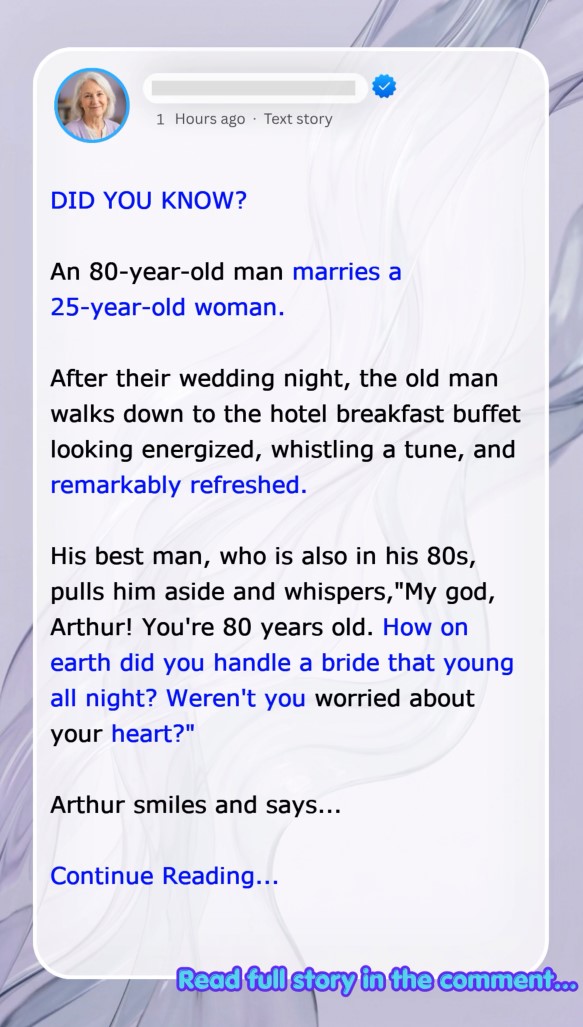
“My god, Arthur! You’re 80 years old. How on earth did you handle a bride that young all night? Weren’t you worried about your heart?” George whispered, his voice cracking on the final word like a boy caught behind the bleachers.
Arthur didn’t even blink. He just adjusted his gold-rimmed reading glasses, took a slow sip of his black coffee, and smiled that dry, slow smile he usually reserved for city inspectors trying to condemn a historical foundation.
The dining room around us hummed with the usual chatter of tourists and retirees spooning out lukewarm oatmeal, entirely unaware that a lifelong friendship was currently hovering on the razor edge of an absolute cardiac episode. George stood there huffing softly, his face the color of a bruised plum, waiting for some wild confession of blue pills or midnight heroics that would confirm every cynical gossip column in the county.
Instead, Arthur set his coffee saucer down with a crisp little clatter against the marble top.
“George, at my age, the secret is knowing when to let someone else do the heavy lifting, we played three games of gin rummy, ate room-service peach pie, and talked until four in the morning,” Arthur said, his voice carrying just enough gravel to slice through the ambient noise of the breakfast rush.
George let out a sound like a punctured bicycle tire. He stared at Arthur for three full seconds, waiting for the punchline, waiting for the wink that would signal a crude joke among old war buddies. But Arthur just picked up his plate and walked right past him toward a quiet table by the terrace doors, leaving George standing by the juice machine with his mouth half-open.
I had been sitting two tables away, nursing a stale decaf and watching the whole exchange play out over the top of the morning paper. You don’t live in a town this small for forty years without developing an antenna for other people’s wreckage. When the wedding invitations went out six months ago, listing Arthur Vance, eighty, alongside Clara Hayes, twenty-five, the local coffee shop basically turned into a tribunal. People whispered about midlife crises on a geological scale. They whispered about inheritance theft and senile delusion. They looked at Clara like she was some sort of fortune-hunting siren who had drifted in off the interstate to fleece a retired architect of his life savings before he could cash his final pension check.
Nobody knew the real math. Not George, not the ladies in the quilting circle, and certainly not Julian, Clara’s slippery first cousin who had spent the last year trying to bulldoze her family’s legacy into a strip mall parking lot.
The whole thing went back fifty-eight years, to a muddy engineering camp outside of Munich where Arthur and Clara’s grandfather, Thomas Hayes, had spent twelve freezing months drafting structural repairs for bombed-out municipal buildings under three inches of soot. They weren’t just colleagues; they were the kind of friends who kept each other alive by sharing stale rations and swearing that if they ever made it back to the States, they would build something that actually lasted. Thomas went on to establish the Hayes Botanical Conservancy, a sprawling twenty-acre sanctuary of rare alpine flora and Victorian glasshouses tucked away in the foothills. Arthur went into commercial architecture, built a firm, buried his wife of forty years, and quietly watched the world fill up with glass boxes that had no soul.
Then Thomas passed away, followed six months later by his son, leaving Clara alone at twenty-four to inherit a botanical trust bleeding out in back taxes and deferred maintenance. That was when Julian stepped in with a briefcase full of probate citations and a developer friend from Sacramento who wanted to pave the conservatory ferns for a luxury RV resort.
Clara was an illustrator, not a litigator. She spent her days bent over heavy vellum paper drawing botanical plates with a triple-zero ink brush, capturing the venation of fern fronds and the downy fuzz of alpine poppies with a precision that left gallery curators speechless. She didn’t have the stomach for courtrooms, and she certainly didn’t have the seventy thousand dollars retainer fee that downtown lawyers demanded just to look at a zoning dispute.
I remember the Tuesday afternoon six months ago when Arthur came walking down my gravel driveway with a rolled-up set of blueprints under his arm and a look on his face I hadn’t seen since we served on the zoning board together back in ninety-four. He dropped the plans onto my porch table, kicked the leg with his boot, and told me he was going to commit legal arson.
“Julian thinks he can starve the girl out by tying up the estate in surrogate court until she signs away the deed for pennies,” Arthur had told me that afternoon, his voice tight with the kind of cold fury that only old men can manage without raising their volume. “He forgets that Thomas and I signed a mutual partnership covenant back in 1968 that gives surviving co-signers veto power over any dissolution of trust assets. The only problem is, the county probate clerk ruled that blood descendants supersede business partners unless there’s an immediate familial bond establishing direct guardianship or marital survivorship.”
“Arthur,” I said, looking up from my gardening shears. “You’re seventy-nine years old. What are you suggesting?”
“I’m suggesting I don’t give a damn what the gossips say,” he replied, tapping the blue lines with a calloused thumb. “Clara needs an unassailable legal shield, and I need a project that doesn’t involve designing another suburban subdivision for people who don’t know the difference between load-bearing brick and drywall. We’re going to get married.”
It wasn’t a romance born of candlelight and whispered sweet nothings. It was a tactical alliance forged in a drafting room, an ironclad legal partnership designed to blow Julian’s probate strategy completely out of the water. Under state law, a spouse held absolute priority in estate execution and trust defense, neutralizing Julian’s predatory claims overnight.
Yet looking at George now, sputtering over his bran muffin and trying to process the concept of an octogenarian wedding night spent playing gin rummy, I understood why the world needed to believe the worst. People prefer a scandalous lie to a complicated truth because scandals don’t require you to admire anyone.
Arthur motioned for George to join him out on the sunlit veranda, gesturing to the empty wrought-iron chair opposite his own. George hesitated, his coffee cup trembling slightly, before shuffling across the stone pavers like a condemned man walking to the gallows. He dropped into the chair, crossing his arms over his chest and staring out across the resort’s manicured boxwood hedges.
“Arthur, I’m just saying, at our age, you don’t need the complications,” George muttered, staring down at his plate. “The whole town is talking. My wife hasn’t stopped calling me every two hours asking if you need an ambulance on standby. It’s unseemly. A twenty-five-year-old girl…”
Arthur didn’t interrupt him. He waited until George finally ran out of steam and looked up, expecting a lecture or a defensive snap.
“George, look at me,” Arthur said softly, his voice dropping all the theater. “When was the last time you sat across a table from someone who actually understood what you were talking about without checking their wristwatch or asking how your investments are doing?”
George blinked. He opened his mouth, closed it again, and looked down at the table.
“Clara spent three hours last night going over the architectural restoration specs for the Victorian fern house roof,” Arthur continued, leaning forward with a faint sparkle in his pale blue eyes. “She didn’t ask about my will. She didn’t ask about my bank accounts. She asked if I could help her secure the original cast-iron brackets from the 1884 greenhouse build so the winter snow wouldn’t crush the orchids. She’s got her grandfather’s fire, George. And I’ve got forty years of structural engineering experience and a very stubborn streak that Julian’s lawyers haven’t managed to break yet.”
The screen door to the veranda clicked open, and light footsteps tapped against the stone.
Clara stepped out into the morning air, wearing a simple linen sundress the color of oatmeal and carrying a leather portfolio under her arm. Her dark hair was loosely pinned back, and she had a smudge of charcoal ink right on the bridge of her nose, the exact same smudge Thomas used to sport whenever he spent all night sketching foundation arches. She didn’t look like a gold-digger. She looked like someone who had finally slept eight hours for the first time in six months.
“Morning, Arthur. Morning, Mr. Henderson,” she said, offering a warm, tired smile as she pulled out the third chair at our table. She didn’t wait for an invitation; she just dropped her portfolio onto the iron surface and flipped it open to reveal a crisp, ink-rendered blueprint of a glass greenhouse roof supported by delicate, sweeping ribs. “I found the structural load calculations from the 1890 archive last night while we were looking for the score pads. If we reinforce the central ridge beam with steel inserts, we can save the original cypress framing without ripping out the historical registry.”
George stared at the drawing. Then he looked up at Clara, really looked at her, past the age gap and the gossip columns and the wedding rice still clinging to the hem of her dress. He saw the ink on her fingers. He saw the absolute, unshakable focus in her eyes.
Slowly, almost reluctantly, George’s shoulders unspooled. The fierce, defensive hunch that had defined his posture all morning melted away into something resembling profound, quiet awe. He reached out, picked up one of the architectural sketches by the corner so as not to smudge the ink, and ran his thumb over the clean, precise lines of the drawing.
“My word,” George whispered, his voice losing all its defensive edge. “Thomas used to draw those exact same ventilation cowls on the margin of our field reports in Munich. Exact same angle.”
“He taught me when I was six,” Clara said softly, offering George a small, knowing smile. “He said if you can’t draw a load line with your eyes closed, you shouldn’t be trusted to build a roof over someone’s head.”
George let out a long, slow breath that sounded almost like a laugh. He set the drawing back down on the table, reached into his jacket pocket, and pulled out a crumpled linen handkerchief to wipe his glasses. When he put them back on, he looked directly at Arthur, his expression entirely cleared of suspicion.
“Well,” George said, clearing his throat and sitting up straight in his chair. “If you two are going to spend your honeymoon arguing about cast-iron brackets and load calculations, I suppose I’d better cancel the ambulance.”
Arthur chuckled, picking up his coffee cup and raising it slightly in a silent toast. Clara laughed too, a bright, clear sound that carried out across the veranda and chased away the last lingering shadows of the morning.
A folded deck of playing cards and a handwritten gin rummy scorecard rested between two fresh porcelain coffee cups on the sunlit veranda, with Arthur and Clara sharing an easy, knowing laugh.