
I WOKE UP AFTER FOUR LOST DAYS—AND THE WOMAN HOLDING MY HAND WAS THE EX-WIFE I HADN’T SPOKEN TO IN THREE YEARS. THEN A NURSE TOLD ME WHAT SHE HAD DONE WHILE I WASN’T AWAKE.
The first thing I noticed was the soft electronic beeping beside me.
The second was the hand wrapped around mine.
I opened my eyes slowly and stared at the ceiling of a hospital room, trying to understand why everything felt unfamiliar.
Then I turned my head.
And there she was.
Rachel.
My ex-wife.
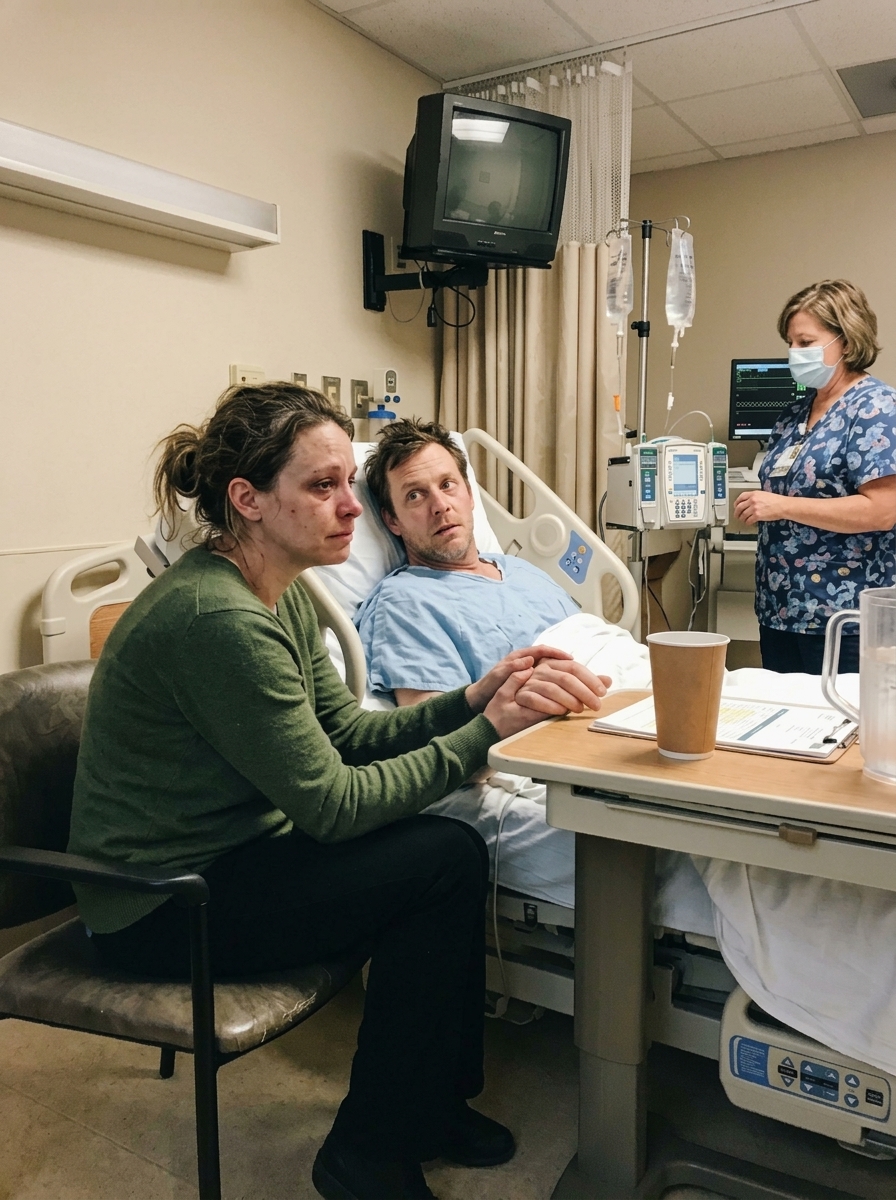
She was sitting in a stiff chair beside my bed with both hands around my right hand. Her brown hair was tied back badly, like she had done it without looking in a mirror.
There were dark circles under her eyes.
Her sweater was wrinkled.
A paper cup sat untouched on the table beside her.
For several seconds, I honestly wondered if my mind was playing some strange trick on me.
Rachel and I had been divorced for almost three years.
We hadn’t had a real conversation in more than two.
Yet she was sitting beside me like she belonged there.
When she realized my eyes were open, her whole face changed.
She leaned forward so quickly the chair scraped across the floor.
“Daniel?”
Her voice came out barely above a whisper.
I tried to answer.
Nothing useful came out.
Rachel covered her mouth with one hand.
Then she started crying.
Not loudly.
Not dramatically.
She simply lowered her head, squeezed my fingers, and cried like somebody who had been holding everything inside for far too long.
That frightened me more than anything else in the room.
Because Rachel had always been the calm one.
Even during our divorce, when I was angry and defensive and determined to pretend I didn’t care, Rachel had remained painfully controlled.
She hadn’t cried in front of me when we divided the furniture.
She hadn’t cried when I carried the last box out of our house.
She hadn’t cried when we stood beside our cars in the driveway after signing the final papers.
She had simply said, “Take care of yourself, Daniel.”
Then she drove away.
That was the Rachel I remembered.
The woman beside my hospital bed looked nothing like her.
A nurse came in before I could ask what had happened.
She smiled when she saw me awake and immediately began checking the equipment around the bed.
“Good to see you with us,” she said.
I looked from her to Rachel.
My mind was slow, but one question was already pushing through everything else.
Why was Rachel here?
The nurse told me I had experienced a sudden medical emergency at my office several days earlier.
She kept the explanation simple.
I had lost consciousness.
Someone from my office had called for help.
The doctors had kept me under close observation while they figured out what was happening and made sure I was stable.
I remembered almost none of it.
The last clear memory I had was sitting at my desk after a long meeting.
There had been paperwork spread across the conference table.
My laptop had been open.
Someone had been talking about a deadline.
I remember rubbing my forehead and thinking I needed to go home.
Then nothing.
According to the nurse, four days had passed.
Four days.
I stared at her.
“Four?”
My voice sounded rough.
She nodded.
Rachel’s hand tightened around mine.
I turned toward her.
Subscribe to Tatticle!
Get updates on the latest posts and more from Tatticle straight to your inbox.
Website
Your Email…
Subscribe
We use your personal data for interest-based advertising, as outlined in our Privacy Notice.
She looked away.
The nurse glanced between us, apparently sensing something I didn’t understand.
Then she smiled gently.
“She’s been waiting a long time for you to wake up.”
Rachel closed her eyes.
My confusion deepened.
After the nurse left, silence filled the room.
I watched Rachel.
She watched the floor.
Finally, I managed to speak.
“How did you know?”
Rachel lifted her eyes.
“The hospital called me.”
“Why?”
Her mouth moved slightly, but no answer came.
A nurse answered that question for me later.
Apparently, when the hospital staff checked the emergency information stored in my phone and office records, Rachel’s name was still there.
I had never changed it.
Three years after our divorce, my ex-wife was still listed as the person to call if something happened to me.
That little administrative mistake had brought her back into my life.
But it didn’t explain the rest.
The hospital called Rachel shortly after I arrived.
She got there twenty-eight minutes later.
I know the exact number because one of the nurses mentioned it while talking to another staff member.
Twenty-eight minutes.
Rachel had been teaching when she received the call.
She had left school, driven across town, and walked into the hospital carrying nothing except her purse and the cardigan she had been wearing in her classroom.
And then she stayed.
That first afternoon, she sat beside my bed.
That evening, she was still there.
The next morning, she was there again.
And the morning after that.
For four days, Rachel barely left the hospital.
She slept sitting up in that chair.
She ate sandwiches from the cafeteria.
She kept a book in her lap but apparently never got through more than a few pages.
She talked to nurses.
She answered calls from my office.
She contacted my sister in Arizona because she knew I would want someone in the family informed.
She even went to my house once to feed the old orange neighborhood cat that had somehow decided my porch belonged to him.
Then she came straight back.
When I learned all of that, something inside me became painfully unsettled.
Rachel didn’t owe me anything.
That fact mattered.
We didn’t have children together.
We didn’t share property anymore.
We didn’t have unfinished business.
There was no practical reason for her to spend four days sitting in an uncomfortable chair beside a man she had divorced.
Yet she had.
I kept looking at her and remembering who we used to be.
Rachel and I had met when we were twenty-six.
I was working as a junior architect at a small design firm in Columbus, Ohio.
She taught third grade at an elementary school across town.
We met in an independent bookstore on a Saturday afternoon.
It wasn’t romantic.
It wasn’t graceful.
Rachel backed into a cardboard display while trying to reach a book from the top shelf.
The whole thing tipped sideways.
Paperbacks slid everywhere.
I was standing ten feet away and watched her freeze in horror.
Then she looked around at the mess and said, “Well, I guess I’m buying all of these now.”
I laughed.
She laughed.
We spent the next fifteen minutes putting books back onto the display.
Then we got coffee from the little counter in the back.
That coffee turned into dinner.
Dinner turned into a walk around downtown.
Our first date, if you could call it that, lasted almost six hours.
I called her the next morning.
Two years later, we got married.
Five years after that, we bought a modest two-story house on a quiet street outside Columbus.
It wasn’t impressive.
The kitchen was too small.
The upstairs bathroom had ugly tile.
The porch railing leaned slightly to one side no matter how many times I tried to straighten it.
We loved that house.
Rachel planted herbs in boxes beside the kitchen window.
I built bookshelves in the living room and immediately discovered that architects are not automatically good carpenters.
One shelf leaned so badly Rachel kept a stack of old magazines under one side to level it.
She refused to let me replace it.
“It’s part of the house now,” she said.
That became our life.
Ordinary.
Comfortable.
Ours.
Sunday mornings meant coffee on the porch.
Friday nights sometimes meant takeout and old movies.
We had friends over for backyard cookouts in summer.
Every December, Rachel insisted on hanging too many lights around the front window.
I complained.
Then I secretly added another strand when she wasn’t looking.
We weren’t wealthy.
We weren’t glamorous.
But for a long time, I thought we were solid.
I thought that meant nothing could break us.
I was wrong.
The beginning wasn’t dramatic.
That’s the strange part.
There was no single terrible betrayal.
No secret affair.
No screaming match that suddenly destroyed everything.
Life simply became heavy.
My father passed away unexpectedly.
He and I had been close.
Closer than I realized until he wasn’t there anymore.
I didn’t know what to do with the grief, so I did what I had always done when something made me uncomfortable.
I worked.
I stayed later at the office.
I volunteered for projects nobody asked me to take.
I answered emails during dinner.
I carried my laptop into the living room at night.
Rachel tried to reach me.
I kept telling her I was fine.
I wasn’t.
About a year later, Rachel’s mother developed serious health problems.
Rachel suddenly had responsibilities everywhere.
She taught all day.
Then she drove across town to help her mother.
Then she came home exhausted.
Instead of recognizing what she was going through, I resented how little attention was left for us.
She resented that I seemed more emotionally available to my work than to my own wife.
We were both hurting.
Neither of us knew how to say it properly.
Our conversations became shorter.
Then sharper.
“Are you working Saturday again?”
“I have to.”
“You always have to.”
“That’s not fair.”
“Neither is sitting alone every weekend.”
A month later, another version of the same argument.
Then another.
Eventually, we stopped fighting because fighting required more energy than either of us had left.
Silence moved into our house instead.
It sat with us at dinner.
It rode in the car.
It followed us upstairs.
We became two polite strangers sharing an address.
I knew things were bad.
Rachel knew things were bad.
But each of us seemed to be waiting for the other person to fix it.
Neither of us did.
One evening, Rachel stood in the kitchen holding a dish towel.
I was answering an email on my phone.
She said my name.
I said, “Just a second.”
She waited.
I kept typing.
Then she placed the towel on the counter.
“Daniel, I don’t think we’re married anymore.”
I finally looked up.
Those words should have terrified me.
Instead, I became defensive.
“What does that even mean?”
“It means we live in the same house, but I don’t know you anymore.”
“That’s ridiculous.”
“Is it?”
I wish I could go back and watch that conversation from across the room.
Maybe I would see the moment where I should have put down the phone.
Maybe I would recognize that Rachel wasn’t attacking me.
She was asking me to notice her.
Instead, I argued.
I explained.
I defended.
I told her she was being unfair.
She told me she was tired.
I said I was tired too.
It turned into another conversation where both of us wanted to be understood and neither of us tried hard enough to understand.
Within months, we were discussing separation.
The process was painfully calm.
Maybe that was the saddest part.
We divided dishes.
We discussed furniture.
We sorted paperwork at the dining room table where we had eaten hundreds of meals together.
Rachel kept the blue mixing bowls her mother had given us.
I kept the old record player from my father.
She took the bedroom dresser.
I kept the bookcase that leaned.
She laughed when I said I wanted it.
“You hated that thing.”
“I know.”
“Then why keep it?”
I didn’t answer.
The truth was simple.
She loved it.
And somehow leaving it behind felt like leaving one more piece of us.
Our divorce became final on a Tuesday morning.
Afterward, we walked outside together.
Rachel stood beside her car.
I stood beside mine.
There were a thousand things I wanted to say.
I’m sorry.
I still love you.
I don’t know how we got here.
Please don’t go.
Instead, I shoved my hands into my pockets.
Rachel looked at me for several seconds.
Then she said, “Take care of yourself, Daniel.”
“You too.”
That was it.
Fourteen years together reduced to two polite sentences in a parking lot.
For the first year after the divorce, I convinced myself we had made the correct decision.
I worked.
I moved into a smaller house.
I bought new furniture.
I told friends I was doing fine.
Whenever anyone asked about Rachel, I said, “We just grew apart.”
It sounded mature.
Reasonable.
Clean.
The truth was messier.
I missed her constantly.
I missed stupid things.
The way she left cabinet doors open.
The way she read the last page of mystery novels before finishing the book.
The way she called every stray animal “buddy.”
The way she hummed while cooking even though she couldn’t carry a tune.
I missed having someone know how I took my coffee.
I missed hearing somebody else moving around the house.
I missed being part of a “we.”
But pride is powerful.
So is embarrassment.
Months passed.
Then years.
Rachel and I exchanged a few short messages about practical things during the first year.
After that, almost nothing.
I assumed she had moved on.
It was easier to imagine that.
Maybe she had found someone more patient.
Maybe she had built a peaceful life without me.
Maybe losing our marriage had been harder for me than it had been for her.
I never asked.
She never told me.
And now she was sitting beside my hospital bed with four days of exhaustion on her face.
The question followed me from the moment I woke up.
Why are you here?
I didn’t ask immediately.
Some part of me was afraid of the answer.
Maybe she was there out of guilt.
Maybe she felt responsible because the hospital had called her.
Maybe she thought leaving would make her seem cold.
Maybe she was simply being Rachel.
Rachel had always taken care of people.
Her students.
Her mother.
Her neighbors.
Even strangers.
Perhaps I wasn’t special at all.
That thought hurt more than it should have.
During the next few days, she continued showing up.
Every morning, she walked through the door carrying coffee.
One cup for herself.
One empty hand for me because the nurses had told her I couldn’t have my normal coffee yet.
“You look offended every time I drink this,” she said one morning.
“I am.”
“Good. That means you’re recovering.”
I laughed.
It surprised both of us.
For a second, Rachel looked exactly like the woman I remembered from our kitchen.
Then the moment disappeared.
We were careful around each other.
Painfully careful.
We talked about safe things.
My office.
Her school.
My sister.
Her mother’s garden.
A bookstore downtown that had moved to a larger building.
We avoided our marriage.
We avoided the divorce.
We avoided the giant question sitting between us.
Yet little things kept happening.
Rachel knew I hated daytime television, so she brought me a mystery novel.
She remembered I liked crossword puzzles and found a book of them in the hospital gift shop.
When I complained that the room felt too bright, she adjusted the blinds without asking.
She knew me.
After three years apart, she still knew me.
One afternoon, I woke from a nap and found her sleeping in the chair.
Her head had fallen slightly to one side.
Her glasses were slipping down her nose.
An open paperback rested upside down in her lap.
I watched her for almost a minute.
Rachel had aged.
So had I.
There were faint lines around her eyes that hadn’t been there during our marriage.
A streak of gray ran near her left temple.
For years, whenever I remembered her, I pictured the younger version.
The woman laughing in our kitchen.
The woman standing beside me on our wedding day.
The woman painting the upstairs bedroom and somehow getting more paint on herself than on the wall.
But the Rachel sleeping beside my bed wasn’t a memory.
She was real.
She had lived three years without me.
She had changed.
So had I.
The thought hit me unexpectedly.
Maybe the woman I missed didn’t exist anymore.
And maybe the man she had divorced didn’t exist either.
That evening, I finally asked.
The room was quiet.
Rachel was sitting beside the window reading.
I stared at her for several seconds before speaking.
“Why are you here?”
She stopped reading.
Her eyes stayed on the page.
I waited.
Slowly, she closed the book.
“I wondered when you’d ask.”
“I’m asking now.”
She placed the book on the table.
Then she looked at me.
Her face had that same controlled expression she’d worn during our divorce.
For one terrible moment, I thought she might give me a polite answer.
Because they called.
Because somebody had to come.
Because it seemed like the decent thing to do.
Instead, her eyes filled with tears.
“When my phone rang, I almost didn’t answer,” she said.
I said nothing.
“It was a number I didn’t recognize. I was between classes. I nearly let it go to voicemail.”
She folded her hands together.
“Then I answered.”
Her voice began trembling.
“When the woman said she was calling from the hospital and asked if I was Rachel Bennett, I thought it was about my mother.”
She looked down.
“Then she said your name.”
The room suddenly felt smaller.
Rachel continued.
“I don’t remember walking to my car. I barely remember driving here. I just remember thinking there had been a mistake.”
She swallowed.
“I kept telling myself they had the wrong Daniel.”
I watched her closely.
“When I got here, they started asking questions. Your date of birth. Whether you had family nearby. Whether I knew about any medical history. And I kept answering.”
She gave a small, sad laugh.
“I knew every answer.”
That sentence stayed with me.
“I hadn’t been your wife for three years, Daniel. But I still knew every answer.”
She wiped her eyes.
“Then they told me they were keeping you under close observation and they didn’t know when you’d wake up.”
She paused.
“I sat down in that chair.”
Her voice dropped.
“And suddenly I could think about only one thing.”
“What?”
“Everything I never said.”
I couldn’t move.
Rachel looked straight at me.
“I thought I might never get another chance to tell you I was sorry.”
My throat tightened.
“For what?”
“For my part in what happened to us.”
I shook my head.
“Rachel—”
“No. Let me say this.”
So I did.
She took a slow breath.
“I spent years telling myself you chose work over me. And sometimes you did. But I also stopped asking what was happening inside you.”
Her voice remained soft.
“I knew you were hurting after your dad died. I knew you didn’t know how to talk about it. But eventually I became so angry that I stopped trying.”
I stared at the blanket over my legs.
“I wasn’t easy to reach.”
“I know.”
That should have sounded harsh.
It didn’t.
It sounded honest.
Rachel continued.
“When Mom got sick, I felt like everybody needed something from me. My students needed me. Mom needed me. You needed me. And I was angry because I felt like nobody was asking what I needed.”
“I should have.”
“Yes.”
She didn’t soften it.
And strangely, I appreciated that.
“Then I started keeping score,” she said. “Every late night. Every forgotten dinner. Every time you checked your phone while I was talking.”
I closed my eyes.
“I remember.”
“But I never told you how scared I was. I never said, ‘Daniel, I feel like I’m losing you.’ I said things like, ‘You’re working again?’”
I gave a weak smile.
“You said that a lot.”
“You worked a lot.”
“Fair.”
A tiny laugh escaped her.
Then her expression changed again.
“I wasn’t innocent in our marriage.”
“Neither was I.”
“For three years, I’ve wanted to tell you that.”
“Why didn’t you?”
She looked at me for a long time.
“Why didn’t you?”
There it was.
The simplest question.
The one I had no good answer for.
Pride.
Fear.
Embarrassment.
The belief that too much time had passed.
The fear that she would respond politely and then disappear again.
Finally, I said, “I thought you were happier without me.”
Rachel’s eyebrows lifted.
“Happier?”
“I thought you moved on.”
She gave me a sad smile.
“I thought you did.”
I stared at her.
Neither of us spoke.
Then something almost ridiculous happened.
We both laughed.
Not because anything was funny.
We laughed because for three years, two grown adults had apparently been sitting on opposite sides of the same silence, each assuming the other person had stopped caring.
Rachel covered her face.
“We were idiots.”
“Completely.”
“Unbelievable.”
“Architecturally, very poor planning.”
That made her laugh harder.
And there it was again.
That laugh.
The one from the bookstore.
For the first time since waking up, I forgot where we were.
I saw Rachel.
Not my ex-wife.
Not my emergency contact.
Rachel.
The woman I had loved for almost half my adult life.
We talked for nearly three hours that night.
Really talked.
Not the careful conversations we’d been having.
We talked about our marriage.
We talked about the divorce.
We talked about my father.
We talked about her mother.
We talked about resentment.
We talked about loneliness.
We talked about all the arguments that had never actually been about dishes, work schedules, groceries, or unanswered text messages.
Rachel admitted she had sat in her car outside our old house the day I moved out.
I had never known that.
“I waited until your truck disappeared,” she said.
“Why?”
“I don’t know.”
“Did you want me to come back?”
She stared at me.
“Yes.”
That answer nearly broke whatever defenses I had left.
“I wanted you to stop the car,” she continued. “I wanted you to walk back inside and say we were making a mistake.”
“I wanted you to ask me to stay.”
“I thought you wanted to leave.”
“I thought you wanted me gone.”
Again, silence.
Again, two people staring at each other across years of assumptions.
“Daniel,” she whispered, “how did we manage to misunderstand each other that badly?”
I had no answer.
Maybe marriages don’t always end because love disappears.
Sometimes they end because communication disappears first.
And once silence becomes normal, every assumption begins sounding like truth.
I told Rachel things I had never told anyone.
I told her how many times I had driven past our old neighborhood after the divorce.
I told her I still owned the crooked bookcase.
She laughed.
“You kept that terrible thing?”
“I did.”
“I used magazines to hold it up.”
“I know.”
“You hated those magazines too.”
“I know.”
“Why?”
I looked at her.
“You loved the bookcase.”
Rachel went quiet.
I told her about the first Thanksgiving after our divorce.
My sister had invited me to Arizona.
I had refused because of work.
The truth was that I didn’t want to sit at a crowded table pretending I wasn’t thinking about Rachel.
So I stayed home.
I bought a small prepared dinner from a grocery store.
I ate half of it at my kitchen counter.
Then I threw the rest away.
“I almost called you that day,” I admitted.
Rachel’s eyes widened.
“So did I.”
“Why didn’t you?”
“I wrote a message.”
“What happened?”
“I deleted it.”
“What did it say?”
She smiled through tears.
“‘I hope you’re not eating terrible grocery-store turkey by yourself.’”
I stared at her.
“You knew me too well.”
“I still do.”
That sentence landed softly.
Neither of us followed it.
We were not foolish enough to think one emotional conversation repaired fourteen years of history.
We didn’t make promises.
We didn’t declare that fate had brought us together.
We didn’t pretend the divorce had been a misunderstanding.
It hadn’t.
We had genuinely failed each other in important ways.
But that night, for the first time, we stopped trying to decide whose failure had been worse.
We simply told the truth.
The truth was uncomfortable.
It was also freeing.
Over the next two weeks, I remained under medical supervision while slowly returning to my normal routine.
Rachel continued visiting.
I told her several times that she didn’t have to.
She ignored me every time.
One afternoon she arrived carrying a folder.
“What is that?”
“You’ll laugh.”
“Try me.”
She sat beside the bed.
“I found something while looking for an old tax document in my filing cabinet.”
She opened the folder.
Inside were letters.
A lot of them.
All handwritten.
None had stamps.
None had envelopes.
I recognized Rachel’s handwriting immediately.
“What are those?”
Her cheeks turned pink.
“Letters I wrote to you.”
I stared at her.
“When?”
“After the divorce.”
“Why didn’t you send them?”
“Because I was apparently committed to making everything unnecessarily difficult.”
I almost smiled.
Then she handed me the first page.
At the top was a date.
Six weeks after our divorce.
I read the first few lines silently.
Daniel,
I almost called you tonight because the sink is dripping again and I realized you’re the only person who ever knew how to make that annoying sound stop.
Then I remembered you’re not supposed to be the person I call anymore.
I stopped reading.
Rachel looked nervous.
“I wrote when I wanted to talk to you.”
“How many?”
“Twenty-three.”
“Twenty-three letters?”
“Over about two years.”
I couldn’t believe it.
“Why keep them?”
“I don’t know. Throwing them away felt wrong.”
I turned another page.
One letter was written on my birthday.
Another after she drove past a diner where we used to eat breakfast.
Another after finding one of my old shirts in a box.
Another after her mother asked about me.
The letters weren’t dramatic.
That made them more powerful.
There were no grand declarations.
Mostly they contained ordinary things.
I saw a man buying the cereal you like.
The porch light burned out and I remembered you always bought the wrong size bulb.
I heard that song you used to play while cooking.
One of my students wants to become an architect and I almost told him about you.
Mom asked whether you’re still working too much.
Each page was evidence of a life where I had remained present despite being absent.
When I finished reading several of them, I couldn’t speak.
Rachel took the folder back.
“I shouldn’t have brought these.”
“No.”
I reached toward it.
“Please.”
She hesitated.
Then returned it.
“I want to read them.”
“You don’t have to.”
“I know.”
That mattered too.
Not obligation.
Choice.
I read every letter over the next three days.
Then I asked Rachel to bring me something from my house.
In the bottom drawer of my desk was a black notebook.
She found it.
When she returned, I handed it to her.
“What is this?”
“My version.”
She opened it.
Unlike Rachel, I had never written letters.
I had written notes.
Short entries.
Dates.
Fragments.
Things I wanted to tell her but never did.
Rachel called today in my head when I passed the bakery.
Saw a blue sweater she would hate.
Dreamed about the old house.
Almost texted her.
Wonder if she still reads the ending first.
She flipped through several pages.
Then looked at me.
“We really were idiots.”
“I think that’s officially established.”
She laughed.
But there were tears in her eyes.
That notebook became another turning point.
The divorce had made both of us believe our story ended when the paperwork was complete.
The letters and notes told another story.
Not a romantic one.
Not yet.
They simply proved that neither of us had become as indifferent as we pretended.
When I was discharged, Rachel drove me home.
The ride was quiet.
The closer we got to my neighborhood, the more nervous I became.
At the hospital, everything had existed inside a strange bubble.
Rachel came every day.
We talked.
We read.
We laughed.
Real life was different.
Real life had houses, jobs, routines, expectations.
When she pulled into my driveway, neither of us moved immediately.
Rachel stared through the windshield.
“So.”
“So.”
“You’re home.”
“Apparently.”
She smiled.
Then she looked at me.
“What happens now?”
There it was.
The question we had both avoided.
I could have said something dramatic.
Instead, I said the only thing that felt honest.
“I don’t know.”
Rachel nodded.
“Good.”
“Good?”
“I don’t know either.”
That was strangely comforting.
We decided not to decide.
Rachel helped me settle in.
She put groceries in the refrigerator.
She watered a plant I had nearly forgotten I owned.
Then she stopped in the living room.
Her eyes widened.
Against the far wall stood the crooked bookcase.
Under one corner was a stack of old magazines.
She walked toward it slowly.
“You weren’t joking.”
“No.”
She ran her fingers across the shelf.
“You kept it.”
“I told you.”
“Daniel.”
“What?”
“This thing is awful.”
“You said it was part of the house.”
“That was our old house.”
“Apparently it transferred.”
She laughed.
Then she noticed something on the second shelf.
A framed photograph.
Not of us.
I had packed away those photographs after the divorce.
This picture showed our old porch.
Rachel had taken it years earlier after we painted the railing.
There were two coffee cups sitting on the steps.
She picked it up.
“Why do you have this?”
“I liked the porch.”
She gave me a look.
“The porch?”
“Fine. I liked what the porch reminded me of.”
She returned the picture carefully.
For the next few weeks, Rachel checked in regularly.
Not every day.
We both agreed that would be too easy to misunderstand.
We needed boundaries.
We needed time.
We needed to learn whether what we felt was genuine or simply the emotional result of an unexpected reunion.
So Rachel went home.
I stayed home.
We returned to work.
And we started meeting for coffee.
Actual planned coffee.
Not hospital visits.
Not emergency circumstances.
Our first one felt absurdly awkward.
We met at a small cafe near her school.
I got there twelve minutes early.
She arrived eight minutes early.
We both laughed when we realized it.
“This feels like a first date,” Rachel said.
“Technically, we’ve had hundreds of dates.”
“Technically, we’re divorced.”
“Thank you for making this more comfortable.”
“You’re welcome.”
We sat in a corner.
For an hour, we talked about our lives now.
Not our marriage.
Rachel told me she had become the reading coordinator at her school.
She still taught part of the day but spent more time helping other teachers.
Her mother was doing better and had moved into a smaller apartment closer to Rachel.
Rachel had joined a weekend book club.
She had started painting.
I blinked.
“Painting?”
“Don’t sound so shocked.”
“You once painted a bedroom ceiling fan.”
“Accidentally.”
“The whole fan.”
“I was ambitious.”
I laughed.
Then she asked about me.
I told her I had cut back my hours.
Not because of any lesson I planned to preach to anyone.
I had simply reached a point where I no longer wanted every conversation in my life to begin with work.
I told her about my neighborhood.
My sister.
The orange porch cat.
His unofficial name was Frank because he behaved like an irritated retired mailman.
Rachel laughed until she nearly spilled her coffee.
I realized how much I had missed making her laugh.
We met again the next week.
Then again.
Sometimes we talked for hours.
Sometimes we argued.
That surprised me.
The first serious disagreement happened over something tiny.
Rachel thought I had canceled dinner at the last minute.
I thought I had told her earlier that my schedule might change.
Old tension appeared instantly.
Her shoulders stiffened.
I became defensive.
For about thirty seconds, we were suddenly back in our old kitchen.
Then Rachel stopped.
“Wait.”
I stopped too.
She looked at me.
“We’re doing it.”
“Doing what?”
“The old thing.”
I knew exactly what she meant.
I sat down.
“Okay.”
Instead of continuing the argument, we started again.
I apologized for not being clear.
Rachel admitted she had assumed the worst too quickly.
The whole conversation lasted five minutes.
Years earlier, the same disagreement might have poisoned an entire weekend.
That difference gave me hope.
Not because we had become perfect.
We hadn’t.
We had simply become more willing to admit when fear was speaking louder than reality.
Months passed.
Friendship came back first.
That was important.
We stopped trying to recreate the marriage we had lost.
We built something new.
Rachel came over one Saturday and helped me reorganize the garage.
I found a box labeled KITCHEN – RACHEL in my handwriting.
We froze.
“I thought you took everything,” I said.
“So did I.”
Inside were a few old serving dishes, a recipe notebook, and a ceramic mug shaped like a chicken that Rachel’s aunt had given her.
Rachel lifted the mug.
“You kept this?”
“I forgot it existed.”
“You always hated this mug.”
“I still hate it.”
“Then I’m taking it.”
“Please do.”
At the bottom of the box was a yellow folder.
I recognized it.
It had once held household receipts.
Rachel sat on the floor and opened it.
Inside were grocery lists, paint samples, old utility notes, and a handwritten budget from the year we bought the house.
Nothing important.
Just paper.
But one sheet stopped both of us.
It was titled:
THINGS TO DO THIS YEAR.
Rachel had written it.
Paint guest room.
Replace porch railing.
Drive to Tennessee.
Try that diner outside Cincinnati.
Plant tomatoes.
Save for new couch.
Take one weekend with no phones.
At the bottom, I had added:
Grow old without becoming boring.
Rachel stared at the page.
“Oh.”
I sat beside her.
Neither of us spoke.
That ordinary sheet of paper felt heavier than the divorce documents ever had.
It was a record of two people who had once assumed they had endless time.
Rachel ran her finger beneath my handwriting.
“We became boring.”
“We became worse than boring.”
“Busy?”
“Exactly.”
She folded the page carefully.
“Can I keep this?”
“Yes.”
She slipped it into her purse.
A week later, she sent me a photo.
The list was attached to her refrigerator with a magnet.
Underneath my old sentence, she had added:
Still possible.
I stared at those two words for a long time.
That evening, I called her.
“Rachel?”
“Yeah?”
“I saw the picture.”
Silence.
“Too much?”
“No.”
“You sure?”
“Yeah.”
I looked around my quiet living room.
“Still possible sounds good.”
Her voice softened.
“I thought so too.”
We didn’t rush.
That surprised our friends.
My sister especially.
When she found out Rachel and I were spending time together, she nearly dropped the phone.
“Rachel Rachel?”
“How many Rachels do you think I’ve been married to?”
“I don’t know what you’ve been doing in Ohio.”
“Very little, apparently.”
She became serious.
“Are you two getting back together?”
“I don’t know.”
“Do you want to?”
I looked through my kitchen window.
Rachel had left a small pot of basil on the sill the week before.
“Maybe.”
“That’s not an answer.”
“It’s the only one I have.”
And it was.
I loved Rachel.
I knew that.
But loving somebody and knowing how to build a life together were different things.
We had learned that the hard way.
So we kept talking.
We discussed things we should have discussed years earlier.
What did a good week look like?
How much time did each of us need alone?
How would we handle work pressure?
What happened when her mother needed extra help?
What happened when my office became demanding?
How did we want to spend holidays?
What did commitment mean now that we were older?
These weren’t romantic conversations.
They were better.
They were real.
Sometimes Rachel came to my house.
Sometimes I went to hers.
Her place was exactly what I expected.
Books everywhere.
Paintbrushes in jars.
A ridiculous number of throw pillows.
On one shelf sat a photograph I recognized immediately.
Our old house.
The same porch.
Different picture.
“Rachel.”
She looked guilty.
“What?”
“You kept one too.”
She glanced at the frame.
“Oh.”
“The porch?”
She smiled.
“The porch.”
We both laughed.
Then one evening, almost ten months after I woke up in the hospital, Rachel and I sat on my front porch.
Frank the orange cat had taken over the bottom step.
Rachel had brought iced tea.
I had finally repaired the loose railing.
She tested it with one hand.
“Look at that.”
“What?”
“An architect fixed a railing.”
“It only took me fifteen years.”
“I’m impressed.”
We sat quietly.
No grand music.
No dramatic moment.
A pickup rolled slowly down the street.
Somebody nearby was mowing a lawn.
A dog barked behind a fence.
It felt ordinary.
And after everything we’d been through, ordinary felt beautiful.
Rachel leaned back in her chair.
“Can I ask you something?”
“Sure.”
“If the hospital hadn’t called me, would you ever have called?”
I thought carefully.
“I want to say yes.”
“But?”
“I don’t know.”
She nodded.
“Me neither.”
I looked at her.
“That bothers me.”
“Why?”
“Because we lost three years.”
Rachel was quiet.
Then she said, “Maybe.”
“Maybe?”
“We lost three years of being together.”
She looked toward the street.
“But I don’t think those years were completely wasted.”
I waited.
“I learned things about myself I never would have learned if we’d stayed together exactly the way we were.”
I understood.
“So did I.”
She turned toward me.
“I wish we hadn’t hurt each other.”
“Me too.”
“But I don’t want us to spend whatever comes next wishing we could erase everything.”
That sentence stayed with me.
Whatever comes next.
Not our old marriage.
Not our old house.
Not our old mistakes.
Next.
I reached across the space between our chairs.
Rachel looked at my hand.
Then she placed hers in it.
The same way she had held my hand beside that hospital bed.
Except this time, neither of us was frightened.
A year after the day I woke up and saw Rachel sitting beside me, I returned to the bookstore where we first met.
It had moved.
The original building had become something else years earlier, but the bookstore had reopened in a larger location several blocks away.
Rachel had mentioned it during one of our coffee dates.
She didn’t know I remembered.
On a Saturday afternoon, I told her I wanted to take her somewhere.
“That sounds suspicious.”
“It’s a bookstore.”
“Less suspicious.”
When we pulled into the parking lot, she immediately understood.
“No.”
“Yes.”
“You remembered?”
“I remember a lot of things.”
We walked inside.
The place was bigger than the old store.
Different shelves.
Different carpet.
Different coffee counter.
But the smell of paper and coffee was the same.
Rachel stood just inside the entrance.
“You know this isn’t technically where we met.”
“I know.”
“Different building.”
“Rachel.”
“What?”
“Please allow me one sentimental moment without correcting the architecture.”
She grinned.
“Fine.”
We wandered through the shelves.
At one point, Rachel reached toward a high display.
I grabbed her elbow.
“Careful.”
She looked offended.
“That happened once.”
“It changed my entire life.”
“You’re welcome.”
We found two chairs near the back.
For a while, we simply sat there.
Then I took something from my jacket pocket.
Not a ring.
I wasn’t ready to repeat our old promises just because we had rediscovered old feelings.
What I took out was a folded piece of paper.
Rachel looked curious.
“What’s that?”
“The list.”
Her expression changed.
Months earlier, she had put our old THINGS TO DO THIS YEAR list on her refrigerator.
Eventually she had given me a copy.
I unfolded it.
At the bottom were the words:
Grow old without becoming boring.
Still possible.
Underneath, I had written one more line.
Start again, but do it better.
Rachel stared at it.
Her eyes filled with tears.
I suddenly became nervous.
“I don’t mean pretending nothing happened.”
She kept looking at the page.
“I don’t mean moving backward.”
Still nothing.
“I mean I love you. I think I probably always did. And I don’t want fear or pride or assumptions making decisions for us anymore.”
Rachel looked up.
“I don’t know exactly what our future looks like.”
My voice shook.
“But I’d like to find out with you.”
She wiped one eye.
“You practiced that.”
“Absolutely not.”
“You definitely practiced that.”
“Maybe twice.”
“More than twice.”
“Fine. Six times in the car.”
She laughed through her tears.
Then she reached across the small table between us.
“Daniel.”
“Yeah?”
“I’d like to find out too.”
That was enough.
No grand promise.
No audience.
No dramatic announcement.
Two older, slightly wiser people sitting in a bookstore admitting they wanted another chance.
We began calling ourselves a couple again.
It felt strange at first.
Then natural.
We told our families.
My sister shouted so loudly I had to move the phone away from my ear.
Rachel’s mother simply said, “About time.”
Rachel stared at her.
“Mom.”
“What?”
“You never said anything.”
Her mother shrugged.
“You weren’t ready to hear it.”
I liked that answer.
A few months later, Rachel started leaving things at my house again.
A toothbrush.
A cardigan.
A stack of books beside the couch.
The chicken mug appeared in my kitchen cabinet.
I objected.
She refused to remove it.
Frank the orange cat liked her better than me.
I objected to that too.
Nobody cared.
We still disagreed.
That matters.
I don’t want to tell this story as if people can simply rediscover love and suddenly become perfect.
Rachel still leaves cabinet doors open.
I still get too focused on work sometimes.
She still reads the ending of mystery novels first.
I still believe that should be illegal, even though I’m apparently not allowed to say that around her book club.
But now we notice when old patterns appear.
And we talk.
Sometimes badly.
Sometimes awkwardly.
But we talk.
One night, I arrived home later than expected.
Rachel was sitting at the kitchen table.
Years earlier, that scene might have started an argument before I even removed my coat.
I saw the tension on her face.
She saw the defensiveness beginning on mine.
Then I stopped.
“I should’ve called.”
“Yes.”
“I’m sorry.”
She nodded.
“I was worried you’d forgotten dinner.”
“I didn’t forget you. I handled the schedule badly.”
Her shoulders relaxed.
“Okay.”
That was it.
No scorekeeping.
No list of old mistakes.
No silent treatment.
Just two people solving the problem that was actually in front of them.
That small conversation meant more to me than any romantic speech.
It showed me we were different.
Not completely.
But enough.
Eventually, people started asking whether we planned to marry again.
Rachel and I always gave the same answer.
“We’re not rushing.”
That confused some people.
It didn’t confuse us.
The first time we made promises to each other, we were young and convinced love itself would carry us through everything.
The second time around, we understood that love needed honesty beside it.
Patience too.
Humility.
The willingness to say, “I misunderstood.”
The courage to say, “I need you.”
The maturity to say, “I was wrong.”
About eighteen months after we found our way back to each other, Rachel moved into my house.
Not our old house.
That distinction mattered.
We weren’t trying to rebuild the past.
This was the house I had bought after the divorce.
The place that had once felt empty.
She brought her books.
Her paintings.
Her plants.
An unreasonable number of pillows.
And somehow the rooms changed.
One Saturday, we moved the crooked bookcase.
Rachel stood back and studied it.
“You know, we could replace this.”
I looked at her.
“You want to replace it?”
“It’s objectively terrible.”
“You protected that thing for years.”
“I’ve grown.”
“No.”
“We could buy a proper shelf.”
I pretended to think.
“No.”
She laughed.
“Why?”
“Because it’s part of the house now.”
Rachel stared at me.
Then she smiled.
“Fair enough.”
We left it.
The magazines are still under one side.
Some things don’t need fixing.
They simply need a little support.
Every now and then, I think about the emergency contact information that started all of this.
For years, Rachel’s name had remained in my records because I forgot to change it.
I could call it luck.
Coincidence.
An administrative oversight.
Maybe it was all three.
But the mistake itself didn’t repair anything.
The phone call didn’t rebuild our relationship.
The hospital didn’t magically erase years of disappointment.
It simply opened a door neither of us had been brave enough to open ourselves.
Everything after that was a choice.
Rachel chose to answer the phone.
She chose to come.
She chose to stay.
I chose to ask why.
She chose to tell the truth.
I chose to tell mine.
Then we both kept choosing.
Coffee after coffee.
Conversation after conversation.
Awkward apology after awkward apology.
There was no single magical moment when everything became easy.
There was only a long collection of small moments when we stopped protecting our pride and started protecting the connection between us.
One evening, not long ago, Rachel found the folder containing those twenty-three letters.
We were cleaning the guest room.
She sat on the floor and opened it.
“I can’t believe I wrote all these.”
“I can.”
“You read every one.”
“More than once.”
She looked surprised.
“You did?”
I nodded.
“Why?”
I picked up the first letter.
The one about the dripping sink.
“Because these are three years of conversations we should have had.”
Rachel touched the edge of the page.
“Do they make you sad?”
“Sometimes.”
“Me too.”
Then I smiled.
“But they also remind me that silence isn’t the same thing as not caring.”
She looked at me.
“No.”
“It just looks like it from the outside.”
Rachel closed the folder.
Then she rested her head against my shoulder.
We sat on the floor for several minutes.
No need to fix anything.
No need to explain.
Just two people surrounded by old paper from a life they had almost lost.
Today, when someone hears that Rachel and I divorced and later found our way back to each other, they usually want one simple explanation.
They ask what changed.
They ask whether I suddenly realized I loved her.
They ask whether Rachel forgave me.
They ask whether the hospital was some kind of dramatic wake-up call.
The truth is less dramatic.
I already loved her.
Rachel already cared.
What changed was that we finally stopped making assumptions about what the other person felt.
For three years, I believed Rachel had moved on happily.
She believed the same thing about me.
I thought calling her would interfere with her new life.
She thought contacting me would reopen something I wanted closed.
Neither of us verified any of it.
We built entire realities out of silence.
That’s the part I remember most.
Not the hospital room.
Not the beeping machines.
Not losing track of several days.
I remember opening my eyes and seeing a familiar hand around mine.
I remember Rachel’s tired face.
I remember asking why she was there.
And I remember her answer.
“Because when they said your name, I realized losing you once had been enough.”
I think about those words often.
We still have that yellow list from our old house.
Rachel eventually framed it.
It hangs beside the crooked bookcase.
Paint guest room.
Replace porch railing.
Drive to Tennessee.
Try that diner outside Cincinnati.
Plant tomatoes.
Save for new couch.
Take one weekend with no phones.
Grow old without becoming boring.
Still possible.
Start again, but do it better.
We’ve crossed off several things.
We planted tomatoes.
Half of them failed.
Rachel blamed the soil.
I blamed Frank.
We took the Tennessee trip.
We found the diner outside Cincinnati.
It was decent, not life-changing.
Rachel said that made the story more realistic.
We took a weekend with no phones.
I cheated once to check a baseball score.
Rachel caught me.
I maintain that sports scores shouldn’t count.
She strongly disagrees.
The last item isn’t something we can cross off yet.
Grow old without becoming boring.
We’re working on it.
Some nights we sit on the porch and talk about nothing important.
Rachel reads.
I complain about the crooked railing on our neighbor’s house.
Frank sleeps under her chair.
Sometimes we laugh about how strange our story is.
Sometimes we don’t talk about the past at all.
And I think that’s progress.
For years, our marriage was the biggest thing that had ever happened to me.
Then our divorce became the biggest thing.
Now neither one defines us completely.
We’re simply Daniel and Rachel.
Older.
Less certain.
More honest.
Still learning.
Still choosing.
I once believed second chances arrived like grand events.
I thought there would be some clear moment when everything changed.
Now I think they usually arrive quietly.
A phone call answered.
A chair beside a bed.
A letter never mailed.
A question finally asked.
An apology offered without defending it.
A cup of coffee between two people who don’t know what happens next.
Those little moments can look insignificant.
Sometimes they aren’t.
Sometimes they are the whole story.
And whenever I think back to the morning I opened my eyes and found the woman I thought I’d lost forever sitting beside me, one detail stays clearer than all the others.
Rachel wasn’t wearing makeup.
Her hair was a mess.
Her sweater was wrinkled.
She looked exhausted.
She had been sleeping in an uncomfortable chair for days.
And she was the most beautiful person I had ever seen.
Not because she looked perfect.
Because she had stayed.
Three years earlier, we had stood beside our cars and walked away from each other because neither of us knew how to say what mattered.
This time, when life placed us in the same room again, we finally found the words.
We didn’t get our old marriage back.
We got something better.
We got the chance to meet each other again.
And this time, neither of us walked away.