
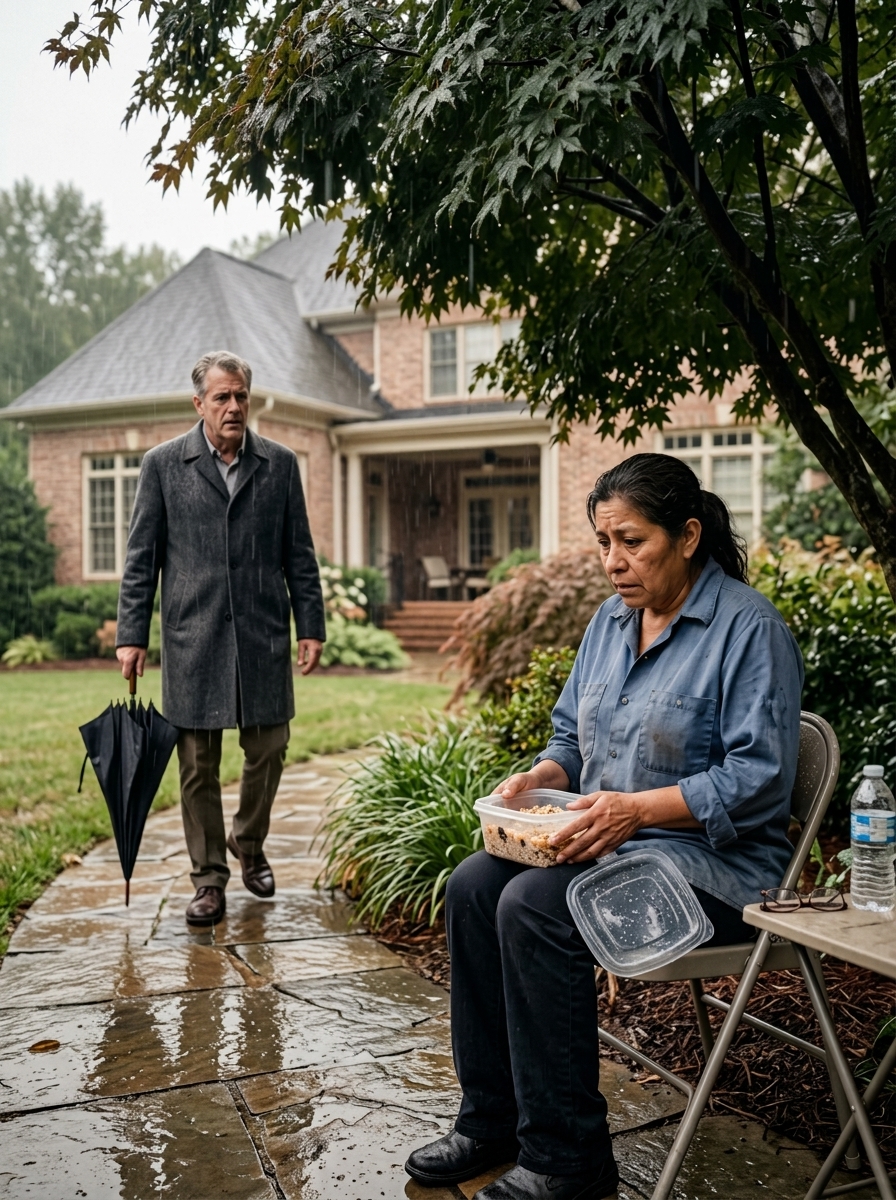
THE MILLIONAIRE SAW HIS HOUSEKEEPER EATING A SOAKED LUNCH UNDER A TREE—BUT WHEN SHE FINALLY TOLD HIM WHY SHE WAS AFRAID TO EAT INSIDE, HE COULDN’T LOOK AT HIS OWN HOME THE SAME WAY AGAIN.
“Maria, what are you doing out here?”
Richard Hale’s voice carried across the back lawn, but the woman beneath the maple tree didn’t move at first.
Rain ran from the ends of her dark hair and dripped onto the plastic container balanced on her knees.
She was trying to eat rice and beans with a small plastic fork.
Half the food was already wet.
“Maria?”
This time she looked up.
Her face changed the moment she saw him.
She snapped the lid onto her lunch, stood too quickly, and nearly dropped the container.
“I’m sorry, Mr. Hale.”
Richard stopped several feet away.
“Sorry for what?”
Maria looked at the ground.
“I’ll finish my break.”
“That isn’t what I asked.”
She held the lunchbox against her faded blue work shirt as if she had been caught doing something wrong.
Richard glanced toward the house behind them.
There were nearly twelve thousand square feet under that roof.
Three kitchens.
A breakfast room.
A staff room beside the laundry area.
A covered back porch large enough for thirty people.
And Maria Lopez was standing in the rain because, apparently, she believed there was nowhere inside she was supposed to sit.
“Why are you eating out here?” Richard asked.
Maria forced a small smile.
“It’s okay.”
“That doesn’t answer the question.”
“I like the quiet.”
Richard stared at her.
Rain rolled down his expensive coat.
He normally hated getting wet.
At that moment, he barely noticed.
Maria looked tired.
Not ordinary end-of-the-day tired.
The kind of tired that seemed to live behind the eyes.
Richard had seen her almost every weekday for more than two years.
At least, he thought he had.
She arrived early.
She cleaned quietly.
She greeted him politely.
She disappeared before dinner.
Until that morning, those were nearly all the facts he knew about her.
“I can have somebody bring you a towel,” he said.
“I’m fine, sir.”
“You’re soaked.”
“I’ll dry off.”
“Come inside.”
Her eyes lifted sharply.
Only for a second.
But Richard saw it.
Fear.
Not fear of him exactly.
Fear of doing the wrong thing.
Fear of being noticed.
It made him uncomfortable in a way he couldn’t explain.
Maria gave a small shake of her head.
“My break is almost over.”
Then she walked past him toward the service entrance.
Richard remained under the tree.
Her unfinished lunch sat inside the thin plastic bag she carried.
He watched her disappear into his house.
His house.
Those words suddenly felt different.
Richard Hale was fifty-eight years old and had spent most of his adult life believing he understood people.
He negotiated contracts.
He bought properties.
He built office complexes and apartment buildings through a private development company he had started in his thirties.
Subscribe to Tatticle!
Get updates on the latest posts and more from Tatticle straight to your inbox.
Website
Your Email…
Subscribe
We use your personal data for interest-based advertising, as outlined in our Privacy Notice.
He could walk into a conference room, listen for ten minutes, and usually tell who was nervous, who was bluffing, and who wanted something.
That ability had made him wealthy.
It had also made him impatient.
Richard liked problems that had numbers attached to them.
A delayed project could be measured.
A bad quarter could be measured.
A construction estimate could be measured.
People were harder.
So somewhere along the way, he had stopped trying very hard with them.
His employees became job titles.
Driver.
Assistant.
Housekeeper.
Groundskeeper.
Cook.
Security.
He knew the names of executives who worked three states away, but he had once called one of his own gardeners “Mike” for six months before learning the man’s name was Daniel.
Richard hadn’t considered that especially troubling.
He paid people fairly.
He gave holiday bonuses.
He considered himself a decent employer.
Decent, he had learned to believe, was enough.
That afternoon, he sat behind the desk in his home office pretending to read a property report.
He read the same paragraph four times.
None of it stayed in his head.
He kept seeing Maria beneath the tree.
Not because she had been wet.
Because she had apologized.
That was the part he couldn’t shake.
Why would someone apologize for eating lunch?
Around four, Richard closed his laptop.
His wife, Claire, found him standing by the office window.
“You’re home early,” she said.
“I work here half the week.”
“You know what I mean.”
Claire Hale had been married to Richard for twenty-nine years.
She could tell when his mind was somewhere else.
She set a stack of mail on the desk.
“What happened?”
Richard hesitated.
“Do you know Maria?”
Claire looked at him.
“Maria who?”
He immediately felt foolish.
“The woman who works here.”
Claire’s expression softened with recognition.
“Maria Lopez?”
“Yes.”
“She handles most of the upstairs cleaning. Of course I know Maria.”
“How long has she worked for us?”
“A little over two years, I think.”
Richard nodded.
“Do you know anything about her?”
Claire folded her arms.
“Why?”
“I saw her eating outside.”
Claire waited.
“In the rain.”
Her eyebrows came together.
“Why?”
“She wouldn’t tell me.”
Claire was quiet for a moment.
Then she said something Richard didn’t expect.
“She always eats outside.”
Richard turned.
“What?”
“When it’s warm, I’ve seen her near the tree. Sometimes by the side garden.”
“Why?”
“I assumed she wanted privacy.”
“Have you ever asked?”
Claire’s silence answered for her.
Richard looked away.
Neither of them liked that answer.
At dinner, their adult daughter, Emily, joined them.
She had moved back to Charlotte temporarily while helping organize a community arts program and often ate at her parents’ house.
Richard barely touched his meal.
Finally, Emily put down her fork.
“Dad, either the potatoes personally offended you, or something happened today.”
Claire smiled.
“I asked him the same thing.”
Richard told her about Maria.
Emily’s reaction was immediate.
“She ate outside in that rain?”
“Yes.”
“And nobody stopped her?”
“I tried.”
“No. I mean before today.”
Richard looked toward the dining room doorway.
A staff member had just passed through carrying folded towels.
The house suddenly seemed full of details he had never considered.
Where did the people who worked there sit?
Where did they keep their bags?
Did they eat together?
Did anyone ever invite them to use the main kitchen?
Who made those decisions?
Richard realized he didn’t know.
Emily leaned forward.
“Ask her.”
“I did.”
“Really ask her.”
“She said she likes the quiet.”
Emily gave him the same look she had given him since she was sixteen whenever she thought he was missing something obvious.
“And you believed that?”
Richard didn’t answer.
The following day, he came home before noon.
He told himself he needed files from his office.
That wasn’t true.
At 12:17, Maria came through the side door carrying the same plastic lunch container.
Richard watched from a hallway window.
She walked past the covered patio.
Past a bench beneath the kitchen windows.
Past the small staff entrance.
Straight toward the maple tree.
The ground was still damp from the previous day.
Maria spread a folded grocery bag beneath herself before sitting.
Richard felt something twist inside him.
She had planned for this.
Eating outside was not an accident.
It was a routine.
He waited several minutes before walking toward her.
This time Maria saw him coming.
She looked almost embarrassed.
“Mr. Hale.”
“Please don’t stand up.”
She remained seated.
Richard pointed toward the grass.
“Do you mind if I sit?”
Maria blinked.
“Here?”
“Yes.”
Her expression almost made him smile.
Almost.
Richard lowered himself onto a stone border near the tree.
His knees immediately reminded him he was fifty-eight.
Maria held her lunchbox in both hands.
Neither spoke for several seconds.
Finally, Richard said, “Yesterday you told me you like the quiet.”
“Yes.”
“I don’t think that’s the whole reason you eat here.”
Maria’s grip tightened.
Richard softened his voice.
“You’re not in trouble.”
“I know.”
“Then tell me.”
She stared at her lunch.
Richard waited.
He had built his career by filling silence.
Negotiations made silence feel dangerous, so he usually rushed to control it.
For once, he didn’t.
Maria finally spoke.
“I used to eat inside.”
Richard said nothing.
“In the staff room?”
“Sometimes there. Sometimes at the small table near the back kitchen.”
She swallowed.
“One afternoon last spring, you had people visiting.”
Richard searched his memory.
People were always visiting.
Investors.
Consultants.
Neighbors.
Friends of Claire.
Clients passing through town.
“I was on my break,” Maria continued. “I was sitting near the kitchen because the staff room was being painted.”
Richard listened.
“Some guests came in early.”
Her voice became quieter.
“They were waiting for coffee.”
“What happened?”
Maria gave a nervous little laugh that contained no humor.
“One of them asked who I was.”
Richard felt his stomach tighten.
“I said I worked here.”
She looked down.
“Then another person said my uniform smelled strongly like cleaning detergent.”
Richard’s jaw tightened.
Maria continued before he could speak.
“They said they were about to have lunch and asked whether I could eat somewhere else.”
Richard stared at her.
“They told you that?”
Maria nodded.
“I didn’t want a problem.”
“Who were they?”
“It doesn’t matter.”
“It matters to me.”
“It was a long time ago.”
Richard’s voice became firmer.
“Maria.”
She looked up.
For the first time, there was something other than nervousness in her eyes.
Pride.
“I don’t want anyone punished because of me.”
Richard leaned back.
The answer stopped him.
She wasn’t protecting herself.
She was protecting people who had embarrassed her.
“I left the kitchen,” she continued. “After that, I thought it was easier to eat outside.”
“Did anyone on staff tell you that you couldn’t eat inside?”
“No.”
“Did I?”
“No.”
“Claire?”
“No.”
“Then why keep doing it?”
Maria stared toward the house.
“Because once somebody makes you feel like you don’t belong in a room, it’s hard to sit comfortably in that room again.”
Richard had no reply.
He had spent decades around confident people.
People who entered every room assuming a chair would be waiting for them.
He had become one of those people.
He had forgotten what the opposite might feel like.
Maria opened her lunchbox.
The rice was mixed with black beans and a few pieces of roasted vegetables.
It looked carefully portioned.
“Is that all you brought?” Richard asked.
Maria smiled faintly.
“It’s enough.”
He realized immediately how rude the question sounded.
“That came out wrong.”
“I know.”
They sat in silence.
Then Richard said, “I’m sorry.”
Maria turned toward him.
He continued.
“That happened in my home.”
“You didn’t say it.”
“I created the kind of house where somebody thought they could.”
Maria’s eyes widened slightly.
Richard had not planned those words.
That made them feel more true.
She shook her head.
“You have always paid me on time. You’ve never spoken badly to me.”
“That’s a very low standard, Maria.”
For the first time, she smiled.
A real smile.
Richard stood.
His knees complained again.
“I’m going inside.”
Maria nodded.
He looked at the lunchbox.
“You should too.”
Her smile faded.
“Maybe tomorrow.”
Richard wanted to argue.
Instead he said, “Tomorrow, then.”
He walked back toward the house thinking about one sentence.
Once somebody makes you feel like you don’t belong in a room, it’s hard to sit comfortably in that room again.
The sentence followed him for the rest of the afternoon.
Around three, Richard asked Helen Parker, the household manager, to meet him in his office.
Helen had worked for the family for eleven years.
She was organized, calm, and one of the few people who spoke to Richard without becoming nervous.
She entered carrying a tablet.
“You wanted to see me?”
“Sit down.”
She did.
Richard asked, “Where does the household staff eat?”
Helen looked confused.
“The staff room.”
“Always?”
“No. Some people use the back patio. Daniel likes eating near the greenhouse.”
“Maria?”
Helen hesitated.
“She usually eats outside.”
“Do you know why?”
Helen’s expression changed.
Not dramatically.
But enough.
Richard noticed.
“You do know.”
“I heard something last year.”
“What?”
Helen looked uncomfortable.
“There were guests here for a luncheon. Maria was sitting in the back kitchen during her break. Someone apparently made a comment about cleaning products.”
“And?”
“She left.”
“Did anyone report it?”
“No.”
“Did you talk to her?”
“The cook mentioned it to me afterward. I asked Maria if she was okay.”
“What did she say?”
“She said it was fine.”
Richard leaned forward.
“And you accepted that?”
Helen’s eyes narrowed slightly.
It was the first hint of irritation Richard had seen from her in years.
“Yes.”
Richard was surprised.
Helen continued.
“Because, Mr. Hale, I supervise fifteen people, and for a long time I believed that when an employee says something is fine, respecting them means not forcing them to discuss it.”
Richard sat back.
Helen took a breath.
“But I’ve thought about it since.”
“So have I.”
“Apparently.”
There was no disrespect in the word.
Just truth.
Richard looked toward a folder on his desk.
“Do we have written policies about staff breaks?”
“Yes.”
“Where people can eat?”
“I believe so.”
“Bring me everything.”
Helen stared at him.
“Everything?”
“Handbooks. Schedules. Old memos. Whatever exists.”
“All right.”
“And Helen?”
“Yes?”
“Don’t tell Maria I asked.”
Helen nodded.
“I won’t.”
An hour later, Richard had a stack of papers on his desk.
Most were ordinary.
Work schedules.
Vacation rules.
Emergency contacts.
Kitchen procedures.
Nothing said household staff could not use the staff room or rear kitchen during breaks.
Nothing said they should avoid common areas when guests were present.
Then Richard found an old event checklist.
It had been written three years earlier by a former event coordinator.
A short line near the bottom caught his eye.
KEEP SERVICE AREAS CLEAR DURING FORMAL GATHERINGS.
It didn’t say employees had to disappear.
It didn’t mention breaks.
But Richard knew how rules changed when they traveled through people.
Clear the service area.
Stay out of sight.
Don’t inconvenience guests.
Don’t be noticed.
Perhaps nobody had ever written those extra sentences.
Maybe nobody needed to.
Richard stared at the paper.
He remembered himself three years earlier.
He had been hosting bigger events then.
Trying to impress clients.
Constantly complaining about details.
He remembered once telling Helen, “I don’t want guests seeing clutter.”
Had he meant employees?
No.
But had someone else interpreted it that way?
Possibly.
For the first time, Richard understood how careless words from the person at the top could become invisible rules for everyone below.
He called Helen back.
“I want this line removed.”
She read the paper.
“Okay.”
“And I want the break policy rewritten.”
“What should it say?”
Richard thought.
“That people working here are allowed to eat comfortably.”
Helen almost smiled.
“We should probably phrase that more specifically.”
“Fine. You phrase it.”
“I can do that.”
“And nobody should ever be expected to hide because guests are here.”
Helen nodded.
“I agree.”
Richard looked at the papers again.
Then he asked, “What else am I not seeing?”
Helen didn’t answer immediately.
That worried him more than anything.
“What?”
“You really want to know?”
“Yes.”
Helen sat down again.
“The staff room chairs are terrible.”
Richard blinked.
“What?”
“Two wobble. One has tape on the seat.”
He stared at her.
She continued.
“The refrigerator is too small when everyone is here.”
“Why didn’t someone replace it?”
Helen lifted an eyebrow.
“You approve household expenses over five hundred dollars.”
“And?”
“You rejected the request last fall.”
Richard searched his memory.
“I did?”
“You wrote, ‘Use existing equipment.’”
Richard closed his eyes.
He vaguely remembered seeing that phrase on an expense sheet.
It had been one item among dozens.
He hadn’t imagined fifteen people trying to fit lunches into one small refrigerator.
He had seen a number.
Nothing more.
“What else?”
Helen started counting on her fingers.
“The side entrance lock sticks.”
“Replace it.”
“The staff coat hooks are crowded.”
“Fix them.”
“Daniel has been asking for a covered place near the garden shed to take breaks during summer.”
“Build it.”
Helen smiled.
“Careful. I have eleven years of requests saved.”
Richard almost laughed.
“Bring them.”
That night at dinner, he told Claire and Emily what Maria had said.
Claire put down her glass.
“Someone actually told her to leave because her uniform smelled like detergent?”
“Yes.”
“Who?”
“She won’t tell me.”
Emily shook her head.
“Good.”
Richard frowned.
“Good?”
“She doesn’t owe you a name.”
“I’m not trying to start a fight.”
“You’re trying to fix the most visible person instead of the system.”
Richard stared at his daughter.
Claire gave Emily a small smile.
Richard sighed.
“You two planned this conversation?”
“No,” Claire said. “We just happen to agree.”
Richard told them about the old event checklist.
Claire’s face fell.
“I’ve probably said things like that too.”
“We both have.”
Emily asked, “So what are you going to do?”
Richard looked toward the hallway.
“I don’t know yet.”
Emily leaned back.
“That’s probably the first smart thing you’ve said.”
“Thank you.”
“You’re welcome.”
For the next week, Richard began arriving home at different times.
Not to spy on anyone.
At least, that was what he told himself.
He wanted to understand the rhythms of the place.
He discovered Daniel, the groundskeeper, drank coffee at 6:40 every morning while standing beside the utility sink because there was nowhere convenient to sit near the equipment room.
He discovered Helen ate lunch at her desk almost every day.
He discovered the afternoon cleaner, Denise, kept an extra pair of inexpensive sneakers in a cabinet because she took two buses and then walked several blocks to reach the Hale house.
He discovered Maria arrived far earlier than necessary.
At 6:15 one morning, Richard found her folding towels in the laundry room.
Her shift did not begin until eight.
“What are you doing here?”
Maria jumped.
Then she laughed nervously.
“You have to stop appearing behind people, Mr. Hale.”
Richard smiled.
“Fair.”
He looked at the clock.
“Why are you here this early?”
“The bus schedule.”
“You take the bus?”
“Part of the way.”
“And then?”
“I walk.”
“How far?”
“Not far.”
Richard had learned that “not far” usually meant she didn’t want to complain.
“How far, Maria?”
She folded another towel.
“About two miles.”
“Every morning?”
“When the second bus lines up, less.”
Richard looked at her hands.
“You’ve been coming two hours early because of the bus schedule?”
Maria shrugged.
“It’s quiet. I can start some things.”
“Are you being paid for this?”
She hesitated.
“That isn’t why I come early.”
“That wasn’t my question.”
“I clock in at eight.”
Richard’s expression changed.
Maria immediately added, “Nobody told me to work early. I choose to.”
“I know.”
He believed her.
That somehow made him feel worse.
“You shouldn’t work before you’re being paid.”
“I don’t mind.”
“I do.”
Maria looked at him.
Richard tried again.
“Please. Have coffee. Read. Sit down. But if you’re folding towels, you’re working.”
She considered this.
“Okay.”
“And Helen will adjust your schedule if an earlier start works better.”
Maria shook her head quickly.
“No, no. I don’t need special treatment.”
“It’s not special treatment if the hours still work.”
“I have another job at night.”
Richard paused.
“What?”
Maria looked annoyed with herself for saying it.
“Just a small cleaning job.”
“How often?”
“Four nights.”
“A week?”
“Yes.”
Richard stared at her.
“So you work here all day and clean offices four nights a week?”
“It helps.”
“With what?”
Maria smiled.
“Life.”
Richard couldn’t argue with that.
Later, he asked Helen for Maria’s employment file.
He felt uneasy doing it, so he limited himself to what an employer would normally have access to.
Schedule.
Pay history.
Attendance.
Performance reviews.
He learned Maria had never missed a scheduled shift without advance notice.
She had received excellent evaluations.
She had declined two opportunities for extra weekend work because of “family responsibilities.”
There was an emergency contact listed.
Daniel Lopez.
Relationship: son.
Richard looked at the age listed on an older benefits form.
Fourteen at the time.
That made Daniel sixteen now.
The same age Emily had been when Richard was traveling four days a week and answering business calls during dinner.
He remembered thinking he was working hard for his family.
Perhaps Maria told herself the same thing.
The difference was that Richard had always had choices.
Maria seemed to have fewer.
At lunch the next day, Richard walked past the maple tree.
Empty.
He continued toward the house.
Through the rear kitchen window, he saw Maria sitting at the small table.
Denise was beside her.
They were laughing about something.
Richard stopped outside.
Maria noticed him.
For half a second, he worried she might stand.
Instead she lifted her coffee mug toward him.
A simple little greeting.
Richard smiled and kept walking.
It felt like progress.
But he still couldn’t leave the rest alone.
That evening, he asked Claire about Maria’s son.
“Daniel?”
“You know him?”
“Maria has mentioned him.”
“What does she say?”
Claire thought.
“He’s a good student. Likes science.”
“Anything else?”
“She’s very proud of him.”
Richard nodded.
“Why are you asking?”
“I’m trying to understand.”
Claire studied him.
“Be careful.”
“About what?”
“Turning her life into one of your projects.”
Richard stiffened.
“I’m trying to help.”
“I know.”
“Then what’s wrong with that?”
“Nothing, if you remember she’s a person and not a building you can renovate.”
The words bothered him because they were accurate.
Richard had spent his entire career identifying problems, making plans, spending money, and expecting results.
Maria was not a problem to solve.
Neither was her son.
The next morning, Richard asked Maria whether he could speak with her.
She followed him into the office.
He deliberately left the door open.
“Please sit.”
Maria sat on the edge of the chair.
Richard remained behind his desk for a moment, then changed his mind and moved to the chair across from her.
“I heard your son likes science.”
Maria’s face immediately brightened.
“Daniel loves it.”
“How old is he?”
“Sixteen.”
“What does he want to do?”
She smiled.
“It changes every six months.”
“That sounds normal.”
“Last year it was engineering. Before that, veterinary medicine. Right now he says he wants to become a doctor.”
Richard smiled.
“Ambitious.”
“He studies all the time.”
“You must be proud.”
“I am.”
Something in Maria’s expression changed.
Pride mixed with worry.
Richard noticed.
“But?”
She shook her head.
“No but.”
“Maria.”
She sighed.
“You ask too many questions.”
“I’ve been told that.”
She smiled.
Then she looked toward the open doorway.
“He has good grades. His school counselor says he should start thinking about college.”
“That’s good.”
“Yes.”
Again, that hesitation.
Richard understood.
College.
Applications.
Transportation.
Books.
Time.
A hundred expenses that sounded small individually and enormous together.
“Does he know what schools he’s interested in?”
“Not yet.”
Richard wanted to say, I can pay for it.
The words nearly came out.
He stopped himself.
Claire’s warning echoed in his mind.
Not a building you can renovate.
Instead he said, “Would it help if Helen gathered information about scholarship programs available to employees’ children?”
Maria stared at him.
“Employees’ children?”
“All of them.”
Richard had not planned to say that.
Once he did, it felt right.
“We don’t have a program now,” he continued. “Maybe we should.”
Maria’s expression became cautious.
“Because of Daniel?”
“Because I should have thought about it years ago.”
She looked at her hands.
“I don’t want him receiving something just because I work here.”
“Neither do I.”
Maria looked up.
Richard continued.
“If we create anything, it should have written rules. Grades. Applications. Whatever makes sense. It shouldn’t depend on whether I happen to like someone.”
Maria considered him for a long moment.
Then she nodded.
“That sounds fair.”
Richard smiled.
“Good.”
He spent the next two weeks doing something his executives would have found remarkable.
He listened.
Helen helped him organize individual conversations with household employees.
No speeches.
No cameras.
No announcements.
Richard asked three questions.
What makes your work harder than it needs to be?
What do you wish this household understood?
What would make this a better place to work?
At first, almost nobody answered honestly.
Daniel the groundskeeper said, “Everything’s fine.”
Denise said, “No complaints.”
The cook said, “We manage.”
Richard realized he had trained people to tell him exactly what he wanted to hear.
So he changed the questions.
“What’s annoying here?”
That worked better.
The dishwasher leaked occasionally.
The supply cabinet shelves were too high.
The employee parking area turned muddy after heavy rain.
Schedules sometimes changed with little notice when Richard hosted events.
The staff room needed better chairs.
People wanted clearer rules about breaks when guests were present.
One employee wanted to know why leftover food from large events was often thrown away instead of being offered to staff.
Richard had no answer.
He had never considered any of it.
Most changes were inexpensive.
Some cost almost nothing.
Richard felt embarrassed by that.
He had spent more on a single decorative light fixture than it cost to fix nearly every complaint on Helen’s list.
Within a month, the staff room had new chairs, a larger refrigerator, better storage, and a table by the window.
The employee entrance was repaired.
A small covered break area was added near the garden building.
Schedules were posted earlier.
The break policy was rewritten in plain language.
Every employee was welcome to use designated indoor break areas regardless of who was visiting.
One sentence was bolded.
NO EMPLOYEE IS EXPECTED TO HIDE OR LEAVE A BREAK AREA FOR THE COMFORT OF A GUEST.
Helen had written that sentence.
Richard approved it without changing a word.
Something else changed too.
Richard began eating lunch in the back kitchen once or twice a week.
The first time he tried, conversation stopped the moment he walked in.
Four people stared at him.
Richard looked at his sandwich.
“This may have been a mistake.”
Denise laughed first.
Everyone else followed.
The next week was easier.
By the fourth week, Daniel the groundskeeper was arguing with Richard about baseball while Maria heated leftovers.
Richard liked that more than he expected.
Not because he wanted employees to become his personal friends.
He understood the boundaries.
He simply began realizing how strange it was to share a property with people for years without knowing anything about them.
Maria had an excellent memory.
Denise loved old mystery novels.
Daniel grew tomatoes behind his apartment building.
Helen was learning to play piano at fifty-four.
The cook had a grandson who called every Wednesday.
These were not dramatic facts.
That was exactly why they mattered.
People were not background characters waiting for Richard to notice them.
They had complete lives whether he looked or not.
One afternoon, Emily found him in the back kitchen drinking coffee with Helen.
She stopped in the doorway.
Richard looked at her.
“What?”
“Nothing.”
“You’re making a face.”
“I’m witnessing personal growth.”
Helen covered a smile.
Richard pointed toward the hallway.
“Go away.”
Emily laughed.
Later, she told Claire, “Dad has discovered employees are human beings.”
Richard overheard.
“I always knew that.”
Emily answered from the next room.
“Knowing and behaving like you know are different things.”
Richard couldn’t argue.
Months passed.
Maria continued working at the Hale house.
But something about her had changed.
Or perhaps Richard was simply seeing things that had always been there.
She joked more.
She sat with others during lunch.
She occasionally disagreed with Helen.
Once, she told Richard the new floor cleaner smelled terrible.
Six months earlier, she would never have said that.
Richard considered it a victory.
The education program took longer.
Richard’s first instinct had been to fund everything himself immediately.
His accountant and Helen persuaded him to slow down and create a proper private employee education benefit instead.
It would apply to employees who had worked for the household or Richard’s privately owned local offices for a minimum period.
Children and dependents could apply.
Employees themselves could apply for career courses too.
Applications would be reviewed by a small committee rather than Richard alone.
The program could cover approved education costs within set limits.
No promises based on personal relationships.
No favoritism.
Clear rules.
Maria read the first draft.
She pointed to three confusing paragraphs.
“This sounds like a bank wrote it.”
Richard laughed.
“An accountant did.”
“They should use normal words.”
So they rewrote it.
Daniel applied the following year.
He was accepted.
Maria brought the letter to work in her purse and kept checking it between tasks, as if the words might disappear.
Richard did not see the letter until lunch.
He walked into the kitchen and found Maria sitting silently while Denise hugged her.
“What happened?”
Maria turned.
Her eyes were wet.
For one terrible second, Richard thought something was wrong.
Then she held up the letter.
“He got in.”
Richard smiled.
“College?”
She nodded.
“His first choice.”
The room erupted.
Daniel the groundskeeper—who had become very annoyed that Maria’s son shared his name—started clapping.
The cook rang a spoon against a coffee mug.
Maria laughed and wiped her eyes.
Richard asked, “Where?”
“A university about two hours away.”
“That’s close enough to come home with laundry.”
Maria laughed harder.
“He already does too much laundry here.”
The education program covered a large portion of Daniel’s tuition after other aid.
Maria still insisted on contributing what she reasonably could.
Richard respected that.
Daniel studied biology.
Then he changed his mind.
Then he changed it again.
At nineteen, he became interested in health sciences after volunteering at a senior community center through school.
Maria worried that he was falling behind because he had not chosen a perfect path.
Richard told her something he wished someone had told him at nineteen.
“People are allowed to change their minds.”
Maria looked skeptical.
“You didn’t.”
“I should have.”
She smiled.
Richard also changed Maria’s role.
But not in the dramatic way he originally imagined.
He did not call her into his office and announce that she was suddenly in charge of everyone.
Helen would have objected.
Maria probably would have refused.
Instead, over time, Maria began training new employees.
She was patient.
She noticed details.
She handled tense moments without embarrassing anyone.
Helen recommended her for assistant household supervisor.
Maria nearly said no.
“I’m not a manager.”
Helen replied, “You’ve been helping me manage for a year.”
“That’s different.”
“How?”
Maria couldn’t answer.
Richard stayed out of the decision until Helen brought him the recommendation.
“Is she ready?”
Helen looked offended.
“She was ready six months ago.”
“Then why didn’t you recommend her six months ago?”
“Because she needed to believe it too.”
Maria accepted the position.
Her salary increased.
Her hours became more predictable.
She was finally able to give up most of her evening cleaning shifts.
Richard learned about that on a Tuesday.
Maria was leaving at five when he saw her by the front hall.
“No office job tonight?”
She shook her head.
“I only kept one evening.”
“That must feel good.”
Maria smiled.
“I went home yesterday and didn’t know what to do with myself.”
“What did you do?”
“Made dinner with Daniel.”
Richard smiled.
“Sounds productive.”
“We burned the bread.”
“Less productive.”
She laughed.
Then her expression softened.
“It was nice.”
Two words.
That was all.
But Richard understood what they meant.
Time.
She had gotten a little of her time back.
That affected him more than any bonus he had ever approved.
Richard’s own family noticed changes at home.
He stopped taking business calls during every meal.
He began leaving his phone in the office on Sundays.
When Emily invited him to a small community art event, he attended instead of sending a donation and claiming he was too busy.
Claire noticed everything.
One night after dinner, she said, “You’re different.”
Richard looked at her.
“Better or worse?”
“Different.”
“That sounds dangerous.”
Claire smiled.
“Better.”
He leaned back.
“What changed?”
“You stopped treating attention like it was a scarce resource.”
Richard thought about that.
For years, he had measured generosity mostly in money.
Money was clean.
Easy.
You could write a check and walk away.
Attention was harder.
Attention required time.
It required remembering.
Listening.
Being inconvenienced.
Being corrected.
Sometimes being embarrassed.
Maria had never asked him for any of that.
Maybe that was why the lesson stayed with him.
Two years after Richard first saw her under the maple tree, Daniel came home from college for spring break.
Maria asked whether he could stop by the house because he wanted to thank Helen and the education committee.
Richard happened to be home.
Daniel was tall now.
Quiet.
He had his mother’s careful smile.
He shook Richard’s hand.
“Thank you, sir.”
Richard shook his head.
“Your grades got you there.”
“The program helped.”
“Good. That’s what it was built for.”
Daniel looked toward his mother.
“She talks about this place differently now.”
Maria immediately said, “Daniel.”
“What?”
“You talk too much.”
Richard smiled.
“What does she say?”
Maria gave her son a warning look.
Daniel ignored it.
“She says people listen now.”
The sentence landed harder than Richard expected.
He looked at Maria.
She seemed embarrassed.
Richard wasn’t.
“That’s good,” he said.
Daniel nodded.
“It is.”
Before leaving, Daniel looked through the kitchen window toward the maple tree.
“Is that the tree?”
Maria froze.
Richard looked at her.
“You told him?”
“Eventually.”
Daniel glanced between them.
“My mom said she ate out there for almost a year.”
Richard felt his chest tighten.
He had never known exactly how long.
Almost a year.
Through summer heat.
Cool fall afternoons.
Cold mornings.
Rain.
Nearly a year of choosing a patch of grass because one careless conversation had told her she was more welcome outside than in.
Richard looked toward the tree.
“I should have noticed sooner.”
Daniel answered gently.
“Mom says you noticed eventually.”
Richard smiled faintly.
“That doesn’t erase the first part.”
“No.”
Richard appreciated the honesty.
Then Daniel said, “But it changed the second part.”
Richard looked at him.
The young man shrugged.
“That matters too.”
For several days after that conversation, Richard kept thinking about second parts.
He had always imagined life as a series of achievements.
Start a company.
Buy the first building.
Reach the next revenue target.
Buy the house.
Expand.
Win another contract.
He rarely thought about correction.
About admitting that something had been wrong and writing a different second part.
Maybe because correction required humility.
Achievement only required ambition.
Richard had plenty of ambition.
Humility had taken longer.
Years passed.
The mansion stopped feeling like a mansion to him.
It was still large.
Still expensive.
Still filled with more rooms than any family truly needed.
But Richard gradually stopped thinking of it as proof that he had succeeded.
It was simply the place where he lived.
The tree remained in the backyard.
The staff sometimes used the shade during breaks.
Maria occasionally sat there too.
But never because she believed she had to.
One afternoon, Richard found her eating there with Denise.
He raised an eyebrow.
“I thought we agreed you weren’t supposed to eat under this tree anymore.”
Maria looked offended.
“You said not in the rain.”
“That sounds like a technicality.”
“It is seventy-two degrees.”
Denise laughed.
Richard pointed toward the kitchen.
“There are chairs inside.”
Maria pointed toward the tree.
“There is shade outside.”
Richard smiled.
“Fine.”
As he walked away, Maria called after him.
“Mr. Hale?”
He turned.
She held up her lunch.
“Rice and beans.”
Richard laughed.
Some things did not need to change.
Daniel graduated from college.
He did not become a doctor immediately.
Life rarely follows the clean path people tell in inspirational stories.
He worked for a year.
Then he applied to graduate programs in healthcare.
He changed directions once more before deciding on physician assistant training.
Maria worried each change meant he was failing.
Daniel insisted he was figuring things out.
Richard privately agreed with Daniel.
When the acceptance email arrived, Maria printed it.
Of course she did.
She carried the page folded inside her purse for three days.
By then, Richard knew this habit.
Important papers lived in Maria’s purse.
College acceptance.
Scholarship notices.
Good report cards.
Promotion letters.
Anything she feared might somehow vanish if left unattended.
Daniel’s program was demanding.
The employee education benefit had expanded by then.
Several workers had used it.
Denise completed a certification course.
One employee’s daughter studied accounting.
Daniel the groundskeeper—older Daniel—took a horticulture program and later accepted a supervisory position at a local property group.
Richard was genuinely sad to lose him.
At Daniel Lopez’s graduation ceremony, Maria invited Richard and Claire.
Richard hesitated at first.
“This is your family day.”
Maria frowned.
“You are coming.”
“That sounded less like an invitation.”
“It is.”
So they went.
The ceremony was held in a large auditorium.
Maria arrived absurdly early.
Richard teased her.
“You’ve spent your whole life arriving two hours early.”
She smiled.
“And somehow you are still always rushing.”
“That is unfair.”
“It is true.”
They found seats near the middle.
Maria kept smoothing the program on her lap.
When Daniel’s name was called, she stood before almost anyone else.
She clapped.
Claire clapped.
Richard clapped.
Maria laughed through tears.
No grand speech followed.
No music swelled at the perfect moment.
Daniel simply crossed the stage, shook hands, took his folder, and looked toward the audience.
When he saw his mother standing, his face changed.
That was the moment Richard remembered.
Not the ceremony.
Not the degree.
Daniel looking at Maria.
Maria looking back.
Everything she had worked for seemed to fit inside that glance.
Afterward, they gathered near a row of trees outside the auditorium.
Daniel hugged his mother.
“You did it,” Maria whispered.
Daniel pulled back.
“We did.”
“No. You did.”
“You worked two jobs.”
“You studied.”
“You got me there.”
“You got yourself there.”
They continued arguing until Claire laughed.
Richard stood a few feet away.
Daniel eventually walked over.
“Mr. Hale.”
“Congratulations.”
“Thank you.”
Richard shook his hand.
Daniel smiled.
“You know my mom still has that first scholarship letter?”
“I would be shocked if she didn’t.”
“She laminated it.”
Richard turned toward Maria.
“You laminated it?”
Maria folded her arms.
“It was an important paper.”
Richard laughed.
Later, while Daniel took photographs with classmates, Maria stood beside Richard.
For a while, neither spoke.
Then she said, “Thank you.”
Richard looked at her.
“You already thanked me years ago.”
“I know.”
“You don’t have to keep doing it.”
“I want to.”
Richard nodded.
Maria looked toward her son.
“That program changed his life.”
Richard followed her gaze.
“It changed mine first.”
Maria glanced at him.
Richard continued.
“The day under the tree.”
She looked embarrassed.
“That was a bad day.”
“For you.”
“For both of us.”
Richard shook his head.
“No. I was uncomfortable. You were the one sitting outside.”
Maria gave him a small smile.
“You came outside.”
“Eventually.”
“You listened.”
“Eventually.”
“You changed things.”
Richard looked at her.
“Because you told me the truth.”
“You asked.”
It was such a simple exchange.
Yet Richard knew they were talking about more than lunch.
Maria had shown him something uncomfortable about the world inside his own front gate.
He could have defended himself.
He could have said he never made the insulting comment.
He could have blamed the guest.
He could have told Maria she should have complained sooner.
He could have written her a check and considered the matter finished.
Instead, for reasons he still did not fully understand, he had listened.
And once he listened, he began noticing.
Once he noticed, it became impossible to pretend he didn’t know.
Richard looked toward Daniel again.
“You gave me more than I ever gave you.”
Maria laughed softly.
“That doesn’t make sense.”
“It does to me.”
She waited.
Richard smiled.
“I spent half my life thinking wealth meant never having to be uncomfortable.”
Maria raised an eyebrow.
“And now?”
“Now I think sometimes being uncomfortable is how you learn something.”
“That sounds exhausting.”
“It is.”
She smiled.
“Good.”
Richard laughed.
On the drive home, Claire rested her hand on his arm.
“You’re quiet.”
“Thinking.”
“That usually gets expensive.”
Richard smiled.
“Not this time.”
They drove through the suburbs while late-afternoon traffic moved steadily around them.
Richard thought about the maple tree.
He remembered Maria under it with soaked hair and a plastic lunchbox.
He remembered her standing the moment she saw him.
Apologizing.
Hiding her food.
Making herself smaller because somebody else had made her feel that taking up a chair was too much.
Richard had once believed the most important thing he could give people was money.
He no longer believed that.
Money mattered.
A fair salary mattered.
Good working conditions mattered.
Education support mattered.
But there was something that came before all of it.
Dignity.
The belief that you were allowed to sit down.
Allowed to speak.
Allowed to disagree.
Allowed to say something was not fine.
Allowed to belong in the room.
A year later, Richard reduced his daily role in the company he had built.
He was not retiring.
He told everyone that repeatedly.
Emily said anyone who repeated “I’m not retiring” that often was obviously terrified of retirement.
Richard ignored her.
He still attended meetings.
Still reviewed major decisions.
Still cared about numbers.
But numbers no longer occupied every available space in his life.
He and Claire traveled more.
He attended family dinners without his phone.
He learned the names of new household employees before they learned his.
Not always.
But he tried.
Helen eventually retired.
At her farewell dinner, she stood beside Richard and Maria in the back garden.
The staff had decorated the covered patio.
Richard looked around.
“So who is going to tell me everything I’m doing wrong now?”
Helen immediately pointed at Maria.
Richard sighed.
“I was afraid of that.”
Maria smiled.
Helen had recommended Maria as her replacement.
Not assistant.
Household manager.
This time Maria did not say she wasn’t ready.
She took the job.
On her first Monday, Richard walked into the kitchen at 9:10 and found a printed list waiting on the counter.
He picked it up.
“What is this?”
Maria didn’t look up from her tablet.
“Things that need approval.”
“You’ve been manager for three hours.”
“I started the list last week.”
Richard scanned it.
New pantry shelving.
Updated maintenance schedule.
A replacement vacuum.
Two chairs for the laundry office.
He smiled.
“The chairs are back.”
“Chairs matter.”
“Yes, apparently they do.”
Maria finally looked at him.
“Should I add a note in bold?”
“No.”
“USE EXISTING EQUIPMENT?”
Richard stared at her.
She kept a perfectly straight face.
Then Denise burst out laughing from the doorway.
Richard shook his head.
“I created a monster.”
Maria smiled.
“No, Mr. Hale.”
She tapped the paper.
“You promoted one.”
He laughed so loudly Claire heard him from the next room.
Years earlier, Maria would never have teased him.
Richard liked that version of the story almost as much as Daniel’s graduation.
Confidence had entered quietly.
First she stayed inside for lunch.
Then she voiced opinions.
Then she asked for changes.
Then she led meetings.
Then she made jokes at the owner’s expense.
Richard considered this an excellent progression.
The maple tree grew taller.
Its lower branches spread farther over the lawn.
Richard refused suggestions to replace it during a landscaping redesign.
The designer complained that its shape didn’t match the symmetry of the garden.
Richard said, “Then redesign the garden.”
Nobody argued.
On warm afternoons, people gathered beneath the tree.
Sometimes employees.
Sometimes family.
Sometimes Richard himself.
There was a bench there now.
Maria had requested it.
Richard approved the expense immediately.
One Saturday, he found her sitting on the bench alone.
She had come by briefly to review preparations for an event.
Richard sat beside her.
“You working on Saturday now?”
“So are you.”
“I live here.”
“That is convenient.”
He smiled.
For several moments they watched Emily’s children run across the far side of the lawn.
Richard’s grandchildren had changed the house more than any renovation ever could.
The formal living room now occasionally contained toys.
Richard pretended this bothered him.
Nobody believed him.
Maria looked up through the maple branches.
“Do you remember that day?”
“Yes.”
“I wish you didn’t.”
“I’m glad I do.”
She turned toward him.
Richard continued.
“I don’t like who I was before it.”
Maria shook her head.
“You weren’t a bad man.”
“I was inattentive.”
“That is different.”
“Sometimes the result isn’t very different.”
Maria thought about that.
Then she said, “You noticed eventually.”
Daniel had said the same thing years earlier.
Richard smiled.
“Your family likes that word.”
“Because it matters.”
She looked across the lawn.
“You know, I was embarrassed that day too.”
“Because I found you outside?”
“No.”
She paused.
“Because I thought telling you would make me look weak.”
Richard listened.
“I had spent years telling myself I didn’t care what people thought,” she continued. “I told myself eating outside was my choice.”
She laughed softly.
“But if I truly didn’t care, I would have gone back inside the next day.”
Richard nodded.
“I understand.”
Maria looked at him.
“You do?”
“I spent years telling myself I didn’t care what anybody thought while building my entire life around proving something.”
“To who?”
Richard smiled.
“That’s the embarrassing part.”
Maria waited.
“I’m not sure.”
She laughed.
They sat beneath the tree until Emily’s youngest child came running toward Richard with a plastic airplane.
“Grandpa!”
Richard stood.
His grandson grabbed his hand and pulled him across the lawn.
Richard glanced back once.
Maria remained on the bench, smiling.
There was a time when Richard would have walked past a woman like Maria without really seeing her.
Not because he was cruel.
Because he was busy.
Because the house ran smoothly.
Because the floors were clean.
Because dinner appeared on time.
Because his shirts returned pressed.
Because invisible work is easy to ignore when the people doing it become invisible too.
He knew better now.
Kindness, he had learned, was not one grand gesture.
It was not an envelope.
Not a promotion.
Not a scholarship.
Those things mattered.
But kindness also lived in smaller decisions.
A chair that didn’t wobble.
A schedule posted early.
A door that opened properly.
A manager who asked a second question when someone said, “I’m fine.”
A person with power admitting, “I didn’t notice.”
And then doing the work required to notice next time.
Richard never forgot Maria’s lunchbox.
Cheap plastic.
Rice and beans.
Rainwater collecting along the lid.
For years, he had believed his most valuable possessions were the things behind locked doors.
The artwork.
The property.
The investments.
The documents in his safe.
He was wrong.
One of the most valuable things he ever received came to him beneath an ordinary maple tree.
It came from a woman who had every reason to stay silent.
She told him the truth.
And because he finally listened, a house full of people stopped feeling like background figures.
A young man received an opportunity he had earned.
A hardworking woman found her voice inside a place where she once felt unwelcome.
And a wealthy man learned something his money had never been able to buy.
No amount of success can make a home warm if the people inside it are afraid to take a seat.
Years later, whenever Richard passed the maple tree, he still remembered the first words Maria had spoken to him that morning.
“I’m sorry.”
Those words had bothered him more than the rain.
They still did.
Because she had never owed him an apology.
If anything, he had owed her one.
For not noticing sooner.
For confusing silence with contentment.
For believing good intentions automatically created good conditions.
For thinking a paycheck alone proved respect.
He could not change the first part of their story.
He had stopped trying.
But he had learned that people are given second parts all the time.
Second chances to listen.
Second chances to speak.
Second chances to correct what should have been corrected sooner.
Second chances to become the person they once assumed they already were.
And sometimes the moment that opens that second chance does not look important at all.
Sometimes it is just a woman beneath a tree.
A plastic lunchbox in her hands.
An empty chair waiting inside.
And one simple question finally asked with enough patience to hear the real answer.