
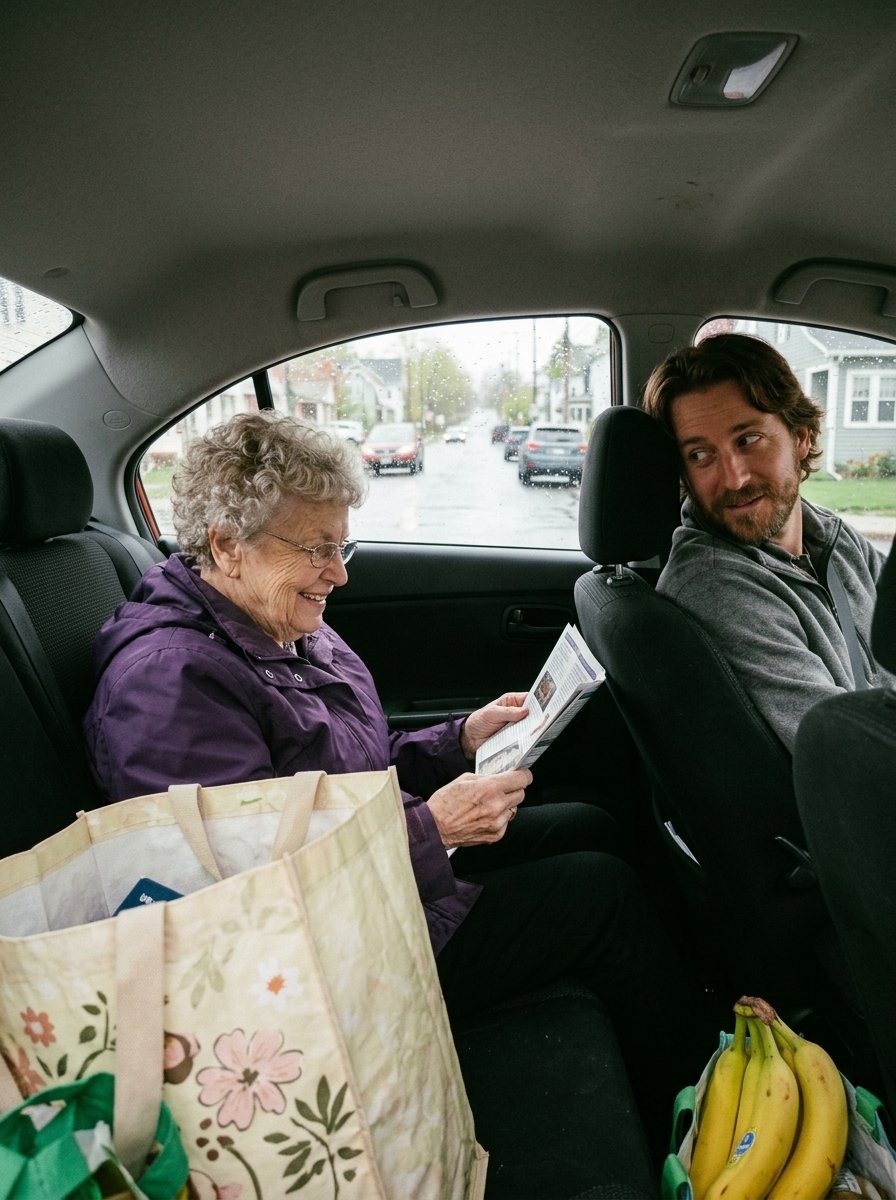
For Twelve Years, an Elderly Widow Read Her Grocery List to the Same Taxi Driver—Then Her Final List Left Him in Tears
“Milk. Two percent. Not whole milk, Calvin. Whole milk sits in my stomach like a brick.”
I glanced at the rearview mirror and tried not to sigh.
Mrs. Holloway was sitting in the back seat of my cab, holding a folded grocery list about three inches from her glasses.
“Bananas,” she continued. “But not green ones. I’m eighty-three years old. I don’t buy bananas I have to make long-term plans for.”
That made me smile despite myself.
It was Thursday afternoon, just after two.
And although I wouldn’t have admitted it back then, hearing that grocery list had become one of the most dependable things in my life.
Twelve years earlier, I had been a very different man.
I was 45, freshly out of a relationship I thought would last forever, sleeping in a one-bedroom apartment outside Pittsburgh with half-unpacked boxes stacked against the wall.
I had taken the taxi job because an old friend knew somebody who needed drivers.
I told myself it was temporary.
Mostly, I liked that nobody expected anything from me.
People got in.
They told me where to go.
I drove them there.
They got out.
That was about as much human connection as I wanted.
Then, one rainy Thursday, I pulled up in front of a little brick house with white railings and a porch light burning in the middle of the afternoon.
An elderly woman came down the walkway wearing a purple raincoat and carrying three reusable grocery bags.
She opened the back door and climbed in slowly.
“Good afternoon,” she said.
I nodded.
“Market on Carson Street, please.”
I started driving.
Thirty seconds later, I heard paper unfolding behind me.
“Let’s see,” she said. “Eggs, bread, coffee, oatmeal…”
I looked at her in the mirror.
She kept going.
“Tomato soup. Crackers. Dish soap. Oh, and cinnamon.”
I thought maybe she was checking the list so she wouldn’t forget anything.
Then she looked up.
“You like cinnamon, Calvin?”
I froze.
“How do you know my name?”
She pointed at the taxi identification card attached to the dashboard.
“It’s right there.”
“Oh.”
“My name is Eleanor Holloway.”
I gave another nod.
That should have ended the conversation.
It didn’t.
She talked all the way to the grocery store.
About the weather.
About how tomatoes didn’t taste the way they used to.
About her late husband, Walter, who had apparently believed every household emergency could be solved with duct tape.
When we arrived, she asked if I could pick her up again in forty-five minutes.
I did.
The next Thursday, she called again.
Then the Thursday after that.
For nearly three months, I found her irritating.
She asked too many questions.
Why wasn’t I married?
Did I have children?
Was I eating enough vegetables?
Why did young people spend so much money on coffee when coffee could be made at home?
“You know,” I finally told her one afternoon, “I’m not exactly young.”
She squinted at me.
“You’re younger than me. That makes you young enough to lecture.”
Then came the Thursday that changed everything.
I was loading her groceries into the trunk when I noticed something.
One bag.
That was all she had.
Inside were soup, bananas, bread, milk, and a small package of chicken.
“Is that it?” I asked.
“For one person?” she said. “That’s plenty.”
Something about those words stayed with me.
For one person.
On the drive home, she read the list again, even though every item was already sitting in the trunk.
I suddenly understood.
The grocery list wasn’t about groceries.
It was an excuse to keep talking.
So instead of giving my usual one-word answers, I asked, “What did Walter do for a living?”
Mrs. Holloway went quiet.
Subscribe to Tatticle!
Get updates on the latest posts and more from Tatticle straight to your inbox.
Website
Your Email…
Subscribe
We use your personal data for interest-based advertising, as outlined in our Privacy Notice.
Then she smiled.
“He repaired furnaces for thirty-eight years.”
She leaned forward slightly.
“Would you like to hear about the time he accidentally locked himself in a basement?”
I laughed.
“Sure.”
That was the beginning of our friendship.
Every Thursday, I picked her up.
Every Thursday, she read me the list.
Over the years, I learned that she hated canned peas, loved old game shows, and believed birthday cake tasted better the morning after the birthday.
She learned that I had spent years blaming myself for a relationship that had fallen apart.
She never gave me much advice.
That was one of the things I loved about her.
She just listened.
Sometimes she’d say, “Well, Calvin, people can love each other and still fail each other.”
Or, “A lonely season isn’t the same thing as a lonely life.”
Then she would change the subject and ask me whether I thought pork chops were overpriced.
She never treated me like a sad man who needed fixing.
She treated me like a friend.
When she turned 90, I brought her a cupcake with a candle in it.
When I turned 50, she handed me a card with ten dollars inside.
I tried to give the money back.
She slapped my hand.
“I’m old, Calvin. I’m not broke.”
When snow covered her steps, I shoveled them.
When my father died, she sat in the back seat of my parked cab for almost an hour and said nothing until I was ready to talk.
When she started walking with a cane, I carried her bags.
When she started forgetting little things, I quietly checked her list before we left the store.
And every Thursday, right on schedule, I heard that paper unfold.
Until one Thursday, I didn’t.
Two o’clock came.
No call.
By 2:30, I told myself she might be sleeping.
At three, I drove past her house.
The curtains were closed.
Her porch light was off.
The next morning, I finally called the number she had once given me for her niece.
Mrs. Holloway had been taken to a hospice facility two days earlier.
Her niece paused before saying, “She’s been asking for you.”
I don’t remember much about the drive there.
I remember gripping the steering wheel too tightly.
I remember wishing she would call and complain that I was late.
I remember thinking that twelve years sounded like a long time until suddenly it didn’t.
She looked so small in that bed.
Her silver hair was brushed neatly.
A blanket covered her shoulders.
When she saw me, she smiled.
“Well,” she whispered. “There’s my driver.”
I sat beside her.
“Thursday’s ruined without you.”
“Did you buy your own groceries?”
“I managed.”
“That worries me.”
I laughed, but my eyes were already burning.
She reached toward the table beside her bed.
There was a folded piece of paper there.
“Last list,” she said.
I couldn’t open it at first.
My hands wouldn’t cooperate.
Finally, I unfolded the paper.
Her handwriting was shaky.
Milk.
Bread.
Bananas.
Coffee.
Cinnamon.
Then there was a space.
And at the bottom, she had written:
“One good friend.”
My throat closed.
But those words had been crossed out.
Underneath them, she had written:
“Already found.”
I covered my face.
Mrs. Holloway reached over and patted my arm.
For twelve years, I had thought I was the one helping her.
I drove her to the store.
Carried her bags.
Shoveled her steps.
Checked that she had enough milk.
But sitting beside that bed, I finally understood what she had given me.
She had taught a bitter, lonely man how to belong to the world again.
She had filled the silence I had mistaken for peace.
Mrs. Holloway died three days later.
I still drive a taxi.
And every Thursday afternoon, around two, I think about her.
Sometimes an older passenger gets into my cab and starts talking about something that doesn’t seem important.
Their garden.
Their grandchildren.
The price of eggs.
A television show I’ve never watched.
I listen now.
Because sometimes people aren’t telling you about groceries.
Sometimes they’re telling you, in the only way they know how, that they don’t want to feel invisible.
I still have Mrs. Holloway’s final grocery list.
It’s folded inside my glove compartment, worn soft at the creases after all these years.
And whenever life starts convincing me that friendship has to be complicated, I take it out and read those two words.
Already found.
Because some people enter our lives looking like strangers who need a ride—and somehow become the family our hearts were waiting for.
Part 2:
Three years after Mrs. Holloway died, a woman climbed into my cab, shut the door, and said something I never expected to hear.
“You need to stop helping my father.”
I looked at her in the rearview mirror.
She was maybe fifty.
Dark hair pulled into a tired ponytail.
Work clothes.
A canvas bag on her lap stuffed with folders, a water bottle, and what looked like half her life.
“I’m sorry?”
“George Mercer.”
I knew the name immediately.
George had been riding with me every Thursday for almost four months.
Same time.
Same grocery store.
Same running commentary about everything from the price of chicken to how nobody knew how to sharpen a kitchen knife anymore.
The woman took a breath.
“I’m Rachel. His daughter.”
That explained the eyes.
George had the same gray-green eyes.
His just came with more opinions.
“I don’t understand,” I said.
Rachel looked out the window.
“My father told me you’ve been driving him to the market.”
“He calls for a cab.”
“He’s eighty-six.”
“I know.”
“He fell in his kitchen six weeks ago.”
That I did not know.
She turned back toward me.
“And two months before that, he left a pot burning on the stove and walked outside to get the mail.”
I didn’t say anything.
She continued.
“He got lost walking home from the pharmacy in May.”
My hands tightened slightly around the steering wheel.
George had never mentioned any of that.
“He told me he stopped going out alone,” Rachel said. “Then yesterday, my neighbor mentioned seeing him getting out of your cab with groceries.”
She looked straight at me through the mirror.
“So I’m asking you.”
“Stop taking him?”
“Yes.”
I had been driving a taxi for fifteen years by then.
Long enough to know you hear pieces of people’s lives from the front seat.
Arguments.
Breakups.
Job offers.
Medical appointments.
People going to weddings.
People leaving funerals.
But nobody had ever gotten into my cab to ask me to help take someone’s independence away.
At least that’s how it felt.
And maybe that was unfair.
But I thought about Mrs. Holloway.
I thought about the twelve years she had spent unfolding grocery lists behind me.
I thought about how easy it would have been for somebody to decide that because she was old, lonely, and slow, her Thursday trip didn’t matter.
Rachel must have seen something change in my face.
“I’m not trying to imprison him,” she said.
“I didn’t say you were.”
“You were thinking it.”
I almost smiled.
George had definitely raised her.
Rachel rubbed both hands over her face.
“I know how this sounds.”
She looked exhausted.
Not irritated.
Not angry.
Exhausted.
“I work full time,” she said. “I have two kids in college. My husband travels three weeks out of every month. I drive forty-five minutes each way to check on Dad four times a week.”
She swallowed.
“I do his laundry. I sort his bills. I fill his refrigerator. I make sure he remembers appointments.”
Then she said something I still remember.
“Everyone loves the idea of an independent elderly parent until they’re the person getting the phone call at two in the morning.”
That landed harder than I expected.
Because she was right.
At least partly.
There are certain things we praise from a distance.
Independence.
Loyalty.
Sacrifice.
Family.
They sound simple until somebody has to live inside them.
Rachel reached into her bag and pulled out a folded brochure.
“There’s a senior residence ten minutes from my house.”
I glanced at it.
Pinebrook Commons.
I had driven passengers there before.
Nice place.
Small apartments.
Dining room.
Garden.
Staff at the front desk.
Not a hospital.
Not a prison.
Still, I knew George would hate the idea.
“He refuses to consider it,” Rachel said.
“Have you asked him?”
“Every week.”
“And he says no?”
“Every week.”
I nodded.
“So he’s made his choice.”
Rachel stared at me.
Then she said quietly, “What happens when his choice puts him in danger?”
I had no answer for that.
She reached for the door.
“I’m not asking you to decide what happens to him.”
Her hand stopped on the handle.
“I’m just asking you not to make it easier for him to pretend nothing has changed.”
Then she got out.
I sat there for several minutes after she left.
The cab meter was still running.
I turned it off.
Then I opened the glove compartment.
Mrs. Holloway’s grocery list was still there.
Milk.
Bread.
Bananas.
Coffee.
Cinnamon.
And at the bottom:
One good friend.
Crossed out.
Already found.
The paper had become so soft at the folds that I was afraid one day it would separate into pieces.
I ran my thumb across her handwriting.
“What would you do?” I whispered.
Of course, she didn’t answer.
If she had been sitting behind me, she probably would have told me to stop being dramatic and check whether pork chops were on sale.
But the next Thursday, at exactly 1:57 p.m., my phone rang.
George.
I stared at his name.
I almost let it go to voicemail.
Almost.
Then I answered.
“Calvin.”
“George.”
“You working?”
“Yes.”
“Good. Because apparently the grocery store has decided I’m no longer capable of surviving without blueberries.”
I closed my eyes.
“George.”
“What?”
“Your daughter came to see me.”
Silence.
Not long.
Maybe three seconds.
But it was long enough.
“What did Rachel say?”
“She asked me not to drive you anymore.”
Another silence.
Then George said, “And what did you tell her?”
“I didn’t tell her anything.”
“Well, that was considerate.”
“George.”
“She worries.”
“She says you fell.”
“I sat down unexpectedly.”
“That’s called falling.”
“Depends how optimistic you are.”
“She says you left something burning on the stove.”
“It was one pot.”
“She says you got lost.”
“I took the wrong street.”
“You’ve lived in that neighborhood thirty-nine years.”
“Forty-one.”
“That’s not helping.”
He sighed.
And for the first time since I had known him, George sounded old.
Not funny old.
Not stubborn old.
Just tired.
“Calvin, are you coming or not?”
I looked at Mrs. Holloway’s list sitting on the passenger seat beside me.
I knew what Rachel wanted.
I knew why she wanted it.
And I knew that if I drove to George’s house, I would be stepping into something that wasn’t my family.
Maybe something that wasn’t my business.
But I also knew what it felt like when people stopped asking what you wanted because they had decided they knew what was best.
So I started the engine.
“I’ll be there in twenty minutes.”
Some people will say that was the wrong decision.
Sometimes I think they’re right.
George was waiting on his porch when I arrived.
Khaki pants.
Green sweater.
Brown jacket even though it was nearly seventy degrees.
He had a cane beside him.
I had never seen the cane before.
When he opened the door, I glanced at it.
“Don’t.”
“I didn’t say anything.”
“Your face did.”
He climbed into the back seat.
The cane came with him.
That bothered me more than I wanted to admit.
George reached into his pocket.
Then I heard it.
Paper unfolding.
I looked at him in the mirror.
He held up a grocery list.
“What?”
“Nothing.”
“You’re smiling.”
“I knew somebody who used to read grocery lists to me.”
“That sounds like a very boring friendship.”
“It wasn’t.”
George adjusted his glasses.
“Milk.”
I laughed.
He continued.
“Coffee. Apples. Bread. Eggs.”
Then he frowned.
“Lemons.”
“Lemons?”
“Yes.”
“What are you making?”
“None of your business.”
“Then don’t read me the list.”
He lowered the paper.
“Lemon bars.”
“For who?”
“My granddaughter.”
“Birthday?”
“Tomorrow.”
I started driving.
George looked out the window.
“She’s nineteen.”
“That’s a good age.”
“No, it isn’t.”
I laughed.
“Why not?”
“Nineteen-year-olds think twenty-year-olds are mature.”
He folded the paper again.
“My wife used to make lemon bars for every birthday.”
His voice softened.
“Elaine.”
I had heard about Elaine.
She had died eleven years earlier.
According to George, she had hated his shirts, his driving, and his habit of putting empty containers back in the refrigerator.
Apparently, they had been very happy.
“Rachel makes a cake now,” George said.
“What’s wrong with cake?”
“Nothing.”
“But?”
“But Molly always liked her grandmother’s lemon bars.”
He looked down at his hands.
“I found Elaine’s recipe last week.”
That explained the grocery trip.
Not independence.
Not defiance.
Lemon bars.
I felt my certainty returning.
See?
I thought.
Rachel was overreacting.
George knew exactly what he was doing.
He wanted to buy groceries and make something for his granddaughter.
That was all.
Then we arrived at the market.
George opened his door.
And stopped.
I watched him.
“You okay?”
“Fine.”
But he didn’t move.
“George?”
He looked toward the entrance.
Then toward the rows of parked cars.
His face had changed.
Not dramatically.
Just enough.
“What aisle are the lemons in?” he asked.
“Produce.”
“I know that.”
He still didn’t move.
I got out.
“Want me to come inside?”
“No.”
“Okay.”
He looked toward the store again.
Then said quietly, “Maybe.”
So I went with him.
That had never happened before.
George usually disappeared into the store while I parked somewhere nearby and drank terrible gas station coffee.
That day, I walked beside him.
He moved slower than I realized.
The cane tapped against the tile.
Tap.
Step.
Tap.
Step.
He stopped twice to let faster shoppers pass.
At one point, a little boy almost ran into him with a cart.
George muttered something I’m glad the boy’s mother didn’t hear.
We found the milk.
The eggs.
The coffee.
The lemons.
At the baking aisle, George picked up flour.
Then put it down.
Then picked it up again.
“Do I need this?”
“I don’t know.”
He pulled the recipe from his pocket.
His wife’s handwriting.
Faded blue ink.
Butter.
Sugar.
Flour.
Eggs.
Lemons.
Powdered sugar.
He stared at it for a long time.
“Flour,” I said gently.
“Yes.”
He nodded.
“Of course.”
Then he whispered, “I knew that.”
I pretended not to hear.
At checkout, he tried to pay with a library card.
That scared me.
He laughed when he realized.
“Wrong plastic.”
But his hand shook when he reached back into his wallet.
On the drive home, George didn’t read the list.
He just watched the houses go by.
Five minutes from his street, he leaned forward.
“Calvin.”
“Yeah?”
“Where are we?”
My stomach dropped.
I looked at him in the mirror.
His eyes were wide.
Not panicked.
Confused.
I told him the street name.
He stared out the window.
“Oh.”
Another few seconds passed.
Then recognition returned.
“I know where we are.”
I didn’t answer.
“I’m serious.”
“I know.”
“You’re going to tell Rachel.”
I kept driving.
“Calvin.”
“I haven’t decided.”
He sat back.
“You have no right.”
That irritated me.
“No right?”
“Yes.”
“You called me.”
“For a ride.”
“And if you’d forgotten where you lived?”
“I didn’t.”
“You forgot where we were.”
“For thirty seconds.”
“George—”
“Thirty seconds.”
His voice cracked.
That stopped me.
He looked out the window.
“Do you know what happens when you get old?”
I waited.
“People start collecting evidence.”
He tapped his cane against the floor.
“You forget a name, they remember it.”
“You drop something, they remember it.”
“You repeat yourself, they remember it.”
“You burn toast, suddenly everybody wants to know if you’re safe alone.”
He looked at me in the mirror.
“When you’re forty, forgetting why you walked into a room is funny.”
“When you’re eighty-six, it becomes a family meeting.”
That was one of those sentences that sounds clever until you realize the person saying it isn’t joking.
I pulled into his driveway.
Neither of us moved.
Finally, I said, “Rachel’s scared.”
“So am I.”
That surprised me.
George stared down at his hands.
“You think I don’t know something is changing?”
His voice was barely above a whisper.
“I know.”
He rubbed one thumb over the other.
“Some mornings I wake up and a word takes longer to come.”
He swallowed.
“Sometimes I stand in the kitchen and forget what I was going to do.”
He looked toward his house.
“I know.”
Then he said, “But knowing you’re losing pieces of your independence doesn’t make you eager to hand over the rest.”
There it was.
The part Rachel couldn’t explain.
And maybe the part George couldn’t explain to her.
Fear on both sides.
Rachel was afraid something would happen to him.
George was afraid something already had.
I helped carry his groceries inside.
His house was clean.
Cleaner than my apartment had ever been.
Family photographs covered one wall.
George and Elaine.
George holding two babies.
Rachel in a graduation gown.
Molly missing her front teeth.
Christmases.
Birthdays.
Forty years of proof that a house could become more than lumber and drywall.
On the refrigerator was a large printed calendar.
Appointments were written in black marker.
There were sticky notes everywhere.
LOCK DOOR.
TURN OFF STOVE.
TAKE MORNING PILLS.
CALL RACHEL.
I stared at them.
George noticed.
“She made those.”
“Do they help?”
“Yes.”
He paused.
“Which is irritating.”
I smiled.
Then he took the lemons from the grocery bag.
“I’m still making these.”
“You want help?”
“No.”
“George.”
“I made pancakes before you were born.”
“You don’t know when I was born.”
“Exactly.”
I shook my head.
Then I saw the stove.
And remembered Rachel’s story.
“I’ll stay.”
He looked at me.
“You’re a taxi driver.”
“Today I’m expensive supervision.”
“I’m not paying for this.”
“I wasn’t planning to charge you.”
“That’s worse.”
But he let me stay.
We made lemon bars together.
Or, more accurately, George made lemon bars while I stood nearby pretending not to watch whether he turned off the stove.
He knew the recipe better once his hands started moving.
Butter.
Sugar.
Flour.
The motions came back even when the words didn’t.
At one point he smiled.
“Elaine would say I’m making the crust too thick.”
“You are.”
“You never met Elaine.”
“I’m taking her side anyway.”
He laughed.
Then the front door opened.
“Dad?”
George froze.
So did I.
Rachel walked into the kitchen carrying two grocery bags.
She saw me.
Then the lemons.
Then the flour.
Then the oven.
Her face went white.
“What are you doing?”
George straightened.
“Baking.”
“I can see that.”
Her eyes moved to me.
“You brought him here?”
“He already lives here.”
“You know what I mean.”
George put the spoon down.
“Rachel.”
“No.”
She pointed toward the stove.
“Absolutely not.”
Her voice wasn’t loud.
That somehow made it worse.
“I asked you one thing, Calvin.”
I stepped away from the counter.
“He wanted to make something for Molly.”
“That’s not your decision.”
“I know.”
“Do you?”
George slammed his palm against the counter.
Not hard.
But enough.
“Stop talking about me like I’m not standing here.”
Rachel closed her eyes.
“Dad—”
“No.”
His voice shook.
“You two are arguing over who gets to decide what I can do.”
He pointed at himself.
“I’m still here.”
Rachel stared at him.
Then something inside her broke.
Not anger.
Something deeper.
“Do you know what I did last Tuesday?”
George said nothing.
“I left work at eleven because your neighbor called and said your front door had been standing open for two hours.”
George looked away.
“I drove forty-five minutes.”
“I closed it.”
“Eventually.”
She took a breath.
“Thursday, I missed Molly’s college dinner because you couldn’t find your insurance papers.”
“I found them.”
“In the freezer.”
Silence.
George’s face changed.
I hadn’t heard that story.
Rachel’s eyes filled.
“Saturday, you called me at three in the morning because you thought someone had stolen your car.”
She stopped.
“You sold your car last year.”
George stared at the floor.
I suddenly wished I were anywhere else.
But Rachel wasn’t finished.
“I know you’re scared.”
Her voice softened.
“You think I’m not?”
She pressed a hand against her chest.
“Every time my phone rings after dark, I think this is it.”
George looked at her.
“You never told me that.”
“When would I?”
She gave a small, exhausted laugh.
“Between you telling me I’m bossy and me trying to figure out whether you ate lunch?”
George’s shoulders dropped.
The oven timer went off.
Nobody moved.
Finally, I reached over and turned it off.
That may have been the moment I realized something important.
I had been looking at George and seeing Mrs. Holloway.
But Rachel had known George her whole life.
She remembered him lifting her onto his shoulders.
Teaching her to drive.
Fixing broken cabinets.
Standing outside her first apartment with a toolbox.
She wasn’t trying to turn a capable man into a helpless one.
She was watching the most capable man she knew become less capable.
And she was terrified.
Mrs. Holloway had taught me that old people could become invisible.
Rachel taught me something harder.
Sometimes caregivers become invisible too.
We notice the elderly father losing independence.
We don’t always notice the daughter losing sleep.
We praise the parent who wants to stay home.
We rarely ask who is driving across town four nights a week to make that possible.
George sat down.
Rachel sat across from him.
I should have left.
Instead, I stayed near the sink.
Maybe I was a coward.
Maybe I knew I had helped create the argument and didn’t deserve to escape it.
George finally said, “I don’t want Pinebrook.”
“I know.”
“I don’t want strangers checking on me.”
“I know.”
“I don’t want to eat dinner in a dining room with people I didn’t choose.”
Rachel nodded.
“I know.”
“I want my house.”
“I know.”
His voice rose.
“Then why aren’t you listening?”
Rachel leaned forward.
“Because listening doesn’t always mean agreeing.”
That shut him up.
It shut me up too.
She continued.
“If Molly told me she wanted to drive home in a snowstorm because she was technically an adult, I could respect that she wanted to.”
She shook her head.
“That wouldn’t mean I’d think it was safe.”
George stared at her.
“So now I’m a child?”
“No.”
“Sounds like it.”
“You’re not a child.”
“Then stop treating me like one.”
Rachel stood.
“And stop making me responsible for everything while refusing to let me have an opinion about anything.”
Silence.
Real silence.
The kind where every person in the room suddenly understands the argument is bigger than the argument.
George looked stunned.
Rachel looked like she regretted saying it.
But she didn’t take it back.
And maybe she shouldn’t have.
There are truths families avoid because they sound cruel.
Sometimes avoiding them is crueler.
Rachel picked up her bag.
“The senior residence has an apartment available next month.”
George’s jaw tightened.
“I’m not going.”
“I know.”
“I mean it.”
“I know.”
She looked at me.
Then back at her father.
“But something has to change.”
She walked toward the door.
Before leaving, she stopped.
“I love you, Dad.”
George didn’t answer.
The door closed.
I waited.
Then George said, “She thinks I’m a burden.”
“No.”
“You heard her.”
“I heard someone who’s tired.”
“Same thing.”
“It isn’t.”
He looked at me sharply.
“How would you know?”
That hurt.
Probably because he was right.
I didn’t have children.
I had never taken care of an aging parent for years.
My father had declined quickly.
Three difficult months.
Then he was gone.
Rachel had been doing this little by little.
One appointment.
One forgotten bill.
One open door.
One phone call at a time.
“I don’t know,” I admitted.
George looked toward the window.
After a while, I said, “But I think she’s afraid she’ll fail you.”
He laughed without humor.
“She already thinks I’m failing myself.”
“Maybe.”
He glanced at me.
“That’s supposed to help?”
“No.”
I put my jacket on.
“But maybe both things can be true.”
“What things?”
“You can deserve to make your own decisions.”
I paused.
“And Rachel can still be right that something has to change.”
George hated that answer.
I could tell because he didn’t speak to me for six days.
Then Wednesday night, he called.
“I need a ride tomorrow.”
I sat on the edge of my bed.
“To the market?”
“No.”
“Where?”
“Pinebrook.”
I smiled.
“Want to look at the apartment?”
“No.”
“Then why are we going?”
“So I can personally confirm I hate it.”
“That sounds reasonable.”
“Two o’clock.”
“Two o’clock.”
The next afternoon, George climbed into my cab carrying his cane and a legal pad.
“What’s that?”
“Questions.”
“For the staff?”
“Interrogation.”
“Of course.”
Pinebrook Commons looked nothing like what George had imagined.
That annoyed him immediately.
He had prepared himself to hate dark hallways, plastic furniture, and people staring at televisions.
Instead, there were big windows.
A small courtyard.
Bookshelves.
People drinking coffee.
One man was arguing with another man about baseball.
George watched them.
“Probably both wrong,” he muttered.
A woman named Denise showed us around.
She was the community manager.
George asked approximately four hundred questions.
Could he bring his own furniture?
Yes.
Could he cook?
Yes.
Could he leave whenever he wanted?
Yes.
Could he refuse group activities?
Denise smiled.
“Most people do.”
George liked her less after that.
Then she showed him a one-bedroom apartment.
Small kitchen.
Living room.
Bedroom.
Bathroom with grab bars.
A little balcony facing the courtyard.
George stepped outside.
I followed him.
For a while, neither of us spoke.
Finally he said, “My house has a basement.”
“I know.”
“I built shelves down there.”
“I’m sure.”
“Badly, according to Elaine.”
I smiled.
“She sounds smart.”
He ignored that.
“My workbench is still there.”
“Could Rachel move some of your tools?”
“That’s not the point.”
I knew.
The house wasn’t just a house.
It was proof of the person he had been.
The man who fixed things.
The husband.
The father.
The guy neighbors called when a pipe leaked.
Leaving it felt like leaving evidence behind.
George looked down at the courtyard.
“I don’t want the last chapter of my life written by somebody else.”
I leaned against the railing.
“Then don’t let it be.”
He looked at me.
“But maybe changing the setting isn’t the same as changing the author.”
He stared at me for several seconds.
“That sounds like something an eighty-dollar therapist would say.”
“I’ll charge you forty.”
He almost smiled.
Then he shook his head.
“I’m not ready.”
“Okay.”
“You think Rachel is right.”
“I think Rachel is scared.”
“That’s not what I asked.”
I thought about it.
“I think you should get more help.”
His mouth tightened.
“But I also think you should have some say in what that looks like.”
He stared at the courtyard again.
“Those two things don’t fit together very well.”
“No.”
“They’re inconvenient.”
“Most true things are.”
That Thursday, George did not agree to move.
Rachel was furious.
I know because she called me that evening.
“You took him there?”
“Yes.”
“And?”
“He hated seventy percent of it.”
“Only seventy?”
“He liked the balcony.”
“That’s progress.”
“He says he’s not ready.”
Silence.
Then Rachel said, “Calvin, I don’t know how much longer I can do this.”
There was no anger in her voice now.
Just defeat.
“I’m tired.”
“I know.”
“No, you don’t.”
She caught herself.
“Sorry.”
“No. You’re right.”
She took a breath.
“I had lunch in my car today.”
I didn’t know what to say.
“My husband thinks I should tell Dad he either moves or I stop running over there every time something happens.”
“What do you think?”
“I think that sounds horrible.”
She paused.
“And I also think my husband might be right.”
That was the real dilemma.
Not whether George deserved independence.
He did.
Not whether Rachel loved him.
She did.
The question was how much of another person’s life you are obligated to carry so they can keep living exactly the way they want.
People have strong opinions about that.
I’ve learned this.
Some people believe family means you do whatever it takes.
You rearrange your life.
You miss work.
You cancel plans.
You show up.
That’s love.
Other people believe love without boundaries eventually turns into resentment.
That adult children are allowed to have lives too.
That parents cannot demand unlimited sacrifice just because they once sacrificed for their children.
I don’t know that either side is completely wrong.
That’s what makes it painful.
I told Rachel, “Maybe stop rescuing him from every inconvenience.”
She went quiet.
“What?”
“I’m not talking about emergencies.”
“I know.”
“But maybe some of the things you do are things he could still do himself.”
“Like what?”
“His laundry.”
“He’ll ruin it.”
“Then he’ll have pink underwear.”
She laughed despite herself.
“His groceries.”
“He shouldn’t go alone.”
“Then let him take a cab.”
There was another silence.
“You mean you.”
“Sometimes.”
“After I asked you not to.”
“Yes.”
She sighed.
“You’re irritating.”
“I learned from your father.”
Then I said something that surprised even me.
“What if you stop trying to prove he can’t live independently, and he stops trying to prove he needs nobody?”
Rachel didn’t answer.
But the next Thursday, she was sitting on George’s porch when I arrived.
George came out carrying his grocery list.
He saw her.
Then me.
Then pointed at both of us.
“What have you done?”
Rachel stood.
“I’m coming.”
“No.”
“Yes.”
“This is my grocery trip.”
“I know.”
“Thursday is my day.”
“I know.”
He looked at me.
“You’re allowing this?”
“I drive the car.”
“Traitor.”
Rachel climbed into the back seat beside him.
George moved as far toward the opposite door as possible.
It was ridiculous.
Also deeply familiar.
The two of them spent the entire ride arguing about bananas.
George wanted six.
Rachel said he always let three go bad.
George said bananas were inexpensive.
Rachel said wasted food was still wasted food.
George said she once spent ninety dollars on decorative pillows.
Rachel told him that was twenty-two years ago.
I drove and tried not to laugh.
Then George unfolded his grocery list.
“Milk.”
Rachel looked at him.
“Coffee.”
She smiled slightly.
“Apples.”
He continued.
“Bread.”
Then he paused.
“Bananas.”
“Four,” Rachel said.
“Five.”
“Four.”
“Five.”
She sighed.
“Fine.”
George smiled.
“Five bananas.”
For the first time, I understood that compromise rarely looks dignified while it’s happening.
Sometimes it looks like an eighty-six-year-old man negotiating fruit with his exhausted daughter in the back of a taxi.
Over the next two months, things changed.
Not quickly.
Not gracefully.
But they changed.
Rachel stopped doing George’s laundry.
He turned three white shirts pale blue.
Nobody died.
George agreed to wear a medical alert button.
He hated it.
He wore it anyway.
Rachel hired someone to clean the house every other week.
George complained that he could clean his own bathroom.
Then admitted the woman did a better job.
A neighbor started checking in each morning.
George began using a pill organizer with alarms.
He told me the alarm was obnoxious.
I told him that was probably why it worked.
And every Thursday, I drove him to the market.
Sometimes Rachel came.
Usually she didn’t.
For a while, it seemed like we had solved everything.
Then winter arrived.
One Thursday morning, snow started falling.
Not much.
Maybe two inches by noon.
The roads were wet.
Sidewalks slick.
At 1:45, George called.
“You coming?”
“No.”
“What?”
“Roads are bad.”
“You’re a taxi driver.”
“Thank you for explaining my profession.”
“I need groceries.”
“You have groceries.”
“You don’t know that.”
“You bought enough canned soup last week to survive a minor apocalypse.”
“I need coffee.”
“I’ll bring you coffee tomorrow.”
“That is not the same thing.”
“No Thursday trip today.”
Silence.
Then George said, “You sound like Rachel.”
“Goodbye, George.”
I hung up.
At 3:20, Rachel called.
“Is Dad with you?”
My stomach tightened.
“No.”
“He’s not answering.”
I was already reaching for my keys.
When I arrived, George wasn’t inside.
His coat was gone.
So was his cane.
There were footprints in the snow leading down the walkway.
I followed them.
Rachel pulled up behind me.
She ran toward the porch.
“Where is he?”
“I don’t know.”
Her face changed.
That look still bothers me when I remember it.
Because suddenly every argument we had ever made about independence felt stupid.
Rachel started calling neighbors.
I drove slowly down the street.
Three blocks away, I saw a green sweater under an open coat.
George was sitting on a bench near a bus stop.
His cane beside him.
A grocery bag at his feet.
I stopped so fast the car behind me honked.
George looked up.
“Don’t start.”
I got out.
“What were you thinking?”
“I went to the corner market.”
“In the snow?”
“It’s three blocks.”
“You could have fallen.”
“I didn’t.”
“You could have.”
“So could you.”
“That is not the point.”
“Then what is the point?”
I opened my mouth.
Nothing came out.
Because I didn’t know anymore.
George looked tired.
Really tired.
His cheeks were red from the cold.
His hands shook.
Then Rachel’s car pulled up.
She got out.
And when she saw him, she didn’t yell.
That was worse.
She walked to the bench.
Picked up the grocery bag.
Inside was coffee.
Just coffee.
Rachel looked at it.
Then at her father.
“You scared me.”
George’s face changed.
“I’m sorry.”
She sat beside him.
“You could have called me.”
“You would have said no.”
“Yes.”
“That’s why I didn’t call.”
Rachel laughed once.
But she was crying.
“Do you hear yourself?”
George looked at the snow.
She wiped her cheek.
“I cannot keep doing this.”
He closed his eyes.
“I know.”
That was the first time he said it.
Not sarcastically.
Not defensively.
Just quietly.
I stood several feet away.
George looked older on that bench than he had in the grocery store.
Older than eighty-six.
Rachel said, “I don’t want to take your life away.”
“I know.”
“I don’t want your house.”
“I know.”
“I don’t want control.”
“I know.”
“I just want you alive long enough to keep being difficult.”
That made him laugh.
Then he cried.
I had never seen George cry.
He covered his face with one hand.
Rachel put her arm around him.
They sat like that while snow collected on the shoulders of their coats.
Finally, George said, “I’ll move.”
Rachel froze.
I did too.
“Not Pinebrook,” he added.
She almost laughed.
“Of course not.”
“I want choices.”
“Okay.”
“I want a kitchen.”
“Okay.”
“I want my chair.”
“That ugly brown chair?”
“It’s coming.”
“Fine.”
“And Calvin still drives me Thursdays.”
Rachel looked at me.
I raised both hands.
“Leave me out of negotiations.”
George pointed at her.
“That part is non-negotiable.”
Rachel smiled through tears.
“Okay.”
Two months later, George moved into a smaller apartment complex twelve minutes from Rachel’s house.
It wasn’t specifically for seniors.
That mattered to him.
There was an elevator.
A front desk.
Neighbors close by.
No basement stairs.
No yard to shovel.
His ugly brown chair fit beside the window.
He brought Elaine’s recipe box.
Three lamps.
Far too many screwdrivers.
And one framed photograph of the house he had lived in for forty-one years.
The first Thursday after the move, I picked him up at two.
He climbed into the cab.
No cane.
I looked at him.
“Where is it?”
“Inside.”
“George.”
“I forgot it.”
I stared.
“Fine.”
He opened the door.
“I’ll get it.”
Progress is not a straight line.
Neither is aging.
Neither is love.
For the next year, Thursdays continued.
George slowed down.
He repeated stories.
Sometimes halfway to the grocery store, he would ask me if he had already told me something.
Usually he had.
I always said, “Tell me again.”
Mrs. Holloway taught me that.
Then one Thursday, George climbed into the car and held out an envelope.
“What’s this?”
“For you.”
“I don’t want money.”
“It isn’t money.”
“That’s disappointing.”
He handed it forward.
“Open it later.”
“Why later?”
“Because I don’t want to watch you get sentimental.”
I put it in the glove compartment.
Right beside Mrs. Holloway’s list.
George noticed the old folded paper.
“What’s that?”
I hesitated.
Then I handed it to him.
He read the grocery items.
Then the final lines.
One good friend.
Crossed out.
Already found.
George didn’t speak for a long time.
Finally, he carefully folded the paper along the old creases.
“She was the one?”
“The one who read grocery lists?”
“Yes.”
I nodded.
George handed it back.
“She trained you well.”
“She would have liked you.”
“No, she wouldn’t.”
“Why?”
“You said she had standards.”
I laughed.
That afternoon we bought milk.
Bread.
Coffee.
Apples.
Four bananas.
George complained about the price of butter.
I dropped him off.
He stood on the sidewalk while I pulled away.
I watched him in the mirror.
He raised one hand.
I raised mine.
That was the last grocery trip we ever took together.
Three days later, George suffered a major medical emergency in his apartment.
Rachel was with him at the hospital.
He never returned home.
He died the following week.
I went to the funeral.
The church was full.
Neighbors.
Former coworkers.
Family.
People I had never met.
Molly stood near the front holding Rachel’s hand.
Afterward, Rachel found me in the parking lot.
She hugged me.
Not the polite kind.
A real one.
When she stepped back, she said, “He loved Thursdays.”
“So did I.”
“He drove me crazy.”
“I know.”
She laughed.
Then wiped her eyes.
“I keep thinking about that winter day.”
“The coffee?”
She nodded.
“I still wonder if I should have made him move sooner.”
“You’ll never know.”
“That’s a terrible answer.”
“It’s the only honest one.”
She looked toward the church doors.
“I wanted to keep him safe.”
“I know.”
“But sometimes I think I held on too tightly.”
“Maybe.”
She looked at me.
“You’re not helping.”
I smiled.
Then I said, “He thought you were trying to take his independence.”
Rachel nodded.
“And you thought he was making your life impossible.”
Another nod.
“You were both right sometimes.”
She let out a breath.
“That’s irritating.”
“I learned from your father.”
She smiled.
Then she asked, “Do you regret taking him to the store that first Thursday after I asked you not to?”
I knew exactly which Thursday she meant.
The lemon bars.
The confusion.
The argument.
I thought about it.
“Yes.”
Her eyebrows lifted.
Then I added, “And no.”
“That makes no sense.”
“I know.”
I looked toward my cab.
“If I hadn’t taken him, maybe he would have been safer that afternoon.”
I paused.
“But if I hadn’t taken him, I might never have understood what he was afraid of.”
Rachel looked down.
“And maybe you wouldn’t have either.”
She nodded slowly.
Then she hugged me again.
When I got home that evening, I remembered the envelope.
It was still in the glove compartment.
I opened it.
Inside was a sheet torn from George’s legal pad.
His handwriting had become uneven.
At the top he had written:
THURSDAY LIST.
Coffee.
Milk.
Bread.
Bananas.
Lemons if Molly is coming.
Then there was a blank space.
Underneath it, George had written:
Things I was wrong about:
Pinebrook wasn’t terrible.
Rachel wasn’t trying to get rid of me.
The cane helped.
Four bananas probably were enough.
I laughed.
Then I kept reading.
Things I was right about:
My brown chair is perfectly good.
Coffee tastes better when someone else makes it.
Elaine’s lemon bars needed more sugar than Rachel thinks.
And then there was one last line.
Calvin listened before he decided who I was.
Thank him.
I sat behind the steering wheel and cried.
Again.
You would think a man my age would get better at that.
Apparently not.
I folded George’s note and placed it behind Mrs. Holloway’s list.
Two grocery lists.
Two people who had entered my back seat as passengers.
Two people who had taught me something I didn’t know I needed to learn.
Mrs. Holloway taught me that being noticed matters.
George taught me that being heard matters too.
And Rachel taught me that love doesn’t always look gentle when it’s exhausted.
Sometimes love is carrying groceries.
Sometimes love is saying yes.
Sometimes love is saying no.
Sometimes love is moving your father out of the house he adores because you’re terrified the house has become dangerous.
Sometimes love is letting him keep the ridiculous brown chair because safety doesn’t require erasing everything that makes a person feel like himself.
I still don’t know whether I did the right thing when I ignored Rachel and picked George up that Thursday.
People I’ve told the story to are divided.
Some say Rachel was his daughter and understood the danger better than I did.
They say I should have respected her request.
Others say George was an adult.
That being eighty-six didn’t erase his right to make choices simply because those choices made his family nervous.
I understand both arguments.
Because getting older creates questions nobody prepares families to answer.
When does helping become controlling?
When does independence become risk?
How much should an adult child sacrifice?
How much danger should an aging parent be allowed to accept?
Who gets the final vote when love and freedom start pulling in opposite directions?
I used to think good people knew the answers to questions like that.
Now I think good people are often the ones lying awake at night because they don’t.
They’re just trying not to hurt someone they love.
Rachel wasn’t a bad daughter.
George wasn’t a selfish father.
They were two people standing on opposite sides of the same fear.
Rachel was afraid of losing him.
George was afraid of losing himself.
Maybe that’s why they fought so hard.
These days, I’m older too.
My knees complain when I climb out of the cab after a long shift.
I need brighter light to read restaurant menus.
Sometimes I walk into a room and forget why I’m there.
When that happens, I hear George.
When you’re forty, it’s funny.
When you’re eighty-six, it becomes a family meeting.
And I laugh.
Every Thursday around two, I still notice the time.
Some weeks, nobody special gets into my cab.
Other weeks, somebody does.
An old man tells me his grandson never calls enough.
A woman spends twenty minutes explaining why her neighbor cuts the grass too short.
Someone complains about grocery prices.
Someone tells me about a spouse who died ten years ago as if it happened Tuesday.
I listen.
Not because every story is important.
But because every person telling it is.
Sometimes I even ask questions.
“What did your husband do for work?”
“Where did you meet your wife?”
“Why do you hate canned peas?”
You’d be amazed what happens when you give someone permission to keep talking.
A face changes.
A voice warms.
A stranger stops being a stranger.
A few months after George died, Rachel called me.
“I have something ridiculous to ask.”
“What?”
“Can you pick me up Thursday?”
I smiled.
“Two o’clock?”
There was a pause.
“Yes.”
I arrived at her house at exactly two.
Rachel came outside carrying three reusable grocery bags.
She climbed into the back seat.
I looked at her in the mirror.
“Market?”
“Market.”
We drove.
For the first minute, neither of us said anything.
Then I heard it.
Paper unfolding.
I almost laughed.
Rachel cleared her throat.
“Milk.”
I smiled.
“Two percent?”
She looked up.
“How did you know?”
“Long story.”
She continued.
“Bread.”
“Coffee.”
“Bananas.”
I glanced at her.
“How many?”
Rachel smiled.
“Five.”
And for just a second, I could almost hear George arguing from beside her.
I could almost hear Mrs. Holloway behind me complaining about green bananas.
I could almost believe the back seat held every person I had ever lost.
Not as ghosts.
Not as sadness.
As evidence.
Evidence that ordinary moments can become sacred if you pay attention long enough.
Rachel folded the list.
“My daughter’s coming over tomorrow.”
“Molly?”
“Yes.”
“What are you making?”
She smiled.
“Lemon bars.”
We rode the rest of the way mostly in silence.
But it wasn’t the kind of silence I used to want.
Not empty.
Not defensive.
Peaceful.
There’s a difference.
At the grocery store, Rachel bought four bananas.
Then stopped.
She looked at them.
Walked back.
And added one more.
I didn’t say anything.
Some things don’t need explaining.
After I dropped her home, I sat in the cab for a while.
Then I opened the glove compartment.
Mrs. Holloway’s list was there.
George’s note behind it.
The edges touched.
I realized that for years I had thought Mrs. Holloway’s greatest gift to me was friendship.
I was wrong.
Her greatest gift was teaching me what to do with the next lonely person who crossed my path.
And George had added something to that lesson.
Listening to someone doesn’t mean agreeing with everything they want.
Protecting someone doesn’t mean deciding everything for them.
Real care lives somewhere in the difficult space between those two things.
That space is messy.
Families argue there.
People get things wrong there.
We say too much.
We control too tightly.
We hold on too long.
We let go too soon.
But if we’re lucky, we keep talking.
We keep listening.
We remember that aging does not erase dignity.
And caregiving does not erase the caregiver.
Maybe that’s the part we don’t say enough.
The elderly deserve compassion.
So do the sons and daughters trying to help them.
Independence matters.
So does safety.
Nobody should be made invisible simply because their needs have become inconvenient.
Not the parent.
Not the child.
Not the widow reading a grocery list.
Not the tired daughter driving across town after work.
Not the stubborn old man fighting to keep his brown chair.
Not the taxi driver who still doesn’t have all the answers.
I folded the lists and put them away.
Then another passenger waved from the curb.
An older woman.
White hair.
Green coat.
Two reusable grocery bags.
She opened the back door slowly.
“Good afternoon.”
“Good afternoon.”
“Market, please.”
“You got it.”
I started driving.
About thirty seconds later, I heard paper unfolding.
I looked into the rearview mirror.
She adjusted her glasses.
“Let’s see.”
I smiled.
“Take your time.”
She looked surprised.
Then she began.
“Eggs.”
“Bread.”
“Coffee.”
And this time, I knew enough not to think she was only talking about groceries.