
I Found a Teenage Delivery Driver Freezing in a Minnesota Blizzard—But It Was His Old Beagle Who Finally Told Me Something Was Wrong
The dog was the reason I opened the door.
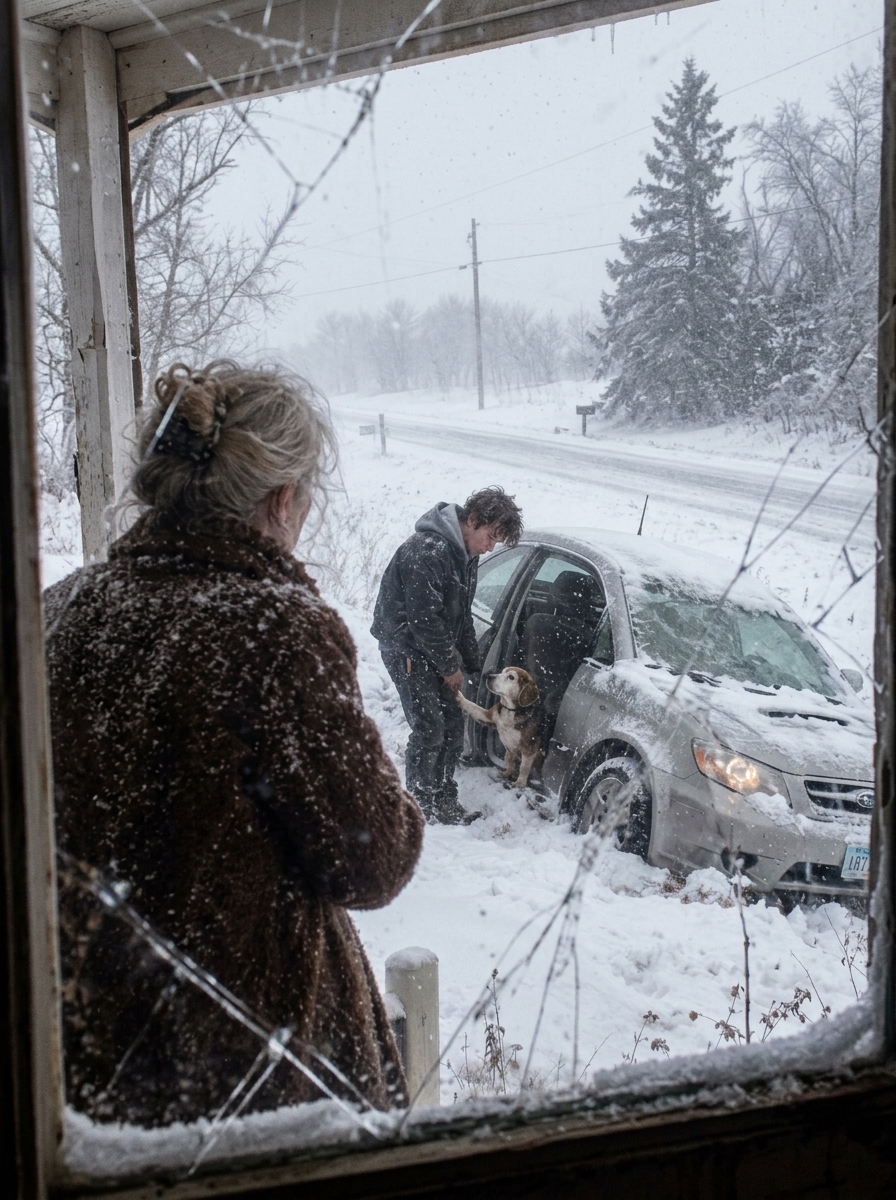
I had been standing at my kitchen window, watching snow erase the road outside my house, when I saw a small delivery car slide sideways and sink nose-first into the ditch.
A teenage boy climbed out.
He tried pushing the car. He tried digging around the tires with his boots. Then he leaned against the driver’s door for a moment, shoulders rising and falling beneath a thin jacket that had no business being worn in a Minnesota blizzard.
I was 71 years old, recently widowed, and had spent most of that winter convincing myself that minding my own business was the same thing as being independent.
Then I saw the beagle.
He was sitting in the passenger seat, gray around the muzzle, staring through the windshield.
The boy opened the door and said something to him.
The dog didn’t move.
Instead, he reached out one paw and kept scratching at the boy’s leg.
Again.
Again.
Again.
Something about it bothered me.
I taught middle school for thirty-eight years. You learn to recognize when a child says, “I’m fine,” and absolutely is not.
So I pulled on my late husband’s old boots, wrapped myself in the wool coat he’d bought me twenty Christmases earlier, and stepped outside.
The wind nearly took my breath away.
“Young man!” I shouted.
He turned toward me.
“I’m okay!” he yelled back immediately.
Of course he did.
He couldn’t have been more than seventeen.
His cheeks were bright red, his lips pale, and he was shivering so hard I could see it from twenty feet away.
“You don’t look okay.”
“My phone’s almost dead, but somebody will come.”
“When?”
He shrugged.
The beagle pawed him again.
I walked closer.
“What’s your name?”
“Caleb.”
“I’m Mrs. Harlan.”
He gave me the tired half-smile teenagers give older women when they’re trying to be polite.
“Nice to meet you, ma’am.”
Then his knees buckled slightly.
That was the end of the discussion.
“Inside.”
“I’m really fine.”
“Caleb, I spent almost four decades telling thirteen-year-olds to sit down when they didn’t want to. You’re not going to win this one.”
For the first time, he almost laughed.
I pointed toward the house.
“Bring the dog.”
That convinced him.
The beagle’s name was Chester.
He was twelve years old, arthritic, overweight, and apparently the only creature on earth whose opinion Caleb respected without argument.
The moment we got inside, Chester shook snow across my entryway and waddled straight toward the heating vent.
Caleb apologized three times.
I told him snow melted and floors dried.
People were harder to replace.
That stopped him.
I wrapped him in two blankets and sat him at the kitchen table while I called for help.
The roads were nearly impassable. Emergency crews were overwhelmed, and we were told to stay inside unless Caleb’s condition worsened.
So I did what women my age have been doing for frightened children long before anyone called it a skill.
I fed him.
Tomato soup.
Grilled cheese.
Hot cocoa.
He ate like he hadn’t seen food all day.
He hadn’t.
The delivery job was something he did after school to help his mother with bills. His father had been gone for years. His mother worked long shifts, and Caleb had been trying to finish his route before the storm got worse.
“Why didn’t you stop earlier?” I asked.
He looked embarrassed.
“I thought I could handle it.”
I almost smiled.
I’d heard my husband say those exact words a hundred times.
Usually immediately before needing stitches, jumper cables, or a neighbor with a tractor.
That thought hurt more than I expected.
My husband, Frank, had died eight months earlier.
Forty-six years of marriage, and then suddenly I was living in a house built for two people with one coffee cup in the sink.
People checked on me at first.
They brought casseroles.
They called.
They told me to reach out if I needed anything.
But grief has a strange calendar.
Everyone else eventually returns to Tuesday.
You are still standing in the day everything changed.
By January, my house had become painfully quiet.
I kept the television on for company.
I sometimes talked to Frank’s empty chair.
I had started eating dinner at the kitchen counter because sitting alone at the table felt too much like admitting something permanent.
That night, Caleb sat in Frank’s chair.
I almost asked him to move.
Subscribe to Tatticle!
Get updates on the latest posts and more from Tatticle straight to your inbox.
Website
Your Email…
Subscribe
We use your personal data for interest-based advertising, as outlined in our Privacy Notice.
Instead, I let him stay.
Chester lay beneath the table with his head on Caleb’s boot.
We talked for two hours.
At first, it was awkward.
He thought seventy-one was ancient.
I thought teenagers communicated entirely through phones and mysterious abbreviations.
He asked whether televisions had existed when I was a child.
I told him I wasn’t raised during the Civil War.
He laughed so hard he nearly spilled his cocoa.
I learned he loved history but hated writing essays.
He learned I’d taught English.
“Of course,” he groaned.
“You’re trapped in a retired English teacher’s house during a blizzard. Consider your life choices.”
He smiled.
It was the first real smile I’d seen from him.
Eventually a tow driver reached us.
Caleb’s mother arrived later, terrified and grateful, hugging him so tightly he protested that he couldn’t breathe.
Before they left, Caleb stood awkwardly in my entryway.
“Thank you, Mrs. Harlan.”
“You’re welcome.”
He looked down at Chester.
Then back at me.
“I mean it.”
“I know.”
I assumed that would be the end of it.
People pass through our lives every day.
Most don’t come back.
Two weeks later, I heard scraping outside my front door.
Caleb was shoveling my walkway.
I opened the door.
“What are you doing?”
“You saved me from freezing.”
“I gave you soup.”
“And blankets.”
“They were old blankets.”
“And grilled cheese.”
“That may have been heroic.”
He grinned.
Chester was sitting in the car watching him.
When Caleb finished, I invited him inside.
He drank coffee for the first time at my table and hated it.
“How do adults drink this?”
“We’re tired.”
That became our joke.
Then it became a routine.
Every few days after school, Caleb stopped by.
Sometimes he shoveled.
Sometimes he carried groceries.
Sometimes he brought Chester, who immediately claimed the rug beside Frank’s recliner.
In return, I helped Caleb with school.
His first history essay came back with an A-minus.
He burst into my kitchen waving it over his head like he’d won a championship.
I put it on my refrigerator.
He pretended that embarrassed him.
It stayed there.
Spring came slowly.
One afternoon, I realized something strange.
I had gone almost the entire day without feeling lonely.
Not because I had forgotten Frank.
I never would.
But grief was no longer the only thing waiting for me in the house.
Sometimes there was a muddy pair of teenage boots by the door.
Sometimes there was an old beagle snoring beneath my table.
Sometimes there was laughter coming from the chair I once couldn’t bear to look at.
Caleb needed someone to tell him he was smarter than he believed.
I needed someone to remind me that being needed had not ended when retirement and widowhood began.
We were fifty-four years apart.
Different music.
Different slang.
Different lives.
But loneliness, it turns out, doesn’t care how old you are.
Neither does kindness.
Last winter, on the anniversary of the storm, Caleb brought me a small framed photograph.
It was Chester sitting beside my kitchen table.
Underneath, Caleb had written one sentence.
“Thanks for opening the door.”
I cried.
Because I finally understood something he didn’t.
I had opened the door for him that night.
But somehow, that boy and his stubborn old dog had opened one for me too.
Sometimes the person you rescue is the person who quietly teaches you how to live again.
Part 2:
The second time Chester tried to tell me something was wrong, there wasn’t a blizzard.
There wasn’t even snow.
He was standing in my kitchen on a perfectly ordinary Tuesday afternoon, scratching frantically at Caleb’s backpack while Caleb kept pulling it away from him.
“Chester, stop.”
The old beagle scratched again.
“Seriously.”
Scratch.
Scratch.
Scratch.
I looked up from the essays I was helping Caleb review.
“What’s in the backpack?”
“Nothing.”
I stared at him.
Caleb sighed.
“Mrs. Harlan.”
“Caleb.”
He had turned eighteen three weeks earlier.
Apparently, becoming legally adult had convinced him that he was now immune to the stare of a retired middle school teacher.
Thirty-eight years in a classroom had taught me otherwise.
Chester pawed the backpack again.
Caleb pushed it beneath his chair.
“He’s being weird.”
“No,” I said. “He’s being Chester.”
That was different.
Chester had become slower over the past year.
His muzzle was almost completely white now.
His hips bothered him when the weather turned cold, and getting onto my porch sometimes required the concentration of a man solving advanced mathematics.
But his instincts remained excellent.
Especially when it came to Caleb.
The night I first found them stranded in that Minnesota blizzard, Chester had been the one pawing Caleb’s leg when the boy insisted he was fine.
He had known before I did.
Apparently, he knew something again.
I leaned back.
“What’s going on?”
“Nothing.”
“That’s twice you’ve said nothing.”
“Because nothing’s going on.”
“Three times.”
He looked toward the ceiling.
“Do teachers count everything?”
“Only lies.”
That got his attention.
“I’m not lying.”
“Then what’s in the backpack?”
He reached down quickly and pulled it closer to his boots.
Too quickly.
That was when I knew.
Teenagers think adults discover things because we’re smarter.
Usually, we discover them because teenagers are terrible actors.
“Caleb.”
His jaw tightened.
“Can we just finish the essay?”
“No.”
“Mrs. Harlan.”
“No.”
“You don’t even know what it is.”
“Correct.”
“Then why are you making this a thing?”
“Because you’re making it a thing.”
For several seconds, neither of us spoke.
Chester sat between us.
Then the ridiculous old dog sneezed.
Under different circumstances, I might have laughed.
Caleb didn’t.
He stood.
“I should go.”
That frightened me more than anything else.
Caleb almost never left angry.
Even when we disagreed, which happened regularly because I believed commas mattered and he believed commas were invented by people with too much free time, he stayed.
He argued.
He ate whatever I had cooked.
Then he usually apologized by carrying something heavy that I had not asked him to carry.
But this time he reached for his coat.
As he lifted the backpack, the zipper caught against the chair.
A folder slid out.
Papers scattered across my kitchen floor.
Caleb froze.
I bent automatically to help him.
Then I saw the words printed across the top page.
HIGH SCHOOL WITHDRAWAL REQUEST.
My hand stopped.
Caleb grabbed the paper.
Too late.
I looked up at him.
“What is that?”
He stuffed it back into the folder.
“It’s nothing.”
“That is not nothing.”
“It’s just paperwork.”
“For leaving school?”
His face changed.
Not much.
But enough.
The same boy who had once stood freezing beside a wrecked delivery car suddenly looked twelve years old.
“I’m eighteen.”
“I know how old you are.”
“I can make my own decisions.”
“Of course you can.”
“Then don’t do the teacher thing.”
“The teacher thing?”
“That look.”
“What look?”
“Like you’re about to explain why I’m ruining my life.”
I stood slowly.
“Are you?”
He looked away.
And that’s when Chester pressed his head against Caleb’s knee.
Caleb rested one hand between the dog’s ears.
“I got offered full-time hours.”
I waited.
“At the distribution warehouse.”
“What about school?”
“I can work nights.”
“And school?”
He didn’t answer.
“Caleb.”
“I only have a few months left anyway.”
That sentence still makes me angry when I remember it.
Not because he said it.
Because he had somehow convinced himself it made sense.
“You have fourteen weeks until graduation.”
“I know.”
“So you’re quitting fourteen weeks before you graduate?”
“I’m not quitting.”
“What would you call it?”
“Working.”
“You can work and graduate.”
“Not enough.”
There it was.
Not enough.
Two words that can swallow an entire family.
Not enough money.
Not enough hours.
Not enough food.
Not enough time.
Not enough strength to keep pretending everything is fine.
I lowered my voice.
“What’s happened?”
“Nothing happened.”
“Caleb.”
He sat back down.
This time, when he spoke, the fight had disappeared.
“My mom’s hours got cut.”
I said nothing.
“Not completely. Just… a lot.”
“When?”
“Before Christmas.”
It was March.
I felt something inside me tighten.
“Three months ago?”
“She didn’t want people knowing.”
“I’m not people.”
“I know.”
The answer came so softly that my anger disappeared.
He stared at Chester.
“The transmission in Mom’s car went bad in January. We put it on a credit card.”
I didn’t ask how much.
“The rent went up again.”
He swallowed.
“She keeps saying we’re okay.”
I almost laughed.
Not because anything was funny.
Because apparently every person I cared about had the same ridiculous definition of okay.
Frank had once stood in our driveway with a nail through his work boot and told me he was okay.
Caleb had nearly frozen beside a ditch and told me he was okay.
Now his mother was falling behind on bills and telling her son they were okay.
People lie most convincingly when they’re trying to protect someone they love.
“Does your mother know about this?”
He looked at the folder.
“Not exactly.”
“Caleb.”
“She’s already stressed.”
“Does she know you’re planning to leave school?”
“No.”
I closed my eyes.
There are moments when being seventy-two is useful.
You learn that reacting immediately is rarely as satisfying as you imagine.
So I counted to five.
Then ten.
At eleven, I was still angry.
“You’re hiding this from her.”
“I’m handling it.”
“By quitting school.”
“Stop saying quitting.”
“What word would you prefer?”
“Helping.”
That silenced me.
He looked at me for the first time.
“She’s done everything for me.”
“I know.”
“She’s worked double shifts. She’s skipped stuff so I could have stuff. She’s driven a car that sounded like it was filled with rocks because I needed mine for deliveries.”
His eyes were wet now.
He hated that.
He turned his face.
“So yeah. Maybe I don’t graduate on time. Maybe I get some equivalency thing later.”
“Caleb—”
“People do it.”
“They do.”
“And they’re fine.”
“Some are.”
“There. See?”
“That doesn’t mean it’s the best choice for you.”
He laughed bitterly.
“Best choice?”
I didn’t like that laugh.
“Do you know what my best choice is right now?”
I waited.
“Making enough money that my mom doesn’t have to stare at the grocery total before she puts stuff back.”
The words landed hard.
I had seen that look.
Not from his mother.
From my own mother.
There were six of us growing up.
My father repaired farm machinery.
Some winters were good.
Some weren’t.
I remembered standing beside a grocery cart while my mother quietly removed canned peaches because the total was too high.
Children notice more than adults think.
They simply don’t always understand what they’re seeing.
“I understand why you want to help her.”
“No, you don’t.”
That hurt.
And because I am human, I wanted to defend myself.
I wanted to tell him about my childhood.
About Frank and me sharing one car for twelve years.
About teaching summer school because the roof leaked and we didn’t have the money to replace it.
About stretching hamburger with oatmeal when our budget got tight.
But the truth was, Caleb was partly right.
I didn’t know exactly what his life felt like.
Nobody ever truly knows the weight another person is carrying.
So instead I said, “You’re right.”
He blinked.
“I don’t know exactly.”
He had been prepared for an argument.
That confused him.
“But I know this.”
I tapped the withdrawal form.
“A permanent decision deserves more than a frightened Tuesday afternoon.”
“I’m not frightened.”
“You’re eighteen. Of course you’re frightened.”
That almost made him smile.
Almost.
“I’m serious.”
“So am I.”
“I start Monday.”
My stomach dropped.
“At the warehouse?”
He nodded.
“Full-time.”
“What hours?”
“Four in the afternoon until midnight.”
“And school?”
He shrugged.
“Until Friday.”
I stared at him.
He had already decided.
The form wasn’t something he was considering.
It was something he was doing.
“Have you submitted this?”
“Tomorrow.”
“Don’t.”
His expression hardened.
“It’s my decision.”
“Then give yourself forty-eight hours.”
“Why?”
“Because if the decision is still correct in forty-eight hours, waiting won’t hurt anything.”
“And if it isn’t?”
“Then forty-eight hours may save you years.”
He rubbed his face.
Chester placed one paw on his shoe.
Finally, Caleb said, “One day.”
“Two.”
“One.”
“Thirty-eight years of negotiation experience, young man.”
He groaned.
“Fine. Two.”
“Thank you.”
“But you can’t call anybody.”
I hesitated.
He noticed.
“I’m serious.”
“Your mother deserves to know.”
“I’ll tell her.”
“When?”
“After I start working.”
“That is not telling her. That’s cornering her.”
His jaw tightened.
“Promise me.”
I didn’t answer.
“Mrs. Harlan.”
I hated the choice he was giving me.
He was eighteen.
He trusted me.
He had brought me into a part of his life he had hidden from everyone else.
Maybe accidentally.
But he had stayed and explained.
Trust matters.
So does family.
And sometimes those two things pull in opposite directions.
“Promise you won’t call my mom.”
I looked at the boy sitting in Frank’s chair.
The boy I had fed during a storm.
The boy whose essay was still hanging on my refrigerator beneath three newer ones.
The boy who had spent the previous summer fixing my screen door even after I told him seven times that I could hire someone.
I thought about what I owed him.
Then I thought about what I owed the truth.
“I won’t call tonight,” I said.
His eyes narrowed.
“That’s not what I asked.”
“It’s what I’m promising.”
He stood.
“That’s messed up.”
“Probably.”
“I trusted you.”
“You still can.”
“Not if you’re going behind my back.”
“I’m asking you to tell her yourself.”
“And I’m asking you to stay out of it.”
There it was.
The line.
Every relationship eventually discovers one.
The place where caring about someone starts looking suspiciously like interfering with them.
I wish I could tell you I handled it perfectly.
I didn’t.
I said something teachers should know better than to say.
“You’ll understand someday.”
Caleb’s face closed immediately.
Nothing makes a young person feel smaller faster than being told their age disqualifies them from understanding their own life.
He grabbed his backpack.
“That’s exactly what everybody says.”
“I’m sorry. That came out wrong.”
“No. It’s fine.”
It wasn’t.
He put on his coat.
Chester struggled to his feet.
“Caleb.”
He opened the door.
“See you around, Mrs. Harlan.”
Not tomorrow.
Not Thursday.
See you around.
The door closed.
My kitchen became very quiet.
For the first time in almost a year, Frank’s chair was empty again.
I hated it.
I hated myself a little too.
That night, I barely slept.
At 2:14 in the morning, I got up and made tea.
Frank’s photograph sat on the shelf beside the kitchen window.
“You’d know what to do,” I told him.
That was a lie.
Frank would have done something dramatic and deeply impractical.
He once repaired our neighbor’s furnace without permission because the man was too proud to ask for help.
The neighbor didn’t speak to him for two weeks.
Then they became best friends.
Frank believed boundaries were mostly suggestions.
I believed boundaries mattered.
Usually.
I drank my tea.
At three o’clock, I decided I would respect Caleb’s wishes.
At three-fifteen, I changed my mind.
At three-thirty, I decided changing my mind was manipulative.
At four, I wondered whether dead husbands were allowed to haunt wives who made bad decisions.
By breakfast, I had reached one conclusion.
Caleb deserved the chance to tell his mother himself.
But his mother deserved to know before he left school.
Both things could be true.
So I waited.
Wednesday passed.
No Caleb.
Thursday morning, I drove into town.
I told myself I needed groceries.
This was technically true.
I bought milk, bread, eggs, and absolutely nothing else because I spent the entire trip thinking about a boy who was not my child.
That distinction mattered.
He wasn’t my son.
He wasn’t my grandson.
I had no legal right to decide his future.
I wasn’t even related to him.
I was an old English teacher who had opened a door during a storm.
Maybe that was all I was supposed to be.
Then I remembered something Caleb had said months earlier.
We had been talking about family trees for a history assignment.
He had complained that his was boring.
“I’ve got, like, four people.”
“That’s not boring.”
“It’s tiny.”
“Families aren’t measured by head count.”
He had looked at Chester.
“Does he count?”
“More than some relatives.”
Caleb laughed.
Then he had said something I hadn’t forgotten.
“I guess you should be on there somewhere.”
I nearly cried at the time.
Instead, I corrected his grammar because affection makes me uncomfortable.
By Thursday afternoon, I had made my decision.
I called his mother.
Her name was Denise.
We had met dozens of times by then.
She was forty-three, worked harder than anyone should have to, and possessed the weary politeness of someone who hated owing anybody anything.
She answered on the fourth ring.
“Mrs. Harlan?”
“Hello, Denise.”
“Everything okay?”
I almost laughed.
There was that word again.
“I need to ask you something.”
A pause.
“Okay.”
“Has Caleb talked to you about school?”
Silence.
Long enough.
“What about school?”
My heart sank.
“He hasn’t told you.”
“Told me what?”
There are moments when you know a relationship is about to change.
You just don’t know whether it will survive.
“He’s planning to withdraw.”
Nothing.
“Denise?”
“What?”
“He has the paperwork.”
“No.”
“I saw it.”
“No. He’s graduating in June.”
“That’s what I thought.”
“He told me he picked up a few extra shifts.”
My chest tightened.
“He’s been offered full-time work.”
Another silence.
Then I heard her whisper something I had never heard her say before.
Not anger.
Fear.
“Oh, Caleb.”
I felt terrible.
“I told him he should tell you himself.”
“When did you find out?”
“Tuesday.”
“And you’re telling me now?”
“He asked me not to.”
That sentence sounded worse aloud.
“So you knew for two days?”
“I was trying to give him a chance.”
“Mrs. Harlan…”
“I know.”
“No, you don’t.”
Her voice broke.
“My son thinks he has to quit school because of me.”
“Denise—”
“Because he thinks I can’t take care of us.”
“I don’t think that’s how he sees it.”
“That’s exactly how he sees it.”
She was crying now.
Quietly.
I sat down.
“I’m sorry.”
“I didn’t know he was that worried.”
“He loves you.”
“I know he loves me.”
There was anger now.
Not at me.
Maybe not even at Caleb.
Sometimes love turns into anger because anger is easier to carry.
“I never asked him to fix this.”
“I know.”
“He shouldn’t even know how far behind I am.”
I hesitated.
“How far behind are you?”
She didn’t answer.
“I’m sorry. You don’t have to tell me.”
“We’re not losing the apartment.”
The speed of her answer worried me.
“I didn’t ask that.”
“We’re fine.”
There it was.
Again.
I almost told her that word should be outlawed.
Instead I said, “What do you need?”
“Nothing.”
“Denise.”
“Please don’t.”
Her voice changed.
Sharp now.
Proud.
And suddenly I understood Caleb a little better.
“I appreciate everything you’ve done for him. I do.”
“I know.”
“But we don’t need charity.”
“I didn’t say charity.”
“It’s what you meant.”
“It isn’t.”
“Then what did you mean?”
I didn’t know yet.
So I told the truth.
“I mean I don’t want either of you drowning while the other one pretends not to notice.”
That stopped her.
I continued.
“You are protecting Caleb by hiding how difficult things are.”
“He’s my child.”
“And he’s protecting you by leaving school.”
“He shouldn’t.”
“I agree.”
“But that’s different.”
“Why?”
She had no answer.
Neither did I.
That was the problem.
Parents believe sacrifice belongs to them.
Children eventually decide sacrifice belongs to them too.
Then everybody starts secretly suffering in separate rooms because nobody wants to become somebody else’s burden.
Frank and I had done versions of the same dance for forty-six years.
Human beings are remarkably consistent.
“Talk to him,” I said.
“I will.”
“Please don’t tell him I called because I think he’s incapable of deciding.”
“Then why did you call?”
That was the question.
I looked toward the refrigerator.
At Caleb’s essays.
At his A-minus.
His first A.
A photograph from the school history fair.
A crooked birthday card he’d made me that said:
TO MRS. HARLAN.
THANKS FOR MAKING GRAMMAR SLIGHTLY LESS TERRIBLE.
I smiled despite myself.
“Because sometimes loving somebody means risking that they’ll be angry with you.”
Denise was quiet.
Then she said, “He’s going to be furious.”
“I know.”
She was right.
Caleb didn’t come Friday.
He didn’t come Saturday.
Sunday evening, my phone rang.
I answered before the second ring.
“Hello?”
“You called her.”
No hello.
No Mrs. Harlan.
Just accusation.
“Yes.”
“You promised.”
“I promised I wouldn’t call that night.”
“Don’t do that.”
“Do what?”
“Teacher-word-game me.”
Despite everything, I nearly smiled.
He knew me too well.
“You’re right.”
Silence.
“I shouldn’t hide behind wording.”
“You betrayed me.”
There are words that hurt more when they are accurate.
That was one of them.
“I broke your confidence.”
“Yeah.”
“I did.”
“I told you not to call.”
“I know.”
“Do you even care what I wanted?”
“Very much.”
“Then why?”
“Because what you wanted wasn’t the only thing that mattered.”
That made him furious.
“It’s my life!”
“Yes.”
“My school.”
“Yes.”
“My job.”
“Yes.”
“Then you don’t get to decide.”
“I’m not deciding.”
“You already did!”
His voice cracked.
“You made my mom cry.”
I closed my eyes.
“I’m sorry.”
“She thinks she’s failing me now.”
“I never said that.”
“Doesn’t matter.”
He breathed hard into the phone.
“She called the school.”
My heart jumped.
“What happened?”
“She told them I wasn’t withdrawing.”
I was relieved.
I should not have sounded relieved.
“Good.”
Silence.
Then:
“Wow.”
I knew immediately.
“Caleb, I didn’t mean—”
“No. That’s what you wanted.”
“I want you to graduate.”
“You want me to do what you think is right.”
“Because I think it is right.”
“Exactly.”
The phone went dead.
I stared at it.
There is a particular kind of loneliness that comes after an argument.
It is different from ordinary loneliness.
Ordinary loneliness is an empty chair.
This kind is knowing the chair is empty because you helped make it that way.
Caleb stopped coming.
One week passed.
Then two.
I removed nothing from the refrigerator.
His coffee mug stayed in the cupboard despite the fact that he hated coffee and mostly filled it with cocoa.
The rug beside Frank’s recliner remained empty.
That was the part I noticed most.
No Chester.
I missed the old dog terribly.
I had not realized how much of my routine belonged to him.
At four o’clock, I still expected scratching at the door.
When I dropped toast, I looked down automatically.
There was nobody waiting.
I began eating dinner at the counter again.
The first night I noticed myself doing it, I almost threw the plate across the room.
Not because I was angry with Caleb.
Because I was angry with myself for slipping so easily backward.
Grief has habits.
So does loneliness.
You think you’ve escaped them.
Then one quiet Tuesday arrives, and you’re standing at the kitchen counter eating soup because sitting at the table suddenly feels unbearable again.
“Ridiculous,” I told Frank’s chair.
It did not disagree.
Three weeks after the argument, someone knocked.
Not Caleb.
Denise.
She stood on my porch holding a casserole dish.
I stared at it.
“What is that?”
“Lasagna.”
“I know what lasagna is.”
She almost smiled.
“Can I come in?”
I stepped aside.
She put the dish on my counter.
For a moment, neither of us knew what to say.
Then Denise looked around.
“He isn’t here?”
“You know he isn’t.”
“I thought maybe he was sneaking over.”
“He inherited your stubbornness.”
She laughed once.
“He probably got some from his father too.”
We sat at the table.
Frank’s chair stayed empty.
“How bad is it?” I asked.
She knew I wasn’t talking about money.
“He’s angry.”
“I noticed.”
“At me too.”
“I’m sorry.”
“Don’t be.”
She picked at the edge of a paper napkin.
“I needed to know.”
That surprised me.
“He thinks I don’t.”
“Know what?”
“That you told me.”
I stared at her.
“You didn’t tell him?”
“I told him I found out.”
“Denise.”
She lifted one eyebrow.
“Now who’s keeping secrets?”
I deserved that.
“Why?”
“Because I wanted him mad at me.”
“That’s ridiculous.”
“I know.”
“Then why?”
She looked at me for a long time.
“Because you’re good for him.”
My throat tightened.
“He needs you.”
“He isn’t speaking to me.”
“He’ll get over it.”
“You sound remarkably confident.”
“I’m his mother.”
That was apparently the end of the argument.
I poured us tea.
Denise wrapped both hands around the mug.
“The bills are bad,” she said.
I waited.
“Not disaster bad.”
“That sounds like something people say immediately before disaster.”
She smiled faintly.
“The car repair wiped out what I had saved.”
“How much are you behind?”
“One month on rent.”
“Utilities?”
“Current.”
“Groceries?”
“We’re eating.”
That answer told me everything.
“What does Caleb give you?”
Her face hardened.
“Nothing.”
“Denise.”
“I won’t take his money.”
“So he’s trying to quit school because you’re struggling, and you won’t let him contribute.”
“He’s eighteen.”
“Yes.”
“He’s supposed to be worrying about graduation and girls and whatever eighteen-year-olds worry about.”
“Apparently warehouse schedules.”
She smiled despite herself.
“I don’t want him becoming responsible for me.”
“Maybe he doesn’t see it that way.”
“How else would he see it?”
“Being part of a family.”
She looked down.
I understood her fear.
There is a difference between helping and becoming responsible for another adult’s survival.
A young person shouldn’t have to surrender every opportunity because a parent is struggling.
But pretending grown children should never contribute to the people they love didn’t feel right either.
Life rarely gives us clean moral categories.
Most choices arrive muddy.
“Would you let him help a little?”
She frowned.
“What do you mean?”
“Not quit school. Not hand over every paycheck.”
I thought for a moment.
“But something.”
“He shouldn’t have to.”
“That’s not what I asked.”
She sighed.
“Maybe.”
There was progress.
Tiny progress.
Middle school teachers learn to celebrate tiny progress.
“Now,” I said, “what if there were another way for him to earn money?”
Her eyes narrowed.
“No.”
“You don’t even know what I’m suggesting.”
“I know you.”
Fair.
“I need help.”
“With what?”
I looked around my extremely tidy house.
That was a flaw in my plan.
“Things.”
“What things?”
“Many things.”
She started laughing.
“I am seventy-two years old.”
“You shovel your own steps.”
“Poorly.”
“You mow your own lawn.”
“Recklessly.”
“You cleaned your gutters last fall.”
I pointed at her.
“That was one time.”
“You climbed onto the roof.”
“I remained mostly on the ladder.”
“You don’t need help.”
“I could become needier.”
She laughed so hard she covered her face.
It was the first time I had ever heard Denise laugh like that.
When she stopped, I said, “Frank’s workshop.”
Her smile disappeared.
That surprised me too.
I hadn’t opened it properly since he died.
The small detached garage behind my house had been Frank’s kingdom.
Tools.
Fishing gear.
Boxes of screws organized according to a system understood only by him and perhaps NASA.
There were shelves filled with forty-six years of things he had been absolutely certain would become useful someday.
I hadn’t touched most of it.
“There’s enough work in there to occupy Caleb for months,” I said.
“You want to pay him to clean it?”
“Organize it.”
“You hate people touching Frank’s things.”
“I know.”
That sentence sat between us.
The truth was, I didn’t need Caleb to clean the workshop.
I needed a reason to finally open it.
Maybe he needed a reason to come back.
Sometimes help works in both directions.
That doesn’t make it fake.
“How much?” Denise asked.
“Enough to matter.”
“Mrs. Harlan.”
“Not charity.”
“It sounds like charity.”
“It sounds like employment.”
“For a job you just invented.”
“Most jobs were invented by somebody.”
She rolled her eyes.
“I can pay him what I’d pay anyone else.”
“You wouldn’t hire anyone else.”
“Details.”
She shook her head.
But she was smiling.
“I’ll mention it.”
“No.”
“No?”
“He’ll know it came from me.”
“What do you suggest?”
I thought about Chester.
“Bring the dog.”
The following Saturday, I heard scratching at my door.
Not knocking.
Scratching.
I opened it.
Chester stood on my porch.
Denise held his leash.
“I thought you might need help with the workshop,” she said.
I looked at the beagle.
“He’s underqualified.”
“He works cheap.”
Chester walked inside without waiting for permission.
He went directly to the rug beside Frank’s recliner, turned around three times, and collapsed with a sigh.
I nearly cried.
Denise pretended not to notice.
“Caleb’s working?”
“Until three.”
“Still part-time?”
“For now.”
“For now?”
She looked exhausted.
“We’re negotiating.”
“Good.”
“He wants to pay the electric bill.”
“And?”
“I told him no.”
“Denise.”
“I said we’re negotiating.”
At three-thirty, Caleb’s car pulled into my driveway.
I was standing in Frank’s workshop with the garage door open.
Denise had left an hour earlier.
Chester was sleeping beside an old tackle box.
Caleb stepped out of the car.
He saw me.
Then the garage.
Then Chester.
His expression became suspicious.
“My mom said Chester was here.”
“He is.”
He walked closer.
“What are you doing?”
“Apparently destroying forty-six years of your typical American male’s belief that every bent nail has future value.”
He looked inside.
I’d managed to fill two trash bags.
That was impressive until you understood Frank’s workshop probably contained enough material to reconstruct a small town.
Caleb folded his arms.
“Why are you doing this?”
“Because it needs doing.”
“You’ve never touched this room.”
“Correct.”
“Why now?”
I met his eyes.
“Because I finally can.”
That softened something.
Not enough.
But something.
He walked inside.
Picked up one of Frank’s old screwdrivers.
“You okay with this?”
“No.”
He looked at me.
“Then why—”
“Because being ready isn’t always required.”
He put the screwdriver down carefully.
I nodded toward a stack of boxes.
“I could use help.”
“I’m busy.”
“I pay twenty dollars an hour.”
He stared at me.
“No.”
“That’s roughly what I’d pay someone else.”
“You weren’t going to hire someone else.”
“Your mother said exactly the same thing.”
His face darkened.
“This is charity.”
“It is work.”
“You invented it.”
“Technically, Frank created it by refusing to throw away extension cords that stopped working during the first Bush administration.”
Caleb tried not to laugh.
I saw it.
“I don’t want your money.”
“Then don’t take it.”
“Okay.”
“Okay.”
He hesitated.
Apparently, he had expected me to argue.
I returned to the shelf.
After thirty seconds, he said, “That box goes with electrical.”
“I know.”
“You’re putting it with plumbing.”
“I know.”
“Why?”
“I enjoy chaos.”
He sighed.
Then he took off his coat.
“I can stay an hour.”
He stayed four.
We barely spoke at first.
That was fine.
Some apologies need silence before they can breathe.
Around five, Caleb found one of Frank’s old thermoses.
He held it up.
“This still good?”
“It has been in here since 2009.”
“So no?”
“Open it and we’ll both find out.”
He unscrewed the lid.
Then immediately recoiled.
I laughed so hard I had to sit down.
“That’s disgusting!”
“I warned you.”
“You told me to open it!”
“Education requires curiosity.”
“You’re horrible.”
For one wonderful second, everything felt normal again.
Then he put the thermos in the trash and said quietly, “I was really mad at you.”
“I know.”
“You had no right.”
“I know.”
He looked at me, surprised.
I leaned against Frank’s workbench.
“I would probably make the same choice again.”
His face hardened.
“But that doesn’t mean I had the right.”
“That makes no sense.”
“Most difficult things don’t.”
He sat on an overturned bucket.
“You broke your promise.”
“I did.”
“So how am I supposed to trust you?”
I thought carefully.
“You shouldn’t trust me because I always do what you want.”
He looked away.
“You should trust me because I’ll tell you the truth, even when that truth makes me look bad.”
Silence.
“I was scared,” I said.
“Of what?”
“That you’d wake up at thirty-five still paying for a decision you made at eighteen because everybody around you was too polite to interfere.”
His jaw tightened.
“I could go back.”
“You could.”
“People do.”
“I know.”
“You act like leaving school ruins your whole life.”
“No.”
I shook my head.
“I taught children who left school and built wonderful lives.”
That surprised him.
“Then why are you making such a big deal?”
“Because you don’t want to leave.”
He looked at me.
There it was.
The truth underneath everything.
“You love history.”
He said nothing.
“You spent six weeks complaining about that research project and then voluntarily read two extra books.”
“They were interesting.”
“Exactly.”
“You talk about college.”
“Sometimes.”
“You’ve been looking at programs.”
His eyes narrowed.
“How do you know?”
“You left three brochures on my table.”
“Oh.”
“You want to graduate.”
He stared at the floor.
Finally, he whispered, “Wanting something doesn’t mean you get to have it.”
My heart broke a little.
“No,” I said.
“It doesn’t.”
He looked up.
“But being afraid you can’t have something doesn’t mean you’re required to give it away first.”
He rubbed Chester’s ears.
The old beagle had wandered over and put his chin on Caleb’s knee.
“My mom told you about the bills?”
“Some.”
He shook his head.
“Everybody talks about me.”
“Welcome to having people who care whether you’re alive.”
He almost smiled.
“I hate it.”
“Also normal.”
He glanced around the workshop.
“You really paying twenty?”
“Yes.”
“Cash?”
“Check.”
“That’s worse.”
“Taxes build character.”
He groaned.
And just like that, we had a deal.
For the next two months, Caleb worked twelve hours a week for me.
Not sixteen.
Not twenty.
Twelve.
That was the compromise Denise and I eventually forced him to accept.
He kept his weekend delivery shifts.
He stayed in school.
And every Saturday morning, he showed up at my house and attacked Frank’s workshop with the determination of a man excavating an archaeological site.
We found everything.
Three broken radios.
Eleven tape measures.
A coffee can filled with keys that opened absolutely nothing we owned.
A wedding photograph I thought I’d lost in 1987.
Frank’s Army surplus jacket from before we met.
A receipt for our first refrigerator.
And, in the back of a drawer beneath old fishing licenses, an envelope with my name written on it.
MARGARET.
Caleb saw it first.
He stopped.
“Mrs. Harlan.”
I knew Frank’s handwriting immediately.
My knees weakened.
The envelope was yellowed.
Probably years old.
“Do you want me to leave?”
I couldn’t answer.
Caleb stepped toward the door.
“No.”
He stopped.
“Stay.”
I sat on Frank’s old stool.
My hands shook opening the envelope.
Inside was a folded sheet of notebook paper.
Frank had apparently written it while replacing the workshop roof nine years earlier.
I won’t pretend it was poetry.
My husband was many things.
A poet was not one of them.
The letter began:
Margaret,
If you’re reading this, either I finally cleaned the garage or I’m dead.
Knowing me, probably the second one.
I laughed.
Then I cried.
Caleb stared determinedly at a shelf.
I read the rest silently.
Frank wrote about ordinary things.
The house.
Our marriage.
The arguments we had survived.
The trips we had never taken.
The kitchen table he’d built badly the first time and rebuilt because I complained it wobbled.
Then, near the end, he wrote something that changed the way I looked at everything.
He said:
Don’t turn this house into a museum.
Use my chair.
Use my tools.
Give away my junk.
Let people in.
A home is supposed to have living people making a mess in it.
For several minutes, I couldn’t speak.
Caleb finally said, “Was it bad?”
I handed him the letter.
He read it.
His eyes stopped at the last lines.
Then he looked around the workshop.
“He called this junk.”
“He finally admitted it.”
“After death.”
“Typical man.”
Caleb smiled.
Then his eyes filled.
He wiped them quickly.
“You okay?”
I looked at Frank’s stool.
At Caleb.
At Chester snoring beneath the bench.
“Apparently.”
Caleb laughed.
“That’s your favorite lie.”
He was right.
Graduation came in June.
Three days before the ceremony, Caleb appeared at my door wearing the expression he reserved for disasters.
“What happened?”
“Nothing.”
I pointed at him.
“We have discussed that word.”
He held out an envelope.
College letter.
I recognized the school.
A small public college seventy miles away.
Good history program.
Affordable enough that Caleb had been pretending not to hope too much.
“Open it.”
“You open it.”
“No.”
“Why?”
“Because it has your name on it.”
“I can’t.”
“Then Chester opens it.”
The beagle was asleep.
“He doesn’t have thumbs.”
“Excuses.”
Caleb sat at the table.
Frank’s chair.
He opened the envelope.
His eyes moved across the page.
Then stopped.
I waited.
“Well?”
He read it again.
“Caleb.”
He looked up.
“I got the scholarship.”
I screamed.
I am not proud of the sound.
It frightened Chester awake and caused Caleb to nearly fall out of his chair.
“You got it?”
He nodded.
“Half tuition.”
I hugged him.
He stood stiffly for half a second.
Then hugged me back.
“Mrs. Harlan.”
“I’m allowed.”
“I can’t breathe.”
“Your mother said the same thing during the blizzard.”
He laughed.
Then suddenly stopped.
“What?”
He looked at the letter.
“It’s still a lot.”
Of course.
Joy rarely arrives alone.
Fear usually follows it through the door.
“We’ll figure it out.”
He shook his head.
“I don’t want everybody figuring my life out for me.”
That was fair.
So I corrected myself.
“You’ll figure it out.”
He looked at me.
“And we’ll stand nearby being extremely annoying.”
“Better.”
Graduation night was warm.
The kind of Minnesota evening that makes you forgive January.
Hundreds of folding chairs covered the football field.
Parents waved.
Grandparents shouted names before they were supposed to.
Somebody behind me had brought an air horn despite repeated instructions not to.
I liked them immediately.
Denise sat beside me.
Chester wasn’t allowed on the field.
Caleb had argued this was discrimination.
The principal remained unmoved.
When Caleb’s name was called, Denise grabbed my hand.
We both stood.
Caleb walked across the stage.
For half a second, I didn’t see an eighteen-year-old in a graduation gown.
I saw a freezing seventeen-year-old boy standing beside a ditch.
Thin jacket.
Pale lips.
Too proud to admit he needed help.
Then I saw the boy who had shoveled my walkway.
The boy who had occupied Frank’s chair.
The boy who had taught me that grief and happiness could exist in the same room without canceling each other out.
He accepted his diploma.
Then he looked toward the audience.
Toward us.
And pointed.
At first, I thought he meant Denise.
Then he pointed again.
At me.
I cried through the rest of the alphabet.
Afterward, we gathered in my kitchen.
Where else?
Denise brought cake.
Caleb complained the frosting had too much sugar while eating two pieces.
Chester received a tiny portion he absolutely did not need.
At ten o’clock, Denise left.
Caleb stayed.
We sat at the table.
The windows were open.
Crickets outside.
No snow.
No wind.
No emergency.
Just quiet.
The good kind.
“What are you thinking?” I asked.
“College.”
“Terrifying.”
“Yeah.”
“Good.”
He looked at me strangely.
“Good?”
“Important things should scare you a little.”
“Why?”
“So you respect them.”
He nodded.
Then he looked toward Frank’s chair.
“You know I almost didn’t graduate.”
“I remember.”
“You called my mom.”
“I also remember that.”
“I still think you were wrong.”
I looked at him.
He looked completely serious.
I smiled.
“Good.”
“What?”
“You don’t owe me agreement because things worked out.”
He frowned.
“You really think that?”
“Absolutely.”
He leaned back.
“I thought you’d say the result proved you were right.”
“Oh, I was right.”
He laughed.
“But that isn’t the same thing.”
He considered that.
“I think you should’ve trusted me.”
“Maybe.”
“I think people should be allowed to make mistakes.”
“Absolutely.”
“Even big ones?”
I hesitated.
“Sometimes.”
“And sometimes people should interfere?”
“Sometimes.”
“That’s a terrible answer.”
“It’s the most accurate one I have.”
He smiled.
Then his expression softened.
“I’m glad you did.”
I looked at him.
“Even if you were wrong.”
“Thank you.”
“Don’t enjoy that too much.”
“I already am.”
That summer, something happened none of us expected.
Chester started slowing down quickly.
At first, Caleb blamed the heat.
Then arthritis.
Then age.
But the old dog stopped following him from room to room.
He stopped begging beside the refrigerator.
One Saturday, he came into my kitchen and simply stood there looking at Caleb.
Then he rested his head against Caleb’s leg.
Caleb froze.
“What?”
Chester didn’t move.
Caleb knelt.
“Buddy?”
I knew before he did.
Not exactly what was wrong.
Just that something had changed.
We took Chester to a local veterinary clinic.
The veterinarian was kind.
She examined him for a long time.
Then she explained that Chester’s heart was becoming weaker.
There were treatments that could help keep him comfortable.
But Chester was old.
Thirteen now.
Maybe more.
Caleb listened without interrupting.
On the drive home, he didn’t speak.
Chester sat in the back seat.
His head rested on Caleb’s backpack.
When we reached my house, Caleb stayed in the car.
I waited beside him.
Finally, he said, “How long?”
“I don’t know.”
“That’s what she said.”
“Then she probably doesn’t know either.”
He stared through the windshield.
“I’ve had him since I was five.”
“I know.”
“My dad got him.”
That was the first time Caleb had ever volunteered anything about his father.
I said nothing.
“He wasn’t always bad.”
I waited.
“He just wasn’t good at staying.”
There are sentences you should not rush to answer.
So I didn’t.
“Chester stayed.”
Caleb looked into the back seat.
“Every time.”
I reached for his hand.
He let me take it.
“I don’t want him to die.”
“I know.”
“That’s stupid.”
“No.”
“He’s a dog.”
“He’s Chester.”
His face crumpled.
And there, in my driveway, the boy who had spent years believing strength meant handling things alone finally stopped trying.
He cried.
I held him.
Chester watched from the back seat.
Over the next several months, the old dog became an honored citizen of my house.
He had medication.
A softer bed.
A ramp Caleb built for my porch.
And a dietary plan he violated whenever I dropped bacon.
Caleb started college in August.
He commuted the seventy miles at first because he refused to leave Chester overnight.
I argued with him.
Denise argued with him.
Even the veterinarian gently suggested Chester would probably sleep through his absence.
Caleb didn’t care.
Eventually, he agreed to stay on campus three nights a week.
On those nights, Chester stayed with me.
The first evening, Caleb called four times.
“Is he eating?”
“Yes.”
“Did he take the pill?”
“Yes.”
“Is he breathing okay?”
“I have not personally audited every breath.”
“Mrs. Harlan.”
“He’s fine.”
That word again.
But sometimes it was true.
College changed Caleb.
Not dramatically.
He didn’t come home wearing mysterious scarves or announcing philosophical theories.
He still hated coffee.
He still left wet towels on my porch when he washed his car.
He still believed semicolons were unnecessary.
But something in him expanded.
He began talking about becoming a teacher.
History.
High school, preferably.
“Middle school kids are terrifying,” he told me.
“Coward.”
He laughed.
I didn’t tell him how proud I was.
I didn’t need to.
He knew.
That October, Chester died.
Quietly.
In my house.
On the rug beside Frank’s chair.
Caleb had come home for the weekend.
We had eaten dinner.
Chester ate half a hamburger he was definitely not supposed to have.
Then he settled onto the rug.
Around midnight, Caleb woke me.
He was sitting on the floor beside him.
“Mrs. Harlan.”
I knew from his voice.
I sat beside them.
Chester was peaceful.
Caleb had one hand on his head.
“I think he’s gone.”
He was.
For a while, neither of us moved.
There was no dramatic goodbye.
No perfect final moment.
Just an old dog who had lived a good life and two people who loved him sitting together on a kitchen floor.
Caleb cried quietly.
So did I.
Then, sometime around two in the morning, he said something I will remember for the rest of my life.
“He saved me first.”
I looked at him.
“The storm.”
His hand rested on Chester’s white muzzle.
“If he hadn’t kept scratching at me, you probably wouldn’t have come outside.”
“Probably not.”
“And if you hadn’t come outside…”
He didn’t finish.
He didn’t need to.
Then he looked around the kitchen.
“And if none of that happened, I wouldn’t have kept coming here.”
I swallowed.
“No.”
“You wouldn’t have opened Frank’s workshop.”
“Probably not.”
“I might’ve dropped out.”
“Maybe.”
He wiped his face.
“That’s a lot for one fat dog.”
I laughed through my tears.
“He was extremely talented.”
We buried Chester beneath the maple tree behind my house.
Caleb chose the spot.
Frank had planted that tree thirty-two years earlier.
In the spring, Caleb placed a small wooden marker there.
Nothing elaborate.
Just:
CHESTER
GOOD BOY.
EXCELLENT JUDGE OF CHARACTER.
I told Caleb the second line was sentimental and the third was questionable.
He told me to stop editing gravestones.
Fair.
Two years have passed since that night.
Caleb is twenty now.
He is still studying history.
Still planning to teach.
Denise has a better job.
She lets Caleb pay one small household bill when he’s home because both of them finally learned that receiving help and surrendering independence are not the same thing.
I learned that too.
Last winter, Caleb came home during a snowstorm.
Nothing like the one that brought us together.
Just a few inches.
Enough to turn the yard white.
He walked into my kitchen without knocking.
That privilege has been permanently granted.
He was carrying a cardboard box.
“What’s that?”
“You have to promise not to yell.”
“I promise nothing.”
He set it on the floor.
The box moved.
I stared at him.
“No.”
“Just look.”
“No.”
A small brown nose appeared over the edge.
Then two floppy ears.
A beagle puppy.
“Caleb.”
“I know.”
“Absolutely not.”
“You haven’t even held her.”
“That is how they get you.”
The puppy climbed halfway out.
I stepped backward.
“Take her home.”
“Can’t.”
“Why?”
“She’s yours.”
“What?”
He grinned.
“Happy birthday.”
“My birthday is four months away.”
“I panicked.”
“You bought me a dog because you panicked?”
“There’s more.”
“That sentence has never led anywhere good.”
He handed me an envelope.
Inside was a photograph.
Chester.
The same photograph he’d given me years before.
Chester sitting beside my kitchen table.
Underneath the original words:
Thanks for opening the door.
Caleb had written another sentence.
I read it twice.
Then once more.
Sometimes you have to keep it open.
I looked at the puppy.
She had escaped the box.
She waddled toward Frank’s chair.
Sniffed Chester’s old rug.
Then sat directly in the middle of it.
I started crying.
Caleb looked alarmed.
“Is that good crying?”
“I don’t know yet.”
“So we’re keeping her?”
“We?”
“You’re keeping her.”
“Then why did you say we?”
“Emotional support.”
I picked up the puppy.
That was my mistake.
She licked my chin.
“Oh, no.”
Caleb smiled.
“Got you.”
“I dislike you.”
“No, you don’t.”
Unfortunately, he was correct.
Her name is Rosie.
I chose it.
Caleb wanted to name her Blizzard.
I explained that naming animals after traumatic weather events was ridiculous.
He reminded me that I once owned a cat named Tuesday.
We agreed never to discuss it again.
Rosie now sleeps on the rug beside Frank’s chair.
She steals socks.
She chews newspapers.
She has destroyed two throw pillows and one copy of a grammar handbook, which Caleb considered evidence of superior intelligence.
My house is messy again.
Frank would approve.
Sometimes people ask me what happened to the boy from the storm.
They expect a simple answer.
They expect me to say I saved him.
I didn’t.
I opened a door.
That’s all.
He walked through it.
Then he came back.
Again.
And again.
And again.
Eventually, I realized something I’ve spent most of my life learning.
We are very fond of telling people to be independent.
Stand on your own two feet.
Don’t depend on anybody.
Handle your problems.
Take care of yourself.
There is dignity in independence.
Of course there is.
But somewhere along the way, I think we confused independence with isolation.
They are not the same thing.
Caleb wasn’t weak because he needed help during a storm.
Denise wasn’t a failure because money became tight.
I wasn’t helpless because widowhood made my house lonely.
And asking somebody to carry part of your burden doesn’t mean you’ve handed them your entire life.
Sometimes strength looks like standing alone.
Sometimes it looks like opening a door.
Sometimes it looks like telling the truth even when the person you love might be angry with you.
I still don’t know whether I was right to call Denise.
Caleb still occasionally reminds me that I violated his trust.
I remind him he graduated.
He reminds me outcomes do not automatically justify methods.
Which is an annoyingly good argument.
He will probably make an excellent teacher.
Maybe that’s the real lesson.
Love doesn’t always know the perfect thing to do.
Sometimes it gets things wrong.
Sometimes it crosses a line.
Sometimes it apologizes.
Sometimes it stays.
The important part is what happens afterward.
Do we listen?
Do we forgive?
Do we learn?
Do we leave the door open long enough for somebody to come back?
Last week, I found Caleb sitting beneath the maple tree where Chester is buried.
Rosie was beside him.
He had a textbook open but wasn’t reading.
I sat down.
Neither of us spoke for a while.
Finally, he said, “Do you ever think about that night?”
“The blizzard?”
“Yeah.”
“Sometimes.”
“What if you hadn’t looked out the window?”
I thought about it.
“What if Chester hadn’t scratched you?”
He smiled.
“Exactly.”
We sat beneath Frank’s tree.
An old widow.
A college student.
A ridiculous beagle puppy digging where she had been specifically instructed not to dig.
Three lives that should probably never have intersected.
But did.
Caleb looked at me.
“You know what I think?”
“That punctuation is oppression?”
“Besides that.”
I waited.
“I think people miss each other all the time.”
“What do you mean?”
“Like that night.”
He pointed toward the house.
“You could’ve looked away.”
I nodded.
“I could’ve driven past your house.”
“Technically, you drove into a ditch.”
“You know what I mean.”
“I do.”
He rubbed Rosie’s ears.
“I think everybody is walking past doors.”
I looked at him.
“And sometimes you don’t know the person on the other side is going to matter.”
For someone who once wrote four pages without using a single paragraph break, he had become surprisingly wise.
“That’s very profound.”
“Don’t make it weird.”
“Too late.”
He smiled.
Then he went back to his textbook.
I looked toward my house.
Frank’s house.
My house.
Our house, in different ways.
The porch where Chester once stood covered in snow.
The kitchen window where I’d first noticed something wasn’t right.
The door I had opened because an old dog wouldn’t stop scratching at a frightened boy’s leg.
For years after Frank died, I thought the hardest part of losing someone was the empty space they left.
I was wrong.
The hardest part was believing that space was supposed to remain empty forever.
It isn’t.
Nobody replaces the people we lose.
Caleb never replaced Frank.
Chester didn’t.
Rosie hasn’t.
That’s not how love works.
The heart doesn’t throw old people out to make room for new ones.
It builds another room.
And another.
And somehow, against all logic, there is still space.
That evening, snow began falling.
Soft flakes.
Nothing dangerous.
Rosie stood at the back door barking at them as if she had personally discovered winter.
Caleb laughed.
I made tomato soup.
Grilled cheese too.
Some traditions deserve repetition.
We sat at the kitchen table.
Caleb in Frank’s chair.
Me across from him.
Rosie underneath waiting for something to fall.
Halfway through dinner, Caleb lifted his sandwich.
“You know, technically, if I hadn’t crashed that night, none of this would’ve happened.”
“Correct.”
“So crashing was actually a good decision.”
“No.”
“But the outcome—”
“Do not use my argument against me.”
He grinned.
I pointed my spoon at him.
“And you didn’t crash. You slid into a ditch.”
“Semantics.”
“Words matter.”
“Retired English teacher.”
“Future history teacher.”
He groaned.
Outside, snow covered the road.
Inside, the house was warm.
And loud.
And messy.
And alive.
Exactly the way Frank had wanted it.
Sometimes I still wonder who rescued whom.
Then I remember Chester scratching Caleb’s leg.
Again.
Again.
Again.
An old dog insisting that someone pay attention.
Maybe that is what kindness really is.
Not fixing someone’s entire life.
Not knowing exactly what to say.
Not making perfect choices.
Just noticing.
Stopping.
Opening the door.
And sometimes, if you’re very lucky, having the courage to leave it open.