
A Six-Year-Old Tried to Sell Her Birthday Bike for Groceries—Then the Man Who Fired Her Mother Stopped, Read the Sign, and Realized Exactly Whose Child She Was
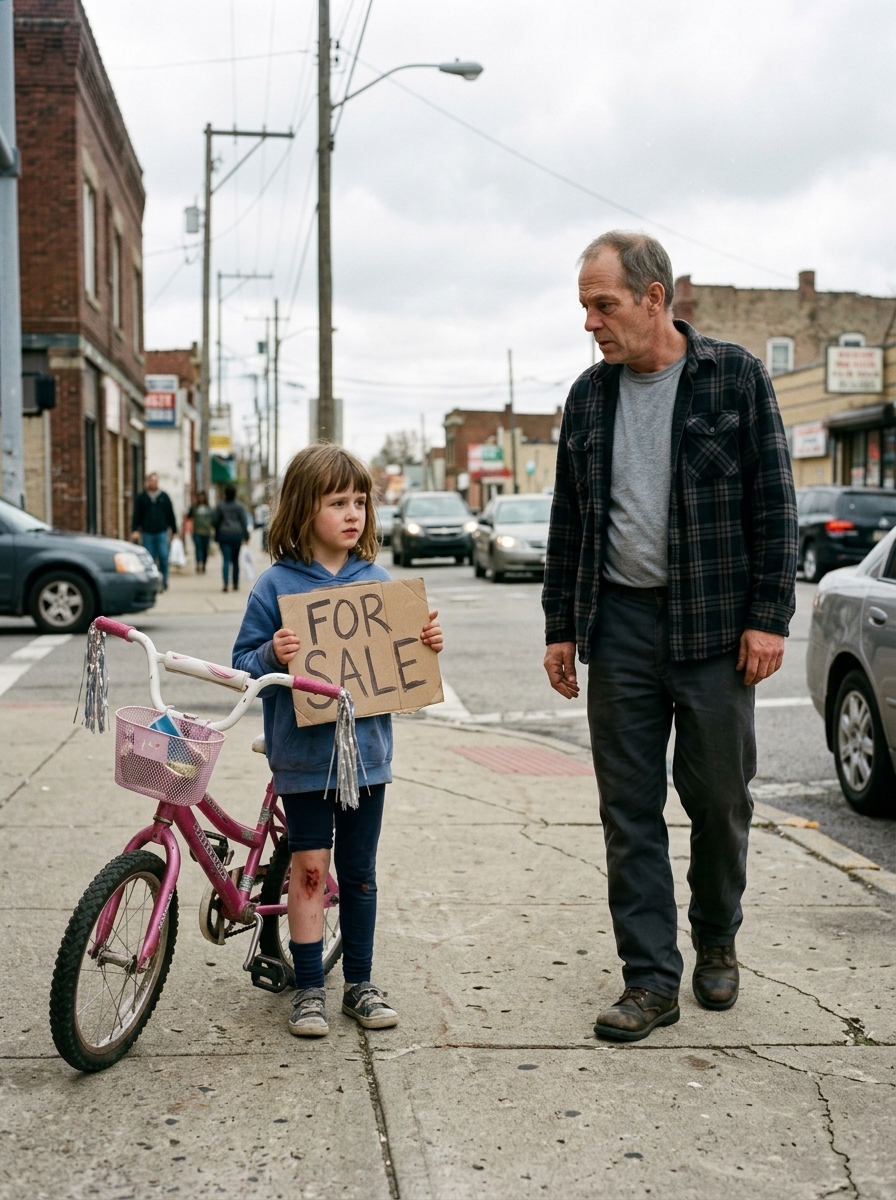
Emily Miller stood beside a scratched pink bicycle on a busy corner outside Dayton, Ohio, holding a crooked piece of cardboard against her chest.
The words were written in thick purple marker.
FOR SALE.
She was six years old.
The bicycle had white rubber grips, a little plastic basket, and silver streamers that had once hung straight from the handlebars.
Now one streamer was missing.
There was a scrape along the frame from the afternoon Emily had tried to ride without training wheels and tipped over into a hedge.
Her mother had laughed so hard that day she had to sit down on the front steps.
Emily remembered that laugh.
She had not heard it in almost two weeks.
A woman walking toward the bus stop slowed down.
“How much are you asking, honey?”
Emily looked at the bicycle, then at the woman.
“I don’t know.”
The woman frowned slightly.
“You don’t know?”
Emily shook her head.
“I just need enough for groceries.”
The woman stopped completely.
Emily lowered her voice.
“My mom thinks I’m at my friend’s apartment.”
That was not exactly true.
Her friend lived downstairs, and Emily had told her mother she was going to show her the bicycle.
She just had not said what she planned to do afterward.
The woman looked as if she wanted to ask more questions.
Before she could, her bus arrived.
She squeezed Emily’s shoulder gently.
“Don’t go anywhere with strangers, okay?”
Emily nodded.
The woman climbed aboard.
Emily stood alone again.
Cars moved through the intersection.
People walked past carrying coffee cups, work bags, grocery sacks, and phones.
A few noticed the little girl.
Most did not.
Emily kept both hands around the cardboard sign.
She had made it the night before while her mother was in the bathroom.
Sarah Miller had thought her daughter was coloring.
Instead, Emily had been sounding out two words.
FOR SALE.
She knew what those words meant because she had seen them taped to an old lamp in the downstairs hallway.
A neighbor had sold the lamp for fifteen dollars.
Fifteen dollars sounded like a fortune to Emily.
Maybe bread cost two dollars.
Maybe peanut butter cost three.
Maybe milk was four.
She did not know exactly.
She only knew her mother had opened the refrigerator the night before, stared at the almost-empty shelves, then closed the door without taking anything out.
“You’re not eating?” Emily had asked.
“I already did.”
Sarah had smiled.
Emily knew that smile.
It was the same smile her mother used when she said she was not tired even though her eyes were red.
The same smile she used when she said everything would be okay while envelopes covered half the kitchen table.
Emily had gone to bed.
An hour later, she woke up thirsty.
On the way to the kitchen, she heard her mother whispering on the phone.
“I’m not asking for much,” Sarah said. “Just a few shifts. Even evenings. I can clean, organize, wash dishes, whatever you need.”
There was a pause.
Sarah’s shoulders dropped.
“I understand.”
Another pause.
“Yes. If anything opens up, please call me.”
Emily stayed hidden in the hallway.
Sarah ended the call.
For a long time, she sat alone at the kitchen table.
Then she covered her face with both hands.
Emily had never seen her mother do that before.
That was when the bicycle became an idea.
Sarah had given it to Emily for her fifth birthday.
It had not been new.
Sarah had bought it from another mother across town, scrubbed it clean, replaced one pedal, tied new ribbons around the handlebars, and rolled it into the living room with a red bow.
Emily had screamed with happiness.
Sarah had laughed.
For months, Emily rode it everywhere she was allowed.
Around the apartment courtyard.
Down the sidewalk.
To the small neighborhood park.
She loved the tiny basket most.
She filled it with leaves, dolls, rocks, dandelions, and once an entire collection of acorns she insisted were “groceries.”
Now the real groceries were gone.
So Emily decided the bicycle could become groceries again.
She did not understand unemployment.
She did not understand rent notices.
She did not understand why the power company wanted money every month just because lights came on when you touched a switch.
She understood only one thing.
Her mother needed help.
And the bicycle was something Emily had that other people might want.
Across the street, Richard Jameson glanced at his watch.
He was already seven minutes behind schedule.
That almost never happened.
At fifty-four, Richard had built his entire adult life around minutes, numbers, deadlines, and measurable results.
His dark suit was pressed.
His shoes were polished.
His phone had been buzzing every few minutes since he left home.
A department head wanted approval on a staffing change.
His assistant needed an answer about a lunch meeting.
Someone from accounting wanted clarification on a revised facilities budget.
Richard read none of it.
He had stopped because he saw a child holding a cardboard sign.
He watched Emily for several seconds.
Something about the scene bothered him.
At first, he thought it was simply the obvious question.
Why was a six-year-old selling a bicycle alone?
Then he noticed her shoes.
One lace was knotted because the plastic tip was missing.
Her coat was slightly too large.
The bicycle beside her was clearly precious to her.
She kept touching the seat with her free hand.
Not casually.
Protectively.
As if she hoped no one would actually buy it.
Richard should have kept walking.
He had an executive meeting at nine.
Several people would be waiting for him.
Normally, that would have been enough.
That morning, it was not.
He crossed the street.
Emily looked up when his shadow reached the bicycle.
Richard kept a few feet between them.
“Is this your bike?”
Emily nodded.
“Yes.”
“You’re selling it?”
Another nod.
Richard glanced at the sign.
“How much?”
Emily looked uncertain.
“How much do groceries cost?”
Richard stared at her.
He thought he had misheard.
“I’m sorry?”
“My mom needs groceries.”
Emily’s fingers tightened around the sign.
“So I need enough for that.”
Richard felt something inside him shift.
Not dramatically.
Not all at once.
Just enough to make the world around him feel suddenly too loud.
“Where is your mother?”
“At home.”
“Does she know you’re selling this?”
Emily looked at the sidewalk.
“No.”
Richard exhaled slowly.
He took out his phone, ready to call someone for help, then stopped.
“What’s your mother’s name?”
Emily hesitated.
The woman at the bus stop had warned her about strangers.
“My mom says I shouldn’t tell strangers stuff.”
“She’s right.”
Richard put his phone away.
“You don’t have to tell me anything you don’t want to.”
Emily studied him.
Adults often forgot that children watched faces carefully.
Emily watched his.
“You really want to buy it?”
Richard looked at the little pink bicycle.
“I might.”
Emily considered this.
Then she said, “Her name is Sarah.”
Richard’s expression changed.
There were thousands of Sarahs.
That name alone should have meant nothing.
But something in Emily’s face bothered him.
A familiar shape around the eyes.
A memory he could not immediately place.
“Sarah what?”
“Miller.”
Richard did not move.
For three days after Sarah Miller’s termination meeting, her name had remained on a personnel summary sitting near the corner of his desk.
Sarah Miller.
Facilities services.
Four years and three months.
Strong attendance.
No disciplinary record.
Positive supervisor reviews.
Position eliminated during cost reduction.
Richard remembered the file because of the photograph.
A small school photo had accidentally slipped from a clear pocket in the folder when he opened it.
A little girl with brown hair.
Missing one front tooth.
Bright smile.
Pink shirt.
Richard had handed the picture back to the human resources manager.
“Make sure this gets returned to her.”
Then he moved to the next name.
There had been eleven names that afternoon.
Eleven lines on a spreadsheet.
Eleven payroll reductions.
Eleven numbers that helped close a budget gap.
Richard had not asked whether Sarah had another income in the household.
He had not asked whether she had children.
He had not asked whether the facility team had another position available.
Those were not questions he usually handled personally.
He made the larger decision.
Other people managed the details.
At least that was what he had told himself.
Now one of those details was standing on the sidewalk.
“How old are you, Emily?”
“Six.”
That confirmed it.
Richard felt his stomach tighten.
“Does your mom work?”
“She did.”
Emily looked down again.
“But they told her not to come anymore.”
Richard swallowed.
“What did she do?”
“She cleaned offices.”
That was enough.
He knew.
This little girl was Sarah Miller’s daughter.
The child from the photograph.
The child whose mother Richard had dismissed in less than seven minutes.
The child now trying to sell her birthday bicycle for food.
Richard had spent his career believing that difficult decisions became easier if you kept emotion separate from numbers.
Numbers were clean.
Numbers did not cry.
Numbers did not ask questions.
Numbers did not stand beside scratched pink bicycles.
He crouched slightly so he was not towering over Emily.
“I knew your mom from work.”
Emily’s eyes widened.
“You did?”
“Yes.”
“Were you her friend?”
Richard could not answer immediately.
“No,” he finally said. “Not really.”
Emily seemed disappointed.
“She needs a friend.”
Richard glanced away.
That simple sentence landed harder than the accusation he probably deserved.
“Emily, I don’t think you should sell your bicycle.”
“But Mommy needs food.”
“I understand.”
“No, you don’t.”
She said it without anger.
That made it worse.
“You have shiny shoes.”
Richard looked down.
Emily continued.
“My mom said people who have office shoes have jobs.”
Despite everything, Richard almost smiled.
“Your mom isn’t wrong.”
Emily looked at his suit.
“You probably have lots of groceries.”
Richard nodded once.
“Yes.”
“Then you don’t understand.”
Richard had spent years in meetings where people challenged him with polished arguments and detailed reports.
No one had ever left him as speechless as a six-year-old girl.
After a moment, he said, “You’re right.”
Emily blinked.
Adults rarely admitted that so quickly.
Richard pointed toward the bicycle.
“I won’t buy it.”
Her face fell.
“But I’d like to talk to your mom.”
Emily immediately pulled the bicycle closer.
“You said you might buy it.”
“I know.”
“You changed your mind?”
“About the bicycle, yes.”
Emily’s eyes filled.
Richard raised his hands slightly.
“I still want to help with the groceries.”
That made her suspicious again.
“Why?”
Because I fired your mother.
He could have said it.
He did not.
Not there.
Not to a six-year-old.
“Because I think your mom and I need to talk.”
Emily thought about it for a long time.
Finally she said, “She might be mad.”
Richard nodded.
“She has every right to be.”
Sarah Miller was sorting coins on the kitchen table when someone knocked.
She had eleven dollars and eighty-three cents.
That was everything she could find between her purse, a kitchen drawer, two coat pockets, and the jar where she normally kept quarters for laundry.
The rent was already late.
A shutoff notice for the electric bill was folded beneath an unopened envelope.
Her phone had become a source of dread.
Every unknown number might be a job.
Every unknown number might also be another reminder of money she did not have.
She had filled out fourteen applications in ten days.
Two businesses had called back.
One wanted someone available overnight.
Sarah had no one to stay with Emily.
The other offered three hours a week.
She had accepted.
Three hours was three hours.
The knock came again.
“Emily?” Sarah called.
No answer.
She stood quickly.
Emily was supposed to be downstairs.
Sarah opened the door.
Her daughter stood in the hallway.
The pink bicycle was beside her.
And behind the bicycle stood Richard Jameson.
Sarah forgot how to breathe.
For one strange second, she thought she must have misunderstood what she was seeing.
The man who had ended her job was standing outside her apartment.
Richard looked exactly as he had in the office.
Controlled.
Neat.
Expensive coat.
Serious face.
But something in his eyes was different.
“Ms. Miller.”
Sarah immediately straightened.
Then she hated herself for doing it.
She was no longer his employee.
She did not need to stand straighter because Richard Jameson was in front of her.
“What are you doing here?”
Before Richard answered, Emily smiled.
“Mommy, he knows you.”
Sarah looked at her daughter.
Then she saw the cardboard sign.
Her eyes moved from the sign to the bicycle.
Then back to Emily.
“What is that?”
Emily’s smile weakened.
“My sign.”
Sarah picked it up.
FOR SALE.
The words tilted across the cardboard.
Sarah’s face changed.
“Emily.”
The little girl looked suddenly unsure.
“I was helping.”
“Helping with what?”
“The groceries.”
Sarah stared at her.
Emily pointed to the bicycle.
“I was selling it.”
The hallway became very quiet.
Richard looked away.
Sarah’s lips parted, but nothing came out.
Emily hurried to explain.
“You said we needed money.”
“Oh, baby.”
“You said there wasn’t enough.”
Sarah dropped to her knees and pulled Emily into her arms.
“You were never supposed to worry about that.”
“But you worry.”
Sarah closed her eyes.
Emily pressed her face into her mother’s shoulder.
“You didn’t eat dinner.”
“I wasn’t hungry.”
“Yes, you were.”
Sarah’s hands began trembling.
She held her daughter tighter.
“I’m sorry.”
Emily whispered, “I don’t need the bike.”
Sarah leaned back and looked directly at her.
“Yes, you do.”
“No, I don’t.”
“You love that bicycle.”
“I love you more.”
Sarah covered her mouth.
Richard turned his head toward the hallway window.
He felt as if he had walked into a private moment he had no right to witness.
But he also knew he had helped create it.
Not intentionally.
That no longer felt like a meaningful defense.
Sarah finally stood.
She wiped under her eyes and looked at Richard.
Her embarrassment hardened into something else.
“What did you say to her?”
“Almost nothing.”
“Why is she with you?”
“I saw her at the corner.”
Sarah’s face went pale.
“What corner?”
“Near Jefferson and Maple.”
Sarah looked at Emily in alarm.
“You crossed Maple by yourself?”
“I used the light.”
“Emily.”
“I looked both ways.”
Sarah pressed one hand against her forehead.
Her fear came out as a shaky breath.
“You cannot do that again.”
“I’m sorry.”
Richard spoke quietly.
“She was careful. I stayed with her after I realized she was alone.”
Sarah looked at him sharply.
“You realized she was alone?”
“Yes.”
“And then you brought her home?”
“She brought me.”
Sarah gave a short, humorless laugh.
“Of course.”
Richard understood the message.
He was not being welcomed.
He deserved that.
“I should explain why I’m here.”
Sarah crossed her arms.
“You fired me twelve days ago. I remember why you were in my life.”
Emily looked between them.
“You fired Mommy?”
Richard’s face tightened.
Sarah immediately crouched beside her daughter.
“It means his company didn’t have my job anymore.”
Emily looked at Richard.
“You told her not to come?”
Richard could have hidden behind corporate language.
Position elimination.
Budget restructuring.
Operational reduction.
Instead he said, “Yes.”
Emily’s brow furrowed.
“Why?”
Richard felt Sarah watching him.
“Because I made a decision I thought was right for the company.”
“Was it?”
That question came from Sarah.
Not Emily.
Richard looked at her.
“I’m not sure anymore.”
Sarah’s jaw tightened.
“You weren’t unsure in your office.”
“No.”
“You barely looked at me.”
Richard said nothing.
“You had my folder open.”
“I remember.”
“You said the company had to reduce costs.”
“Yes.”
“I told you I would take fewer hours.”
“I remember.”
“I told you I could cover evenings.”
“Yes.”
“I told you I had a daughter.”
Richard lowered his gaze.
“I remember that too.”
Sarah laughed again, softly.
“That’s surprising.”
Emily tugged at Sarah’s sleeve.
“Mommy.”
Sarah looked down.
“I’m sorry, sweetheart.”
Richard took a breath.
“May I come in for five minutes?”
Sarah looked toward the apartment.
The living room was small.
A blanket covered a worn spot on the couch.
Laundry was folded in one basket.
Three job applications sat beside the old laptop on the table.
The refrigerator hummed softly from the kitchen.
Sarah knew exactly what Richard would see.
For several seconds, pride told her to say no.
Then Emily said, “He said he might help with groceries.”
Sarah closed her eyes briefly.
“Emily.”
Richard shook his head.
“She didn’t ask me.”
Sarah looked at him.
“She didn’t have to.”
“No.”
He paused.
“You’re right.”
Sarah stepped aside.
“Five minutes.”
Richard entered.
He had spent the previous week in polished conference rooms, private offices, and a downtown restaurant where the water glasses were refilled before anyone noticed they were empty.
Sarah’s apartment had none of that.
But what struck him most was not what was missing.
It was what had been carefully maintained.
Emily’s school papers were arranged on the refrigerator with cheap magnets.
The couch had been patched neatly.
A jar of pencils sat on the table beside a stack of library books.
A child’s jacket hung from a hook near the door.
Everything looked cared for.
Even scarcity had been organized.
Sarah pointed toward a chair.
Richard remained standing.
“I won’t stay long.”
“That would be best.”
Emily rolled the bicycle against the wall.
Sarah noticed her doing it.
The sight made her eyes fill again.
She turned away.
Richard reached inside his coat and took out his wallet.
Sarah immediately shook her head.
“No.”
“I haven’t offered anything.”
“You were about to.”
“I was.”
“I don’t want cash.”
“Sarah—”
“No.”
Her voice was low but firm.
“I spent four years cleaning your building.”
Richard stopped.
“I worked when I had a fever because I needed the hours.”
He did not interrupt.
“I stayed late when people left food all over conference tables because someone had to make those rooms usable the next morning.”
Sarah’s voice began shaking.
“I cleaned coffee out of carpet. I scrubbed break rooms. I emptied trash cans filled with reports about record quarters and expansion plans.”
Richard looked at her.
Sarah continued.
“I never asked your company for charity.”
“I know.”
“No, you don’t.”
Emily sat quietly on the couch.
Sarah lowered her voice.
“I asked to work.”
Richard nodded.
“You did.”
“And you told me my position was gone.”
“Yes.”
“So please don’t stand in my kitchen and solve that decision with money from your wallet.”
Richard slowly put the wallet away.
“That’s fair.”
Sarah had expected resistance.
His agreement unsettled her.
Richard looked toward the applications on the table.
“Have you found anything?”
“A few hours next week.”
“Doing what?”
“Cleaning a small medical office after closing.”
He nodded.
“Anything else?”
“I have applications out.”
“References?”
“My supervisor said she would give me one.”
Richard glanced at her.
“Who was your supervisor?”
“Donna Pierce.”
Richard knew the name.
Facilities coordinator.
Twenty-two years with the company.
Reliable.
Blunt.
He remembered seeing several notes from her during the restructuring.
He had not read all of them personally.
“Donna recommended we keep you.”
Sarah’s expression changed.
“How do you know?”
Richard paused.
He did not know.
Not for certain.
But suddenly he remembered something from the stack of documents.
A yellow note clipped to the facilities list.
Please reconsider Miller. Covers three floors. Trains new hires. Never misses.
Richard had seen it.
He had moved it aside.
“I saw a note.”
Sarah stared at him.
“She told me she wrote one.”
Richard felt heat climb his neck.
“She did.”
“And?”
“And I didn’t give it the attention I should have.”
Sarah looked away.
“Of course.”
Richard pulled out his phone.
“May I check something?”
Sarah shrugged.
“You’re going to anyway.”
He opened his email.
There were more than sixty unread messages from the previous two days.
He searched Sarah’s last name.
Seven results appeared.
One was an older message from Donna.
Another was a facilities report.
Richard opened the report.
He read silently.
Then he scrolled.
His face changed.
Sarah noticed.
“What?”
Richard looked up.
“You were doing lead duties.”
Sarah said nothing.
“Scheduling supply closets. Training new staff. Checking evening work.”
“Yes.”
“That wasn’t in your title.”
“No.”
“Were you being paid extra?”
“No.”
Richard stared at the report again.
Sarah folded her arms.
“Does that surprise you?”
“Yes.”
“It shouldn’t.”
Richard looked at another page.
There was more.
Donna had recommended Sarah for a lead maintenance position six months earlier.
The request had stalled during a hiring freeze.
It had never reached Richard’s desk directly.
Then the restructuring began.
The facilities group had been told to reduce payroll by a fixed percentage.
Three full-time workers and several part-time positions had been cut.
Sarah was one of them.
Richard had approved the list.
The spreadsheet had shown annual salary.
Benefits cost.
Length of service.
Nothing about who trained employees.
Nothing about who covered missed shifts.
Nothing about who knew which old floor machine jammed unless the handle was lifted before starting.
Nothing about who knew that the fourth-floor conference room lock stuck in humid weather.
Nothing about who quietly did lead work without a lead title.
Richard looked at Sarah.
“I made this decision using incomplete information.”
Sarah’s laugh was tired.
“You had four years of information.”
Richard nodded.
“Yes.”
“Then don’t call it incomplete.”
He accepted that.
“I didn’t look deeply enough.”
“No.”
“I should have.”
“Yes.”
Emily slid off the couch.
“Can I have cereal?”
Sarah’s face softened instantly.
“Sure, baby.”
Emily walked into the kitchen.
A moment later, she returned.
“There’s no cereal.”
Sarah froze.
Richard looked toward the kitchen.
Emily added helpfully, “There’s oatmeal.”
Sarah stood quickly.
“I’ll make oatmeal.”
“It’s okay.”
“No. You need breakfast.”
Emily looked at Richard.
“Do you like oatmeal?”
“I do.”
“We only have one packet.”
Sarah closed her eyes.
“Emily.”
“What?”
“Go wash your hands for me.”
Emily left.
Sarah waited until the bathroom door closed.
Then she turned to Richard.
“Now you’ve seen it.”
Richard did not pretend not to understand.
“Yes.”
“Congratulations.”
“Sarah.”
“This is what your spreadsheet looks like.”
He had no answer.
Sarah leaned against the counter.
“The first week, I thought I could fix it fast.”
Her voice became quieter.
“I thought I’d have another job in a few days. I have experience. Good references. I’m reliable.”
Richard listened.
“Then every place wanted different hours.”
She looked toward the bathroom.
“I can work when Emily is in school. I can work evenings if I find someone to watch her. I can work weekends sometimes.”
Sarah shook her head.
“But every problem needs another problem solved first.”
Richard knew this was not something a check could magically repair.
Childcare.
Transportation.
Scheduling.
Stable hours.
Benefits.
A job close enough to reach when Sarah’s old sedan decided not to start.
He had never had to fit employment around those things.
For him, work had always demanded time.
For Sarah, work demanded a structure around an entire life.
The bathroom door opened.
Emily returned.
“My hands smell like lemons.”
Sarah smiled despite herself.
“Good.”
Richard checked the time.
He was now thirty-four minutes late.
His phone had eleven new notifications.
For once, none felt urgent.
“Sarah, I want to offer you your job back.”
Sarah stared at him.
Emily smiled.
“See?”
Sarah did not.
“No.”
Richard had expected hesitation.
He had not expected an immediate refusal.
“No?”
“No.”
“Why?”
“Because yesterday you thought my job was unnecessary.”
“I was wrong.”
“You figured that out in my kitchen?”
Richard met her eyes.
“In part.”
“That doesn’t make me feel better.”
“It shouldn’t.”
Sarah shook her head.
“I cannot go back and wonder if one bad quarter means I’m standing in your office again.”
“That’s fair.”
“And I’m not going back because you feel guilty.”
“That’s also fair.”
Richard thought for a moment.
“Then don’t come back under the same arrangement.”
Sarah narrowed her eyes.
“What does that mean?”
“The lead maintenance role Donna recommended.”
Sarah went still.
Richard continued.
“It should have been reviewed months ago.”
“You don’t even know if I’m qualified.”
“I’m looking at the reports.”
“That’s not the same as knowing.”
“No.”
Richard put his phone on the table.
“So tell me.”
Sarah looked almost offended.
“Tell you what?”
“What you actually did.”
Sarah hesitated.
Richard pulled out the chair.
“I have a meeting waiting for me.”
“Then go.”
“They can wait.”
Sarah stared at him.
“I’m serious.”
Richard sat.
“What did you actually do?”
For the first time since he entered the apartment, Sarah looked uncertain.
Then something shifted.
She had spent four years making her work invisible.
That was the nature of cleaning.
If it was done properly, most people never thought about the person who had done it.
Now Richard was asking her to explain.
So she did.
“I trained five new workers.”
Richard nodded.
“I kept track of supplies on floors three through six because we kept running out of basics.”
“Was that your supervisor’s responsibility?”
“Technically.”
“But you did it?”
“Donna had the whole building.”
Richard listened.
“I made a checklist for conference rooms because we kept getting complaints that evening teams missed things.”
“Did complaints decrease?”
“Yes.”
“How much?”
“I don’t know. Ask Donna.”
Richard made a note.
Sarah frowned.
“You’re taking notes?”
“Yes.”
“Why?”
“Because I should have the first time.”
That silenced her.
She continued.
“I rearranged the supply closet so people stopped opening new boxes before old ones were empty.”
Richard looked up.
“That saved money?”
“A little.”
“How much?”
“I don’t know.”
“What else?”
Sarah slowly sat across from him.
For the next twenty minutes, she described a job Richard had never really known existed.
Not the job title.
The job itself.
She knew which floors needed extra attention after large meetings.
She knew which employees worked quickly but needed clear lists.
She knew which cleaning supplies were being ordered too often because people could not find unopened stock.
She knew the storage rooms.
The equipment.
The night schedule.
The people.
She had been solving small problems before they became expensive problems.
Richard wrote everything down.
Emily ate the last oatmeal packet while watching them.
Finally, Sarah stopped.
“That’s it.”
Richard looked at his notes.
“No.”
Sarah frowned.
“No?”
“That’s not a cleaner’s job description.”
“I was still a cleaner.”
“You were doing operations work.”
Sarah gave him a tired smile.
“Funny how jobs get more important after somebody stops paying you to do them.”
Richard deserved that too.
His phone rang.
He looked at the screen.
His chief operating officer.
Richard silenced it.
Sarah noticed.
“You should answer.”
“No.”
“This is ridiculous.”
“No, it isn’t.”
“You have a company to run.”
Richard looked around the apartment.
“Yes.”
The meaning was clear.
This was part of running it too.
Richard stood.
“I’m going back to the office.”
Sarah’s expression closed again.
“I thought so.”
“I need to verify several things before I say anything else.”
“Such as?”
“Your work record. Donna’s recommendation. The current facilities structure.”
Sarah shook her head.
“I’m not begging for a job again.”
“I’m not asking you to.”
“Then what are you asking?”
“Nothing yet.”
He picked up his coat.
“I’m asking you not to sell the bicycle.”
Emily smiled.
Sarah looked at her daughter.
“The bicycle was never being sold.”
Emily whispered, “But—”
“No.”
Sarah knelt in front of her.
“That bike is yours.”
“But groceries—”
“I’ll figure out groceries.”
Richard looked at Sarah.
She knew what he was thinking.
“Don’t.”
He stopped.
“No envelope.”
He nodded.
“No envelope.”
“No pity.”
“No pity.”
Sarah stood.
Richard moved toward the door.
Then Emily called after him.
“Mr. Office Shoes?”
Richard turned.
Sarah covered her eyes.
Emily pointed at him.
“You still made Mommy sad.”
Richard looked at the little girl.
“Yes.”
“Are you going to fix it?”
Richard considered the question carefully.
“I’m going to try to fix what I can.”
Emily accepted this.
“Okay.”
Richard walked out carrying a piece of cardboard.
Emily had handed him the FOR SALE sign at the last second.
“I don’t need it now,” she had said.
He folded it once and put it inside his coat.
Richard arrived at the office forty-seven minutes late.
No one in the conference room mentioned it.
They had worked with him long enough to understand that Richard Jameson did not arrive forty-seven minutes late.
His operations chief, Mark Ellis, closed the document in front of him.
“Everything okay?”
Richard remained standing.
“Cancel this meeting.”
People exchanged glances.
Mark frowned.
“We have the quarterly facilities review.”
“I know.”
Richard placed his notebook on the table.
“That’s exactly why I’m canceling it.”
Nobody moved.
Richard looked at the department heads.
“I approved staffing reductions two weeks ago.”
“Yes,” Mark said cautiously.
“I want the underlying evaluations.”
Mark glanced toward the finance director.
“We sent the summaries.”
“I don’t want summaries.”
Richard’s voice remained calm.
“I want supervisor recommendations, performance notes, role descriptions, overtime coverage, internal promotion requests, and any correspondence attached to the affected positions.”
The finance director leaned forward.
“That’s a lot of material.”
“Yes.”
“Is there a problem?”
Richard thought about Emily’s bicycle.
“There may be several.”
Within an hour, Richard was sitting in his office with Donna Pierce.
Donna was sixty-one and had no interest in executive ceremony.
She entered carrying a thick folder and closed the door behind her.
“You finally read my email?”
Richard deserved that too.
“Some of it.”
Donna sat.
“You should read all of it.”
“I intend to.”
She studied his face.
“What happened?”
Richard did not mention Sarah’s apartment.
He did not mention the empty cereal box.
He did not believe Sarah’s private hardship belonged in workplace gossip.
Instead he said, “I saw Sarah Miller this morning.”
Donna’s expression sharpened.
“How is she?”
“Looking for work.”
Donna leaned back.
“I told you not to cut her.”
“I know.”
“No, you know now.”
Richard nodded.
“You’re right.”
Donna stared at him.
That was not the response she expected.
She opened the folder.
“Sarah was already doing half a lead’s workload.”
“I know that now.”
“She trained people.”
“I know.”
“She reduced supply waste.”
“I know.”
“She covered when Kevin was out for six weeks.”
“I didn’t know that.”
Donna tapped the folder.
“You would have if someone had read page seventeen.”
Richard accepted the point.
“What happened to the lead promotion?”
Donna sighed.
“Frozen.”
“By whom?”
“Budget control.”
“Before it reached me?”
“Yes.”
“Why wasn’t it reconsidered?”
“We were told there would be no title changes during the freeze.”
Richard looked at the folder.
“Then we eliminated her position.”
“Yes.”
“Which means we removed someone doing higher-level work because she was officially classified lower.”
Donna nodded.
“That’s what I tried to tell everyone.”
Richard stood and walked toward the window.
“How has the building been since the cuts?”
Donna laughed once.
“You want the polite answer?”
“No.”
“We’re spending overtime.”
Richard turned.
“How much?”
“Enough to make the savings look less impressive.”
His jaw tightened.
“Why?”
“Because three people are covering work that used to be done by five.”
Donna opened another document.
“Your spreadsheet cut payroll. It didn’t cut bathrooms, conference rooms, break areas, offices, deliveries, spills, supply inventory, or evening events.”
Richard returned to the table.
“How much overtime?”
Donna showed him.
Richard stared at the number.
It was not catastrophic.
But it was large enough to matter.
More importantly, it was growing.
“We saved money on paper.”
Donna nodded.
“For about five minutes.”
Richard leaned back.
This was not fraud.
No one had lied.
No one had broken rules.
Every number in the restructuring summary had been technically correct.
That was almost worse.
The mistake had been created by people doing exactly what they had been asked to do.
Cut a percentage.
Find positions.
Hit the number.
Do it quickly.
The system had rewarded speed and punished context.
Richard had built part of that system.
At noon, he called Mark Ellis into his office.
Mark sat across from him.
“I’ve reviewed the facilities reductions.”
Mark nodded cautiously.
“And?”
“We’re reopening the staffing model.”
Mark’s eyebrows rose.
“Because of one employee?”
“Because the model was weak.”
“Richard, every department could make that argument.”
“Then every department should support its decisions better.”
Mark leaned back.
“This is going to create a mess.”
“Maybe.”
“We’ve already told people their jobs are gone.”
“I know.”
“We can’t reverse every difficult decision because it feels bad afterward.”
Richard looked at him.
“I agree.”
Mark relaxed slightly.
Richard continued.
“But we also don’t defend a bad decision simply because reversing it is uncomfortable.”
Mark’s expression hardened.
“What exactly are you proposing?”
“A review.”
“That sounds simple when you say it.”
“It isn’t.”
“People will ask whether leadership knows what it’s doing.”
Richard looked at the cardboard sign lying near his notebook.
“They should ask.”
Mark followed his gaze.
“What’s that?”
Richard unfolded the sign.
FOR SALE.
Mark frowned.
Richard did not tell him whose handwriting it was.
He simply said, “A reminder.”
That afternoon, Sarah received a call from Donna.
“I’m not supposed to tell you this yet.”
Sarah sat straighter.
“That sentence has never led anywhere good.”
Donna laughed.
“Richard is reviewing the cuts.”
Sarah went quiet.
“All of them?”
“At least facilities. Maybe more.”
Sarah looked toward Emily, who was coloring at the coffee table.
“Why?”
Donna paused.
“He met you, didn’t he?”
“Yes.”
“That’s why.”
Sarah did not know how to feel about that.
She did not want her life becoming an executive lesson.
She did not want pity changing company policy.
But another part of her remembered every coworker whose face had looked empty when their names were called.
“Donna.”
“Yeah?”
“If they offer me something, I need it to be because I earned it.”
“I know.”
“I mean it.”
“So do I.”
Sarah looked at the unpaid bills.
“Tell them everything.”
Donna’s voice softened.
“Oh, I plan to.”
Two days later, Sarah received an email.
It was not a job offer.
It was an invitation.
Richard wanted her to meet with Donna and the operations director regarding a newly approved facilities lead position.
Sarah read the message four times.
She did not answer immediately.
Pride told her not to go.
Fear told her she could not afford not to.
Common sense finally won.
She went.
Sarah wore the same black pants she had worn to work for years.
Her blouse had been ironed twice.
She dropped Emily at school and arrived ten minutes early.
Walking into the building felt strange.
The lobby looked exactly the same.
People hurried past.
The floors shined.
The front desk worker smiled at her, then did a double take.
“Sarah?”
“Hi.”
“I thought—”
“I’m here for a meeting.”
The woman smiled.
“Good.”
That single word nearly made Sarah cry.
She rode the elevator to the seventh floor.
Richard was already in the conference room.
Donna sat beside him.
Mark Ellis sat across the table.
There was a folder in front of an empty chair.
Sarah remained standing.
Richard gestured toward it.
“Thank you for coming.”
“I almost didn’t.”
“I understand.”
She sat.
Mark introduced himself.
Sarah had seen him before but had never spoken to him.
He explained that the company had completed an internal review of facilities operations.
The review found that the previous staffing reduction underestimated the actual responsibilities performed by several employees.
Sarah listened without expression.
Then Mark opened the folder.
“We’re restoring two positions.”
Sarah blinked.
“Two?”
“Yours and another evening position.”
Donna nodded.
Sarah looked at her.
Donna smiled slightly.
Mark continued.
“In your case, we’re not restoring the same role.”
Sarah’s stomach tightened.
Richard spoke.
“We approved the lead position Donna requested six months ago.”
Sarah looked at him.
“This is permanent?”
“As permanent as any normal full-time position can reasonably be.”
“Same risk of disappearing next month?”
Richard did not dodge the question.
“No one can promise that a business never changes.”
Sarah appreciated that more than a dramatic guarantee.
“But the position is part of the approved operating structure,” he continued. “It has defined responsibilities, a written job description, and a compensation range consistent with those responsibilities.”
Mark slid the document toward her.
Sarah read the salary twice.
It was more than she had made before.
Not wildly more.
Enough to matter.
Enough that groceries would stop being a calculation she performed in every aisle.
There were predictable daytime hours.
Health benefits.
Paid time off.
A small transportation allowance because the role involved occasional movement between buildings.
Sarah looked up.
“Why?”
Richard answered.
“Because this is what the job was worth before I met Emily.”
Sarah watched his face carefully.
“You expect me to believe that?”
“No.”
Richard pushed another folder toward her.
“These are Donna’s original recommendation, your performance reviews, supply savings reports, training records, and the revised operations analysis.”
Sarah opened it.
There were pages.
Lots of them.
Her work.
Documented.
Measured.
Seen.
Richard said, “You don’t have to trust my motive. Read the paperwork.”
Sarah did.
For almost ten minutes, no one spoke.
At the bottom of one page, Donna had written months earlier:
Sarah Miller has already been performing many lead functions without title recognition. Formalizing the role would improve consistency, accountability, and retention.
Sarah read the sentence again.
Her eyes burned.
She closed the folder.
“Why didn’t this happen before?”
Richard answered quietly.
“Because our system made it easy to ignore.”
“And you?”
“I let the system make decisions too quickly.”
Sarah looked at Mark.
He shifted in his chair.
Richard continued.
“That doesn’t make every decision wrong. But this one was.”
Sarah touched the edge of the folder.
“If I say yes, I’m not your charity project.”
“You won’t be.”
“I don’t want people knowing about Emily selling her bicycle.”
“They won’t hear it from me.”
“I mean it.”
“So do I.”
“And I report to Donna?”
Donna smiled.
“Unfortunately for you.”
Sarah almost laughed.
Almost.
“When would I start?”
Donna answered.
“Monday.”
Sarah looked down at the offer again.
Then she thought about the refrigerator.
The rent.
The electric bill.
The bicycle.
The way Emily had said, I love you more.
Sarah signed.
She did not hug Richard.
She did not call him a hero.
She did not tell him he had changed her life.
She signed because the job was fair.
That mattered more.
On Monday morning, Emily rode her pink bicycle in the apartment courtyard before school.
Sarah stood nearby with coffee.
“Helmet.”
Emily groaned.
“I have it.”
“Buckle.”
“I know.”
“Emily.”
The little girl buckled it.
Sarah smiled.
“Thank you.”
Emily pushed off.
Her silver streamer fluttered behind her.
Sarah watched her circle the courtyard.
For the first time in weeks, the sound of the bicycle did not make her chest hurt.
That evening, Sarah came home carrying two grocery bags.
Emily ran to the kitchen.
“You got strawberries!”
“I did.”
“And cereal!”
“Yes.”
“The good kind?”
Sarah laughed.
“The kind you like.”
Emily looked into the second bag.
“Mac and cheese!”
Sarah leaned against the counter.
It was such an ordinary moment.
That was what made it feel enormous.
She had never wanted luxury.
She wanted ordinary.
A refrigerator with choices.
A bill paid before the warning letter.
A school field trip fee that did not require moving money from somewhere else.
A daughter who could keep being six.
Over the next several weeks, Sarah settled into the lead role.
She discovered something surprising.
She was good at managing people.
Not because she enjoyed telling anyone what to do.
She did not.
She was good because she knew the job.
When an evening worker complained that a schedule was unrealistic, Sarah checked it herself.
When supplies ran low, she fixed the ordering system instead of blaming employees.
When a new cleaner moved slowly, Sarah worked beside him for half an hour and showed him a better sequence.
Donna watched all of it.
One afternoon she said, “You know what your problem is?”
Sarah looked up from a supply sheet.
“I’m sure you’re about to tell me.”
“You should’ve been running half this department two years ago.”
Sarah smiled.
“Maybe start with one hallway.”
Richard did not hover.
Sarah appreciated that.
He stopped by the facilities office once during her first week.
“How’s it going?”
“Busy.”
“Anything you need?”
“Three replacement vacuum belts.”
Richard blinked.
“That’s all?”
“For today.”
He nodded seriously.
“I’ll alert the board.”
Sarah stared at him.
Then she laughed.
It was the first time she had laughed around him.
Richard smiled too.
Their relationship remained careful.
He was still the chief executive.
Sarah was still an employee.
Neither pretended the past had disappeared.
But Richard started asking different questions in meetings.
When a manager proposed eliminating positions, Richard asked what the employees actually did.
Not their titles.
Their work.
He asked which responsibilities would remain after the people were gone.
He asked about overtime.
Training.
Hidden duties.
Coverage.
He asked whether anyone on the list had been recommended for promotion.
At first, executives found the questions frustrating.
They made decisions slower.
That was the point.
Three months after Emily tried to sell the bicycle, Richard created a small internal emergency-support program.
He did not name it after Emily.
He did not turn the story into advertising.
Employees facing sudden short-term hardship could apply confidentially for temporary help with transportation, childcare gaps, or groceries.
The program was funded privately by senior leadership contributions and administered without public recognition.
Sarah heard about it through Donna.
“Was that him?”
Donna asked.
“You mean Richard?”
“Who else?”
Sarah thought about it.
“Good.”
Donna looked surprised.
“That’s all?”
“What do you want me to do, bake him a cake?”
“No.”
“Then good.”
Sarah went back to work.
Richard made another change.
Every eliminated position now required a written operational review from the direct supervisor.
Not because layoffs could never happen.
They could.
Businesses changed.
Budgets changed.
Work changed.
But Richard no longer accepted a spreadsheet as the full story of a person’s job.
Some people inside the company called the new process slower.
Richard agreed.
Slower was sometimes cheaper than careless.
Several months passed.
Sarah’s life did not transform into perfection.
Her old car still made a strange noise.
The apartment sink still leaked if the faucet was turned too far.
Emily still forgot to put her shoes away.
Sarah still worried about money.
But worry was no longer sitting beside her at every meal.
The rent was current.
The lights stayed on.
There was food in the refrigerator.
Sarah even started putting twenty dollars from each paycheck into a small emergency envelope.
She called it boring money.
Emily called it the “never sell my bike fund.”
Sarah laughed every time.
One Friday afternoon, Richard was leaving the office when he saw Sarah near the entrance.
Emily was with her.
She had a school backpack on and held Sarah’s hand.
The bicycle was nowhere in sight.
Richard stopped.
“Hi, Emily.”
Emily looked at his shoes.
“They’re still shiny.”
Sarah sighed.
“Emily.”
Richard smiled.
“They are.”
Emily looked up at him.
“Mom says you ask more questions now.”
Richard glanced at Sarah.
“She said that?”
Sarah looked embarrassed.
“Not exactly.”
Emily continued.
“She said people at work have to explain stuff better because of you.”
Richard nodded.
“That’s true.”
“Good.”
Then Emily hugged him.
It happened so quickly he did not react at first.
Her arms went around his waist for about two seconds.
Then she stepped back.
Richard looked startled.
Sarah did too.
Emily shrugged.
“You fixed some of it.”
Richard swallowed.
“Some of it.”
Sarah watched his face.
Then she said quietly, “That’s enough for today.”
Richard nodded.
Months later, the company held its annual employee meeting.
Usually, it was predictable.
Numbers.
Goals.
Department updates.
A short speech from Richard.
Lunch.
Everyone returned to work.
That year, Richard changed the format.
Instead of opening with revenue charts, he spoke about decisions.
Not one decision.
Decisions in general.
He talked about how companies were built from procedures because procedures created consistency.
Then he said procedures could also hide people.
He did not mention Sarah’s apartment.
He did not mention hunger.
He did not mention Emily.
He did not tell a dramatic story about himself becoming a better man.
He simply said leadership had made a staffing decision earlier that year that was based on incomplete operational understanding.
“We corrected it,” he told the room. “But correction does not erase the original mistake.”
Sarah sat near Donna.
Her stomach tightened.
Richard continued.
“The lesson was not that difficult decisions should never be made. The lesson was that difficult decisions deserve more attention, not less.”
The room was silent.
“We are responsible for understanding the work behind the numbers.”
Then Richard stepped away from the microphone.
Sarah had been invited to speak next.
She had said no twice.
Donna convinced her the third time.
“You spend all day telling people to take pride in their work,” Donna had said. “Take your own advice.”
Sarah walked onto the stage holding three pages.
She never looked at them.
“My name is Sarah Miller.”
Her voice sounded too loud through the speakers.
“I’ve worked here a little over four years, if we ignore one very strange two-week break.”
Laughter moved through the room.
Even Richard smiled.
“I started as part of the cleaning crew.”
Sarah looked across the audience.
“I thought good work meant nobody noticed you.”
A few facilities employees nodded.
“When a room is clean, people walk in and think about the meeting. They don’t think about who emptied the trash.”
She paused.
“When the restroom has soap, people use it. They don’t think about who checked the dispenser.”
Another pause.
“When supplies are stocked, when floors are clean, when chairs are back where they belong, when the building is ready in the morning, our best days are the days nobody talks about us.”
Several people smiled.
“I used to think being invisible meant I was doing my job right.”
Sarah looked toward Donna.
“Then I learned that invisible work can also become undervalued work.”
The room grew quiet.
“I’m not standing here because someone rescued me.”
Richard looked down.
Sarah continued.
“I’m standing here because my work was finally documented accurately.”
That distinction mattered to her.
“A mistake was made. Then people looked at the records again. They asked questions. They corrected the job structure.”
Sarah rested one hand on the podium.
“I think kindness matters.”
She paused.
“But respect matters too.”
People listened closely.
“Kindness can buy someone lunch.”
She smiled slightly.
“Respect asks why the person working beside you cannot afford lunch after years of doing a necessary job.”
The room was completely silent now.
Sarah took a breath.
“I don’t need anyone to feel sorry for me.”
She looked toward the facilities team.
“Neither do the people I work with.”
Then she smiled.
“We need clear expectations, fair pay for the work we actually do, and leaders who know the difference between a job title and a job.”
Applause began near the back.
It spread.
Sarah stepped away from the microphone.
Richard stood with everyone else.
Sarah noticed.
She did not cry.
Neither did he.
The moment did not need tears.
After the meeting, employees filled the hallway.
A young office assistant stopped Sarah.
“That was good.”
Sarah smiled.
“Thank you.”
A maintenance worker shook her hand.
Another employee told her he had never thought about how much invisible work happened around him every day.
Donna appeared carrying two pieces of cake.
“You survived.”
“Barely.”
“Cake?”
“Absolutely.”
They were halfway through eating when Richard approached.
Donna looked at him.
“You want my cake?”
“No.”
“Good.”
Richard turned to Sarah.
“That was a better speech than mine.”
Sarah raised an eyebrow.
“Careful. Compliments from leadership create expectations.”
Richard smiled.
“I’ll document it properly.”
Sarah laughed.
Then Richard reached inside his jacket.
For one alarming second, Sarah thought he was pulling out another offer or official document.
Instead, he handed her a folded piece of cardboard.
Sarah stared at it.
She knew immediately.
FOR SALE.
Emily’s purple letters had faded slightly where the cardboard had been folded.
Sarah looked up.
“You kept this?”
Richard nodded.
“Why?”
“To remind myself what a spreadsheet can miss.”
Sarah ran one finger over the letters.
For several seconds, she could not speak.
Then she folded the cardboard carefully.
“I think Emily should have this.”
Richard nodded.
“That’s why I brought it.”
That evening, Sarah placed the sign on the kitchen table.
Emily recognized it immediately.
“You still have that?”
“Mr. Jameson kept it.”
Emily’s eyes widened.
“Why?”
Sarah sat beside her.
“He said it reminded him of something.”
“What?”
Sarah thought about how to explain it to a seven-year-old.
Emily had recently had a birthday.
The bicycle now had a small bell and two new streamers.
Sarah chose her words carefully.
“Sometimes grown-ups look at numbers and forget the numbers belong to real people.”
Emily considered this.
“Like math?”
“Sort of.”
“I don’t like math.”
Sarah laughed.
“That makes two of us.”
Emily picked up the sign.
“Can I throw it away?”
Sarah hesitated.
A part of her wanted to keep it forever.
Not because it represented hardship.
Because it marked the moment their lives turned.
But another part understood that Emily had already carried enough meaning inside a piece of cardboard.
“You can.”
Emily walked to the trash can.
Then she stopped.
“Actually…”
She ran to her room.
When she returned, she had crayons.
Sarah watched as Emily turned the cardboard over.
On the blank side, she drew a pink bicycle.
Then a stick figure beside it.
Then another taller figure.
Then, after thinking for a moment, a man with black shoes.
Sarah laughed.
“Is that Mr. Jameson?”
“Yes.”
“Why is his head so big?”
“He’s important.”
Sarah laughed harder.
Emily added grass under the bicycle.
Then she wrote slowly across the top.
NOT FOR SALE.
Sarah’s laughter stopped.
She looked at her daughter.
Emily was focused on the drawing.
“You keeping it now?”
Sarah asked.
“Yeah.”
“Why?”
Emily shrugged.
“Because I like this side better.”
Sarah did too.
The cardboard stayed on the refrigerator for years.
Not the FOR SALE side.
That side faced the wall.
The side everyone saw had a pink bicycle, three crooked people, and two words written by a child who had once believed the only way to help her mother was to give away the thing she loved most.
NOT FOR SALE.
Richard never became part of Sarah and Emily’s family.
He did not show up every weekend.
He did not suddenly become a perfect man.
Real change was quieter than that.
He remained Sarah’s boss.
Over time, he became someone she trusted professionally.
Occasionally, he asked about Emily.
Occasionally, Emily asked whether “Mr. Office Shoes” was still asking better questions.
Sarah always smiled.
“Yes.”
Years later, Richard would still remember that corner.
Not because he had performed an extraordinary act.
He knew better than to tell himself that.
He had not saved Sarah.
Sarah had already been working, applying, calling, adjusting, surviving.
Donna had already documented her value.
The evidence had already existed.
Richard’s part was smaller and more uncomfortable.
He finally stopped long enough to see what he had overlooked.
That became the lesson he carried.
Not that money could fix every hard moment.
Not that one generous gesture could erase a careless decision.
Not that every story ended neatly.
It was simpler than that.
Every system had blind spots.
Every spreadsheet left something out.
Every job title failed to describe some part of the human being performing it.
And sometimes the most important question was the one nobody had asked yet.
Richard had spent years measuring success by growth, efficiency, deadlines, and clean quarterly reports.
He never stopped caring about those things.
A company still had to function.
Budgets still mattered.
Numbers still mattered.
But after meeting Emily, he stopped believing numbers were the whole story.
Sarah never became rich.
She never wanted to.
She eventually moved into a slightly larger apartment with a small balcony where Emily kept three flowerpots and forgot to water them.
Sarah bought a reliable used car.
She replaced the kitchen table.
She built up a modest emergency fund.
She became operations supervisor three years later after Donna retired.
Donna claimed she retired because Sarah had finally learned enough to become annoying.
Sarah said Donna simply wanted more time to complain from home.
They remained close.
Emily grew.
The pink bicycle eventually became too small.
On the day Sarah suggested giving it away, Emily stood in the garage of their new apartment building and stared at it for a long time.
Sarah leaned against the doorway.
“You haven’t ridden it in two years.”
“I know.”
“A little girl downstairs could use it.”
“I know.”
“You don’t have to.”
Emily touched the worn white handle grip.
The streamers were gone now.
The plastic basket had cracked.
There were scratches everywhere.
“What if we fix the basket first?”
Sarah smiled.
“We can do that.”
They bought a replacement basket.
Emily cleaned the frame herself.
She tightened the bell.
Then she rolled the bicycle downstairs.
A five-year-old girl named Ruby lived with her grandmother on the second floor.
When Ruby saw the bicycle, her mouth fell open.
“For me?”
Emily nodded.
Ruby touched the handlebars.
“How much?”
Emily looked at Sarah.
Sarah felt a lump rise in her throat.
Emily smiled.
“It’s not for sale.”
Ruby stared.
Emily placed the helmet in the basket.
“It’s yours.”
The little girl hugged the bicycle before she hugged Emily.
Sarah turned away for a second.
Not because she was sad.
Because she remembered a different sidewalk.
A different sign.
A six-year-old girl who thought love meant selling her happiness.
Now Emily was old enough to understand something better.
Giving from abundance felt different from giving out of fear.
There was enough food at home.
The rent was paid.
No desperate problem waited upstairs.
Emily was not surrendering her bicycle because she thought her mother needed saving.
She was simply finished with something she had loved, and another child could love it next.
That evening, they walked upstairs together.
Sarah unlocked the apartment.
Emily stopped before going inside.
“Mom?”
“Yeah?”
“Do you remember when I tried to sell it?”
Sarah smiled.
“Every day.”
Emily looked embarrassed.
“I was so little.”
“You were.”
“I thought I had a great plan.”
“You usually do.”
Emily bumped her shoulder into Sarah’s.
“Did Mr. Jameson really buy groceries?”
Sarah shook her head.
“No.”
“He didn’t?”
“No.”
Emily looked confused.
“I thought he did.”
“He wanted to.”
“Why didn’t he?”
“Because I wouldn’t let him.”
Emily stared at her.
“Mom.”
“What?”
“We were broke.”
Sarah laughed.
“We were.”
“You could’ve taken the groceries.”
“I know.”
Emily shook her head.
“You’re weird.”
“That is also true.”
They stepped inside.
The refrigerator was covered with photos, appointment cards, school notices, and one old piece of cardboard.
NOT FOR SALE.
Emily glanced at it.
“You’re never taking that down, are you?”
“Nope.”
“Even when I go to college?”
“Nope.”
“When I’m forty?”
“It’ll be framed.”
Emily groaned.
Sarah smiled.
Some memories were warnings.
Some were promises.
That cardboard had become both.
A warning that hardworking people could disappear inside systems that reduced them to numbers.
A promise that Emily would never again have to believe her childhood belonged on the selling block when life became difficult.
And for Richard Jameson, somewhere across town, another reminder remained in his desk.
Not the cardboard.
Sarah had that.
Richard kept a photocopy Donna had made before returning the original.
It sat inside the front cover of his quarterly planning binder.
He saw it whenever someone entered his office carrying a proposal full of numbers.
Sometimes the proposal was approved.
Sometimes it was rejected.
Sometimes positions still changed.
Sometimes budgets still tightened.
But the questions came first.
Who does this affect?
What work are we actually removing?
What work remains?
What information are we missing?
Who has been doing more than their title says?
What happens after this line disappears from the spreadsheet?
Those questions did not make leadership easy.
They made it slower.
Messier.
More human.
Years after the morning on the street corner, Richard attended Donna Pierce’s retirement dinner.
Sarah sat beside Donna.
Emily, now a teenager, came with her mother.
Richard almost did not recognize her.
She was taller than Sarah.
Her hair was pulled into a messy ponytail.
She wore sneakers, jeans, and the expression of a teenager who had been promised there would be dessert.
Richard walked over.
Emily looked at his shoes.
He laughed immediately.
“You remember?”
“Of course.”
Richard looked down.
His shoes were brown now and considerably less shiny.
“I’ve changed.”
Emily nodded seriously.
“They’re better.”
Sarah laughed.
Donna looked between them.
“What am I missing?”
“A long story,” Richard said.
Emily smiled.
“About a bike.”
Richard looked at Sarah.
Sarah looked at Emily.
None of them needed to tell it.
They already knew how the story ended.
Not with a wealthy executive rescuing a struggling mother.
Not with a miraculous envelope.
Not with someone arriving and making every problem disappear.
It ended with a child keeping her bicycle.
A worker finally being paid for the work she was already capable of doing.
A manager being forced to examine the distance between a clean number and a complicated life.
A mother regaining stability without surrendering her dignity.
And a little cardboard sign being turned over.
Sometimes second chances arrive loudly.
Sometimes they arrive as a phone call.
A corrected document.
A reopened decision.
A better question.
Sometimes they look like a six-year-old standing beside a pink bicycle she should never have needed to sell.
And sometimes the person who needs a second chance is not the one standing beside the bicycle.
It is the person who finally stops long enough to notice her.