
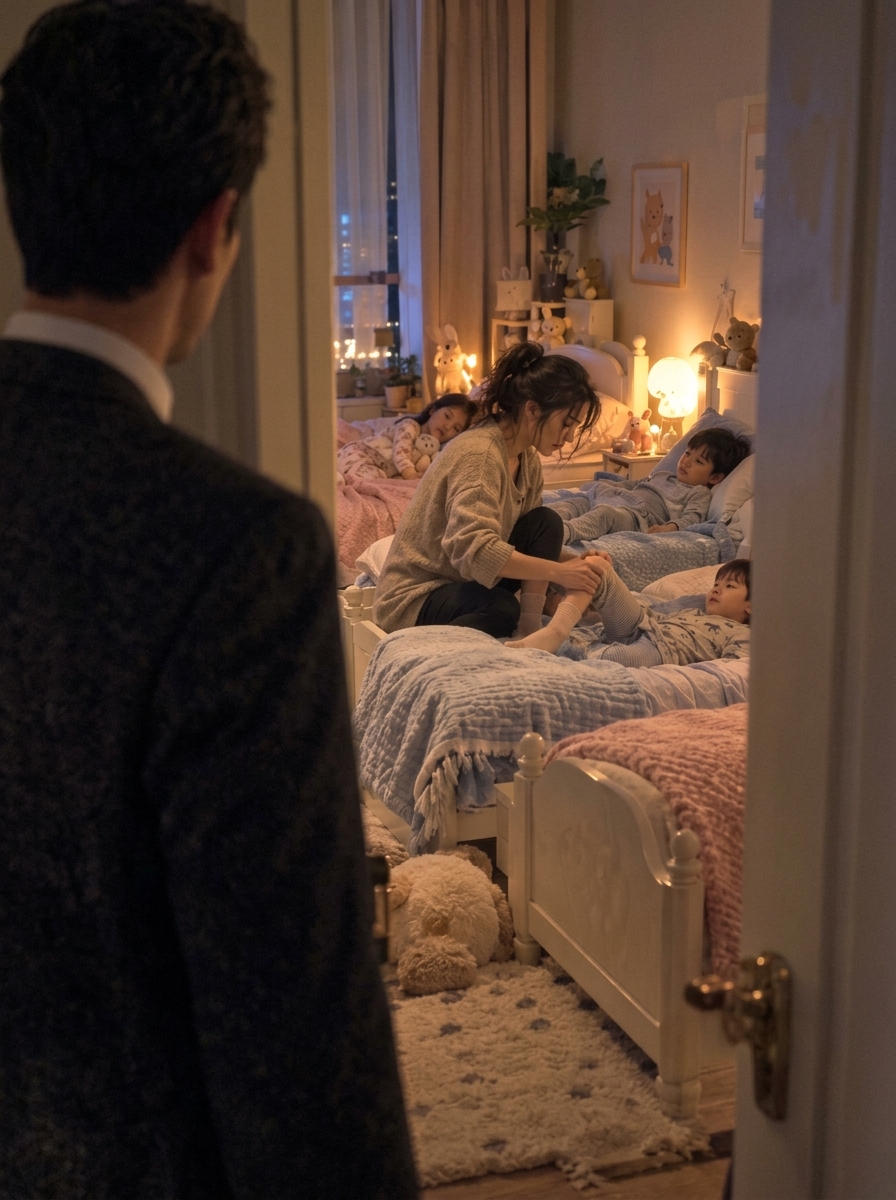
The Billionaire Installed Secret Cameras to Protect His Paralyzed Triplets—But What He Saw Their Night Maid Doing After Midnight Broke His Rules, His Pride, and Everything He Thought Love was Supposed to look like
Michael Grayson watched the footage three times before dawn.
Then a fourth.
Then a fifth, slower than the rest, his finger hovering over the pause button like he could stop reality if he pressed hard enough.
On the screen, Lena moved through the nursery with the calm of someone who had done this a hundred times before. No hesitation. No wasted motion. Just quiet hands, a low voice, and a kind of confidence that made Michael’s stomach turn.
She wasn’t fluffing pillows.
She wasn’t checking blankets.
She was working with his children.
His triplets.
The three kids every specialist in the country had warned him to protect, preserve, stabilize, and never push too far.
Lena was removing their braces.
Michael leaned closer.
She bent over Eli first, speaking so softly the camera barely caught it.
“That’s it, sweetheart. Breathe for me. Don’t fight your body. Listen to it.”
Then she shifted his legs with slow, practiced precision.
Michael had spent a fortune on the best pediatric neurologists, physical medicine teams, private nurses, adaptive equipment, and every therapy plan money could buy. He knew what licensed professionals looked like in a treatment room.
And somehow, the woman he had hired to help with meals, laundry, and bedtime stories looked better than half of them.
That was the part he hated most.
She wasn’t guessing.
She knew exactly what she was doing.
Michael pulled up saved clips from the children’s formal rehab sessions and compared them side by side. The angles were similar. The stretches were similar. But Lena’s timing was different. She watched each child’s breathing. She adjusted instantly when a muscle tightened. She spoke the entire time, not like a technician reading a script, but like someone trying to call strength back into a body that had forgotten it was still there.
At 12:19 a.m., Eli’s toes moved.
It was tiny.
So small most people would have missed it.
But Michael saw it.
He froze the frame, stared at the screen, and felt the ground shift under everything he believed.
The next morning, he said nothing.
He kissed Ava on the forehead before breakfast. He asked Owen if he wanted the blue bowl or the red one. He signed two business documents in his office and drank coffee that went cold in his hand.
Then he called Dr. Samuel Reed, the triplets’ lead neurologist.
“Come to the house,” Michael said. “I need you to review something.”
Reed arrived before lunch. Michael led him into the private screening room and played the footage without commentary.
The doctor watched with his arms crossed.
No blinking.
No interruption.
When the clip ended, Reed stayed silent long enough to make Michael’s jaw tighten.
Finally, he said, “This isn’t random.”
Michael looked at him. “Meaning?”
“Meaning she’s not experimenting. Whoever taught her knew what they were doing.”
Michael’s voice turned flat. “She has no medical training.”
Reed kept staring at the frozen image of Lena kneeling beside Eli’s bed.
“Then somebody forgot to tell her that.”
That night, Michael canceled a dinner in San Francisco and stayed home.
At 11:30 p.m., he stood in the dark hall outside the children’s room and waited.
Right on time, Lena slipped inside.
She moved the way she always did around the triplets—careful, gentle, familiar. She checked on Ava first, brushed a curl from her forehead, and whispered something that made the little girl smile even half asleep.
Then she began again.
The braces came off.
The stretching started.
The quiet coaching.
“Push a little, Owen. Just a little. That’s my brave boy.”
Michael stepped into the room.
“Stop.”
Lena turned so fast her shoulders jerked, but she didn’t scream. She didn’t run. She didn’t even look guilty.
She stood slowly and kept both hands where he could see them.
The children were awake now.
Ava looked frightened.
Eli stared at the blanket.
Owen’s lip trembled.
“You are not authorized to do this,” Michael said. His voice was controlled, but only barely. “You are going against direct medical guidance in my house, with my children, in the middle of the night.”
“I know,” Lena said.
That answer landed harder than denial would have.
Michael took one step closer. “Then explain yourself.”
She glanced at the triplets.
“Not in front of them.”
They walked into the hallway, and Michael shut the door behind them.
For a second, neither of them spoke.
Then Lena looked him in the eye and said, “My younger brother lost the use of his legs when he was nine.”
Michael said nothing.
“He got sick. Spinal infection. By the time my mom got him to a real hospital, the damage was done. We didn’t have money. We didn’t have specialists. We didn’t have a private team telling us what to hope for.”
Her voice stayed steady, but something old and painful moved underneath it.
“There was a retired physical therapist who lived two buildings down from us. She wasn’t supposed to practice anymore. Arthritis in both hands. But she taught me what she knew. Quietly. Off the record. She showed me what to watch for. She showed me how fear makes families freeze. She showed me that sometimes doctors decide too early what a body will never do again.”
Michael folded his arms. “So you decided you knew better than the people I pay to treat them?”
“No,” Lena said. “I decided your children were ready for more than they were getting.”
His face hardened.
“You went behind my back.”
“Yes.”
“You lied to me.”
“Yes.”
“Why?”
She didn’t flinch.
“Because you would’ve said no.”
That should have made him angry enough to end the conversation.
Instead, what shook him was the fact that she was right.
Michael had built his life by controlling outcomes. He didn’t become one of the richest men in Northern California by trusting instinct, luck, or emotion. He trusted systems. Contracts. Specialists. Security. Measured risk.
And Lena, a woman with no degree on paper and no permission from him, had walked straight through all of it because she believed his children needed something more than caution.
“You do not make decisions like that in this house,” he said.
Lena’s face changed then—not fearful, not defensive. Just tired.
“In this house,” she said softly, “everybody is so afraid of hurting them that nobody asks whether standing still is hurting them more.”
Michael fired her the next morning.
He did it in the kitchen, with his assistant present and a security officer waiting by the front door.
He told himself it was necessary.
Professional.
Responsible.
Lena didn’t beg. She didn’t argue. She only looked past him toward the breakfast room, where the triplets were already crying because they understood more than adults liked to pretend.
Ava refused her oatmeal after Lena left.
Owen threw his therapy ball across the room.
Eli, usually the quietest, would not look at Michael at all.
For two days, the house felt wrong.
Too polished.
Too quiet.
Too obedient.
Then Dr. Reed called.
Michael answered from his office, already irritated.
“What is it?”
Reed didn’t waste time.
“I reran the scans. I reviewed muscle response from their last sessions. There’s improvement.”
Michael sat up slowly. “How much?”
“Not dramatic. But real. More than we’ve seen in months.”
A hard ache spread through Michael’s chest.
He looked through the glass wall of his office toward the therapy wing he had built onto the house. A million-dollar room full of machines, supports, mats, rails, screens, sensors—and still it was the one thing he had not approved that seemed to have broken the silence inside his children’s bodies.
He called Lena.
No answer.
He called again an hour later.
Nothing.
So he got in his car and drove himself.
Her address was in Palo Alto, in a tired apartment complex with cracked walkways, faded numbers on the doors, and bicycles chained to rusted railings.
No gate.
No marble.
No staff.
Just ordinary life.
Lena opened the door wearing jeans and an old sweatshirt, her face unreadable.
When she saw him standing there, she did not invite him in.
“I want you to come back,” Michael said.
Her eyebrows lifted slightly, but that was all.
“With oversight,” he added. “Proper compensation. A formal arrangement. Doctors involved.”
Lena leaned against the doorframe.
“No.”
Michael stared at her. “No?”
“That’s right.”
His pride almost made him leave right then.
Instead he asked, “What do you want?”
This time she answered without pause.
“To be trusted,” she said. “Or not at all.”
The words hit him harder than any accusation could have.
Because trust was the one thing Michael had never given anyone freely.
Not after the divorce that stripped his private life into headlines.
Not after the lawsuits, the attempted blackmail, the cousins who only called when they needed money, the smiling professionals who treated his children like a case study attached to a billing code.
Trust, to Michael, had always looked like surveillance.
Verification.
Proof.
Lena stood there waiting, and for the first time in years, he had no clean way to win.
So he did something that felt almost unnatural.
He compromised.
He proposed a trial period. Lena would return, but not as house staff. She would work as a rehabilitation aide in training. Dr. Reed would supervise. The therapy team would observe. Everything would be open, documented, discussed.
No hidden cameras.
No secrets.
Lena listened without interrupting.
Then she said, “One condition.”
Michael nodded.
“The triplets know the truth. No pretending. No fake story about some new miracle plan that came from a committee. They need to know their progress comes from their own work.”
Michael looked past her into the apartment. There was a secondhand bookshelf against the wall, a chipped mug on the table, a stack of folded towels in a crate near the couch.
He thought of his mansion.
Its spotless halls.
Its locked cabinets.
Its silent cameras.
And he said, “Agreed.”
When Lena came back, everything changed.
Therapy moved into daylight.
No more midnight shadows. No more secret routines.
She worked beside licensed professionals who were polite at first, then skeptical, then visibly unsettled when she began adjusting exercises in ways that got better responses.
She challenged them when they became rigid.
She stopped them when they pushed too mechanically.
She pushed harder herself when the children were only afraid, not injured.
“Again, Ava.”
“I can’t.”
“You can. You’re tired. That’s different.”
“Owen, don’t hold your breath.”
“Eli, don’t look at the floor. Look where you want your body to go.”
There were tense meetings.
Notes taken in clipped voices.
Long discussions about liability, protocols, and approved scope.
But the progress kept showing up.
And progress is hard to argue with.
Three months later, Owen lifted one leg six inches off the mat and held it there.
The room went silent.
One of the physical therapists actually swore under his breath.
Ava stood between parallel bars for eleven seconds, shaking so hard Michael thought she would collapse. But she stayed up, her tiny hands white around the rails, tears streaming down her cheeks.
Eleven seconds.
Michael cried in the hallway where no one could see him.
Eli learned to transfer from chair to bed with minimal help.
Not gracefully.
Not easily.
But honestly.
And that became the new standard in the house.
No fantasy.
No miracle talk.
No false promises.
Just inches earned the hard way.
The cameras Michael had once relied on were gone now. One by one, he had them taken down. The nursery. The hallways. The therapy room. Even the common spaces.
He started watching with his own eyes instead.
From the doorway.
From a chair pulled too close to the therapy mat.
From the edge of a game night while the triplets bickered over cards and cheated at board games and laughed loud enough to make the whole house feel human again.
Lena never once brought up being fired.
She never asked for an apology.
That somehow made Michael feel the weight of it more.
One evening, almost a year after the night he caught her, the children were in the family room arguing over whose turn it was.
Ava accused Owen of moving the spinner.
Owen accused Eli of helping her cheat.
Eli denied everything with the solemn face of a tiny lawyer.
Lena sat nearby sorting therapy bands into a bin.
Michael stood by the doorway and said quietly, “I thought money could keep them safe.”
Lena didn’t look at him right away.
“I thought systems could,” he added.
Now she lifted her eyes.
There was no judgment in them.
Only truth.
“Systems don’t love anybody,” she said. “People do.”
He let that sit there.
Because there was nothing to defend.
No lawsuit ever came.
What Lena had done was unauthorized, but not criminal. Reckless to some. Necessary to others. By the end, even Dr. Reed stopped arguing about what box it fit in.
Michael funded a rehabilitation pilot program based on the principles Lena had used with the triplets—less rigid, more responsive, more centered on patience, repetition, and the child’s own relationship to movement.
He offered to name it after her.
She refused.
He offered again.
She refused again.
“I’m not interested in my name on a plaque,” she told him. “I’m interested in whether kids get helped.”
That answer stayed with him.
A year later, the triplets started attending school part-time.
They still used wheelchairs.
They still had braces.
Some days they needed walkers. Some days they needed breaks. Some days they came home frustrated, exhausted, and angry at bodies that still would not cooperate fast enough.
But there were also days Ava stood long enough to brush her own teeth.
Days Owen moved across a mat without crying.
Days Eli got into bed with only a little help and looked proud instead of ashamed.
Their progress was not cinematic.
It was not clean.
It was not miraculous in the way strangers liked to use that word.
It was better than that.
It was real.
Late one night, Michael opened a storage box in the garage.
Inside was the final camera he had removed from the house.
The same kind of lens he once believed could protect what he loved.
He held it for a long moment, then placed it back in the box and sealed the lid.
He didn’t need proof anymore.
He had learned, at great cost to his pride, that control could monitor a child.
It could document a child.
It could surround a child with money, rules, specialists, and polished plans.
But control could not reach into the dark and teach a frightened little body to trust itself again.
Love could.
And sometimes, love looked like the one person brave enough to break the rules.