
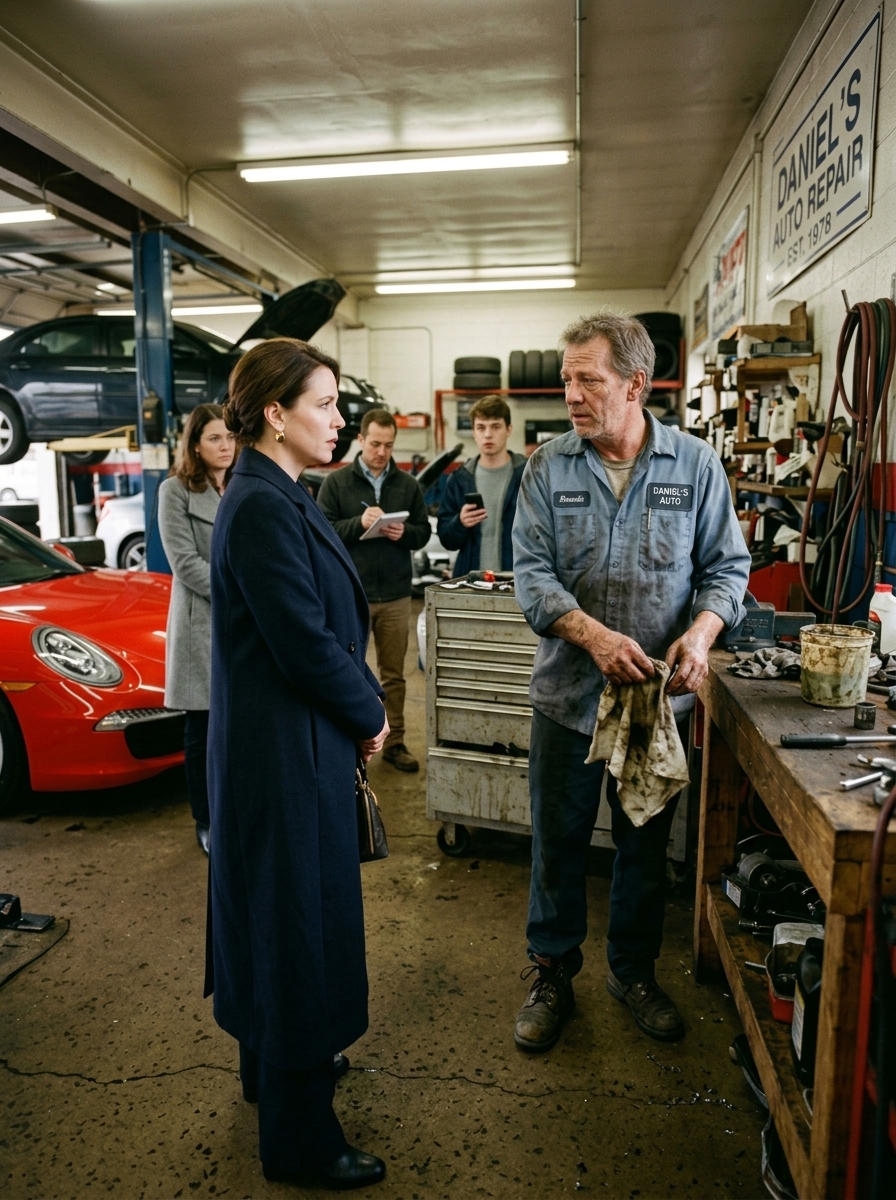
A Billionaire Asked a Grease-Stained Mechanic for “Investment Advice” as a Joke—Then His Quiet Answer Stopped the Entire Garage and Changed the Way She Treated Everyone Around Her
“So tell me, Daniel,” Vanessa Hart said, loud enough for the people around her to hear. “If you’re so good at fixing expensive things, what should someone like me invest in next?”
A few people laughed.
Not cruelly at first.
It was the kind of quick, careless laughter people make when they assume the person standing across from them is part of the joke.
Daniel Mercer slowly lowered the rag in his hand.
His knuckles were dark with grease. His work shirt had been washed so many times that the blue had faded almost gray. One bootlace had snapped that morning, so he had tied it together with a small knot and tucked the loose end beneath the tongue of his boot.
Behind Vanessa sat a bright red sports car that cost more than Daniel expected to earn in many years.
Behind Daniel sat an old metal toolbox with one drawer that never closed properly.
For several seconds, nobody said anything.
Vanessa smiled.
She was still waiting for the punch line.
Daniel looked at her expensive coat.
Then at the two assistants standing behind her.
Then at the young man holding a phone near his chest, apparently recording part of her visit for social media.
Finally, Daniel looked directly at Vanessa.
“I wouldn’t know what you should do with your money,” he said.
The laughter faded.
“But I can tell you what I wish I’d had more of.”
Vanessa’s smile weakened.
Daniel placed the rag on the workbench.
“Time with people before you lose the chance. Friends who still answer when you have nothing impressive to offer. Work you can respect yourself for doing. Enough peace that you don’t dread being alone with your own thoughts.”
Someone behind Vanessa lowered their phone.
Daniel continued.
“And if you have more than you need, maybe remember the people who make your life possible but never get invited into the picture.”
The garage became completely still.
Vanessa stared at him.
She had expected a joke from a mechanic.
Instead, in less than thirty seconds, a man she had barely noticed had said something that made every expensive thing she owned suddenly feel strangely quiet.
Daniel had not planned to say any of it.
He had come to work that morning expecting an ordinary Tuesday.
At forty-eight, ordinary Tuesdays were something he had learned to appreciate.
He arrived before seven, parked his fourteen-year-old pickup behind the garage, carried a dented travel mug through the side entrance, and checked the repair schedule taped to the office window.
He liked being early.
An empty garage made sense to him.
No customers.
No ringing phones.
No voices asking how long something would take.
Just tools hanging where they belonged, concrete floors waiting to be swept, and engines that had problems you could actually identify.
People were more complicated.
Engines usually told you what was wrong if you listened long enough.
Daniel had been listening to machines since he was twelve.
His father, Raymond, had kept a small collection of broken radios, lawn equipment, fans, and old appliances in a shed behind their house outside Dayton, Ohio.
Raymond rarely threw anything away.
“It already survived long enough to get broken,” he used to say. “Might as well give it one more chance.”
Daniel had loved that sentence as a boy.
He would sit on an upside-down bucket beside his father and watch him remove tiny screws, lay pieces carefully on old towels, and explain what each part did.
They never had much money.
Daniel did not know that at first.
Children usually don’t.
He thought everyone’s father repaired the toaster instead of buying another one.
He thought everyone waited until Friday to fill the gas tank.
He thought everyone kept an envelope in the kitchen drawer marked ELECTRIC and another marked GROCERIES.
Then he got older and started noticing things.
He noticed that other kids replaced sneakers before the soles came loose.
He noticed that some families ordered pizza without checking the price first.
He noticed that his mother, Linda, sometimes sat at the kitchen table after dinner with a calculator and the same worried crease between her eyebrows.
But Daniel never remembered feeling poor.
His parents did not have much, but they had rules.
You showed up when you said you would.
You returned tools to the place you found them.
You didn’t embarrass someone just because you could.
And if a person was working while you were standing comfortably nearby, you did not act like the work made them smaller than you.
Daniel had forgotten many things his father told him.
He had never forgotten that.
Raymond died when Daniel was nineteen.
There was no dramatic final conversation.
No perfect last sentence.
His father was simply there one week and gone from Daniel’s everyday life soon afterward following a sudden health crisis the family had not expected.
Daniel learned something then that would stay with him forever.
The people you love can disappear while you are still assuming there will be another Saturday.
He had planned to attend a technical program out of state.
Instead, he stayed close to home.
Linda still had his younger sister, Emily, to care for, and the household had become much harder to manage without Raymond.
Daniel found work.
First changing tires.
Then doing oil changes.
Then brakes.
Then electrical problems.
Then almost anything that could roll into a garage.
He discovered that he was good at it.
Not flashy good.
Reliable good.
The kind of mechanic other mechanics quietly called over when something did not make sense.
Daniel could listen to an engine for twenty seconds and sometimes hear what everyone else had missed.
He never became wealthy.
But his hands became valuable.
That mattered to him.
Over the years, Linda’s health needs increased, and Daniel helped where he could.
He drove her to appointments.
He picked up groceries.
He handled small repairs around her house.
He remembered which prescription needed collecting without being reminded.
Emily grew up, finished school, married, and moved several hours away.
She always told Daniel he had done too much for everybody else.
Daniel always said the same thing.
“I’m fine.”
It was his most practiced answer.
Sometimes it was even true.
He had wanted things once.
A little garage of his own.
Maybe a house with enough backyard space for a dog.
Maybe somebody to come home to.
Life had moved differently.
Not tragically.
Just differently.
There had been a serious relationship in his thirties that ended quietly when they realized they wanted lives moving in different directions.
There had been opportunities he could not take because Linda needed help.
There had been months when every dollar seemed to arrive already assigned to something.
Daniel did not consider himself unlucky.
He simply knew that choices looked different depending on where you started.
That was why Vanessa’s question had landed harder than she understood.
To her, it had been a joke.
To Daniel, it sounded like every moment when somebody mistook limited money for limited intelligence.
Vanessa Hart lived in another world.
At fifty-one, she was one of the most recognizable business figures in the country.
She had built an enormous investment and property empire through a collection of private companies carrying invented names few ordinary people remembered.
Business magazines liked photographs of her standing beside glass windows forty stories above a city.
Profiles described her as disciplined.
Relentless.
Brilliant.
Demanding.
Sometimes all four words appeared in the same paragraph.
Vanessa had become extremely wealthy before turning forty.
By fifty, she owned homes in several states, traveled with assistants, and could cross the country without standing in an airport security line.
People returned her calls before she finished leaving messages.
Restaurants found tables.
Hotels found rooms.
Meetings waited if she was late.
For years, Vanessa had barely noticed how often the world rearranged itself around her.
It had happened gradually.
That was the dangerous part.
Nobody woke up one morning and decided they were more important than everyone else.
At least Vanessa hadn’t.
It came in tiny pieces.
A driver opening a door.
An assistant carrying her coat.
Someone else cleaning a conference room after she left.
Someone changing the sheets.
Someone loading luggage.
Someone fixing an air-conditioning system while she continued a meeting without learning the worker’s name.
Eventually, the invisible work of other people had become part of the background.
Vanessa was not cruel.
That was what made her blind spot so easy to defend.
She donated money.
She supported education programs.
She sent generous holiday gifts.
She wrote polite thank-you notes when reminded.
If anyone had accused her of looking down on working people, she would have been offended.
She believed she treated everyone well.
But there was a difference between not openly mistreating people and actually seeing them.
Vanessa had not understood that difference yet.
The red sports car came into Daniel’s garage because of a small mechanical issue that another shop had failed to identify.
The owner of Daniel’s garage specialized in high-end vehicles, though the building itself was surprisingly plain.
Concrete floors.
White walls.
Fluorescent lights.
Metal shelves.
Coffee nobody particularly liked.
Vanessa’s assistant had scheduled the appointment.
Vanessa had not planned to come.
Then one of her friends suggested they stop by on the way to lunch because Vanessa had been complaining about the car for weeks.
So they arrived together.
Vanessa.
Her friend Allison.
Another friend named Claire.
Two assistants.
And a young media coordinator who was gathering harmless footage from Vanessa’s day for a lifestyle feature.
Daniel noticed them the moment they walked inside.
Everyone did.
They looked out of place in the way expensive clothes sometimes look out of place around machinery.
Vanessa wore a cream-colored coat with a sharp collar.
Allison carried a handbag Daniel suspected cost more than his truck was worth.
The young media coordinator immediately asked where he could stand without interfering.
Daniel appreciated that.
Then Vanessa walked toward the red car.
“Is this the person working on it?” she asked.
Daniel heard the wording.
This person.
Not Daniel.
Not the mechanic.
Just the person.
The shop manager introduced them.
“Daniel’s our best diagnostic guy.”
Vanessa glanced at Daniel’s hands.
“Well,” she said lightly, “then Daniel may be the first person in three weeks who can explain why my car keeps complaining.”
Daniel smiled politely.
“It isn’t complaining. It’s warning you.”
Vanessa laughed.
That part was genuine.
“Fair enough.”
Daniel explained the likely issue in simple terms.
He expected the conversation to end there.
Then Allison made a comment about Vanessa spending too much money collecting cars she rarely drove.
Vanessa rolled her eyes.
“I’m diversifying.”
Allison laughed.
“Ask the expert.”
Vanessa glanced at Daniel.
The idea hit her as funny.
That was when she said it.
“So tell me, Daniel. If you’re so good at fixing expensive things, what should someone like me invest in next?”
The others laughed.
Daniel knew immediately what she meant.
She did not seriously expect financial guidance from him.
She expected him to smile.
Maybe say, “I have no idea.”
Maybe point to his toolbox and joke that she should invest in better mechanics.
Daniel had laughed along with jokes like that before.
It was easier.
A man working for hourly pay learns which moments are worth turning into problems.
Most aren’t.
But that morning, Daniel was tired.
Not angry.
Just tired.
The night before, he had sat with Linda at her kitchen table.
She was seventy-four now.
The old calculator still lived in the drawer.
So did the envelopes, although most bills were paid differently these days.
Linda had smiled at him across the table and said, “Your father would be proud of you.”
Daniel had looked down at his coffee.
“For what?”
“For staying kind without letting people make you feel small.”
The sentence had followed him into work.
So when Vanessa made her joke, Daniel heard his mother’s voice.
He decided not to laugh.
“I wouldn’t know what you should do with your money,” he told her.
The garage quieted.
“But I know something about things that become valuable after you almost lose them.”
Vanessa studied him.
Daniel kept going.
“When my dad was alive, I thought time was cheap because I assumed there was always more coming.”
Nobody moved.
“I would give almost anything for one ordinary Saturday in his old shed. Not a vacation. Not something impressive. Just him asking me to hand him the right screwdriver.”
Vanessa’s face changed slightly.
Daniel noticed.
So did Allison.
Daniel leaned against the workbench.
“I spent a long time thinking being successful meant reaching a place where money stopped worrying you.”
He shook his head.
“Maybe that’s part of it. I wouldn’t know.”
A small nervous laugh came from somewhere behind Vanessa.
Daniel didn’t smile.
“But I’ve met people with plenty of money who still seem worried every minute. I’ve also known people who had to check their bank balance before buying groceries but would still drive two hours if their kid needed them.”
Vanessa folded her arms.
Not defensively.
Almost as if she suddenly needed something to hold onto.
Daniel continued.
“My mother never owned anything anybody would photograph for a magazine. But when my father died, neighbors brought food for weeks because she had spent years doing the same for them.”
The media coordinator lowered his phone completely.
“My sister still has a cheap birthday bracelet I saved for months to buy when I was twenty-one. It wasn’t worth much then. It’s worth nothing to anybody else now.”
Daniel paused.
“But she still keeps it.”
Vanessa looked toward his toolbox.
“Why?”
“Because she remembers what it cost me.”
“Money?”
Daniel shook his head.
“Sacrifice.”
The word sat there.
Nobody laughed now.
Daniel could feel heat rising in his face.
He had said more than he intended.
He almost stopped.
Then Vanessa asked quietly, “So what would you invest in?”
Her tone had changed.
The joke was gone.
Daniel looked surprised.
He thought for a moment.
“People who would still sit beside you if your name disappeared tomorrow.”
Vanessa’s eyes moved toward Allison.
Then toward Claire.
Neither woman spoke.
“Your time,” Daniel continued. “Because everybody thinks they have plenty until they realize they don’t.”
He pointed toward the car.
“And whatever lets you look at yourself at the end of the day and know you didn’t make somebody feel small just because they were standing on a different side of the counter.”
Vanessa flinched.
Daniel saw it.
He immediately regretted the sharpness.
“I’m not trying to insult you.”
“No,” Vanessa said.
Her voice was almost a whisper.
“You’re answering the question.”
Daniel nodded once.
“Yes.”
Vanessa looked around the garage.
For the first time since entering, she seemed to notice the room rather than simply occupy it.
She saw another mechanic kneeling beside a tire.
She saw the receptionist sorting invoices through the office window.
She saw a young apprentice carrying a box of parts carefully against his chest.
She saw Daniel’s torn bootlace.
And suddenly Vanessa remembered something she had not thought about in years.
Her grandfather’s hands.
Before money.
Before penthouses.
Before magazines.
Before private offices and polished conference tables.
Her grandfather had repaired heating systems in apartment buildings.
He came home with cracked skin around his fingers during the winter.
Vanessa had been seven or eight when he retired.
She remembered sitting at his kitchen table while he drank coffee from a chipped brown mug.
He had once told her, “Never become the kind of person who thinks clean hands mean important work.”
Vanessa had laughed because she was a child and did not understand what he meant.
She had forgotten the sentence.
Until Daniel stood in front of her.
Her stomach tightened.
She suddenly wanted everyone else to leave.
Not because Daniel had embarrassed her.
Because she had embarrassed herself.
The realization was unfamiliar.
Vanessa was accustomed to defending decisions.
Explaining strategy.
Correcting people.
Controlling rooms.
She was not accustomed to standing quietly while someone else’s words rearranged something inside her.
Daniel picked up the rag again.
“I should finish looking at your car.”
Vanessa nodded.
“Of course.”
Nobody moved.
Daniel glanced at the group.
“Unless there’s something else.”
Allison looked at Vanessa.
Vanessa took a slow breath.
“Yes.”
Daniel waited.
Vanessa turned toward the assistants and her friends.
Then back toward him.
“I owe you an apology.”
Daniel’s eyebrows lifted.
“You don’t have to—”
“I do.”
Her voice became steadier.
“I asked you that question because I assumed your answer would entertain me.”
No one interrupted.
“I made you the punch line before I knew anything about you.”
Daniel looked down at the rag.
Vanessa continued.
“That was disrespectful.”
For once, she did not soften the sentence with an excuse.
She did not say she had only been joking.
She did not say everyone had misunderstood.
She did not explain that she was tired.
She simply stood there.
“I’m sorry.”
Daniel had received many bad apologies in his life.
Sorry you took it that way.
Sorry, but you know what I meant.
Sorry, I was only kidding.
This one sounded different.
He looked at Vanessa carefully.
“Thank you.”
Her shoulders lowered slightly.
Daniel turned back toward the car.
He expected that to be the end.
It wasn’t.
Vanessa stayed.
Not hovering.
Not talking.
She removed her coat, handed it to nobody, folded it over her own arm, and watched Daniel examine the car.
After a minute, she asked, “What are you checking?”
Daniel pointed beneath the hood.
He explained.
Vanessa listened.
Then she asked another question.
And another.
Some were basic.
One made Daniel smile.
“Cars aren’t really my area,” she admitted.
“I gathered that.”
Vanessa laughed.
This time Daniel did too.
Allison seemed relieved.
After fifteen minutes, the group finally left for lunch.
Vanessa paused near the door.
“Daniel?”
He looked up.
“Would you mind if I came back when the car is ready?”
“That’s usually how repair shops work.”
Vanessa smiled.
“No. I mean actually came back. Not my assistant.”
Daniel shrugged.
“It’s your car.”
For the next hour, the garage returned to normal.
Almost.
Every twenty minutes someone looked at Daniel and grinned.
One mechanic finally said, “Did you just give a billionaire a lecture about life?”
Daniel groaned.
“I fixed her car.”
“You did both.”
“I should’ve kept my mouth shut.”
“No chance.”
Daniel pointed a wrench at him.
“Go work.”
But later, alone near the parts shelf, Daniel wondered whether he had gone too far.
He needed his job.
Vanessa had influence.
One complaint from the wrong customer could cause trouble.
By three in the afternoon, Daniel had convinced himself that the owner would call him into the office.
Instead, the owner walked past and said, “Whatever you said, she approved the repair and thanked us for employing you.”
Daniel blinked.
“That’s all?”
“That’s all.”
Then the owner smiled.
“Although she specifically requested that nobody clean your toolbox before she comes back.”
Daniel stared at him.
“Why would anybody clean my toolbox?”
“I have no idea.”
Neither did Daniel.
Three days later, Vanessa returned alone except for her driver, who remained outside.
She wore jeans, flat shoes, and a plain dark sweater.
Daniel almost didn’t recognize her.
The red car was ready.
He explained the repair.
She listened closely.
Then she paid the invoice without comment.
Daniel assumed she would leave.
Instead, Vanessa pointed toward a small stool beside his workbench.
“Can I sit there?”
“You can.”
She sat.
Daniel waited.
“So,” Vanessa said, “I’ve been thinking about what you said.”
Daniel closed a drawer.
“I was hoping you’d forgotten.”
“I tried.”
He smiled.
Vanessa looked down at her hands.
“I don’t think people speak honestly to me very often.”
Daniel leaned against the bench.
“Maybe they do.”
“They don’t.”
“How do you know?”
“Because I’ve spent three days remembering conversations where everybody agreed with me.”
Daniel nodded.
“That could mean you’re always right.”
Vanessa looked up.
He held a straight face for two seconds.
Then she laughed.
It surprised both of them.
Vanessa’s laugh in magazines looked controlled.
Her real laugh was louder.
Daniel liked it better.
She became serious again.
“Can I ask you something?”
“Depends.”
“Were you angry with me?”
“Yes.”
Vanessa looked almost relieved by the answer.
“But not because you’re wealthy,” Daniel said.
“I know.”
“I don’t think money makes anybody bad.”
“What do you think it does?”
Daniel considered that.
“Probably makes it easier to become more of whatever you already are.”
Vanessa was quiet.
“If you’re generous, you can be generous in bigger ways. If you’re scared, maybe you build bigger walls. If you like control, you can buy a whole lot of it.”
Vanessa stared at the concrete floor.
“And if you stop paying attention?”
“Then more people become invisible.”
She nodded slowly.
“That’s what happened to me.”
Daniel said nothing.
Vanessa looked toward the open garage doors.
“I had dinner in my apartment the night we met.”
“Congratulations.”
She smiled faintly.
“I mean I actually sat there alone.”
Daniel understood.
“No meetings. No calls. No guests. No television.”
“That sounds dangerous.”
“It was.”
He laughed softly.
Vanessa didn’t.
“I realized I didn’t know the name of the man who had been driving me for nearly two years.”
Daniel’s expression changed.
“I knew his schedule,” she said. “I knew when he should arrive. I knew which entrance he should use.”
She swallowed.
“But I didn’t know his daughter was starting college.”
Daniel folded his arms.
“I found out because I finally asked.”
“That’s a start.”
Vanessa looked at him.
“You really believe that?”
“I believe most people don’t change because somebody humiliates them.”
The words landed gently.
“They change because they notice something they can’t unnotice.”
Vanessa nodded.
“You did that.”
“I fixed your car.”
“You keep saying that.”
“It’s what you paid me for.”
Vanessa smiled.
Before leaving, she asked if she could return sometime.
Daniel frowned.
“Is something wrong with the car?”
“No.”
“Then why would you come to a garage?”
“I don’t know yet.”
Daniel stared at her.
Vanessa stood.
“That answer bothers you, doesn’t it?”
“A little.”
“Good.”
She came back the following Saturday.
Not with a camera.
Not with friends.
Not wearing clothes that made everyone in the shop nervous about grease.
She brought two paper cups of coffee from a small independent diner down the street.
Daniel accepted one.
“You guessed wrong.”
“About what?”
“I drink mine black.”
Vanessa looked at the cream she had added.
“I asked the receptionist.”
“She guessed wrong too.”
Vanessa stared at the cup.
Daniel took it anyway.
“I’ll survive.”
That Saturday, Vanessa asked if Daniel could show her how an engine actually worked.
Daniel laughed.
She didn’t.
“You’re serious?”
“Yes.”
“Why?”
“Because I’ve owned cars for thirty years and the only thing I know how to do is complain when a light appears on the dashboard.”
“That’s more common than you think.”
“I don’t like it.”
“What?”
“Being that disconnected.”
Daniel studied her face.
She meant it.
So he showed her.
Not anything dangerous.
Not anything complicated.
Just the basics.
What major components did.
Why maintenance mattered.
How systems depended on one another.
Vanessa listened with the concentration she probably used in boardrooms.
At one point Daniel handed her a clean, removed part and asked what she thought it did.
She guessed completely wrong.
He laughed so hard he had to turn away.
Vanessa narrowed her eyes.
“You seem very happy.”
“I am.”
“This is revenge.”
“A little.”
She laughed too.
Something shifted between them that morning.
Daniel stopped seeing Vanessa as the woman from the magazines.
Vanessa stopped seeing Daniel as the mechanic who had corrected her.
They became two middle-aged people standing beside an engine, arguing about whether a piece of metal looked important.
Over the next several weeks, Vanessa appeared every Saturday she was in town.
Sometimes for twenty minutes.
Sometimes for two hours.
She learned everybody’s name.
Not because Daniel told her to.
Because she started asking.
Miguel worked on transmissions and made terrible coffee.
Travis was the apprentice and attended evening classes.
Ruth handled the front office and could find any invoice from the previous decade faster than the computer system.
The shop owner, Frank, had started the garage after working for someone else for twenty-two years.
Vanessa listened to their stories.
At first, everyone was cautious.
Then they realized she actually remembered details.
“How did your exam go?” she asked Travis one morning.
The young man stared at her.
“You remembered?”
Vanessa looked embarrassed.
“Was I not supposed to?”
“No. I just… didn’t think you would.”
She did.
Daniel noticed.
One afternoon, Vanessa visited Linda with Daniel.
It happened almost accidentally.
Daniel mentioned he needed to leave early to bring groceries to his mother.
Vanessa said, “I’ll come.”
Daniel nearly dropped his keys.
“No.”
“Why?”
“Because she doesn’t need a billionaire showing up in her kitchen.”
Vanessa frowned.
“What does she need?”
“Milk.”
“I can carry milk.”
Daniel stared at her.
“You have people who carry things for you.”
“Not today.”
Linda loved Vanessa immediately.
That annoyed Daniel.
Within ten minutes, his mother had Vanessa sitting at the kitchen table eating homemade lemon cake.
Within twenty minutes, Linda had shown her photographs of Daniel as a teenager.
“Mom.”
Vanessa picked up a picture.
“Is that a mullet?”
“It was 1994.”
“It was a mullet.”
Linda laughed so hard she had to put down her fork.
Daniel pointed toward the door.
“You can both leave.”
“It’s my house,” Linda said.
Vanessa grinned.
“Looks like you’re outnumbered.”
Daniel had not seen his mother laugh that much in weeks.
That evening, after Vanessa left, Linda stood beside the sink while Daniel packed leftovers.
“She’s lonely,” Linda said.
Daniel looked at her.
“Who?”
“Your friend.”
“She’s not my friend.”
Linda raised an eyebrow.
“What is she?”
“A customer.”
“Customers don’t spend two hours looking at your childhood pictures.”
“She has poor judgment.”
Linda smiled.
Then her expression softened.
“Money doesn’t protect anybody from loneliness.”
Daniel closed the container.
“I know.”
“Does she?”
He thought about Vanessa’s silent apartment.
“She’s learning.”
Vanessa had been lonely for longer than she wanted to admit.
Her life looked crowded from the outside.
There were always people around.
Assistants.
Executives.
Advisers.
Guests.
Drivers.
House staff.
Business partners.
But most relationships came with a purpose.
Somebody wanted approval.
Access.
A decision.
A favor.
An introduction.
A photograph.
Even Vanessa had forgotten what it felt like to spend time with someone who wanted absolutely nothing from her.
Daniel wanted nothing.
That confused her.
The first time she offered to help him financially, the conversation went badly.
She had learned through Linda that Daniel had once wanted his own garage.
Vanessa thought she had discovered the perfect way to repay him.
She arrived one Saturday with a folder.
Daniel saw it and immediately became suspicious.
“What’s that?”
“An idea.”
“I already don’t like it.”
“You haven’t heard it.”
“You brought paperwork.”
Vanessa placed the folder on the bench.
“I found a building fifteen minutes from here.”
Daniel did not touch it.
“It has six service bays, new lifts, office space, good road access—”
“No.”
Vanessa stopped.
“You haven’t looked.”
“I don’t need to.”
“I could buy it.”
“No.”
“Daniel.”
“No.”
Her face tightened.
“I’m trying to do something kind.”
“I know.”
“Then why are you acting offended?”
“Because you’re trying to solve my life without asking whether I think it needs solving.”
That stopped her.
Daniel lowered his voice.
“I told you I once wanted my own place. That doesn’t mean I want you to hand me one.”
“It wouldn’t be charity.”
“What would it be?”
Vanessa opened her mouth.
Nothing came out.
Daniel tapped the folder.
“Exactly.”
She pulled it back toward herself.
“I thought you’d be happy.”
“I’m not angry that you offered.”
“You look angry.”
“I’m frustrated.”
“Difference?”
“Anger says you did something terrible. Frustration says you still aren’t listening.”
Vanessa looked wounded.
Daniel immediately softened.
“I know you mean well.”
“Apparently that isn’t enough.”
“No.”
She stared at him.
Daniel sighed.
“Meaning well matters. But so does asking.”
Vanessa sat on the stool.
For several moments, neither spoke.
Finally she asked, “What would actually help?”
Daniel smiled slightly.
“That’s a better question.”
She waited.
“My mother could use someone to fix the loose railing by her back steps.”
Vanessa blinked.
“That’s it?”
“That’s what needs doing.”
“You want me to fix a railing?”
“No. I’ve seen you hold a wrench.”
She gave him a flat look.
“I want you to call the handyman you mentioned.”
Vanessa started laughing.
Daniel did too.
The railing was repaired two days later.
Daniel paid the invoice.
Vanessa complained.
Daniel ignored her.
A few weeks after that, Vanessa learned Emily’s daughter had been accepted to college.
She immediately looked at Daniel.
“No.”
“I didn’t say anything.”
“You were about to.”
“I was thinking.”
“Think quieter.”
Vanessa rolled her eyes.
Instead of offering money, she wrote Daniel’s niece a note congratulating her.
She included no check.
No promise.
No special opportunity.
Just a note.
Months later, Daniel told Vanessa his niece had taped it above her desk.
Vanessa was more moved by that than she expected.
Daniel had been right again.
Not every meaningful gesture needed a large number attached to it.
Meanwhile, Vanessa began changing in places Daniel never saw.
At the headquarters of her main business group, employees noticed first.
Vanessa began arriving early for meetings and sitting in common areas rather than disappearing directly into the executive suite.
She asked the receptionist how long she had worked there.
Nine years.
Vanessa had not known.
She began visiting departments she usually saw only in reports.
Facilities.
Mail services.
Maintenance.
Customer support.
Administrative operations.
She asked people what made their jobs unnecessarily difficult.
At first, the answers were careful.
Then one employee said, “Do you actually want to know?”
Vanessa felt the old instinct to defend herself.
She pushed it down.
“Yes.”
The employee told her.
Then another did.
And another.
None of the problems were dramatic.
That was what affected Vanessa most.
Schedules that changed with almost no notice.
Break rooms that had not been updated in years.
Front-line workers learning about policy changes after customers already knew.
Supervisors rewarded for numbers but not for retaining good people.
Employees who had ideas but no practical way to send them upward.
Vanessa had spent years reading reports.
Very few reports described what it felt like to work there.
So she began listening.
She asked her leadership team to review policies affecting hourly employees.
She expanded predictable scheduling where possible.
She created regular meetings where employees from different levels could speak directly with senior leaders.
She changed how internal recognition worked so people doing behind-the-scenes work were included.
She did not announce a moral transformation.
She did not film herself shaking hands with workers.
She simply started making different decisions.
Some executives thought it was temporary.
It wasn’t.
At one meeting, a senior manager interrupted a junior employee three times.
Vanessa finally held up her hand.
“Let her finish.”
The room went silent.
The employee finished.
Her suggestion saved the team hours of unnecessary work each week.
Afterward, Vanessa sat alone in the conference room.
She thought about Daniel.
People become invisible.
The phrase had become a warning in her head.
One afternoon, Allison visited Vanessa’s office.
They had known each other for fifteen years.
Allison closed the door.
“You’ve changed.”
Vanessa looked up from a document.
“That sounds ominous.”
“I mean it.”
Vanessa leaned back.
“How?”
“You ask different questions.”
“Such as?”
“You used to ask, ‘Why isn’t this done?’ Now you ask, ‘What’s keeping this from getting done?’”
Vanessa considered that.
“Those are different questions.”
“Very.”
Allison smiled.
“And you don’t make jokes about Daniel anymore.”
Vanessa’s expression changed.
“I made one joke about Daniel.”
“One was enough.”
Vanessa nodded.
“Yes.”
Allison sat across from her.
“Do you know what bothered me?”
“What?”
“I laughed.”
Vanessa looked at her.
“So did Claire.”
“I know.”
Allison picked at the edge of a notebook.
“I’ve thought about it too.”
Vanessa smiled softly.
“Apparently he repaired more than the car.”
Allison laughed.
“That line is terrible.”
“I know.”
“Never say it publicly.”
“Agreed.”
The friendship between Vanessa and Daniel developed slowly.
There was never anything romantic about it.
Neither wanted that.
What they had was stranger and, in some ways, more valuable.
Daniel could tell Vanessa she was being ridiculous.
Vanessa could tell Daniel when he was pretending not to need anybody.
One evening, she found him still at the garage after everyone else had left.
He was organizing tools.
“You’ve put that wrench in the same drawer three times.”
Daniel looked down.
“No, I haven’t.”
“You absolutely have.”
He sighed.
“What’s wrong?”
“Nothing.”
Vanessa waited.
Daniel kept rearranging the drawer.
She crossed her arms.
“You taught me this.”
“Taught you what?”
“That ‘nothing’ is usually a lazy answer.”
Daniel gave her a look.
She smiled.
He closed the drawer.
“My mother called earlier.”
Vanessa’s face tightened.
“She’s fine.”
“All right.”
“She just needs more help around the house.”
Vanessa nodded.
Daniel rubbed his forehead.
“I knew this was coming.”
“You don’t have to pretend you’re surprised for it to be hard.”
He looked at her.
“That sounded suspiciously wise.”
“I know a mechanic.”
Daniel smiled.
Then the smile disappeared.
“I’ve spent thirty years being the person who handles things.”
Vanessa said nothing.
“I don’t know how to stop.”
“Maybe you don’t stop.”
“What does that mean?”
“Maybe you just let other people hold part of it.”
Daniel shook his head.
“That’s easy for you to say.”
Vanessa almost laughed.
Then she realized he was right.
She had assistants for things Daniel handled alone.
She chose her next words carefully.
“Yes. It is easier for me.”
Daniel looked surprised.
Vanessa continued.
“So I won’t pretend I understand exactly.”
He leaned against the bench.
“But I understand what it feels like to believe being needed is the same as being strong.”
Daniel studied her.
“Is that what you do?”
“All the time.”
“Why?”
Vanessa looked around the empty garage.
“Because if everyone needs something from you, you never have to ask whether they actually want you around.”
Daniel stared at her.
The sentence seemed to surprise Vanessa as much as him.
He pulled the stool out with his foot.
“Sit.”
She did.
They talked for an hour.
Not about cars.
Not about money.
About parents.
Work.
Age.
Regret.
The strange fear that came with realizing you were no longer the young person in the room.
Vanessa told him about her grandfather.
About the heating systems.
About the chipped brown mug.
About the sentence she had forgotten.
Clean hands do not mean important work.
Daniel smiled.
“I would’ve liked him.”
“He would’ve liked you.”
“How do you know?”
“He distrusted anybody with expensive shoes.”
Daniel glanced at hers.
Vanessa looked down.
“These are practical.”
“They cost more than my refrigerator.”
“You don’t know that.”
“I know enough.”
She laughed.
By winter, Daniel’s coworkers no longer stared when Vanessa walked into the garage.
She had become part of the place.
Ruth kept a mug for her.
Miguel no longer apologized for the coffee.
Travis asked her about job interviews, though she was careful not to promise anything.
Frank once handed her a broom while everyone cleaned up before closing.
Vanessa took it.
Daniel watched from across the garage.
She pointed at him.
“Don’t.”
“I didn’t say anything.”
“Your face did.”
“What did my face say?”
“That this is deeply entertaining.”
“It is.”
Vanessa swept the floor badly.
Daniel eventually took the broom away.
“Hey.”
“You missed half the dirt.”
“I’m learning.”
“You’re failing.”
“I employ thousands of people.”
“None of that dirt cares.”
Vanessa laughed until Ruth came out of the office to see what was happening.
The moment would have looked meaningless to anyone passing outside.
To Vanessa, it was one of the happiest evenings she could remember.
Nobody wanted a speech from her.
Nobody wanted a decision.
Nobody cared what she owned.
She was simply bad at sweeping a garage floor.
And somehow that felt wonderful.
The biggest change came several months after their first meeting.
Vanessa had been invited to speak at a private leadership event.
The organizer wanted her usual presentation.
Growth.
Decision-making.
Success.
Vanessa stood backstage holding the prepared notes.
Then she thought about Daniel.
She walked onto the stage and placed the notes on the podium.
“I was rude to someone several months ago,” she began.
The room quieted.
She did not name the garage.
She did not give Daniel’s last name.
She did not turn him into a prop.
She simply told the audience what she had done.
“I asked a working man a question because I assumed his answer would be less sophisticated than mine.”
Vanessa paused.
“I thought education, money, and status had given me more to teach than to learn.”
People listened.
“I was wrong.”
She explained that dignity was not something powerful people handed down to others.
People already had dignity.
Power simply gave someone more opportunities either to respect it or ignore it.
She spoke about invisible work.
The people cleaning offices after executives went home.
The person answering the phone when customers were upset.
The workers repairing elevators, preparing meeting rooms, maintaining buildings, moving boxes, solving quiet problems no one noticed until something stopped working.
“I used to think leadership meant being the person with the answer,” Vanessa said.
“Now I think part of leadership is knowing how often your answer is incomplete because you never asked the people closest to the problem.”
There was no dramatic standing ovation.
Vanessa was glad.
People simply listened.
Afterward, several attendees approached her.
One senior executive said, “That made me uncomfortable.”
Vanessa smiled.
“It made me uncomfortable too.”
That night, she called Daniel.
“I talked about you today.”
Daniel groaned.
“I knew this would happen.”
“I didn’t use your name.”
“Good.”
“I told them about the question.”
“Why?”
“Because it mattered.”
Daniel was quiet.
“Did you tell them I fixed the car?”
“Yes.”
“Good. I don’t want people thinking I just stand around giving speeches.”
Vanessa laughed.
Then Daniel asked, “Did you tell them what you did afterward?”
“What do you mean?”
“Did you tell them you changed things?”
Vanessa looked out the window of her apartment.
“No.”
“Why not?”
“Because I’m not sure I deserve applause for finally noticing what I should’ve noticed before.”
Daniel smiled on the other end.
“You’re getting annoying.”
“I learned from you.”
“Clearly.”
Spring came.
Linda’s back railing remained sturdy.
Emily’s daughter started preparing for college.
Travis passed another certification exam.
Ruth replaced Vanessa’s garage mug after Vanessa accidentally dropped the first one.
Miguel’s coffee did not improve.
Some things stayed the same.
Others shifted slowly.
Daniel did not become rich.
Vanessa did not give away her fortune.
The world did not transform because of one conversation.
That wasn’t the point.
Daniel continued arriving early.
He continued worrying about his mother.
He continued working with his hands.
Vanessa continued running large companies.
She still had assistants.
She still flew privately when her schedule required it.
She still owned expensive cars.
What changed was not that she suddenly rejected her life.
She simply stopped confusing comfort with character.
And Daniel changed too.
That surprised him.
He had always believed the lesson belonged to Vanessa.
Then one Thursday afternoon, Frank called Daniel into the office.
Daniel immediately assumed something was wrong.
Instead, Frank closed the door and pushed a folder across the desk.
Daniel stared at it.
“If this is another building Vanessa found, I’m quitting.”
Frank laughed.
“It has nothing to do with Vanessa.”
Daniel opened the folder.
Inside was a proposal.
Frank wanted to step back from daily operations over the next few years.
He wanted Daniel to become service manager immediately and gradually take on more responsibility.
Daniel looked up.
“I don’t know anything about managing people.”
“You manage half the shop already.”
“I answer questions.”
“That’s managing people.”
“I fix mistakes.”
“That’s managing people.”
“I complain about Miguel’s coffee.”
Frank shrugged.
“That’s executive leadership.”
Daniel laughed.
Then he became serious.
“Why me?”
Frank leaned back.
“Because people trust you.”
Daniel looked at the papers again.
The old reaction came immediately.
I’m fine where I am.
Don’t ask for more.
Don’t risk what you already have.
He heard the words forming.
Then he remembered Vanessa.
Maybe you just let other people hold part of it.
He realized something uncomfortable.
For years, Daniel had defended his dignity so carefully that sometimes he refused opportunity simply because he did not want to owe anyone.
There was pride in that.
Maybe too much.
This offer was not charity.
He had earned it.
That difference mattered.
“I need time to think.”
Frank nodded.
“Take it.”
Daniel took the folder home.
He placed it on Linda’s kitchen table.
She read the first page.
Then she smiled.
“What?”
“You already know what you want to do.”
“No, I don’t.”
“Yes, you do.”
“How?”
“You have your father’s face when you’re trying to convince yourself not to want something.”
Daniel leaned back.
“That doesn’t even make sense.”
“It does to me.”
Linda touched the folder.
“You’re allowed to move forward, Daniel.”
“I know.”
“No.”
She looked directly at him.
“I don’t think you do.”
Daniel’s throat tightened.
Linda continued.
“You stayed when our family needed you.”
He looked down.
“You worked.”
“You helped Emily.”
“You helped me.”
“Mom—”
“Listen.”
Daniel stopped.
“You have spent years acting like wanting something for yourself would erase all the good you’ve done for everyone else.”
She shook her head.
“It won’t.”
Daniel stared at the table.
“I’m not asking you to leave me behind.”
“I know.”
“Do you?”
He did not answer.
Linda smiled.
“Take the job if you want it.”
Daniel swallowed.
“And if you don’t want it, don’t.”
“That simple?”
“Most important things are simple.”
She stood slowly.
“People just make them complicated because simple decisions can still be scary.”
Daniel accepted the position.
Vanessa was the third person he told.
After Linda.
After Emily.
Vanessa stared at him for a moment.
Then she shouted.
Actually shouted.
“Yes!”
Everybody in the garage turned.
Daniel looked horrified.
“What are you doing?”
Vanessa hugged him.
Daniel went stiff.
She immediately stepped back.
“Sorry.”
He looked around.
Travis was grinning.
Ruth gave him a thumbs-up.
Miguel started clapping.
Daniel covered his face.
“I hate all of you.”
“No, you don’t,” Vanessa said.
“I’m reconsidering.”
She smiled.
“I’m proud of you.”
The sentence hit him harder than he expected.
Daniel looked away.
Vanessa noticed.
She did not make a joke.
She simply stood beside him.
A week later, Daniel bought new work boots.
Vanessa noticed immediately.
“What happened to the old ones?”
“They wore out.”
“You kept them for months with a broken lace.”
“They were comfortable.”
“They were falling apart.”
“They had character.”
“They had ventilation.”
Daniel laughed.
Then Vanessa looked at his new boots again.
“You know what I like about those?”
“What?”
“You bought them yourself.”
Daniel stared at her.
“That is the strangest compliment you’ve ever given me.”
“I know.”
“But I understand it.”
“So do I.”
Nearly a year after their first meeting, Vanessa’s red sports car returned to the garage.
There was nothing seriously wrong with it.
Just routine service.
Vanessa arrived on a Saturday morning.
The garage doors were open.
Sunlight stretched across the concrete.
Daniel stood beside the same workbench where he had answered her question months earlier.
His toolbox still had the broken drawer.
Vanessa had offered to replace it once.
Daniel had refused.
So she stopped asking.
She walked over carrying two coffees.
Daniel accepted one.
He took a sip.
Black.
He looked impressed.
“You remembered.”
“I’ve remembered for eleven months.”
“You brought cream the last two times.”
“That was for me.”
“Oh.”
Vanessa leaned against the bench.
For a while, they watched the garage.
Travis was helping a customer.
Ruth was laughing with Frank near the office.
Miguel was underneath a car complaining loudly about a stubborn bolt.
Nothing important was happening.
Vanessa had learned to appreciate that.
Ordinary moments did not need to become memories before they became valuable.
Sometimes you could notice them while they were still happening.
“Do you remember what you asked me that first morning?” Daniel said.
Vanessa groaned.
“Unfortunately.”
“What should you invest in next?”
“Please don’t.”
“You looked so pleased with yourself.”
“I apologized.”
“You did.”
“Repeatedly.”
“True.”
Vanessa sipped her coffee.
“Do you know what I remember most?”
“What?”
“You didn’t try to embarrass me back.”
Daniel thought about that.
“I wanted to.”
She smiled.
“But you didn’t.”
“No.”
“Why?”
Daniel looked across the garage.
“Because my father used to say something.”
Vanessa waited.
“He said if somebody makes you feel small, you don’t get taller by making them smaller.”
Vanessa looked at him.
“I like that.”
“So did he.”
They stood quietly.
After a minute, Vanessa said, “I spent most of my life thinking success meant needing less from people.”
Daniel frowned.
“What do you think now?”
“I think that might be impossible.”
“Probably.”
“I have more money than I’ll ever need.”
Daniel nodded.
“I had every convenience.”
Another nod.
“Every kind of access.”
Daniel looked at her.
“And I was still sitting alone in a beautiful apartment without knowing whether the people around me liked me or just needed something.”
Her voice stayed calm.
“That was the poorest I’ve ever felt.”
Daniel said nothing.
Vanessa continued.
“And then I walked into a garage and made a stupid joke to a man with a broken bootlace.”
“It was a very good knot.”
“It was terrible.”
“It lasted all day.”
“So does duct tape. That doesn’t make it fashion.”
Daniel laughed.
Vanessa smiled.
Then she became quiet.
“You didn’t make me less successful that day.”
“No.”
“You made me ask what all that success was for.”
Daniel looked at the red car.
“Did you ever figure it out?”
“I’m still figuring it out.”
“Good.”
“Why good?”
“Anybody who thinks they’ve figured out life completely is probably about to make a mess.”
Vanessa laughed.
“I’m putting that in a speech.”
“Absolutely not.”
“Too late.”
“You owe me royalties.”
“You refused the garage.”
“Royalties are different.”
They both laughed.
Across the room, Frank looked over.
He had watched their strange friendship develop from the beginning.
He later told Ruth that the two of them seemed like relatives who had somehow forgotten to share the same childhood.
They argued.
They corrected each other.
They showed up.
Maybe that was friendship after all.
Vanessa finished her coffee.
“I have a meeting at noon.”
“Of course you do.”
“I almost canceled.”
“Why?”
She looked around.
“Because this is better.”
Daniel shook his head.
“Go to your meeting.”
“Bossy.”
“I’m management now.”
Vanessa grinned.
She started walking toward the door.
Then she stopped.
“Daniel?”
“Yeah?”
“Thank you.”
He knew immediately she was not talking about the car.
He could have made another joke.
Instead, he nodded.
“You’re welcome.”
Vanessa stepped outside.
Daniel returned to work.
A few minutes later, he heard his phone buzz inside his pocket.
It was a message from Linda.
Did you eat breakfast?
Daniel smiled.
Some things in life never changed.
He typed back.
Yes.
A second message arrived immediately.
Was it real breakfast or garage coffee?
Daniel laughed out loud.
Vanessa heard him from outside and turned around.
For one brief moment, she saw the whole scene as if she were standing outside her own life.
Daniel beside the workbench.
Grease on his hands.
Sunlight on the floor.
People working.
People laughing.
Nothing glamorous.
Nothing staged.
Nothing that would have interested the magazines that once defined her world.
And yet Vanessa knew she would remember this longer than many of the expensive places she had visited.
For years, she had thought wealth was mostly about having choices.
Daniel had taught her another definition.
Wealth was being known without needing to perform.
Being respected without demanding it.
Having someone who would tell you the truth when everyone else found agreement more convenient.
Having an ordinary place where people noticed when you walked through the door.
Daniel had never meant to teach her any of that.
He had simply refused to participate in his own humiliation.
That was all.
He had answered one careless question honestly.
He had protected his dignity without attacking hers.
And because he did, Vanessa had been given something very few people in her life had been willing to give her.
A clear mirror.
What she did with the reflection was her responsibility.
She could have dismissed him.
She could have complained.
She could have told herself he was bitter.
Instead, she listened.
That choice changed everything that came afterward.
Not overnight.
Not perfectly.
Vanessa still caught herself interrupting people.
She still sometimes walked through rooms without noticing everyone in them.
Daniel still became stubborn when anyone offered help.
He still said “I’m fine” when he was clearly exhausted.
They called each other out.
Again and again.
Change was not a dramatic moment followed by permanent wisdom.
It was noticing.
Correcting.
Trying again.
Vanessa learned names.
Daniel learned to accept help without confusing it with pity.
Vanessa learned that generosity without listening could become another form of control.
Daniel learned that refusing every open hand could become another kind of pride.
Vanessa became better at asking, “What do you need?”
Daniel became better at answering honestly.
Neither became perfect.
That was never the goal.
One year after the morning they met, Daniel visited Linda on a Sunday afternoon.
The loose railing outside remained solid.
Inside, the kitchen looked almost exactly as it had when he was nineteen.
Different refrigerator.
Same table.
Same drawer where the old calculator still lived.
Linda poured coffee.
Daniel showed her a photograph on his phone.
Vanessa stood in the garage holding a broom badly while Ruth laughed beside her.
Linda smiled.
“She looks happy.”
“She’s terrible at sweeping.”
“That isn’t what I said.”
Daniel put the phone down.
Linda studied him.
“You look happier too.”
“I got a promotion.”
“That isn’t what I said either.”
Daniel laughed.
His mother reached across the table and touched his hand.
“Your father would like the man you became.”
Daniel’s smile faded.
For a moment, he could almost hear Raymond in the old shed.
Hand me the screwdriver.
No, the other one.
Daniel looked toward the kitchen window.
“I wish he could see it.”
Linda squeezed his hand.
“I think the part that matters is that you can.”
Daniel swallowed.
Then he nodded.
On Monday morning, Vanessa stood in a high-rise conference room preparing for another full week.
Twenty people were seated around a long table.
Years earlier, she would have opened the meeting by speaking first.
That morning, she looked around.
A young operations coordinator sat near the far end, holding several pages covered in notes.
Vanessa recognized the expression.
Someone who had something to say but was not sure the room wanted to hear it.
Vanessa closed her own folder.
“Before we start,” she said, “I want to hear from the people closest to the work.”
The senior executives looked toward one another.
Vanessa smiled.
“Who knows what we’re missing?”
The young coordinator slowly raised her hand.
Vanessa pointed toward her.
“Go ahead.”
Then she listened.
Miles away, Daniel stood beside a car with Travis.
The young mechanic had made a mistake.
Not a dangerous one.
Just a frustrating one that would take time to correct.
Travis looked embarrassed.
“I’m sorry.”
Daniel remembered all the supervisors who had made him feel foolish when he was young.
He could still hear their voices.
How could you not know that?
What were you thinking?
Do I have to do everything myself?
Daniel picked up a tool.
“I made the same mistake when I was twenty-two.”
Travis looked surprised.
“You did?”
“Worse.”
“What happened?”
“My boss made me fix it.”
Daniel handed him the tool.
“So that’s what you’re going to do.”
Travis nodded.
Daniel started walking away.
“Daniel?”
“Yeah?”
“Thanks for not making me feel stupid.”
Daniel stopped.
He thought about Vanessa.
He thought about his father.
He thought about how dignity moved through people.
One person protected yours.
You learned to protect someone else’s.
“Everybody starts somewhere,” Daniel said.
Then he went back to work.
That evening, Vanessa’s car moved through downtown traffic while she sat in the rear seat reviewing notes.
The driver glanced at her through the mirror.
“Long day?”
Vanessa closed the folder.
“Good day.”
“How’s your daughter doing?”
The driver smiled immediately.
“Really well. She likes college more than she expected.”
Vanessa smiled.
“Tell her I said congratulations on finishing her first month.”
“I will.”
He paused.
Then he added, “Thank you for remembering.”
Vanessa looked out the window.
She thought of a mechanic with grease on his hands asking for nothing.
She thought of how easy it was to move through life surrounded by people and still fail to see them.
She thought of how one ordinary morning had exposed that truth without destroying her.
The lesson had not cost her anything.
No consultant had billed her for it.
No university had issued a certificate.
No executive retreat had placed it inside a glossy binder.
It came from a man beside a toolbox with a broken drawer.
A man she had underestimated before he had even finished wiping his hands.
Vanessa had once believed people like Daniel existed in the background of successful lives.
Now she understood something different.
There was no background.
There were only people.
Some stood under brighter lights.
Some earned larger paychecks.
Some had impressive titles.
Some wore work shirts with permanent stains.
But dignity did not rise and fall with income.
Wisdom did not arrive only through expensive education.
And a person’s value did not increase because someone powerful finally noticed them.
Daniel had value before Vanessa entered the garage.
That was the point she would carry for the rest of her life.
She had not given him worth.
She had finally learned to see the worth that was already there.
And Daniel, in turn, learned something about Vanessa.
People could make careless mistakes without being permanently defined by them.
An apology could matter when it was followed by different behavior.
Humility was not feeling ashamed forever.
It was allowing the truth to change what you did next.
A year earlier, Vanessa had walked into the garage expecting people to bend around her.
Daniel had simply stood still.
That was enough.
Sometimes a life does not change because of a dramatic event.
Sometimes it changes because someone refuses to laugh when a joke is made at their expense.
Sometimes because another person has the courage to say, “I was wrong.”
Sometimes because one honest answer reaches a place money, status, comfort, and applause never could.
And sometimes the richest lesson in the room comes from the person everyone else almost forgot to notice.