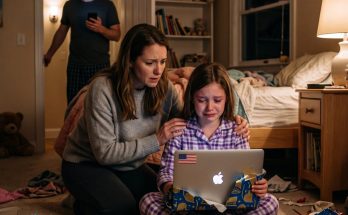
My in-laws left a note on my 11-year-old’s bedroom door: “We gave your dog away. Your cousin didn’t want it around. Don’t make a scene.” She showed it to me, crying. I didn’t cry. I did this. The next morning, they got a knock at the door — and started screaming …

By the time I got home from work, I could tell Sophie had been crying for a long time.
Her eyes were swollen and red, and her nose was pink and raw. She was waiting for me in the hallway, still in her school clothes, hands clenched into fists at her sides.
“Mom,” she said.
Her voice came out.
“You have to see this.”
My heart dropped.
“What happened?”
She didn’t answer. She just turned and walked toward her room.
I followed.
There was a sheet of paper taped to her bedroom door.
White printer paper, black marker, big block letters pressed hard enough to dent.
We gave your dog away.
Your cousin didn’t want it around.
Don’t make a scene.
For a second, the words didn’t make sense. They just sat there like a bad joke with no punchline.
Then my brain caught up.
My chest went cold.
I pulled the paper off the door and opened it as if there might be some softer version written on the back.
There wasn’t.
“Where’s Sadie?” I asked.
Sophie’s face crumpled.
“She’s gone,” she said.
And the word broke in the middle.
“Her bed is gone. Her bowls are gone. Her toys. Everything. I came home.”
And she stopped, sucking in a shaky breath.
“They said she’s not coming back.”
Sadie wasn’t just a dog.
She was a small red and white spaniel mix with long silky ears that Sophie used to braid when she was little. She had one cloudy eye and a soft, careful way of moving, like she never wanted to bump into anyone.
Sophie used to say Sadie understood her better than people did.
And honestly, some days that felt true.
They’d grown up side by side.
Bedtime stories, backyard adventures, storm-night cuddles. A kid and her dog in that quiet, unspoken way that feels more like family than half the people you share a house with.
Losing Sadie wasn’t losing a pet.
It was losing the one creature Sophie trusted completely.
I stepped into her room.
The corner where Sadie’s bed had been was empty.
The little metal bowls we kept beside the dresser were gone, leaving faint circles on the floor.
The worn rope toy that had lived under the desk was missing.
The whole room looked wrong, like a staged version of Sophie’s life, where someone had quietly erased the one living thing that made the noise bearable.
I turned back to her.
“Where were you when you found this?”
“I came home from school and it was there,” she said. “Grandma was in the kitchen.”
Then she slid into Brenda’s clipped tone.
“We did what we had to do. Don’t you dare start crying about it, young lady. It’s just a dog.”
Sophie choked on a sob.
“She said if I made a scene, I’d go to my room without dinner, but Sadie’s not here.”
So, I pulled her into my arms before she could finish that sentence.
She shook against me, hot tears soaking into my work shirt. She smelled like school and salt and the faint dog shampoo that never quite left our clothes.
“It’s okay,” I lied into her hair. “I’ve got you.”
I didn’t say it’s just a dog.
I didn’t say we’ll get another one.
I just held her until the worst of the shaking passed.
“Go sit on my bed, okay?” I said quietly. “Take your pillow. I’m going to talk to them.”
She nodded without looking at me and shuffled down the hall, wiping her nose with the back of her hand.
I looked at the note again, at the part about Sophie’s cousin, Madison, at the last line.
Don’t make a scene.
Right.
I went downstairs.
My mother-in-law, Brenda, and my father-in-law, Gordon, were at the kitchen table.
Brenda had a cup of tea. Gordon had the newspaper spread open.
They didn’t look surprised to see me.
“Elena,” Brenda said, like I’d just come in from the grocery store. “You’re home early.”
“Where is she?” I asked.
Brenda tilted her head.
“Who?”
“Sadie. Our dog,” I said. “Where is Sadie?”
Gordon folded the paper with a sigh.
“We found her a new home,” he said. “Some nice people from church. It was time.”
“No, it wasn’t,” I said.
Brenda rolled her eyes.
“We’ve talked about this. Madison doesn’t like that dog. She’s afraid of it. She told us she didn’t want to come over anymore. What were we supposed to do? Lose our granddaughter because you insist on keeping an animal in the house?”
“You have two granddaughters,” I said.
Brenda’s mouth pinched.
“You know what I mean.”
“Where does this nice family live?” I asked. “What are their names?”
“That’s none of your concern,” Gordon said. “We handled it. You should be thanking us. Less hair in the house, less smell, less responsibility for you.”
“She wasn’t your responsibility,” I said.
“She was my daughter’s dog.”
“It’s our house,” Gordon said, like he was spelling it out for a slow child. “We make the rules here.”
“This isn’t a rule,” I said. “It’s theft.”
Brenda slammed her cup down hard enough that tea sloshed onto the saucer.
“Oh, for heaven’s sake. You’re being ridiculous. We rehomed a dog. That’s it. Children come first. Your daughter will be fine. She’s old enough to understand that the world doesn’t revolve around her feelings.”
“She’s 11,” I said.
“And very sensitive,” Brenda said pointedly. “You’ve made her that way.”
I stared at them.
There was a buzzing in my ears, but my voice stayed flat.
“You left a note on her door,” I said. “You didn’t even look her in the eye.”
“We knew you’d blow it out of proportion,” Gordon said. “We didn’t want a scene.”
There it was, the math laid out on the table.
Madison’s comfort on one side, my mother’s dog, and my daughter’s grief on the other.
“The people who took Sadie,” I said. “Did you tell them she wasn’t yours to give?”
Gordon’s jaw clenched.
He didn’t answer.
Brenda stood up and started stacking plates that didn’t need stacking.
“We’re not having this argument,” she said. “The decision is made. You can either accept it and help Sophie move on, or you can keep stirring her up and make this harder than it needs to be.”
I looked at her, at him, at the kitchen where I’d spent years cooking and cleaning and swallowing small insults in exchange for a roof over our heads.
“Okay,” I said.
Brenda relaxed just slightly.
“Good. I’m glad you’re being sensible.”
I walked out without another word.
Upstairs, Sophie was sitting on our bed, clutching Sadie’s old collar so tightly her knuckles were white.
The little brass tag with my mother’s number, now crossed out and replaced with ours, glinted in the lamplight.
“She’s not coming back, is she?” Sophie asked.
“They won’t tell me where she is,” I said. “Yet.”
Sophie’s eyes filled again.
“Grandma said if I cry about it, I’m being selfish,” she whispered. “She said Madison is scared and that Madison is family like Sadie isn’t.”
My throat hurt.
I sat down beside her and pulled her close again.
“You are allowed to be sad,” I said. “You are allowed to be angry. What they did was wrong.”
“Are you going to make them bring her back?” she asked.
I looked at the note on the nightstand, at the empty corner of her room.
“I’m going to do everything I can,” I said. “I’m not promising it will be easy, but I’m not going to pretend this didn’t happen, and I’m not going to tell you to get over it.”
She nodded against my shoulder.
They thought I’d tell Sophie to accept it.
They thought I’d swallow it like I always had.
This time, I didn’t feel sad.
I felt done.
People always want a clean line they can point to.
There, that’s where it all went wrong.
But things like this build slowly.
One decision, one comment, one little shift that doesn’t seem like much until you look back and realize the floor was moving the whole time.
My husband Colin and I moved in with his parents when Sophie was still in diapers.
We were both in school, both broke, and both drowning in the kind of optimism only people in their 20s have.
“We’ll help you,” Brenda said, meaning we’ll supervise you.
“You’ll get back on your feet,” Gordon said, meaning you’ll be grateful forever.
It was supposed to be temporary, just until finals were behind us, just until we could afford rent, just until student loans cleared.
Just until became, “Why don’t you stay a little longer?”
And before I knew it, 5 years had passed.
We had money by then. Colin had a solid job. I had stable hours.
We could have afforded our own place easily, but every time I brought it up, Brenda found a new way to twist the knife.
“Oh, Elena,” she’d say, “it’s sweet you think you manage better on your own. You’re not ready. Not with your background.”
Background meaning not as polished as my sister-in-law Alicia, not from a family they approved of.
And Colin, sweet, conflict-avoidant Colin, said, “Maybe one more year.”
Because keeping peace with his parents was easier than disappointing them.
He didn’t see it yet.
He didn’t see that we weren’t living with his parents anymore.
We were living under them.
We paid the grocery bills. We paid the electric bill. We paid a chunk of the mortgage every month because interest went up.
Colin fixed whatever broke.
I cleaned and cooked and ran errands because Brenda always had a headache or a long day.
And still, every time something didn’t go their way, Gordon would remind us, “This is our house.”
As if we lived here on luck, not labor.
Then there was Alicia.
Alicia floated into the house like royalty.
Long hair, perfect makeup, high heels clacking across the floor like applause.
She always had stories about her job, her workout group, her new friends.
Brenda stared at her like she invented oxygen.
And behind her came Madison.
If Alicia was royalty, Madison was the heir.
11 going on 30, always with a fresh manicure and an opinion about everyone else’s life.
Brenda adored her.
Gordon catered to her.
Madison would sneeze, and Brenda would bring tissues on a silver platter.
Meanwhile, Sophie could cough blood and Brenda would say she should drink more water.
The favoritism wasn’t subtle.
When Madison visited, the whole house shifted.
Brenda cooked her favorites.
Gordon changed the TV to whatever she wanted.
If Madison didn’t like a blanket on the couch, Brenda removed it.
If Sophie didn’t like something, she was old enough to adjust.
Brenda said, “Don’t indulge her.”
For Sophie’s birthdays, we got a store cake.
For Madison’s, Brenda hired a clown, ordered catering, and filled the yard with balloons.
“It’s just a bigger family this year,” she insisted. “Don’t be jealous, Sophie. It’s not attractive.”
And then there was Sadie.
Sadie belonged to my mother first.
She wasn’t a puppy when I got her. She was already trained, already steady.
My mother had vision problems and some mobility trouble, so Sadie learned to help her, not through some fancy agency. My uncle hired a private trainer, and Sadie took to it like she’d been born for the job.
She knew how to guide around obstacles, how to fetch dropped items, how to sense panic rising and ground a person just by pressing against them.
When my mother died, Sadie sat by the door for 2 days.
When she finally came with me, she walked straight into Sophie’s room and lay down next to her crib.
And that was that.
Sophie had a dog, and the dog had a child.
They grew up together, literally.
And when Sophie was three, Sadie saved her life.
It wasn’t dramatic like a movie. No fireball or collapsing building.
Just Sophie climbing up on a toy box she shouldn’t have, reaching for something, losing her balance.
I was across the room folding laundry. I couldn’t get there in time.
Sadie did.
She wedged herself under Sophie just enough to break the fall.
Sophie hit carpet instead of the corner of the dresser.
No stitches, no ambulance, just a bruise, a scared kid, and a dog who stood guard over her the rest of the afternoon like she was afraid the universe might take a second swing.
Sophie never forgot that.
Neither did I.
But Brenda did.
She hated dogs inside houses.
They smell.
She hated fur.
It floats.
She hated Sadie’s bed in Sophie’s room.
This isn’t a barn.
And then Madison started complaining.
“That dog looks at me weird,” Madison said one day, standing in the hallway.
“She’s blind in one eye,” I said. “She’s not staring. She’s trying to figure out who’s in front of her.”
“Well, it creeps me out,” Madison said. “I don’t want to come over if she’s here.”
Brenda acted like Madison had made a proclamation from the throne.
“We’ll figure something out, sweetheart,” she cooed, brushing Madison’s hair off her shoulder. “You shouldn’t feel unsafe in Grandma’s house.”
Unsafe from Sadie, who tripped over dust bunnies.
I tried compromise after compromise.
I offered to keep Sadie upstairs during their visits.
I offered to crate her for short periods.
I offered to take her out for long walks when Alicia and Madison came over.
Not enough, Brenda said.
Madison shouldn’t have to worry.
Children come first, Elena.
By children, she meant one.
Sophie noticed.
Of course, she noticed.
Kids always do.
When she asked why Madison got special cupcakes and she didn’t, Brenda told her, “Because Madison is younger, sweetheart. You’re the big girl. Big girls don’t get jealous.”
Madison is 4 months younger.
When she asked why Madison got the big present at Christmas, Brenda said, “You understand sharing better, don’t you? Madison needs the encouragement.”
And every time Sadie wandered into the room, Madison shrieked like she was being chased.
One afternoon, when Madison refused to come inside because Sadie was sleeping on her cushion, Brenda said loudly, “This dog is ruining family time.”
I said quietly, “She’s family, too.”
Brenda looked at me with pity disguised as patience.
“It’s just a dog,” she said.
Sophie was standing behind me when she heard that.
She didn’t say anything.
She just knelt beside Sadie and buried her face in her fur.
The older Sophie got, the more obvious it became.
Sadie wasn’t just a dog.
She was the last piece of my mother.
She was Sophie’s anchor.
She was the one creature in the house who never made Sophie feel like a guest in her own life.
Brenda and Gordon hated that.
They didn’t want sentimental attachments getting in the way of their version of order, their version of family, their version of who deserved what.
And they especially didn’t want anything getting in the way of Madison.
I should have seen the dog thing coming, but you never expect people to do the exact thing you told them would break your child’s heart.
And then the note happened, and suddenly everything made sense.
The comments, the complaints, the sighs, the whispers, the children-come-first speeches.
They hadn’t snapped.
They’d planned.
And they’d chosen exactly which child came first.
The morning after the note, the house felt like it was holding its breath.
I called in sick before I even brushed my teeth.
“Family emergency,” I said, and hung up before anyone could ask a question.
Sophie wasn’t going to school.
She looked like she hadn’t slept at all, and Sadie’s collar was still clutched in her fist, like she thought it might disappear, too, if she let go.
Gordon left for work like he hadn’t wrecked a child the day before.
Brenda stayed in the kitchen, making noise with the dishes, her usual signal that she was busy and couldn’t possibly be questioned.
Colin sat at the table with a mug of cold coffee.
His eyes were on the hardwood floor.
He looked sick.
I set the note between us.
“I’m asking one more time,” I said. “Where is Sadie?”
Brenda didn’t even turn.
“We told you. A nice family from church, a yard, space. She’ll be better off.”
“And their names?” I asked. “Address?”
“That’s private,” she said. “We’re not dragging strangers into your tantrum. You’re only upsetting Sophie more. Let it go.”
“I’m making it worse,” I repeated. “Not the people who took her dog while she was at school.”
From the hallway, Gordon barked, “She’s gone. End of story. You should be grateful we didn’t dump her at the shelter.”
I picked up the note, folded it, and walked upstairs.
I didn’t slam the door.
I didn’t yell.
I just closed it gently because rage came easy, but clarity needed quiet.
I pulled Sadie’s file box from under the bed.
All her papers were there.
The vet records, the vaccine sheets, the training receipts in my mother’s handwriting, the microchip documents, everything I needed to prove she belonged to me, to Sophie, not to the people downstairs who treated her like clutter.
When I went back down, Sophie was curled on the couch, hugging her knees.
The TV was off.
The house was heavy.
“Do you want to help me find her?” I asked.
Her head snapped up.
“We can find her?”
“We’re sure as hell going to try,” I said.
We sat together at the coffee table.
I took a breath and called the vet, told them Sadie was missing.
They flagged her file.
I submitted a stolen report with the microchip company.
My hands shook.
I kept going.
Then I opened the neighborhood Facebook group.
I typed, “My dog Sadie was taken from my home and rehomed without my permission. She’s older, small, trained to help with mobility and anxiety. She belonged to my late mother and is my daughter’s dog now. If anyone has seen a post offering a trained older dog recently, please message me. Photo in comments.”
I added a picture of Sophie reading with Sadie’s head in her lap.
Within minutes, sympathy.
Within an hour, a few dead ends.
By noon, nothing.
Sophie kept twisting the sleeve of her sweatshirt.
“Maybe she’s in another city,” she whispered. “Maybe they drove far.”
“We only know they lied,” I said. “Everything else, we’ll find out.”
Just after 2, my phone buzzed again.
A message from someone I didn’t know.
Hi, Elena. Someone in my church group shared this yesterday. Thought it might be her.
Below was a screenshot.
The moment I saw it, I felt my chest hollow out.
The photo wasn’t sharp, but it didn’t need to be.
Sadie sat on an unfamiliar porch, looking patient and brave like she always did.
The caption: Older assistance type dog. Well-trained, calm, $2,500 rehoming fee. Call for details.
The number underneath belonged to Gordon.
I stood so fast the laptop nearly slid off the table.
“Colin.”
He came in, wiping his hands on a towel, eyes weary.
I showed him the screen.
He went pale.
“That’s my dad’s number.”
“Yeah,” I said. “It is.”
Sophie looked back and forth between us, confused and scared.
“What does that mean?”
“It means,” I said, “they didn’t rehome her for free.”
I messaged the woman back immediately.
She sent me the name and number of the buyer, Martha.
My thumb shook as I called.
A cautious voice answered.
“Hello.”
“Hi, is this Martha? My name is Elena. I think you might have my dog.”
Silence.
I explained everything in one breath.
My mother, the training, Sophie, the note, the ad, Gordon’s number.
When I finished, I heard her gasp.
“He told us she was his,” she said. “He said you didn’t want her. He said he was doing you a favor. We paid him $2,500.”
Her voice wobbled.
“I’m so sorry. We didn’t know.”
“I believe you,” I said. “Can we meet somewhere public today?”
“Of course,” she said. “Please bring her papers. We’ll give her back.”
We met near sunset in a shopping plaza parking lot.
Martha and her husband Jim were standing beside their car.
Sadie lay on a blanket between them.
When she saw me, she stood, tail thumping once, twice, and then she trotted over and pressed her head into my leg like she was saying, you found me.
Of course you did.
I dropped to my knees and wrapped my arms around her neck.
Sophie fell beside me, sobbing into Sadie’s fur.
Martha handed me the file folder.
Jim swore quietly at the screenshot on my phone.
They apologized.
They promised to file their own complaint.
On the way home, Sadie stretched across the back seat with her head in Sophie’s lap.
Sophie kept one hand on her collar like she was anchoring the world.
Colin drove in silence, his jaw tight.
“They sold her,” he said finally. “My parents sold your mother’s dog.”
“They did,” I said.
“I kept telling myself they were strict,” he murmured. “But this… this is something else.”
He looked at me, and for the first time in years, I saw him see his parents clearly.
“We’re leaving,” he said.
No hesitation.
“We should have left a long time ago.”
When we got home, I tucked Sophie into bed with Sadie curled beside her.
Then I went straight to the police station.
I gave them everything.
The note, the ad, the screenshot, the buyer’s statement, the papers proving Sadie was mine.
The officer typed for a long time.
Then he said, “We’ll follow up.”
When I walked back into the house, Colin was at the table with a notepad.
“We can afford to move,” he said.
“I don’t want to stay here another day longer than we have to,” I said.
He nodded.
“Tomorrow we pack.”
And just like that, the fear I’d carried for years of rocking the boat, of upsetting them, of being difficult, cracked open and slid off my shoulders.
Brenda and Gordon went to bed that night smug and satisfied, thinking the house was quiet again.
For the first time in a long time, I wasn’t the one lying awake wondering what they’d do next.
I already knew.
The knock came the next morning just after 9.
I was at the kitchen table with a mug of coffee that had already gone lukewarm.
Sophie sat across from me, poking at a slice of toast.
Sadie was under the table, pressed against my feet.
Upstairs, Colin was packing books into boxes.
Down the hall, I could hear Brenda moving around in the living room, the murmur of the morning news drifting through.
Then three hard knocks on the front door.
Not a neighbor knock.
Not a delivery.
Gordon muttered something and got up.
I heard his slippers shuffle across the hardwood.
The door opened.
“Morning, sir,” a man’s voice said.
Calm. Official.
“Are you Gordon Thompson?”
“Yes,” Gordon said. “Who wants to know?”
“This is Officer Green with town police,” the man replied. “We’re here to follow up on a report about a dog that was taken from this address and sold. May we come in?”
Silence.
The kind that fills your ears.
“What?” Gordon said. “That’s ridiculous. It was just a family thing. Who called you?”
“We’ll explain,” a second voice said.
A woman this time. Steady, but not unkind.
“Can we step inside?”
I heard the door close.
Footsteps.
The living room TV turned off.
Sadie lifted her head and huffed.
“Stay,” I whispered, mostly to myself.
I couldn’t hear every word, but some sentences carried down the hallway.
“Advertisement posted from this number.”
“The couple who paid you.”
“Microchip registered to your daughter-in-law.”
And from Brenda, sharp and high, “This is none of your business. We found that dog a good home. It’s not a crime to rehome an animal.”
“It is a crime to sell property that isn’t yours,” the officer said.
His voice didn’t rise.
That made it worse.
“Especially when you misrepresent ownership. I’m not here to argue. I’m here to document what happened and explain the legal consequences.”
Sophie’s eyes were wide.
“Is Grandpa going to jail?” she whispered.
“No,” I said. “Probably not, but for the first time, someone is telling him he can’t just do whatever he wants.”
She nodded slowly.
A few minutes later, footsteps came toward the kitchen.
I straightened in my chair.
The officers appeared in the doorway first.
A tall man, a shorter woman with her hair in a bun, both in uniform.
Their eyes flicked over me, over Sophie, over Sadie at my feet.
“Elena?” the woman asked.
“Yes,” I said.
“Thank you for coming in last night,” she said. “We’ve spoken with your in-laws. We’ll file our report, and the prosecutor will determine how to proceed. At a minimum, they’ll be required to repay the buyers and may face fines. If this moves forward, you’ll get a letter.”
“Understood,” I said.
The man nodded.
“We’re sorry this happened,” he said. “You did the right thing. Reporting it.”
They left.
The front door shut.
The house was too quiet for three full seconds.
Then Brenda and Gordon came into the kitchen.
Gordon’s face was red.
Brenda’s was white.
“How could you do this?” Brenda hissed. “You called the police on us.”
“I reported a theft,” I said. “They decided to investigate it.”
“You’re destroying this family over a dog,” she said. “Over a dog. Elena, do you hear yourself?”
“I hear you,” I said. “I also heard you tell my daughter not to make a scene when you ripped away the last thing she had from my mother. I heard you tell me it was just a dog and that Madison’s feelings mattered more. I heard you lie to strangers for $2,500.”
“That money was for this house,” Gordon snapped. “For bills, for repairs. You have no idea what it takes to keep this place going.”
“I do,” I said. “I’ve been paying for it with you.”
He opened his mouth, closed it.
The muscle in his jaw jumped.
Brenda jabbed a finger toward Sadie.
“She’s here now,” she said. “What more do you want? You got your way. Why drag the law into it? You think neighbors aren’t going to talk? You think we aren’t going to hear about this at church?”
“For once,” I said, “you get to worry about what other people think. Not me.”
“You’re ungrateful,” Gordon said. “We took you in when you had nothing. We gave you a place to live. We helped raise your child.”
“You also taught her that, in this house, she comes second,” I said. “I’m not letting that lesson sink in any deeper.”
At that moment, Colin came down the stairs carrying a box of books.
He stopped in the doorway, taking in the scene.
“Mom, Dad,” he said.
His voice was flat in a way I’d never heard before.
“Enough.”
Brenda turned to him like she’d been waiting for backup.
“Tell her she’s gone too far,” she said. “Tell her you won’t stand for this. You are our son.”
“I am,” he said. “And that’s exactly why I’m not pretending this is okay.”
She froze.
“You lied,” he said quietly. “You took Sadie while we were out. You sold her. You told strangers we didn’t want her. You watched Sophie come home and find a note on her door instead of a dog. You knew what that dog meant to us. And you told us to let it go.”
“We were going to talk about it,” Brenda protested. “We were going to work something out.”
“No,” Colin said. “You were hoping Elena would cry, calm down, and move on like always. And when she didn’t, you got caught.”
Gordon snorted.
“So what? You’re moving out in a huff. Where will you go? You can’t afford—”
“We can,” Colin said. “We’ve run the numbers. We’ll manage. And at least when we pay rent, the landlord won’t sell our dog.”
Brenda flinched like he’d slapped her.
“You are really going to walk out on us,” she whispered.
“We’re not walking out,” I said. “We’re walking away. There’s a difference.”
“We’re your parents,” Gordon said.
“You had a chance to be my family’s safe place. You chose to be the opposite.”
He picked up the box again.
“We’ll be out by the end of the month,” he said. “We won’t be paying your bills anymore. We won’t be your backup plan.”
Brenda sat down hard in a chair.
They didn’t say anything to that.
They slammed cupboards louder that week.
They muttered about people who don’t appreciate what they have.
But they didn’t apologize.
They didn’t mention Sadie.
They never said the word sorry out loud.
It didn’t matter anymore.
We found a small two-bedroom apartment across town.
Nothing fancy, but the lease had our names on it and no one else’s.
On the last night in the old house, Sophie stood in her empty room and looked around.
“I’m not going to miss it,” she announced.
“What about the tree in the yard?” I asked. “And your pink curtains?”
“We can plant a new tree,” she said. “We can get new curtains. It’s not worth sad.”
She wasn’t wrong.
A year later, it’s amazing how far the fallout reached.
Once the police finished their investigation, Brenda and Gordon walked away with a small but permanent criminal record for theft and fraud.
They had to repay all $2,500 to Martha and Jim, plus fines and fees they definitely weren’t prepared for.
Without our money and Colin’s repair work, the house became too heavy to hold up.
6 months after we moved out, the for sale sign went up.
They ended up in a cramped rental on the edge of town.
Madison stopped visiting when she saw there was no yard, no extra bedroom, no reason to perform.
For the first time, Brenda and Gordon learned what it felt like not to be the center of their own little universe.
People tell me they still argue about it.
“Maybe we shouldn’t have gotten rid of that dog,” Gordon mutters, as if Sadie was a bad investment, not a life they tore out of my daughter’s hands.
Still no apology.
Not one word.
Meanwhile, Sophie and Sadie are thriving.
Our home is peaceful, quiet, ours.
So, what do you think?
Did we go too far or not far enough?
If you came here from Facebook because of this story, please go back to the Facebook post, tap like, and leave exactly “Heartfelt” in the comments to support the storyteller. That small action means a lot and helps give the writer more motivation to keep bringing you stories like this.