
PART 1: THE ANNOUNCEMENT HE EXPECTED ME TO ACCEPT
Michael Harper waited until our wedding reception was well underway before telling me what he and his mother had apparently already decided. As the band played and nearly two hundred guests celebrated around us, he leaned close enough that I could smell whiskey on his breath.
“My mother will move into your apartment now.”
For a moment, I honestly thought I had misunderstood him. The ballroom around us was glowing beneath chandeliers, champagne glasses covered the tables, ivory roses filled the centerpieces, and everyone still believed they were witnessing the happiest evening of my life.
“What did you just say?”
Michael barely reacted. His calmness disturbed me almost as much as the words themselves because he spoke as though there was nothing unusual about announcing what would happen to a home that belonged entirely to me.
“My mother has been alone for years,” he explained. “You know how hard things have been for her since Dad died. She needs stability. We can rent something smaller for a while.”
I looked across the ballroom toward Margaret Harper. My new mother-in-law sat elegantly at the family table in a dark silk gown, watching us with the quiet satisfaction of someone waiting for a plan she already knew about to unfold. When our eyes met, she raised her wineglass slightly, not quite as a toast, but almost as confirmation.
“That apartment is mine.”
Michael released an impatient sigh, the kind he often used when he wanted to make my objections sound unreasonable.
“Caroline, don’t start.”
“Start what?”
“Making this emotional.”
I reminded him that I had purchased the apartment years before meeting him. Every dollar had come from my own savings, and the property existed entirely under my name.
“We’re married now.”
Michael said those words as though putting a wedding ring on my finger had somehow erased every boundary I possessed.
“As husband and wife, we share things. That’s what marriage is.”
“No. Marriage is not your mother moving into my home without asking me.”
His expression tightened, although he maintained his smile because guests were nearby.
“You’re embarrassing yourself.”
“Not yet.”
He warned me not to become dramatic, which was hardly new. Throughout our engagement, “dramatic” had been Michael’s favorite word whenever I questioned something that made me uncomfortable.
Three weeks earlier, I had asked why Margaret wanted copies of my building’s security policies. Two months before that, she had casually wondered whether my apartment received enough sunlight for someone with aging joints, and I had once found Michael measuring my kitchen while claiming he merely wanted to know whether another sofa might fit someday.
At the time, each incident had seemed small enough to dismiss. Standing in that ballroom, however, those harmless little moments suddenly connected into something much larger.
“Tell me the truth. Was this your idea, or hers?”
Michael gave a quiet laugh.
“Don’t turn this into some little power war between women.”
“That’s not an answer.”
“My mother suggested it because she understands family.”
That word almost made me laugh. During our engagement, Margaret had repeatedly demonstrated what “family” meant to her: Michael’s needs came before mine, her criticism was always disguised as advice, and whenever I disagreed with her son, I was expected to step aside and let him lead.
Apparently, her definition of marriage also meant that my apartment, income, time, and independence became available to the Harper family the moment I became Michael’s wife.
Fortunately, I had noticed enough warning signs before the wedding to make one decision Michael considered too boring to investigate.
I had hired an attorney.
Grace Caldwell had asked me a simple question during our first meeting.
“Do you love him?”
“Yes.”
“Do you trust his mother?”
“No.”
Grace clicked her pen and nodded.
“Good. Love makes people careless. Distrust makes good documents.”
The prenuptial agreement she prepared was straightforward. Everything either of us owned before marriage remained separate property. My savings, business shares, and apartment remained exclusively mine, and no relative from either family could occupy separately owned property without written permission from its owner.
Michael had signed the agreement impatiently because he assumed it was another routine document associated with the wedding. He barely looked at it before signing.
That mistake belonged to him.
Margaret’s mistake was believing I would be so grateful to become Mrs. Harper that I would forget how to protect Caroline Reed.
“You’re quiet,” Michael said.
“I’m thinking.”
“That usually causes trouble.”
“No. Avoiding it does.”
His smile disappeared as he leaned closer.
“My mother is moving in after the honeymoon. I already told her.”
That sentence finally removed whatever doubt remained. This was not a suggestion or a conversation Michael hoped to have with me; he had already made the decision and deliberately waited until our wedding reception to announce it because he assumed hundreds of guests would pressure me into staying polite.
I calmly placed my champagne glass on the table and stood.
“What are you doing?”
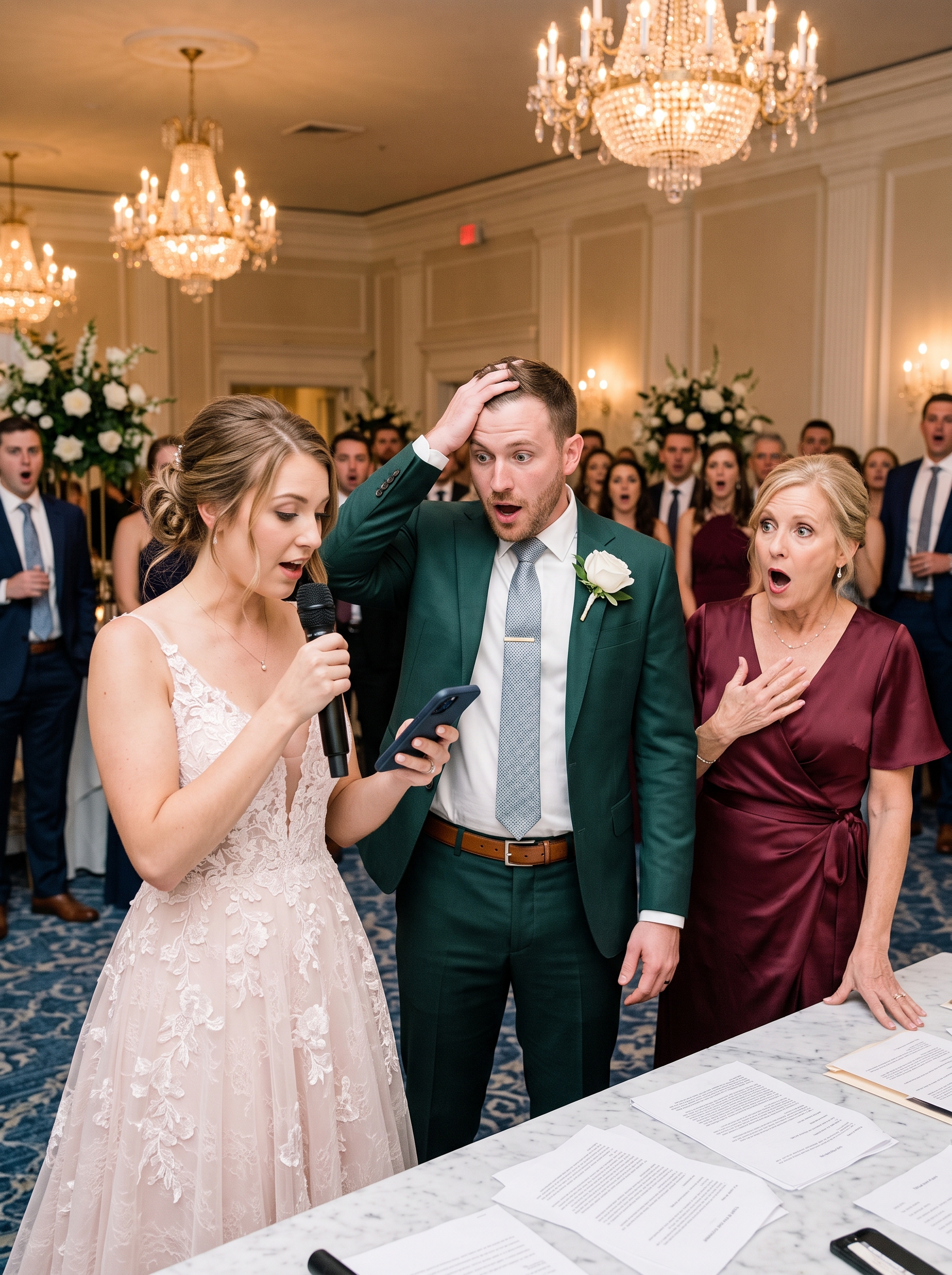
Michael followed as I walked toward the stage. The DJ saw the bride approaching and immediately lowered the music, probably assuming I was about to give an emotional speech thanking everyone for attending.
Instead, I picked up the microphone.
“Excuse me.”
My voice carried across the speakers, and conversations gradually disappeared. Guests turned toward me smiling while my parents watched proudly from their table, still unaware of what had happened only moments earlier.
Behind me, Michael spoke quietly.
“Put it down.”
I ignored him.
“First, I want to thank all of you for coming tonight to celebrate what was supposed to be one of the most meaningful days of my life.”
Several guests applauded, and someone called out that they loved me. I waited until the room became quiet again.
“However, I’ve just learned something interesting.”
Michael moved closer.
“Caroline.”
I turned slightly toward him before addressing the ballroom again.
“My husband has just informed me that the apartment I purchased years before this marriage will now become his mother’s new residence.”
The reaction moved slowly across the room. Conversations stopped, silverware froze against plates, and confused whispers spread between tables as people tried to understand whether they had heard me correctly.
Across the ballroom, Margaret carefully lowered her wineglass.
Michael’s face turned red.
“She’s joking.”
I looked directly at him and smiled.
“I wish I were.”
PART 2: THE ENVELOPE THAT TURNED THE ROOM AGAINST THEM
For several seconds, the ballroom seemed frozen. Guests stared between Michael, Margaret, and me while my parents slowly lowered their glasses, realizing that what had begun as a wedding celebration had suddenly become something entirely different.
Michael tried to laugh off what I had revealed.
“She’s had too much champagne.”
“I’ve had half a glass.”
“Caroline, come down.”
“In a minute.”
“This is not funny.”
“No. It isn’t.”
My heart was pounding, but the microphone made my voice sound calmer than I felt. I had imagined plenty of things going wrong at my wedding, from ruined flowers to a damaged cake, but never that my husband would treat our marriage as permission to hand my home to his mother.
Margaret finally stood from her table.
“This is ridiculous. Caroline is emotional. Weddings overwhelm young women.”
I was thirty-two years old, the chief financial officer of a medical equipment company, and the owner of the apartment they were discussing as though I had no say in it.
“You’re right about one thing. This wedding is overwhelming.”
Michael stepped closer and reached toward the microphone, but I moved it away.
“Don’t.”
For the first time that evening, uncertainty appeared in his expression. I turned back toward the guests and explained that the real problem was not simply Michael believing his mother could move into my apartment. The details I had noticed during our engagement suggested that this arrangement had been planned well before our wedding night.
“You ungrateful girl,” Margaret snapped.
My mother started to rise from her chair.
“Caroline?”
“I’m all right.”
Strangely, I meant it. I was hurt and furious, but I could finally see the situation clearly instead of searching for excuses to explain Michael’s behavior.
I reached into the ivory handbag beside the DJ booth and removed a sealed envelope. The instant Michael saw it, something changed in his face because he recognized it from my home office, although he had never bothered asking what was inside.
I opened the envelope and removed the first document.
“When I bought my apartment, it was purchased entirely in my name. Before this marriage. Before this relationship. Before Michael Harper ever entered my life.”
“Everyone knows that,” Michael snapped.
“Apparently not everyone.”
I lifted another document.
“Several weeks ago, Michael signed a prenuptial agreement.”
Whispers spread immediately across the ballroom.
“What?”
“A prenuptial agreement. It clearly states that all premarital property remains separate. My apartment remains mine. No spouse or family member has any right to occupy, transfer, lease, sell, or control it without my written consent.”
Margaret left her table and moved toward the stage.
“That document means nothing.”
I looked toward one of the tables.
“The notary who witnessed the signatures is sitting right there.”
Nearly every guest turned at once. A middle-aged man in a gray suit cleared his throat and raised his hand.
“I notarized it. Both signatures were valid. Both parties were present.”
Michael stared at him.
“You knew about this?”
“I was hired to notarize a document, not manage your reading habits.”
A few guests struggled to hide their laughter. Margaret immediately accused me of deceiving her son.
“You tricked him.”
“No, Margaret. I protected myself. There’s a difference. A trick is asking a woman to marry your son while planning to move into the home she paid for.”
Margaret’s expression darkened.
“You were joining our family.”
“I was not donating real estate.”
Michael stepped onto the stage, no longer pretending to be amused.
“You’re humiliating me.”
I looked at the man I had married only hours earlier. His anger was not coming from heartbreak; it came from the fact that the plan he expected me to accept quietly was now being exposed in front of everyone.
“No. I’m correcting the minutes.”
Michael leaned closer, and his voice was low enough to sound threatening even though the microphone still caught it.
“You will regret this.”
“Michael, you made your plan public the moment you delivered it like an order.”
“It was a family discussion.”
“No. A family discussion includes the person whose home you’re taking.”
That sentence changed the atmosphere completely. Suddenly, several strange moments from our engagement made sense: Margaret’s questions about my building’s occupancy rules, the moving-company brochure I had found in Michael’s briefcase, his insistence on delaying our honeymoon, and his mother’s repeated comments about older women needing somewhere comfortable to live.
My father finally stood.
“Michael, is this true?”
Michael said nothing.
His silence answered the question.
Margaret turned toward my parents.
“You raised a selfish daughter.”
My father placed his champagne glass down and reminded her that I had bought that apartment after years of exhausting work while paying off graduate-school debt. My mother added that I had saved for five years to afford it.
Margaret remained defensive.
“And my son sacrificed for his family too.”
“Then perhaps he should have bought you an apartment.”
This time, several guests openly laughed.
Michael glared at me.
“You’re enjoying this.”
“No.”
I genuinely wasn’t. Beneath the anger, I was grieving the marriage I thought I had begun that morning and the future I had imagined building with him. Months of compromises suddenly looked different now that I understood what Michael and Margaret had been preparing behind my back.
“I am not enjoying this. But I am done mistaking silence for grace.”
My hand moved toward my wedding ring. I looked at the diamond for a moment, remembering what it had represented only hours earlier, before slowly pulling it from my finger.
The entire room seemed to inhale at once.
“Caroline.”
I walked to the nearest table and placed the ring beside a champagne glass.
“Thank you.”
Michael stared at me.
“For what?”
“For showing me who you are before I changed the locks to make room for you.”
Margaret reacted immediately.
“You cannot walk away from a marriage during the reception.”
“I can walk away from a scam at any hour.”
Michael reached toward my arm, but I stepped away before he could touch me.
“Do not touch me.”
His hand stopped in midair, and dozens of people saw it. Whatever power Michael believed he possessed in private was disappearing beneath the attention of an entire ballroom.
I picked up the microphone one final time.
“The reception is already paid for. Please enjoy the dinner, the cake, and the open bar. I apologize for the interruption.”
Then I looked directly at Michael.
“No gifts will be returned to people who find this entertaining.”
Nervous laughter moved through the room, and my cousin Ellen actually raised her glass toward me. I put down the microphone and headed for the ballroom doors.
Margaret shouted after me.
“You’ll come crawling back when you realize marriage isn’t about selfish independence.”
I stopped at the doorway and looked over my shoulder.
“No, Margaret. Marriage isn’t about selfish independence. It also isn’t about organized theft.”
Then I walked out of my own wedding reception, leaving Michael, his mother, and their carefully arranged plan behind me.
What neither of them understood yet was that the prenuptial agreement was only the beginning of the consequences they were about to face.
PART 3: THE MOST EXPENSIVE MISTAKE HE NEVER GOT TO MAKE
Outside the hotel, the night air felt unexpectedly clean after everything that had happened inside. I stood beneath the entrance awning in my wedding dress, holding my clutch with my left hand now bare, and for the first time since Michael had announced his plan, I could finally breathe normally.
I managed to hold myself together until my parents came outside. Dad approached without his coat, while Mom followed behind him and gathered the train of my dress so it wouldn’t drag across the wet pavement.
Dad stopped in front of me and simply opened his arms. The moment I stepped into them, every emotion I had suppressed inside the ballroom finally broke loose.
“I’m sorry.”
Dad pulled back and stared at me.
“For what?”
“For ruining everything.”
His expression immediately hardened, not with anger toward me, but disbelief that I could blame myself.
“You did not ruin your wedding.”
He gently moved a strand of hair away from my face.
“You saved your life in formalwear.”
That managed to make me laugh through the tears.
My parents took me back to the apartment Michael had attempted to claim for his mother. Mr. Alvarez, the doorman, almost called me Mrs. Harper when I entered before quickly correcting himself.
“Ms. Reed.”
“Good evening.”
He gave me a quiet, reassuring look.
“Your home is safe.”
Those words meant more to me than he could possibly have known.
Inside, everything remained exactly where I had left it that morning: the blue velvet sofa, the white oak floors, my books beside the reading chair, the artwork I had purchased after my first promotion, and the bowl of lemons Mom always insisted made the kitchen feel alive.
Nothing inside the apartment had changed, yet I felt as though I were seeing my home for the first time.
I went into the bedroom, removed my wedding dress without anyone’s assistance, and carefully folded it over a chair. Mom sat nearby and watched me quietly.
“You don’t have to be strong tonight.”
“I’m not.”
“You looked strong.”
“I looked angry.”
Mom nodded.
“Good. Anger has carried women out of worse rooms than ballrooms.”
By the following morning, Michael had called seventeen times, while Margaret had tried five. I ignored Michael completely and blocked Margaret after her second voicemail shifted from outrage to bargaining.
Around noon, Mr. Alvarez called from downstairs.
“Ms. Reed, Mr. Harper is in the lobby.”
“Does he have an appointment?”
There was a brief pause.
“No.”
“Then no.”
Michael wasn’t allowed upstairs.
Minutes later, a message appeared on my phone.
“You embarrassed me in front of everyone.”
I finally responded.
“You embarrassed yourself by mistaking my home for a wedding gift.”
His reply came immediately.
“We need to talk like adults.”
“Adults read contracts before signing them.”
Then I blocked him.
Two days later, Grace Caldwell filed my petition for annulment. The documents cited misrepresentation, attempted coercion involving premarital property, and fraudulent inducement, transforming everything Michael had dismissed as a “family discussion” into precise legal language.
Michael’s attorney contacted Grace within twenty-four hours.
“My client feels this matter has been emotionally escalated.”
Grace leaned back in her chair.
“My client feels your client attempted a property grab during a wedding reception.”
“That characterization is inflammatory.”
“The ballroom footage is clearer than adjectives.”
I turned toward Grace.
“Footage?”
She smiled.
“Your cousin Ellen sent three angles.”
Within days, recordings from the reception began circulating through family groups and professional circles before eventually reaching strangers online. I received messages from women describing fiancés demanding ownership of their houses, future mothers-in-law asking invasive questions about finances, and relationships in which control had been disguised as commitment.
One message stayed with me.
“I wish I had done what you did.”
That was when I realized how many women recognized what had happened to me. Their circumstances were different, but the pattern was painfully familiar.
Michael’s professional life soon began unraveling as well. He worked in private wealth management, a career built almost entirely on convincing clients that he could be trusted with their assets, and footage of him attempting to dictate what happened to his bride’s property was hardly reassuring.
Clients began asking questions. One removed a portfolio, another followed, and eventually Michael’s firm placed him on temporary leave.
Margaret tried defending him publicly, but her efforts only made the situation worse. During a church luncheon, she complained that modern women no longer understood sacrifice, prompting someone to ask whether “sacrifice” meant surrendering real estate without consent.
Three weeks after the wedding, Michael sent me a letter.
“Caroline,
I handled everything badly. My mother is old-fashioned and afraid of being alone. I should have discussed it with you privately. I was embarrassed, and I reacted poorly. We can still fix this. We don’t have to throw away a marriage over an apartment.
Michael”
I read it twice, searching for something that never appeared.
An actual apology.
Michael still framed the problem as my reaction rather than his behavior. The language had softened, but the strategy underneath it remained unchanged, so I placed the letter beside my copy of the prenuptial agreement and continued with the annulment.
The hearing itself was surprisingly brief.
Michael appeared in a gray suit while Margaret sat behind him clutching her handbag. When the judge gave him an opportunity to speak, he stood and attempted to reduce everything that happened to a misunderstanding.
“Your Honor, this was a misunderstanding between newlyweds that became public before it could be resolved.”
The judge looked over her glasses.
“You informed your wife during the reception that your mother would be moving into her premarital residence?”
“I phrased it poorly.”
“That was not my question.”
Michael had no answer.
Grace stood next.
“My client requests annulment and full enforcement of the prenuptial agreement.”
The judge granted both.
Outside the courtroom, Michael caught up with me near the elevators.
“Caroline.”
I stopped.
“My mother pushed too hard.”
I almost smiled because even after everything, his first instinct was still to move responsibility onto someone else.
“There it is.”
“What?”
“The first betrayal after the last one. Blame her.”
“She did push.”
“And you carried.”
He fell silent.
“You could have said no to her at any point.”
“She’s my mother.”
“And I was your wife.”
The elevator arrived, and I stepped inside. Michael remained outside, looking as though he believed one final sentence might somehow reverse everything.
“Did you ever love me?”
“Yes.”
His expression changed.
“Then why is it so easy for you to leave?”
I held the elevator door for another second.
“It wasn’t easy. It was necessary.”
Before the doors closed, I gave him the answer I wished I had understood much earlier.
“That’s the part you never learned about women like me. We don’t walk away because we feel nothing. We walk away because we finally feel ourselves.”
The doors closed between us.
Six months later, I hosted dinner in the same apartment Michael had once promised to his mother. The locks were different, some of the furniture had changed, and new artwork covered the walls, but most importantly, the silence inside my home no longer felt lonely.
My parents came, Ellen brought wine, and Grace joined us not as my attorney but as my friend. At one point, Mom looked around the apartment and smiled.
“It feels more like you now.”
“It is.”
A year after the wedding, I purchased another apartment near the hospital district. I didn’t need another property for myself, so I partnered with a nonprofit and made the apartment available to women leaving financially controlling relationships.
We named it The Reed Room.
The first woman who arrived carried two suitcases, a toddler, and a folder of documents pressed tightly against her chest. When I handed her the key, embarrassment and relief competed across her face.
“I’m sorry. I don’t know why I’m crying.”
“Because doors matter.”
She stared down at the key.
“Is it really mine for now?”
“Yes.”
“No one can come in?”
“No one you don’t invite.”
I recognized the relief in her expression because I had once felt it myself.
Later that evening, I returned to my own apartment and paused in the doorway. On the console table sat the envelope from my wedding, now preserved behind museum glass with the prenuptial clause that had protected my home inside it.
Some visitors thought displaying it meant I was bitter.
They misunderstood.
It wasn’t a monument to betrayal. It was a reminder that loving someone should never require becoming defenseless, and sometimes the most important protection is the protection you put in place before discovering you’ll need it.
I occasionally heard pieces of Michael’s life through mutual acquaintances. He eventually moved to a smaller firm, Margaret sold her house, and the two of them ended up renting a condo together outside the city.
Perhaps Michael eventually understood what he had done.
I no longer needed him to.
The woman I had been on my wedding night might once have waited for an apology, an explanation, or proof that Michael finally understood what he had nearly taken from me.
The woman I became stopped waiting.
I changed the locks. I kept my home. And then I used what I had learned to create a safe door for someone else.
Whenever people later asked why I had exposed Michael publicly instead of quietly resolving everything behind closed doors, my answer remained simple.
“Because private was where they planned to take it.”
And that was why I chose the one place they never expected me to fight back.
“Public was where I took it back.”