
The steady beeping of the heart monitor was the only sound keeping me connected to reality.
It sounded too much like a countdown.
I sat inside a painfully white room at Portland Memorial Hospital, watching my mother sleep. Her skin, normally warm and deep brown, looked gray beneath the fluorescent lights.
She had survived more than most people could imagine.
Twenty years earlier, she had received a folded American flag after my father’s helicopter went down during a deployment in Afghanistan. She had stood beside his grave as a bugler played the final notes, then returned home and raised me alone.
She had survived grief, poverty, and decades of sacrifice.
I could not let a damaged heart valve be the thing that finally defeated her.
“Thirty-six hours, Aaron,” Dr. Patel had told me before sunrise. His voice had been low and painfully direct. “We need the deposit to reserve the surgical suite and the specialized perfusion team. If it is not secured today, the team will be assigned to another patient. Your mother cannot safely remain on the waiting list.”
I looked down at my hands.
They were scarred and rough from years of carrying a rifle overseas. More recently, they had been burned by soldering equipment, chemicals, and machinery inside the cold workshop behind my rented house.
After the Army medically discharged me, I returned home carrying a severe case of post-traumatic stress disorder and more guilt than I knew how to survive.
During my final deployment, my closest friend, Lucas, had been struck by shrapnel. A fragment tore through an artery in his leg.
I had pressed both hands against the wound while he bled into the desert sand.
Nothing I did could stop it.
I had watched the life leave his eyes while waiting for an evacuation helicopter that arrived too late.
That moment followed me home.
It entered my dreams, my marriage, and every quiet room.
Eventually, I decided to build something that could prevent another soldier from dying the way Lucas had.
For four years, I developed the Guardian Hemostatic Compound, a rapidly expanding medical foam made from microscopic particles designed to seal major arterial injuries within seconds.
Most people thought I was delusional.
To them, I was only a damaged veteran wearing an old field jacket and wasting my disability payments on chemicals and 3D printers.
That was certainly what my former wife, Lauren, believed when she handed me divorce papers.
Lauren judged people by their income, clothing, and social position. When my nightmares worsened, she placed a mental health brochure beside my breakfast instead of asking whether I was all right.
When I invested my disability payments in laboratory equipment instead of vacations and expensive furniture, she called me irresponsible.
During our divorce, she told the mediator that I was financially unstable, mentally broken, and using scientific fantasies to avoid getting a real job.
I reached inside my faded canvas jacket.
A stiff rectangular document rested against my chest.
My invention was no longer a fantasy.
The Defense Department had completed its testing. The device had received emergency authorization for battlefield use, and the government had purchased exclusive military distribution rights.
The document in my pocket was a United States Treasury payment for five million dollars.
It was the first installment of a larger defense contract.
It represented years of work, Lucas’s memory, and the possibility of saving thousands of lives.
But at that moment, none of that mattered as much as my mother.
The money could pay for her surgery.
I kissed her forehead and left the hospital.
Cold rain fell across Portland as I walked toward the parking structure. I barely noticed it.
All I needed to do was deposit the payment into the account connected to my family trust and transfer the surgical funds to the hospital.
Unfortunately, that account was held at Pacific Crest Bank.
The same branch where Lauren had recently become regional director.
I stood across from the bank’s glass tower, watching well-dressed employees move through the revolving doors.
Anxiety tightened around my chest.
I knew what people inside would see when I entered.
A tired veteran in worn boots and an old jacket.
Not an inventor.
Not a man carrying a government contract.
Not someone whose mother was running out of time.
I forced myself across the street.
The lobby smelled of polished stone, espresso, and wealth. Employees lowered their voices when I passed. A young teller watched me suspiciously, one hand moving beneath the counter.
I ignored the teller line and walked toward the offices behind the glass wall.
Lauren sat behind an enormous walnut desk. She wore a fitted gray suit and was studying a report on her tablet.
When she looked up and saw me, irritation crossed her face.
“Aaron,” she sighed. “If this concerns the settlement adjustment, speak with my attorney.”
“This has nothing to do with the divorce. I need to deposit a federal payment and authorize an immediate transfer to Portland Memorial.”
Her eyes moved slowly over my clothes.
“There are machines in the lobby for ordinary deposits.”
“This cannot go through a machine.”
She leaned back.
“Did someone finally buy one of those strange devices you built in your shed?”
I ignored the insult.
I took the Treasury document from my jacket and placed it in the center of her desk.
Lauren looked down.
Her expression changed when she saw the amount.
Five million dollars.
Her eyes shifted to the Treasury seals and then to my name printed on the payee line.
For several seconds, the room was silent.
Then she smiled.
It was not surprise or pride.
It was contempt.
“You cannot possibly expect me to believe this.”
“It is authentic. The procurement office’s verification number is attached. Call them.”
She lifted the document carefully.
“You have always been committed to your delusions, Aaron. But forging a government payment is not pathetic. It is criminal.”
“My mother needs surgery tomorrow morning,” I said. “The hospital will release the surgical team if the deposit is not made today. Verify the payment. Run every compliance check you need, but do it now.”
Lauren studied me with the same expression she had worn during our divorce.
She still saw the man waking from nightmares.
She did not see what I had built after she left.
“You need treatment,” she said with false sympathy. “Your PTSD has finally destroyed your judgment. The government is not giving five million dollars to an unemployed veteran who plays with chemicals.”
Before I could answer, she gripped the document with both hands.
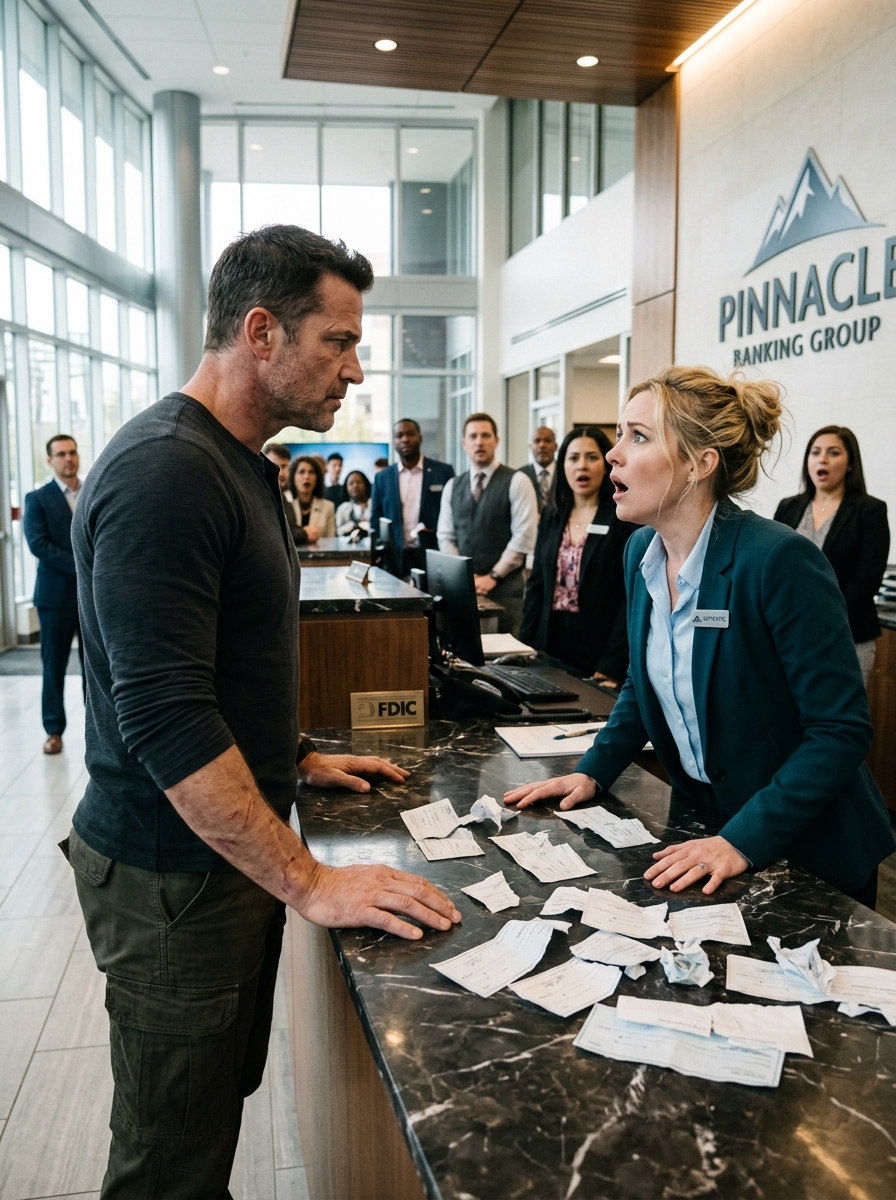
She tore it in half.
The sound exploded inside my head like a rifle shot.
Then she placed the halves together and tore them again.
Pieces of the payment fluttered onto her desk.
“There,” she said. “Now leave before you make this worse.”
For one terrible second, I could not breathe.
“You destroyed a validated federal payment instrument.”
“I prevented fraud.”
She pressed a button beneath her desk.
Her assistant appeared, followed by two security guards.
“Call the police,” Lauren ordered. “Mr. Carter attempted to deposit a forged Treasury document.”
The guards stepped toward me.
“Keep your hands visible,” one of them said.
I did not argue.
I looked through the glass wall toward the street.
Lauren laughed.
“What are you waiting for? Another imaginary rescue?”
“No,” I replied.
A heavy rhythmic sound rolled across the city.
Helicopter rotors.
“I’m waiting for the people who issued the payment.”
Traffic outside stopped.
Three black armored vehicles pulled against the curb. Emergency lights flashed across the gray morning.
The bank’s doors opened, and military police entered in disciplined formation.
The civilian guards immediately stepped backward.
Behind the officers walked a man in a formal military uniform. Medals covered his chest, and four silver stars shone on his shoulders.
General Thomas Rourke, director of the Defense Department’s advanced medical research command.
He moved through the lobby without hesitation and entered Lauren’s office.
Then he stopped in front of me and saluted.
“Sergeant Carter.”
I returned the salute.
“General.”
The entire bank had gone silent.
“I apologize for the arrival,” General Rourke said. “The procurement division detected that you were personally carrying the payment to a civilian bank. Once we learned about your mother’s medical deadline, I came to make sure nothing delayed the transfer.”
“How is she?” he asked.
“Running out of time.”
Lauren rose from her chair.
“This man is my former husband,” she said. “He is unemployed and attempted to use a fraudulent check.”
General Rourke turned slowly toward her.
His eyes dropped to the torn pieces on her desk.
“Did you destroy this document?”
“It was obviously fake.”
“What Sergeant Carter created in his workshop is the Guardian Hemostatic Compound,” the general said. “During a classified field trial last month, it stopped fatal bleeding in twelve wounded soldiers.”
Lauren’s face went pale.
“The government purchased military rights to his technology for twenty-eight million dollars. The payment you destroyed was the first five-million-dollar installment.”
Lauren looked at me.
The confidence drained from her expression.
The bank’s regional counsel, a woman named Cynthia Blake, hurried into the office.
She looked at the general, the military police, and the shredded Treasury document.
“Ms. Lawson,” she said to Lauren, “what did you do?”
“I followed fraud procedures.”
“You are prohibited from personally handling accounts connected to your former spouse,” Cynthia replied. “That conflict is documented in your employment file.”
She turned toward me.
“Mr. Carter, we can open an emergency credit line while the payment is replaced.”
“That will not be necessary,” General Rourke said. “The Department of Defense has already wired the surgical deposit directly to Portland Memorial.”
My knees nearly weakened.
My mother’s surgery was secured.
But the general did not leave.
“There is another matter,” he said.
A man in a dark suit stepped from behind the military officers and displayed an FBI badge.
“During Sergeant Carter’s security review,” the agent said, “we found irregularities involving his Veterans Affairs benefit payments.”
Lauren gripped her desk.
“That was a banking error.”
“Eighteen months ago, someone using your administrative credentials placed a false criminal-risk freeze on Mr. Carter’s account,” the agent continued. “The report claimed suspected narcotics activity despite having no supporting evidence.”
Lauren said nothing.
“The freeze prevented him from receiving federal disability payments for nearly three months.”
Her assistant stared at her in horror.
“You used your position inside a federally insured institution to interfere with government benefits owed to a wounded veteran,” the agent said. “That may constitute wire fraud, abuse of authority, and unlawful interception of federal funds.”
Lauren’s composure vanished.
“Aaron,” she whispered. “Tell them we had a difficult divorce. Tell them I was angry. I made a mistake.”
I looked at the woman who had mocked my injuries, interfered with my income, and attempted to destroy the money that could save my mother.
“You did not make a mistake,” I said. “You made a decision because you believed I could never defend myself.”
The agent placed her under arrest.
Her cries echoed through the same lobby where employees had judged my clothes only minutes earlier.
General Rourke put a hand on my shoulder.
“Let’s get you back to the hospital.”
The armored convoy moved quickly through the wet streets.
When we entered Portland Memorial, Dr. Patel was waiting.
“The payment cleared,” he said. “Your mother is being prepared for surgery now.”
“I need to see her.”
“You have two minutes.”
He led me through the corridor.
My mother lay on a gurney, already drowsy from medication.
I held her hand.
“Mom.”
Her eyes opened slightly.
“Aaron,” she murmured. “Did your invention work?”
Tears filled my eyes.
“Yes. It worked.”
“And the surgery?”
“It is happening. You are going to be all right.”
She smiled.
“I always knew you would finish it.”
The nurses rolled her toward the operating room.
The doors closed.
General Rourke sat beside me in the waiting area. He did not offer false reassurance. He simply remained there, the way soldiers remain beside one another when nothing useful can be said.
One hour passed.
Then two.
Then three.
Suddenly, an alarm sounded behind the surgical doors.
A nurse rushed into the hallway demanding a crash cart.
I stood.
Dr. Patel appeared in the doorway. His surgical gown was covered in blood.
“She is hemorrhaging,” he shouted. “The aorta tore near the repair site. Her tissue is too fragile to hold the sutures.”
The smell of blood reached me.
For a moment, I was back in Afghanistan with my hands pressed against Lucas’s leg.
“Use the compound,” I said.
Dr. Patel stared at me.
“What?”
“The Guardian compound. Use it on the arterial tear.”
“This is not a battlefield wound.”
“The principle is the same. It was designed to bind with damaged tissue and create a flexible seal.”
General Rourke opened a temperature-controlled case carried by one of his aides. Inside was a silver canister stamped with a classified research seal.
He placed it into the surgeon’s hands.
“The product received emergency medical authorization last week,” the general said. “If sutures cannot hold, apply the foam directly to the breach.”
Dr. Patel looked at the canister, then at me.
“If this fails—”
“She dies if you do nothing.”
He nodded and returned to the operating room.
The doors closed again.
The next fifteen minutes felt longer than the previous four years.
I stood beside the surgical entrance, listening to muffled commands and alarms.
Then the continuous warning tone changed.
It broke into a slow rhythm.
Beep.
Beep.
Beep.
The doors opened.
Dr. Patel removed his mask. His face was exhausted, but his eyes held disbelief.
“It worked.”
I could not speak.
“The compound expanded immediately and bonded with the damaged tissue. It sealed the rupture long enough for us to reinforce the artery with a graft.”
He took a breath.
“Her pressure has stabilized. Her heart is beating normally. She is going to survive.”
The strength left my body.
I slid down the wall and covered my face as years of grief, guilt, and exhaustion finally broke through me.
General Rourke stood nearby with a quiet smile.
Six months later, a ribbon-cutting ceremony was held on a bright spring morning.
The new Carter-Reed Institute for Emergency Trauma Research stood on the same property where my leaking rental workshop had once been.
The glass-and-steel building contained laboratories, training rooms, and a medical manufacturing wing. Natural light filled every floor.
I stood at the podium wearing a dark suit, looking across a crowd of military officers, surgeons, scientists, investors, and combat medics.
My attention remained on the front row.
My mother sat beside General Rourke.
She looked healthy again. Her color had returned, and the Gold Star pin she always wore rested above a heart that now beat steadily.
The Guardian compound had become standard equipment in military trauma kits. Its civilian version had received full approval and was being distributed to major trauma centers across the country.
With the first profits from the contract, I established a foundation providing emergency surgery and medical support for uninsured veterans and their immediate families.
No family would ever be forced to beg a bank employee for permission to save someone they loved.
As the audience applauded, my phone vibrated.
An email from my legal team confirmed that Lauren had pleaded guilty to federal fraud, abuse of fiduciary authority, and interference with protected veteran benefits.
She received a five-year federal sentence, was ordered to repay the Veterans Affairs Administration, and was permanently barred from holding a banking or financial license.
Attached to the email was a letter she had written from prison.
It was not an apology.
She asked me to use my government contacts to help shorten her sentence. She blamed the divorce, emotional stress, and misunderstanding.
She still believed consequences were something others had inflicted upon her.
I deleted the message.
Then I took a photograph from my jacket.
It had been taken that morning.
My mother stood beside me, smiling and healthy. General Rourke stood on my other side, saluting the camera.
I placed the picture inside an envelope addressed to Lauren’s inmate number.
On the back, I wrote one sentence.
Real power is used to heal the wounded, not to crush those who have already sacrificed.
I sealed the envelope and handed it to my assistant.
Then I stepped away from the podium and walked into the sunlight.
My mother was waiting for me.
For years, I had believed I failed Lucas because I could not stop his bleeding.
Now I understood that failure had not been the end of his story.
It had become the beginning of something that would save lives.
I reached the front row, leaned down, and embraced my mother.
Her heart was beating strongly against mine.
That sound was no longer a countdown.
It was a promise.