
Part 1 – My Six-Year-Old Nephew Crawled Seven Blocks With an Injured Leg to Save His Little Sister, Then the Doctor Told Me the Injury Wasn’t New
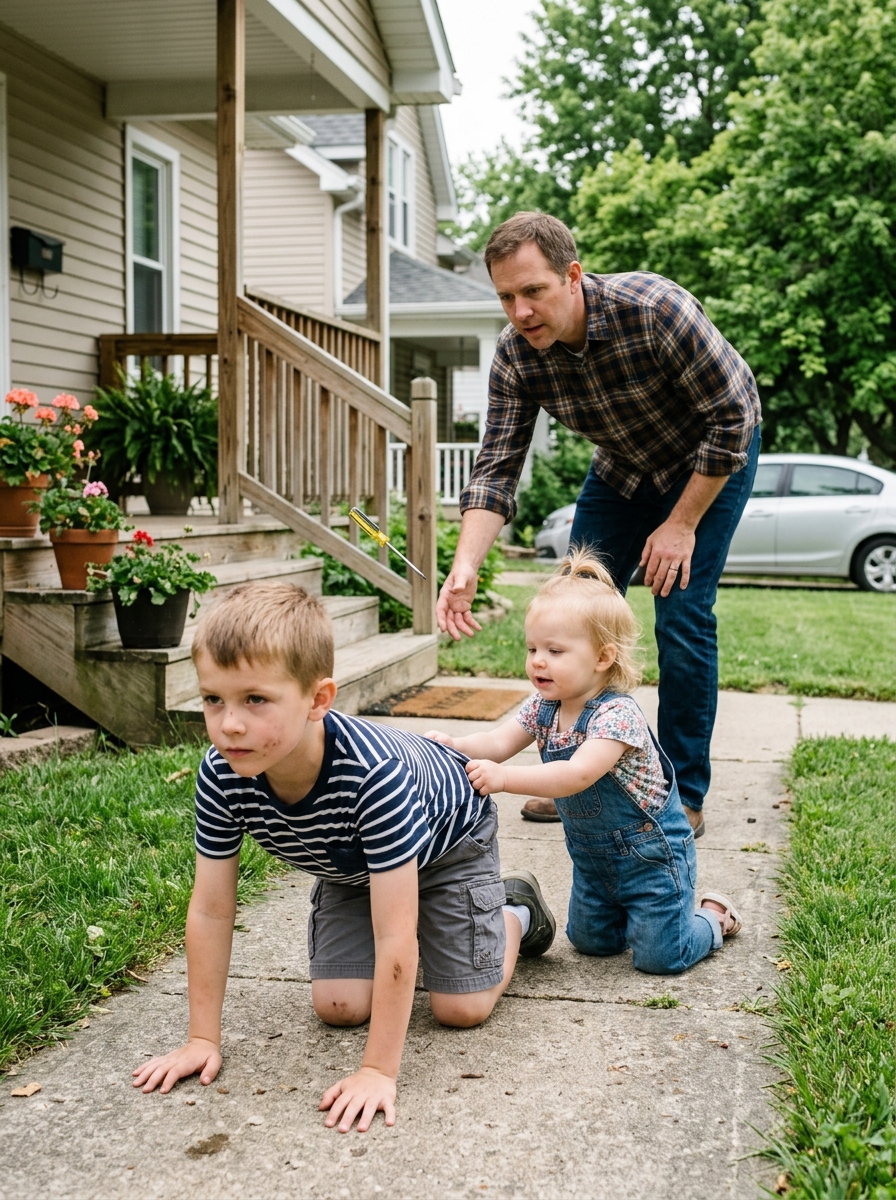
I was repairing a loose hinge on my front porch when I heard a strange scraping sound coming from the steps. At first, I assumed something had fallen near the railing, but when I turned around, the screwdriver slipped from my hand and struck the wooden boards.
A small boy was dragging himself toward my porch with both hands while a much younger girl struggled behind him, clutching the back of his shirt. It took my mind only a second to recognize them as my six-year-old nephew Drew and his three-year-old sister, Lily.
Drew’s hair was soaked with sweat and plastered against his forehead. His face looked gray beneath the dirt, one leg trailed stiffly behind him, and his arms trembled every time he pulled himself another few inches forward.
Lily looked almost as frightening.
She stumbled behind her brother, gripping his shirt with both fists as though letting go would mean losing the only person keeping her safe. Neither child should have been anywhere near my house alone because their home was seven blocks away.
I rushed down the porch steps just as Drew’s arms began giving out.
“Drew. God, buddy, what happened?”
He lifted his face toward me.
His eyes were glassy with exhaustion.
“She locked us downstairs again.”
One word lodged immediately in my mind.
Again.
Not once.
Not an accident.
Again.
“I had to get Lily out,” Drew whispered. “She was really hungry.”
I picked Lily up first because she was wobbling so badly she could barely remain standing. The moment I lifted her, another kind of fear went through me because she felt frighteningly light beneath her dirty shirt.
Then I went back for Drew.
I slipped one arm behind his shoulders and the other beneath his good leg, doing everything possible not to move the injured one. His lips pressed tightly together when I lifted him, but he barely made a sound.
That frightened me more than screaming would have.
I carried them inside and carefully lowered Drew onto the couch. Although the house was already warm from the summer morning, I brought blankets for both children because they were trembling.
Lily spotted a sleeve of crackers on the table.
She grabbed it with both hands.
Then she began eating so quickly that I instinctively moved closer, afraid she might choke.
Before I could say anything, Drew reached toward her.
He was covered in dirt, visibly injured, and barely able to remain upright, yet he rubbed his little sister’s back with one hand.
“Slow, Lily. Slow.”
I stared at him.
Drew was six years old.
He should have been asking me to make the pain stop.
Instead, his first concern was whether his three-year-old sister was eating too quickly because she had apparently been hungry long enough to forget how to slow down.
Whatever explanation Reena eventually gave me, I already knew one thing.
These children needed help immediately.
I pulled out my phone.
“I’m calling for help.”
Drew’s expression changed at once.
I expected relief.
What I saw was fear.
“She’ll be mad.”
I crouched directly in front of him.
I wanted him to understand every word.
“She is not touching you again.”
Then I called 911.
I gave the dispatcher my address, explained the children’s ages, and told her Drew appeared to have a serious leg injury while Lily looked weak and underfed. Then I repeated what my nephew had just told me—that their stepmother had locked them downstairs.
Even saying those words aloud felt unreal.
Reena had been part of our family for years.
Three years earlier, after my younger brother Aaron died unexpectedly from a heart attack at only thirty-five, she had stood beside his casket promising everyone that her only concern was creating stability for his two children.
I had believed her.
I wanted to believe her.
Aaron had been my younger brother, and his death happened so suddenly that none of us had time to prepare for the life left behind. Drew was only three then, Lily was still a baby, and I thought the most respectful thing I could do was remain available without interfering with Reena’s role as their surviving parent.
So I called regularly.
I offered groceries whenever I was already heading to the store.
I bought birthday presents.
I volunteered to repair anything around the house that Aaron would once have handled himself.
At first, Reena simply told me the children were sleeping or sick.
Then the excuses became more personal.
“They had a rough night.”
“Drew isn’t feeling social today.”
“Lily needs rest.”
Eventually, she gave me the explanation that finally convinced me to stop pushing.
“You remind them too much of their father.”
The first time Reena said it, I didn’t know how to respond.
I understood grief well enough to believe that seeing Aaron’s brother might stir emotions the children weren’t ready to handle, and because Reena was the parent making their daily decisions, I told myself respecting her boundaries was the responsible thing to do.
I didn’t disappear completely.
I kept calling.
I continued buying gifts.
I still offered help whenever possible.
But whenever Reena said no, I stopped challenging her.
Standing in my living room with Drew injured on the couch and Lily eating crackers as though she hadn’t seen food in days, every one of those decisions came back to me differently.
The sirens arrived three minutes after my call.
Those three minutes felt much longer.
I sat near Drew while Lily remained beside him, and I deliberately avoided overwhelming either child with questions. I wanted answers badly enough that my chest hurt, but Drew looked like he was holding himself together through stubbornness alone.
When the paramedics entered, everything became focused and controlled.
They stabilized Drew’s injured leg, checked Lily’s pulse and temperature, and spoke gently enough that neither child seemed frightened by them. Two police officers arrived as well, and while the medical team worked, I gave them Reena’s address.
It was the same house where I had repeatedly tried to visit Aaron’s children.
The same house where I had been told they were sleeping.
The same house where birthday gifts had been accepted at the door while I remained outside.
Now my nephew had dragged himself seven blocks from that house with an injured leg.
I followed the ambulance to the hospital.
Drew was taken for X-rays while Lily received bloodwork and fluids. For the first time since they appeared on my porch, there was nothing immediate for me to do, and somehow that made everything worse.
I paced the waiting room.
Every unanswered phone call replayed in my head.
Every excuse Reena had given me.
Every time she told me the children were tired or sick.
Every birthday present I had eventually carried back to my truck because she wouldn’t let me hand it directly to Drew or Lily.
After Aaron died, Reena used one word constantly.
Stability.
She needed stability.
The children needed stability.
Everyone had to give them room to rebuild stability after losing Aaron.
It sounded reasonable.
That was why I had believed it.
I had convinced myself that keeping the peace might protect Drew and Lily from more disruption after losing their father. Now I couldn’t stop seeing the way Drew had positioned himself beside his sister even while injured, as though protecting Lily had become such an ordinary responsibility that he no longer expected an adult to do it.
He was six years old.
Drew should have been worried about cartoons, cereal, scraped knees, or whether someone would make him go to bed before he felt tired. He shouldn’t have known how to get his three-year-old sister out of a locked basement.
He shouldn’t have been responsible for deciding whether his injured body could carry him seven blocks toward the one relative he believed might open the door.
And he definitely shouldn’t have been afraid that calling an ambulance would make an adult angry.
I stopped pacing.
The thought of Aaron became almost unbearable.
My brother had trusted me in the ordinary way brothers trust each other after a lifetime of shared history. He never made me formally promise to protect his children because at thirty-five, neither of us imagined he needed to.
Then he died.
I had treated Reena’s decisions as the closest thing available to Aaron’s wishes because she was the children’s surviving parent. At the time, I had no reason to believe she was lying.
Now Drew’s sentence wouldn’t leave my head.
“She locked us downstairs again.”
Again meant there had been another time.
Maybe several.
And what Drew said afterward frightened me almost as much.
“I had to get Lily out.”
Not we got out.
Not someone opened the door.
I had to get Lily out.
My six-year-old nephew had apparently assigned himself responsibility for saving his little sister.
I wanted to drive directly to Reena’s house and demand an explanation for every closed door, unanswered call, and refused visit. But Drew and Lily were inside that hospital, and the only useful thing I could do was remain where they could find me.
So I waited.
My mind kept reaching backward.
I remembered the first Christmas after Aaron died when I bought Drew a toy truck and Lily a stuffed animal. Reena met me at the door and said the children were resting, so I handed her the gifts without insisting on seeing them.
I told myself not to make the moment about me.
Months later, on Drew’s birthday, I called and heard noise behind Reena before she stepped away from the phone. When she returned, she told me Drew was too tired to talk.
For a moment, I wondered why my nephew never seemed available anymore.
Then I dismissed it.
Children changed.
Families developed new routines.
Grief looked different inside every house.
All of those explanations were reasonable.
That was what made them so easy to believe.
Now I wondered whether every reasonable explanation I accepted had helped build a wall around Aaron’s children.
I didn’t know yet.
And despite my anger, I refused to turn uncertainty into certainty before the facts were established.
But some facts required no interpretation.
I had seen Drew crawling toward my porch.
I had felt how little Lily weighed when I lifted her.
I had watched a three-year-old grab crackers with both hands and eat desperately.
And I had seen terror cross Drew’s face when I told him I was calling for medical help.
Eventually, a nurse allowed me to see Lily briefly.
She looked impossibly small against the hospital bed while fluids ran through an IV line. I stayed beside her without asking questions because my anger wouldn’t help anyone if I frightened a three-year-old into believing she had to explain things she might not even understand.
Drew was still undergoing imaging.
I checked my phone several times without processing what the clock actually said.
There were relatives I could call.
There were questions I desperately wanted answered.
But I didn’t yet know what to tell anyone beyond what I had already told police.
Aaron was dead.
His children had arrived at my house in a condition I could barely accept.
Everything after that needed facts.
Not excuses.
Not assumptions.
Not whatever explanation made the situation easiest to live with.
Facts.
When the doctor finally entered the waiting room carrying Drew’s chart, I knew from his expression that the news wasn’t simple.
I stood immediately.
For one final second, I expected the most obvious explanation.
Drew had injured his leg while escaping the basement.
Maybe he had fallen on the stairs.
Maybe he landed badly somewhere along those seven blocks.
What had already happened was terrible enough.
I wasn’t prepared for another layer.
“Mr. Calder?”
“Yes.”
The doctor glanced briefly at the chart.
“The X-ray tells us this did not happen today.”
I stared at him.
At first, the sentence didn’t make sense.
Drew had arrived that morning dragging the injured leg, so naturally I had assumed the injury happened during his escape. But if the doctor was telling me otherwise, then my nephew had already been hurt before he began crawling seven blocks toward my house.
Before Lily grabbed his shirt.
Before he reached my porch.
Before he whispered that Reena had locked them downstairs again.
My stomach turned.
“How old is the injury?”
The doctor lowered his voice.
And before he even answered, I realized the question confronting us had completely changed.
It was no longer simply what Reena had done that morning.
It was how long my six-year-old nephew had been living with an injured leg behind that closed door while I kept accepting explanations about why I wasn’t allowed to see him.
I thought about Aaron again.
My brother had died believing Reena would give his children the stability she promised.
I had believed it too.
Until Drew dragged himself and his hungry little sister seven blocks to my porch and forced me to confront the possibility that everything we had believed about their life after Aaron’s death had been wrong.
Part 2 – The Doctor Said Drew Had Been Walking on a Broken Leg for Days, and What Police Found at the House Explained Why He Had Crawled to Me
The doctor lowered his voice before explaining that Drew’s fracture showed early signs of healing. Based on what the X-ray revealed, the injury was several days old, which meant my six-year-old nephew had already been living with a broken leg long before he dragged himself and his little sister seven blocks to my porch.
I stared at the image, struggling to reconcile it with the child I had carried into my house that morning. Drew hadn’t injured himself while escaping the basement as I originally assumed; he had escaped despite already being injured, somehow forcing his small body forward because he believed Lily needed him to get her somewhere safe.
“Was the fracture ever treated?”
“There’s no indication that it was properly immobilized.”
The doctor explained that Drew would need treatment and continued monitoring, but his concern extended beyond the fracture itself. Lily’s examination also showed dehydration and signs that she hadn’t been receiving adequate nutrition consistently, making it impossible to treat what happened as a single bad morning.
Child-protection authorities had already been contacted.
A hospital social worker joined us shortly afterward, accompanied by one of the officers who had responded to my house. They assured me Drew and Lily wouldn’t simply be returned to Reena while investigators were trying to understand how a six-year-old with an untreated fracture and a hungry three-year-old had ended up traveling across the neighborhood alone.
I asked whether police had reached Reena.
They had.
According to the officer, she initially claimed she had left the children sleeping while she went to a nearby pharmacy. When police informed her that Drew and Lily were at the hospital, her explanation changed and she said Drew must have unlocked the basement himself after being sent downstairs for misbehaving.
“Was the door locked?”
The officer looked at me.
“From the outside.”
That answer made my stomach tighten.
Police had found a sliding bolt installed high on the hallway side of the basement door, well beyond the children’s reach. Inside the basement were two thin mattresses, several blankets, children’s clothing, empty water bottles, and food wrappers.
There was no bathroom downstairs.
There was no refrigerator.
And according to the officer, the small basement window appeared to have been forced open from inside.
I immediately pictured Drew.
“Could he fit through it?”
“A child his size could.”
The officer paused.
“We found dirt and fabric caught along the frame.”
I looked toward the hallway leading to my nephew’s room.
Somehow, Drew had climbed through that window with a broken leg. Then he had helped Lily through and started toward the one house he apparently still remembered as safe.
Mine.
That realization brought no comfort.
It only made me wonder how desperate those children had become before a six-year-old decided crawling seven blocks was safer than staying home.
When I was finally allowed into Drew’s room, his leg had been stabilized and he looked exhausted beneath the blanket. He immediately asked where Lily was, and the tension in his face didn’t ease until I assured him she was safe in another room with nurses.
“Is she getting food?”
“Yes.”
“Enough?”
The question nearly broke me.
“Enough.”
Drew nodded.
Then he whispered, “Good.”
I sat beside him without asking about Reena or the basement. The social worker had already explained that trained specialists needed to handle detailed interviews so the children weren’t forced to repeatedly relive what happened for every adult who wanted answers.
Instead, I asked whether he wanted anything.
He thought for several seconds.
“Can I save my crackers?”
“For later?”
He nodded.
“For Lily.”
I swallowed.
“She has her own food.”
Drew looked uncertain.
“What if it’s gone tomorrow?”
I didn’t have an immediate answer.
Not because I didn’t know what to say, but because I suddenly understood that this wasn’t a child thinking about an afternoon snack. Drew had learned to plan around scarcity.
“There will be food tomorrow.”
I leaned closer.
“And the day after that.”
He studied my face as though deciding whether adults were still capable of making promises he could trust.
“For Lily too?”
“For both of you.”
Only then did he open the crackers.
Later that afternoon, the hospital allowed Lily to visit him. She climbed carefully onto the chair beside his bed and immediately reached for his hand, while Drew began inspecting her as though he were the parent and she were the child he had brought to the hospital.
“Did you eat?”
Lily nodded.
“What?”
“Chicken.”
“And apples.”
She smiled.
“And pudding.”
Drew finally relaxed.
Watching them together made the pattern impossible to miss.
At six years old, Drew had somehow become responsible for monitoring whether his sister ate, whether she was frightened, and whether she remained safe. He wasn’t simply protective in the ordinary way older siblings sometimes are; he behaved as though Lily’s survival depended on him.
The social worker noticed it too.
She sat nearby and spoke casually with the children without forcing the conversation toward the basement. Lily talked about the ambulance, the hospital bracelet, and the crackers she had eaten at my house.
Then she said something quietly.
“Uncle Peter has food upstairs.”
The social worker smiled.
“Do you like eating upstairs?”
Lily nodded enthusiastically.
“Downstairs doesn’t have food.”
Drew immediately looked toward her.
“Lily.”
His voice wasn’t angry.
It was frightened.
The social worker responded before he could say anything else.
“Drew, nobody is in trouble for talking here.”
He stared at the blanket.
“She’ll know.”
“Reena isn’t here.”
“She always knows.”
His eyes filled with tears.
That was the first moment all day when Drew stopped looking like the child who had somehow carried responsibility for both himself and his sister. He looked six again.
Small.
Tired.
Terrified.
The social worker didn’t push him.
Instead, she reassured both children that they were safe and changed the subject. There would be formal interviews later, conducted by people trained to ask questions without leading them.
Lily continued eating her pudding.
A few minutes later, she casually said something that silenced every adult in the room.
“When we ask for dinner, Reena turns the light off.”
The social worker kept her expression neutral.
“What light?”
“Downstairs.”
“And when does she turn it back on?”
Lily shrugged.
“When we’re good.”
I looked toward Drew.
He had stopped eating.
His hands were clenched around the blanket.
I wanted to cross the room, take both children home, and promise them nobody would ever put them in darkness again. Instead, I remained quiet because this wasn’t the moment for my anger to become another thing they had to manage.
The social worker ended the conversation shortly afterward.
Outside the room, I finally asked the question that had been growing inside me since the doctor showed me the X-ray.
“How did Drew break his leg?”
She couldn’t give me everything from the children’s interviews, but she told me investigators were working to establish the circumstances. What mattered immediately was that the injury wasn’t new and there was no evidence Drew had received appropriate medical treatment afterward.
Then my phone rang.
Reena.
I almost ignored it.
Instead, I answered and activated the speaker while the officer stood nearby.
“Peter, thank God.”
Her voice was breathless.
“The police are treating me like some kind of criminal.”
I said nothing.
“Drew had an accident.”
“When?”
“This morning.”
The officer looked toward me.
I kept my voice steady.
“What happened?”
“He fell on the basement stairs.”
The lie came so easily that it clarified something for me.
“The doctor says his fracture is several days old.”
Silence.
Then Reena changed direction.
“You don’t understand Drew.”
“What don’t I understand?”
“He lies constantly.”
She exhaled sharply.
“He has been impossible since Aaron died.”
My hand tightened around the phone.
“He’s six.”
“He knows exactly how to manipulate people.”
I looked through the window at Drew.
He was breaking his dinner roll into two pieces.
Then he placed the larger half beside Lily’s plate.
“No.”
My voice became quieter.
“I think the problem is that I haven’t known Drew for three years.”
Reena paused.
“And you’re the reason why.”
Her tone immediately hardened.
“I was protecting those children.”
“From whom?”
“From instability.”
I almost laughed.
“You locked them in a basement.”
“It wasn’t like that.”
“Then tell me what it was like.”
She began explaining that the basement was a play area and the lock existed because Drew wandered around the house at night. She claimed the children were never kept there for long periods and insisted the food wrappers proved they had been given meals.
Every sentence transformed something alarming into something ordinary.
The locked door became childproofing.
The mattresses became a play area.
The food wrappers became proof of care.
The broken leg became an accident.
And somehow, the children themselves became unreliable witnesses.
I had heard variations of that logic for three years.
Drew was sleeping.
Lily was sick.
The children needed space.
Seeing me reminded them of Aaron.
Every explanation had been plausible enough individually.
Together, they had kept me outside.
“You told me seeing me reminded them of their father.”
“They were grieving.”
“Did they ever say they didn’t want to see me?”
Reena didn’t answer.
“Did Drew ever tell you that?”
Still nothing.
“You told me what they wanted because you knew I’d respect it.”
Her voice became cold.
“You don’t know what it’s like raising two children alone.”
“You’re right.”
I looked through the window again.
“But I know what it looks like when a six-year-old crawls seven blocks on a broken leg because staying in your house frightens him more than the pain.”
Reena hung up.
The officer immediately documented the call.
That evening, police obtained additional records after discovering that Drew had missed several weeks of school. Reena had repeatedly reported him sick, claiming he suffered from recurring stomach problems and seasonal infections.
The school had requested medical documentation.
None had been provided.
Lily’s daycare attendance showed a similar pattern.
At first, she attended regularly.
Then the absences increased until Reena withdrew her completely, explaining that she had decided to care for Lily at home.
The timeline disturbed me.
The children had gradually disappeared from every environment where another adult might have noticed something.
School.
Daycare.
Family visits.
Even routine medical care had become inconsistent.
The isolation hadn’t happened overnight.
It had happened one reasonable-sounding excuse at a time.
The next morning, investigators returned to Reena’s house with a warrant allowing a more extensive examination.
They found something in the upstairs hallway closet.
Not drugs.
Not some dramatic hidden weapon.
Something much simpler.
Boxes.
Birthday gifts.
Christmas presents.
Books.
Clothes.
Toy cars.
A stuffed rabbit with Lily’s name written on the tag.
I recognized them immediately from the photographs police showed me.
They were mine.
Three years of presents I had dropped off whenever Reena refused to let me see the children.
Most were still unopened.
The toy truck from Drew’s fourth birthday was there.
So was the stuffed elephant I bought Lily for Christmas.
The books I sent.
The clothes.
Even cards containing photographs of Aaron and me as children.
Reena hadn’t simply prevented me from seeing Drew and Lily.
She had hidden the evidence that I kept trying.
When investigators asked Drew whether he knew Uncle Peter had sent him birthday gifts, he apparently looked confused.
He thought I had forgotten him.
That was the detail that finally broke something inside me.
For three years, I had been standing seven blocks away believing I was respecting the boundaries of grieving children.
And seven blocks away, my nephew believed his father’s brother had stopped caring.
The social worker found me sitting alone outside Drew’s room.
“Mr. Calder?”
I wiped my face.
“I’m fine.”
She didn’t pretend to believe me.
Instead, she sat beside me.
After a moment, she explained that emergency placement decisions would be made before the children were discharged. Because I was a close relative and had already demonstrated a relationship with them, authorities wanted to evaluate my home as a possible temporary placement.
I turned toward her.
“You mean they could stay with me?”
“Possibly.”
I didn’t hesitate.
“Tell me what you need.”
There would be background checks.
A home inspection.
Interviews.
Documentation.
I agreed to all of it before she finished explaining.
Then another officer approached.
He carried a folder.
“We received the preliminary report on Drew’s fracture.”
I stood.
The officer looked toward the children’s room before continuing.
“Drew told the interviewer he hurt his leg several days ago.”
I waited.
“He says Reena knew.”
My stomach tightened.
“How?”
The officer hesitated.
Then he answered.
According to Drew, the injury happened when he tried to stop Reena from taking Lily downstairs alone.
Whatever happened in that moment was still being investigated, and the officer refused to speculate beyond the child’s statement.
But one fact was now clear.
Drew had been injured.
Reena knew he couldn’t walk normally.
And afterward, the basement door had still been locked.
Days later, when Drew realized Lily hadn’t eaten since the previous evening, he forced open the small window.
He lowered his three-year-old sister outside first.
Then he followed her.
With a leg that had already been broken for days, my six-year-old nephew began dragging himself seven blocks toward my house because he remembered where I lived.
He didn’t know whether I would be home.
He didn’t know whether he could make it.
He only knew Lily was hungry.
And apparently, despite three years of being told otherwise, some part of Drew still believed his Uncle Peter might open the door.
Part 3 – Drew Thought I Had Forgotten Him for Three Years, but the Boxes Police Found Proved Someone Had Worked Hard to Make Him Believe It
The possibility that Drew and Lily could temporarily stay with me changed everything. Until then, I had been reacting to one terrible discovery after another, but now there was finally something practical I could do besides wait in hospital hallways and wonder how much I had missed.
The home inspection happened faster than I expected because the children couldn’t remain in the hospital indefinitely. A social worker checked the bedrooms, kitchen, locks, smoke detectors, medications, and every other detail required before deciding whether my house could safely accommodate two young children.
I didn’t care how many forms they gave me.
I filled out every page.
I moved tools from my workshop into locked storage, installed another safety gate near the stairs, and turned my spare bedroom into a room for Lily. Drew could have the bedroom across the hall from mine, although when I told him that, his first question had nothing to do with where he would sleep.
“Where will Lily be?”
“Right across from you.”
He frowned.
“Can her door stay open?”
“Yes.”
“Mine too?”
“If that’s what you want.”
His shoulders relaxed.
“Okay.”
That conversation told me how little ordinary childhood privacy mattered to Drew compared with knowing he could reach his sister. For now, I wasn’t going to force independence on a child who had spent too long believing separation meant danger.
The doctors kept Drew another night while they finalized treatment for his fracture. Lily was medically cleared sooner, but authorities arranged for her to remain nearby rather than separating the children unnecessarily.
Before discharge, a nurse brought Drew a small backpack.
Inside were clean clothes, toiletries, snacks, and a stuffed dinosaur donated by a local children’s organization. Drew examined everything carefully before pulling out two granola bars.
“Can I keep these?”
“Of course.”
“For later?”
“As long as you want.”
He placed them inside the front pocket and zipped it shut.
I didn’t tell him he wouldn’t need emergency food anymore.
Not yet.
Promises are easy for adults.
Drew needed repetition.
He needed to wake up tomorrow and discover breakfast was still there.
Then again the next day.
And the day after that.
The emergency placement was approved that afternoon.
When the social worker told me, I expected to feel victorious.
Instead, I felt terrified.
Aaron had been a natural father in a way I never had the opportunity to become. He could calm Drew as a toddler simply by carrying him around the kitchen, and I remembered watching him feed baby Lily at two in the morning while joking that fatherhood was ninety percent exhaustion and ten percent pretending you knew what you were doing.
Now his children were coming home with me.
Not for a weekend.
Not because Reena needed help.
Because the place they had called home was no longer considered safe.
On our first evening together, I made too much food.
Chicken.
Rice.
Vegetables.
Bread.
Fruit.
I put everything on the table because I had no idea what the children wanted, and some irrational part of me believed an overflowing table might compensate for every meal they had missed.
Lily immediately reached for the bread.
Drew stopped her.
“Only take one.”
I sat across from him.
“She can have another if she wants.”
He looked at the basket.
“Even tomorrow?”
“Yes.”
“What if we eat all of it?”
“I’ll buy more.”
His eyes moved toward me.
“What if we eat that too?”
“Then I’ll buy more again.”
Lily was already chewing.
Drew remained suspicious.
Finally, he took a second piece for himself.
After dinner, I showed them the pantry.
It wasn’t something I planned.
I simply realized Drew kept watching me put leftovers away, so I opened the cupboard and let him see the shelves.
“If you’re hungry, you tell me.”
He nodded.
“And if I’m sleeping, you wake me up.”
Another nod.
“You don’t have to save food for Lily.”
His expression tightened.
“Who’s going to?”
“I am.”
He stared at me.
“That’s my job now.”
Drew looked toward his sister.
For a moment, I thought he might argue.
Instead, he whispered, “Okay.”
That first night, neither child wanted the bedroom doors closed.
At 2:13 in the morning, I heard footsteps in the hallway.
I found Drew standing outside Lily’s room on his crutches.
“What happened?”
He looked embarrassed.
“I was checking.”
“Checking what?”
“That she’s here.”
I glanced into the room.
Lily was asleep beneath a yellow blanket with one hand wrapped around the stuffed rabbit the hospital had given her.
“She is.”
Drew nodded.
Then he looked toward the stairs.
“Are you mad?”
“No.”
“Reena got mad when we got out of bed.”
I crouched so we were closer to eye level.
“You can get out of bed here if you need me.”
“What if it’s nighttime?”
“Especially then.”
He thought about that.
Then I helped him back to bed.
Three hours later, he checked again.
I didn’t get angry then either.
For the first few weeks, our lives revolved around routines.
Breakfast happened every morning.
School arrangements were made.
Medical appointments were kept.
Lily started attending a preschool program again, while Drew received temporary accommodations until his leg healed enough for him to move comfortably.
Both children also began working with professionals trained to support children after frightening experiences. I didn’t ask what they discussed unless they chose to tell me, because I had learned that protecting them didn’t mean owning every detail of what happened.
Meanwhile, the investigation into Reena continued.
Police documented the basement, the exterior lock, the window Drew used to escape, the children’s living conditions, and the unopened gifts found upstairs. Medical records established that Drew’s fracture had gone untreated for days, while his school attendance and Lily’s daycare history helped investigators reconstruct how gradually both children had disappeared from regular contact with adults outside the home.
The most painful evidence was often the least dramatic.
School emails showed repeated attempts to reach Reena.
There were messages asking for documentation of Drew’s supposed illnesses and reminders about missed assignments. Daycare records showed Lily’s attendance declining before she was eventually withdrawn.
My own messages became part of the timeline too.
Can I take the kids for ice cream Saturday?
Reena’s response:
They’re sick. Maybe next week.
Another month:
I bought Drew a birthday present. Can I stop by?
He’s having a difficult day. Leave it at the door.
Christmas:
I’d love to see them, even for twenty minutes.
Please respect their grief, Peter. Seeing you brings Aaron back for them.
Reading those messages in sequence made the pattern obvious in a way individual conversations never had.
Reena hadn’t needed to make me disappear suddenly.
She only needed to keep giving me reasons to wait.
One week became a month.
A month became a year.
Eventually, I became the uncle who sent gifts but rarely saw the children.
Except Drew hadn’t received the gifts.
When investigators showed him photographs of the unopened boxes, he recognized one birthday card because his name was written across the envelope in my handwriting.
“That’s mine?”
The interviewer told him it was.
Drew apparently asked the question I had been dreading.
“Why didn’t Uncle Peter give it to me?”
When the social worker later told me, I had to leave the room.
I walked into the hospital parking lot and sat inside my truck with both hands on the steering wheel.
For three years, I had been blaming myself for not pushing harder.
Now I understood something even worse.
Drew had been blaming himself.
He thought I stopped visiting because I didn’t want him anymore.
That evening, after he and Lily were settled at my house, I brought down a storage box from my closet.
Inside were photographs.
Aaron and me as children.
Aaron holding Drew shortly after he was born.
Me standing beside him at the hospital.
Aaron asleep on the couch with baby Lily on his chest.
Drew looked through them slowly.
“Dad knew you?”
I almost laughed.
“Knew me?”
I pointed toward a photograph of Aaron and me covered in mud when we were teenagers.
“Your dad spent thirty-five years annoying me.”
Drew smiled.
It was small.
But it was real.
“He liked you?”
“He loved me.”
I swallowed.
“And I loved him.”
Drew looked down at the photographs.
Then he asked, “Did you stop liking us?”
There it was.
I moved closer.
“No.”
“Then why didn’t you come?”
I could have told him everything about Reena.
I could have defended myself.
Instead, I gave him the only answer that felt fair.
“I believed an adult who told me you needed space.”
He waited.
“I should have checked.”
“Were you mad at me?”
“Never.”
“What about Lily?”
“Never.”
He stared at the photograph in his hands.
“I thought maybe we were bad.”
I felt something inside me crack.
“You weren’t.”
I put my hand beside his without forcing him to take it.
“You were children.”
After a moment, Drew placed his hand on mine.
The criminal case against Reena moved forward over the following months. The evidence ultimately supported multiple charges related to the children’s treatment and the failure to obtain appropriate care for Drew after his injury, while the family court separately considered where the children could safely live.
I attended every hearing I was permitted to attend.
Reena’s attorney argued that she had become overwhelmed after Aaron’s death and lacked adequate support. He described the basement as an improvised play and sleeping area, while insisting the lock was intended to prevent the children from wandering through the house unsupervised.
Then prosecutors presented the photographs.
The exterior bolt.
The mattresses.
The window.
The medical evidence.
The attendance records.
And the messages showing how consistently Reena prevented relatives and school staff from seeing the children.
Nobody needed exaggerated language.
The documented facts were enough.
During one hearing, Reena looked directly at me.
“You think you’re their father now?”
I didn’t answer.
I wasn’t Aaron.
I would never try to be.
Drew and Lily had a father.
He had loved them.
He had died.
My role wasn’t to replace my brother.
My role was to make sure his children never again had to crawl seven blocks looking for someone willing to protect them.
The family court eventually extended their placement with me.
Months later, after further review, I was granted permanent guardianship.
I cried in the courthouse bathroom.
Not because I had won.
There was nothing about the circumstances that felt like victory.
I cried because two children had lost another version of home, even if that home had failed them.
Healing wasn’t immediate.
Lily stopped asking whether dinner would disappear relatively quickly, but Drew took much longer.
For months, I found food hidden in his bedroom.
Crackers behind books.
A granola bar under his pillow.
Bread wrapped inside a napkin in his backpack.
I never punished him.
I simply replaced anything spoiled and kept the pantry full.
Eventually, the hidden food became less frequent.
Then one day, I realized I hadn’t found any for weeks.
Drew’s leg healed too.
The first afternoon the doctor allowed him to walk without crutches, he insisted on going outside.
We stood on my porch.
The same porch where I had first seen him dragging himself toward me.
He stared down the sidewalk.
“Did I really come from all the way there?”
“Seven blocks.”
He looked toward his leg.
“I don’t remember all of it.”
“You were exhausted.”
“Lily cried a lot.”
“I imagine she did.”
He became quiet.
Then he said, “I thought if I stopped, she’d have to go back.”
I looked away for a second.
No six-year-old should ever have needed that thought to keep moving.
“You don’t have to carry her anymore.”
Drew frowned.
“But I’m her brother.”
“You can still be her brother.”
I put my hand on his shoulder.
“You just don’t have to be her parent.”
He considered that.
“So who’s responsible?”
“I am.”
A smile slowly appeared.
“All the time?”
“All the time.”
He looked suspicious.
“Even when she’s annoying?”
I laughed.
“Unfortunately.”
Drew laughed too.
From inside the house, Lily shouted his name.
He immediately turned.
Then he stopped himself.
For the first time, he didn’t run toward her as though something terrible must have happened.
“What?” he shouted.
“I can’t find my purple crayon!”
Drew rolled his eyes.
“It’s under the table!”
I smiled.
That was the kind of emergency I wanted them to have.
Missing crayons.
Broken toys.
Arguments over cartoons.
Shoes that disappeared five minutes before school.
Ordinary childhood problems that didn’t require courage.
A year after Drew first reached my porch, I found an unopened box while cleaning the hall closet.
It was one of the presents police had recovered from Reena’s house.
The label read:
To Drew. Love, Uncle Peter.
It was the toy truck I had bought for his fourth birthday.
I carried it into the living room.
Drew recognized my handwriting immediately.
“Is that one of them?”
“Yes.”
“Can I open it?”
I smiled.
“It’s only about three years late.”
He tore through the paper.
Lily immediately tried to steal the truck.
Drew pulled it away.
“It’s mine!”
She screamed.
I waited.
Then Drew looked at me.
“Aren’t you going to tell me to give it to her?”
“No.”
He blinked.
“But she wants it.”
“It’s your birthday present.”
Drew stared at the truck.
For years, he had been taught that protecting Lily meant surrendering whatever he had.
Food.
Comfort.
Safety.
Even childhood.
Now he was learning something different.
He could love his sister without disappearing for her.
“Can she play with it later?”
“If you want.”
He thought for a moment.
“Later.”
Then he drove the truck across the carpet.
Lily complained for approximately thirty seconds before becoming distracted by the wrapping paper.
I sat on the couch and watched them.
Sometimes people asked me how Drew managed to travel seven blocks with a broken leg.
I never had a satisfying answer.
Children shouldn’t have to discover how much pain they can tolerate when someone smaller depends on them.
What mattered wasn’t how he did it.
What mattered was why he believed he had to.
For three years, I had respected a closed door because an adult told me opening it would disturb two grieving children.
Drew taught me the cost of accepting that explanation without ever seeing what was happening behind it.
I couldn’t change those three years.
I couldn’t give him back the birthdays he thought I’d forgotten or the nights he spent worrying about whether Lily would eat.
But I could make sure what happened next was different.
Every morning, there would be breakfast.
Every night, their bedroom doors could stay open.
Every birthday present would go directly into their hands.
And whenever Drew called for me, I would answer.
Because the first time he truly needed me, my six-year-old nephew crossed seven blocks on a broken leg to reach my door.
He would never have to make that journey again.