
The door kept rattling in its frame every time the wind hit it.
Jenna Carter stood behind the counter at a broken roadside diner off a back highway in eastern Kentucky, wiping down the same coffee mug so many times the rag had gone cold in her hand.
The place was nearly closed.
Only a few lights still worked. One booth had duct tape on the seat. The coffee had been sitting too long. The fryer was off. The radio behind the counter hummed low with some old country song about loss that made her chest ache worse.
She was twenty-eight years old, running on caffeine, grief, and unpaid bills.
Six months earlier, she’d still been in nursing school.
She had a plan. She had savings in an envelope. She had a mother who called every night to ask if she was eating enough and sleeping enough and pushing herself too hard.
Then her mother got sick.
At first it was little things. Then it was hospitals. Then it was specialists. Then it was paperwork Jenna didn’t understand and numbers she couldn’t breathe through. Tuition money vanished into prescriptions and treatments and gas for late-night drives to clinics two counties over.
When her mother died, the world didn’t stop.
The rent still came.
The debt still came.
The silence just got louder.
So Jenna picked up more shifts.
She worked doubles. She stopped thinking past the next day. She told herself being tired was easier than falling apart.
She was counting the register when the bell over the front door gave one weak little ding.
She looked up.
The door wasn’t open.
The wind had just shoved it hard enough to make the bell shake.
Jenna frowned, stepped out from behind the counter, and glanced through the rain-streaked window.
Then she saw him.
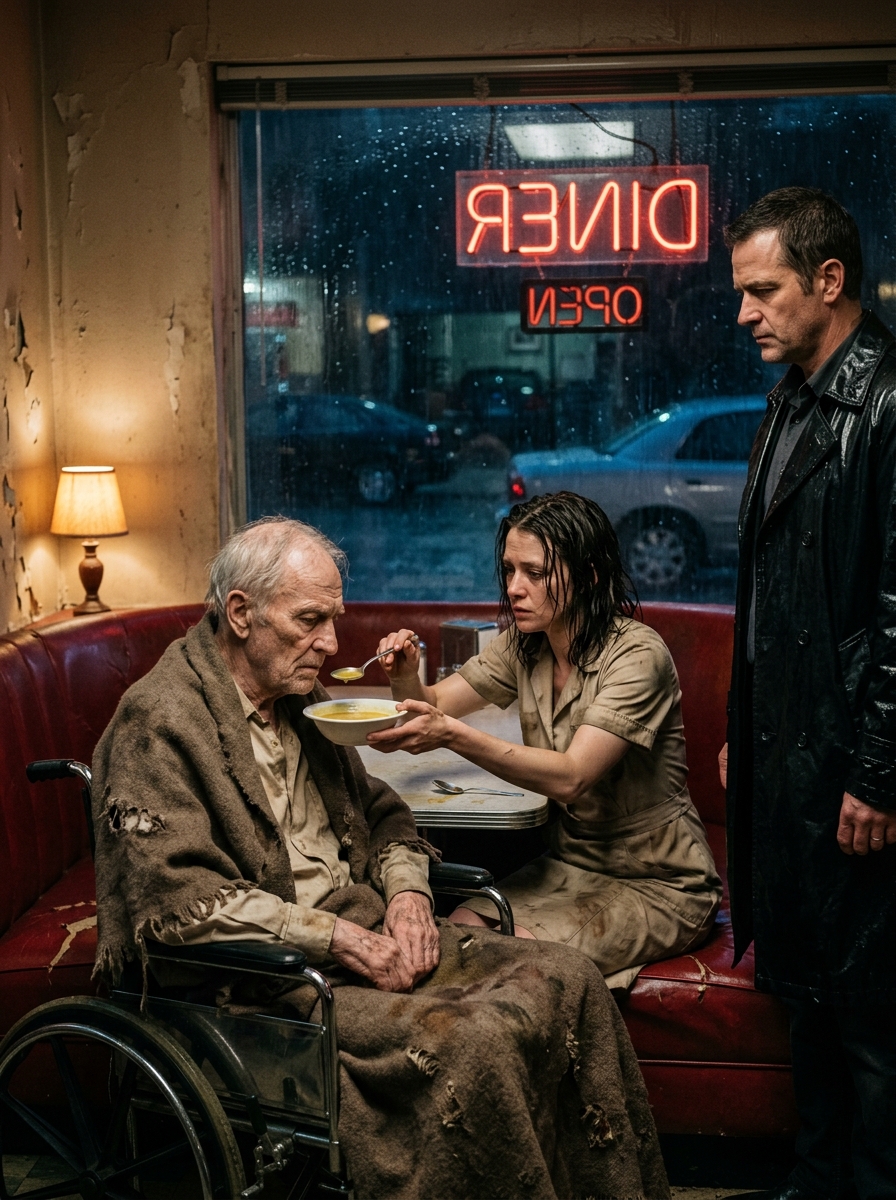
An old man sat alone in a wheelchair under the dying glow of the parking lot light.
No car.
No umbrella.
No coat thick enough for that kind of cold.
Rain poured over him in sheets. His shoulders were hunched. His hands trembled so hard she could see it even through the glass. His head hung low like he didn’t have the strength to lift it anymore.
For one terrible second, Jenna just stared.
Then she bolted for the door.
The rain slapped her face the second she stepped outside.
“Sir?” she shouted, crouching in front of him. “Sir, can you hear me?”
The old man slowly raised his head.
His lips were pale. His eyes looked glassy and lost. He tried to say something, but it came out broken and thin, like his body had already given up on being heard.
Jenna’s stomach turned.
“No,” she whispered. “No, not out here.”
She grabbed the handles of the wheelchair and started pushing.
The wheels dragged and slipped over cracked pavement flooded with rainwater. Her sneakers soaked through in seconds. Wet hair stuck to her cheeks. She pushed harder anyway.
“Stay with me,” she said, breathless. “Come on. You’re coming inside.”
By the time she got him through the door, both of them were drenched.
She locked the wheels by the nearest booth, ran to the supply closet, and came back with the only blanket the diner had—a faded one they kept for winter power outages and the occasional customer who drank too much coffee and fell asleep in a booth.
She wrapped it around his shoulders.
“It’s okay,” she said softly. “You’re safe now.”
His hands were still shaking.
The kitchen was already shut down, but Jenna didn’t care.
She turned one burner back on and found the leftover chicken soup she’d been planning to throw out. She heated it slowly, grabbed crackers, filled a mug with warm water, and carried everything to the booth.
The old man looked too weak to hold the spoon steady.
So Jenna sat across from him and fed him herself.
“Small bites,” she murmured. “Nice and easy.”
She’d done this before.
Not here.
At home.
At her mother’s bedside, in the last months, when pride had already left the room and tenderness was the only thing that still made sense.
She lifted the spoon again.
The old man swallowed slowly.
“That’s it,” she whispered. “You’re doing just fine.”
She didn’t notice the black sedan pulling into the lot.
Didn’t notice the headlights washing across the wet glass.
Didn’t notice the tall man in the dark coat stepping out into the rain and striding toward the diner like his whole body had been locked in a fight against panic for hours.
When the door finally opened, Jenna looked up.
The man standing there didn’t belong in a place like this.
His shoes cost more than her monthly bus pass. His coat was tailored. His watch caught the dull light for one clean flash before he lowered his arm. He looked like the kind of man who owned buildings, not the kind who stopped at a roadside diner with peeling paint and a busted neon sign.
But his face told a different story.
He looked wrecked.
Not messy. Not weak.
Wrecked.
His eyes landed on the old man in the booth.
Then he stopped breathing for a second.
“Dad,” he said.
It came out rough. Human. Barely holding together.
Jenna stood quickly. “Do you know him?”
The man stepped forward like the room had narrowed around that one booth.
“That’s my father.”
The old man stirred faintly at the sound of his voice.
The man dropped to one knee beside the booth and took his father’s trembling hand in both of his, like he was trying to make up for something in the grip alone.
“Dad,” he said again, quieter this time. “I’m here. I’m here.”
Jenna looked between them, heart still pounding.
“I found him outside,” she said. “He was out in the storm. He was freezing.”
The man lifted his head and looked at her fully for the first time.
His name, she would later learn, was Ethan Holloway.
People in three states knew that name. He owned a massive investment firm, a chain of private care centers, and enough property that local papers wrote stories about his real estate deals like they were sports scores.
But standing there in that diner, kneeling beside his father with water dripping off his coat, he didn’t look powerful.
He looked like a son who had almost been too late.
“You brought him in?” he asked.
Jenna nodded.
“And fed him?”
“He couldn’t hold the spoon.”
Ethan swallowed hard. His eyes moved over the blanket around his father’s shoulders, the half-empty bowl of soup, the crackers she’d opened, the way she’d placed the napkin carefully in the old man’s lap.
“You did more for him in ten minutes than the people I pay to care for him have done in months,” he said.
Jenna didn’t know what to say to that.
So she just said the truth.
“He shouldn’t have been out there alone.”
Ethan closed his eyes.
It wasn’t anger she saw first.
It was shame.
The old man—Walter Holloway—had once run a machine shop by hand. He’d raised Ethan in a house with one bathroom, one used truck, and more pride than money. He’d taught his son to work hard, speak plainly, and never leave people behind.
Then age took pieces of him.
Memory first.
Then balance.
Then words, sometimes.
Ethan had responded the only way he knew how.
He paid for the best facility money could buy.
Private room. Round-the-clock staff. Security. Specialists. Clean brochures. Polished floors. Every expensive promise packaged into one place so he could tell himself his father was safe even when he was too busy to visit as often as he should have.
Now here Walter sat, soaked to the bone in a diner booth, being cared for by a waitress who looked like she hadn’t slept a full night in half a year.
Ethan pressed his forehead briefly against his father’s hand.
Jenna turned away, giving them privacy the way decent people do.
She refilled the old man’s water. Wiped the counter. Pretended she wasn’t listening while Ethan quietly told his father over and over that he was sorry.
A deputy arrived twenty minutes later, wet hat in hand, having followed a report about a missing elderly man in a wheelchair.
Everything moved quietly after that.
No shouting.
No big dramatic scene.
Just paperwork. A blanket tucked tighter around Walter’s shoulders. Ethan thanking the deputy. Ethan thanking Jenna twice, then a third time like two wasn’t enough.
Before he left, he reached into his pocket like he was about to offer money.
Jenna saw it and stiffened.
He noticed.
Slowly, he pulled his hand back out empty.
“Thank you,” he said instead.
That meant more.
After they left, Jenna locked the diner, stood alone in the silence, and stared at the booth where Walter had been sitting.
Then she grabbed her backpack and walked through the rain to the bus stop because her car had died three months earlier and she still couldn’t afford to fix it.
By morning, she figured it was over.
A strange night.
A sad night.
One more story life handed her and took back.
She was wrong.
Three days later, Ethan Holloway came back.
Not with cameras.
Not with reporters.
Not with flowers, either, which somehow would’ve annoyed her more.
He came alone, in jeans and a plain jacket, carrying a folder thick with papers.
Jenna was pouring coffee for a truck driver when she saw him walk in.
Her body went tense before she could help it.
He waited until her shift slowed.
Then he asked, “Can we talk?”
She led him to the far booth.
The same booth.
He sat down and looked like a man who hadn’t slept much since the last time he’d been there.
“I found out what happened,” he said.
Jenna didn’t answer.
He went on.
Walter hadn’t simply wandered.
A caregiver had been skipping checks. Another had propped open a service exit while taking out trash and never secured it properly. Reports had been falsified. Complaints had been ignored. Staffing had been cut while administrators collected bonuses and smiled through inspections.
Ethan had built the business.
But he had stopped looking closely.
He had trusted systems more than people.
Trusted reports more than instinct.
Trusted money to do what love was supposed to do.
“I thought paying for the best meant I was doing right by him,” Ethan said, staring down at his hands. “Turns out I was buying distance and calling it care.”
Jenna felt that somewhere deep.
Because grief knew how to spot grief, even in people with expensive watches and polished voices.
“What happens now?” she asked.
He looked up.
“Now I tear it apart.”
And he did.
The stories that followed never used real names. They called it a major elder-care company. A private network. A regional operator under investigation. There were lawsuits. Firings. Criminal reviews. Emergency audits. Families coming forward with stories they’d buried because no one with power had listened before.
Ethan shut facilities down.
Rebuilt them.
Changed staffing rules.
Installed real oversight.
Started spending time in places he used to manage from conference rooms.
He learned what fluorescent hallways smelled like at midnight. Learned what loneliness looked like in a wheelchair by a window. Learned how many old people stopped asking for things after enough people ignored them.
And then he came back to Jenna again.
This time with different papers.
She looked at the folder and frowned. “What is this?”
He slid it toward her.
Her fingers shook as she opened it.
Her unpaid medical bills were gone.
Not delayed. Not reduced.
Gone.
There was proof her nursing tuition had been covered too. A reinstatement form from the community college. A scholarship endowment under a private family fund. A paid training placement at one of the new care centers he was opening—one with patient advocates, fair staffing, and a policy that no one got treated like a task to be completed.
Jenna stared at the pages so long they blurred.
“I can’t take this,” she whispered.
“Yes, you can.”
“I didn’t help your father for money.”
“I know that.”
Her chin trembled. “Then why?”
Ethan leaned back and answered so quietly she almost missed it.
“Because my father was seen that night.”
He nodded toward the booth, the window, the world outside.
“You didn’t know his name. You didn’t know who he belonged to. You didn’t know whether anybody would thank you. You just saw a human being in pain, and you moved.”
Jenna looked down.
No one had talked to her like that in a long time.
Not since before the hospitals.
Before the bills.
Before grief turned her into a machine built to survive one shift at a time.
“You reminded me who my father is,” Ethan said. “And you reminded me who I stopped being.”
That was when she cried.
Not loud.
Not pretty.
Just silent tears she could no longer hold back.
She cried because her mother was gone.
Because she was tired.
Because somebody had finally looked past the stained apron and the cheap shoes and the dark circles under her eyes and seen something in her that life had not managed to crush.
Years passed.
Jenna went back to school.
Then she graduated.
Then she became the kind of nurse families remembered years later.
The one who stayed a little longer.
The one who noticed when a patient had stopped talking because they were scared, not difficult.
The one who adjusted blankets without being asked.
The one who fed people slowly.
The one who never rushed the weak just because the clock said she should.
People said she had a gift.
She knew better.
It wasn’t a gift.
It was a choice.
A hard one, some days.
To keep your heart open after life gave you every reason to close it.
Walter Holloway lived long enough to see her in scrubs.
On good days, he remembered her.
On the harder days, he didn’t.
But every time she visited, he smiled when she touched his hand.
Maybe the body remembers kindness even when memory doesn’t.
Ethan changed too.
Not into a saint.
Not into some perfect man.
But into someone less in love with power and more afraid of what happens when power has no soul.
He stopped chasing control like it could save the people he loved.
He started showing up instead.
And every now and then, when storms hit the highway and rain beat against the windows hard enough to make the glass tremble, Jenna would remember that night in the diner.
The broken sign.
The cold soup reheated on a dead shift.
The old man in the wheelchair.
The son on his knees.
And the truth that came out of all of it.
Real wealth isn’t what you own.
It’s what you do when there is nothing to gain and someone helpless is sitting in the dark, waiting to see if the world will leave them there.