
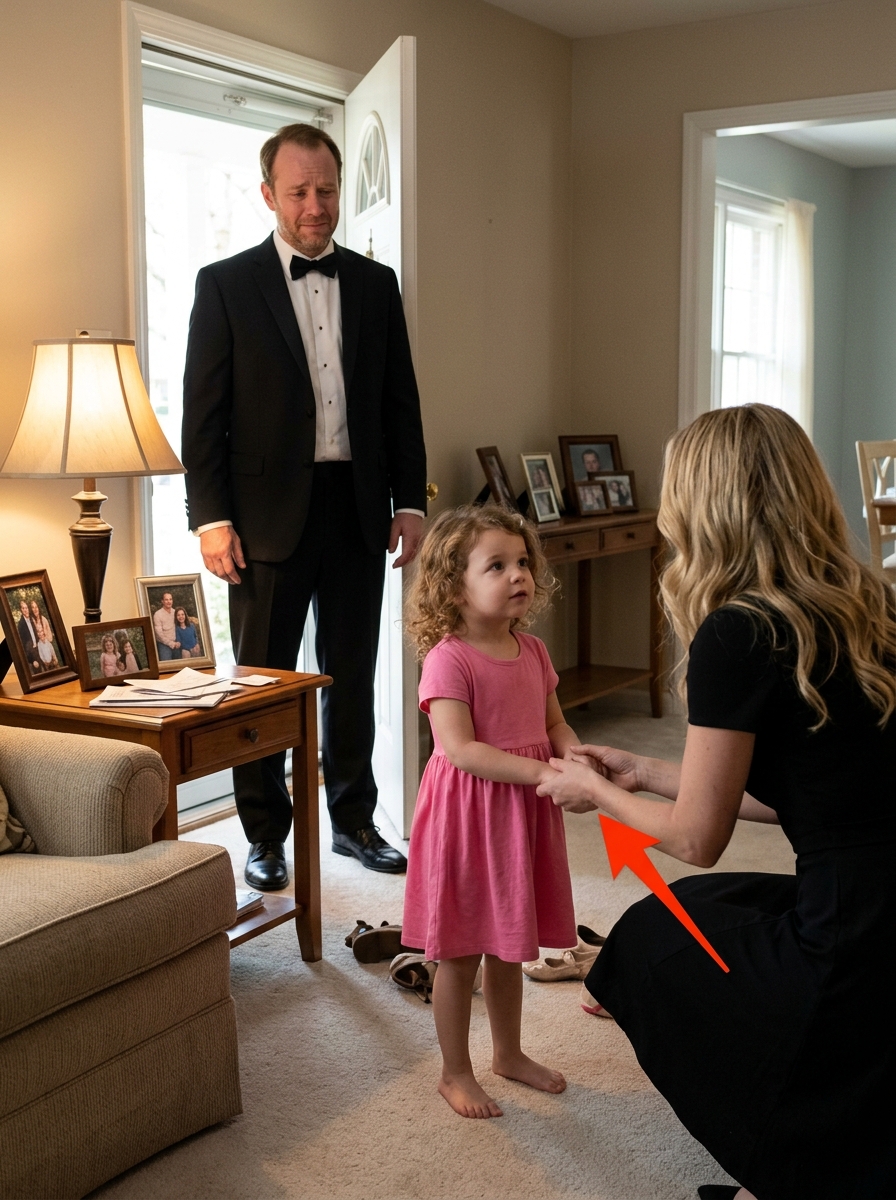
“Daddy, is she your girlfriend?”
My six-year-old daughter asked the question before I had even shaken Claire Morrison’s hand.
I wanted the floor to open beneath my dress shoes.
Claire didn’t flinch.
She crouched beside Lily in our front entryway, careful not to wrinkle her simple black dress, and smiled at her like Lily had asked the most reasonable question in the world.
“No, sweetheart,” she said. “I’m just going to a work party with your dad so he doesn’t have to go alone.”
Lily studied her.
Then she looked at me.
“Daddy goes everywhere alone now.”
There are sentences adults learn to soften.
Children don’t.
They just put the truth on the table and wait for you to deal with it.
Claire glanced at me, but there was no pity in her face.
Thank God.
I had gotten enough pity to last a lifetime.
My name is Robert Carson. I was forty-two then, living outside Charlotte, North Carolina, running a mid-sized company I had spent nearly fifteen years building.
From the outside, my life looked polished.
Big house in a quiet subdivision.
A corner office.
A respectable title.
A calendar so full that people assumed I must be important.
But every evening, I came home to one little girl and one empty chair at the kitchen table.
My wife, Jennifer, had passed away three years earlier after an illness.
Lily had been three.
She remembered pieces of her mother.
The smell of her hand lotion.
A yellow sweater Jennifer used to wear.
The song she hummed while making pancakes.
The way she tucked Lily’s blanket under her chin.
Small things.
Sometimes I thought those small things hurt more than the big memories because they appeared without warning.
A half-empty coffee mug could do it.
A song playing quietly in a grocery store could do it.
One of Lily’s expressions could do it.
Grief didn’t announce itself.
It simply walked into the room.
And after Jennifer was gone, I became obsessed with making sure nothing else in Lily’s life changed.
Same house.
Same school.
Same Saturday pancakes.
Same bedtime routine.
Same Christmas ornaments.
Same framed pictures.
I told myself consistency was what she needed.
Maybe it was.
But somewhere along the way, consistency became a hiding place for me.
Friends tried to introduce me to women.
I went to dinner a few times.
Nice women.
Kind women.
Nothing was wrong with them.
That almost made it harder.
Because every time I imagined one of them meeting Lily, my chest tightened.
What if Lily got attached?
What if it didn’t work?
What if someone came into her life and disappeared?
She had already learned too young that people could leave.
I wasn’t going to teach her that lesson twice if I could help it.
So I stopped dating.
Then I stopped accepting setups.
Eventually, people stopped asking.
That was easier.
Until the invitation came.
The annual charity gala was the biggest formal event our company supported each year.
Black tie.
Dinner.
Donors.
Business partners.
Community leaders.
And, unofficially, a room full of people who seemed to arrive in pairs.
For the previous two years, I had gone alone.
Each time, I spent half the evening answering well-intended questions.
“Still keeping busy?”
“How’s Lily?”
“Are you seeing anyone?”
“You know, Jennifer would want you to be happy.”
That last sentence bothered me most.
Maybe Jennifer would have wanted that.
Probably.
But knowing what someone would want and knowing how to get there are two different things.
My assistant, Margaret, finally suggested something I would never have considered myself.
“There are professional event companions,” she told me.
I stared at her.
“There are what?”
“Not what you’re thinking.”
“I’m not thinking anything.”
“You’re making a face.”
“I’m trying very hard not to.”
Margaret had worked with me for almost nine years. She had earned the right to ignore most of my defenses.
She explained that some people hired trained companions for business dinners, weddings, awards ceremonies, and other events where attending alone could feel uncomfortable.
Nothing romantic.
No pretending.
Just another person at the table.
Someone socially confident.
Someone who knew how to talk to strangers.
Someone who understood boundaries.
“It’s basically professional company for an awkward evening,” Margaret said.
“That might be the saddest sentence I’ve heard all month.”
“Or the most practical.”
I said no.
Then I spent three days staring at the invitation.
Finally, I called.
The agency sounded almost painfully professional.
They asked about the event.
Dress code.
Time.
General expectations.
Conversation topics to avoid.
Whether I wanted the companion introduced as a friend, colleague, or simply by name.
I told them I didn’t want anyone pretending to be something she wasn’t.
The woman on the phone said, “Neither do we.”
That was how Claire ended up ringing my doorbell on a Friday evening.
She was thirty-four, though I learned that later.
Long blond hair.
Blue-gray eyes.
A few faint smile lines near the corners that made her look warmer, not older.
She was elegant without looking like she had spent all afternoon trying to be.
But none of that was what caught my attention.
It was the way she talked to Lily.
Not like a cute interruption.
Not like a child who should be humored until the adults could get on with their evening.
Like a person.
Claire pointed toward Lily’s pink dress.
“That’s a serious party dress.”
Lily grinned.
“I picked it myself.”
“I can tell.”
“How?”
“Because grown-ups almost never choose that much pink unless a six-year-old tells them to.”
Lily laughed.
I hadn’t expected the sound to hit me the way it did.
Then Lily asked Claire her favorite color.
“Blue,” Claire said.
“Why?”
“Because it can be quiet or bright. It depends on the day.”
“Mine is pink because pink is always happy.”
Claire nodded seriously.
“That is an excellent reason.”
I was still standing there with my hand half-raised like a man who had forgotten how introductions worked.
Finally I said, “I’m Robert.”
Claire stood and shook my hand.
“Claire Morrison.”
Her grip was steady.
“Thank you for coming,” I said.
Before she could answer, Lily asked the girlfriend question.
After Claire explained that she was just keeping me company, Lily nodded.
Then came the sentence.
“Daddy doesn’t have very many friends anymore.”
I swallowed.
“Lily.”
“What?”
She looked honestly confused.
“Not since Mommy went to heaven.”
Silence.
I waited for the expression I knew so well.
The tilted head.
The softened eyes.
That look people gave me when they were already imagining the saddest chapter of my life.
Claire didn’t do it.
She simply said, “Then I’m glad I get to be his friend tonight.”
That was all.
Lily accepted it immediately.
Our longtime housekeeper, Mrs. Walsh, appeared from the kitchen and reminded Lily that they had popcorn and a movie waiting.
Mrs. Walsh had been with us since before Jennifer died.
By then, she was less employee than family.
She knew where Lily hid lost crayons.
She knew I drank coffee too late at night.
She knew when to talk to me and, more importantly, when not to.
“Come on, peanut,” she said. “Let your dad get going.”
Lily grabbed Claire’s hand.
“Wait. You have to see something.”
I opened my mouth.
Claire looked at me.
“We have a few minutes.”
I should have said no.
The gala mattered.
I was expected early.
There were donors I needed to greet.
Instead, ten minutes later, I was standing in Lily’s playroom while she gave Claire a guided tour of approximately forty-seven drawings.
There were cats.
Houses.
Rainbows.
People with arms coming straight out of their heads.
Claire treated every picture like it belonged in a museum.
Then Lily picked up one sheet of construction paper.
I recognized it immediately.
She had drawn it the week before.
Three stick figures.
And an empty space.
“This is me,” Lily said.
She pointed to the smallest figure.
“This is Daddy.”
Then she pointed to a woman with yellow hair floating above them.
“And this is Mommy. She’s in heaven.”
Claire nodded.
She didn’t look at me.
I appreciated that.
“And this,” Lily continued, touching the blank area beside my stick figure, “is where somebody else might go someday.”
My stomach tightened.
I had asked her about that blank spot when she first drew it.
She had shrugged and said she didn’t know.
Now she looked at Claire.
“I just don’t know who yet.”
Claire knelt beside her.
“That’s okay.”
“You think?”
“Absolutely.”
Lily frowned.
“But shouldn’t I know?”
“Nope.”
Claire tapped the blank part gently.
“Sometimes empty spaces don’t need to be filled right away.”
Lily stared at the drawing.
Then Claire added, “Sometimes the right people show up when you aren’t even looking for them.”
I looked at her.
She seemed unaware that the sentence had landed anywhere beyond Lily.
Eventually, we left.
The drive downtown was quiet for the first few minutes.
I kept both hands on the wheel.
“I’m sorry about all the questions.”
Claire turned toward me.
“Why?”
“She can be direct.”
“She’s six.”
“That doesn’t make it less awkward.”
“I didn’t find it awkward.”
I glanced at her.
She was watching the road ahead.
“She misses her mother,” Claire said. “Children say out loud what adults spend years learning to hide.”
Something in that sentence made me loosen my grip on the steering wheel.
“She liked you.”
“I liked her.”
“She usually takes longer with people.”
Claire smiled faintly.
“Kids are good at reading a room.”
I waited.
Then I asked the question I had been curious about since she arrived.
“How did you end up doing this?”
“The agency?”
“Yeah. If you don’t mind.”
“I don’t mind.”
She folded her hands in her lap.
“I taught elementary school for almost eight years.”
That explained everything.
The way she listened.
The way she waited for Lily to finish speaking.
The way she answered questions without talking down to her.
“You left teaching?”
“My mother needed me.”
Claire’s voice stayed calm.
“She became very ill, and I was the closest family member. I thought I could balance everything for a while, but eventually I had to choose.”
“So you chose your mother.”
“Yes.”
“Do you regret it?”
“Not for one second.”
She looked out the passenger window.
“She passed away two years ago.”
“I’m sorry.”
“Thank you.”
She took a small breath.
“The hardest part was that near the end, she often didn’t know who I was.”
I didn’t say anything.
Claire continued.
“I would sit with her anyway. Sometimes she thought I was a nurse. Sometimes an old friend. Once she asked me whether I had children even though she had asked the same thing ten minutes earlier.”
“That must have been hard.”
“It was.”
She looked at me.
“But I learned something from it.”
“What?”
“Love doesn’t become meaningless just because somebody can’t name it.”
That sentence stayed with me.
Maybe because Jennifer had been gone for three years, and yet I still found myself doing things because she once loved them.
Planting tulips near the back porch.
Keeping her chipped Christmas angel.
Ordering lemon pie at a diner because it had been her favorite.
Perhaps love was like that.
It kept existing even when the person who gave it a name was no longer there.
Claire said she had taken flexible work after her mother’s passing because she wasn’t ready to return to a classroom.
A friend had told her about event companionship.
“At first I thought it sounded strange,” she admitted.
“That makes two of us.”
She laughed.
“But then I realized a lot of people aren’t hiring somebody because they want to impress a room.”
“What are they hiring you for?”
“Sometimes they just don’t want to walk into it alone.”
I felt that sentence in my chest.
The gala was held in a downtown hotel ballroom.
Everything was polished.
White tablecloths.
Soft music.
Flowers on every table.
Men checking cuff links.
Women adjusting name cards.
People greeting one another with the practiced warmth of adults who attend too many formal events.
I braced myself.
Then something unexpected happened.
I had a good time.
Not because Claire performed some elaborate role.
She didn’t.
When people asked how we knew each other, she simply said, “I’m a friend accompanying Robert tonight.”
No invented story.
No false romance.
No pretending.
She talked easily with everyone.
One of my board members mentioned that his granddaughter hated reading.
Within five minutes, Claire had him laughing about the strange things second graders say when they are trying to avoid homework.
A woman at our table asked whether Claire missed teaching.
“Every day,” she said.
“Then why not go back?”
Claire thought before answering.
“I probably will.”
“Probably?”
“I spent a long time believing every year of my life needed a plan.”
Several people smiled.
Claire continued.
“Taking care of my mother changed that. Sometimes life takes a turn you didn’t choose. I’m learning not to treat every detour like a mistake.”
I sat very still.
For three years I had treated my entire life like something that needed to be controlled.
Every meal.
Every school pickup.
Every bedtime.
Every holiday.
I thought if I managed enough details, nothing else could surprise us.
Nothing else could hurt Lily.
Nothing else could hurt me.
And here was this woman I had met less than two hours earlier calmly telling a dinner table that not knowing what came next was not the same as failing.
After dinner, music began.
Some couples moved toward the dance floor.
Claire excused herself to make a phone call.
I stepped onto a quieter hallway near the ballroom because I needed a minute without conversation.
My phone rang.
Mrs. Walsh.
I answered immediately.
“Everything okay?”
There was a pause.
“Lily’s asking for you.”
My stomach dropped.
“What happened?”
“She had one of those dreams again.”
The dreams had been happening more often.
Lily would wake convinced I had disappeared.
Sometimes I could calm her by phone.
Sometimes Mrs. Walsh could.
That night, neither worked.
“She keeps asking whether you’re coming home,” Mrs. Walsh said.
“I’m coming now.”
I didn’t hesitate.
I found Claire near the ballroom entrance.
“I’m sorry. I need to leave.”
“Lily?”
I must have looked surprised.
“You answered your phone like a dad,” she said.
“She had a nightmare.”
“Then let’s go.”
I shook my head.
“You don’t have to leave. I can arrange a ride for you.”
“I know.”
“I’ll still pay for the full evening.”
“Robert.”
She picked up her wrap.
“I said, let’s go.”
It wasn’t dramatic.
That was what struck me.
No performance.
No grand display of kindness.
She simply acted as though the obvious thing to do was go home to a scared little girl.
We barely spoke in the car.
When we reached my house, Mrs. Walsh opened the door before I could use my key.
“She’s upstairs.”
I took the stairs two at a time.
Lily was sitting against her pillows.
Her cheeks were wet.
The moment she saw me, her face folded.
“Daddy.”
I crossed the room.
She wrapped both arms around my neck.
“I thought you weren’t coming back.”
“I told you I would.”
“But I dreamed you didn’t.”
“I’m here.”
“What if someday you don’t come back?”
There is no good answer to that question.
Not when the child asking has already learned that “always” sometimes ends.
I wanted to tell her nothing would ever happen.
I wanted to promise that I would be there until she was old and gray.
But somewhere beneath my panic, I knew I couldn’t build her safety on a promise no human being could make.
Claire was standing near the doorway.
She had stayed back, giving us space.
Lily saw her.
“You came too.”
“I did.”
“Why?”
Claire smiled.
“Because I wanted to make sure my new friend was okay.”
Lily wiped her face.
“Me?”
“You.”
That earned the smallest smile.
Claire looked at me before entering farther.
I nodded.
She sat in the rocking chair beside Lily’s bed.
“When I was little,” she said, “I worried a lot.”
“You did?”
“All the time.”
“About what?”
“Mostly people leaving.”
Lily watched her.
“My grandmother used to tell me worrying was like sitting in a rocking chair.”
Lily glanced at the chair beneath Claire.
Claire rocked once.
“You can work very hard at it and still end up in the same place.”
Lily considered this.
“But bad things really happen.”
Her voice was tiny.
“My mommy died.”
Claire’s face changed then.
Not with pity.
With respect.
Like Lily had just said something important and deserved a truthful answer.
“You’re right.”
Lily blinked.
Claire continued.
“Bad things happen sometimes, and when they do, they can hurt a lot.”
I held Lily’s hand.
“But something else is true too,” Claire said. “Your dad loves you. Mrs. Walsh loves you. Your friends love you. Your teachers care about you.”
Lily looked down.
“And tonight, when you needed your dad, he came home.”
“He left his party.”
“He sure did.”
“Was it an important party?”
I said, “Not as important as you.”
Lily looked satisfied with that.
Claire leaned forward.
“We don’t have to pretend scary things can never happen. We just don’t have to let them steal every good thing that is happening right now.”
Lily was quiet.
Then she asked, “Are you leaving?”
Claire glanced at me.
“Well, eventually.”
“Can you not yet?”
“What do you mean?”
“Can you stay until I fall asleep?”
I expected Claire to find a polite way out.
She had completed the job I hired her for.
More than completed it.
It was late.
Instead, she asked me with her eyes.
I nodded.
“If you’re sure.”
Claire settled back into the chair.
“Do you like stories?”
Lily gave her the kind of look only a six-year-old can give an adult who has asked an obviously ridiculous question.
“Yes.”
“Okay.”
Claire began making one up.
It was about a little girl who lived in a house with a porch swing and a garden full of crooked flowers.
The girl believed courage meant never being afraid.
Eventually she learned she had been wrong.
Courage, Claire said, was being afraid and still letting yourself enjoy breakfast.
Still drawing pictures.
Still laughing at silly jokes.
Still loving people.
Still believing tomorrow might contain something good.
Halfway through, Lily’s eyes closed.
Claire kept speaking more quietly.
A few minutes later, Lily was asleep with one hand wrapped around two of my fingers.
I sat there longer than necessary.
When I finally stood, Claire followed me downstairs.
Mrs. Walsh had gone to bed.
I made tea because I didn’t know what else to do with my hands.
Claire sat at the kitchen counter.
“Thank you,” I said.
“You’ve already said that.”
“I’m going to say it again.”
“Then I’ll keep accepting it.”
I pushed a mug toward her.
“Lily has been having those dreams more often.”
Claire listened.
“She talks to someone about grief,” I said. “We’re helping her through it. I just…”
I stopped.
“What?”
“I don’t always know whether I’m doing it right.”
“Being her dad?”
“Yes.”
Claire smiled gently.
“The fact that you’re worried about doing it right probably means you care very much about doing it well.”
“That isn’t the same thing.”
“No.”
She wrapped both hands around the mug.
“But no parent gets a map.”
I stared at my tea.
“I’m scared of failing her.”
“You came home.”
“That’s a low bar.”
“It mattered to her.”
I leaned against the counter.
“She remembers Jennifer less every year.”
“That must scare you.”
It did.
I had never said it out loud.
“I’m terrified she’ll forget her.”
Claire didn’t rush to reassure me.
That was one of the first things I learned about her.
She didn’t fill silence just because silence made other people uncomfortable.
Finally she said, “Maybe she will forget some details.”
I looked up.
“But you won’t.”
“No.”
“You can keep telling the stories.”
My throat tightened.
Claire continued.
“She may not remember every sound of her mother’s voice or every shirt she wore. But she can grow up knowing how her mother laughed. What she loved. What kind of pancakes she made. What she believed about people.”
“You make it sound simple.”
“It isn’t.”
She looked into her mug.
“My mother forgot my name.”
I waited.
“Near the end, I would walk into her room and she’d smile politely at me like I was someone from church she couldn’t place.”
Claire’s voice never broke, but it became softer.
“At first, every time it happened, I tried to bring her back.”
“How?”
“Pictures. Stories. Questions. Anything.”
She shook her head.
“Then one afternoon I realized I was spending all our time testing what she had lost.”
That sentence stayed in the kitchen between us.
“So I stopped.”
“What did you do instead?”
“I sat beside her.”
Claire smiled faintly.
“If she thought I was an old friend, I was an old friend. If she wanted to talk about a house she had lived in fifty years earlier, we talked about that house.”
She looked at me.
“I couldn’t control what was disappearing. I could control whether she felt alone.”
I had spent three years trying to control what was disappearing.
Maybe Claire could see that.
Maybe that was why I told her things I hadn’t told anyone.
How lonely the house felt after Lily went to bed.
How guilty I felt for sometimes wanting adult conversation so badly that I would sit in my office long after everyone had left.
How I occasionally caught myself laughing and immediately felt disloyal.
How Jennifer’s side of the closet had stayed untouched for fourteen months because moving her sweaters felt like admitting something I already knew.
Claire listened.
Really listened.
Not waiting for her turn.
Not trying to repair me.
Not offering five steps to a better life.
Just listening.
At some point I realized we had been talking for more than an hour.
Claire looked at the kitchen clock.
“I should go.”
“I’ll drive you.”
“You’ve had a long night.”
“So have you.”
“That is technically what I was hired for.”
“No.”
The word came out more firmly than I intended.
Claire looked at me.
I lowered my voice.
“No, it isn’t.”
Neither of us said anything for a second.
I drove her to her apartment.
When we stopped outside, I reached for my wallet.
“I need to settle your fee.”
Claire held up a hand.
“The agency handles that.”
“I know, but you stayed much longer.”
“Robert.”
“I mean it.”
“So do I.”
She looked directly at me.
“Tonight stopped feeling like work somewhere around the time Lily showed me that picture.”
I didn’t know what to say.
Claire smiled.
“You don’t owe me anything extra.”
“You came back to the house.”
“I wanted to.”
“You stayed with my daughter.”
“I wanted to.”
“You sat in my kitchen for an hour listening to me talk.”
“That part may require additional billing.”
I laughed.
A real laugh.
It startled both of us.
Claire smiled wider.
“See? There you are.”
“What does that mean?”
“Nothing.”
“It clearly meant something.”
“It means good night, Robert.”
She opened the door.
Then she stopped.
“Your daughter is wonderful.”
“I know.”
“And for what it’s worth, I think you’re doing better than you think you are.”
Before I could answer, she touched my hand briefly.
Then she stepped out.
I watched her walk into the building.
On the drive home, I kept replaying the evening.
I had hired a stranger because I didn’t want people looking at me like the lonely widower at a formal dinner.
Instead, I had spent most of the night telling that stranger exactly how lonely I was.
The irony wasn’t lost on me.
When I got home, I checked on Lily.
She was sleeping peacefully.
Her drawing was still on the small desk beside her bed.
Mommy.
Daddy.
Lily.
And the empty space.
I stood there longer than I should have.
Something had changed.
I couldn’t name it yet.
But for the first time in three years, the empty space didn’t feel like a threat.
The next morning, Lily was pushing cereal around her bowl when she asked, “Can Claire come back?”
I nearly dropped my coffee.
“She probably has her own things to do.”
“I know.”
“She’s busy.”
“I know.”
I sat across from her.
“What exactly are you asking?”
“I want her to visit.”
“Why?”
Lily shrugged.
“She makes the house feel different.”
My coffee cup stopped halfway to my mouth.
“Different how?”
“Not so quiet.”
Children.
Again.
Truth without padding.
“She made you feel better last night?”
Lily nodded.
“She didn’t tell me not to be scared.”
That surprised me.
“Is that good?”
“Yes.”
“Why?”
“Because I was scared.”
I stared at her.
“She just stayed.”
I had nothing to say to that.
Then Lily added, “I think you like her too.”
I nearly choked on my coffee.
“She was nice.”
“You laughed.”
“I laugh.”
“Not like that.”
Apparently I was being evaluated by a six-year-old.
“Finish your cereal.”
“Can Claire stay forever?”
I looked at my daughter.
“Forever is a long time.”
“Okay.”
She took one bite.
“Can she come Saturday?”
The directness was impressive.
I called the agency that morning to settle the payment.
Then, trying to sound casual, I asked whether they could pass my number to Claire.
The woman on the phone explained that they couldn’t provide her private information.
“I’m not asking for hers,” I said. “Can you give her mine?”
“That we can do.”
I hung up.
Then I immediately regretted it.
What was I doing?
Claire had been working.
She had been kind because kindness was part of who she was.
Maybe I had mistaken that for something else.
Maybe loneliness had made one meaningful conversation feel larger than it was.
By lunch, I had convinced myself she wouldn’t call.
By two, I was relieved.
By three, disappointed.
At four seventeen, my phone rang from an unfamiliar number.
“Robert?”
I knew the voice.
“Claire.”
“I hope this isn’t strange.”
“No.”
I stood from my desk even though there was nowhere to go.
“The agency gave me your number.”
“I asked them to.”
“I figured.”
There was a pause.
“I wanted to check on Lily.”
“She’s good.”
“Did she sleep okay after that?”
“Until seven thirty.”
“Excellent.”
“She asked about you.”
Claire was quiet.
“What did she say?”
“She wants you to stay forever.”
Claire laughed.
“Wow.”
“I negotiated her down to Saturday.”
Another pause.
Then Claire said, “I might be available Saturday.”
That Saturday, we took Lily to a small art museum.
It was Claire’s idea.
Lily carried a sketchbook and stopped in front of nearly every painting.
Claire never told her what she was supposed to see.
She asked questions.
“What do you notice first?”
“What do you think happened five minutes before this picture?”
“If this painting made a sound, what would it sound like?”
Lily loved it.
I loved watching them.
At one point Lily sat on a bench and tried to copy a painting of a bowl of fruit.
Her version looked more like potatoes in a bathtub.
Claire told her it was excellent.
“It doesn’t look like the picture,” Lily complained.
“It doesn’t have to.”
“Yes, it does.”
“Why?”
“Because I’m copying it.”
Claire shook her head.
“You’re noticing it.”
“What’s the difference?”
“Copying means trying to make the same thing. Noticing means seeing what matters to you.”
Lily considered that.
Then she drew the bowl purple.
Afterward, we got ice cream.
That should have been the end.
Instead, Claire came again the next Saturday.
Then two weeks later.
Sometimes she and Lily painted at the kitchen table.
Sometimes they read.
Sometimes we all went to a neighborhood diner where Lily ordered pancakes no matter what time of day it was.
Claire never pushed.
That mattered.
She never moved Jennifer’s photographs.
Never suggested that the house needed changing.
Never acted uncomfortable when Lily talked about her mother.
Once, Lily showed her Jennifer’s old recipe box.
Claire spent nearly an hour helping her choose one recipe to make.
They picked banana bread.
It came out slightly lopsided.
Lily called it perfect.
Claire agreed.
I began finding excuses to stay nearby when Claire visited.
I told myself I was being a responsible father.
That was partly true.
The other truth was that I liked hearing her voice in the house.
Sometimes I worked in my study with the door open.
Sometimes I gave up pretending to work altogether.
One Saturday, Claire found me standing in the kitchen while she and Lily painted.
“Do you need something?” she asked.
“No.”
“You’ve opened the refrigerator three times.”
“I’m thinking.”
“Is the answer in the refrigerator?”
“Possibly.”
Lily looked up.
“Daddy likes you.”
I closed the refrigerator.
Claire pressed her lips together to stop herself from laughing.
“Thank you, Lily.”
“You’re welcome.”
I cleared my throat.
“I think I’m going back to my office.”
“Good luck with your thinking,” Claire said.
It had been years since someone teased me like that.
Not cruelly.
Not carefully.
Normally.
I had forgotten how much I missed normal.
About two months after the gala, I asked Claire to dinner.
Just Claire.
No Lily.
No agency.
No excuse.
She looked at me for several seconds.
“Are you asking because Lily likes me?”
“No.”
“Are you sure?”
“Yes.”
“Because I care about her, Robert.”
“I know.”
“And I don’t want us to confuse what she wants with what you want.”
I respected her even more for saying it.
“I’m asking because I want to have dinner with you.”
Claire nodded.
“Then yes.”
Our first real date was at a small neighborhood restaurant.
Nothing fancy.
I had spent years attending expensive dinners where I barely remembered the food.
That night, I remembered everything.
The chipped edge on the little candle holder.
Claire laughing so hard at one of my stories that she covered her mouth.
The way she admitted she still owned a box of classroom decorations because she couldn’t bring herself to throw them out.
The fact that she hated olives.
The way my chest tightened when she smiled at me.
On the drive home, I felt guilty.
It happened suddenly.
Jennifer.
That old reflex.
As if enjoying another woman’s company erased something.
Claire noticed.
“You got quiet.”
“I’m okay.”
“You don’t sound okay.”
I pulled into her apartment parking lot.
For a moment, I stared through the windshield.
“I feel guilty.”
Claire didn’t ask why.
She knew.
“I loved my wife.”
“I know.”
“I still love her.”
“I know.”
“I don’t know how to do this.”
Claire turned slightly toward me.
“Then don’t know.”
I looked at her.
“What?”
“You don’t have to solve the next ten years tonight.”
“That sounds suspiciously like advice.”
“Fine.”
She smiled.
“Then consider it permission to be confused.”
I laughed quietly.
She grew serious.
“Robert, I would never want your love for Jennifer to become something you have to hide from me.”
That hit somewhere deep.
“She’s part of your life. She’s Lily’s mother. Nothing about me changes that.”
I looked down at my hands.
“I’m afraid there isn’t room for both.”
Claire answered immediately.
“The heart isn’t a parking lot.”
I looked up.
She shrugged.
“That sounded smarter in my head.”
“No.”
I smiled.
“It was pretty good.”
We kept going slowly.
Very slowly.
There were dinners.
Walks.
Saturday afternoons.
Coffee on my back porch.
One afternoon, Claire and Lily planted flowers along the fence because Lily insisted the backyard needed “more happy colors.”
Another Saturday, we took a drive to a little town outside Charlotte and ate lunch at a diner with red vinyl booths.
Lily put six quarters into an old tabletop jukebox and chose the same song twice.
Claire danced in her seat just to embarrass me.
I realized I hadn’t felt embarrassed in a happy way for years.
At home, things changed in tiny ways.
Not dramatically.
A blue mug appeared in the cabinet because Claire always used it.
A box of markers stayed permanently on the kitchen counter.
Lily started saving funny school stories to tell Claire.
And I started checking my phone more often than a forty-two-year-old CEO should admit.
But there were difficult moments too.
One afternoon, Claire helped Lily organize her bookshelf.
She moved a framed picture of Jennifer six inches to the left.
That was all.
Lily froze.
“No.”
Claire stopped immediately.
“What?”
“That goes there.”
“I’m sorry.”
“Mommy put it there.”
Claire returned the frame to the exact spot.
“I didn’t know.”
“You can’t move Mommy’s things.”
“I understand.”
Lily’s eyes filled.
“You’re trying to take her place.”
The room went silent.
I stepped forward.
“Lily—”
Claire lifted one hand slightly.
Not to stop me.
Just asking for a second.
She sat on the floor so she was eye level with Lily.
“I’m not trying to take your mom’s place.”
“You moved her picture.”
“I did. And I’m sorry.”
Lily stared at her.
Claire pointed toward the photograph.
“Your mom has a place nobody else can have.”
“Forever?”
“Forever.”
Lily’s shoulders dropped slightly.
“Then why are you here?”
That question cut through me.
Claire answered calmly.
“Because I care about you.”
“And Daddy?”
“Yes.”
“A lot?”
Claire glanced at me.
“A lot.”
Lily looked between us.
“Does that mean you’re replacing Mommy?”
“No.”
“How?”
Claire thought.
“Do you remember your drawing?”
“The family one?”
“Yes.”
“The one with the blank place?”
Lily nodded.
Claire said, “Maybe adding someone to the picture doesn’t mean erasing anybody who was already there.”
Lily looked toward Jennifer’s photograph.
For a long moment, nobody moved.
Then she picked up the frame.
She placed it back herself.
Exactly where it had always been.
“Okay.”
Claire smiled.
“Okay.”
That night after Lily went to bed, I found Claire sitting alone on the back porch.
I joined her.
“That was hard,” I said.
“She needed to ask it.”
“It hurt you.”
“A little.”
“I’m sorry.”
“Don’t be.”
Claire looked toward the kitchen window.
“She loves her mother.”
“Yes.”
“She should.”
I sat beside her.
“I’m starting to care about you.”
Claire looked at me.
“I know.”
“That confident, huh?”
“You stare at me when you think I’m not looking.”
I nearly laughed.
“I do not.”
“You absolutely do.”
“Maybe occasionally.”
“Constantly.”
I shook my head.
Then the humor faded.
“It scares me.”
Claire knew what I meant.
She didn’t push.
Spring turned toward summer.
By then, six months had passed since the gala.
Six months since I had opened my front door expecting an employee of an event service.
Six months since Lily had announced to a stranger that her father didn’t have enough friends.
Six months since Claire had sat beside my daughter’s bed and told her that fear did not deserve every good moment we were given.
One evening, Lily was running around the backyard catching fireflies in a plastic jar with holes in the lid.
Claire and I sat on the porch.
There were two glasses of iced tea between us.
Lily laughed somewhere near the fence.
I watched her.
Then I said, “I need to tell you something.”
Claire turned.
“That sounds serious.”
“It is.”
She waited.
“When I called that service, I was trying to survive one awkward dinner.”
“I remember.”
“I didn’t want people asking questions.”
“I remember that too.”
“I wanted to get through one evening without feeling like the saddest man in the room.”
Claire didn’t say anything.
“I never expected you.”
Her expression softened.
“I didn’t expect you either.”
I looked toward Lily.
Then back at Claire.
“I think about you when you’re not here.”
Claire smiled slightly.
“I think about you too.”
“I think about your laugh.”
“Oh no.”
“I think about how you talk to Lily.”
“That part is acceptable.”
“I think about things I want to tell you before I tell anyone else.”
Her smile disappeared.
Not in a bad way.
She was listening now.
“I haven’t felt this way since Jennifer.”
Claire reached for my hand.
“And that terrifies me.”
“Why?”
I almost laughed at how obvious the answer seemed.
“Because I know what losing somebody feels like.”
Claire’s fingers tightened around mine.
“I know.”
“I built my entire life around making sure Lily and I would never feel that kind of disruption again.”
“You can’t guarantee that.”
“I know.”
“But you’ve been trying.”
“Yes.”
I looked down.
“I’ve been treating love like a risk I can avoid.”
Claire was silent.
“I thought if I didn’t let anyone close enough, nobody could leave another hole.”
My voice had gone quiet.
“But it turns out keeping everybody out leaves a hole too.”
Claire stared at me.
Behind us, Lily shouted, “I GOT ONE!”
A tiny light flickered inside her jar.
Claire smiled toward her.
Then she turned back to me.
“I can’t promise you that life will always cooperate.”
“I know.”
“I can’t promise we’ll never argue.”
“I know.”
“I can’t promise I’ll always know the right thing to say.”
“You usually do.”
“That is a dangerous misconception.”
I smiled.
Claire didn’t.
“But I can tell you what’s true now.”
“What?”
“I care about you.”
My throat tightened.
“And I love that little girl.”
I looked toward Lily.
Claire continued.
“I don’t want Jennifer’s place.”
“I know.”
“I don’t want the life you had before.”
That surprised me.
“What do you mean?”
“I want whatever life we might build next.”
The word we sat between us.
Simple.
Terrifying.
Beautiful.
“What if I’m still scared?” I asked.
Claire squeezed my hand.
“Then be scared.”
“That’s your answer?”
“Yes.”
She smiled.
“You don’t have to wait until fear disappears before you live.”
Before I could answer, Lily came racing toward the porch.
She held the jar carefully.
“Look!”
We leaned closer.
A firefly blinked inside.
Lily grinned.
“Isn’t it pretty?”
“It is,” Claire said.
Lily stared at the tiny light.
Then her expression changed.
“We have to let it go.”
“Why?” I asked.
“Because I like it.”
Apparently that made perfect sense to her.
She unscrewed the lid.
The firefly disappeared into the yard.
Lily watched it go.
Then she climbed onto the porch between us.
She looked at our joined hands.
Neither Claire nor I moved.
Lily’s mouth slowly curled into a smile.
“So.”
I knew that tone.
“So what?” I asked.
“Is Claire your girlfriend now?”
Claire laughed.
I looked at her.
“For once, I think the answer might be yes.”
Lily threw both hands up.
“Finally.”
“Finally?”
“You take forever.”
Claire laughed harder.
I pointed toward the yard.
“Go catch another firefly.”
Lily ran off.
Claire leaned closer.
“Your daughter has been managing this relationship for six months.”
“Apparently.”
“She’s very efficient.”
“She gets that from me.”
“No chance.”
For the first time in years, I sat on my own back porch without measuring happiness against what I had lost.
I simply felt it.
That should have been the end of the story.
It wasn’t.
Because opening your heart is not one decision.
It is a hundred small decisions.
Sometimes the past returns when you think you have finally made peace with it.
A few weeks later, I found Lily sitting on the floor of my bedroom closet.
Jennifer’s old memory box was open beside her.
Photographs.
Birthday cards.
A dried flower from our wedding.
Little notes Jennifer used to leave in my lunch bag during the early years of our marriage.
I stood in the doorway.
“What are you doing?”
Lily held up a photograph.
“Was Mommy funny?”
The question caught me off guard.
“Very.”
“Funnier than Claire?”
I sat beside her.
“They’re different.”
“Who was funnier?”
“Your mother once convinced me for almost an hour that our kitchen sink was making a strange noise just so she could surprise me with a birthday cake hidden in the laundry room.”
Lily laughed.
“Why the laundry room?”
“Because I checked everywhere else.”
“That is funny.”
“She thought so.”
Lily studied the photograph.
Then she asked the question I had been expecting without realizing it.
“If you love Claire, do you love Mommy less?”
I looked at my daughter.
“No.”
“How?”
I thought about Claire’s parking-lot line and nearly smiled.
“Because love doesn’t work like a cup.”
“A cup?”
“You don’t pour some out before you can put more in.”
Lily frowned.
“That doesn’t make sense.”
“It sounded better in my head.”
She giggled.
Then I tried again.
“Loving Claire doesn’t change what your mother meant to me.”
“Do you still miss Mommy?”
“Every day.”
“Then why are you happy?”
That one stopped me.
Three years earlier, I wouldn’t have known how to answer.
Now I did.
“Because missing someone and being happy can happen at the same time.”
Lily looked surprised.
“That’s allowed?”
“Yes.”
“Are you sure?”
“I’m learning.”
She leaned against me.
After a while she said, “Can we show Claire Mommy’s box?”
My eyes burned.
“Do you want to?”
“Yes.”
“Then we can.”
Claire came over that evening.
Lily carried the box to the living room.
For nearly two hours, the three of us looked through Jennifer’s life.
Claire never seemed threatened.
She laughed at the funny photographs.
Listened to stories.
Asked Lily questions.
At one point, Lily held up our wedding picture.
“Daddy had more hair.”
Claire examined it.
“He really did.”
“Hey.”
They ignored me.
Lily laughed so hard she fell sideways on the couch.
And something in me finally understood what Claire had been trying to show me.
The past did not need to be sealed away to protect the future.
Jennifer’s memory wasn’t a fragile object Claire might accidentally break.
It was part of our family.
There was room.
More room than I had believed.
Several months later, Claire returned to teaching.
A small private elementary school nearby had an opening.
She was nervous about it.
She almost didn’t apply.
I reminded her of something she had told me the first night we met.
“Sometimes a detour isn’t a mistake.”
Claire narrowed her eyes.
“You’ve been saving that.”
“For months.”
“I regret ever saying anything wise around you.”
She applied.
She got the job.
On her first morning, Lily made her a card.
On the front, in huge crooked letters, she wrote:
YOU ARE GOING TO BE GREAT.
Inside, she drew three people.
Me.
Herself.
Claire.
Above us was a fourth figure with yellow hair.
Jennifer.
I stared at it.
There was no blank space anymore.
But nobody had been erased.
I found Lily in the kitchen.
“Can I ask you about the picture?”
She nodded.
“Who’s everybody?”
She pointed.
“That’s me. That’s you. That’s Claire.”
Then she pointed above us.
“And Mommy.”
I swallowed.
“You put all of us in it.”
“Yeah.”
“Why?”
Lily looked confused by the question.
“Because that’s my family.”
There are moments adults spend years trying to understand.
Children sometimes draw them with crayons.
Claire kept that picture.
Years later, it was still framed on her desk.
And yes, eventually, she became more than my girlfriend.
But we didn’t rush.
There was no grand movie moment.
No dramatic speech in a ballroom.
No crowd watching.
About eighteen months after the night we met, I asked her to marry me on the same back porch where I had first admitted I loved her.
Lily knew beforehand.
That was a mistake.
She nearly ruined the surprise six separate times.
The proposal itself was simple.
Claire was drinking coffee.
Lily was pretending not to stare through the kitchen window.
I took Claire’s hand.
“I spent years believing that loving somebody again would mean I had stopped loving the person I lost.”
Claire’s eyes filled.
“I was wrong.”
I knelt.
“You didn’t replace anything.”
I looked toward the window where Lily’s forehead was now pressed openly against the glass.
“You helped us make room.”
Claire laughed through her tears.
I asked.
She said yes.
From inside the house came a muffled scream of celebration.
Claire looked toward the window.
“Was she watching?”
“The entire time.”
“I knew it.”
We married in a small ceremony.
Family.
Friends.
A few people from work.
Several teachers Claire knew.
Nothing extravagant.
Lily stood beside us.
Before the ceremony, she asked if we could place one of Jennifer’s favorite flowers near an empty chair in the front row.
Claire said yes before I could speak.
It wasn’t sad.
Not really.
It felt honest.
That mattered more.
The strangest part of my story is that I almost never made that first phone call.
I almost went to the gala alone.
I almost spent another evening smiling politely while protecting the locked room inside me.
I almost decided that avoiding pain was the same thing as being safe.
But life is strange.
Sometimes the person who changes everything doesn’t arrive the way you imagined.
Sometimes she doesn’t arrive through friends or some perfect romantic moment.
Sometimes she rings your doorbell because you hired her to help you survive an uncomfortable work dinner.
Sometimes your six-year-old daughter opens the door before you do.
Sometimes the most important thing that happens at a charity gala happens after you leave it early.
And sometimes one little girl sees the truth long before the adults are brave enough to say it.
A few years after our wedding, I found that old drawing while cleaning out a cabinet.
The original one.
Mommy.
Daddy.
Lily.
And the blank space.
The paper was wrinkled.
One corner had folded over.
I sat at the kitchen table staring at it.
Claire walked in carrying groceries.
“What did you find?”
I turned the paper toward her.
She stopped.
“Oh.”
“You remember?”
“Of course.”
Lily was older by then.
She walked in, saw us staring at the picture, and rolled her eyes.
“Why are you both being weird?”
I held it up.
“Remember this?”
She took it.
For several seconds, she studied the little figures.
Then she smiled.
“I forgot about that.”
“You told Claire this blank spot was where someone new might go someday.”
“I did?”
“You did.”
She looked at Claire.
Then at the empty space.
“That’s kind of creepy.”
Claire laughed.
“I prefer prophetic.”
Lily handed the picture back to me.
“Did I really say I didn’t know who belonged there?”
“You did.”
She shrugged.
“Well.”
“What?”
She hugged Claire quickly on her way toward the hallway.
“I figured it out.”
Then she disappeared upstairs.
Claire stood beside me.
Neither of us spoke for a while.
I looked again at the old blank space.
For years, I believed empty spaces were evidence of what had been taken from us.
Now I know better.
Some empty spaces are grief.
Some are loneliness.
Some are chapters that ended before we were ready.
But sometimes an empty space is simply room.
Room for another friendship.
Another laugh at the kitchen table.
Another Saturday afternoon.
Another person who sits beside a frightened child instead of telling her she shouldn’t be afraid.
Another kind of love that doesn’t erase the one that came before it.
I still miss Jennifer.
I always will.
Claire knows that.
Lily knows that.
And I no longer apologize for it.
Love did not ask me to choose between my past and my future.
Fear did.
For three years, I listened to fear.
Then one night, a woman I barely knew sat in my daughter’s rocking chair and said we could spend our lives worrying about what might disappear—or notice the love that was already in the room.
I thought she was talking to Lily.
It took me months to understand she was talking to me too.
I had hired Claire for one evening because I didn’t want to walk into a ballroom alone.
I had no idea that the real reason she entered our lives was to teach me something far more difficult.
Walking alone and living alone are not the same thing.
Neither are remembering and refusing to move forward.
Neither are grief and loyalty.
Neither are fear and love.
You can carry what you lost without letting it close your hands to what arrives next.
And sometimes, when you finally open them, you discover that the empty space you were guarding so fiercely was never asking to stay empty.
It was simply waiting for you to believe there could still be room for something good.