The 76-Year-Old Grocery Clerk Kept “Finding” Expired Coupons for a Struggling Teen—Years Later, He Finally Learned Where They Really Came From
“Hold on, honey. I think I’ve got one more coupon down here.”
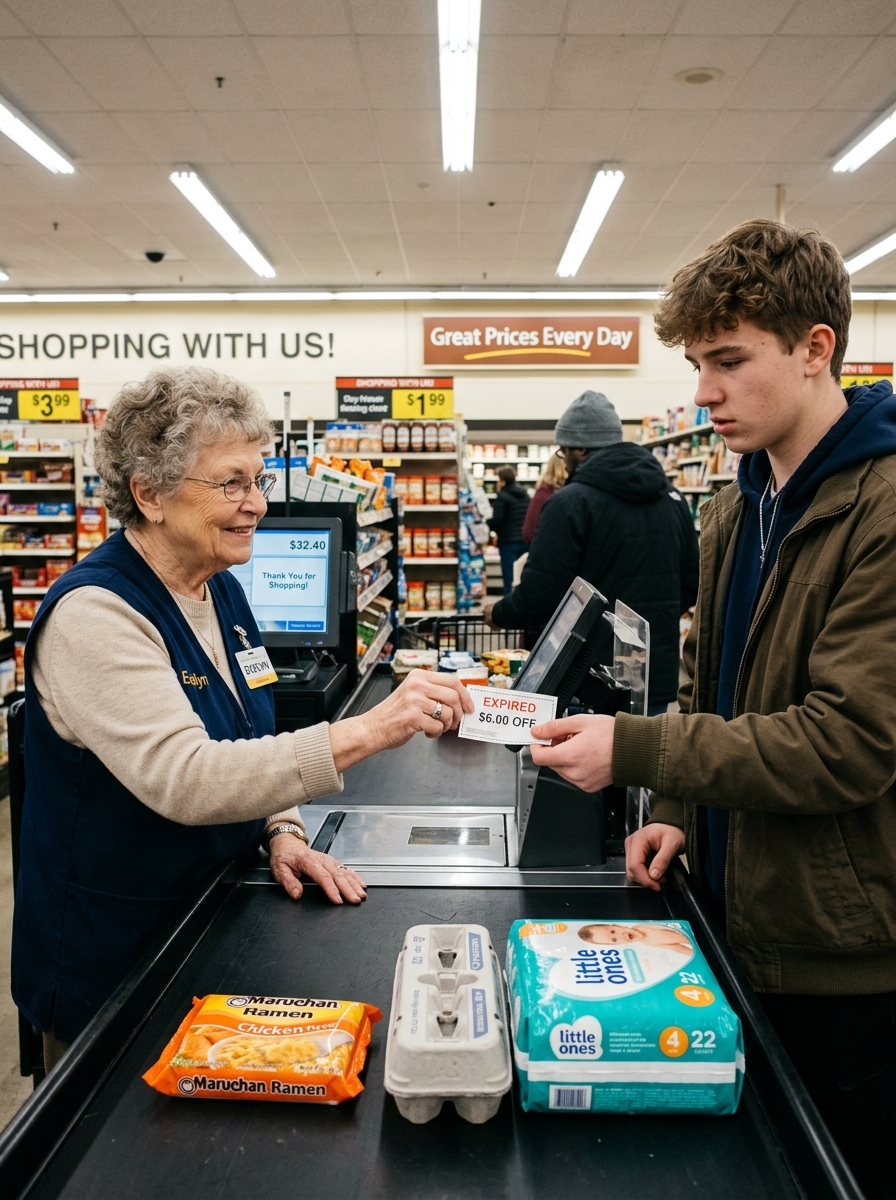
Evelyn Cross ducked beneath register six and pretended to search through a stack of papers.
The teenage boy standing in front of her knew exactly what she was doing.
So did she.
Trey was seventeen, tall and painfully thin, wearing the same faded work jacket he wore nearly every Friday night. On the conveyor belt sat two packs of noodles, a dozen eggs, generic cereal, a gallon of milk, and the smallest package of diapers the store sold.
Evelyn looked at the total.
Trey looked at the five crumpled bills in his hand.
He was $6.43 short.
Again.
“Mrs. Cross,” he muttered, his face turning red, “you don’t have to do that.”
“Do what?”
“The coupon thing.”
Evelyn pulled a wrinkled piece of paper from beneath the register and studied it through her reading glasses.
“Well, would you look at that,” she said. “Six dollars off household essentials.”
Trey stared at her.
“That’s not a real coupon.”
Evelyn raised one eyebrow.
“You work here now?”
The woman behind him smiled, but Trey didn’t.
He shoved his hands into his pockets.
“I’m not a charity case.”
The words came out harder than he intended.
For a moment, Evelyn said nothing.
Then she quietly entered a discount, slid the diapers into a bag, and pushed the groceries toward him.
“No,” she said. “You’re a boy buying diapers on a Friday night when most boys your age are worried about football games.”
Trey grabbed the bags.
“I’ll pay you back.”
“I didn’t ask you to.”
“I said I will.”
And he walked out.
Evelyn watched through the glass doors as Trey crossed the parking lot toward an old sedan waiting beneath the yellow lights.
In the back seat was a little girl in a car seat.
That was why the diapers were always there.
Trey lived with his mother and his eighteen-month-old sister, Maisie, in a small rental house near the edge of town.
His mother worked evenings cleaning offices.
Trey worked afternoons at a tire shop and attended high school in the mornings.
Friday was payday.
Friday was grocery day.
And Friday was the night he tried to stretch whatever remained until the following week.
Evelyn had figured most of that out without asking.
People told you plenty if you paid attention to what they bought.
She knew which elderly men had suddenly started purchasing frozen dinners after losing their wives.
She knew which mothers put meat back after seeing the total.
She knew which children were allowed to choose one treat and which children already understood not to ask.
Evelyn noticed because once, long before she wore a grocery-store name tag, she had been the one silently counting pennies.
She was sixteen when her parents died within the same year.
There had been no dramatic rescue waiting for her.
Just three younger siblings, an aunt who helped when she could, and a kitchen table covered with overdue bills.
Evelyn learned to cook beans six different ways.
She learned that powdered milk tasted better if it was cold enough.
She learned to mend jeans, cut hair, stretch a chicken through three dinners, and smile when little children asked whether everything was going to be okay.
She always told them yes.
Even when she had no idea.
Years later, Evelyn married a good man named Frank.
Together they raised two children and eventually opened a small repair business.
They worked nearly forty years.
They thought retirement was secure.
Then the business failed after several bad years, and debts swallowed almost everything they had saved.
Frank died not long afterward.
At seventy-six, Evelyn returned to work three days a week.
She never complained about it.
But she remembered what it felt like to stand at a checkout and realize your money had run out before your responsibilities had.
The next Friday, Trey came through her line again.
This time, he had calculated carefully.
Milk.
Bread.
Eggs.
Baby food.
Diapers.
Nothing else.
“You forgot something,” Evelyn said.
“No, I didn’t.”
“Chocolate milk.”
“I don’t drink chocolate milk.”
“Your sister does someday.”
“She’s one.”
“Then you’d better start planning ahead.”
Trey almost smiled.
Almost.
The total came to $23.71.
He placed $24 on the counter.
Evelyn handed him twenty-nine cents.
“No coupon?” he asked.
“Nothing good this week.”
That became their routine.
Some Fridays Trey needed help.
Some Fridays he didn’t.
Evelyn never made a show of it.
Sometimes the “coupon” was fifty cents.
Sometimes three dollars.
Once it was nearly ten.
Trey would sigh.
Evelyn would pretend not to notice.
Months passed.
Their conversations slowly became longer.
Trey told her he wanted to become an electrician.
Evelyn told him people would always need someone who knew how to fix things.
He told her Maisie had learned to say his name.
“She calls me ‘Tree.’”
“I’ve heard worse nicknames.”
He told her his mother felt guilty because he worked so much.
Evelyn scanned a carton of eggs.
“Good mothers feel guilty about things nobody else blames them for.”
Trey looked at her.
“You always talk like somebody’s grandmother.”
“I am somebody’s grandmother.”
“You know what I mean.”
She smiled.
One snowy Friday, Trey arrived near closing carrying only milk and diapers.
His eyes were red.
Evelyn didn’t ask why.
She simply scanned the items.
“My mom got her hours cut,” he finally said.
Evelyn nodded.
“I might quit school.”
Her hand stopped above the register.
“No.”
“I could work full-time.”
“No.”
“You don’t know our situation.”
Evelyn slowly removed her glasses.
“You’re right. I don’t.”
Then she looked directly at him.
“But I know what it costs when a young person gives away tomorrow to survive today.”
Trey stared at the floor.
Evelyn softened her voice.
“I quit school to raise my brothers and sister.”
He looked up.
“You?”
“Me.”
“You never told me that.”
“You never asked.”
For the first time, Evelyn told him about the cold house, the overdue bills, the beans, the hand-me-down coats.
She told him she never regretted caring for her siblings.
But she did regret believing she had no future beyond the emergency in front of her.
“You can help your family,” she said, “without giving away every piece of yourself.”
Trey said nothing for a long time.
Then he picked up the grocery bag.
“I’ll see you next Friday.”
He stayed in school.
The following year, Evelyn attended his graduation.
She sat near the back beside his mother and clapped so hard her palms hurt when Trey crossed the stage.
Afterward, he found her in the crowd.
“No coupon for graduation?” he asked.
Evelyn reached into her purse and handed him a folded piece of paper.
Trey laughed.
Then he opened it.
It wasn’t a coupon.
It was a note.
**Keep going. Someday somebody will need what you learned during the hard years.**
Trey kept it.
He finished trade school.
He became an electrician.
Life got busy.
Fridays changed.
Maisie grew out of diapers.
Evelyn continued working register six.
Then, several years later, a familiar voice came from the other side of her checkout lane.
“Any good coupons this week?”
Evelyn looked up.
Trey stood there in work boots and a clean company shirt.
He was older now.
Broader.
More confident.
Beside him stood Maisie, carrying a school backpack.
Evelyn came around the register and hugged them both.
From then on, Trey started stopping by most Fridays again.
But he rarely bought much.
Coffee.
Bread.
A carton of eggs.
Sometimes nothing at all.
Then Evelyn began noticing something strange.
Gift cards kept appearing beneath her register.
Twenty-five dollars.
Fifty dollars.
Sometimes one hundred.
Always tucked inside plain envelopes.
The first envelope said:
**For the family who comes up short.**
The second said:
**Use your judgment. You always do.**
Evelyn suspected immediately.
One Friday she caught Trey slipping another envelope beneath the counter.
“Trey.”
He froze.
Evelyn held out her hand.
“What is that?”
He smiled.
“Coupon.”
Her eyes filled before she could stop them.
“You don’t have to do this.”
Trey leaned against the counter.
“I know.”
“Then why?”
He looked toward the line of shoppers moving through the store.
An older man buying soup.
A young mother with two children.
A construction worker checking the balance on his debit card.
Then Trey looked back at Evelyn.
“Because somebody helped me without making me feel small.”
Evelyn wiped her cheek.
“For the record, those coupons were terrible.”
“They were completely fake.”
“Watch your accusations. I’m still on the clock.”
Trey laughed.
Then his expression grew serious.
“You told me somebody would need what I learned during the hard years.”
He tapped the envelope.
“You were right.”
Evelyn retired the following spring.
On her final Friday, register six was decorated with paper flowers and a crooked handwritten sign.
Trey and Maisie came.
So did several former coworkers.
Before Evelyn left, she opened the drawer beneath her register one last time.
Inside was a single envelope.
No money.
Just the old graduation note she had written years earlier.
Trey had added one sentence beneath hers.
**You taught me that helping someone isn’t about having more than they do. It’s about remembering what it felt like when you had less.**
Evelyn stood behind that grocery register because life had not turned out the way she planned.
Trey stood in front of it because life had asked too much of him too young.
Neither one could fix the other’s problems.
But for a few dollars on a Friday night, one generation told another:
I see how hard you’re trying.
Keep going.
And years later, that kindness found its way back to the same counter, waiting for someone else.
The best kindness isn’t the help we repay. It’s the help we pass on.