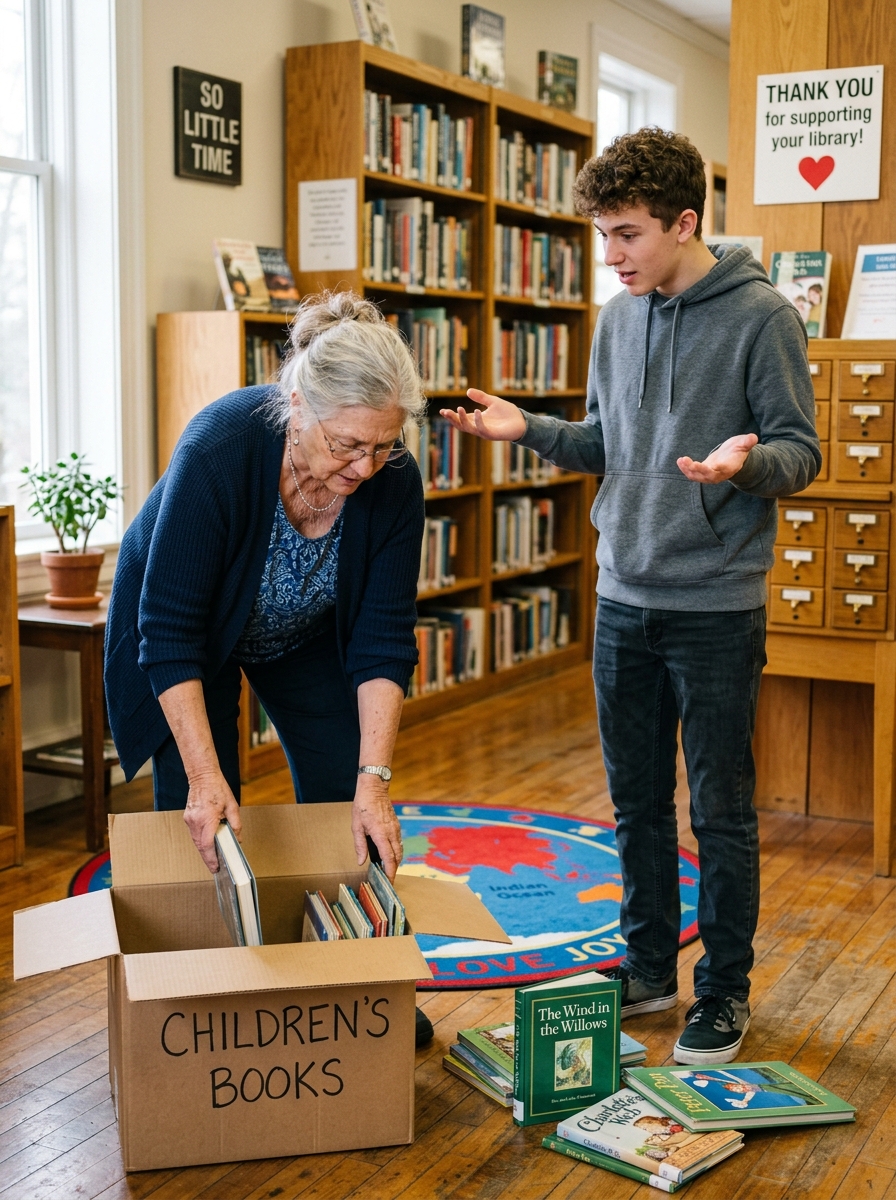
Elaine Porter had already filled six cardboard boxes when Noah walked in and stopped cold.
“Why are all the shelves empty?”
Elaine looked down at the book in her hands. It was an old copy of *The Wind in the Willows*, its green cover faded almost gray from decades of small fingers.
“The county is considering closing us,” she said.
Noah stared at her.
“What?”
Elaine tried to smile.
“They say people don’t use libraries the way they used to.”
She didn’t tell him the exact words she had heard at the county office two days earlier.
“Everything is online now.”
The sentence had followed her home.
It sat beside her while she ate soup alone at the kitchen table.
It followed her into bed.
It was still there at 3:00 in the morning when she stared at the ceiling and thought about how much of her life had quietly become unnecessary.
Elaine was 70 years old.
She had worked at that tiny public library in rural Nebraska for thirty-four years.
She had raised two children while checking out mysteries, westerns, cookbooks, biographies, and stacks of picture books with torn corners.
She had watched farmers come in during drought years to use the fax machine.
She had helped teenagers fill out college applications.
She had sat beside widows who came in just to have somewhere to go after lunch.
Her husband, Jack, used to tease her.
“You spend more time with those books than you do with me.”
But he always said it smiling.
After Jack died five years earlier, the library became even more important.
At home, every room reminded Elaine that someone was missing.
At the library, people still needed things.
A password reset.
A copy made.
A book recommendation.
Directions to a government website.
Sometimes they just needed someone to say, “Good morning.”
Elaine understood that kind of need.
So when the county talked about closing the library, it felt like losing Jack all over again.
Not because of the building.
Because of what disappearing feels like.
Noah was 16 and skinny enough that his hoodies always looked one size too large.
He came to the library most afternoons, sat at the computer near the back window, and wore old headphones with tape around one side.
Elaine had assumed he liked the quiet.
Then one afternoon the internet went down.
Noah looked genuinely panicked.
“I have to turn in an assignment by six.”
“Can’t you do it at home?”
He shook his head.
“Our internet only works when it feels like it.”
That was the first time Elaine understood why he stayed until closing.
Now he stood among the boxes, looking angrier than she had ever seen him.
“So you’re just packing everything?”
“The decision hasn’t been made yet.”
“But you think they’ll close it.”
Elaine folded her hands.
“They have numbers, Noah.”
“So?”
“Numbers matter.”
He looked around the room.
The scratched tables.
The children’s rug with faded alphabet letters.
The bulletin board covered in community notices.
The old wooden card catalog that no one used anymore but Elaine couldn’t bring herself to throw away.
Then he looked at her.
“People matter too.”
Elaine laughed softly.
“That sounds like something an old librarian would say.”
“No,” he said. “It sounds like something people forget.”
The next afternoon, Noah showed up holding his phone.
“I have an idea.”
Elaine immediately distrusted it.
Most ideas involving teenage boys and phones made her nervous.
“What kind of idea?”
“We make videos.”
She frowned.
“Videos of what?”
“People saying why this place matters.”
Elaine almost said no.
She hated being photographed.
She hated hearing her own recorded voice even more.
And the phrase “make videos” sounded exactly like the kind of modern nonsense county officials had used to explain why libraries were obsolete.
But Noah was already setting his backpack down.
“You said they have numbers.”
“Yes.”
“Then we give them faces.”
The first person Noah recorded was Mrs. Delaney, an 82-year-old widow who came every Tuesday to read the newspaper.
She sat near the front window with both hands wrapped around her cane.
Noah asked, “What does this library mean to you?”
She thought for a moment.
“My husband died two years ago,” she said. “After that, I went about three weeks without talking to anybody except the grocery cashier.”
Elaine looked down.
Mrs. Delaney continued.
“Then Elaine called and said she had a new gardening book she thought I’d like.”
Her eyes filled.
“I didn’t care about the gardening book.”
Nobody spoke for a few seconds.
“I came because somebody noticed I was gone.”
Noah posted the video.
By evening, hundreds of local people had watched it.
Then came others.
A young father said he had used the library computer to apply for the job that kept his family in town.
A farmer admitted Elaine had helped him print forms he was too embarrassed to admit he didn’t understand.
A mother brought in her eight-year-old daughter.
“This is where she learned to love reading,” the mother said.
The girl interrupted.
“And dinosaurs.”
The mother laughed.
“And dinosaurs.”
A man in work boots explained that during a layoff, he came to the library every morning because he couldn’t afford home internet.
“That table over there,” he said, pointing, “is where I filled out the application for the job I have now.”
One woman talked about a grief group that had met in the back room after three families in town lost loved ones during the same winter.
Another held up a tax form.
Another talked about homeschooling materials.
Another remembered coming there as a child because her parents couldn’t afford many books.
Then something happened Elaine hadn’t expected.
Teenagers started participating.
Not because Elaine asked them.
Because Noah did.
One girl said she studied there because home was too noisy.
A boy said he came because nobody bothered him when he sat alone.
Another teenager shrugged into the camera and said, “Sometimes you need somewhere to go that doesn’t expect you to buy anything.”
Elaine had to sit down when she heard that one.
For decades, she had thought she was taking care of books.
She suddenly realized the books were only part of it.
The library had been taking care of people.
Quietly.
One chair at a time.
One conversation at a time.
One open door at a time.
The county meeting was scheduled for a Thursday night.
Elaine wore the navy dress she had worn to Jack’s funeral because it was still the nicest thing she owned.
She arrived twenty minutes early.
There were already people standing in the hallway.
By the time the meeting started, every chair was full.
Farmers.
Teachers.
Retirees.
Parents holding children.
Teenagers leaning against the walls.
Elaine spotted Noah in the back with his phone lowered at his side.
One county official cleared his throat.
“We appreciate everyone coming.”
Elaine had prepared a speech.
Three pages.
She had rewritten it six times.
When her name was called, she walked to the microphone with trembling hands.
She unfolded the pages.
Then she looked at the crowd.
Mrs. Delaney was there.
The farmer was there.
The laid-off father was there.
The little girl who loved dinosaurs was sitting on her mother’s lap.
Noah gave Elaine one small nod.
Elaine folded the speech again.
“I thought I was here tonight to save a library,” she said.
The room went still.
“But these past two weeks taught me something.”
She glanced around.
“A library is not shelves.”
She paused.
“It is not a roof. It is not a budget line. It is not even books.”
Her voice cracked.
“It is a place where a person can walk in with nothing and still belong.”
Nobody moved.
Elaine swallowed.
“And I think every town needs at least one place like that.”
The vote was delayed that night.
A month later, the county announced that the library would remain open under a reduced budget while a community committee developed new programs and funding.
Noah helped create computer classes for seniors.
Elaine started a weekly homework hour for teenagers.
Someone donated new routers.
Someone else donated paint.
The old card catalog stayed exactly where it was.
One afternoon, Elaine found Noah standing beside it.
“You know,” he said, “nobody needs that thing anymore.”
Elaine narrowed her eyes.
“Careful.”
He grinned.
“I said nobody needs it. I didn’t say we should get rid of it.”
Elaine smiled.
That boy had learned something from her.
And she had learned something from him.
Old things do not survive simply because they were once important.
They survive when someone takes the time to explain why they still matter.
And sometimes the person who reminds us of that isn’t someone our own age.
Sometimes it’s a kid with taped headphones, unreliable internet, and enough stubbornness to make an entire town remember what it almost lost.
Because progress should give us more ways to connect, not fewer places to belong.
And the things worth saving are rarely just buildings, books, or traditions.
They are the quiet places where human beings still notice when someone is missing.
Some doors are worth keeping open because, for someone who has nowhere else to go, they are more than doors—they are a way back into the world.