The Teacher Asked to Leave Her Classroom—Then the Student Who Mocked Her Followed Her Outside and Told Her Why She Couldn’t Quit
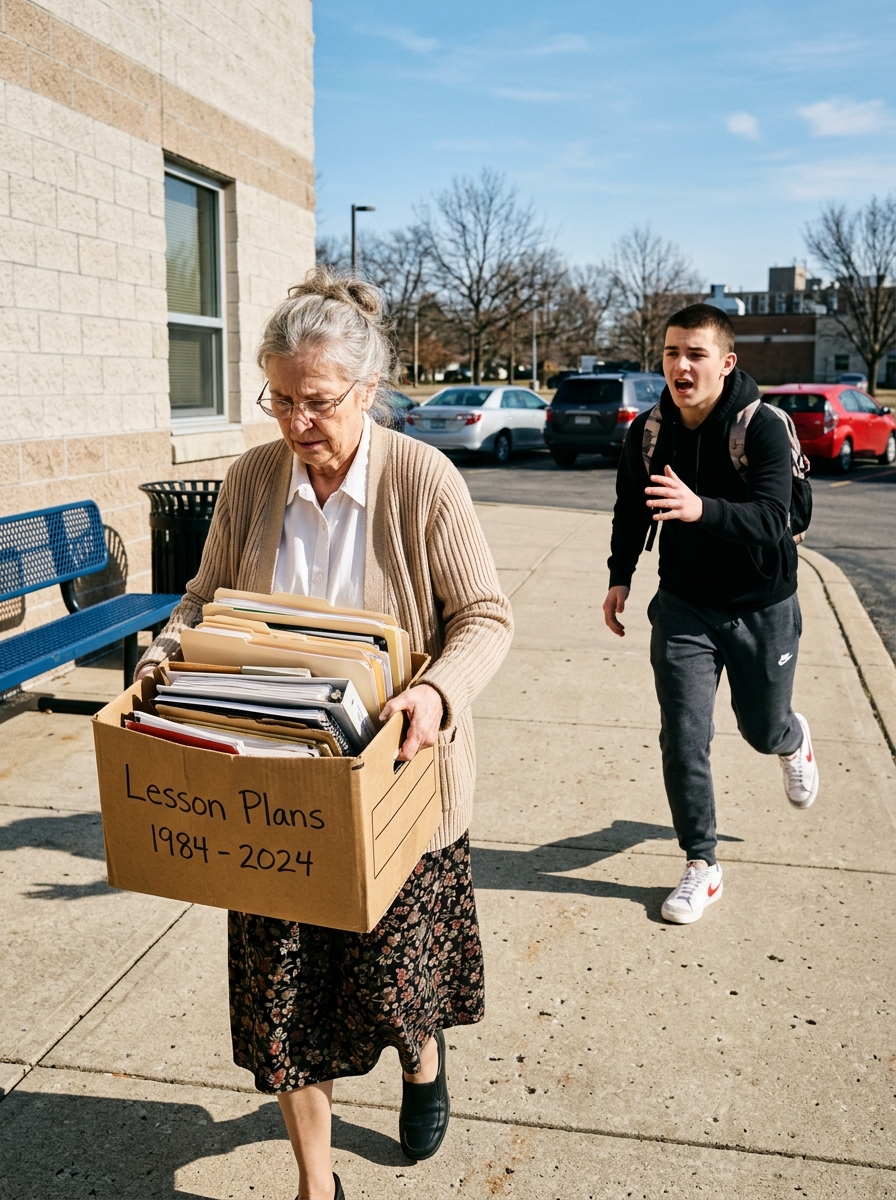
Ruth McKenna was halfway through putting forty years of teaching into a cardboard box when she heard someone laughing in the hallway.
For a second, she thought it was about her again.
At 71, Ruth had learned to recognize that particular kind of teenage laughter—the kind that came whenever she accidentally projected her email inbox onto the classroom screen or forgot which button made the smart board work.
She folded another yellowed lesson plan and placed it carefully inside the box.
Handwritten.
Blue ink.
Dated 1998.
The assistant principal had been kind about it.
That almost made it worse.
“Ruth,” he had said twenty minutes earlier, sitting across from her at the little round table near the windows, “you’ve given a lot to this school.”
She knew what came next.
People always began goodbye speeches by telling you how valuable you had been.
“We’re moving toward more technology-based instruction,” he continued. “The students need someone comfortable with the systems we’re using now.”
Ruth looked at the laptop sitting between them.
She had spent ten minutes that morning trying to open an attendance program.
A sophomore finally whispered, “Mrs. McKenna, you have to double-click.”
Half the class laughed.
Ruth had smiled along with them.
She had gotten good at that.
“So you’re asking me not to substitute anymore?” she asked.
The administrator hesitated.
“I think it might be time.”
Ruth nodded once.
“I understand.”
And she did.
That was the painful part.
She wasn’t angry at the school.
The world had changed.
Classrooms had passwords now. Assignments lived online. Students turned in essays without ever touching paper.
Ruth still carried spare pencils in her cardigan pocket.
She still believed a teacher should stand at the door and greet every student by name.
She still wrote vocabulary words on index cards.
Maybe there simply wasn’t room for teachers like her anymore.
But she had needed the substitute work.
After her husband, Patrick, developed dementia, Ruth had spent most of their retirement savings caring for him.
For six years, she had watched the man who once remembered every anniversary slowly forget which drawer held the forks.
Near the end, he forgot Ruth’s name.
She never forgot his.
After Patrick died, Ruth discovered that grief had bills attached to it.
So twice a week, sometimes three times, she woke before sunrise, put on sensible shoes, packed a sandwich, and drove twelve miles to the high school.
Not only because she needed the money.
Because an empty house at 7 a.m. could be unbearably quiet.
Ruth taped the cardboard box shut.
Inside were lesson plans, grammar exercises, a cracked wooden ruler, two red pens, and a photograph of her first class from 1984.
Thirty-two children.
Big hair.
Denim jackets.
No laptops anywhere.
She lifted the box against her chest and walked toward the parking lot.
“Mrs. McKenna!”
Ruth kept walking.
“Mrs. McKenna, wait!”
She turned.
Jamal Carter was running toward her.
Seventeen years old.
Hoodie half-zipped.
Backpack hanging from one shoulder.
And, Ruth remembered painfully, one of the students who laughed loudest whenever technology defeated her.
“What is it, Jamal?”
He stopped several feet away.
His eyes dropped to the box.
“You’re leaving?”
“I suppose word travels quickly.”
“They told you not to come back?”
Ruth adjusted the box in her arms.
“They suggested I enjoy my retirement.”
Jamal stared at the pavement.
Then he said something Ruth never expected.
“You can’t.”
She almost laughed.
“I’m afraid I can.”
“No.” He looked up. “I mean—you can’t leave yet.”
Ruth studied him.
Jamal shoved his hands into his pockets.
“You remember when you made me stay after class last month?”
“Yes.”
“You asked why I never read out loud.”
Ruth remembered.
Jamal could talk his way through almost anything. He was funny, confident, and popular.
But whenever she asked students to read, his entire personality changed.
He suddenly needed the bathroom.
Or he had forgotten his glasses.
Or he became fascinated by something outside the window.
Ruth had seen it before.
So one afternoon, after everyone left, she handed him a short paragraph and quietly asked him to read it.
He made it through three sentences.
Then stopped.
“I’m stupid,” he had muttered.
Ruth remembered setting down her pencil.
“No, you’re not.”
“I’m seventeen and I read like a little kid.”
“That means somebody missed something,” she said. “It does not mean there’s something wrong with you.”
Nobody had apparently said that to him before.
Now, standing in the parking lot, Jamal rubbed the back of his neck.
“My mom works nights,” he said. “My dad’s gone. I’ve been passing classes because I’m good at remembering stuff people say. Nobody figured it out.”
Ruth’s throat tightened.
“I figured it out because I’ve been teaching children longer than your parents have been adults.”
Jamal smiled.
“Exactly.”
Then he said, “You’re the first teacher who didn’t make me feel dumb.”
Ruth looked away.
Cars moved slowly through the pickup lane.
A cold Kansas wind pushed a paper cup across the pavement.
“I’m sorry, Jamal.”
“For what?”
“That I won’t be here to help.”
He pointed at the box.
“You got those old worksheets in there?”
Ruth blinked.
“Some of them.”
“Then teach me somewhere else.”
And that was how it began.
Every Tuesday and Thursday afternoon, Jamal met Ruth at the town library.
They sat at a scratched wooden table near the back, beneath a clock that ticked louder than it should have.
Ruth brought index cards.
Jamal brought embarrassment.
At first, he hid whenever anyone his age walked past.
But Ruth never rushed him.
They worked through sounds, vocabulary, comprehension, and the kinds of small gaps that become enormous when nobody notices them for ten years.
Some afternoons Jamal became frustrated.
“This is baby stuff.”
Ruth would shake her head.
“No. This is foundation stuff. Nobody insults a house because somebody had to pour concrete first.”
Jamal started reading better.
Then something else happened.
He began teaching Ruth.
“You’re clicking the wrong thing again,” he said one afternoon.
“I suspected as much.”
“Move over.”
Jamal showed her how to organize files on her laptop.
How to enlarge text.
How to use the school’s learning website.
How to connect a computer to a projector.
Ruth took notes on paper.
Jamal laughed.
“You know your computer has a notes app, right?”
“Yes.”
“And you’re writing instructions for using the computer on paper.”
“Yes.”
He shook his head.
“You’re unbelievable.”
“So I’ve been told.”
By spring, two other students joined them at the library.
Then four.
Then seven.
Some needed reading help.
One needed algebra.
Another simply needed an adult who would sit beside her and say, “Try again.”
Jamal began telling classmates about Ruth.
Not the old substitute who couldn’t work the smart board.
The teacher who remembered whether your mother was sick.
The teacher who noticed when you stopped eating lunch.
The teacher who carried pencils because she knew some kids were too embarrassed to admit they didn’t have one.
One morning, the assistant principal called Ruth.
“We’ve had some students asking about you.”
Ruth smiled into the phone.
“Complaints?”
“Requests.”
The school was starting an after-school tutoring program.
They wanted Ruth to help.
“And,” he added awkwardly, “Jamal says he can make sure you don’t destroy the computers.”
Ruth laughed so hard she had to sit down.
Her first afternoon back, she stood outside the classroom door the way she had for forty years.
Students walked past carrying phones and tablets.
Ruth carried index cards.
Jamal stopped beside her.
“You nervous?”
“A little.”
He nodded toward the smart board.
“You remember how to turn it on?”
Ruth gave him a look.
“Don’t push your luck.”
He grinned and went inside.
By the end of that year, Jamal read an entire page aloud in front of the tutoring group.
Slowly.
Not perfectly.
But without pretending he needed the bathroom.
When he finished, nobody laughed.
Ruth clapped first.
The others followed.
Jamal looked at her, eyes shining, and said, “Guess old-school still works.”
Ruth shook her head.
“No, Jamal. People work. Schools, machines, methods—they’re just tools. People are what matter.”
Years later, Ruth still kept that cardboard box.
But she never thought of it as the box she packed when the school asked her to leave.
She thought of it as the box Jamal stopped her from carrying away.
Because inside were forty years of things the world had decided were outdated.
Patience.
Handwritten notes.
Second chances.
Listening.
Looking a child in the eye long enough to notice what everyone else missed.
Technology can teach us how to move faster.
But sometimes an older pair of eyes can still see what everyone rushing past has forgotten to notice.
Wisdom doesn’t become useless just because the world learns a newer way to click.