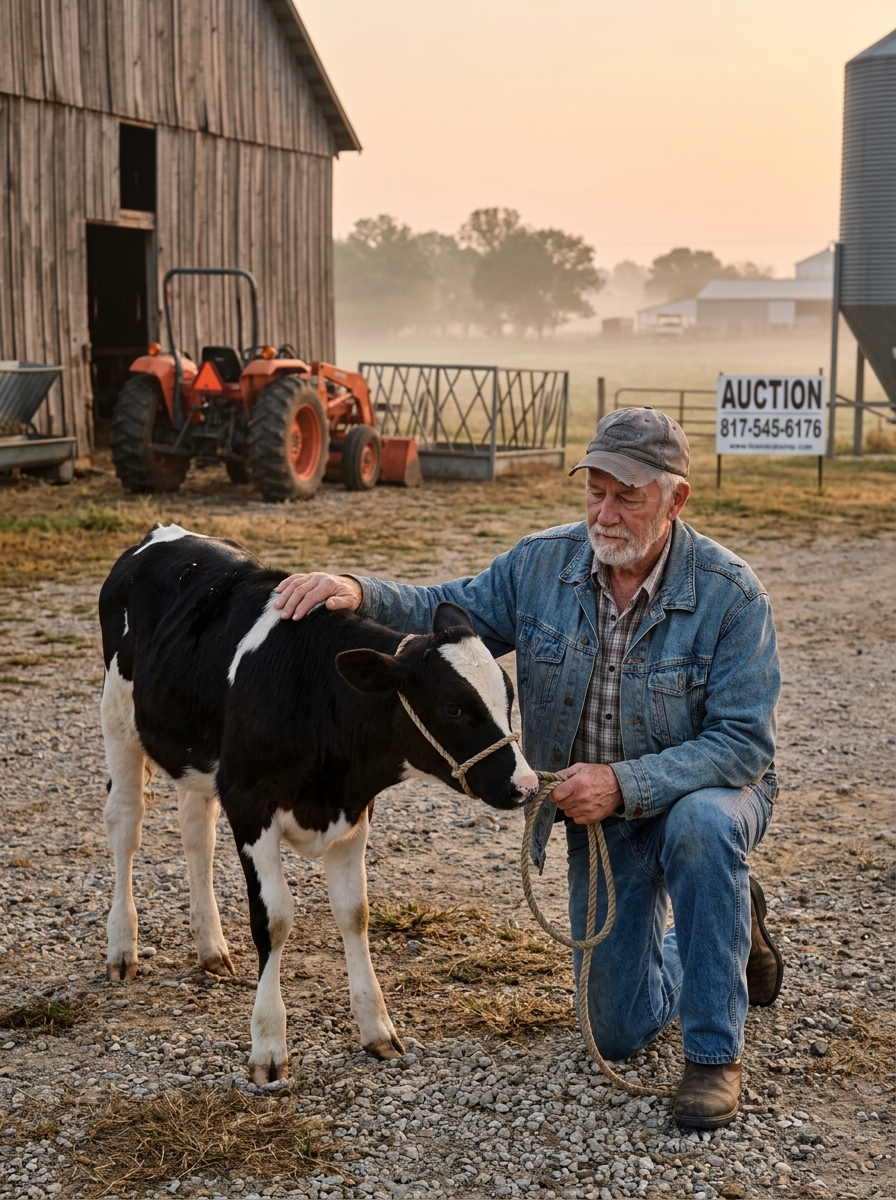
A 71-year-old farmer prepared to sell the very last calf his late wife bottle-fed to save their land, but what he found outside on auction morning changed absolutely everything.
Harlan Beck stood in the dim, dusty light of his barn, running a calloused hand over the dark, soft coat of a young calf. He was 71 years old, and this was shaping up to be the hardest morning of his life.
The calf nudged his faded denim jeans, expecting a warm bottle. Harlan swallowed hard, feeling a thick lump form in his dry throat.
“I’m sorry, little one,” he whispered, his voice cracking in the quiet barn. “I’m so sorry.”
His wife, Martha, had named the calf Daisy. Just three days before she passed away from a brutal, exhausting fight with cancer, Martha had sat right here on a turned-over plastic bucket. She was too weak to stand, but she insisted on being in the barn, letting the little calf suckle milk from a bottle she held with trembling hands.
Now, Martha was gone. And the farm was next.
It had been a brutal three years. The Midwestern sky had stubbornly refused to rain, baking the topsoil into hard concrete and destroying their crops. Then came the endless flood of medical bills.
No matter how much they had saved over forty years of marriage, it wasn’t enough to beat the sickness, and it wasn’t enough to hold off the bank. The foreclosure notices in the mailbox had turned from polite reminders to final warnings.
Harlan was out of time, out of money, and completely out of hope.
Today was the dreaded livestock auction. He had to load up the absolute last of the cattle on his property, including little Daisy, just to pay off a fraction of the crushing debt.
He grabbed the frayed lead rope, feeling the immense weight of four generations of Beck farmers pressing down on his tired shoulders. His grandfather had bought this land with pennies. His father had bled for it. Harlan had loved it. And now, he was the one losing it.
He led Daisy out of the barn stall, stepping into the crisp, gray pre-dawn air.
That’s when he heard it.
It wasn’t the familiar, sputtering hum of his own old tractor. It was the heavy crunch of tires on gravel. A lot of tires.
Harlan squinted through the early morning fog. Coming down his long, winding dirt driveway was a solid line of headlights.
At first, a knot formed in his stomach. He thought it was the bank representatives coming early to take inventory of his equipment. He felt a flash of anger, followed quickly by deep, biting shame. He didn’t want anyone to see an old man broken like this.
But as the first truck pulled into the yard, he recognized the rusted front bumper. It was Tom, the owner of the local hardware store in town.
Right behind Tom was a heavy flatbed truck driven by a neighboring farmer. It was a man Harlan hadn’t spoken to in five years because of a bitter, stubborn dispute over a shared fence line.
Behind him was a minivan driven by a woman holding a casserole dish wrapped in foil. Harlan recognized her immediately. She had been in Martha’s third-grade class over twenty years ago.
Truck after truck rolled onto the property. They parked on the wet grass, along the wooden fence, and right up to the edge of the front porch. There were dozens of them.
Harlan stood frozen in the dirt, dropping the lead rope. Daisy stayed right by his leg, chewing softly on a patch of grass.
Doors opened, and people started pouring out into the morning chill. There were members of the small local church, young men in scuffed work boots, and elderly couples leaning on wooden canes.
They didn’t come empty-handed.
The rival neighbor backed his flatbed right up to Harlan’s empty barn. It was fully loaded with heavy, golden round bales of hay and a whole pallet of new fencing supplies.
“Figured your winter pasture was getting a little low, Harlan,” the man said, looking down at his boots, brushing off the years of silence.
Another truck pulled up carrying hundreds of gallons of red diesel fuel, enough to keep the tractors running for months.
Then, Tom from the hardware store walked up to Harlan. He took off his faded baseball cap and reached into the pocket of his heavy canvas coat. He pulled out a thick white envelope and pressed it firmly into Harlan’s calloused, shaking hands.
“We heard about the auction today, Harlan,” Tom said softly. “And we decided we aren’t letting it happen.”
Harlan stared down at the envelope. It was thick. Far too thick.
“Martha taught half the kids in this county how to read,” Tom continued, his eyes shining with unshed tears. “You pulled my delivery truck out of the mud three winters in a row. You never charged a dime or asked for a favor when folks around here needed a hand.”
Other neighbors stepped forward, gently pressing more envelopes into the pockets of Harlan’s worn flannel jacket. Some contained cash. Some contained checks. Some just held heartfelt letters of prayer, gratitude, and memories of Martha.
“You can’t do this,” Harlan wept, the tears finally spilling over his weathered cheeks and disappearing into his gray beard. “I can’t ask this of you.”
“You didn’t ask,” said a young woman who used to sit at Martha’s kitchen table for after-school tutoring. “That’s exactly why we’re all here.”
Harlan looked around his front yard. The quiet, lonely farm he thought he was losing in silence was suddenly overflowing with life, love, and grace.
They couldn’t erase every single cent of his medical debt that morning. But when Harlan finally sat down and counted the envelopes on his kitchen table an hour later, it was more than enough to stop the bank’s foreclosure. It was enough to buy him another season.
Most importantly, it was enough to keep Daisy right there in the barn where she belonged.
Harlan walked back out to the wooden porch as the sun finally broke over the horizon, casting a warm, beautiful golden glow over the fields.
For the first time in months, the crushing weight on his chest was entirely gone.
He realized something deeply profound as he watched his neighbors unload hay into his barn. He had spent his whole life thinking this land belonged only to his family.
But he was wrong. This farm belonged to the memories of a whole community. It belonged to the people who had gathered around their dinner table, the kids who had learned life lessons in their pastures, and the neighbors who had shared their burdens over the fence.
When you spend a lifetime quietly planting seeds of kindness, you never know when the harvest will come back to save you.
We live in a world that constantly tells us people are divided, selfish, and cold. But if you look closely, you will see that the old-fashioned values of neighborly love, quiet sacrifice, and looking out for one another are still absolutely alive and well.
Sometimes, we just need a gentle reminder that we are never truly walking alone.
True wealth isn’t measured in the acres of land you own, but in the people who refuse to let you fall when you have nothing left to give.