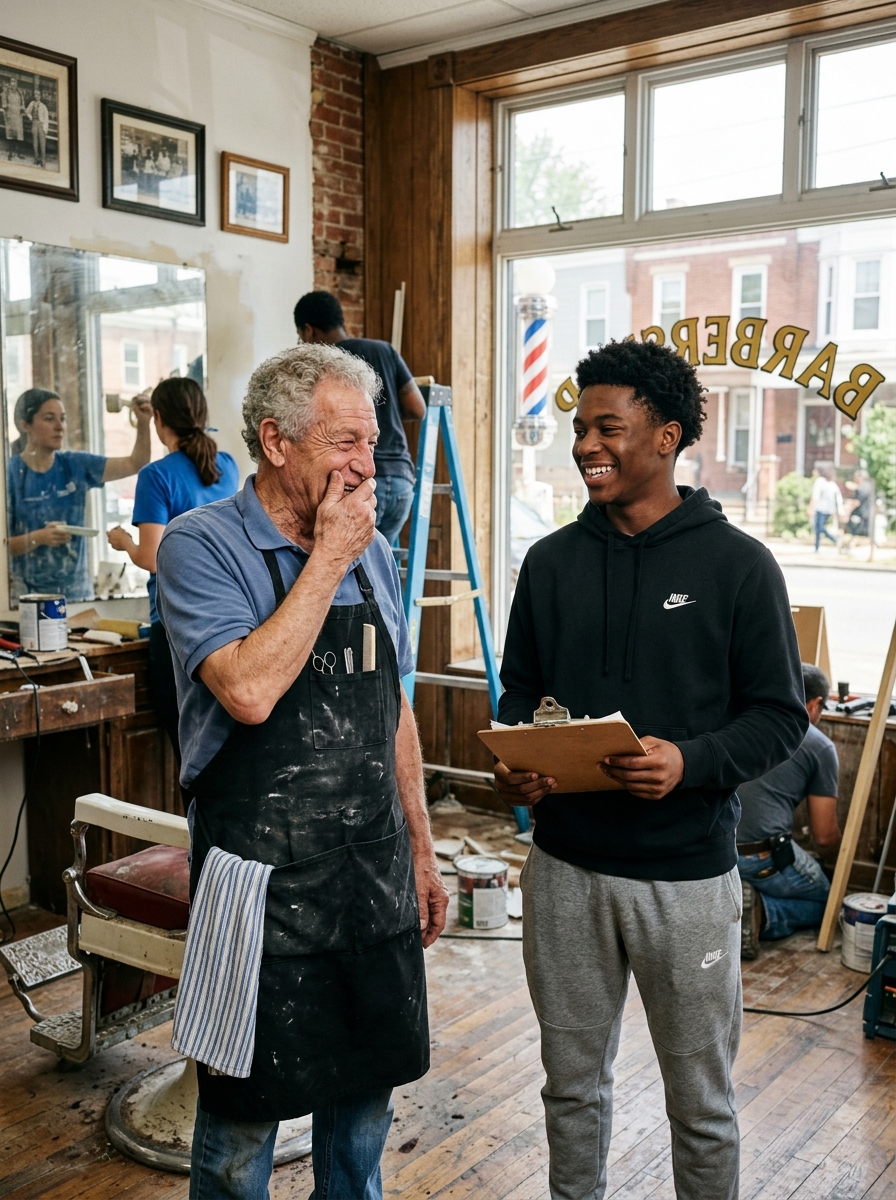
The first time sixteen-year-old Jamal Carter walked into Wendell Price’s barbershop, he didn’t ask for a haircut.
He pointed at the broom leaning beside the old Coke machine and said, “Mr. Price, you mind if I sweep up?”
Wendell looked over his glasses.
“You applying for a job?”
Jamal shook his head.
“No, sir.”
“Then why do you want to sweep my floor?”
The boy glanced toward the barber chair, then down at his worn sneakers.
“Figured maybe sweeping could be worth a haircut.”
Wendell understood immediately.
He pretended he didn’t.
“Haircuts cost eighteen dollars.”
“I know.”
“And sweeping takes fifteen minutes.”
“I can sweep slow.”
That made Wendell laugh for the first time in days.
“Sit down, kid.”
That was how Tuesdays started.
Wendell was seventy and had been cutting hair in that fading Missouri town since men still came in asking for sideburns like Elvis.
His shop had two barber chairs, though only one was used anymore.
There were faded baseball photographs on the wall, a radio with a crooked antenna, jars of combs soaking in blue liquid, and a bell over the door that had been ringing since 1978.
For thirty-seven years, Wendell’s wife, Marlene, had handled the books.
She remembered birthdays.
She brought coffee.
She knew which customers had lost wives, which ones had new grandchildren, and which men needed to sit quietly for a while before going home.
Then cancer came.
Wendell spent nearly everything they had saved trying to buy more time.
When Marlene died, the bills stayed.
So did the empty chair by the front window where she used to sit.
People told Wendell to retire.
He always answered the same way.
“Retire with what?”
But the truth was harder than that.
If he closed the shop, he would have to go home to a house where nobody called his name.
So he kept cutting hair.
And every Tuesday at 4:15, Jamal arrived.
At first, Wendell assumed the boy was like plenty of teenagers he complained about.
Phone always in his hand.
Earbuds dangling from his sweatshirt.
Music Wendell called “noise with a drumbeat.”
Jamal thought Wendell’s old country station sounded like “sad men arguing with guitars.”
They disagreed about nearly everything.
“You kids don’t look people in the eye anymore,” Wendell said one afternoon.
“You old people stare too much,” Jamal replied.
“Take that hat off indoors.”
“Why?”
“Because that’s what civilized people do.”
“Who decided?”
“Civilized people.”
Jamal grinned.
Wendell tried not to.
Their routine became simple.
Jamal swept.
Wendell cut his hair.
Then Jamal stayed.
He wiped mirrors.
Folded towels.
Took out trash.
Eventually, Wendell noticed something.
Jamal never hurried home, but he always left by 5:30 exactly.
One Tuesday, Wendell asked why.
“Gotta pick up my sisters.”
“From where?”
“Neighbor watches them till five-thirty.”
“Your mom working?”
“Night shift.”
“What about your dad?”
Jamal kept sweeping.
Wendell immediately regretted asking.
“Not around much,” the boy said.
That was all.
Over the next few months, the rest came out in pieces.
Jamal’s mother worked evenings cleaning rooms at a roadside motel and picked up weekend shifts at a nursing facility.
Jamal made dinner for his sisters, ages seven and nine.
He checked homework.
He packed lunches.
He learned how to braid hair by watching videos because his youngest sister cried when her ponytails looked crooked.
He didn’t have money for regular haircuts because every dollar he earned doing yard work went toward groceries, school supplies, or whatever emergency had appeared that week.
Wendell stopped teasing him about his phone after that.
One Tuesday, Jamal arrived carrying a grocery bag.
“What’s that?”
“Dinner.”
Inside were three cans of soup and a loaf of discount bread.
Wendell stared at it.
“That feeding all three of you?”
“Probably.”
Wendell walked to the back room and returned with half a meatloaf, mashed potatoes, green beans, and four dinner rolls.
“My neighbor brought too much food,” he lied.
Jamal looked at him.
“You live alone.”
“Don’t get smart.”
“My sisters love meatloaf.”
“Then get it out of here before I change my mind.”
The following Tuesday, Jamal brought Wendell a slice of homemade chocolate cake wrapped in foil.
“My little sister made it.”
Wendell took one bite.
“Good Lord.”
“Bad?”
“Terrible.”
Jamal smiled.
Wendell finished every crumb.
Somewhere along the way, Tuesdays stopped being about haircuts.
Wendell taught Jamal how to sharpen clippers.
How to shake a man’s hand properly.
How to sweep beneath the barber chair before hair stuck to your shoes.
How to listen when an older customer repeated the same story for the fourth time.
Jamal taught Wendell how to use text messages.
How to take a decent picture without putting his thumb over the camera.
And, reluctantly, how to play music through the tiny speaker Jamal bought him for Christmas.
Wendell hated most of Jamal’s songs.
Jamal hated most of Wendell’s.
They made a playlist anyway.
Then one Tuesday, Jamal found Wendell sitting alone in the barber chair with the lights half off.
No customers had come in all afternoon.
An envelope sat open on the counter.
“What’s wrong?”
Wendell folded the paper.
“Nothing.”
“Mr. Price.”
“You always this nosy?”
“You taught me to look people in the eye.”
Wendell sighed.
The rent was going up.
The furnace needed replacing.
Business had been shrinking for years as families moved away and storefronts went dark.
Wendell could no longer keep pretending.
“I’ll probably close after Christmas.”
Jamal stood very still.
“What do you mean close?”
“I mean shut the door.”
“For how long?”
“For good.”
Jamal stared at the old mirrors, the worn chairs, the photographs on the walls.
“But everybody comes here.”
“Not enough everybody.”
“What about Tuesdays?”
Wendell smiled sadly.
“Kid, you can sweep your own floor.”
Jamal didn’t laugh.
He grabbed his jacket.
“I gotta go.”
For the first time in almost two years, he left without getting a haircut.
Three days later, Wendell pulled into the shop parking lot and slammed on his brakes.
There were trucks everywhere.
Cars lined both sides of the street.
Twenty or thirty people stood outside his barbershop.
Then Wendell noticed ladders.
Paint cans.
Lumber.
A new furnace sitting in the back of a pickup.
And Jamal.
The boy stood on the sidewalk holding a clipboard.
“What did you do?”
Jamal grinned.
“Made some phone calls.”
It turned out Jamal had found Wendell’s old appointment book.
He contacted former customers.
Their sons.
Their daughters.
Men Wendell had given first haircuts to thirty years earlier.
A retired carpenter repaired the rotting trim.
An electrician replaced bad wiring.
A plumber fixed the sink that had leaked for five years.
Someone painted the storefront.
Someone else replaced the cracked front window.
A former customer who owned a heating business donated the furnace.
Women from the neighborhood brought casseroles and coffee.
By noon, the sidewalk looked like the town Wendell remembered from forty years ago.
Busy.
Laughing.
Alive.
Wendell stood in the doorway unable to speak.
An elderly man patted him on the shoulder.
“You cut my hair the morning I got married.”
Another said, “You came to the house when my father couldn’t walk anymore.”
A woman wiped tears from her cheek.
“My husband wouldn’t let anyone else cut his hair after the stroke.”
Wendell looked at Jamal.
“You did all this?”
Jamal shook his head.
“No, sir.”
“You did it. You just spent forty years doing it a little at a time.”
Wendell sat down in Marlene’s old chair by the window.
For a moment, he covered his face.
Jamal sat beside him.
Wendell finally whispered, “I thought I was helping you.”
“You were.”
“Haircuts and sweeping floors.”
Jamal shook his head.
“No.”
Then the sixteen-year-old boy said something Wendell would remember for the rest of his life.
“You thought you were teaching me how to work. You taught me how to stay.”
The shop never closed.
In fact, Wendell made one change.
A handwritten sign appeared in the window the next week.
TUESDAYS — PAY WHAT YOU CAN.
Underneath, in Jamal’s handwriting, were four more words:
OR SWEEP THE FLOOR.
Years later, people in town still talked about Wendell’s Tuesday haircuts.
But Wendell always said the haircut was never the important part.
Sometimes a boy walks through your door needing something he cannot afford.
Sometimes an old man thinks he has nothing left to give.
And sometimes two people from completely different generations discover that what saves a life is rarely money.
It is having somewhere you belong.
Someone who notices when you don’t show up.
Someone who teaches you that responsibility is another word for love.
And someone who leaves the light on until you find your way back.
The best thing we can give another person is not always a handout—it is a place where they know they matter.