
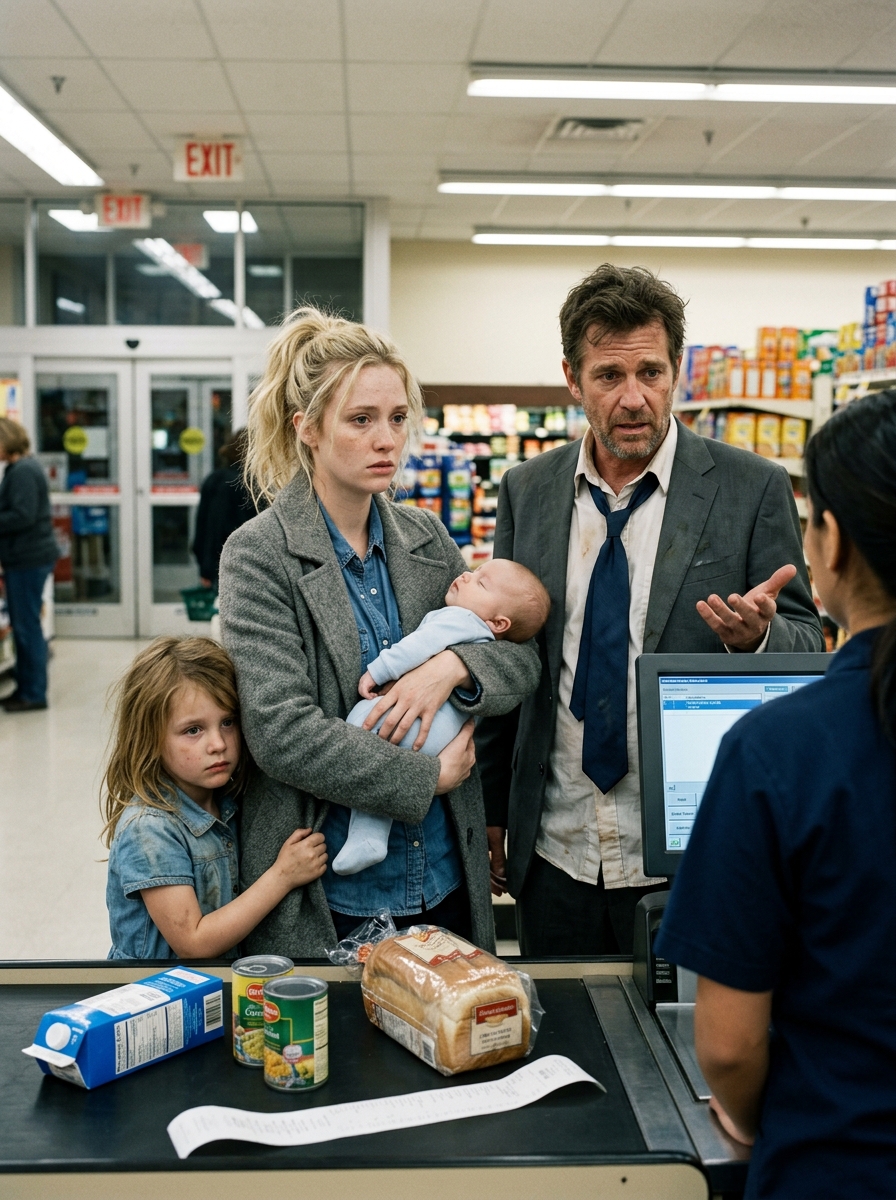
A Widowed Executive Stopped a Young Mother From Returning Baby Formula at Closing Time—Then a Small Grocery Receipt Revealed the One Thing His Money Had Never Been Able to Buy
“I’m sorry. I need to return it.”
The young woman’s voice was so quiet that David Harper almost missed it.
He was standing in the express lane of a nearly empty supermarket on the south side of Indianapolis, holding a frozen dinner and a bag of coffee. The woman in front of him had one hand wrapped around a can of baby formula and the other supporting a small baby against her chest.
Beside her stood a little girl in a faded blue dress.
“Mama,” the girl whispered, “is Emma still going to eat tonight?”
The woman closed her eyes for half a second.
“Yes, Lily.”
Her voice shook.
“I’ll figure it out.”
David felt something tighten in his chest.
The cashier looked down at the register.
“The refund is going back to the card you used.”
“I need cash,” the woman said quickly. “Please. The other card got declined. I thought I had enough left, but I was wrong.”
The cashier’s expression softened.
“I’m sorry. The system won’t let me change the original payment method.”
The woman stared at the formula.
Then at the baby.
Then at the little girl holding the side of her coat.
“All right,” she whispered. “Just return it.”
David had spent years sitting through negotiations involving millions of dollars without showing emotion.
He had delivered bad quarterly numbers to rooms full of executives.
He had watched entire departments argue over budgets while remaining calm enough to make everyone else look nervous.
But there was something about that little girl asking whether her baby sister would eat that got past every wall he had built.
The cashier reached for the formula.
“Wait.”
David heard his own voice before he had decided to speak.
The woman turned.
She looked exhausted, but not defeated.
Her blonde hair was pulled into a loose ponytail. She wore a gray coat with frayed cuffs. The baby in her arms looked only a few months old.
David stepped forward.
“I’ll buy it.”
The woman blinked.
“What?”
“The formula. I’ll buy it.”
“No.”
Her answer came so fast that even the cashier looked surprised.
David stopped.
“I’m not trying to embarrass you.”
“I know.”
She shifted the baby higher against her shoulder.
“But I don’t take money from strangers.”
The baby began fussing.
The little girl looked up at her mother.
“Mama…”
“I know, sweetheart.”
David glanced at the formula sitting beside the register.
Then back at the woman.
“I’m David.”
She said nothing.
He tried again.
“You don’t have to tell me anything about yourself. You don’t owe me a story. You don’t owe me an explanation. Just let me buy the formula.”
Her eyes became shiny.
“I said I’ll figure it out.”
David nodded slowly.
“I believe you.”
That seemed to surprise her more than anything else.
“I really do,” he continued. “But figuring it out doesn’t mean you have to refuse every hand that reaches toward you.”
The cashier looked away, pretending to straighten a stack of paper bags.
The little girl studied David with serious brown eyes.
“Are you rich?”
The mother nearly dropped her purse.
“Lily!”
“What?”
The girl looked genuinely confused.
“He has a nice watch.”
David almost laughed.
It was the first time in months that laughter had tried to come out naturally.
“I do okay,” he said.
The woman covered her face for a second.
“I’m sorry.”
“Don’t be.”
Lily pointed at the formula.
“If you’re rich, you could buy Emma’s milk.”
“Lily, honey.”
This time David did laugh, softly.
“She has a point.”
The woman stared at him for another long moment.
The struggle on her face was obvious.
Pride on one side.
Need on the other.
Finally, she looked down at the baby.
“Just the formula.”
David nodded.
“Just the formula.”
The cashier scanned it.
Then the woman reached into her cart and quietly placed a loaf of bread on the belt.
She immediately pulled it back.
David noticed.
“So there were other things.”
“No.”
“There was bread.”
“We have some food at home.”
Lily looked up.
“We have cereal.”
Her mother’s cheeks turned red.
“That’s enough, Lily.”
David kept his voice gentle.
“What else were you trying to buy?”
“Nothing.”
The cashier leaned slightly toward the woman.
“Sweetheart.”
The woman looked at her.
The cashier gave her a small nod.
Something in the woman’s expression broke.
Not dramatically.
There was no sobbing.
She simply stopped pretending for a moment.
She put the bread back on the belt.
Then a jar of peanut butter.
Milk.
Bananas.
A small box of cereal.
Nothing fancy.
Nothing unnecessary.
David looked at the items and felt almost ashamed of the way he lived.
He had spent more on a business lunch that afternoon than this woman was trying to spend feeding two children for days.
“That’s everything,” she said.
David picked up two additional cans of the same formula from a nearby display.
Her head snapped toward him.
“No.”
“They’re for later.”
“You said just the formula.”
“I said I’d help.”
“That’s not the same thing.”
“It can be tonight.”
For the first time, there was a spark of irritation in her eyes.
David respected it.
This was not a woman looking for someone to rescue her.
This was someone fighting hard to keep control of a life that had suddenly become too heavy.
He put one extra can back.
“One extra?”
She looked at him.
He lifted both hands slightly.
“Compromise.”
After a moment, she nodded.
“One.”
The cashier finished ringing everything up.
David paid.
The total barely registered to him.
To the woman, it seemed to mean something entirely different.
She stared at the receipt as though the little strip of paper represented a debt she was already trying to calculate.
“I’m going to pay you back.”
“You don’t have to.”
“I’m going to.”
“Then I won’t argue with you tonight.”
She looked relieved.
The cashier packed the groceries.
Lily tugged lightly on David’s jacket.
“Are you a helper?”
He looked down at her.
“What do you mean?”
“My teacher says helpers are people who notice when somebody needs something.”
David swallowed.
“I guess I’m trying to be.”
“My name is Lily.”
“I heard.”
She pointed proudly at the baby.
“That’s Emma.”
“And your mom?”
The woman hesitated.
“Anna Collins.”
“Nice to meet you, Anna.”
She gave him a tired smile.
“Under strange circumstances.”
“I’ve had meetings that started worse.”
That earned a small laugh from her.
It changed her entire face.
For a second, David wondered when he had last heard an ordinary laugh that wasn’t happening across a conference table.
He couldn’t remember.
He picked up two grocery bags.
Anna reached for them.
“I’ve got those.”
“So do I.”
“You’ve already done enough.”
“I’m walking toward the door anyway.”
She sighed.
“You don’t give up easily, do you?”
“No.”
“I can tell.”
They walked outside together.
Anna headed toward a bus stop near the edge of the shopping center.
David stopped.
“You’re taking the bus?”
“Yes.”
“With both girls and all these bags?”
“It’s three stops.”
He looked at Lily, who was rubbing her eyes.
Then at the baby.
“Let me drive you.”
Anna gave him a look that said he had finally pushed too far.
“No.”
“All right.”
He surprised her by accepting the answer immediately.
She shifted one grocery bag.
David handed her the other.
Then Lily yawned so widely that her whole face disappeared behind it.
Anna looked at her daughter.
Then at the bus stop.
Then at David.
“What kind of car?”
David pointed across the lot.
Anna stared at the dark sedan.
“Of course.”
“What does that mean?”
“You look exactly like the man who would drive that car.”
David looked down at his suit.
“Is that good?”
“I haven’t decided.”
He smiled.
Anna studied him.
“Fairmont Avenue.”
“I know it.”
“You drive us there and nowhere else.”
“Fairmont Avenue.”
“And then you leave.”
“Absolutely.”
“And you don’t try to give me more money.”
David paused.
Anna narrowed her eyes.
“No more money.”
“Fine.”
They loaded the groceries into the trunk.
Lily climbed into the back beside her mother after Anna carefully secured the baby.
David drove.
For the first few minutes, nobody spoke.
Then Lily leaned forward.
“Mister David?”
“Yes?”
“Why are you wearing work clothes at night?”
Anna groaned.
“Lily.”
“It’s okay.”
David looked at the child through the mirror.
“Because I work too much.”
“My mama works a lot.”
Anna looked out the window.
“Not right now.”
David noticed the change in her voice.
“What happened?”
She hesitated.
Then shrugged.
“The diner where I worked closed about a month ago.”
“I’m sorry.”
“It happens.”
“You were a waitress?”
“Server, cashier, sometimes I helped with ordering. I basically did whatever needed doing.”
“How long?”
“Almost six years.”
“And you’re looking now?”
“Every day.”
Her answer came with a little edge, as though she had already defended herself against that question more than once.
David heard it.
“I wasn’t judging.”
“I know.”
She looked at Emma.
“It’s just been a long month.”
“You don’t have to explain.”
Anna let out a tired breath.
“I had some savings. Not much, but enough that I thought I could make it until I found something else.”
She adjusted the baby blanket.
“Then there were regular expenses. Rent. Groceries. Bus fare. The kind of things that don’t care whether you have a job.”
David nodded.
“The girls’ father?”
Anna’s expression became still.
David immediately regretted asking.
“Sorry. None of my business.”
“No, it’s all right.”
She watched the passing storefronts.
“He left before Emma was born.”
David said nothing.
“He decided family life wasn’t for him.”
There was no anger in her voice.
That was almost worse.
Only exhaustion.
“We don’t talk much,” she continued. “I stopped building plans around promises.”
David understood more than she could have known.
His life had also been divided into before and after.
Eighteen months earlier, his wife Rebecca had died.
He rarely spoke about it.
He had discovered that people became uncomfortable around grief after a certain amount of time.
For the first few months, everyone called.
Then fewer people called.
Eventually, most people returned to their lives.
David returned to work.
He was forty-three years old and the chief financial officer of a large manufacturing company.
He had a beautiful house in a quiet suburb.
A successful career.
A retirement account he barely thought about.
A closet full of suits.
A kitchen full of appliances he almost never used.
And nobody waiting for him at home.
He and Rebecca had wanted children.
It had never happened.
They had built a good life anyway.
Then Rebecca was gone, and every object in the house seemed to become proof that she wasn’t coming back.
So David worked later.
He attended more meetings.
He answered emails at midnight.
He ate frozen dinners standing at the kitchen counter because sitting at the table felt worse.
Nobody at the office knew how lonely he was.
They saw David Harper, executive.
Anna, somehow, seemed to sense the rest.
“You lost someone.”
David glanced at her in the mirror.
“Yes.”
“Your wife?”
He nodded.
“Eighteen months ago.”
“I’m sorry.”
“Thank you.”
“How long were you married?”
“Twelve years.”
Anna was quiet.
Then she said, “That explains the frozen dinner.”
David almost missed the turn.
“What?”
“You didn’t look like a man who enjoys frozen dinners.”
He laughed.
“No.”
“And you were only buying one.”
“That obvious?”
“A little.”
He turned onto Fairmont Avenue.
Anna’s apartment building was small and old, but clean.
The hallway smelled faintly of laundry soap and somebody’s dinner.
David carried the grocery bags upstairs.
Anna protested the entire way.
He ignored her.
Her apartment had one bedroom, a narrow kitchen, and a living room barely large enough for a couch and a small table.
But it was spotless.
Crayon pictures were taped to the wall.
Children’s books sat in a neat stack.
A paper chain hung beside a small lamp.
Lily immediately dragged a wooden stool toward the counter.
“I can make my own sandwich.”
“No climbing,” Anna said.
“I’m careful.”
“You’re three.”
“I’m almost four.”
Anna looked at David.
“She’s been almost four for six months.”
David smiled.
Emma started fussing again.
Anna moved quickly to prepare the formula.
David set the bags down.
“This is where I leave.”
Anna looked over her shoulder.
“Thank you.”
“You’re welcome.”
“I mean it.”
“I know.”
She hesitated.
Then said, “How do I pay you back?”
“You don’t.”
“You promised you wouldn’t argue.”
“I promised I wouldn’t argue tonight.”
“It’s still tonight.”
David pulled a business card from his wallet.
“Fine.”
He wrote his personal number on the back.
“If paying me back matters that much, call me when you’re working again.”
Anna took the card.
She read the front.
Then read it again.
Her eyes lifted.
“You’re the CFO?”
“Yes.”
“Of that big manufacturing company outside the city?”
“That’s the one.”
Anna looked from the card to his suit.
Then toward the front window as though remembering his car.
“I thought maybe you were a lawyer.”
“No.”
“Banker?”
“No.”
“Something expensive.”
David laughed.
“Something expensive?”
“You know what I mean.”
“I’m not sure I do.”
She looked at the card again.
“So you really are rich.”
“Your daughter established that ten minutes ago.”
Anna smiled.
Then her expression became serious.
“You didn’t have to do this.”
David looked around the apartment.
At Lily spreading peanut butter with intense concentration.
At Anna holding her baby.
At the groceries on the counter.
“No,” he said quietly. “I didn’t.”
Something about the answer made Anna look directly at him.
“Then why?”
David opened his mouth.
The automatic answer would have been because it was the decent thing to do.
But that wasn’t the whole truth.
“I don’t know.”
He glanced toward Lily.
“I saw what was happening at the register, and for the first time in a long time, I felt like there was something right in front of me that actually mattered.”
Anna’s expression softened.
David continued.
“I spend all day moving numbers around. Budgets. Forecasts. Reports. Half the time, the amounts are so large they stop feeling real.”
He pointed toward the grocery bags.
“That felt real.”
Anna looked down.
“You’re lonely.”
David gave a small, surprised laugh.
“You’re very direct.”
“I have a three-year-old. I’ve adapted.”
He nodded.
“Yes.”
Anna waited.
“Yes, I’m lonely.”
She looked at the business card.
“Then maybe we both had a bad night.”
“Maybe.”
She tucked the card onto the refrigerator beneath one of Lily’s drawings.
David left.
On the drive home, something felt different.
Nothing dramatic had changed.
Rebecca was still gone.
His house would still be empty.
There would still be emails waiting.
But for the first time in eighteen months, David wasn’t thinking only about what he had lost.
He was thinking about Anna.
Lily.
Emma.
Whether they had enough formula.
Whether Anna would get one of the jobs she was applying for.
Whether Lily had successfully made that sandwich without covering the kitchen in peanut butter.
David walked into his house and turned on the lights.
He usually went straight upstairs.
That night, he stood in the kitchen.
Then he opened the refrigerator.
There were eggs.
Vegetables.
Cheese.
Actual food.
Rebecca had loved cooking.
David had stopped after she died.
He stared at the ingredients for a long time.
Then he made himself dinner.
It wasn’t very good.
But it wasn’t frozen.
Four days passed.
Anna didn’t call.
David found himself checking his phone more often than usual.
A week passed.
Nothing.
He told himself that was good.
It meant she was managing.
Then, nine days after the supermarket, his phone rang while he was leaving the office.
“David?”
He recognized her voice instantly.
“Anna?”
“I’m sorry to bother you.”
“You’re not.”
“I almost didn’t call.”
“That sounds like you.”
She laughed nervously.
“I have an interview tomorrow.”
“That’s great.”
“For an office coordinator position.”
“Even better.”
“I haven’t interviewed for an office job before.”
David slowed down.
“What did you do at the diner besides serving?”
“Everything.”
“Be specific.”
“Scheduling sometimes. Inventory. Vendor calls. Training new people. Handling customer complaints. Closing paperwork.”
David smiled.
“Anna.”
“What?”
“You’ve been doing office management work while carrying plates.”
There was silence.
“I never thought of it that way.”
“Most people don’t.”
She exhaled.
“Could you maybe look at my résumé?”
“Yes.”
“I don’t want you calling anyone.”
“I won’t.”
“And I don’t want you getting me a job.”
“I understand.”
“I mean it.”
“So do I.”
Another pause.
“Thank you.”
They met at a neighborhood diner the next afternoon.
Anna brought Lily because her friend who usually watched her was working.
Emma slept in a carrier beside the booth.
David reviewed Anna’s résumé.
It was one page.
Too modest.
Almost apologetic.
“You’re leaving half your experience out.”
“I was a waitress.”
“You were an employee trusted with inventory, scheduling, training and nightly paperwork.”
“That sounds very official.”
“It was official.”
“I wore an apron.”
“An apron doesn’t erase responsibility.”
For the next hour, they rewrote the résumé together.
David didn’t invent anything.
He didn’t exaggerate.
He simply helped Anna see that the work she had been doing already had value.
Lily colored beside them.
Every few minutes, she held up another picture.
“This is a horse.”
“It looks fast,” David said.
“It’s standing still.”
“I can tell.”
Anna covered her mouth to hide a laugh.
The next day, she interviewed.
She didn’t get the job.
David expected her to be crushed.
Instead, she called and said, “They told me I interviewed well.”
“That matters.”
“And they said they might call if something else opens.”
“That matters too.”
“I have another interview Monday.”
David smiled.
“Good.”
Over the next month, their conversations became regular.
Sometimes Anna called about job applications.
Sometimes Lily grabbed the phone and told David a long story about something that had happened at preschool.
Sometimes David called simply because he wanted to hear another human voice after leaving the office.
He never said that.
Anna knew anyway.
Then one Thursday afternoon, Anna called him from a parking lot.
“I got one.”
David stood up so quickly that his desk chair rolled backward.
“You got the job?”
“I got the job.”
He heard laughter in her voice.
A real laugh.
“They offered me an assistant office manager position.”
“That’s fantastic.”
“And I didn’t need you to call anybody.”
“You did it yourself.”
“I did.”
David sat down again.
For reasons he couldn’t explain, his eyes burned.
“When do you start?”
“Monday.”
“What about the girls?”
“My friend and I worked something out. She can watch Emma during the day for now, and Lily’s preschool schedule works.”
Anna paused.
“David?”
“Yes?”
“I can start paying you back.”
His smile disappeared.
“Anna.”
“You said when I was working again.”
“I was joking.”
“I wasn’t.”
“You needed groceries.”
“You bought them.”
“It was maybe a hundred dollars.”
“One hundred and eighteen dollars and forty-three cents.”
David blinked.
“You remember the exact amount?”
“I kept the receipt.”
“Why?”
“So I could pay you back.”
David leaned back.
Something about that small detail moved him more deeply than he expected.
“All right.”
“All right what?”
“You can buy me dinner sometime.”
“That isn’t repayment.”
“It is if the food is good.”
She laughed.
“Deal.”
Anna started work.
The first few weeks were difficult.
She was exhausted.
She doubted herself.
She called David one evening and said she was sure everybody could tell she had never worked in a professional office before.
“Do you know what everybody at my first executive job could tell?” David asked.
“What?”
“That I had never had an executive job before.”
“That is not helpful.”
“It’s true.”
“You were probably confident.”
“I was terrified.”
“You?”
“Yes.”
“You wear a suit like you were born in one.”
“I practiced.”
Anna laughed.
Slowly, her confidence grew.
She learned the job.
Her supervisor trusted her.
She became good at solving small problems before they became large ones.
David wasn’t surprised.
He had seen that ability the night they met.
Anna didn’t collapse at the register.
She adapted.
She calculated.
She protected her children.
She kept moving.
Three months after their first meeting, Anna invited David to dinner.
“Payment,” she announced when he arrived.
Lily opened the door before Anna could.
“Uncle David!”
David froze.
Anna did too.
Lily smiled.
“What?”
Anna crouched beside her.
“Honey, he’s David.”
“I know.”
“You called him Uncle David.”
Lily shrugged.
“He comes for dinner.”
Apparently that settled it.
David looked away because his eyes had suddenly filled.
Anna noticed.
She didn’t say anything.
Dinner was spaghetti, salad, and grocery-store garlic bread.
David couldn’t remember enjoying a meal more.
Lily talked through most of it.
Emma sat in a high chair banging a spoon.
Anna apologized twice.
David told her to stop apologizing.
At the end of dinner, Anna placed an envelope beside his plate.
David looked at it.
“What’s this?”
“Payment.”
He opened it.
Inside were several bills.
“Anna.”
“You promised.”
“I did not promise this.”
“You said I could pay you back.”
David looked at the money.
Then at her.
“You need this more than I do.”
“That isn’t the point.”
“Then what is the point?”
“The point is that I need to know I can stand on my own feet.”
Her voice wasn’t angry.
It was firm.
“You helped me when I needed it. I will never forget that. But I don’t want our friendship to be built on you always giving and me always receiving.”
David sat silently.
Anna continued.
“You have a lot more money than I do.”
“That’s true.”
“You could pay for every dinner. Every grocery trip. Every birthday. You could solve every problem with a check.”
David felt something uncomfortable in his chest.
“Probably.”
“But if you do that, eventually I stop feeling like your friend.”
That hurt.
Anna saw it.
“I’m not saying you’ve done anything wrong.”
“Then what are you saying?”
“I’m saying I don’t want to become your project.”
David looked down at the envelope.
The words stayed with him.
Your project.
He had never thought of Anna that way.
At least he didn’t think he had.
But on the drive home, he forced himself to examine the possibility.
He liked helping.
He liked being needed.
After Rebecca’s death, he had felt useless outside work.
Then Anna and the girls appeared, and suddenly he could fix things again.
Groceries.
A résumé.
A ride.
Advice before an interview.
But friendship wasn’t supposed to be a list of problems he solved.
That night, David went into the small office Rebecca had once used.
He had avoided the room for months.
A few boxes still sat near the closet, filled with things he had never been ready to sort.
He opened one.
Receipts.
Old calendars.
Greeting cards.
Notes Rebecca had saved for reasons only she understood.
David sat on the floor.
Halfway through the box, he found a yellow sheet of paper covered in Rebecca’s handwriting.
It was a list they had made years earlier.
Things We Want Our Life To Mean.
David remembered the evening immediately.
They had been talking about someday having children.
About what kind of parents they wanted to be.
The list was simple.
Make our home a place people feel welcome.
Be generous without making people feel small.
Show up.
Listen before fixing.
Use what we have to make somebody’s day lighter.
David read the fourth line again.
Listen before fixing.
He laughed softly.
“Okay, Rebecca.”
The next day, he called Anna.
“You were right.”
She was silent.
“That was quick.”
“I had help.”
“What kind of help?”
“Old paperwork.”
“That sounds mysterious.”
“It isn’t.”
David explained what he had found.
When he reached the line about listening before fixing, Anna became quiet.
“Your wife sounds smart.”
“She was.”
“And you’re okay with what I said?”
“No.”
Anna laughed.
“At least you’re honest.”
“It bothered me.”
“I know.”
“But I needed to hear it.”
David took a breath.
“So here’s my proposal. No more surprise money. No more fixing problems you didn’t ask me to fix.”
“Good.”
“If you ask my opinion, I’ll give it.”
“Reasonable.”
“If Lily asks me for ice cream, I reserve the right to ignore all boundaries.”
“Absolutely not.”
“That may be nonnegotiable.”
“David.”
He smiled.
“And when we have dinner, we take turns.”
Anna paused.
“Friends?”
“Friends.”
“Good.”
That changed everything.
Their relationship became easier.
David stopped arriving with grocery bags.
Sometimes he arrived empty-handed.
The first time, Anna opened the door and looked behind him.
“What?”
“Nothing.”
“You expected something.”
“I did not.”
“You’re checking for groceries.”
She laughed.
“Maybe a little.”
“I’m learning.”
“So am I.”
Anna and the girls began spending time at David’s house.
The first visit was uncomfortable.
Not because of them.
Because of him.
Rebecca’s photograph still sat on the mantel.
Her coffee mug remained in the kitchen cabinet.
Her gardening gloves were still beside the back door.
David wondered whether Anna would think it strange.
She didn’t.
She looked at Rebecca’s picture.
“She had kind eyes.”
“She did.”
“That’s your favorite photo.”
David looked at it.
“How do you know?”
“Because you put it where you see it every day.”
Lily came running through the room carrying a stuffed rabbit.
“Was this Rebecca’s?”
David smiled.
“No. That was mine.”
Lily stared at him.
“You had a bunny?”
“I was six.”
She hugged the rabbit.
“I’m keeping this information forever.”
Soon David’s house started changing.
Not because anyone removed Rebecca from it.
Nobody did.
Instead, new memories began appearing beside the old ones.
Lily left crayons in a kitchen drawer.
Emma’s cup appeared beside David’s coffee mugs.
A small basket of toys stayed in the living room.
Anna once apologized for the mess.
David looked around.
“What mess?”
“All of this.”
“This house was silent for eighteen months.”
He picked up a wooden block.
“I’ll take blocks on the floor.”
At work, people noticed changes too.
David left at reasonable hours more often.
He stopped volunteering for every late meeting.
His assistant stared at him one Friday afternoon when he closed his laptop at five-thirty.
“Everything okay?”
“Yes.”
“You’re leaving.”
“That’s usually how leaving works.”
“You haven’t left before six on a Friday in two years.”
David put on his jacket.
“I have dinner plans.”
His assistant smiled.
“Well, whoever they are, keep them.”
David did.
Six months after the supermarket, Anna moved into a slightly larger apartment closer to work.
She paid for it herself.
That mattered to her.
David helped carry boxes.
Lily labeled one box DAVID’S STUFF even though nothing inside belonged to him.
“What’s in this?”
“Kitchen things.”
“Then why does it say my name?”
“Because I wanted you to carry it.”
David stared at her.
Anna laughed from across the room.
“You walked right into that.”
That evening, after Lily was asleep and Emma had finally settled, David and Anna sat among half-unpacked boxes.
Anna handed him a paper cup of lemonade.
“You changed our lives.”
David shook his head.
“You changed yours.”
“I mean it.”
“So do I.”
She looked around the new apartment.
“I did the work. I know that.”
“You did.”
“But I don’t think I would have gotten here this quickly without that first push.”
David looked at her.
“That’s fair.”
“You gave me room to breathe.”
Anna stared at the cup in her hands.
“When you’re worried about groceries, you don’t think about next year. You think about dinner.”
David listened.
“When you’re worried about whether a card will go through, you don’t sit down and make some grand five-year plan. You count what’s in the cart.”
She looked at him.
“You gave me enough space to look farther ahead.”
David nodded.
Then Anna’s expression changed.
“But I still wonder something.”
“What?”
“Why me?”
David didn’t answer immediately.
“I’ve wondered too.”
“You could help thousands of people.”
“I’m not responsible for thousands of people.”
“You have resources.”
“That isn’t the same as having the answer.”
Anna waited.
David looked toward the bedroom where Lily was sleeping.
“I think I noticed you because I understood one part of what I saw.”
“Hunger?”
“No.”
He shook his head.
“Being at the end of something.”
Anna’s eyes softened.
“You were at the end of something too.”
“Yes.”
“My money was running out.”
“My sense of purpose was.”
She sat back.
For a while neither of them spoke.
Then Anna asked, “Are we still helping you?”
David smiled.
“Every day.”
“Good.”
“What about me?”
Anna looked toward the bedrooms.
Then back at him.
“You gave the girls another person who shows up.”
She paused.
“And you gave me someone I trust.”
David felt his heart move in a way that frightened him.
Their friendship changed slowly after that.
There was no dramatic declaration.
No sudden kiss in the rain.
No secret relationship.
It happened through ordinary things.
David remembering how Anna took her coffee.
Anna making sure David didn’t spend his birthday alone.
David attending Lily’s preschool program and sitting in a folding chair that was far too small for him.
Anna bringing soup when David caught an ordinary cold and insisting it was not “help,” it was “payment for résumé services.”
They teased each other.
They disagreed.
They learned each other’s habits.
David liked schedules.
Anna considered schedules “optimistic suggestions.”
Anna left cabinet doors open.
David closed them.
David organized his refrigerator by category.
Anna found this deeply suspicious.
One evening, nearly ten months after they had met, they sat on David’s back porch after dinner while the girls were inside drawing.
Anna looked at him.
“Can I ask you something without making everything weird?”
“That introduction guarantees it will be weird.”
“I’m serious.”
“So am I.”
She took a breath.
“Are we still just friends?”
David’s heart started pounding.
“I don’t know.”
“Good.”
He stared at her.
“Good?”
“Because I don’t know either.”
David looked through the window.
Lily was making Emma laugh.
Then he looked back at Anna.
“I care about you.”
“I know.”
“Not because of what happened at the supermarket.”
“I know.”
“Not because I feel responsible for you.”
“I know that too.”
He swallowed.
“I’ve been afraid to say anything because I never want you to wonder whether helping you came with an expectation.”
Anna’s face softened.
“That’s why I brought it up.”
David said nothing.
“If you had pushed this six months ago,” she continued, “I would have walked away.”
“I know.”
“I needed to know I could build my own life first.”
“You did.”
“And I needed to know you could see me without needing to save me.”
David nodded.
“I think I can.”
“You can.”
Anna reached across the small table.
She took his hand.
“That doesn’t mean we have to rush.”
“I don’t want to rush.”
“Good.”
“Anna?”
“Yes?”
“I would like to take you to dinner.”
She smiled.
“You’ve taken me to dinner twenty times.”
“No.”
David squeezed her hand.
“I mean dinner.”
Her smile grew.
“All right.”
Their first official date was almost comically ordinary.
They went to a small Italian restaurant.
No expensive private room.
No dramatic gestures.
David didn’t send flowers to her office.
Anna didn’t buy a new dress.
They ate pasta.
Talked for three hours.
And discovered that taking two children out of the room made conversation strangely quiet.
Halfway through dessert, Anna laughed.
“This is weird.”
“Very.”
“I keep expecting Lily to interrupt.”
“Me too.”
“She would hate this dessert.”
“Why?”
“Too much chocolate.”
David stared.
“There is no such thing.”
“Tell that to Lily.”
When David drove Anna home, they stood outside her apartment.
He didn’t assume anything.
Anna leaned forward and kissed his cheek.
“Good night.”
David smiled.
“Good night.”
He walked back to his car feeling younger than forty-three.
They dated carefully.
The girls remained the center of Anna’s life.
Rebecca remained part of David’s past.
Neither tried to erase what had come before.
Anna once asked him whether talking about Rebecca made him uncomfortable.
“No.”
“Some people might think I should be jealous.”
“Are you?”
Anna looked toward Rebecca’s picture on the mantel.
“No.”
“Why not?”
“Because she helped make you the person you are.”
David stared at her.
Anna shrugged.
“I’m grateful to her.”
That was the moment David knew.
Not that he was attracted to Anna.
He had known that.
Not that he cared about her.
That had been obvious for months.
He knew he could build a life with her.
A real one.
One that didn’t require forgetting the old life.
A little more than a year after the supermarket, David asked Anna to marry him.
He didn’t do it in a restaurant.
He didn’t arrange anything elaborate.
They were in his kitchen.
Emma was in a high chair dropping pieces of banana onto the floor.
Lily was drawing at the table.
David had planned to wait until later.
Then Lily looked up and asked, “When are you going to marry Mama?”
Anna nearly dropped a plate.
“Lily!”
David froze.
Lily pointed at him with a crayon.
“You come over all the time.”
“That doesn’t mean—”
“You love her.”
Anna stared at David.
Lily continued.
“She loves you.”
“Lily.”
“And Emma likes you.”
Emma slapped the high-chair tray.
“See?”
David started laughing.
Anna covered her face.
“This is not happening.”
David walked out of the kitchen.
Anna stared after him.
“Great. You scared him away.”
“I didn’t.”
Thirty seconds later, David came back holding a small ring box.
Anna stopped breathing.
Lily’s mouth fell open.
David looked at the ring.
Then at Anna.
“Well.”
Anna started laughing and crying at the same time.
“You were going to ask?”
“Tonight.”
“You had a plan?”
“I had an excellent plan.”
Lily stood on her chair.
“I helped!”
“You absolutely destroyed it.”
“I made it faster.”
David turned to Anna.
“I can wait until after dinner.”
“No.”
Anna shook her head.
“You are not making me wait now.”
So David asked.
Quietly.
Simply.
He told Anna he loved her.
He loved Lily.
He loved Emma.
He loved the life they had built slowly enough to trust.
He promised not to solve every problem.
Anna laughed through her tears.
“That needs to be in the vows.”
He promised to keep listening before fixing.
“That too.”
Then he asked whether she would marry him.
Anna said yes.
Lily cheered.
Emma threw another banana piece.
Their wedding was small.
Family friends attended.
A few of David’s coworkers came.
Several people from Anna’s office joined them.
Lily took her flower-girl duties with intense seriousness.
Emma ignored all instructions and wandered toward the wrong side of the room, making everyone laugh.
David kept a small photograph of Rebecca in his jacket pocket.
Anna knew.
She had put it there.
Later, when they had a quiet moment, David asked why.
“Because she was part of the road that brought you here.”
He kissed Anna’s forehead.
“Thank you.”
After the wedding, David eventually became the girls’ legal father through the proper family process.
But paperwork was not what made Lily call him Dad.
That had already happened.
The first time slipped out while he was helping her tie a shoe.
“Dad, that’s too tight.”
Both of them froze.
Lily looked up.
David couldn’t speak.
“You okay?”
He nodded.
“Yeah.”
She studied his face.
“Can I call you that?”
David sat down beside her.
“I would like that very much.”
“Okay.”
And that was that.
Emma followed soon after because Emma copied everything Lily did.
David set aside money for their future education.
But the things he valued most could not be placed in an account.
Bedtime stories.
School programs.
Breakfast at the kitchen table.
Driving Lily to practice.
Teaching Emma how to ride a bike.
Listening to Anna complain about cabinet doors he still insisted she left open.
Those were the things that made the house feel alive again.
On David and Anna’s first wedding anniversary, Anna handed him a flat wrapped package.
“What is it?”
“Open it.”
Inside was a frame.
On one side was a wedding photograph.
On the other side, carefully flattened behind glass, was an old supermarket receipt.
David stared.
“You kept it.”
“I told you I did.”
The paper had faded slightly.
But the total was still visible.
$118.43.
David touched the glass.
Anna sat beside him.
“That little piece of paper is where everything changed.”
“For both of us.”
“For all of us.”
David smiled.
“I still can’t believe you saved it.”
“I was going to pay you back.”
“You did.”
Anna looked at him.
“I never actually gave you all the money.”
“You gave me considerably more than a hundred eighteen dollars.”
“That sounds suspiciously sentimental.”
“It is.”
She leaned against him.
“If you hadn’t spoken that night, I would have walked out of the store.”
“You would have figured something out.”
“I probably would have.”
“You always do.”
“But it would have been harder.”
David looked at the receipt.
“I almost didn’t say anything.”
Anna lifted her head.
“Really?”
“I thought about minding my own business.”
“You?”
“I know. Shocking.”
She smiled.
“What made you speak?”
David thought about it.
“I don’t know.”
He looked toward Rebecca’s photograph.
“Maybe I was tired of walking past things that mattered.”
Anna followed his gaze.
“Maybe Rebecca would have liked us.”
David’s throat tightened.
“She would have loved the girls.”
“And me?”
David pretended to think.
Anna elbowed him lightly.
“She would have loved you.”
Anna smiled.
Then she looked at the receipt.
“Do you still have that list you found?”
David knew exactly which list.
“Of course.”
They framed that too.
Not in the living room.
They kept it in David’s office.
Make our home a place people feel welcome.
Be generous without making people feel small.
Show up.
Listen before fixing.
Use what we have to make somebody’s day lighter.
Over the following years, those sentences quietly shaped the family.
David and Anna began helping other local families when they could.
Nothing grand.
Nothing designed for attention.
Sometimes it meant covering a week of groceries through a community program.
Sometimes it meant paying for school supplies.
Sometimes Anna helped someone rewrite a résumé because she remembered what it felt like to look at six years of hard work and believe it didn’t count.
Eventually they created a small private support fund in Rebecca’s memory.
Anna insisted on one rule.
“No treating people like projects.”
David smiled.
“That sounds familiar.”
“Good.”
The fund worked through established community groups.
They didn’t make public speeches about recipients.
They didn’t post photographs of people receiving help.
Anna hated the idea of turning someone’s difficult week into somebody else’s performance.
“People deserve help without having their hardest moment turned into a story they didn’t choose,” she said.
David agreed.
So they worked quietly.
Years passed.
Lily grew taller.
Emma became the loud one.
David’s hair turned almost completely gray.
Anna teased him that it made him look “expensively serious.”
He told her she had stolen that line from Lily.
She denied it.
Their family had ordinary problems.
They disagreed about chores.
They worried about school.
They had schedules that never lined up perfectly.
They burned dinner sometimes.
They forgot appointments.
They apologized.
They started again.
That mattered to David.
For years, he had imagined happiness as something large.
A promotion.
A bigger house.
A milestone.
Then he learned happiness was often the sound of someone opening the refrigerator and asking who finished the milk.
Fifteen years after the night at the supermarket, David found himself standing in another checkout line.
This time Lily was beside him.
She was eighteen.
She had been accepted to college and earned a scholarship she was fiercely proud of.
David had offered to pay for anything she needed.
Lily had answered, “I know. I still earned the scholarship.”
David had looked at Anna.
Anna had smiled.
“That’s your daughter.”
Now David and Lily were shopping for dorm supplies.
Towels.
Laundry detergent.
A desk lamp.
More storage boxes than David believed any human being needed.
Lily insisted they were all necessary.
“You have twelve towels.”
“I have six.”
“You put twelve in the cart.”
“Some are washcloths.”
“That feels like accounting fraud.”
“You’re a finance executive. You should know the difference.”
David stared at her.
“You’ve been waiting years to say that.”
“Maybe.”
They reached the checkout area.
Then Lily stopped.
David nearly pushed the cart into her.
“What?”
She wasn’t looking at him.
She was looking three lanes over.
A woman stood beside a cart with a small child.
The cashier had removed several items and placed them beside the register.
The woman was quietly counting bills.
She removed a box of diapers.
Then bread.
Then put the bread back.
Then removed the diapers again.
Lily watched.
David watched Lily.
Her expression changed.
Not into pity.
Into recognition.
“Dad.”
“I see.”
The old scene returned so clearly that David could almost hear a three-year-old voice asking if her baby sister was going to eat.
Lily turned toward him.
“Do you remember what I asked you?”
“At the supermarket?”
“Yes.”
“Every word.”
“What did I call you?”
“A helper.”
Lily smiled.
“And what did you say?”
David felt his throat tighten.
“I said I was trying to be.”
Lily reached for her wallet.
David raised an eyebrow.
“What are you doing?”
“Trying.”
She walked toward the other checkout lane.
David followed, but he stayed several steps behind.
This was Lily’s moment.
He watched his daughter approach the woman gently.
He watched her speak quietly enough that nobody else in line needed to hear.
The woman shook her head at first.
Lily nodded.
Said something else.
The little child looked up.
The woman hesitated.
Then accepted.
Lily paid for the few items that had been taken out of the cart.
Nothing more.
No dramatic gesture.
No giant shopping spree.
No questions about why the woman needed help.
No demand for gratitude.
When Lily returned, David was smiling.
“What?”
“Nothing.”
“You’re doing the face.”
“What face?”
“The emotional dad face.”
“I don’t have one.”
“You definitely do.”
They started pushing the cart again.
After a few steps, Lily became quiet.
“Do you think she was embarrassed?”
“Probably.”
“I tried not to make it weird.”
“You didn’t.”
“How do you know?”
“Because you gave her a choice.”
Lily nodded.
Then she looked at him.
“Did Mom feel embarrassed that night?”
“Yes.”
“Even though she needed the help?”
“Especially because she needed it.”
Lily thought about that.
“So helping isn’t just giving somebody something.”
“No.”
“It’s how you do it.”
David smiled.
“Your mother taught me that.”
They reached the parking lot.
Lily helped him load the bags.
Then she leaned against the car.
“Dad?”
“Yes?”
“I know you helped us.”
David closed the trunk.
“And I know Mom says you all helped me.”
“She’s right.”
“But do you ever think about how strange it is?”
“What part?”
“One decision.”
Lily snapped her fingers.
“One tiny decision.”
David knew where she was going.
“You could have stayed quiet.”
“Yes.”
“Mom could have refused.”
“Yes.”
“You could have driven home.”
“Yes.”
“And then none of this exists.”
She pointed between them.
“No wedding. No family dinners. No you teaching me to drive badly.”
“I taught you to drive extremely well.”
“You held the dashboard the whole time.”
“That was because you were driving extremely badly.”
Lily laughed.
Then her expression softened.
“Do you ever think about that?”
“All the time.”
“Does it scare you?”
David looked back toward the supermarket doors.
“A little.”
“Why?”
“Because most of the choices that shape your life don’t announce themselves.”
Lily listened.
“They don’t show up with a sign saying, ‘This is the moment everything changes.’”
He smiled.
“Sometimes you’re just standing in a grocery line holding a frozen dinner.”
Lily looked at him for a long second.
Then she hugged him.
She was almost as tall as he was now.
David closed his eyes.
For one brief moment, he could see every version of their lives layered together.
Anna standing at the register.
Lily in the faded blue dress.
Baby Emma.
The groceries.
The tiny apartment.
The résumé on the diner table.
The envelope of repayment money.
Rebecca’s handwritten list.
The wedding.
The first time Lily called him Dad.
The framed receipt.
All of it.
A life built not from one grand rescue, but from thousands of ordinary choices afterward.
Choices to show up.
Choices to listen.
Choices to stay.
Choices to let other people help you too.
That evening, Anna found the original framed receipt sitting on David’s desk.
She picked it up.
“You were looking at this again.”
“Lily helped someone at the supermarket today.”
Anna turned.
“What happened?”
David told her.
By the end, Anna was smiling.
“She paid for the diapers?”
“And a few groceries.”
“Did she make a big production out of it?”
“No.”
“Good.”
“Your influence.”
“Our influence.”
David nodded.
“Our influence.”
Anna placed the frame back on his desk.
Then she noticed Rebecca’s old list beside it.
“You know what’s funny?”
“What?”
“The first time we met, I thought you were the person with everything.”
David laughed softly.
“I remember.”
“Nice suit. Nice car. Fancy title.”
“Expensively serious.”
“Exactly.”
She sat on the edge of his desk.
“And I thought I was the person with nothing.”
“You had Lily and Emma.”
“I know that now.”
She looked toward the hallway.
“But that night, all I could see was what I couldn’t provide.”
David took her hand.
“And all I could see was what I’d lost.”
Anna squeezed his fingers.
“We were both wrong.”
“Very.”
She smiled.
“You were still too generous.”
“You were still too stubborn.”
“I was surviving.”
“So was I.”
Anna became quiet.
Then she said the sentence that had taken David years to fully understand.
“We saved each other, just in different ways.”
David nodded.
Anna had needed something practical that first night.
Food.
Formula.
A ride.
A little breathing room.
David had needed something no bank account could provide.
Connection.
Purpose.
A reason to unlock the front door of his house and feel that life might still be waiting inside.
He had once believed helping Anna meant becoming important in her life.
Eventually he understood the deeper truth.
Anna had become important in his.
Lily had.
Emma had.
They hadn’t filled the space Rebecca left behind.
Nobody could.
They built something new beside it.
And somehow, there was room for both.
There was room for grief and laughter.
For old photographs and new school pictures.
For remembering one family and building another.
For being the person who helped and the person who needed help.
David looked again at the faded grocery receipt.
One hundred eighteen dollars and forty-three cents.
He had approved transactions worth millions.
Signed documents that moved more money than most families would ever see.
Sat in rooms where people argued over percentages and projections.
None of those pieces of paper had changed his life like this one.
Because the receipt wasn’t really about money.
It was proof of a moment when two strangers stopped pretending they were completely separate from each other.
Anna had allowed herself to accept help.
David had allowed himself to care again.
Everything else came later.
Trust came later.
Friendship came later.
Love came later.
Family came later.
There had been no guarantee of any of it.
That was what made the memory so powerful.
David hadn’t bought a family for the price of groceries.
Anna hadn’t owed him affection because he helped her.
They had simply met during one difficult evening.
Then, day after day, both of them had chosen what happened next.
They chose respect.
Boundaries.
Honesty.
Patience.
Friendship.
Eventually, love.
That was the part David wanted Lily and Emma to understand.
A single kind act could open a door.
But what you built on the other side depended on how you treated people after they walked through it.
Years earlier, three-year-old Lily had looked up at a stranger and asked one simple question.
“Are you a helper?”
At the time, David hadn’t known the answer.
He had been a successful man who could manage a corporate budget but could barely manage the silence inside his own house.
So he had told her the only truth he had.
“I’m trying to be.”
Fifteen years later, standing in the home that once felt impossibly empty, David finally understood that being a helper wasn’t something a person achieved once.
It was something you kept choosing.
Sometimes it meant paying for formula.
Sometimes it meant listening instead of fixing.
Sometimes it meant letting a proud woman repay $118.43 because her dignity mattered more than your generosity.
Sometimes it meant sitting through a preschool performance on a chair made for a child.
Sometimes it meant honoring the wife you lost while allowing yourself to love again.
Sometimes it meant trusting your daughter to step forward while you stayed quietly behind her.
And sometimes it meant accepting that the person you thought you were rescuing had been reaching back for you the whole time.
Anna squeezed David’s hand.
“You okay?”
He looked toward the living room.
Lily was home from shopping, arguing with Emma over which dorm lamp looked better.
Emma insisted the brighter one was “obviously correct.”
Lily said she had no taste.
Their voices filled the house.
David smiled.
More than fifteen years earlier, he had walked into a supermarket expecting to buy dinner for one.
He had thought he was going home to the life he already knew.
He had been wrong.
He looked at Anna.
“Yeah.”
Then he glanced once more at the faded receipt beneath the glass.
“I’m more than okay.”