
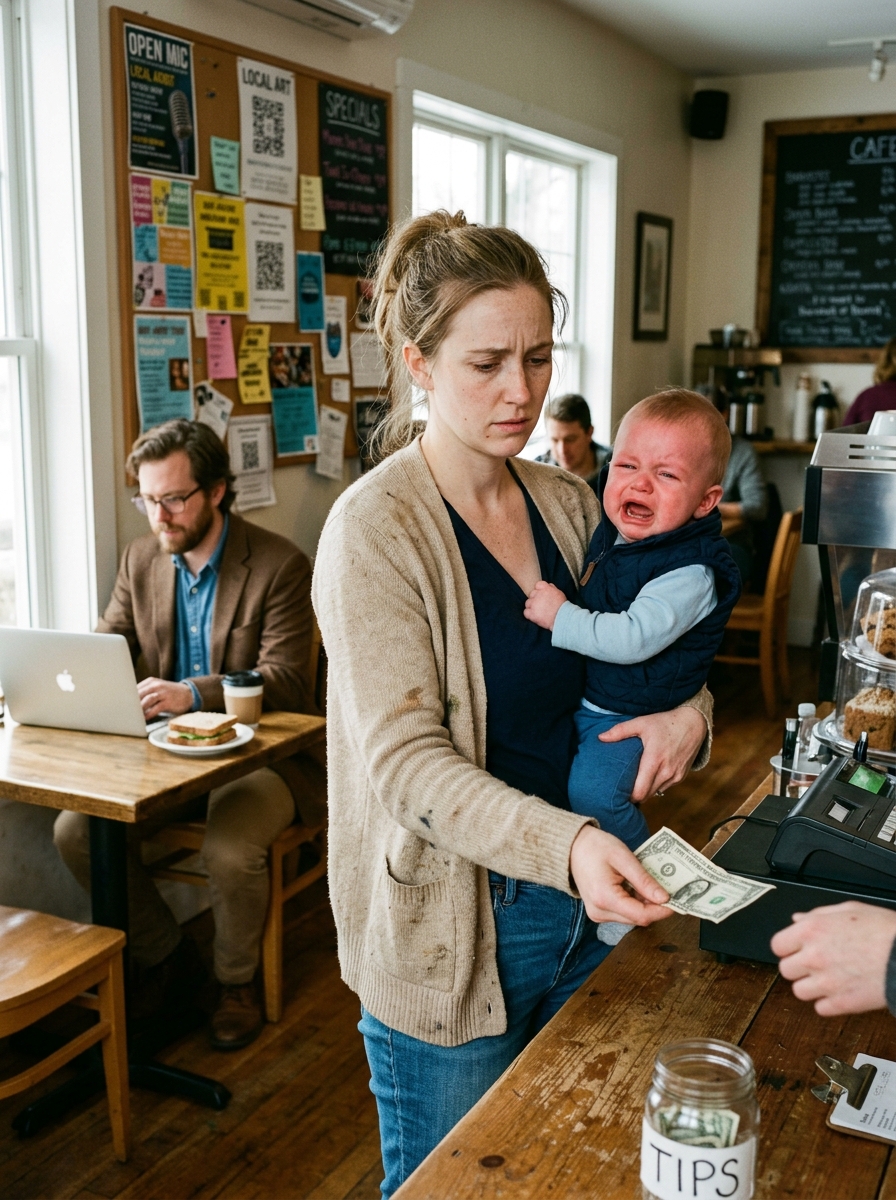
She Walked Into a Small Missouri Café With $1.23 and a Hungry Baby—Then a Stranger Heard Her Ask for One Slice of Bread and Quietly Changed the Next Ten Years of Her Life
“I’m sorry,” the cashier said softly. “We don’t usually sell bread by the slice.”
Rachel Bennett stared at the crumpled dollar bill and coins in her palm.
One dollar and twenty-three cents.
That was everything.
Her six-month-old daughter, Lucy, began fussing against her chest as Rachel stood at the counter of a small neighborhood café outside St. Louis.
“I understand,” Rachel whispered. “Could you ask your manager anyway? I don’t need a whole loaf. Just whatever this will buy.”
The cashier hesitated, then disappeared through a swinging door behind the counter.
Rachel lowered her head.
She could feel people looking.
Maybe they weren’t.
Maybe shame simply made every small glance feel enormous.
Lucy’s fussing turned into a sharp, tired cry.
Rachel bounced her gently.
“I know, baby. I know.”
She reached into the diaper bag and touched the bottle she had prepared before leaving home.
It contained the last formula she had until payday.
Three days away.
Rachel closed her eyes.
Three days had never sounded so long.
“Shh. Mama’s got you.”
Lucy cried harder.
Rachel’s cheeks burned.
She had almost turned around before entering the café. She had stood outside for several minutes telling herself she could make it another day without eating much.
But she knew this place sometimes discounted bread near closing.
A small loaf usually cost two dollars.
She had hoped maybe one dollar and twenty-three cents could buy half.
Or even a few slices.
Anything.
Her own last real meal had been oatmeal the morning before.
She had told herself that was fine.
Adults could wait.
Babies couldn’t.
That was the rule Rachel had been living by since Lucy was born.
The baby ate first.
Rent came second.
Everything else came after that.
Rachel could disappear from the list if necessary.
“Excuse me.”
The voice came from behind her.
Rachel turned quickly.
A man had risen from a corner table. He looked to be in his late thirties, with dark hair, a plain white shirt, and a charcoal jacket folded over the back of his chair.
A laptop sat open beside a half-finished sandwich.
He looked comfortable in the quiet way of someone who didn’t check prices before ordering lunch.
Rachel immediately tightened her hold on Lucy.
“I’m sorry,” she said. “We’re leaving.”
The man frowned.
“Why are you apologizing?”
Rachel blinked.
“She’s loud.”
“She’s a baby.”
His voice held no irritation.
Rachel glanced toward the counter.
The cashier still hadn’t returned.
“I know people are trying to eat,” Rachel said.
“So are you, apparently.”
Her eyes snapped back to him.
He must have heard everything.
Rachel wished the floor would open beneath her.
The man seemed to realize what she was thinking.
“I’m Daniel,” he said. “Daniel Reed.”
Rachel gave a cautious nod.
He pointed toward the empty chair across from him.
“Please sit down.”
“I’m fine.”
“You’re asking if a dollar twenty-three can buy one slice of bread.”
Rachel’s jaw tightened.
“I said I’m fine.”
Daniel didn’t argue.
He just lowered his voice.
“Then sit down because your baby needs a minute.”
That stopped her.
Lucy was still crying.
Rachel looked at the chair.
Then at the door.
Then at the cashier station.
Her pride told her to leave.
Her tired legs told her something else.
Daniel stepped back from the table.
“No catch,” he said. “No speech. No questions you don’t want to answer. Let me buy you lunch.”
Rachel stared at him.
“I can’t pay you back.”
“I didn’t ask you to.”
“I don’t take money from strangers.”
“I’m not offering you money.”
He gestured toward his table.
“I’m offering you a chair and lunch.”
Rachel swallowed.
Daniel’s expression softened.
“Please. Feed your little girl. Eat something yourself. After that, you can walk out and never see me again.”
The words landed differently than pity would have.
He wasn’t staring at her worn cardigan.
He wasn’t staring at the frayed hem of her skirt.
He wasn’t asking how she had gotten into this situation.
He was simply offering food.
Rachel looked down at Lucy.
The baby’s tiny face had gone red from crying.
Rachel’s resistance finally gave way.
“Okay.”
Daniel pulled out the chair.
Rachel sat.
Her knees almost buckled with relief.
“What do you want?” Daniel asked.
“Whatever’s cheapest.”
“That wasn’t the question.”
Rachel looked embarrassed.
Daniel smiled a little.
“Soup?”
She nodded.
“And a sandwich?”
“That’s too much.”
“Rachel.”
She froze.
“I never told you my name.”
He pointed toward the diaper bag.
A little fabric tag hanging from the strap had RACHEL stitched across it.
She almost laughed.
It was the first time her face had done anything close to smiling all day.
“Soup is enough,” she said.
“Soup and a sandwich.”
“Daniel—”
“And tea.”
“I don’t even like tea.”
“Good. We’ve found the limit of my generosity.”
Rachel let out a surprised laugh.
Lucy paused her crying as though confused by the sound.
Daniel smiled.
“Coffee?”
“Water is fine.”
“Water, then.”
He walked to the counter.
Rachel watched him speak quietly to the cashier.
She hated how grateful she felt.
Gratitude had become complicated lately.
Every favor reminded her that she needed one.
Every kind look made her aware that she looked like someone who needed kindness.
She wanted desperately to be ordinary again.
She wanted to buy groceries without counting every item twice.
She wanted to open the electric bill without feeling her stomach tighten.
She wanted to order a sandwich because she liked it, not because someone had rescued her from buying bread with coins.
Most of all, she wanted Lucy to grow up never remembering any of this.
Daniel returned carrying a glass of water.
“Food’s coming.”
“Thank you.”
“You’re welcome.”
Rachel took the bottle from the diaper bag.
Lucy calmed almost instantly when she began drinking.
Daniel watched from across the table, but he didn’t stare.
“How old?”
“Six months.”
“She’s tiny.”
“She thinks she runs the house.”
“Does she?”
Rachel looked down at her daughter.
“Completely.”
Daniel smiled.
“What’s her name?”
“Lucy.”
“That fits her.”
Rachel raised an eyebrow.
“You’ve known her forty seconds.”
“Forty very loud seconds.”
Rachel laughed again.
This time it hurt.
Not physically.
It hurt because she couldn’t remember the last time she had laughed with another adult.
Daniel seemed to notice the change in her face.
“You’re doing a good job,” he said.
The laughter vanished.
Rachel looked away.
“Please don’t.”
“Don’t what?”
“Say things because you feel sorry for me.”
“I don’t.”
“You don’t know me.”
“I know you made sure your daughter had a bottle while you were trying to buy one slice of bread for yourself.”
Rachel’s eyes burned.
Daniel continued quietly.
“That tells me something.”
“It tells you I’m bad at budgeting.”
“No.”
“It tells you I’m a mess.”
“No.”
Rachel looked directly at him.
“I have three jobs, Daniel.”
He didn’t respond.
“I clean offices three nights a week. I work weekend shifts at a discount store. And I do online data-entry work after Lucy goes to sleep.”
Daniel’s expression changed.
Not pity.
Attention.
Rachel hated that attention almost as much.
“And I still came in here with a dollar twenty-three.”
Her voice cracked.
“So please don’t tell me I’m doing a good job.”
The food arrived before Daniel could answer.
A bowl of vegetable soup.
A turkey sandwich cut diagonally.
Pickles.
Crackers.
Rachel stared at it.
There was enough food on the plate to make her feel embarrassed all over again.
“Eat,” Daniel said.
Rachel picked up half the sandwich.
She meant to take one polite bite.
Instead, her body seemed to take control.
She chewed too fast.
Swallowed.
Took another bite.
Then another.
She caught Daniel noticing and forced herself to slow down.
He looked at his laptop instead.
That small act almost broke her.
He was pretending not to see how hungry she was.
Giving her privacy at the same table.
Rachel finished half the sandwich before speaking again.
“I had oatmeal yesterday.”
Daniel looked up.
“What?”
“You’re wondering when I ate last.”
“I wasn’t going to ask.”
“You were thinking it.”
He leaned back.
“Okay.”
“Oatmeal yesterday morning.”
“And after that?”
“Coffee at work.”
“That’s not food.”
“It had creamer.”
Daniel didn’t smile.
Rachel stared at the soup.
“I make sure Lucy has what she needs.”
“I can see that.”
“That’s what matters.”
“You matter too.”
Rachel shook her head.
“No. That sounds nice, but that’s not how it works when there’s not enough.”
Daniel rested his hands on the table.
“How does it work?”
“You pick.”
She counted on her fingers.
“Diapers or laundry.”
“Formula or bus fare.”
“Rent or the electric bill.”
“Child care or enough hours to work.”
“You pick whatever disaster is closest and push everything else down the road.”
Daniel said nothing.
Rachel’s voice became quieter.
“And eventually you get so used to choosing that you stop putting yourself on the list.”
Lucy finished her bottle and went limp with sleep against Rachel’s chest.
Rachel kissed the top of her head.
For a minute, neither adult spoke.
Then Daniel asked, “Where’s her father?”
Rachel’s shoulders stiffened.
He immediately lifted a hand.
“Sorry. You don’t have to answer.”
“No, it’s okay.”
She took a breath.
“He left before she was born.”
Daniel waited.
Rachel appreciated that he didn’t ask why.
There was no dramatic story.
No scandal.
No big scene.
He had simply decided that parenthood wasn’t the life he wanted.
Rachel had spent months waiting for him to change his mind.
He didn’t.
“My parents and I weren’t doing well even before that,” she continued. “They thought I had made too many bad choices. Things got tense. Then we stopped talking much.”
She looked down.
“I thought I could handle everything.”
Daniel’s voice was gentle.
“And then?”
“My full-time job disappeared during a restructuring.”
She gave a tired laugh.
“That was the good job. Benefits. Regular hours. I was finally starting to believe I could make it.”
“And now you’re working three jobs.”
“Trying to.”
Rachel dipped a cracker into her soup.
“Sometimes I feel like I’m working every hour I’m awake, and somehow I’m still falling backward.”
Daniel was quiet for a long moment.
“What kind of full-time work did you do?”
“Administrative support.”
“Before that?”
“I was in college.”
“For what?”
“Business administration.”
Daniel leaned forward slightly.
“You finished?”
Rachel shook her head.
“Almost.”
“How close?”
“Six credits.”
Daniel stared at her.
“Six?”
“Two classes.”
“Why didn’t you finish?”
“Money.”
She shrugged.
“Then pregnancy. Then work. Then Lucy.”
She looked at him.
“That version sounds simple when you say it quickly.”
“What school?”
“A state college nearby.”
“Could you finish online?”
“Probably.”
“Why haven’t you?”
Rachel almost laughed again.
“You’ve been listening, right?”
“I mean if tuition were covered.”
She stopped chewing.
Daniel’s expression had become very serious.
Rachel slowly put down the spoon.
“What are you asking?”
He reached into his jacket pocket and removed a plain business card.
He placed it on the table between them.
Rachel looked at it.
Daniel Reed.
President.
Regional property development and management.
There was no flashy logo.
No giant brand name.
Just his name, title, phone number, and office address.
Rachel looked back at him.
“You run a company?”
“I do.”
“How big?”
“Big enough that I spend too much time in meetings.”
“That isn’t an answer.”
“About four hundred employees across the region.”
Rachel leaned back.
She suddenly became aware again of her worn clothes.
Her messy hair.
The baby stain near her shoulder.
The man across from her wasn’t simply a businessman eating lunch.
He was the person in charge.
“I should go.”
Daniel looked confused.
“Why?”
“Because this is weird.”
“Fair.”
“You’re a company president.”
“Yes.”
“I’m eating the lunch you bought because I couldn’t afford bread.”
“Yes.”
“And now you’re asking about my education.”
“Yes.”
Rachel narrowed her eyes.
“Why?”
Daniel closed the laptop.
“When I was twenty-seven, I was raising a little girl by myself.”
Rachel’s expression changed.
Daniel glanced toward Lucy.
“My daughter was very young. I was working long shifts during the day and taking classes at night.”
He paused.
“There was a period when every bill seemed to arrive at once. I remember standing in a grocery store putting things back because I was short at checkout.”
Rachel said nothing.
“I remember feeling like every person in line was watching me.”
He gave a small, uncomfortable smile.
“Maybe they weren’t.”
Rachel understood immediately.
“But it felt like they were,” she said.
“Exactly.”
Daniel looked down at his hands.
“One evening, an older man behind me paid for the groceries I had put back.”
Rachel waited.
“I told him I couldn’t accept it.”
“What did he say?”
“He said, ‘Then make it matter someday.’”
Rachel’s eyes stayed on Daniel.
“I never saw him again.”
Daniel tapped one finger on the table.
“But I remembered him.”
“Did that grocery money make you start a company?”
“No.”
He smiled.
“I still had to finish school. I still worked ridiculous hours. I still made mistakes. I still got turned down for jobs.”
His smile faded.
“But that moment changed something in my head.”
“What?”
“I stopped believing I was completely alone.”
Rachel looked down at Lucy.
Daniel continued.
“People talk about helping as though it always has to be enormous. Sometimes it’s just removing one obstacle so someone has enough room to handle the next one.”
Rachel felt uneasy.
“Where is this going?”
“I have an opening.”
She stared at him.
“An opening?”
“Administrative assistant. Part-time to start. Predictable daytime hours.”
Rachel didn’t move.
Daniel kept going.
“The pay is better than what you’re making now. Benefits start after the introductory period. We also have tuition assistance for employees taking job-related courses.”
Rachel’s mouth opened.
No words came out.
Daniel raised a hand.
“I’m not offering it to you at this table.”
Her face fell slightly.
He noticed.
“I’m offering you an interview.”
Rachel blinked.
“You’ll meet the department manager. You’ll complete the same application process anyone else would. We’ll check your work history and references. If you can do the job, you’ll be considered for it.”
She looked at his business card again.
“And the classes?”
“If you become an employee and qualify for the program, the company can cover approved tuition within the program limits.”
Rachel’s eyes filled.
Daniel leaned back.
“That isn’t charity.”
“I don’t understand.”
“You don’t have to.”
“No, I do.”
Her voice trembled.
“You were just sitting here eating lunch. You don’t know me. Why would you even give me an interview?”
Daniel nodded toward the counter.
“Because when you had almost nothing, you were trying to buy the smallest amount possible instead of demanding something for free.”
Rachel lowered her eyes.
“You’re working three jobs.”
He continued.
“You got within six credits of finishing a degree.”
“You’re taking care of a baby.”
“And you walked into this café instead of giving up and going hungry without trying one more option.”
Daniel shrugged.
“I can’t know from that whether you’re right for the job.”
“But it’s enough for me to think you deserve a chance to show us.”
Rachel wiped one cheek.
“What if I’m terrible?”
“At interviewing?”
“At everything.”
“Then one awkward interview will not destroy the economy.”
Rachel laughed through her tears.
Daniel smiled.
“What if I get hired and can’t keep up?”
“Then you talk to your manager.”
“What if Lucy gets sick?”
“You use the same family policies available to everyone.”
“What if I can’t finish school?”
“Then you take one class instead of two.”
Rachel looked at him.
“You make everything sound easy.”
“No.”
Daniel shook his head.
“I’m saying it can be hard without being impossible.”
That sentence stayed with her.
Hard without being impossible.
Rachel had started to believe those were the same thing.
She slowly picked up the business card.
“When would the interview be?”
Daniel smiled.
“Tomorrow is too soon.”
“Yes.”
“Monday?”
Rachel hesitated.
“I work Monday morning.”
“Tuesday?”
“I can do Tuesday.”
“Ten?”
Rachel nodded.
“Ten.”
Daniel wrote a name on the back of the card.
“Ask for Karen in the front office.”
Rachel slipped the card into the small zipper pocket of her diaper bag.
The pocket where she kept Lucy’s insurance card, emergency ten-dollar bill when she had one, and anything else too important to lose.
“You should finish your soup,” Daniel said.
Rachel looked down.
“You’re still telling me to eat.”
“Apparently I’m committed now.”
She smiled.
For the first time in months, the future contained something other than bills.
Tuesday.
Ten o’clock.
An interview.
Not a rescue.
Not a promise.
A door.
And Rachel intended to walk through it.
The interview lasted almost an hour.
Rachel arrived twenty minutes early because she was terrified of being late.
She had borrowed a navy blouse from a woman she worked with at the discount store.
Her skirt was the same one from the café, but she had carefully repaired the frayed hem herself.
Lucy stayed with a neighbor for two hours.
Rachel spent the bus ride repeating answers in her head.
Strengths.
Weaknesses.
Experience.
Software.
Scheduling.
Customer communication.
By the time she reached the office, her palms were damp.
The building wasn’t enormous.
That helped.
It looked like a place where people actually worked, not a glass tower full of people who spoke a language she had forgotten.
The office manager, Karen, interviewed her.
Daniel did not.
Rachel found that strangely reassuring.
Karen asked hard questions.
She asked why Rachel had moved between several recent jobs.
Rachel explained.
She asked about the gap in her education.
Rachel explained that too.
Then Karen handed her a scheduling exercise and a stack of fictional emails to prioritize.
Rachel forgot to be nervous.
She simply worked.
Twenty minutes later, Karen looked over the completed exercise.
“You’ve done this before.”
“For three years.”
“You’re organized.”
“I have to be.”
Karen smiled.
“That answer I believe.”
Rachel was offered the job two days later.
When the call came, she was standing in the laundry room of her apartment building folding towels while Lucy slept in a carrier.
Rachel answered quietly.
Karen’s voice came through the phone.
“We’d like you to start next Monday.”
Rachel sat down on top of a dryer.
“Are you serious?”
“I usually am when discussing payroll.”
Rachel covered her mouth.
The starting pay was several dollars more per hour than she earned at either of her other jobs.
The schedule was twenty-five hours per week.
Daytime.
Monday through Friday.
Most important, it was predictable.
Rachel could finally plan.
She didn’t quit everything at once.
That wasn’t who she was.
For the first month, she kept two evening cleaning shifts.
She was terrified the new job would disappear.
Every morning she walked into the office expecting someone to tell her there had been a mistake.
Nobody did.
She answered phones.
Organized vendor records.
Scheduled meetings.
Corrected spreadsheets.
Tracked invoices.
Prepared employee packets.
She remembered skills she thought she had lost.
Then she began learning new ones.
Three weeks after she started, Karen called her into the office.
Rachel’s stomach dropped.
Karen pointed at the chair.
“Relax. You look like I’m about to fire you.”
“I always look like this.”
“That seems exhausting.”
“It is.”
Karen pushed a folder across the desk.
Inside was information about the company’s education benefit.
Rachel read the first page twice.
“You’re eligible to apply next term.”
Her fingers trembled.
“It covers these classes?”
“If they’re approved and you remain eligible.”
Rachel looked up.
“I only need two.”
“So finish.”
That night, after Lucy fell asleep, Rachel opened the college website.
She had visited it dozens of times over the previous year.
Usually she stared at the tuition numbers, closed the page, and went back to data entry.
This time she clicked REGISTER.
Her hands shook when the confirmation appeared.
Two classes.
Six credits.
One semester.
She took a picture of the screen.
Then, without thinking too hard about it, she sent it to Daniel.
His response arrived a few minutes later.
Three words.
Keep going, Rachel.
She did.
The next five months were not magical.
They were exhausting.
Rachel worked during the day.
She studied at night.
Lucy went through a phase of waking at inconvenient hours with the absolute confidence of a baby who believed schedules were suggestions.
Rachel submitted one assignment at 11:57 p.m.
Another was completed while sitting on the floor beside Lucy’s crib.
She cried over an accounting project.
She rewrote a paper after her professor said the first version lacked detail.
She drank too much coffee.
She forgot laundry in the washer twice.
Once she showed up at work wearing two different black socks.
Karen looked down.
“Fashion statement?”
“Survival statement.”
Karen nodded.
“I respect it.”
Slowly, Rachel stopped feeling like the woman with $1.23.
Her bank account was still modest.
Her apartment was still small.
She still watched every grocery receipt.
But the constant panic started loosening its grip.
She paid rent on time.
Then the electric bill.
Then the phone bill.
In that order.
One Friday, she bought strawberries because Lucy liked them.
Rachel stood in the produce aisle staring at the carton.
It cost more than the cheapest bananas.
For several seconds, she almost put it back.
Then she realized she had enough.
Not barely enough.
Enough.
She bought the strawberries.
That evening, Lucy smashed one against her high-chair tray and laughed.
Rachel laughed too.
It was such an ordinary moment that nobody else would have noticed it.
Rachel remembered it for years.
Daniel checked in occasionally.
Never too much.
He would pass her desk and ask, “Classes?”
“Still alive.”
“Baby?”
“Running management from a high chair.”
“Good.”
Then he kept walking.
Rachel began to understand that his greatest kindness was not the lunch.
It wasn’t even the interview.
It was that after helping her, he didn’t hover.
He didn’t make her perform gratitude.
He didn’t remind her where she had started.
He allowed her to become an employee instead of remaining a rescue story.
At work, she discovered something else.
Many employees were quietly struggling.
Not always with money.
Some were caring for aging parents.
Some were trying to finish degrees.
Some had unreliable child care.
Some simply didn’t know which workplace resources existed.
Because Rachel knew what it felt like to be overwhelmed, people talked to her.
At first, she just listened.
Then she began creating simple information sheets.
Which department handled schedule changes.
Where to find tuition forms.
Who to ask about child-care assistance.
What flexible scheduling options were available.
Nothing fancy.
Just clear information in plain language.
Karen noticed.
“You made this?”
Rachel nodded.
“People kept asking the same questions.”
Karen flipped through the pages.
“This is useful.”
That word mattered to Rachel.
Useful.
Not lucky.
Not needy.
Not inspiring.
Useful.
Near the end of the semester, Karen moved Rachel into a full-time employee-support position.
It came with better pay.
Better benefits.
And more responsibility.
Rachel accepted before fear could talk her out of it.
Then graduation arrived.
Rachel had imagined the moment for years.
In reality, she almost missed the beginning because Lucy refused to keep one shoe on.
By then, Lucy was a year old and deeply suspicious of footwear.
Rachel’s cap sat crooked.
Her gown was wrinkled.
She was nervous.
And she had never felt more proud.
When her name was called, she walked across the stage with shaking legs.
The applause blurred together.
Then she heard one voice above the rest.
“THAT’S IT, RACHEL!”
She turned.
Daniel was standing several rows back, clapping.
Beside him was his teenage daughter, Emily, laughing at her father’s complete inability to behave quietly at a graduation.
Rachel covered her mouth.
She nearly cried before reaching the other side of the stage.
After the ceremony, Daniel found her near the exit.
“You did it.”
Rachel hugged her diploma against her chest.
“We did it.”
Daniel shook his head.
“No.”
“You gave me the interview.”
“I gave you a phone number.”
“You bought me lunch.”
“Turkey sandwich. Soup.”
“You opened the door.”
Daniel smiled.
“That part I’ll accept.”
Rachel looked at him.
“I don’t know where I would be if you hadn’t spoken to me that day.”
“You would have found another door.”
“You don’t know that.”
“No.”
Daniel became serious.
“But I know you walked through this one.”
Rachel looked down at the diploma.
For years, she had imagined success as a dramatic transformation.
A new apartment.
A large paycheck.
A perfect life.
Instead, success looked like a slightly bent diploma folder, a tired baby, repaired shoes, and knowing the next month’s rent was already covered.
It was enough.
More than enough.
A few months later, Daniel asked Rachel to attend a planning meeting.
She walked into the conference room expecting another employee-policy discussion.
Instead, there were folders spread across the table.
At the top of the first page were the words:
FAMILY OPPORTUNITY PROGRAM — DRAFT.
Rachel looked at Daniel.
“What’s this?”
“Something I’ve been thinking about for a long time.”
He sat across from her.
“I want the company to fund a small community program for working parents who are close to finishing education or job training but are stuck because of practical barriers.”
Rachel slowly turned the page.
Tuition support.
Child-care assistance.
Career mentoring.
Job-readiness workshops.
Transportation help through prepaid passes.
Emergency grocery support.
Every item was boring on paper.
Rachel knew how life-changing boring things could be.
“Why are you showing this to me?”
“Because you know which parts sound good in a boardroom and which parts actually help.”
Rachel stared at him.
“You want my opinion?”
“I want more than your opinion.”
Daniel slid another folder toward her.
“I want you on the planning team.”
Rachel laughed nervously.
“You have people with degrees for this.”
Daniel raised an eyebrow.
“You have a degree.”
“A very new one.”
“You also have experience they don’t.”
Rachel opened the folder.
“What would I do?”
“Tell us when we’re being unrealistic.”
“That could become a full-time job.”
“Exactly.”
For the next year, Rachel helped build the program from scratch.
She challenged nearly everything.
When someone suggested reimbursement after a semester ended, Rachel shook her head.
“That only works for people who can afford to pay first.”
When someone proposed meetings at 6 p.m., she said, “That’s pickup time for half the parents you’re trying to reach.”
When someone wrote a six-page application, Rachel dropped it on the conference table.
“Anyone exhausted enough to need this is going to close this document on page two.”
The room went silent.
Daniel tried not to smile.
“What do you suggest?”
“Two pages.”
“Can we get everything we need in two?”
“If we can’t, maybe we’re asking for things we don’t need.”
They made it two.
During its first year, the program helped thirty-two parents complete certificates, degrees, or job training.
Rachel knew each story.
There was a father who had been taking one class at a time for years.
A mother who needed a predictable child-care arrangement to finish a bookkeeping program.
A warehouse employee who completed a certification and moved into a supervisory role.
A receptionist who finished the final semester of an associate degree.
The details were different.
The pattern wasn’t.
People usually didn’t need someone to take over their lives.
They needed one impossible thing to become possible.
Two years after Rachel walked into the café with $1.23, the company held a community dinner to raise support for expanding the program.
Daniel asked Rachel to speak.
She refused immediately.
“No.”
“You didn’t even think about it.”
“I thought quickly.”
“Why?”
“I would rather reorganize ten years of payroll records.”
“Rachel.”
“I mean it.”
“You’re the best person to explain why this matters.”
“I’m not telling a room full of people that I couldn’t afford bread.”
Daniel leaned back.
“Then don’t.”
Rachel frowned.
“What?”
“Tell them whatever part you want.”
He pointed toward the conference-room door.
“The story belongs to you.”
That changed her answer.
The night of the dinner, Rachel stood behind a small podium in a dark green dress she had bought on sale.
Her hands trembled so badly she kept them wrapped around the sides.
Daniel sat near the front.
Lucy, now two, was spending the evening with Rachel’s neighbor.
Rachel looked at the room.
Then she stopped thinking about donors.
She thought about the woman at the café counter.
The woman counting coins.
The woman who believed needing help meant she had failed.
“Two years ago,” Rachel began, “I walked into a café with one dollar and twenty-three cents.”
The room became quiet.
“I had a six-month-old baby, three part-time jobs, and six college credits standing between me and a degree I had almost finished.”
Rachel swallowed.
“I didn’t walk into that café looking for an opportunity.”
A few people smiled.
“I was looking for discounted bread.”
Daniel lowered his eyes.
Rachel continued.
“A stranger heard me asking whether I could buy one slice.”
Her voice steadied.
“He did not ask me to explain every mistake I had ever made.”
“He did not give me a lecture.”
“He did not tell me to work harder.”
“I was already working as hard as I knew how.”
Several people nodded.
“He bought me lunch.”
Rachel paused.
“That sounds small.”
She looked toward Daniel.
“It wasn’t.”
“That lunch gave me enough dignity to sit at a table instead of standing at a counter counting coins.”
“Then he told me about a job opening.”
“He gave me an interview.”
“The company gave me a chance.”
“And once I had that chance, I worked.”
Rachel held up one hand.
“I finished those six credits.”
Applause broke out.
She smiled.
“I got my degree.”
More applause.
“I built a career.”
She glanced toward Daniel.
“And now I help run a program designed around something I learned the hardest possible way.”
Rachel took a breath.
“People do not always need to be rescued.”
“Sometimes they need one obstacle moved.”
“One bill covered.”
“One class paid for.”
“One safe child-care arrangement.”
“One employer willing to look beyond a rough season.”
“One person who says, ‘I see how hard you’re trying. Here’s a door. Walk through it.’”
By the time Rachel stepped away from the podium, she was crying.
So was Daniel.
He stood when she returned to the table.
“That was much better than payroll records.”
“Debatable.”
The dinner raised enough money to double the number of families the program could support the following year.
Then something unexpected happened.
Other regional employers called.
They wanted to know how the program worked.
Community groups asked whether they could participate.
Local educators offered mentoring.
Rachel spent months helping create a separate community nonprofit so the work could reach people beyond Daniel’s company.
They deliberately kept its name simple and generic.
No founder’s name.
No giant corporate branding.
No photograph of Daniel shaking hands with people he had helped.
Rachel insisted on that.
“This should never become advertising disguised as kindness.”
Daniel agreed.
The community fund grew slowly.
Then steadily.
Three cities joined.
Then five.
Rachel moved from her employee-support role into full-time program leadership.
When Daniel offered her the position, he did it at the same café where they had first met.
Rachel walked in carrying Lucy’s tiny backpack.
Lucy was three and a half by then and had strong opinions about pancakes.
Daniel sat at the corner table.
Rachel stopped.
“Oh, no.”
He looked up.
“What?”
“This table.”
“What about it?”
“You only ask me life-changing questions at this table.”
“That is completely untrue.”
“Last time I sat here, I ended up with a career.”
Daniel pointed toward the chair.
“Sit.”
Rachel narrowed her eyes.
“Am I getting fired?”
“The opposite.”
“That sounds dangerous.”
Lucy climbed into the chair beside Daniel.
“Can I have pancakes?”
Daniel nodded solemnly.
“Finally, someone asks a reasonable question.”
Rachel sat.
Daniel pushed a folder toward her.
She groaned.
“I knew it.”
Inside was a job description.
Executive Director.
Rachel stopped smiling.
She read the first page.
Then the second.
Then looked up.
“You want me to run the whole thing?”
“I want you to lead it.”
“Daniel.”
“You’ve already been doing half the job.”
“Half is not all.”
“You’ll hire people for the other half.”
Rachel stared at the salary.
Then closed the folder.
“This is too much.”
Daniel sighed.
“We’ve had this conversation before.”
“You already changed my life.”
“No.”
He leaned forward.
“We’re not doing that version anymore.”
“What version?”
“The one where every accomplishment you earn gets credited to one lunch I bought years ago.”
Rachel looked down.
Daniel’s voice softened.
“I opened a door.”
“You walked through it.”
“You studied.”
“You worked.”
“You earned the degree.”
“You built the employee resources.”
“You helped design the family program.”
“You stood in meetings and told executives when their ideas made no sense.”
“That was my favorite part.”
“I know.”
Daniel smiled.
“You helped expand the program.”
“You trained staff.”
“You created the mentoring model.”
“You built relationships with community partners.”
He tapped the folder.
“This isn’t another favor.”
“It’s a promotion.”
Rachel’s eyes filled.
Across the table, Lucy was arranging sugar packets into little towers.
Rachel looked at her daughter.
Then at the folder.
Four years earlier, Rachel had believed her life would always be about surviving until Friday.
Until payday.
Until rent.
Until the next bottle.
Now someone was asking her to lead something bigger than herself.
She opened the folder again.
“When do I start?”
Daniel grinned.
“Monday?”
Rachel laughed.
“You really like Mondays.”
Under Rachel’s leadership, the community fund expanded carefully.
She refused to chase growth just so they could announce bigger numbers.
Every program had to answer one question.
Does this make a working parent’s life more manageable?
If not, they didn’t do it.
Rachel hired people who listened well.
She trained staff not to treat applicants like problems to be fixed.
She discouraged long speeches about personal responsibility.
“People who are working two jobs do not need us explaining hard work to them,” she often said.
“They need us to respect the work they’re already doing.”
Within five years, hundreds of parents had received some kind of support.
Not everyone experienced dramatic transformation.
Rachel thought that mattered too.
Some finished degrees.
Some changed careers.
Some simply made it through one difficult semester.
Some received grocery assistance while completing job training.
Some got child-care support long enough to accept better work hours.
Success didn’t always mean a new title.
Sometimes success meant stability.
A stocked refrigerator.
A working car.
A full night of sleep.
A parent who no longer opened every envelope with fear.
Rachel understood those victories.
Every year, on the anniversary of the day she met Daniel, she returned to the café.
She didn’t make a ceremony of it.
She simply ordered lunch for herself.
Then she paid attention.
If she noticed someone counting coins carefully, she might quietly cover their meal.
If she saw a tired parent trying to keep children calm while checking menu prices, she sometimes asked the cashier to add their order to hers.
She never forced conversation.
Sometimes people wanted to talk.
Sometimes they didn’t.
Rachel respected both.
Once, a woman approached her table afterward.
“You paid for our lunch?”
Rachel looked toward the woman’s two children.
“I did.”
“Why?”
Rachel smiled.
“Someone once bought mine.”
The woman’s eyes filled.
“I’ll pay you back.”
“No need.”
“I want to.”
Rachel thought of Daniel’s story about the stranger at the grocery store.
“Then make it matter someday.”
The woman stood very still.
Then nodded.
“I can do that.”
Rachel believed her.
Ten years after the day in the café, the community fund held an anniversary gathering.
Nothing glamorous.
Rachel hated glamorous.
There were folding chairs, buffet tables, framed photographs, and a wall covered in handwritten notes from families.
Lucy was sixteen now.
Tall.
Funny.
Independent.
She knew the story.
Of course she knew.
It had become part of their family history.
Not as a tale about poverty.
Rachel refused to let it become that.
It was a story about a door.
Daniel’s daughter, Emily, was in her early twenties and studying community development.
She and Lucy stood near the photograph wall, laughing about something.
Rachel watched them.
Daniel appeared beside her carrying two cups of coffee.
“Still drinking yours black?”
“Still judging me for it?”
“Yes.”
He handed her the cup.
They stood quietly for a moment.
Then Rachel said, “Do you remember exactly what you said that day?”
Daniel thought.
“I probably said many brilliant things.”
“You told me to sit down.”
“Sounds brilliant.”
“And eat.”
“Even better.”
Rachel smiled.
“That was the part I remember most.”
Daniel looked at the crowd.
“Not the job interview?”
“No.”
“Not the tuition program?”
“No.”
“Not the world-class turkey sandwich?”
Rachel laughed.
“Definitely not.”
She became serious.
“I remember that you let me eat before asking me to prove anything.”
Daniel looked at her.
Rachel continued.
“I was so used to feeling like I had to justify every need.”
“If I needed help with rent, I had to explain.”
“If I needed a schedule change, I had to explain.”
“If I couldn’t afford something, I felt like I had to explain every decision that had led me there.”
She looked into her coffee.
“You didn’t ask for an explanation first.”
Daniel nodded.
“I knew hunger wasn’t going to improve your résumé.”
“That should be on a motivational poster.”
“I’ll have marketing work on it.”
“Absolutely not.”
They both laughed.
Then Rachel looked toward the wall of notes.
“One meal.”
Daniel followed her gaze.
“That’s where all this started.”
“One meal and an interview.”
“And a lot of work.”
“Yes.”
Rachel smiled.
“A lot of work.”
Lucy approached them.
“Mom?”
“What?”
“I need your help with something.”
Daniel raised an eyebrow.
“Should I leave?”
“It’s for a school essay.”
Daniel immediately turned.
“I’m leaving.”
Lucy laughed.
“You’re literally in the essay.”
Daniel stopped.
“That sounds risky.”
Lucy pulled out her phone.
“The topic is about a moment from family history that shaped your values.”
Rachel groaned.
“Please tell me you’re not writing about the café.”
“I’m writing about the café.”
“Of course.”
Lucy looked at Daniel.
“I have a question.”
He nodded.
“Okay.”
“Why did you help her?”
Daniel’s smile disappeared.
He glanced at Rachel.
Then back at Lucy.
“I saw someone who needed lunch.”
Lucy waited.
“That’s it?”
“At first.”
“You didn’t know she would work for you?”
“No.”
“You didn’t know she’d finish college?”
“No.”
“You definitely didn’t know she’d run all this?”
Daniel looked around the room.
“Absolutely not.”
Lucy frowned thoughtfully.
“So why take the chance?”
Daniel leaned against the table.
“Because kindness doesn’t have to know the ending.”
Lucy became still.
Rachel did too.
Daniel continued.
“If you only help when you can guarantee what happens afterward, that isn’t much of a gift.”
“You help with what’s in front of you.”
“Then the other person decides what comes next.”
Lucy typed something into her phone.
“That’s good.”
Daniel looked pleased.
“Quote me accurately.”
Rachel rolled her eyes.
Lucy turned toward her mother.
“Did you trust him?”
Rachel laughed.
“No.”
Daniel looked offended.
“You didn’t?”
“You were a stranger offering me lunch.”
“That hurts.”
“You asked for honesty.”
Lucy smiled.
“So when did you trust him?”
Rachel thought about it.
“Not all at once.”
She looked at Daniel.
“I trusted him when the interview turned out to be real.”
“I trusted Karen when she treated me like an applicant instead of a charity case.”
“I trusted the company when my first paycheck cleared.”
Daniel laughed.
“Practical.”
“I trusted the tuition program when the college account showed a zero balance.”
“Very practical.”
Rachel smiled.
“And eventually I trusted myself.”
Lucy stopped typing.
“That was the hardest part?”
Rachel nodded.
“Yes.”
“Why?”
Rachel thought carefully before answering.
“Because when life goes wrong for a long time, you can start believing struggle is your identity.”
“You stop saying, ‘I’m having a hard year.’”
“You start saying, ‘I’m the kind of person whose life is hard.’”
Daniel watched her silently.
Rachel continued.
“That changes how you see every opportunity.”
“You assume it belongs to someone else.”
“You assume stable jobs are for someone else.”
“Degrees are for someone else.”
“Comfort is for someone else.”
“Then one day somebody holds open a door, and you have to decide whether you’re willing to imagine yourself on the other side.”
Lucy looked at her mother.
“And you walked through.”
Rachel smiled.
“Eventually.”
Lucy reached over and hugged her.
Rachel closed her eyes.
For one second, she saw the baby again.
Six months old.
Asleep against her chest.
The last bottle in the diaper bag.
One dollar and twenty-three cents in her hand.
It felt like another lifetime.
Later that evening, Rachel walked alone past the wall of notes.
She stopped at one handwritten card.
It came from a mother who had completed a teaching program.
Another was from a father who had finished a technical certificate.
Another simply said:
Thank you for helping me get through one semester I thought I would have to quit.
Rachel touched the edge of the card.
That one stayed with her.
One semester.
Not a miracle.
Not a dramatic rescue.
Just enough.
She finally understood why Daniel had always resisted when she said he saved her.
He hadn’t.
He had interrupted a downward spiral for one afternoon.
He bought lunch.
He pointed toward an opportunity.
Then Rachel had done what people do every day when someone finally gives them a fair chance.
She worked.
Years later, when Lucy was preparing to leave for college, Rachel helped her pack boxes in the same small living room where she had once completed homework beside a crib.
They no longer lived in the old apartment.
But Rachel had kept one thing from those years.
A tiny fabric diaper bag.
Lucy found it in a closet.
“This thing is ancient.”
“Be respectful.”
“It has ducks on it.”
“You liked ducks.”
“I was six months old.”
“You had strong opinions.”
Lucy unzipped the small front pocket.
Inside was a faded business card.
The corners were soft from age.
Daniel Reed.
President.
Lucy looked up.
“No way.”
Rachel smiled.
“I wondered where that went.”
“You kept it?”
“Apparently.”
Lucy turned it over.
On the back, in Daniel’s handwriting, was Karen’s name and the date of Rachel’s interview.
Lucy stared at it.
“This is the actual card?”
“The actual one.”
“The one from the café?”
“Yes.”
Lucy held it carefully.
“You walked around with this in a diaper bag?”
“For months.”
“Why?”
Rachel sat on the edge of the couch.
“At first because I was afraid I’d need proof that the whole thing had happened.”
Lucy smiled.
“And later?”
Rachel looked at the faded card.
“Because it reminded me what a door can look like.”
Lucy sat beside her.
“Just a business card?”
“Sometimes.”
Rachel took it from her daughter.
“Sometimes a door looks like a job interview.”
“Sometimes it looks like a meal.”
“Sometimes it looks like someone saying your name kindly on a day when you’re ashamed of your life.”
Lucy rested her head briefly against Rachel’s shoulder.
“I’m keeping this story.”
“You’d better.”
“One day I’ll tell my kids.”
Rachel smiled.
“Leave out the part about my terrible skirt.”
“No promises.”
The morning Lucy left for college, Rachel slipped a small envelope into one of her bags.
Inside was a copy of the business card.
And a note.
Lucy found it that evening.
It said:
You will meet people whose lives make sense from the outside and people whose lives look messy.
Do not assume you know the difference between the two.
Do not wait until you are wealthy, important, powerful, or perfectly prepared before you help somebody.
You may not be able to fix everything.
You are not supposed to.
Sometimes the next right thing is small.
Buy the lunch.
Hold the door.
Make the call.
Offer the interview.
Listen without making someone prove they deserve your attention.
Give people dignity before advice.
Then trust them to decide what comes next.
Lucy called immediately.
“You made me cry.”
Rachel laughed.
“College hasn’t even started.”
“The note, Mom.”
“Oh.”
There was a pause.
Then Lucy asked, “Do you still have the original card?”
“Yes.”
“Keep it.”
“I plan to.”
Another pause.
“Mom?”
“Yes?”
“I’m glad you went into that café.”
Rachel looked around her quiet kitchen.
For years, she had thought about that day as the moment Daniel changed her life.
Now she saw it differently.
She had changed her own life before Daniel ever stood up from his table.
She had walked six blocks with a crying baby because she had heard bread might be cheaper there.
She had walked through the door despite being embarrassed.
She had asked the cashier for what she could afford.
She had swallowed her pride and sat down when help was offered.
She had shown up for the interview.
She had registered for school.
She had finished the assignments.
She had gone to work.
She had kept going.
Daniel had not created her strength.
He had noticed it before she could see it herself.
“I’m glad too,” Rachel said.
After the call ended, she opened the drawer where the original business card rested inside a small envelope.
Beside it was another object.
A one-dollar bill.
And twenty-three cents in coins.
Rachel had saved them years later.
Not the actual money from that day.
Those coins were long gone.
This was symbolic.
A reminder.
Not of how poor she had been.
Of how narrow her world had felt.
One dollar and twenty-three cents had once seemed like the boundary around her entire future.
Now Rachel regularly sat across from parents who carried that same expression.
The expression that said:
Please don’t judge me.
Please don’t make me explain every mistake.
Please don’t make me feel smaller than I already do.
Rachel knew exactly what to do.
She would pull out a chair.
She would listen.
She would ask practical questions.
What do you need right now?
What is the one thing keeping you from your next step?
What can we actually change?
Sometimes the answer was tuition.
Sometimes child care.
Sometimes transportation.
Sometimes a grocery card and one quiet week.
And sometimes the only thing Rachel could offer was information.
She had learned not to underestimate that either.
Years after Daniel first spoke to her in the café, Rachel met him there again for lunch.
They were both older.
The corner table had been replaced.
The menu had changed.
The cashier was new.
Daniel picked up his sandwich.
Rachel looked at it.
“Turkey?”
“Tradition.”
“You don’t even like turkey that much.”
“I’m committed to historical accuracy.”
Rachel laughed.
A young mother entered carrying a toddler.
She walked to the counter.
Rachel noticed her studying the menu carefully.
The woman opened her wallet.
Closed it.
Checked the menu again.
Daniel noticed Rachel noticing.
He said nothing.
Rachel watched the woman quietly ask the cashier a question.
The cashier answered.
The woman nodded and turned toward the door.
Rachel stood.
Daniel smiled into his coffee.
“Where are you going?”
Rachel looked at him.
“You know exactly where I’m going.”
She approached the woman near the entrance.
“Excuse me.”
The woman turned.
Rachel smiled.
“I think there’s been a misunderstanding.”
The woman looked confused.
Rachel pointed toward the counter.
“My lunch order came with an extra meal.”
Daniel nearly laughed from across the room.
Rachel ignored him.
“I can’t eat both.”
The woman stared at her.
“I didn’t order—”
“I know.”
Rachel lowered her voice.
“Take it anyway.”
The woman looked down at her child.
Then back at Rachel.
“I can’t pay for it.”
Rachel smiled.
“You don’t have to.”
The woman hesitated.
Rachel remembered another café.
Another table.
Another stranger.
Another version of herself.
“No strings,” Rachel said.
“Sit down.”
“Eat first.”
And this time, she finally understood why four simple words could feel like someone had opened a door.