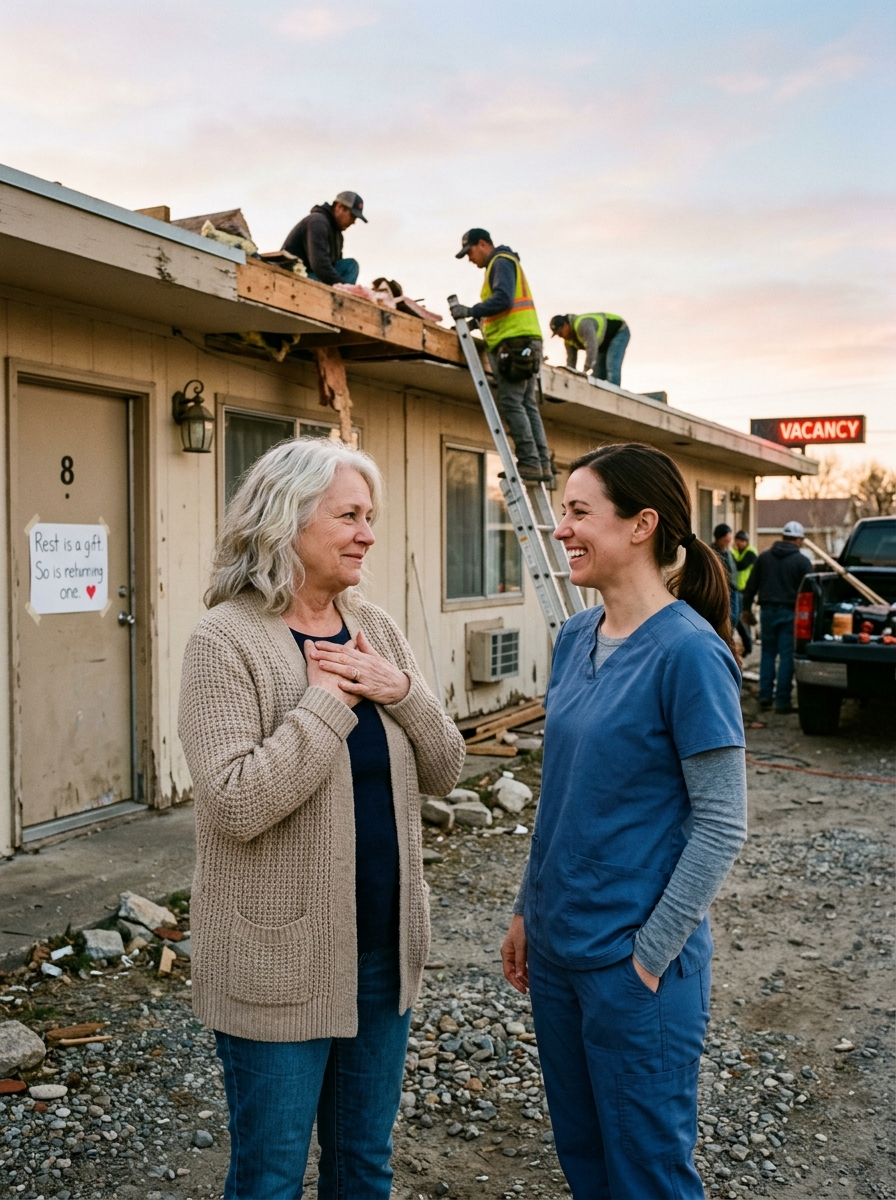
The Motel Manager Left Room 8 Unlocked for a Tired Woman Who Slept in Her Car—Months Later, an Entire Town Came Back
The first time I found Marissa asleep in her car, the temperature was twenty-eight degrees.
Her little sedan was parked beneath the flickering motel sign, engine off, windows fogged from her breathing. She was still wearing pale blue scrubs, one hand tucked beneath her cheek and the other resting on a paper cup that had gone cold.
I knocked gently on the glass.
She woke with a start.
“I’m sorry,” she said immediately. “I’ll move. I wasn’t trying to cause trouble.”
That sentence bothered me more than anything.
She wasn’t doing anything wrong.
She was just tired.
My name is Claudette Hayes. I was sixty-three then, and I had managed that little roadside motel in South Dakota for nearly nineteen years.
It wasn’t fancy.
We had twelve rooms, a soda machine that occasionally ate dollar bills, a lobby with fake wood paneling, and a neon VACANCY sign that buzzed loudly enough to keep you company on lonely nights.
Truckers stayed with us.
Families passing through stayed with us.
Hunters, grandparents headed to graduations, divorced dads picking up their kids for weekends, traveling nurses, storm crews—you name it.
I’d seen nearly every kind of tired a person can carry.
But something about Marissa’s tiredness stayed with me.
She was maybe thirty-five.
She worked as a home health aide, driving from one elderly patient to another across several small towns. She helped people bathe, changed bedding, cooked simple meals, reminded them about appointments, and sat beside them when their families lived too far away.
That evening, she had finished one shift at almost midnight and had another starting before sunrise.
Her home was forty miles away.
“I’m just trying to save the gas,” she admitted after I brought her into the lobby for coffee.
She looked embarrassed saying it.
“By the time I drive home, I’d have to turn around again anyway.”
I asked why she didn’t get a room somewhere.
She gave me a tired little smile.
“Because people who sleep in motels usually have motel money.”
That stayed with me too.
At the time, I was grieving my younger sister, Denise.
She had died unexpectedly a few months earlier.
Denise had always been the one who called me after closing.
“You home yet?”
“Did you eat?”
“Storm coming your way?”
Little questions.
Ordinary questions.
The kind you don’t realize are holding pieces of your life together until nobody asks them anymore.
After she was gone, I had started keeping the television on in the motel office even when I wasn’t watching.
Silence had become too loud.
That night, Room 8 was empty.
It wasn’t our nicest room, but I’d always liked it.
It was at the far end, away from the ice machine. The heater worked well. The mattress was newer than most. Morning sunlight came through the curtains if you opened them just right.
I handed Marissa a key.
She shook her head.
“I can’t pay for this.”
“I didn’t ask you to.”
“Ma’am—”
“Claudette.”
“Claudette, I really can’t.”
I looked at those dark circles under her eyes.
Then I thought about Denise.
My sister had spent her whole life noticing when people needed something before they had the courage to ask.
A sandwich.
A ride.
Twenty dollars.
A place at the table.
So I told Marissa, “Room 8 is empty. Empty rooms don’t sleep.”
She laughed.
It was the first time I’d heard her laugh.
That became our arrangement, although we never really called it one.
If Room 8 wasn’t booked, I left it ready.
Clean sheets.
Fresh towels.
A little bar of soap.
Sometimes a granola bar on the nightstand.
On the first night, I left a note beside the lamp.
**No charge. Get some sleep.**
Marissa folded that note and kept it.
For months afterward, she occasionally appeared after midnight.
Never often.
Never expecting anything.
Sometimes Room 8 was occupied, and she’d wave through the lobby window and keep driving.
But when it was free, she knew.
The porch light outside the room would be on.
I never made a big deal about it.
Neither did she.
She always stripped the bed before leaving.
Always folded the towels.
Once she fixed the loose handle on my supply closet.
Another time she left homemade banana bread at the front desk.
“Call it interest,” she said.
Life went along that way until June.
Anyone who has lived on the Plains knows how fast a summer sky can change.
That afternoon, the clouds turned green-gray.
Then the hail came.
Not little hail either.
It sounded like somebody was throwing rocks at the roof.
When it stopped, tree branches covered the parking lot, one window had cracked, and shingles were scattered across the grass like playing cards.
The roof over Rooms 6 through 10 took the worst of it.
Including Room 8.
I called my insurance company the next morning.
Then I called again.
Then again.
Weeks of paperwork followed.
Photographs.
Estimates.
Phone calls.
More paperwork.
In the end, what they agreed to cover wasn’t close to what the full repair would cost.
I remember sitting alone behind the front desk, staring at the estimate.
I had some savings.
Just not enough.
The motel wasn’t simply my job.
It was my retirement plan.
My home was attached to it.
It was everything Denise had helped me hold together after my husband died years earlier.
And suddenly, for the first time, I wondered if I might lose it.
I didn’t tell Marissa.
I didn’t tell many people at all.
Pride has a funny way of making people lonely.
Then, one Saturday morning around seven, I heard trucks pulling into the parking lot.
At first I thought we had guests arriving early.
I stepped outside.
Marissa was standing beside her car.
Behind her were eight other people.
Two women in scrubs.
A man carrying a ladder.
An older couple from a small church down the highway.
Three people I recognized as caregivers from the county.
And two local roofers with tool belts around their waists.
I just stared.
“What is this?”
Marissa smiled.
“You’ve got a roof problem.”
“I can see that.”
“And we’ve got Saturday.”
I felt my throat tighten.
“No. Absolutely not. I can’t let you people—”
One of the roofers interrupted me.
“Materials were donated.”
The older woman from the church lifted a cooler.
“Lunch too.”
Another volunteer waved from behind a pickup.
“We’ve got coffee.”
I looked at Marissa.
“How did you even know?”
She shrugged.
“Small town.”
That was all she said.
But later, I learned the truth.
One of Marissa’s patients had a grandson who knew the roofer.
The roofer knew someone at a building supply place.
A church volunteer had once stayed at my motel during a winter storm.
Someone else remembered that years earlier I’d let a stranded family wait in the lobby all night after their van broke down.
Stories I had forgotten had apparently been traveling around town without me.
People climbed ladders.
People carried shingles.
People hauled away damaged pieces.
The women in scrubs washed windows and cleaned rooms.
Someone brought sandwiches.
Someone else brought lemonade.
By noon, my parking lot looked less like a motel and more like an old-fashioned barn raising.
I stood there uselessly holding a roll of paper towels, crying into them.
“Quit that,” Marissa told me.
“I’m not crying.”
“You’re soaking the paper towels.”
By Sunday evening, the worst section of the roof was repaired.
The debris was gone.
The gutters had been fixed.
Even the cracked window had been replaced.
Before everyone left, I walked toward Room 8.
Something white was taped above the door.
Another note.
I reached up and pulled it down.
The handwriting wasn’t Marissa’s.
I never found out who wrote it.
It said:
**Rest is a gift. So is returning one.**
I sat down on the little metal chair outside Room 8 and cried harder than I had cried since Denise’s funeral.
Because in that moment, I finally understood something my sister had tried to teach me for years.
Kindness rarely disappears.
You may forget giving it.
The person receiving it may never have a chance to repay you.
It may pass through five different hands.
Ten.
A hundred.
But kindness has a strange way of remembering the road home.
Room 8 is still there.
The carpet has been replaced since then.
The old curtains are gone.
The neon sign finally stopped buzzing and had to be replaced.
I’m older now too.
But whenever Room 8 is empty, I still leave the porch light on.
Because somebody, somewhere, is probably carrying more than you can see.
And sometimes the greatest thing you can offer a tired person isn’t advice, money, or answers.
Sometimes it’s simply a safe place to rest until they can stand again.
The kindness you quietly give away may be the very shelter that finds you when your own roof starts to fall.