The Mail Carrier Kept “Misdelivering” Groceries to a Proud Old Veteran—Until a Blizzard Revealed the Truth and Changed an Entire Town
“Ma’am, these aren’t mine.”
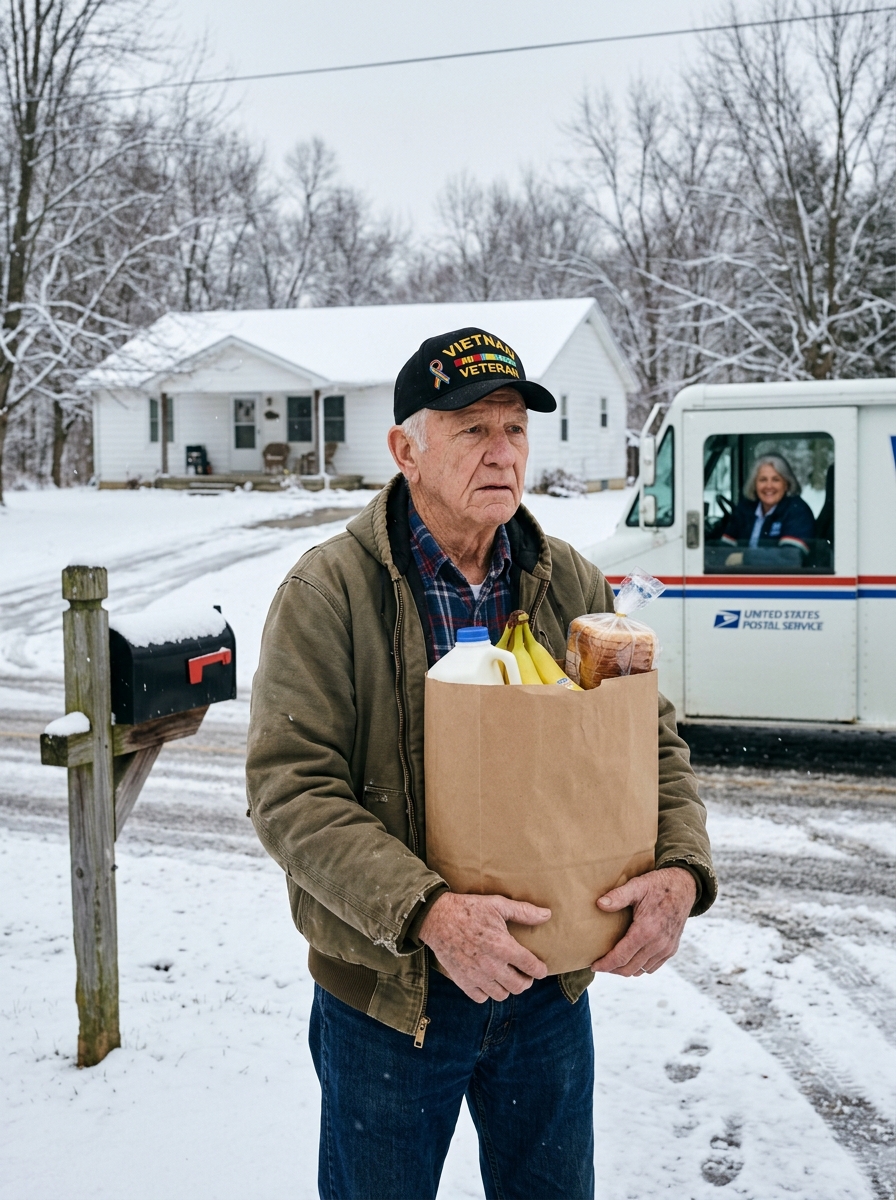
Vernon Hale stood in the snow holding a paper grocery bag against his chest like it was evidence in a crime.
Inside were a loaf of wheat bread, a half-gallon of milk, eggs, bananas, coffee, and two cans of beef stew.
Darlene Whitcomb didn’t even slow down.
She leaned out the window of her mail truck and shouted, “Then that grocery driver messed up again. Keep it before the milk freezes.”
Vernon frowned.
“That’s the third time this month.”
Darlene shrugged.
“Some people are just terrible with addresses.”
Then she drove away before he could argue.
Darlene was 64 and had carried mail along the same northern Wisconsin route for nearly twenty years.
She knew which farmers left their gates open.
She knew which dogs barked but never bit.
She knew who liked their packages tucked behind the porch chair and whose mailbox froze shut every January.
And she knew something else.
Proud people were often the hardest people to help.
Vernon was 79, a veteran, a widower, and the kind of man who still shoveled his own walkway even when his knees clearly hurt.
His little farmhouse sat at the end of a county road surrounded by bare maple trees and fields buried beneath snow.
He never complained.
Not once.
But Darlene had started noticing things.
One Tuesday, she brought a certified letter to his door and saw three empty soup cans lined beside the sink.
There was half a sleeve of crackers on the counter.
Nothing else.
Vernon opened the refrigerator to put away his medicine, and Darlene caught a glimpse inside.
Mustard.
A jar of pickles.
Half an onion.
That was about it.
“You doing okay for groceries?” she asked.
Vernon immediately stiffened.
“I’m fine.”
Darlene knew that tone.
It was the same tone her late husband, Bill, had used when his back hurt.
The same tone men of their generation seemed to use when “fine” actually meant, Please don’t make me admit I need help.
Later, Darlene learned from a neighbor that Vernon’s furnace repair had eaten through most of his monthly check.
He had decided he could “stretch things” until the next one came.
Stretch things meant canned soup.
Crackers.
Coffee made twice from the same grounds.
Darlene went home that evening and sat alone at her kitchen table.
There were still two coffee mugs in the cabinet above the sink.
She had never been able to move Bill’s.
He had died the winter before after forty-one years of marriage.
For months afterward, people had brought casseroles and pies and envelopes.
Darlene had hated needing them.
But she had never forgotten what it felt like to open the front door and discover that someone had quietly made the next day a little easier.
So the following morning, she stopped at the grocery store before work.
Bread.
Milk.
Eggs.
Bananas.
Stew.
Nothing fancy.
She left the bag beside Vernon’s mailbox and practiced her lie before driving up.
“Wrong address.”
Vernon protested.
Darlene blamed an imaginary delivery driver.
It worked.
Barely.
Two weeks later, another bag appeared.
Then another.
Sometimes it contained oatmeal and apples.
Sometimes chicken soup and potatoes.
Once, Darlene included a small package of cookies.
Vernon held them up suspiciously the next day.
“Since when do wrong-address groceries know I like oatmeal cookies?”
Darlene stared straight ahead.
“Coincidence.”
Vernon narrowed his eyes.
“You’re a terrible liar, Darlene.”
“So I’ve been told.”
She drove away smiling.
For several months, that was their arrangement.
He pretended to believe her.
She pretended she believed him.
Then February brought the worst storm of the year.
Snow came sideways across the fields.
The roads disappeared beneath white drifts.
Most people stayed home.
Darlene should have too.
But she knew Vernon’s mailbox had been empty for two days.
And she knew his refrigerator probably was too.
So near dusk, she pulled her old pickup onto his road with groceries on the passenger seat.
She had barely reached the mailbox when the front door opened.
Vernon stepped onto the porch in a heavy coat.
Darlene froze with a gallon of milk in one hand.
For several seconds, neither of them said anything.
Snow collected in Vernon’s gray hair.
Finally, he walked toward her.
Darlene sighed.
“Okay. You caught me.”
Vernon looked at the milk.
Then at the grocery bag.
Then back at her.
“I knew after the second bag.”
Darlene blinked.
“You knew?”
“Darlene, there hasn’t been grocery delivery out here since the store stopped doing it four years ago.”
She stared at him.
“Well, why didn’t you say something?”
Vernon looked down at the snow.
His voice became quieter.
“Because you let me keep my pride.”
That sentence hit Darlene harder than she expected.
Vernon cleared his throat.
“You never stood there asking if I was poor.”
“You never made me explain myself.”
“You just gave me something to blame.”
He smiled a little.
“That imaginary delivery driver was a real idiot.”
Darlene laughed.
Then she started crying.
Right there beside the mailbox.
Maybe it was Vernon.
Maybe it was Bill.
Maybe grief had simply been waiting for permission.
Vernon didn’t say anything.
He just reached into his coat pocket and handed her a white envelope.
On the front, in shaky handwriting, were four words.
FOR THE NEXT WRONG ADDRESS.
Inside was five dollars.
Darlene tried to give it back.
Vernon shook his head.
“Next month might be better for me.”
Then he pointed at the envelope.
“But somebody else might be having this month.”
Darlene kept it.
And something began that neither of them planned.
She told one woman on her route about Vernon’s envelope.
The woman added ten dollars.
A dairy farmer heard about it and left a sack of potatoes beside his mailbox.
A retired teacher contributed grocery store gift cards.
The owner of a small repair garage sent canned chili.
One family started leaving extra cereal whenever they bought groceries.
Nobody called it charity.
Nobody formed a committee.
Nobody put anyone’s name on a list.
They simply called it the Wrong Address Fund.
Darlene became the middleman.
A bag might appear beside the mailbox of a single mother whose hours had been cut.
“Wrong address.”
A box of pantry food might show up at the home of an elderly couple after a hospital stay.
“Wrong address.”
A sack of dog food once appeared on the porch of a widower who had been feeding his old Labrador scrambled eggs because he couldn’t afford both groceries and pet food that week.
Wrong address.
Always wrong address.
And whenever someone tried to pay Darlene back, she gave them an envelope.
FOR THE NEXT WRONG ADDRESS.
By spring, half the route seemed to be involved.
Some gave five dollars.
Some gave food.
Some gave nothing for months, then helped when they could.
Nobody kept score.
That was the point.
One April morning, Darlene arrived at Vernon’s farmhouse and found him sitting on the porch.
The snow was finally melting along the fence lines.
Vernon held two cups of coffee.
He handed her one.
“You know,” he said, “I spent most of my life thinking being strong meant handling your own troubles.”
Darlene sat beside him.
Vernon watched the water drip from the roof.
“Took me seventy-nine years to figure out sometimes strength is letting somebody carry one bag.”
Darlene thought about Bill.
About casseroles on her porch after the funeral.
About Vernon’s empty refrigerator.
About all those five-dollar bills tucked into envelopes by people who might someday need an envelope themselves.
“Maybe,” she said, “we’re supposed to take turns.”
Vernon smiled.
“That sounds about right.”
Darlene still delivers that route.
Vernon still complains when she puts too many cookies in his grocery bag.
And somewhere along those snowy Wisconsin roads, groceries still occasionally arrive at the wrong house.
At least, that’s what everyone says.
Because dignity matters.
Pride matters.
And kindness doesn’t always have to announce itself.
Sometimes the best way to help another person is to leave them enough room to stand tall while you quietly make their burden lighter.
The strongest communities aren’t built by people who never need help—they’re built by people who remember to take turns carrying the bag.