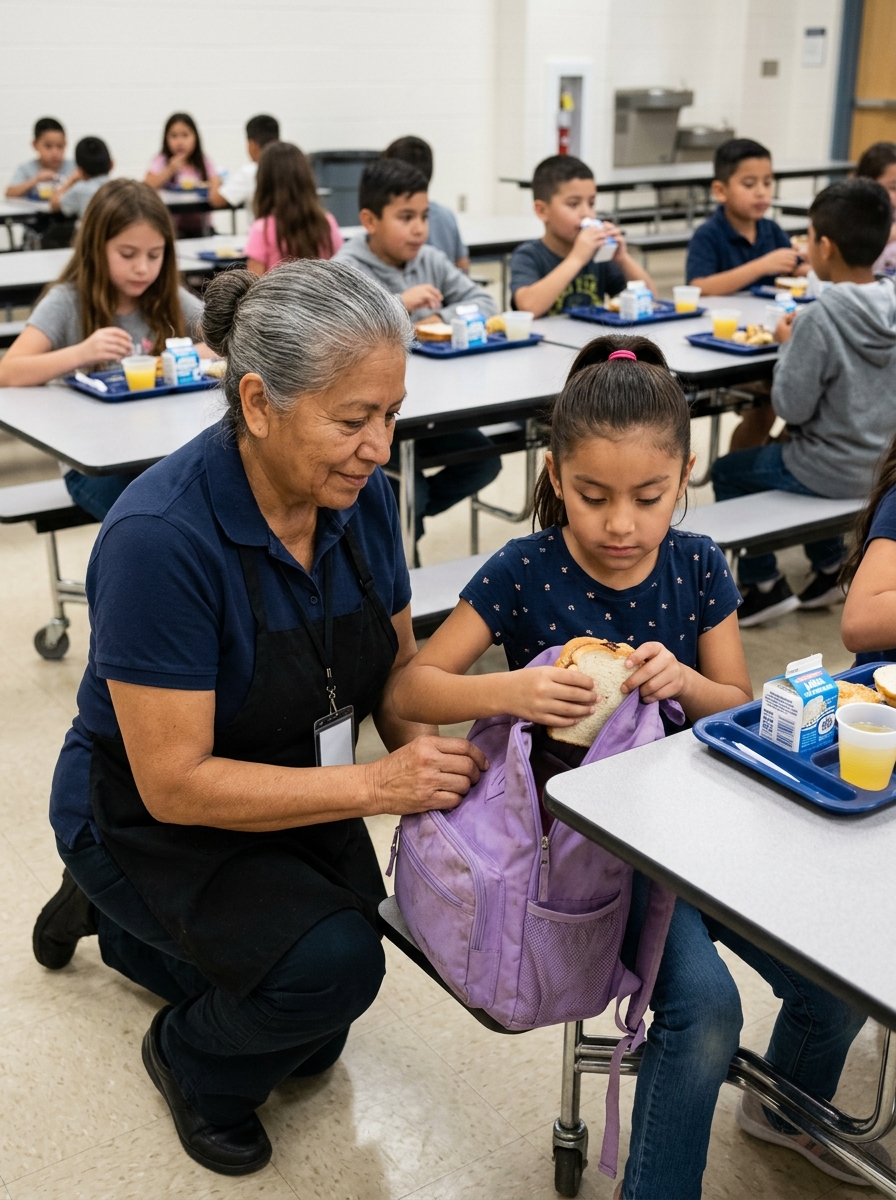
The Cafeteria Worker Thought a Little Girl Hated School Lunch—Until She Learned Who Was Really Eating Half of It
“Sweetheart, why do you keep putting your sandwich in your backpack?”
Nine-year-old Ava froze with one hand inside the faded purple bag.
Across the elementary school cafeteria, trays clattered, milk cartons popped open, and nearly two hundred children talked at once. But at that little corner table, Gloria Maddox suddenly heard nothing except Ava’s quiet answer.
“My little brother isn’t in school yet.”
Gloria stared at her.
Ava lowered her eyes.
“He gets hungry before Mom gets home.”
Gloria was sixty years old and had worked behind that cafeteria counter in a small Arkansas town for nearly thirteen years.
She knew which children wanted extra ketchup.
She knew who hated green beans, who traded apple slices, and who always asked whether Friday was pizza day before even saying good morning.
But lately, she had started noticing other things.
Children who drank every drop of milk.
Children who asked if they could keep an unopened cereal packet.
Children who seemed unusually excited on Mondays.
And Ava.
For nearly three weeks, Gloria had watched the fourth grader carefully wrap half her lunch in napkins and slide it into her backpack.
At first, Gloria assumed Ava simply didn’t like the food.
Then she noticed Ava eating the less desirable half herself.
If lunch was a turkey sandwich, Ava saved half the sandwich but ate the carrots.
If it was chicken, she saved the biscuit.
If there was a banana, it disappeared into the backpack untouched.
A child being picky didn’t do that.
A child planning ahead did.
Gloria crouched beside Ava’s table.
“How old is your brother?”
“Four.”
“Does he like peanut butter?”
Ava finally looked up.
“He likes everything.”
That answer stayed with Gloria for the rest of the day.
She thought about it while wiping tables.
She thought about it while stacking trays.
She thought about it that evening while eating canned soup alone at the little kitchen table she had shared with her husband, Dale, for thirty-four years.
Dale had been gone two years.
Cancer had taken him slowly.
The bills had come quickly.
By the time the funeral flowers wilted, most of what they had saved for retirement was gone.
Friends occasionally asked Gloria why she was still working at sixty.
She usually smiled and said, “I’d be bored at home.”
That was easier than explaining debt.
Easier than admitting that some months she stood in the grocery aisle adding prices in her head before putting something back.
Gloria understood more about stretching food than most people knew.
So the next morning, when there were two extra sandwiches after the lunch count had been completed, Gloria wrapped one carefully.
When Ava came through the line, Gloria slipped it beside her tray.
Ava looked confused.
“Lunch staff mistake,” Gloria whispered.
Then she winked.
Ava understood.
That sandwich went into the purple backpack.
The next day there was an extra apple.
A few days later, an unopened carton of crackers remained.
Gloria never took food meant for another child.
She never made a scene.
She simply paid attention to what would otherwise be leftover and, when she could, made sure Ava’s backpack was a little heavier going home.
Sometimes there was nothing extra.
On those days, Gloria hated watching Ava carefully divide her own meal.
Then one Thursday, Ava came through the line looking worried.
“My brother ate breakfast yesterday,” she whispered.
Gloria smiled.
“Well, that’s what breakfast is for.”
Ava shook her head.
“No. I mean he ate all of it.”
Gloria had to turn toward the warming trays for a moment because her eyes filled unexpectedly.
She remembered Dale during his final months.
He had hated being fussed over.
Whenever neighbors brought casseroles, he would grumble, “We can feed ourselves.”
Then, after they left, he would look at Gloria and quietly say, “Put some in the freezer.”
Pride and hunger often lived in the same house.
Gloria knew that.
So she never asked Ava questions about her mother.
She never made the child feel poor.
She just kept watching.
Then, one afternoon, the cafeteria manager called Gloria into the office.
A school administrator was sitting inside.
On the desk was a printed report.
“Gloria,” the manager said carefully, “we need to talk about food leaving the cafeteria.”
Gloria’s stomach dropped.
She knew immediately.
Someone had noticed.
There were policies.
Inventory rules.
Meal-program regulations Gloria barely understood.
Gloria sat down and folded her hands in her lap.
“I did it,” she said.
The administrator looked surprised.
Gloria continued before anyone could speak.
“There’s a little girl taking food home to her four-year-old brother. I only gave her leftovers when I knew they weren’t needed. If somebody has to answer for it, I will.”
Her voice cracked.
She hated that.
She had survived two years of hospitals, debt collectors, funeral arrangements, and coming home to an empty house.
But the thought of losing the job that kept her afloat frightened her.
“I know rules are rules,” Gloria said. “I just couldn’t watch a fourth grader choose between eating lunch and feeding her baby brother.”
Nobody spoke for several seconds.
Then someone knocked on the office door.
It was Mrs. Dawson, a third-grade teacher.
Behind her stood another teacher.
Then another.
The administrator sighed and waved them inside.
Mrs. Dawson placed a grocery bag on the desk.
“There’s something you should know,” she said.
One teacher had a student who regularly asked for extra crackers on Friday afternoons.
Another knew two siblings whose family had been living temporarily with relatives after their father lost his job.
A custodian had noticed unopened food disappearing from classroom trash bins—not because children were playing with it, but because other children were quietly taking it home.
Gloria looked from face to face.
Ava wasn’t the only one.
Not even close.
The administrator rubbed his forehead.
“We have families who would never walk into this school and announce that they’re struggling,” he said.
Mrs. Dawson nodded.
“So don’t make them announce it.”
That sentence changed everything.
Within two weeks, an unused storage room near the front office became something nobody officially called a food pantry.
They called it the “Family Shelf.”
No forms were posted outside.
No children’s names were displayed.
Teachers brought canned soup, cereal, pasta, peanut butter, oatmeal, and fruit cups.
The custodian built simple wooden shelves from leftover boards.
Parents who heard what was happening quietly dropped off grocery bags.
A local farmer sent potatoes.
An elderly woman brought six jars of homemade applesauce and refused to leave her name.
Families could take what they needed without explaining themselves to everyone.
And families who were doing better could leave something behind.
Gloria kept her job.
More than that, she was asked to help organize the shelf because, as the principal told her, “You noticed what the rest of us missed.”
But Gloria never believed that was quite true.
“I just noticed one child,” she said.
“That was enough.”
Months passed.
Ava stopped dividing every lunch in half.
Some days she still tucked something small into her backpack.
But now it was usually because her little brother liked the cookies.
Gloria pretended not to notice.
Then, on Gloria’s sixty-first birthday, the cafeteria staff taped a paper sign beside the serving line.
HAPPY BIRTHDAY, MRS. GLORIA!
Children shouted the words at her all morning.
Someone brought cupcakes.
The kindergarteners sang so loudly and badly that Gloria laughed until she cried.
Near the end of lunch, Ava approached carrying a folded piece of construction paper.
“I made you something.”
Gloria opened it.
The drawing showed a cafeteria worker with enormous yellow hair standing behind a counter.
Gloria’s actual hair was gray.
Apparently artistic accuracy had limits.
Around the woman were children carrying trays, grocery bags, apples, and sandwiches.
At the bottom, written in large purple crayon, were seven words:
**MRS. GLORIA FEEDS PEOPLE NOBODY CAN SEE.**
Gloria read it twice.
Then she sat down.
She thought about how often adults assume hunger has a certain face.
How we imagine struggle will announce itself.
Sometimes it doesn’t.
Sometimes it wears clean clothes.
Sometimes it finishes homework.
Sometimes it says “thank you” and carries half a sandwich home in a backpack.
And sometimes helping someone begins before a committee is formed, before a program gets a name, before anyone writes a policy.
It begins when one person pays attention.
Gloria eventually taped Ava’s drawing inside her kitchen cabinet.
Every morning, when she reached for her coffee mug, she saw those purple words.
Years later, she would say it was the greatest birthday gift she ever received.
Not because Ava called her generous.
But because that little girl reminded her of something Dale had believed his whole life.
You never really know what someone is carrying home.
So when you have enough, you make room at the table.
Sometimes the greatest kindness is simply noticing the hunger someone is too proud, too young, or too afraid to tell you about.