The 39-Year-Old Firefighter Thought the Widow’s Smoke Alarm Calls Were a Nuisance—Until She Said One Sentence That Changed How He Grieved
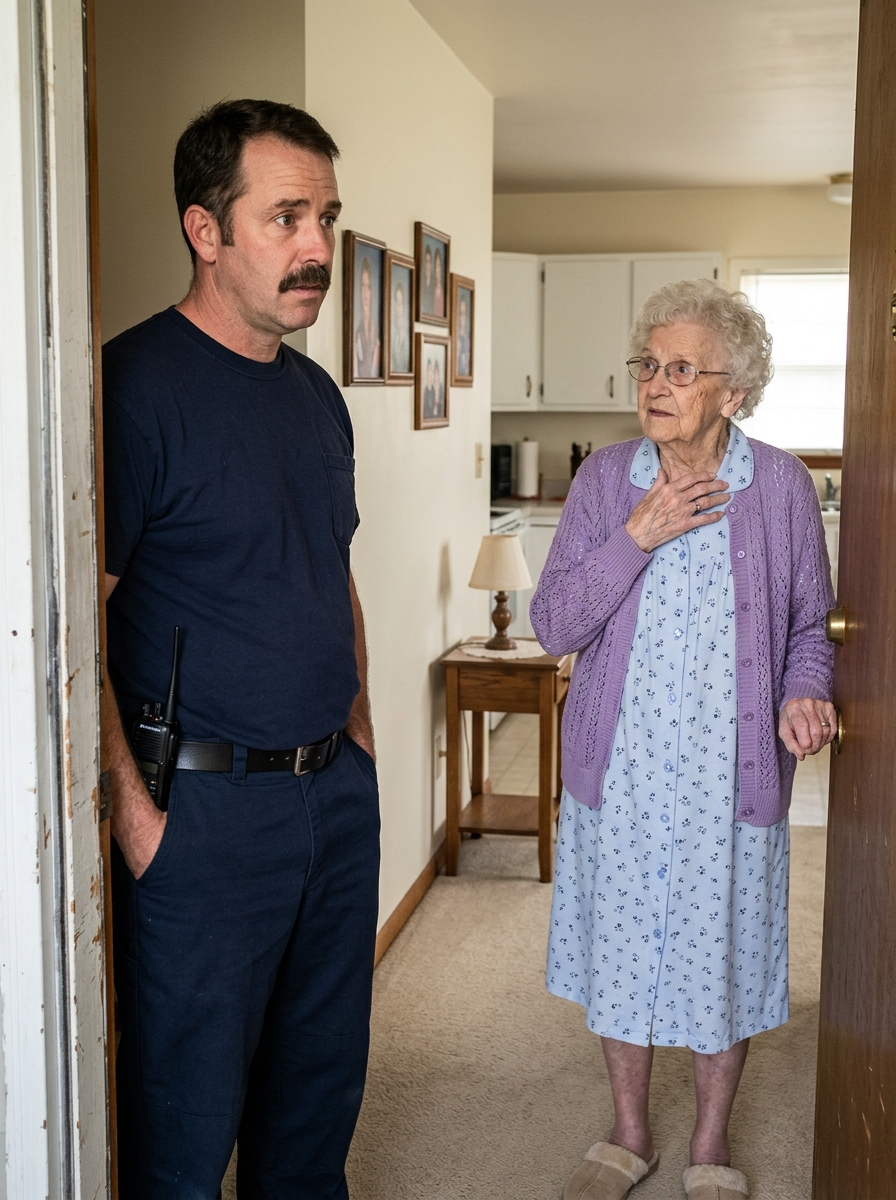
The third time Pearl Donovan called about her smoke alarm, I was irritated before I even pulled into her driveway.
Not proud of that.
Just telling the truth.
I was thirty-nine years old, volunteering with our little rural fire department in Iowa, and for the past six months I had been carrying around an anger I couldn’t explain to anybody.
Pearl was eighty-two.
Her emergency, according to dispatch, was a smoke alarm chirping every forty seconds.
No smoke.
No fire.
Just a battery.
Again.
I parked beside her small white house and sat behind the wheel for a second, listening to that faint chirp through the open porch window.
Then Pearl appeared behind the screen door wearing a blue cardigan and slippers.
“Sorry to bother you boys,” she called.
There were no “boys.”
Just me.
I grabbed the ladder from the truck.
“You know they sell batteries at the hardware store, right, Pearl?”
She looked at me for a long second.
“I know where they sell them, Evan.”
That shut me up.
Inside, the house smelled like coffee, furniture polish, and something baking.
The smoke detector was mounted near the ceiling in the hallway.
I climbed the ladder, replaced the battery, pressed the test button, and climbed down.
Pearl stood beneath me holding the old battery in both hands.
“I’d do it myself,” she said quietly, “but the last time I got on a chair, I woke up on the kitchen floor.”
I looked at her.
She shrugged.
“My balance isn’t what it was.”
That was when I noticed there wasn’t much evidence of anybody else in the house.
No second coat by the door.
No man’s shoes.
No grandchildren’s backpacks.
Just framed photographs.
Most were old.
In one, Pearl stood beside a tall, broad-shouldered man wearing a firefighter’s dress uniform.
I pointed toward it.
“Your husband?”
Her whole face changed.
“Frank.”
She smiled.
“Forty-three years married. Volunteer firefighter for thirty-one of them.”
I stepped closer to the photograph.
Frank had that familiar look firefighters get in old station pictures.
Proud, uncomfortable, trying not to smile too much.
“When did he pass?”
“Eleven years ago.”
Pearl looked toward the hallway.
“After Frank died, my son helped with things around here. Then his job took him to Arizona. My daughter’s in North Carolina.”
She tapped the smoke detector battery against her palm.
“They call. They visit when they can. But neither one can exactly drive over to change a battery.”
I suddenly felt about two inches tall.
I apologized for being short with her.
Pearl waved it off.
“Firefighters have more important things to do than babysit old women.”
“No,” I said.
“We don’t.”
The words came out before I thought about them.
The truth was, for six months, I hadn’t known what was important anymore.
My closest friend, Daniel, had died in a warehouse fire outside town.
We had volunteered together for nearly fifteen years.
We had eaten bad chili at fundraisers together.
Fixed engines together.
Complained about department paperwork together.
Our kids had grown up knowing each other.
During that warehouse fire, Daniel went one direction.
I went another.
A section of roof came down.
I walked out.
He didn’t.
Everybody kept telling me there was nothing I could have done.
I hated hearing that sentence.
Nothing I could have done.
It sounded like permission.
And I didn’t want permission.
I wanted Daniel back.
Instead, I became quieter.
Stopped going to Friday dinners.
Stopped answering friends.
I still responded when the pager went off, but afterward I’d drive home and sit in my garage with the engine off until my wife finally opened the door and asked whether I was coming inside.
Some nights, I wasn’t sure.
A week after Pearl’s smoke alarm call, I drove past her house and noticed her grass.
It was high enough to bend over at the sidewalk.
A rusted lawn mower sat beneath a tarp beside the garage.
I kept driving.
Then I made it about half a mile.
I turned around.
Pearl came outside when she heard my mower.
She stood on the porch with both hands on her hips.
“I didn’t call the fire department.”
“I know.”
“Then what are you doing?”
“Your yard.”
“I can see that.”
She squinted at me.
“Why?”
I didn’t have a good answer.
So I said, “Because it needs mowing.”
Pearl disappeared inside.
Ten minutes later, she returned carrying a coffee mug.
Black.
Exactly how I liked it.
I never asked how she knew.
The next Saturday, I came back.
And the Saturday after that.
Sometimes I mowed.
Sometimes I changed a furnace filter.
Once I tightened a loose porch railing.
Another time I replaced a bulb above her basement stairs.
Pearl always paid me the same way.
Coffee.
And stories.
She told me about Frank’s first fire call in 1968, when his helmet was too large and kept slipping over his eyes.
She told me about the winter he left Thanksgiving dinner because a barn caught fire and came home at two in the morning smelling like smoke and wet hay.
She told me how firefighters’ wives used to listen to scanners at kitchen tables because there were no cell phones.
“You just waited,” she said.
“And prayed the truck came back with everybody who left on it.”
One Saturday, Pearl brought out an old metal box.
Inside were Frank’s photographs, badges, and newspaper clippings.
She handed me a picture of six young firefighters standing beside an old engine.
“Frank’s best friend was that fellow there.”
She pointed to a skinny man on the end.
“His name was Charlie.”
I studied the photo.
“What happened to him?”
Pearl took a sip of coffee.
“Fire.”
I looked up.
She nodded.
“Frank survived. Charlie didn’t.”
For some reason, I couldn’t breathe right.
I set the photograph down.
Pearl noticed.
Old people notice more than we give them credit for.
She didn’t push.
She just sat beside me on the porch while the cicadas buzzed in the trees.
Finally I said, “Daniel shouldn’t have died.”
Pearl waited.
“I was right there.”
Still nothing.
“I keep thinking if I’d gone where he went… if I’d seen something sooner… if I’d called him back…”
My voice broke.
I hated that.
I hadn’t cried at Daniel’s funeral.
Hadn’t cried when his wife hugged me.
Hadn’t cried when his son stood beside the casket wearing his father’s old department pin.
But I sat on an eighty-two-year-old widow’s porch and cried into my hands like a kid.
Pearl didn’t tell me to stop.
She didn’t say everything happens for a reason.
She didn’t say Daniel was in a better place.
She didn’t tell me to move on.
She let me finish.
Then she said, “Frank spent years asking the same questions after Charlie died.”
I looked at her.
“He thought surviving meant he owed Charlie something.”
Pearl leaned back in her porch chair.
“Eventually I told him the only thing he owed Charlie was to keep living like his life still mattered.”
She reached over and touched my arm.
Then she said the sentence I’ve carried with me ever since.
“Living isn’t betraying the dead, Evan. Wasting the life they wanted you to have might be.”
Neither of us spoke for a while.
Across the street, somebody’s dog barked.
A pickup truck rolled through town.
Pearl’s wind chime moved in the breeze.
Ordinary sounds.
That was what surprised me most.
The world hadn’t stopped.
Maybe I had.
The next morning, I went to breakfast with my wife.
The next Friday, I showed up at the station dinner.
I sat in Daniel’s old chair by accident.
For a second, I almost moved.
Then I stayed.
A young volunteer named Cody asked me to show him how Daniel used to coil hose because everybody said Daniel had the fastest method in the department.
So I taught him.
Later that month, Daniel’s son asked if I would help him fix his father’s old fishing boat.
I said yes.
None of it made the grief disappear.
I don’t think grief works that way.
But slowly, Daniel stopped being only the man we lost.
He became the jokes I repeated.
The skills I passed down.
The stories I told.
The reason I stayed five extra minutes when a younger firefighter needed help.
And every Saturday morning, I still drove my mower over to Pearl Donovan’s house.
Sometimes Pearl watched from the porch.
Sometimes she napped.
Sometimes she complained I was cutting the grass too short.
“You firefighters think everything needs to be attacked,” she’d yell.
“Grass included.”
The following spring, I installed new smoke alarms throughout her house.
Ten-year sealed batteries.
No chirping.
When I finished, Pearl frowned.
“Well,” she said, “I suppose I’ll have to invent another reason to call you.”
I laughed.
“You don’t need one.”
She looked at me for a moment, then smiled.
There are people who enter your life because you think they need your help.
Then one day you realize they were helping you long before you understood it.
I thought I was changing an old widow’s smoke alarm battery.
Then I thought I was mowing her lawn.
But Pearl Donovan gave me something much harder to replace.
She gave me permission to come back to my own life.
And sometimes the best way to honor the people we’ve lost is not to stop living without them, but to keep carrying the good they left inside us.