
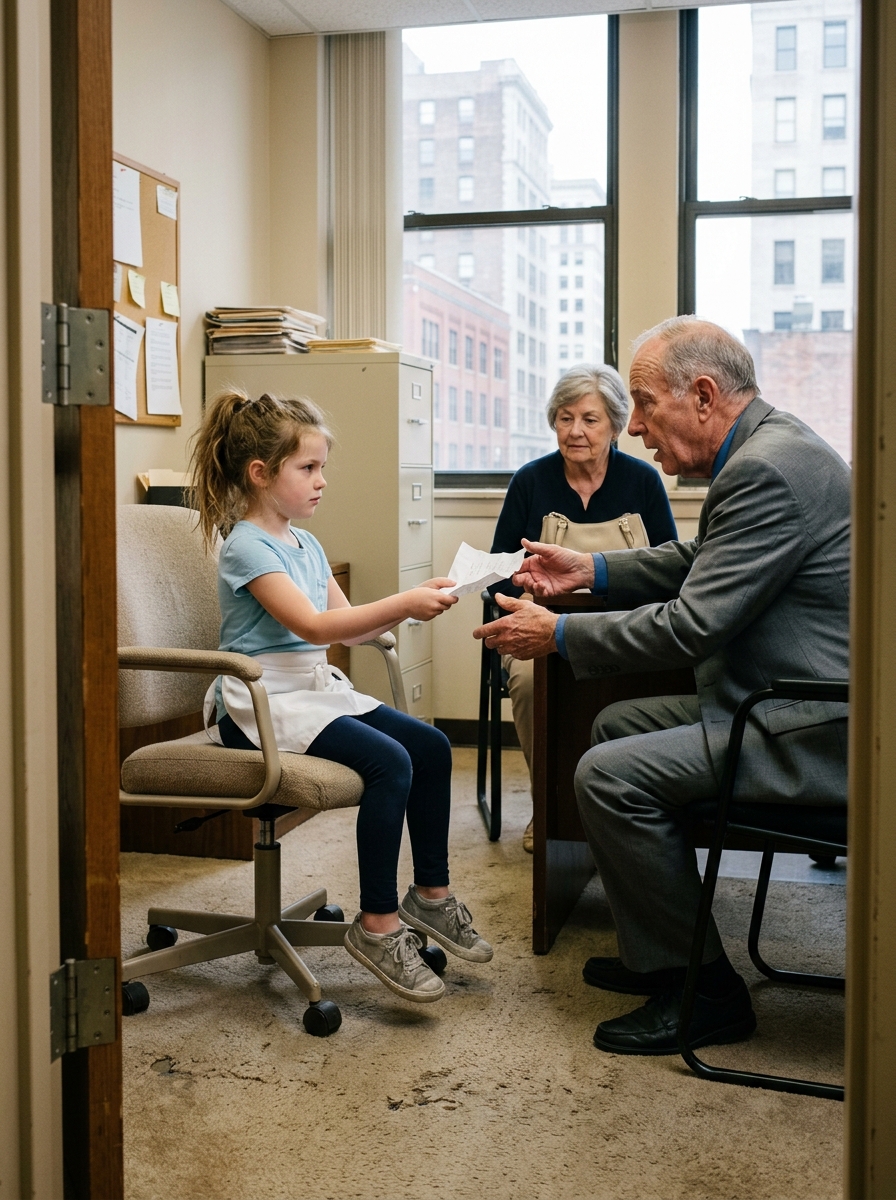
“Mr. Whitaker, there’s a six-year-old girl downstairs asking to interview for our housekeeping job.”
Graham Whitaker slowly lowered the contract he had been reading.
His assistant, Denise, stood in the doorway with one hand still on the frame.
“I’m sorry,” Graham said. “What did you just say?”
“There’s a little girl at reception.”
Denise looked as confused as he felt.
“She’s wearing an apron. She has a résumé. She says her mother was supposed to interview today, but her mother got sick.”
Graham stared at her.
“And she’s here alone?”
“No. An older neighbor brought her downtown and is waiting with security. Apparently the girl begged her to bring her here so she could deliver the résumé.”
That changed things.
But not enough to make the situation any less strange.
Graham leaned back in his chair.
At fifty-eight, he had spent almost thirty years building a property business that managed apartment buildings across Milwaukee and several nearby suburbs.
He had handled angry contractors, difficult tenants, nervous investors, broken elevators, surprise inspections, flooded laundry rooms, and more arguments over parking spaces than he cared to remember.
But never this.
“A six-year-old,” he repeated.
Denise nodded.
“She says her name is Lucy Bennett.”
Graham looked toward the tall windows behind his desk.
The city was beginning to glow below him.
For years, he had loved that view.
Lately, it mostly reminded him how high above everyone else he had managed to place himself.
“Send them up,” he said.
Denise raised an eyebrow.
“Both of them?”
“Definitely both.”
A few minutes later, the office door opened.
The woman who entered first looked to be in her late sixties. She wore comfortable shoes, carried a large purse, and had the worried expression of someone who had spent the entire ride downtown wondering whether she had made a terrible mistake.
Beside her stood the smallest job applicant Graham had ever seen.
Lucy Bennett had light brown hair pulled into a crooked ponytail.
She wore sneakers, dark leggings, and a pale blue shirt.
Around her waist was a white housekeeping apron so large that it had been wrapped around her twice.
The bottom still reached almost to her ankles.
In both hands, she held a folded sheet of paper.
Not a toy.
Not a drawing.
A résumé.
Lucy looked straight at Graham.
“Are you Mr. Whitaker?”
“I am.”
She swallowed.
“My mom was supposed to see you today.”
The older woman touched Lucy’s shoulder.
“I’m Ruth Nolan,” she said quickly. “I live across the hall from them. Clara asked me to keep an eye on Lucy while she rested. I want you to know I didn’t bring her here without an adult.”
“I appreciate that,” Graham said.
Ruth gave him a relieved nod.
Then Lucy stepped forward.
“My mom needs this job.”
Her voice shook on the final word.
Graham came around his desk.
For one second, habit nearly made him offer his hand as if she were another executive.
Instead, he pulled over a chair.
“Why don’t we all sit?”
Lucy climbed onto the chair.
Her feet didn’t come close to touching the floor.
She carefully flattened the oversized apron across her knees.
Graham sat across from her.
Denise stayed near the door.
Ruth took the chair beside Lucy.
“What happened to your mom?” Graham asked.
“She got sick last night.”
Lucy looked down at the paper.
“She thought she would feel better this morning, but she didn’t. She kept saying she had to come anyway because this interview was important.”
Ruth spoke softly.
“Clara has a fever and is exhausted. I told her I would stay nearby today. Nothing serious that we know of. She just couldn’t manage an interview.”
Graham nodded.
Lucy immediately continued.
“My mom was crying.”
The room went still.
“She didn’t want me to see.”
Lucy picked at one loose thread on the apron.
“But I heard her in the kitchen.”
Graham felt something tighten behind his ribs.
He knew that sound.
Not the sound of crying itself.
The sound of someone trying very hard not to be heard.
His wife Anne used to say there were two kinds of sadness.
The kind that asked to be comforted.
And the kind that cleaned the kitchen while everyone else slept.
Anne had been gone four years.
Graham still thought about things she had said almost every day.
Lucy held up the paper.
“So I brought her résumé.”
Graham took it carefully.
“And the apron?”
Lucy looked down at herself.
“It’s hers.”
A faint blush crossed her cheeks.
“She wears it when she cleans houses. I thought if I wore it, you would know she was serious.”
Denise turned her face toward the windows.
Graham noticed her wiping one eye.
He unfolded the résumé.
Clara Bennett.
Thirty-seven years old.
Fifteen years of housekeeping and building-services experience.
Night-shift work at a local medical center.
Daytime cleaning for several families.
Prior experience supervising a small housekeeping team at an apartment complex.
Excellent attendance.
Several references.
Nothing flashy.
Nothing polished.
Just a plain page describing years of work most people barely noticed unless it wasn’t done.
At the bottom, Clara had written three words by hand.
Reliable. Careful. Honest.
Graham read them twice.
Lucy leaned forward.
“She works really hard.”
“I believe you.”
“She cleans places even when she’s tired.”
“I believe that too.”
“And she never takes things.”
Ruth squeezed Lucy’s shoulder.
“She means her mother is trustworthy.”
“I understood,” Graham said gently.
Lucy nodded as if this were a serious business meeting.
“My mom says when you clean somebody’s home, you have to treat their stuff like it belongs to somebody you love.”
Graham looked at the résumé again.
Something about that sentence bothered him.
Not because it was wrong.
Because it sounded exactly like the kind of thing Anne would have said.
He turned the page over.
There was nothing on the back.
“Did your mother apply directly for the housekeeping opening?”
Lucy looked at Ruth.
Ruth answered.
“Yes. About two weeks ago. Clara was thrilled when she finally got the interview.”
Graham frowned.
“Two weeks?”
“That’s what she told me.”
He glanced toward Denise.
“Who scheduled the interview?”
Denise thought for a moment.
“Human resources schedules those. The position is technically through building operations.”
Graham turned back to Lucy.
“Your mother said she was meeting with me?”
Lucy nodded.
“She showed me your name.”
“That’s strange.”
Graham rarely conducted first-round interviews anymore.
Especially not for housekeeping staff.
It wasn’t because he thought the jobs were unimportant.
At least that was what he told himself.
The truth was simpler.
His company had grown.
Layers of people now handled the things Graham once handled personally.
People hired people.
People managed people.
People wrote reports about people.
Graham mostly saw numbers.
Occupancy percentages.
Maintenance costs.
Renewal rates.
Budgets.
Projections.
Everything neat enough to fit inside a spreadsheet.
Lucy did not fit inside a spreadsheet.
Neither did the oversized apron.
Neither did the nervous older neighbor sitting beside her.
Graham looked at Denise.
“Can you find out how this interview reached my calendar?”
“Absolutely.”
Denise left.
Lucy watched the door close.
“Did we do something wrong?”
“No.”
Graham answered faster than he intended.
“No, Lucy. You didn’t.”
She relaxed slightly.
“But I need to tell you something.”
Her hands tightened around the edge of the apron.
Graham waited.
“My mom really needs the job.”
“I understand.”
“No.”
Lucy’s voice dropped.
“I mean really.”
Ruth shifted beside her.
“Lucy—”
“It’s okay,” Graham said.
Lucy looked directly at him.
“Our rent is going up when our lease changes.”
There was no drama in the way she said it.
That somehow made the words hit harder.
“My mom lost one of the houses she cleaned because the family moved away. She said we can still pay this month, but after that she needs more hours.”
Ruth sighed.
“She wasn’t supposed to hear all of that.”
“I hear things,” Lucy said quietly.
Graham almost smiled.
Then he saw her expression.
She was six years old and trying to understand household math.
He thought of his son, Mark, at six.
Mark’s greatest financial concern had been whether Graham would give him enough quarters for the arcade games at the pizza place near their house.
Graham had spent years telling himself he had worked so hard because he wanted Mark to feel secure.
Maybe that had been true.
But somewhere along the way, security had become success.
Then success had become expansion.
Then expansion had become habit.
And habit had become a life.
Anne had seen the change long before he did.
“You’re very good at building places for people to live,” she once told him.
“I just hope you remember to live in yours.”
He hadn’t listened.
Graham returned his attention to Lucy.
“What were you hoping would happen when you came here today?”
Her answer came immediately.
“I was hoping you would still give my mom a chance.”
Not give her money.
Not rescue her.
Not fix everything.
A chance.
That word landed harder than all the others.
Graham placed Clara’s résumé on his desk.
“I think that is a very reasonable thing to ask.”
Lucy’s eyes widened.
“Really?”
“Really.”
She looked at Ruth.
Ruth looked cautious.
“Mr. Whitaker,” she said, “Clara would be embarrassed if she thought Lucy had pressured you.”
“She hasn’t.”
Graham leaned back.
“And I’m not offering anyone a job because a child wore an apron into my office.”
Lucy’s face fell slightly.
Graham raised a finger.
“But I am going to make sure her mother gets the interview she was promised.”
Hope returned just as quickly.
“And I’m going to figure out why she was somehow scheduled with me.”
Lucy nodded seriously.
“Okay.”
“First, though, I think we should call your mother.”
Lucy froze.
Ruth closed her eyes.
“That,” Ruth said, “is the part she has been avoiding.”
“I left a note,” Lucy whispered.
“What did it say?”
Lucy stared at her sneakers.
“It said, ‘I’m with Miss Ruth. We went to help with your interview. Don’t worry.’”
Graham looked at Ruth.
Ruth raised both hands.
“I told her we should call before we came. She asked me to wait until we got here because she thought her mother would tell us to turn around.”
Lucy looked ashamed.
“I knew she would say no.”
Graham understood the logic.
He also understood the mother who was probably waking up and wondering what exactly “went to help with your interview” meant.
“We call now,” he said.
Lucy nodded.
Ruth dialed Clara.
The phone had barely rung once before someone answered.
“Ruth?”
The voice was weak but alert.
“Yes, honey.”
“Where is Lucy?”
“She’s right here.”
A long silence followed.
Then Clara said something Graham could not hear.
Lucy’s eyes filled.
“I’m sorry, Mom.”
Another pause.
“I wanted to help.”
Graham could hear Clara’s voice rising slightly through the phone.
Not angry.
Scared.
Ruth quickly explained that Lucy had never been alone and had been beside her the entire trip.
That seemed to settle the immediate panic.
Then Ruth handed the phone to Graham.
He took it.
“Ms. Bennett?”
“Yes?”
“My name is Graham Whitaker.”
Silence.
Then Clara gave a tired gasp.
“Oh.”
“I believe you were scheduled for an interview today.”
“I was.”
Her voice grew embarrassed.
“I’m so sorry. I meant to call. I thought I might improve by this afternoon, but then I fell asleep. Lucy must have heard me worrying.”
“She brought your résumé.”
“Oh, no.”
“And your apron.”
A longer silence.
“Oh, Lucy.”
The little girl covered her face.
Graham almost laughed.
He managed not to.
“Ms. Bennett, your daughter is safe. She has been with your neighbor the entire time.”
“Thank you.”
Clara sounded as if she might cry.
“I’m so sorry she interrupted your day.”
“She didn’t interrupt anything important.”
The words escaped before Graham could think about them.
He glanced at the stack of contracts on his desk.
An hour earlier, he would have said they were extremely important.
Now they looked like paper.
“Actually,” Graham continued, “I’d still like to interview you.”
“Today?”
“Not unless you feel up to a short conversation. Otherwise, we can reschedule.”
“I can talk.”
Her answer was immediate.
“I don’t look very professional right now, but I can talk.”
“It’s a phone call. Nobody cares what you look like.”
Lucy watched him closely.
Graham picked up the résumé.
“Can I ask you a few questions?”
“Yes.”
“Your résumé says you supervised housekeeping staff several years ago.”
“I did.”
“How many?”
“Seven most of the time. Sometimes nine during busy months.”
“What happened to that position?”
“The property changed management. The new group brought in their own supervisors.”
No resentment.
No long speech.
Just an answer.
Graham continued.
“You currently work nights?”
“Three nights a week.”
“And clean houses during the day?”
“Yes.”
“How many?”
“Three now. It was four.”
“You’re looking for steady daytime work?”
“Yes.”
Clara hesitated.
“I’m not afraid of hard work, Mr. Whitaker. I just want something predictable. Lucy is getting older. I want to be home more evenings if I can.”
Graham looked at the child across from him.
Lucy pretended to be very interested in a button on the apron.
“What was your biggest responsibility as a supervisor?”
Clara paused.
“Making sure nobody felt invisible.”
Graham stopped.
He had expected scheduling.
Inventory.
Quality checks.
Maybe training.
“What do you mean?”
“Housekeeping staff get blamed when something isn’t right, but when everything is right, people usually don’t notice.”
Graham said nothing.
Clara continued.
“So I tried to notice.”
Her voice sounded steadier now.
“I learned who needed extra training. Who was always early. Who could handle difficult units. Who needed a schedule change because of a child. I expected good work, but I tried to treat people fairly.”
Graham slowly sat back.
“What about residents?”
“Respect their space.”
He looked at Lucy.
The girl smiled.
Graham said, “Your daughter gave me a similar answer.”
“Oh, I’m sure she did.”
For the first time, Clara laughed softly.
“She hears everything I say.”
“I’m learning that.”
Lucy grinned.
Graham asked several more questions.
Clara answered plainly.
No inflated language.
No rehearsed lines.
When she didn’t know something, she said so.
When Graham asked whether she had experience with scheduling software, she admitted she had used an older system but was willing to learn whatever his company used.
When he asked how she handled complaints, she said, “First I make sure I understand what the person is actually upset about. Sometimes the dirty floor isn’t really about the floor.”
Graham stared toward the windows again.
Anne used to say the same thing about arguments.
The dishes were rarely about dishes.
The late arrival was rarely about ten minutes.
The forgotten birthday card was rarely about paper.
People carried deeper things.
If you wanted to understand them, Anne believed, you had to listen past the first sentence.
Graham had once been good at that.
Business had trained it out of him.
Or maybe he had allowed it to.
The office door opened.
Denise stepped inside holding several printed pages.
Her expression had changed.
Not worried now.
Annoyed.
Graham covered the phone.
“What?”
“You need to see this.”
She placed the papers in front of him.
Clara Bennett’s application.
Two reference letters.
A supervisor’s recommendation.
And an internal note.
Graham read the top page.
Then read it again.
Clara had not applied two weeks earlier.
She had applied almost six weeks earlier.
One of the building managers had recommended her for a housekeeping-lead position, not the basic housekeeping opening.
The recommendation had been strong.
Very strong.
Dependable.
Experienced.
Excellent with residents.
Natural team leader.
Then the application had apparently been routed into the wrong hiring folder during a staffing transition.
Three weeks later, Clara had called to follow up.
Someone had apologized and scheduled an interview.
But the calendar system had attached Graham’s name because his office had temporarily been listed as the administrative contact for the building.
A clerical mistake.
A simple one.
The kind that caused no dramatic scandal.
No great wrongdoing.
Just a person waiting nearly six weeks while a piece of paper sat where it did not belong.
Graham felt embarrassed anyway.
“How long has this been sitting?”
Denise lowered her voice.
“Too long.”
He looked at Clara’s résumé.
Then at Lucy.
Paper trail.
That was what his business trusted.
Files.
Forms.
References.
Records.
Everything Clara had done right was sitting there in black ink.
And still, nobody had noticed her until a six-year-old walked in wearing an apron.
Graham returned to the phone.
“Ms. Bennett?”
“Yes?”
“I just learned something.”
He explained the application mix-up.
Clara was quiet.
“I thought maybe I just wasn’t qualified.”
“You were qualified.”
Graham felt heat rise in his face.
“Someone recommended you for a lead position weeks ago.”
“What?”
“I’m looking at the recommendation right now.”
Another silence.
Then Clara whispered, “I didn’t know that.”
“You should have.”
Graham looked at Denise.
She nodded.
“We should have contacted you sooner.”
Clara immediately tried to make him feel better.
“That’s all right.”
“No.”
His voice sharpened slightly.
Not at her.
At himself.
“It happened. We’ll correct it. But I’m not going to pretend six weeks doesn’t matter to somebody looking for steady work.”
Lucy looked between the adults.
Graham continued more calmly.
“I would like our operations manager and human resources lead to speak with you tomorrow or whenever you’re feeling well enough.”
Clara hesitated.
“All right.”
“And I’d like them to consider you for the lead position you were originally recommended for.”
There was a small sound on the phone.
“Mr. Whitaker, I came in expecting to apply for regular housekeeping.”
“I know.”
“I don’t want anything I didn’t earn.”
Graham looked at her reference letter.
“You haven’t been offered anything yet.”
He smiled.
“But based on the documents in front of me, you’ve earned the right to interview for more than you were told.”
Clara was silent.
Then she said, “Thank you.”
Those two words carried more weight than Graham wanted them to.
He handed the phone to Lucy.
“You can talk to your mom.”
Lucy took it with both hands.
“Mom?”
Graham turned away, giving her what little privacy the office allowed.
“I’m sorry.”
Pause.
“I know.”
Pause.
“No, I won’t do it again.”
Pause.
“But I helped a little.”
Another pause.
Lucy smiled.
“I love you too.”
When the call ended, she handed the phone back.
“Am I in trouble?”
Ruth gave her a look.
“We are going to have a very long conversation about making plans with grown-ups.”
Lucy sighed.
“That means yes.”
Graham laughed.
It surprised him.
Not the polite laugh he used during lunches.
Not the controlled chuckle that executives made when somebody told a harmless joke.
A real laugh.
Denise stared at him.
Graham couldn’t remember the last time he had laughed that way in the office.
Lucy smiled.
“You laugh loud.”
“So I’ve been told.”
“Your office is too quiet.”
Graham stopped smiling.
Children had a terrible habit of walking directly through the doors adults kept locked.
“You think so?”
Lucy nodded.
“It sounds like a library when everybody is mad.”
Denise covered her mouth.
Ruth looked horrified.
“Lucy.”
“What?”
Graham laughed again.
“She’s not entirely wrong.”
For the next twenty minutes, Denise arranged a ride home for Ruth and Lucy.
Graham insisted they use the company car that usually sat downstairs waiting for executives.
Ruth protested.
He ignored her.
Lucy wandered toward his bookshelf while they waited.
Most of the shelves held industry books, binders, awards, and photographs from building openings.
One photograph stood apart from the rest.
Anne.
She was sitting on the front porch of their old house, barefoot, holding a coffee mug.
Lucy pointed.
“Who’s that?”
“My wife.”
“She’s pretty.”
“She was.”
Lucy looked at him.
“Where is she?”
Graham had answered that question many times.
Usually in five words.
She passed away four years ago.
Clean.
Simple.
End of subject.
But Lucy waited.
“My wife died four years ago,” he said.
Lucy considered this.
“Do you miss her?”
“Every day.”
She nodded as though she understood something he hadn’t said.
“My grandpa died before I remember him. Mom says you can still love somebody when they’re not here.”
Graham looked at Anne’s picture.
“Your mom sounds like a smart woman.”
“She is.”
Lucy leaned closer to the photograph.
“Did your wife like kids?”
“Very much.”
“Did you have kids?”
“A son. Mark.”
“Where is he?”
“Seattle.”
“That’s far.”
“It is.”
“Do you see him?”
“Sometimes.”
Lucy turned.
“How sometimes?”
Graham blinked.
Ruth intervened.
“Lucy, maybe we don’t interview Mr. Whitaker.”
“But he interviewed Mom.”
“That was different.”
Graham smiled.
“It’s okay.”
He looked at Anne again.
“Not often enough.”
Lucy nodded.
“You should.”
Three words.
No accusation.
No lecture.
Just a child’s answer to a complicated adult problem.
You should.
The car arrived.
Before Lucy left, she returned to Graham’s desk and held out her hand.
This time, he shook it.
“Thank you for seeing me,” she said.
“Thank you for coming with Miss Ruth.”
She looked down at the apron.
“Can Mom still use this?”
“I think she probably should.”
Lucy smiled.
Then her face grew serious.
“Mr. Whitaker?”
“Yes?”
“Please don’t give my mom the job just because you feel bad.”
Graham stared at her.
Ruth’s eyes widened.
Lucy continued.
“She’ll know.”
For several seconds, nobody spoke.
Then Graham nodded.
“I promise.”
That seemed to satisfy her.
She walked out holding Ruth’s hand.
The door closed.
The office became quiet again.
Too quiet.
Exactly as Lucy had said.
Graham sat behind his desk.
The contract he had been reading earlier waited in the same place.
He couldn’t remember what it was about.
Denise remained by the door.
“Well,” she said.
Graham rubbed his face.
“Well.”
“She’s something.”
“Yes.”
Denise looked at Clara’s file.
“What do you want me to do?”
“Make sure tomorrow’s interview is real.”
“It will be.”
“And Denise?”
“Yes?”
“Find out how many other applications are sitting in the wrong folders.”
She studied him.
“All of them?”
“All of them.”
“That could be a lot.”
“Then it’s a lot.”
Denise nodded.
“Okay.”
She reached the door.
“Also,” Graham said.
She turned.
“Call Mark.”
Denise’s expression softened.
“Your son?”
“I know who Mark is.”
“I didn’t say anything.”
“You were thinking loudly.”
She smiled.
“I’ll put him through.”
Ten minutes later, Graham heard his son’s voice.
“Dad?”
“Hey.”
A pause followed.
Not hostile.
Just unfamiliar.
They usually communicated by short messages.
Birthday wishes.
Holiday plans.
Photographs of the grandchildren.
Efficient communication for people who loved each other but had somehow forgotten how to talk.
“Everything okay?” Mark asked.
“Yes.”
“You sure?”
“Yes.”
Another pause.
Graham looked at Lucy’s abandoned paper clip on his desk.
“I was wondering when you might come to Milwaukee next.”
Mark laughed softly.
“You called me to ask when I’m visiting?”
“I guess I did.”
“Who are you, and what have you done with my father?”
Graham smiled.
“I deserved that.”
Mark became quiet.
“What’s going on?”
“A kid came into my office today.”
“That sounds dangerous.”
“No. She was with her neighbor.”
Graham told him the story.
Not every detail.
Just enough.
The apron.
The résumé.
Clara’s lost application.
Lucy’s blunt opinion about his silent office.
When Graham finished, Mark said nothing for a while.
Then he asked, “What did Mom used to say?”
Graham knew exactly what he meant.
“She used to say I could build a hundred buildings and still forget to make a home.”
Mark exhaled.
“Yeah.”
“I think she was right.”
Another pause.
Then Mark said, “We can come next month.”
Graham looked toward the windows.
“All of you?”
“All of us.”
The answer hurt in a good way.
“Lucy also says I don’t see you enough.”
“Lucy sounds terrifying.”
“She is.”
Mark laughed.
“Okay, Dad.”
“Okay what?”
“We’ll come.”
The next day, Clara was still recovering, so her interview was moved to the following Monday.
Graham did not attend.
He had promised Lucy.
No special treatment.
No job offered because a child had made him emotional.
The operations manager interviewed Clara.
Then the human resources lead did.
Then they checked her references.
Graham stayed out of it.
Mostly.
He read the notes afterward.
Every reference said nearly the same thing.
Clara arrived early.
She did what she promised.
She noticed details.
She treated residents respectfully.
She stayed calm when people complained.
She trained new workers without making them feel foolish.
One former supervisor had written a sentence Graham circled with his pen.
“If Clara says something is taken care of, it is taken care of.”
Graham knew million-dollar contracts that contained more words and less value.
On Tuesday afternoon, operations recommended hiring her as a housekeeping team lead for one of the larger apartment communities.
Not director.
Not executive.
Not a miracle promotion.
A real job that matched her experience.
Steady hours.
A meaningful raise over what she had been piecing together from several part-time jobs.
Paid time off.
A predictable schedule.
And access to an apartment in one of the firm’s residential buildings at the standard employee housing rate.
Graham approved the recommendation.
Then he made Denise call Lucy.
“Why me?” Denise asked.
“Because I promised I wouldn’t interfere.”
“You’re already interfering by making me call a six-year-old.”
“I’m delegating.”
Denise rolled her eyes and dialed Clara.
When Clara answered, Denise explained the offer.
Graham could hear only one side of the conversation.
Then Denise smiled.
“Mrs. Bennett, I think someone here would like to speak with you.”
She handed Graham the phone.
Clara’s voice trembled.
“I got it.”
“You earned it.”
“I got it.”
“Yes.”
“I don’t think you understand.”
“I’m starting to.”
Clara laughed and cried at the same time.
Graham looked away to give even a telephone conversation some privacy.
Then a small voice appeared in the background.
“Did you get it?”
Clara said something.
Lucy screamed with joy.
Graham pulled the phone away from his ear.
Denise burst out laughing.
A second later, Lucy came on the line.
“Mr. Whitaker?”
“Yes?”
“You didn’t give it to her because of me, right?”
“No.”
“Promise?”
“Promise.”
“Did she do good?”
“She did very well.”
“I told you.”
“You did.”
Lucy lowered her voice.
“Mom says I’m still grounded from making surprise business trips.”
Graham smiled.
“That sounds fair.”
“I don’t think it is.”
“That also sounds fair.”
Clara started work two weeks later.
Graham expected that to be the end of the story.
He had been wrong.
At first, he saw her only in reports.
Housekeeping complaints dropped.
Turnaround times improved.
Employee absences became easier to manage because Clara reorganized schedules more clearly.
One building manager wrote that residents had begun asking for Clara by name when they had concerns.
Another noted something stranger.
The housekeeping staff had stopped quitting.
That caught Graham’s attention.
Staff turnover had always been high in those positions.
Executives discussed it in meetings as though it were a law of nature.
People come and go.
That was the phrase.
People come and go.
Clara apparently disagreed.
When Graham visited the building three months later, he found her in a supply room labeling shelves.
She looked different from the woman he had heard on the phone.
Healthy now.
Hair pulled back.
Plain work clothes.
Clipboard under one arm.
“Mr. Whitaker.”
“Clara.”
She glanced behind him.
“Is Lucy here?”
“No.”
“Then I assume this is actually business.”
Graham laughed.
“I wanted to see how things were going.”
“Good.”
“That’s all?”
She looked at him.
“You want the long version?”
“I do.”
So Clara gave it to him.
Half the team had been receiving schedules too late.
One employee had been assigned buildings so far apart that she lost too much time traveling between them.
Supplies were being ordered in quantities that looked efficient on paper but created shortages in the wrong places.
New hires were being trained differently depending on who happened to be working that day.
Nothing dramatic.
No villain.
No conspiracy.
Just dozens of small problems.
The kind executives never saw from forty floors above the street.
“How did nobody catch this?” Graham asked.
Clara shrugged.
“Everybody caught a piece.”
He frowned.
“What does that mean?”
“One person knew the schedule was bad. Another knew supplies were a problem. Another knew training was inconsistent.”
She pointed toward the hallway.
“But nobody had been asked to put all the pieces together.”
Graham thought about that all afternoon.
Everybody caught a piece.
The sentence followed him back downtown.
Over the next year, Clara became known for fixing problems before they became big enough to reach Graham’s office.
She never made speeches.
She simply paid attention.
She remembered birthdays.
She knew which employees needed morning hours and which preferred evenings.
She learned which residents had difficulty hearing and which wanted everything in writing.
When staff meetings became tense, Clara asked one question.
“What problem are we actually trying to solve?”
Graham started using it himself.
A year after her hiring, Clara was promoted to building-services supervisor.
This time, Graham did attend the meeting.
He sat in the back.
Clara looked at him afterward.
“I hope you didn’t pressure anybody.”
“I didn’t.”
“You sure?”
“Your daughter already trained me.”
That made her laugh.
Lucy, meanwhile, had become a regular visitor.
Clara never brought her into working areas while she was on duty, but after school she sometimes waited in the break room for Ruth to pick her up.
The first time Graham walked in and saw her doing math homework, she looked up.
“Your office still quiet?”
“Terribly.”
“You should get a radio.”
“I’ll consider it.”
She looked at his suit.
“You wear too much gray.”
Graham stared down.
“My suit?”
“Everything.”
“What should I wear?”
“Blue.”
“Why?”
“Because you look less grumpy in blue.”
Clara nearly dropped her coffee.
“Lucy.”
“What?”
Graham pointed toward Clara.
“Your mother is trying very hard not to laugh.”
Clara failed.
After that, Graham occasionally stopped by the break room when he knew Lucy was there.
Five minutes became ten.
Ten became twenty.
Sometimes she asked him for help with homework.
Sometimes he was no help at all.
Elementary-school math had apparently changed since Mark was a child, and Lucy found this deeply suspicious.
“You own apartment buildings,” she said once.
“Yes.”
“And you can’t do my fractions?”
“I can do fractions.”
“You got number four wrong.”
“I made a small mistake.”
“You got number six wrong too.”
Graham looked at the worksheet.
“Your teacher may be unreasonable.”
Lucy laughed so loudly that two employees looked through the doorway.
Graham started laughing too.
That sound slowly became more common around him.
His staff noticed.
Then his son noticed.
Mark brought his family to Milwaukee the following month, just as promised.
Graham’s two grandchildren had not visited his downtown apartment in nearly two years.
The place looked enormous when empty.
With children running from room to room, it suddenly looked almost normal.
On Saturday afternoon, Clara and Lucy stopped by to return a book Graham had lent Lucy.
Graham introduced everyone.
Within ten minutes, the children disappeared into the den with board games.
Mark stood beside his father in the kitchen.
“So that’s Lucy.”
“That’s Lucy.”
Mark watched Graham trying to open a bag of pretzels while three children shouted contradictory instructions from the next room.
“You seem different.”
Graham knew what he meant.
“I’m trying.”
Mark nodded.
“Mom would like that.”
The sentence nearly broke him.
Graham put the pretzel bag on the counter.
For a moment, neither man spoke.
Then Graham said, “I’m sorry I wasn’t around enough.”
Mark stared at the floor.
“Dad.”
“I thought working was how I took care of everybody.”
“I know.”
“It was partly true.”
“It was.”
“But it became an excuse.”
Mark’s eyes filled.
Graham continued before he lost his nerve.
“I missed things.”
Mark nodded.
“Yes.”
No comforting lie.
No quick forgiveness scene.
Just yes.
Graham accepted it.
“I can’t change that.”
“No.”
“But maybe I can stop missing the next things.”
Mark looked at him.
“That would be good.”
From the other room came Lucy’s voice.
“Mr. Graham! Your grandson is changing the rules!”
“I am not!” the boy shouted.
Mark laughed.
Graham called back, “I’m staying out of it.”
“You’re the grown-up!”
“That has never helped me before.”
The children erupted in laughter.
Mark shook his head.
“Who are you?”
“Apparently I wear blue now.”
The following spring, Lucy turned seven.
Clara planned a small party at a neighborhood park room.
Graham offered to help.
Clara immediately became suspicious.
“What does help mean to you?”
“I can bring food.”
“For twelve children?”
“Yes.”
“No expensive nonsense.”
“I wasn’t planning expensive nonsense.”
“You’re a man whose living room has a piano nobody plays.”
“That was Anne’s.”
Clara paused.
“Oh.”
Graham smiled.
“She would agree with you.”
In the end, Graham brought sandwiches, fruit, cupcakes, paper decorations, and absolutely no extravagant nonsense.
Mark and his family flew in again.
Lucy ran between tables wearing a paper birthday crown.
At one point, she dragged Graham toward the cake.
“You have to stand here.”
“Why?”
“Because you’re helping with candles.”
“I thought the birthday person handled candles.”
“I made a rule.”
“What rule?”
“Everybody who helped me when I was six has to help when I’m seven.”
Graham looked at Clara.
She was standing across the room.
For one second, the noise around him faded.
He remembered Lucy in his office.
Tiny shoes.
Huge apron.
Crumpled résumé.
A serious little face asking only for a chance.
Graham stepped beside her.
“All right.”
When the candles were lit, everyone sang.
Lucy closed her eyes and made a wish.
Graham wondered what a child like her wished for now.
He hoped it was something wonderfully ordinary.
A bicycle.
A puppy.
A sleepover.
Something that had nothing to do with rent.
That night, Mark helped Graham clean up.
“You know what’s weird?” Mark said.
“What?”
“I haven’t seen you this happy since before Mom got sick.”
Graham stopped folding a tablecloth.
He looked across the room.
Clara was gathering paper cups.
Lucy was arguing cheerfully with Graham’s granddaughter about who had won a game.
Ruth sat nearby with her shoes off, laughing.
Maybe Mark was right.
“I think I forgot happiness could be noisy,” Graham said.
Mark smiled.
“That sounds like something Mom would say.”
“It probably is.”
By Lucy’s eighth birthday, Clara had been promoted again.
Not because Graham pushed.
Because the numbers pushed.
Resident satisfaction had improved.
Staff retention had improved.
Training had improved.
Operating mistakes had dropped.
More importantly, other supervisors were copying her methods.
Graham finally asked Clara to join a company planning meeting.
She entered the conference room carrying a yellow legal pad and looked at twelve executives seated around the long table.
Then she looked at Graham.
“You didn’t warn me there would be this many suits.”
“They don’t bite.”
One executive cleared his throat.
Graham added, “Usually.”
Clara sat.
The meeting concerned staffing problems across several residential buildings.
For forty minutes, everyone discussed percentages.
Then Graham asked Clara what she thought.
She looked around the room.
“I think you’re measuring why people leave after they leave.”
Nobody spoke.
She continued.
“You conduct exit interviews.”
The human resources director nodded.
“Yes.”
“But by then, they’ve already decided.”
Clara opened her notebook.
“What if we asked people what would make them stay before they’re halfway out the door?”
One executive said, “We do employee surveys.”
“Once a year.”
“Yes.”
“A lot can happen in a year.”
The room grew quieter.
Clara continued.
“I’m not saying promise everybody everything they ask for. You can’t. But some problems are small until nobody listens to them for six months.”
Graham thought of her application in the wrong folder.
Six weeks.
A small problem.
Until it wasn’t small to the person waiting.
The company began holding shorter check-ins with employees several times a year.
No grand slogan.
No flashy announcement.
Just conversations.
What is working?
What is making your job harder?
What can realistically be changed?
Some requests could not be accommodated.
Others were surprisingly simple.
A schedule posted earlier.
Clearer training.
A different supply process.
A few more days of notice when shifts changed.
Clara became one of the people asked to help test those changes.
Three years after walking into Graham’s office, Lucy had grown taller.
The apron no longer reached her ankles.
Not that Clara let her wear it anymore.
“It belongs in a museum,” Lucy complained.
“It belongs in my closet,” Clara said.
“It’s historical.”
“It’s laundry.”
Graham had kept something else from that day.
The résumé.
Clara discovered it when she visited his office for a meeting.
It was framed on the wall near Anne’s photograph.
Clara stopped in the doorway.
“You framed my résumé?”
Graham looked up.
“It seemed important.”
“It has a coffee stain.”
“Authentic.”
“It has Lucy’s crayon mark on the corner.”
“Also authentic.”
Clara stepped closer.
At the top was the handwritten note.
Reliable. Careful. Honest.
Clara stared at it for a long time.
Then she covered her mouth.
“I wrote that at two in the morning.”
“You did?”
“I was exhausted.”
“You had excellent handwriting for two in the morning.”
She laughed.
“I thought nobody would look at it.”
Graham stood beside her.
“I almost didn’t.”
Clara turned.
“What do you mean?”
“If Lucy hadn’t shown up, your file might have stayed misplaced another week. Maybe another month.”
He looked at the frame.
“That bothers me.”
“It worked out.”
“Yes.”
“But?”
Graham exhaled.
“I don’t want ‘it worked out’ to become an excuse for the fact that it nearly didn’t.”
Clara studied him.
“You think about things too much.”
“Anne used to say that.”
“Smart woman.”
“She would have liked you.”
Clara smiled sadly.
“I wish I could have met her.”
“So do I.”
By Lucy’s tenth birthday, she had developed what she called her “business dinners” with Graham.
They happened once a month.
Usually at a small family restaurant or diner-style place near downtown.
Clara attended the first several until she realized Graham and Lucy spent most of the meal arguing about buildings.
Then she started letting Ruth bring Lucy and pick her up afterward.
The tradition began when Graham casually asked Lucy what she thought about a children’s play area planned for one apartment complex.
She had responded with twenty minutes of opinions.
“No hot metal benches.”
“Noted.”
“Shade for parents.”
“Noted.”
“Some kids don’t like loud stuff.”
Graham paused.
“What does that mean?”
“Don’t put everything close together.”
He wrote it down.
“And bathrooms should be easy to find.”
“Anything else?”
“Yes.”
She leaned across the table.
“Stop making everything beige.”
Graham stared at her.
“What is wrong with beige?”
“It looks like oatmeal.”
“There is nothing wrong with oatmeal.”
“That proves my point.”
Graham brought the idea to the design team.
Not the oatmeal comment.
The rest.
Several of Lucy’s suggestions were used.
That was all she needed.
From then on, she took her consulting responsibilities extremely seriously.
“What color should the new lobby be?”
“Not beige.”
“What should we put near the mailboxes?”
“A bench.”
“Why?”
“Because older people might want to sit.”
“What about the courtyard?”
“Tables where people can play cards.”
Graham wrote it all down.
“You know,” he told her, “people are going to start expecting me to pay you.”
Lucy looked horrified.
“I’m ten.”
“Excellent point.”
“Can I get dessert instead?”
“That seems negotiable.”
Clara eventually became director of residential services.
It took years.
She earned each step.
Her promotion announcement listed measurable improvements, leadership results, and strong recommendations.
Lucy read the letter three times.
Then she looked at Graham.
“You didn’t cheat?”
“No.”
“You didn’t tell them they had to promote her?”
“No.”
“Not even secretly?”
“Lucy.”
“I’m checking.”
Clara laughed.
Graham shook his head.
“I created a monster.”
Clara corrected him.
“I created a quality-control department.”
As Clara’s responsibilities grew, she began pushing for small programs aimed at helping employees stay stable.
Flexible scheduling where operations allowed it.
A modest emergency child-care reimbursement system.
Training opportunities for employees who wanted to move into supervisory positions.
A scholarship fund supported by voluntary company donations and an annual budget approved by leadership.
Nothing was presented as charity.
Clara hated that word in the workplace.
“People want opportunity,” she told Graham.
“They want predictable rules. They want to know what door to knock on.”
Graham understood why.
She had spent six weeks knocking on a door nobody realized was closed.
Five years after Lucy first entered the office, Graham reserved a private room at a neighborhood restaurant.
No reporters.
No giant banners.
No corporate presentation.
Just family, friends, and several employees who had worked closely with Clara.
Lucy was eleven now.
Tall enough that Graham had begun joking he would soon have to stop kneeling in photographs beside her.
Mark came with his wife and children.
Ruth came too.
Denise brought the original calendar printout showing the interview error.
She had kept it as a joke.
Clara threatened to throw it away.
Graham stopped her.
“No.”
“Why?”
“Historical.”
Lucy pointed at her mother.
“See?”
Clara groaned.
“You two are impossible.”
After dinner, Graham stood.
He had prepared a speech.
Three pages.
Then he looked at Lucy and folded the pages in half.
Everyone became quiet.
“Five years ago,” he began, “a six-year-old girl entered my office wearing an apron that was about four sizes too big.”
Lucy whispered, “Six.”
Graham looked at her.
“What?”
“It was at least six sizes too big.”
Everyone laughed.
Graham nodded.
“Fine. Six sizes too big.”
Lucy smiled.
“She carried her mother’s résumé like it was the most important document in the city.”
His voice changed.
The room grew still again.
“She did not come asking me to rescue her family.”
Graham looked at Clara.
“She asked me not to overlook her mother.”
Clara lowered her eyes.
“The embarrassing part,” Graham continued, “is that my company nearly had.”
Nobody moved.
“Clara’s application had been misplaced. Her references had been sitting in a folder. Her experience was there. Her recommendation was there.”
He tapped the table.
“Everything we needed to see her was already on paper.”
Graham looked at Lucy.
“But sometimes paper does not make us pay attention.”
Lucy watched him closely.
“People do.”
Graham swallowed.
“That day changed more than a hiring decision.”
He glanced toward Mark.
“It changed how I spoke to my son.”
Mark’s face tightened.
“It changed how I walked through my own buildings.”
He looked toward several employees.
“It changed what questions I asked.”
Then he faced Clara.
“And it changed how I understood leadership.”
Clara shook her head slowly.
“You already knew how to lead.”
“No.”
Graham smiled.
“I knew how to run a company.”
There was a difference.
He turned toward Lucy again.
“You reminded me.”
Lucy’s eyes filled.
Graham’s did too.
“You reminded me that people should not have to become extraordinary just to be noticed.”
Nobody laughed now.
“You reminded me that a person’s work can be important even when nobody sees it happening.”
He paused.
“And you reminded me that an office can become so quiet you stop hearing the people outside it.”
Lucy smiled through her tears.
“I told you it was too quiet.”
“You did.”
“You should mention the gray suits.”
“Not tonight.”
“Okay.”
The room laughed softly.
Graham raised his glass of iced tea.
“To Clara.”
Clara shook her head.
“To Lucy.”
Lucy pointed toward Ruth.
“To Miss Ruth. I couldn’t drive.”
That got the biggest laugh of the night.
Ruth lifted her glass.
“Thank goodness.”
Graham smiled.
“To all three of you.”
Everyone raised a glass.
After dinner, people slowly left.
Mark and his family went ahead to Graham’s apartment.
Ruth left with Denise.
Lucy was outside with Graham’s grandchildren, trying to decide who would ride with whom.
Clara remained behind.
She stood near the empty table.
“Graham?”
He turned.
She rarely used his first name when they were around employees.
“Yes?”
“I never properly thanked you.”
“You’ve thanked me at least fifty times.”
“No.”
She shook her head.
“I thanked you for the job.”
She looked toward the doorway where Lucy had disappeared.
“I never thanked you for how you treated her.”
Graham stayed quiet.
“That day,” Clara continued, “I was embarrassed.”
“You had nothing to be embarrassed about.”
“I know that now.”
Her voice trembled.
“But at the time, I was.”
She folded her hands.
“I was embarrassed that Lucy had heard me worrying. Embarrassed that I needed the job so badly. Embarrassed that my application had been lost and I had kept calling.”
Graham listened.
“And then she came home.”
Clara smiled.
“She walked through our apartment door still wearing that ridiculous apron.”
Graham laughed softly.
“She ran to me and said, ‘Mom, he read the whole résumé.’”
Clara’s eyes filled.
“The whole thing.”
Graham looked away.
“You have no idea what that meant to me.”
“I think I do.”
“No.”
She shook her head.
“It meant somebody had taken five minutes and read my life on one piece of paper.”
Her voice broke.
“I had spent years cleaning rooms after everyone left them. Hallways after people walked through. Apartments between one family moving out and another moving in.”
She wiped her cheek.
“I was used to being part of what happened after everybody else was gone.”
Graham felt his throat tighten.
“You were never invisible.”
Clara gave him a gentle look.
“Maybe not.”
She paused.
“But people can feel invisible even when they aren’t.”
Graham thought of his penthouse.
Forty-two floors above downtown.
A beautiful home where nobody laughed.
A phone full of contacts he rarely called.
A son he loved from two thousand miles away.
“You’re right,” he said.
Clara looked at him.
“Anne would have understood that, wouldn’t she?”
Graham smiled.
“Immediately.”
He reached inside his jacket pocket.
“I brought something.”
He handed Clara a small photograph.
She looked at it.
Her mouth opened.
It was from that first day.
Denise had taken it without telling them.
Graham was sitting across from Lucy.
The little girl’s feet were hanging above the floor.
The oversized apron covered nearly the entire chair.
She was holding out Clara’s wrinkled résumé.
Graham was leaning forward to take it.
Neither of them was smiling.
They were simply looking at each other.
“I’ve never seen this,” Clara whispered.
“Denise found it on her phone a few weeks later.”
“You kept it?”
“There’s another copy on my desk.”
Clara studied the photograph.
Lucy looked tiny.
Determined.
Terrified.
Brave in the quiet way children sometimes are when they don’t yet know bravery is supposed to feel impressive.
“She was so little,” Clara whispered.
“She was.”
“I can’t believe she did that.”
“She had backup.”
Clara laughed.
“Thank goodness for Ruth.”
They stood together for another moment.
Then Lucy appeared in the doorway.
“Mom, are you crying?”
“No.”
“You are.”
“I’m emotional.”
“That means crying.”
Graham nodded.
“She has a point.”
Clara gave him a look.
“You’re not helping.”
Lucy walked over.
“What’s that?”
Clara handed her the photograph.
Lucy stared.
“Oh.”
Her face softened.
“I remember those shoes.”
Graham laughed.
“Of course you do.”
“They had pink stripes.”
“You remember the shoes?”
“I was six.”
She pointed at the picture.
“Look how young you look, Mr. Graham.”
Graham stared at her.
Clara burst out laughing.
“Five years ago?”
Lucy nodded.
“You had less gray.”
“This conversation is over.”
Lucy hugged him.
The move was so sudden Graham barely had time to react.
Then his arms went around her.
At eleven, she was no longer the tiny child whose feet dangled above his office floor.
But for one second, Graham felt those five years collapse.
He could almost hear Anne.
See people.
Not résumés.
Not job titles.
Not apartment numbers.
Not salary lines.
People.
Lucy pulled away.
“You know what I remember most?”
“What?”
“You listened to me.”
Graham smiled.
“You had a lot to say.”
“I still do.”
“That has become very clear.”
She grinned.
Then her expression became serious.
“Mom says you helped us.”
Graham looked at Clara.
“She says that a lot.”
Lucy nodded.
“But I think we helped you too.”
Graham did not answer immediately.
Outside the room, he could hear Mark calling for the children.
Denise laughing.
Ruth reminding somebody not to forget a sweater.
Ordinary sounds.
Family sounds.
Life happening loudly.
“Yes,” Graham finally said.
“You did.”
That night, after everyone left, Graham returned to his apartment.
Years earlier, he had dreaded opening that door.
The silence used to meet him like a wall.
Now the apartment carried evidence of people.
One of his grandson’s socks was under the coffee table.
A board game box sat open near the couch.
Lucy had left a library book on the kitchen counter.
Three glasses were still beside the sink.
Anne would have hated the mess.
Then she would have smiled while cleaning it.
Graham picked up the book.
A scrap of notebook paper slipped from between the pages.
In Lucy’s handwriting, it said:
MR. GRAHAM—
DINNER NEXT MONTH.
WE NEED TO DISCUSS THE NEW LOBBY CHAIRS.
THEY LOOK UNCOMFORTABLE.
—LUCY
Graham laughed.
He placed the note beside Anne’s photograph.
Then he walked into the small study.
On the wall hung Clara’s original résumé.
Wrinkles and all.
Graham had once filled walls with awards.
Certificates.
Photographs of buildings.
Newspaper clippings about business growth.
Most had been moved to storage.
The résumé stayed.
Not because hiring Clara had been some act of greatness.
It hadn’t.
She had earned the job.
That distinction mattered to him.
The résumé stayed because of what almost happened.
A qualified woman had nearly been overlooked because a file had gone to the wrong place.
A little girl had noticed her mother’s fear.
A neighbor had agreed to escort her downtown.
An executive who rarely interviewed anyone had happened to be upstairs.
Nothing magical.
Nothing impossible.
Just a chain of ordinary choices.
Ruth could have said no.
Denise could have sent them away.
Graham could have asked someone else to handle it.
Clara could have been embarrassed enough to refuse the interview.
Operations could have ignored her experience.
Any link could have broken.
Instead, people paid attention.
Graham touched the edge of the frame.
Anne had once asked him a question during an argument he barely remembered.
“What is all this success supposed to make possible?”
At the time, Graham had become defensive.
He had listed everything his work provided.
The house.
The vacations.
Mark’s college education.
Their retirement savings.
All true.
Anne had listened.
Then she had asked again.
“No, Graham. I mean what kind of life is it supposed to make possible?”
He had not understood.
Maybe he hadn’t wanted to.
Now, standing in the apartment he no longer hated coming home to, he finally had an answer.
A useful life.
A connected one.
A life where success made room for people instead of replacing them.
His phone buzzed.
Mark.
A photograph appeared.
His grandchildren were asleep in the back seat on the drive back to their hotel.
The message underneath read:
Good night, Dad.
Love you.
Graham typed back.
Love you too.
He stared at those three words.
For years, he had assumed there would always be another visit.
Another holiday.
Another call.
Another chance.
Anne’s death had taught him that time was not unlimited.
Lucy had taught him something different.
Time did not need to end to be lost.
Sometimes you lost it one quiet evening at a time.
One missed phone call.
One postponed visit.
One dinner you were too busy to attend.
One person you failed to notice because your eyes were on something that seemed more important.
Graham switched off the study light.
Before leaving, he looked once more at the framed résumé.
Reliable.
Careful.
Honest.
Three handwritten words.
Clara had written them to describe herself.
Over the years, Graham had come to see them differently.
They were not just qualities on a job application.
They were instructions for how to show up for people.
Be reliable enough that they know you will be there.
Careful enough to notice what they are carrying.
Honest enough to admit when you have failed to see it.
Five years earlier, a six-year-old girl had entered his office wearing an apron far too large for her.
She carried one wrinkled piece of paper.
She asked him to see her mother.
What Graham had not understood then was that Lucy was also asking him to see himself.
Not the executive.
Not the owner.
Not the man whose name appeared on contracts.
Just Graham.
A widower who had mistaken being busy for being needed.
A father who had confused providing for his son with being close to him.
A man surrounded by buildings who had somehow forgotten what made any place feel like home.
Lucy had not fixed his life.
Life did not work that way.
She had simply interrupted it.
And sometimes, Graham had learned, an interruption was exactly what a person needed.
Not a miracle.
Not a grand rescue.
Just one unexpected moment that forced you to look up from whatever seemed urgent and notice what was actually important.
The next morning, Graham arrived at the office wearing a blue suit.
Denise looked up from her desk.
She stared at him.
“What?”
“Nothing.”
“You’re smiling.”
“I’m not.”
“You are.”
Graham walked toward his office.
Denise called after him.
“Lucy picked the suit, didn’t she?”
Graham stopped.
“No comment.”
Denise laughed.
He opened his office door.
The room was still quiet.
But it no longer felt empty.
Anne’s photograph stood on the shelf.
Lucy’s note about the lobby chairs sat on his desk.
Clara’s résumé hung on the wall.
Mark’s family picture rested beside his phone.
Graham looked around.
Then he did something he had never done before.
He left the office door open.