
“Dad, stop.”
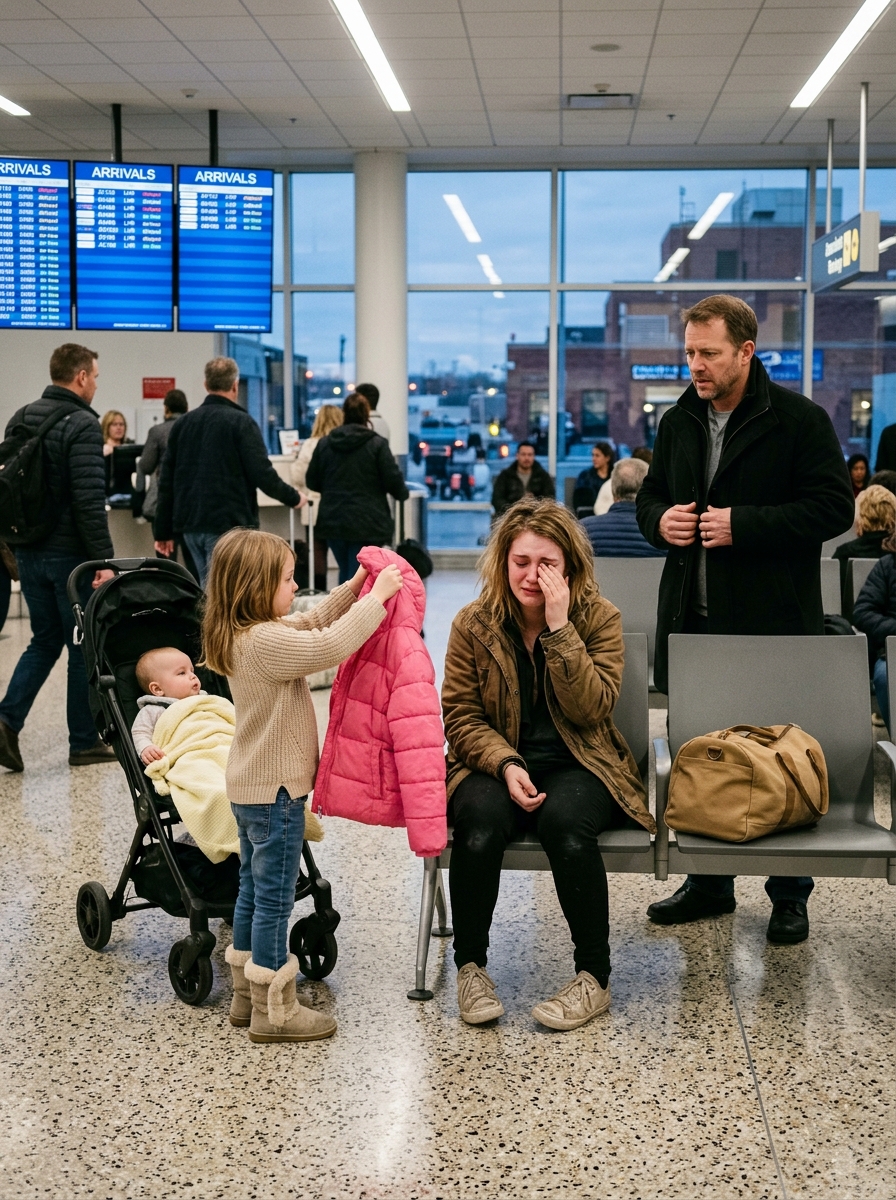
My daughter Lucy was already pulling her bright pink coat off before I understood what she was doing.
“Lucy, what are you doing?”
She didn’t answer me.
She walked straight toward a young woman sitting alone on a bench near the bus schedule board.
The woman looked about twenty-six.
She wore thin jeans, an old sweatshirt, and socks inside worn canvas shoes. A small duffel bag sat between her feet.
In her arms was a baby wrapped in a light yellow blanket.
Lucy stopped in front of her.
“This is for your baby.”
The woman stared at my daughter.
Lucy held out the coat.
“For her,” Lucy repeated. “She can have it.”
“Sweetheart,” I said, catching up, “you need your coat.”
“I have a sweater.”
“That is not the point.”
Lucy looked at me the way only a seven-year-old can look at an adult who is clearly missing something obvious.
“Dad,” she whispered. “The baby doesn’t have one.”
I looked at the woman again.
She lowered her eyes.
“I’m sorry,” she said quickly. “We’re fine. She doesn’t need to give us anything.”
Her voice told me the exact opposite.
It was a Sunday evening in December in Grand Rapids, Michigan.
Lucy and I had just finished pizza downtown, one of our little father-daughter traditions. I worked long hours running the contracting business my father had started, and I tried to protect Sunday nights whenever I could.
The downtown station was a shortcut to the parking garage.
We normally walked through without stopping.
That night, Lucy stopped for both of us.
I glanced at the electronic schedule.
“What bus are you waiting for?”
The woman hesitated.
“The eastbound.”
I looked again.
“That one isn’t coming for almost three hours.”
Her face changed.
Just for a second.
It was tiny, but I saw it.
The kind of expression people make when the last little plan holding them together suddenly disappears.
She tightened her arms around the baby.
“We’ll figure something out.”
Lucy was still holding out the coat.
The woman looked at it.
Then at Lucy.
Then at me.
“I really can’t take your little girl’s coat.”
Lucy stepped closer.
“You’re not taking it from me. I’m giving it.”
I almost smiled.
That was Lucy.
Once she decided something was fair, good luck arguing with her.
I took off my own heavy coat.
“All right,” I said.
The woman immediately shook her head.
“No.”
“Yes.”
“No, sir. Please.”
“My car is five minutes away. I have a suit jacket underneath this. Take it.”
“I can’t.”
“You can give it back later.”
She looked at me suspiciously.
That was understandable.
I was a forty-three-year-old stranger in a business suit telling a young woman with a baby to accept my coat.
So I stepped back.
“You don’t have to go anywhere with us,” I said. “You don’t owe us anything. But sitting here for three hours dressed like that isn’t a good plan.”
Lucy carefully laid her pink coat across the baby’s blanket.
The woman’s eyes filled.
She didn’t cry.
She just stared at that ridiculous bright coat with its silver zipper and tiny embroidered flowers.
“What’s her name?” Lucy asked.
“Sophie.”
“How old?”
“Four months.”
Lucy smiled.
“I’m Lucy. I’m seven.”
The woman finally gave a tiny smile back.
“I’m Claire.”
“My dad is Daniel.”
“I figured he was probably your dad.”
“He makes really good hot chocolate.”
I closed my eyes.
“Lucy.”
“What?”
Claire laughed.
It was barely a laugh.
But it was the first sound from her that didn’t seem guarded.
Lucy pointed toward me.
“He puts too many marshmallows in it.”
“There is no such thing as too many marshmallows,” I said.
Claire looked down at Sophie.
For a few seconds, nobody spoke.
Then I noticed the duffel bag.
One small bag.
One baby.
No stroller.
No suitcase.
No diaper bag that I could see.
Nothing about the situation made sense.
“Claire,” I said quietly, “have you eaten?”
She stiffened.
“I’m okay.”
“That wasn’t what I asked.”
She looked at me.
I could see the pride rising like a wall.
I knew that wall.
I had built my own version of it after my marriage ended three years earlier.
I changed my approach.
“Lucy and I were about to stop at an all-night diner before heading home.”
“We were?” Lucy asked.
“We are now.”
“Oh.”
I looked back at Claire.
“Come have something warm to eat. Public place. Bright lights. Plenty of people. After that, if you still want to wait for your bus, I’ll bring you back.”
“I don’t have money.”
“I didn’t ask you for any.”
Her mouth tightened.
“I don’t want charity.”
“Neither do I.”
That caught her attention.
“I’m hungry,” Lucy announced.
“You just ate three slices of pizza.”
“I could eat fries.”
I gave her a look.
She grinned.
Claire looked at Lucy, then at Sophie.
“I don’t know.”
“You don’t have to know anything tonight except whether you want dinner.”
Lucy leaned toward her.
“The diner has pancakes all day.”
I sighed.
“You are really selling this.”
Claire looked down at the pink coat wrapped around Sophie.
Then she nodded.
“Just dinner.”
“Just dinner.”
That was how it started.
Not with a grand plan.
Not with some big speech about changing a life.
A seven-year-old gave away a pink coat.
And the rest of us followed her.
At the diner, Claire chose the cheapest thing on the menu.
A bowl of soup.
When the waitress walked away, Lucy whispered loudly, “Dad, she needs grilled cheese too.”
Claire heard her.
“I’m fine.”
“You like grilled cheese?” Lucy asked.
“Who doesn’t?”
“Dad, see?”
I ordered two sandwiches for the table.
Claire ate slowly at first.
Tiny bites.
Polite bites.
Then she stopped pretending she wasn’t hungry.
I kept my eyes on my coffee so she wouldn’t feel watched.
Lucy talked enough for all three of us.
She told Claire about second grade, her teacher, the class hamster, a girl named Avery who always borrowed pencils and never returned them, and the birthday party she was planning even though her birthday was four months away.
Claire listened.
Really listened.
That surprised me.
People sometimes tune children out.
Claire didn’t.
She asked questions.
She remembered details.
She smiled when Lucy described her failed attempt to make pancakes without waking me one Saturday.
“You cracked the eggs on the floor?” Claire asked.
“Only one.”
“Three,” I said.
Lucy frowned at me.
“Two and a half.”
Claire laughed again.
This time it sounded real.
Sophie slept through most of dinner.
When she woke, Claire shifted immediately.
Everything else disappeared from her face.
The tension.
The embarrassment.
The suspicion.
All that remained was her baby.
Watching her, I realized something.
Whatever had happened, Claire loved that child with every piece of herself.
After dinner I paid the check.
Claire reached into her duffel bag.
“What are you doing?”
“I have eleven dollars.”
“Put it away.”
“At least let me pay for the soup.”
“No.”
Her cheeks flushed.
“Daniel.”
“Claire.”
“I told you I don’t want a handout.”
“And I told you dinner is dinner.”
“You don’t know me.”
“No.”
“You don’t know if I’m telling the truth about anything.”
“No.”
“You have your daughter with you.”
“Yes.”
That stopped both of us.
She lowered her voice.
“You shouldn’t trust people automatically.”
“I don’t.”
“Then why are you doing this?”
I thought about the question.
There was no clever answer.
“Because Lucy noticed you.”
Lucy was busy drawing circles on a paper placemat.
Claire looked at her.
“And because,” I continued, “someone once helped me when I was too proud to admit I needed it.”
Claire didn’t ask who.
Not yet.
I checked the bus schedule on my phone.
The delay had grown longer.
Claire saw my expression.
“What?”
“That bus isn’t going anywhere tonight.”
Her shoulders dropped.
I hated that look.
The look of someone who had planned their whole future around one bus.
“Where were you headed?”
“Kalamazoo.”
“Family?”
“My cousin.”
“Does she know you’re coming?”
Claire hesitated.
“She knows I’ve been trying to get there.”
“Can you call her?”
“My phone died yesterday.”
“I have a charger in the car.”
“It won’t matter.”
“Why?”
She looked at Sophie.
“I don’t know the number.”
“You don’t have it memorized?”
“It was in my phone.”
“All right.”
I waited.
Claire said nothing.
Lucy leaned against my arm, getting sleepy.
I could have driven Claire back to the station.
I could have wished her luck.
I could have told myself I had done enough.
A coat.
A meal.
A phone charger.
That would have been a perfectly decent thing to do.
But something bothered me.
Maybe it was the baby.
Maybe it was the tiny duffel bag.
Maybe it was the way Claire kept saying she was fine while everything about her said she had run out of options.
“My house has a guest room,” I said.
Claire’s head snapped up.
“No.”
“Okay.”
“I mean it.”
“I heard you.”
“You don’t even know me.”
“That part has been established.”
“I am not staying at a stranger’s house.”
“Fair.”
She stared at me.
I sipped my coffee.
Lucy looked between us.
“Daddy?”
“Yes?”
“Could Claire use Grandma’s room?”
“My mother does not live with us.”
“The room she uses when she visits.”
“That is the guest room.”
“Oh.”
Claire almost smiled.
I leaned forward.
“I’m not asking you to move in. I’m offering you one night in a locked guest room in a family house where my daughter will probably wake you at six-thirty asking if Sophie likes waffles.”
“Six-fifteen,” Lucy corrected.
“Please don’t.”
Claire looked down at Sophie again.
“You’d really let us stay one night?”
“Yes.”
“Why?”
“Because the bus isn’t coming.”
“That’s not the real reason.”
I glanced at Lucy.
She had put her head down on the table.
My little girl had changed the direction of the evening and was now falling asleep next to a ketchup bottle.
“The real reason,” I said, “is that I know what it feels like when your whole life suddenly stops looking like the life you planned.”
Claire studied me for a long time.
Then she nodded.
“One night.”
“One night.”
On the drive home, Lucy sat beside Claire in the back seat.
She had suddenly found another burst of energy.
“Do you like dogs?”
“Yes.”
“We don’t have one.”
“Then why did you ask?”
“I’m trying to figure out things you like.”
Claire laughed.
“I like books.”
“We have lots of those.”
“I like coffee.”
“My dad drinks too much.”
“That sounds serious.”
“He gets cranky if he doesn’t have it.”
“I do not get cranky.”
“You told the toaster it had one job.”
Claire covered her mouth to hide a laugh.
“That toaster knew what it did.”
By the time we pulled into my driveway, the tension inside the car had changed.
It wasn’t gone.
But it had loosened.
My house was simple.
Three bedrooms.
A back porch.
A kitchen my father had helped me remodel.
A living room that always looked slightly unfinished because Lucy left books and art supplies everywhere.
I had money.
More than many people.
But I had never been interested in living like I needed the world to know it.
My father had drilled one line into me growing up.
“If your house gets bigger than your life, Daniel, you’re doing something wrong.”
Claire stood inside the entryway.
She looked around.
Then she looked back at the front door.
I could tell she was calculating how quickly she could leave if she needed to.
“The guest room is upstairs,” I said. “Bathroom across the hall. You can lock the bedroom door from the inside.”
She nodded.
“I’ll find you towels.”
“I don’t need anything.”
“You have a four-month-old baby. I remember that age. Everybody needs something.”
Lucy yawned.
“I have baby blankets in the attic.”
“You were a baby seven years ago,” I said.
“They’re probably still good.”
She had a point.
I found a box with some of Lucy’s old things.
Blankets.
A clean bottle warmer.
A small portable bassinet I had never gotten rid of.
I didn’t know why I had kept any of it.
For years, I had told myself I just hadn’t cleaned the attic properly.
That was not true.
Some things are hard to throw away because they belong to a version of your life you thought would last forever.
My marriage had ended when Lucy was four.
There had been no giant scandal.
No dramatic scene.
No villain.
Rachel and I had simply reached a point where she wanted a life that did not look like the one we had built.
She accepted a job several states away.
We tried for a while.
Then we stopped pretending.
She still called Lucy.
She visited when she could.
But the ordinary days belonged to me.
School mornings.
Dentist appointments.
Lost library books.
Parent meetings.
Hair detangling.
Birthday cupcakes.
I had learned to do all of it while running a business.
Mostly, I had learned because other people helped me.
My father came back to work three days a week after he had already started easing toward retirement.
My neighbor Mrs. Nolan brought dinner every Wednesday for four months.
Lucy’s kindergarten teacher stayed late twice when a job site meeting ran over.
My sister drove two hours one weekend just to help me organize the house.
Nobody fixed my life.
They simply stood close enough that I could fix it myself.
I thought about that as I carried the old bassinet downstairs.
Claire stared at it.
“You kept that?”
“Apparently.”
“It looks brand new.”
“Lucy hated sleeping in it.”
“I preferred Dad’s chest,” Lucy said proudly.
“You preferred not sleeping.”
“Same thing.”
Claire touched the edge of the bassinet.
Her expression changed.
Not sadness exactly.
Something deeper.
“You okay?” I asked.
“Yes.”
“Claire.”
She sighed.
“I had one like this.”
“Had?”
She nodded.
“I left it behind.”
I didn’t ask where.
Not yet.
She looked exhausted.
I made tea while she changed Sophie.
Lucy insisted on making Claire a welcome card even though she could barely keep her eyes open.
WELCOME CLAIRE AND SOFY, she wrote in purple marker.
Sophie’s name was misspelled.
There were eleven hearts.
Claire looked at it for a long time.
Then she folded it carefully and put it in her duffel bag.
“You don’t have to keep that,” I said.
“Yes,” she replied. “I do.”
After Lucy went to bed, I expected Claire to disappear into the guest room.
Instead she came back downstairs.
Sophie was sleeping in her arms.
I poured another cup of tea.
Claire sat across from me at the kitchen table.
“You want to tell me what happened?”
She stared into the mug.
“You always ask direct questions?”
“My employees would say yes.”
“I’m not your employee.”
“I know.”
She looked up.
For the first time that night, I saw a flash of humor.
“Good.”
“You don’t have to tell me anything.”
Claire took a slow breath.
Then she said, “I was supposed to get married.”
I waited.
“His name was Mark.”
Past tense.
That told me enough to stay quiet.
“We met when I was twenty-two. I was taking classes at community college and working at a grocery store. He seemed steady. Responsible. He had plans.”
She looked at the baby.
“When I got pregnant, we talked about getting married sooner.”
“What changed?”
“Everything.”
There was no shouting in her voice.
That somehow made it heavier.
“He liked the idea of being responsible more than he liked actually sharing responsibility.”
Claire rubbed one thumb across the side of her mug.
“He wanted me to quit school because he said it made more sense for me to focus on the baby. I agreed. Then he wanted me to stop working early because childcare planning was complicated. I agreed to that too.”
She gave a small, embarrassed laugh.
“I agreed to a lot.”
“You trusted someone.”
“That’s the polite version.”
“It’s the accurate version.”
She looked at me.
“After Sophie was born, he started talking about how he felt trapped.”
I said nothing.
“He changed the plan every week. First we were getting married in the spring. Then maybe next year. Then he wanted separate bank accounts. Then he said the apartment was too expensive.”
Her jaw tightened.
“The apartment was in his name.”
I could see where this was going.
“One afternoon he told me he had decided not to renew it.”
“You didn’t know?”
“Not until he had already made the decision.”
“Where was he going?”
“Back to his parents for a while.”
“And you?”
“He said I should call friends.”
Claire stared at the table.
“He wasn’t cruel about it. That almost made it worse. He talked like he was canceling cable service.”
My hand tightened around my coffee cup.
I stayed quiet.
“He kept saying, ‘You’ll figure it out, Claire. You always figure things out.’”
She looked at Sophie.
“I had two hundred and forty dollars. No job. No apartment. A baby. And half my things were packed into boxes I couldn’t carry.”
“What about your family?”
“My parents moved overseas years ago after they retired. We haven’t been close.”
“No siblings?”
“Only child.”
“Friends?”
“A couple helped.”
She looked ashamed.
“I stayed with one friend for five nights. Then her landlord told her the apartment wasn’t set up for extra residents. Another friend had three kids of her own.”
“So you tried temporary housing.”
She nodded.
“For about three weeks.”
“What happened?”
“Nothing dramatic. My stay ended. They gave me information for other programs, but everywhere had paperwork, waitlists, different intake days.”
She gave me a tired smile.
“It turns out life can fall apart faster than forms can be processed.”
That sentence stayed with me.
She had a cousin named Jenna in Kalamazoo.
Jenna had once told her, years earlier, that she could always call.
Claire found an old social media message saying Jenna had moved back to Michigan.
She decided to try.
She had enough money for a bus ticket.
Then one transfer was canceled.
Her phone battery died.
And she found herself in Grand Rapids with one bag, a baby, eleven dollars, and no bus until morning.
“I wasn’t asking anyone for anything,” she said.
“I know.”
“I need you to understand that.”
“I do.”
“No, you don’t.”
She looked straight at me.
“I worked from the time I was sixteen. I paid my tuition until I couldn’t. I paid rent. I paid my own phone. I bought everything for Sophie that I could.”
Her voice shook.
“I don’t want my daughter growing up thinking her mother waited around for someone else to fix everything.”
I leaned back.
“Then don’t wait around.”
She frowned.
“What?”
“Don’t wait for somebody else to fix it.”
“That’s what I’m trying to do.”
“I know.”
“Then why are you looking at me like that?”
“Because accepting help and waiting to be rescued are not the same thing.”
She stared at me.
I continued.
“I know because I confused those things once too.”
That quieted her.
I told her about Rachel leaving.
About trying to run the business while becoming the parent responsible for every ordinary detail.
About sitting in my truck one afternoon outside Lucy’s preschool because I had forgotten pajama day.
Every other child had shown up wearing pajamas.
Lucy had been wearing jeans and a polo shirt.
She didn’t complain.
She just said, “It’s okay, Daddy. Maybe next year.”
I had gone back to my truck and cried harder over pajama day than I had over my divorce papers.
Claire smiled sadly.
“Pajama day got you?”
“Destroyed me.”
“Understandable.”
“I thought being strong meant never needing anyone.”
“What changed?”
“My father.”
I told her how Dad had shown up at my house the next morning at six with coffee.
He didn’t ask whether I needed help.
He put a legal pad on my kitchen table.
On one side he wrote WORK.
On the other he wrote LUCY.
Then he said, “You don’t have to prove you can drown in both.”
Claire laughed quietly.
“That sounds like something a dad would say.”
“That sounds exactly like my dad.”
“So what did you do?”
“I let people help.”
“Was that hard?”
“Awful.”
“Good.”
I laughed.
She smiled.
Then I leaned forward.
“So here’s what I’m offering.”
Her smile disappeared.
“Tomorrow morning, I’ll help you charge your phone. You can call your cousin. If she can take you, I’ll drive you to Kalamazoo myself.”
“You don’t have to—”
“Wait.”
She stopped.
“If she can’t, you and Sophie can stay here a few days while you figure out your next move.”
Claire shook her head immediately.
“No.”
“You didn’t let me finish.”
“I know where this goes.”
“Where?”
“You keep helping. I keep needing. Pretty soon I owe you something.”
“No.”
“That’s how it works.”
“That is not how this works in my house.”
She stared at me.
“You owe me exactly nothing.”
“Nobody does that.”
“People did it for me.”
She looked toward the stairs where Lucy was sleeping.
“I can’t stay here indefinitely.”
“I didn’t say indefinitely.”
“How long?”
“A few days.”
“How many is a few?”
“You really need a contract?”
“I like clear expectations.”
“So do I.”
We agreed on five days.
Not forever.
Not rescue.
Five days to charge a phone, contact Jenna, make calls, and decide what came next.
Claire went upstairs.
I stayed at the kitchen table for another hour.
I kept thinking about what I had done.
A practical part of me was nervous.
I had invited someone I had known for a few hours into my home.
Another part of me kept seeing Lucy offering that pink coat.
Children have a strange way of removing all the complicated excuses adults build.
Lucy had seen two facts.
There was a baby.
The baby needed a coat.
Everything after that was just adult paperwork.
The next morning I woke to the smell of coffee.
Claire was in my kitchen.
“You found the coffee maker.”
“I told you I like coffee.”
“You make it stronger than I do.”
“You told a toaster it had one job. I didn’t want to disappoint you.”
Lucy came downstairs in pajamas.
She saw Claire.
Her whole face lit up.
“You stayed!”
Claire smiled.
“I stayed.”
“And Sophie?”
“Still sleeping.”
“Does she like waffles?”
“We’re about to find out.”
That first morning set the tone for the next week.
Claire refused to sit still.
She washed dishes before I could stop her.
She folded towels.
She made her own calls.
She borrowed my laptop and wrote down every phone number, office hour, appointment date, and contact name in a small spiral notebook.
By noon, she had reached Jenna.
That call did not go the way she hoped.
Jenna cared about her.
But Jenna was living in a one-bedroom apartment with her fiancé and his teenage daughter.
She couldn’t offer Claire a room.
She could offer encouragement.
A little help with transportation later.
A promise to stay in contact.
Claire came downstairs after the call and sat at the kitchen table.
“So Kalamazoo is out.”
“For now.”
She nodded.
“What next?”
I expected tears.
Instead she opened the notebook.
That was Claire.
Feelings came later.
First came lists.
Over the next few days, she connected with a local family resource office.
A childcare coordinator explained what options might become available.
An employment counselor helped her update a résumé.
Nothing magical happened.
No one handed her an apartment.
No one handed her a career.
There was no movie-style moment where a stranger made one phone call and fixed everything.
It was forms.
Appointments.
Waiting.
Voicemail.
Another form.
Another appointment.
Another phone call.
Real life is less dramatic than people think.
It is also harder.
On the fourth day, Claire walked into my home office holding three sheets of paper.
“I have an interview.”
I looked up.
“For what?”
“Receptionist. Small medical office on the west side.”
“When?”
“Tomorrow.”
“You sound terrified.”
“I am terrified.”
“Good.”
Her eyebrows rose.
“Why does everyone keep saying that to me?”
“Because terrified people can still show up.”
“I don’t have interview clothes.”
I thought about that.
Then I remembered a box in the hall closet.
My sister had left some clothes at my house months earlier after helping Lucy with a school event.
I called her.
Twenty minutes later she was laughing so hard I had to hold the phone away from my ear.
“You invited a stranger and her baby into your house?”
“For five days.”
“How very Daniel of you.”
“What does that mean?”
“You spend forty-three years acting practical and then suddenly do something that makes no practical sense.”
“Can Claire borrow the navy blazer or not?”
“Yes.”
“Thank you.”
“And Daniel?”
“What?”
“Ask before you give away my shoes.”
I looked toward the doorway.
Claire was listening.
“I was absolutely going to give away your shoes.”
“I knew it.”
She wore the navy blazer to the interview.
She came home two hours later.
Lucy and I were eating cereal at the kitchen counter even though it was almost dinner.
Claire walked in.
She put down her bag.
She looked at me.
Then she started laughing.
“What?” I asked.
“I got it.”
Lucy jumped off the stool.
“You got a job?”
“I got a job.”
Lucy screamed.
Claire laughed harder.
I stood up.
“Well?”
“What?”
“Are we celebrating or not?”
“You don’t have to make a big deal.”
“Lucy, get your shoes.”
“Where are we going?”
“The diner.”
“For pancakes?”
“For victory pancakes.”
Claire put both hands over her face.
“This family is ridiculous.”
“You’re only figuring that out now?”
The job didn’t solve everything.
It created new problems.
She needed childcare.
She needed transportation.
She needed an address for some paperwork.
She needed money before she could save money.
She needed time.
Her five days became eight.
Then ten.
On the tenth night, she came to me.
“This was supposed to be temporary.”
“It still is.”
“I’ve been here almost two weeks.”
“Yes.”
“I need to leave.”
“Where are you going?”
She didn’t answer.
“Claire.”
“I’ll figure it out.”
“There’s that phrase again.”
“What phrase?”
“I’ll figure it out.”
“I will.”
“I know. But you don’t get extra points for making it harder.”
She looked angry.
Not at me.
At herself.
“I feel like I’m taking advantage of you.”
“You work every weekday. You spend your lunch breaks making calls. You help Lucy with homework. You make dinner twice a week even though I never asked you to. You are not exactly lying on the couch demanding grapes.”
“That is not the point.”
“Then what is?”
She looked around my kitchen.
“This feels normal.”
I didn’t understand.
“That’s bad?”
“For me, yes.”
“Why?”
“Because I’m going to get used to it.”
There it was.
Not pride.
Fear.
“You’re afraid to get comfortable.”
“I’m afraid Sophie will.”
“She’s four months old.”
“You know what I mean.”
I did.
Claire had lost one version of stability already.
She didn’t want to build another one on something that belonged to somebody else.
So we made a new plan.
My father owned a small duplex on the other side of town.
One unit had been empty for months after the previous renter relocated for work.
It was basic.
One bedroom.
Tiny kitchen.
Old cabinets.
But it was clean and quiet.
I called Dad.
He listened to the whole story.
Then he said, “What does she want?”
Not what does she need.
What does she want.
That was my father.
“She wants to pay rent.”
“Then charge her rent.”
“She can’t afford market rent yet.”
“Then charge what she can afford.”
“That simple?”
“Most things are simple until people make them about pride.”
“Whose pride?”
“Yes.”
I smiled.
Claire moved into the duplex three weeks later.
We agreed on a modest rent.
She insisted on paying every month.
I insisted on treating her like any other tenant.
She signed papers.
She got a key.
She stood in the living room holding Sophie and looked around.
“This is mine?”
“For as long as you rent it.”
“I have never been this excited about ugly carpet.”
“The carpet has character.”
“The carpet has witnessed things.”
“Do not insult my father’s carpet.”
“It is green.”
“It was a different time.”
Lucy ran into the bedroom.
“Claire! You can fit a crib in here!”
Claire looked at me.
Her eyes were wet.
“I don’t know how to thank you.”
“Pay your rent.”
“I’m serious.”
“So am I.”
“No speeches?”
“No speeches.”
She looked down at the keys.
Then she said quietly, “I’ll pay this forward.”
That was the only promise I asked her to make.
Life became ordinary after that.
Beautifully ordinary.
Claire worked.
Lucy went to school.
Sophie learned to sit up.
Then crawl.
Then walk.
Sunday dinner became a habit.
Every Sunday at five-thirty, Claire and Sophie came over.
Sometimes Claire cooked.
Sometimes I did.
Sometimes we ordered pizza and pretended that counted as cooking.
Lucy became fascinated with Sophie.
She taught her colors.
Animal sounds.
The names of every Disney princess even though I had specifically requested educational priorities.
Claire taught Lucy how to braid hair.
I had spent years producing what I called “functional ponytails.”
Claire took one look at my work and said, “Daniel, this is not a hairstyle. This is a cry for help.”
“I use a brush.”
“That makes it worse.”
Lucy laughed so hard she fell sideways on the couch.
For her eighth birthday, Claire gave Lucy a small kit filled with hair clips, ties, and ribbons.
At the bottom was a folded piece of pink fabric.
I recognized it immediately.
The old coat.
Lucy held it up.
“You kept this?”
“Of course I kept it.”
“It’s too small for me.”
“It’s too small for Sophie too.”
“Then why?”
Claire looked at her.
“Because that coat was the first thing anyone gave Sophie when I was scared I couldn’t give her enough.”
Lucy became very quiet.
Then she hugged Claire.
I looked away.
There are moments a father knows belong to someone else.
That was theirs.
Claire kept growing.
Slowly.
Steadily.
After eighteen months at the medical office, she was promoted.
She had a talent for keeping calm when five things went wrong at once.
Her supervisor encouraged her to go back to school.
Claire resisted for six months.
Then one Sunday she dropped a community college brochure on my kitchen table.
“I’m thinking about it.”
“About what?”
“You know what.”
“I want to hear you say it.”
She glared at me.
“I’m thinking about finishing school.”
“Good.”
“Don’t get excited.”
“Too late.”
“I can only take one class.”
“One is more than zero.”
“It could take years.”
“Years are going to pass anyway.”
She hated when I said things like that.
Mostly because she knew my father had said them to me first.
She started with one evening class.
Then another.
She discovered that she loved healthcare work.
Not the drama people imagine.
The practical parts.
Explaining paperwork.
Helping nervous families understand where to go.
Remembering people’s names.
Making complicated places feel less confusing.
Eventually, she decided she wanted to earn a nursing degree.
“I’m thirty,” she told me.
“So?”
“I’ll be in classes with people ten years younger.”
“So?”
“I have a child.”
“Yes. I’ve met her.”
“Daniel.”
“Claire.”
She rolled her eyes.
“I hate talking to you.”
“No, you don’t.”
“No. I really do.”
She enrolled.
The years moved.
Lucy turned ten.
Sophie turned three.
My father finally stopped pretending he was retired and actually retired.
At least on paper.
He still appeared at the office two or three times a week.
He usually claimed he was “just passing by.”
Nobody accidentally passes through a construction office at seven-thirty in the morning carrying six coffees.
Dad loved Claire.
Not in a dramatic way.
He simply treated her like she had always belonged in the strange extended family forming around us.
He taught Sophie to play checkers.
He fixed a loose cabinet at Claire’s duplex even though I had told him maintenance was my responsibility.
He once spent forty-five minutes explaining to Lucy why buying the cheapest tool twice costs more than buying a good tool once.
She was eleven.
She had asked him how to hang a picture frame.
Dad believed context mattered.
Five years after the bus station, my father called me into his office.
He had a large cardboard file box sitting on his desk.
I immediately disliked the box.
“What is that?”
“Paper.”
“I can see that.”
“I’m retiring.”
“You’ve been retiring for six years.”
“No. I mean it this time.”
I stared at him.
He looked different.
Not weak.
Not sick.
Just older.
I had been too busy to notice.
“You’re leaving the business completely?”
“Yes.”
“When?”
“End of the month.”
My stomach dropped.
“Dad.”
“I’ve made my decision.”
“You could have warned me.”
“I am warning you.”
“Four weeks is not a warning.”
“It is twenty business days.”
“Do not count business days at me right now.”
He smiled.
I did not.
The family business had been his life.
Then mine.
But some part of me had always believed he would be in the next office if everything went wrong.
Even when he worked only a few days a week.
Even when I made almost every major decision.
His presence mattered.
And suddenly he was removing it.
“What are you going to do?”
“Travel.”
“You hate flying.”
“Your mother does not.”
“That doesn’t answer the question.”
“We’re going to visit your aunt in Arizona. Spend time near your sister. Take a road trip.”
“You don’t take road trips.”
“I am discovering new hobbies.”
“You complained for twenty minutes when Mom made you drive to Traverse City.”
“That was traffic.”
I sat down.
“This isn’t funny.”
His smile disappeared.
“I know.”
“Why now?”
“Because if I don’t leave, you’ll always think you still need me here.”
I stared at him.
“That is ridiculous.”
“Is it?”
“Yes.”
He leaned back.
“You run the company.”
“We run it.”
“No.”
He shook his head.
“You run it. I drink coffee and complain about lumber orders.”
“You also know every client we’ve had for thirty years.”
“So do you.”
“You know every mistake I make before I make it.”
“That one is definitely not true.”
“Dad.”
“Daniel.”
His voice softened.
“I built this company because I wanted you to have choices. I did not build it so I could stand over your shoulder until I was ninety.”
I looked at the file box.
“What’s in there?”
“Everything I think you should keep.”
“What does that mean?”
“Old contracts. Pictures. First invoices. Notes from jobs. Letters.”
“Letters?”
“You’ll find them.”
“I don’t want a box of memories. I want you to keep coming to work.”
He smiled sadly.
“That is exactly why I need to stop.”
I left his office angry.
Not loudly angry.
Not dramatic.
The worse kind.
The quiet kind where every thought seems sharper than it should.
That evening, I picked up Lucy from a school event.
Claire was there with Sophie.
One look at me and she knew.
“What happened?”
“My dad is actually retiring.”
Claire blinked.
“I thought he was already retired.”
“So did civilization.”
She laughed.
I didn’t.
“Oh.”
“Yeah.”
“You want coffee?”
“No.”
“That bad?”
“Yes.”
We drove separately to my house.
The girls went upstairs.
Claire and I sat on the back porch.
“You’re scared,” she said.
“I’m annoyed.”
“You’re scared.”
“I have been running the company for years.”
“I know.”
“I don’t need him there.”
“I know.”
“So why does everyone keep acting like this is some emotional milestone?”
“Because it is.”
I looked at her.
She folded her arms.
“You told me once that accepting help wasn’t the same as waiting to be rescued.”
“Yes.”
“Maybe letting go of help isn’t the same as being abandoned.”
That landed harder than I wanted it to.
I stared out toward the backyard.
“You have been saving that sentence, haven’t you?”
“For years.”
“I regret teaching you anything.”
“You didn’t teach me that.”
“Who did?”
“Your father.”
Of course he did.
She smiled.
“Daniel, your dad isn’t leaving you. He’s trusting you.”
“I know.”
“No, you understand the sentence. That’s different.”
I looked at her.
“When did you get so irritating?”
“Probably around the time you fed me pancakes and gave me unsolicited wisdom.”
“I did not give you unsolicited wisdom.”
“You absolutely did.”
We sat quietly.
Then she said, “You’re not alone.”
That was the sentence.
The same one I had spent years trying to prove I didn’t need.
“You have Lucy.”
She counted on her fingers.
“You have your parents. Your sister. Your employees. Me. Sophie. Mrs. Nolan, who still brings you banana bread whenever she thinks you look tired.”
“She does that to everyone.”
“No, Daniel. She thinks you’re incapable of feeding yourself.”
“Fair.”
Claire nudged my shoulder.
“You don’t have to carry every new chapter like nobody else exists.”
I thought about the bus station.
I thought about the girl who had insisted she didn’t need help.
The girl now sitting beside me explaining that I did.
Life has a sense of humor.
Dad retired at the end of that month.
For real.
We held a dinner at our house.
Nothing fancy.
Family.
Employees.
People who had known him for decades.
He gave a short speech.
My father hated speeches.
He talked for exactly three minutes.
He thanked everyone.
He thanked my mother.
He thanked me.
Then he held up his coffee cup and said, “If this place fails without me, I would like everyone to remember I retired first.”
Everyone laughed.
I did too.
After the crowd left, Dad stayed behind.
He carried the file box from his office into my house.
“You’re really making me keep this?”
“Yes.”
“What if I throw it out?”
“You won’t.”
“How do you know?”
“Because you still have Lucy’s broken toy cash register in your basement.”
“That is different.”
“It has been broken for nine years.”
“She loved that thing.”
Dad smiled.
“Exactly.”
He tapped the box.
“Read the blue folder when you’re ready.”
“What’s in the blue folder?”
“You have a serious problem with waiting.”
“You raised me.”
“Good night, son.”
I did not read the blue folder that night.
Or the next.
The box sat in my home office for two weeks.
Then one Saturday morning, I started sorting through it.
Old invoices.
Job photos.
My grandfather standing beside Dad when the business was barely more than two men and a pickup truck.
A picture of me at sixteen wearing a hard hat too large for my head.
Letters from customers.
Thank-you cards.
Newspaper clippings.
Notes Dad had written to himself.
Then I found the blue folder.
Inside were several pages.
At the top was a letter addressed to me.
Daniel,
If you are reading this, then I have finally done what your mother has been telling me to do for years and left the office alone.
I laughed.
That sounded exactly like him.
I kept reading.
I started this business because I wanted to build something solid.
When I was younger, I thought solid meant lumber, concrete, contracts, and enough money to keep a roof over your family.
Those things matter.
But they are not the most solid things you can build.
I stopped smiling.
Dad had written the letter almost a year earlier.
He wrote about the company.
About my childhood.
About watching me become a father.
Then I reached Claire’s name.
I read the paragraph twice.
A few years ago, a young woman named Claire told me about the night you and Lucy found her at the bus station.
She said you changed her life.
I told her she was giving you too much credit.
You did not build her new life for her.
You opened a door.
She walked through it.
Never confuse those two things.
Respect people enough to let them own their own victories.
Then came another page.
I have watched Claire build a home, raise her daughter, work, study, and help other people.
I have watched Lucy grow up believing that family can be bigger than a last name.
I have watched Sophie grow up surrounded by people who chose to show up.
And I have watched you slowly become less interested in what the company owns and more interested in what kind of man you are when nobody is keeping score.
That matters to me more than any business ever could.
My throat tightened.
I continued.
You think my legacy is this company.
It is not.
A company can be sold.
A building can be replaced.
A contract gets filed away and forgotten.
Legacy is what keeps moving after you stop pushing it.
That night at the station, Lucy gave away a coat.
You gave away a few hours of your time.
Claire gave away her pride long enough to accept help.
Look what came from it.
A family.
A career.
Two girls who think of each other as sisters.
Sunday dinners.
A woman returning to school.
A child growing up safe in the knowledge that people will show up for her.
That is what multiplies.
I put the letter down.
For several minutes I couldn’t read.
I wasn’t crying dramatically.
I just sat there with tears running down my face, embarrassed even though nobody was in the room.
Then something fell out of the folder.
A photograph.
Dad had taken it at one of our Sunday dinners.
Lucy was twelve.
Sophie was five.
Claire was sitting on the kitchen counter laughing at something.
I was holding a tray of burned dinner rolls.
My mother was pointing at them.
Dad must have been behind the camera.
Nobody was posing.
Nobody even seemed aware he had taken it.
On the back, in his handwriting, were four words.
This is the real company.
I laughed and cried at the same time.
Then my phone rang.
Claire.
Of course.
“Hello?”
“You sound weird.”
“Good morning to you too.”
“You’ve been crying.”
“No.”
“You have.”
“How do you know?”
“Your voice gets lower when you’re trying to pretend you haven’t.”
“That seems invasive.”
“What happened?”
“I opened the blue folder.”
There was silence.
Then Claire said, “Oh.”
“You knew about it.”
“I knew he wrote you something.”
“What did you tell him?”
“When?”
“He said you told him about the bus station.”
“I did.”
“Why?”
“He asked why Sophie calls him Grandpa Howard.”
I smiled.
“That makes sense.”
“He said he wasn’t her grandfather.”
“I can imagine his face.”
“So I told him he didn’t get to decide that by himself.”
I laughed.
“You told my father that?”
“Yes.”
“You are brave.”
“I learned from Lucy.”
I looked at the photograph again.
“Come over.”
“Why?”
“I want to show you something.”
Twenty minutes later, Claire walked into my kitchen carrying a folder of her own.
“What’s that?”
She held it against her chest.
“You first.”
I showed her Dad’s letter.
Claire read it silently.
Halfway through, she covered her mouth.
When she reached the photograph, she laughed.
“He called us a company?”
“He had a strange sense of humor.”
“No.”
She touched the picture.
“He understood.”
“Understood what?”
“That you were never helping one person.”
I waited.
Claire placed her folder on the table.
“I was going to tell you tonight.”
“Tell me what?”
She pushed it toward me.
On top was a college letter.
I stared at it.
Then at her.
“Claire.”
“I got accepted into the nursing program.”
I stood up so fast my chair nearly tipped backward.
“You got in?”
“I got in.”
“You got in.”
“I just said that.”
“You got in!”
Lucy came running downstairs.
“What happened?”
“Claire got into nursing school.”
Lucy screamed.
From the living room, Sophie screamed too even though she had no idea what had happened.
Within seconds all four of us were laughing.
Claire looked at me.
“Your father’s letter is right.”
“About what?”
“This wasn’t one person helping another.”
She opened her folder again.
Inside were copies of letters, class schedules, old job evaluations, and photographs.
A paper trail of the life she had rebuilt.
At the bottom was Lucy’s old welcome card.
WELCOME CLAIRE AND SOFY.
Eleven purple hearts.
“You still have that?”
“I told you I was keeping it.”
She pulled out another piece of paper.
It was the diner receipt from that first night.
I stared at her.
“No.”
“Yes.”
“How?”
“You left it on the table. I took it.”
“You stole my receipt?”
“Borrowed permanently.”
“I think that is still stealing.”
“Then report me.”
I laughed.
She pointed to the total.
“You paid twenty-seven dollars and forty cents.”
“Apparently.”
“That was the first money anyone had spent on me in months without making me feel guilty about it.”
I looked at the receipt.
“I bought grilled cheese.”
“You bought time.”
That shut me up.
Claire touched the folder.
“I started keeping things after that night.”
“Why?”
“Because I was scared I’d forget.”
“Forget what?”
“How far I came.”
She spread the papers across the table.
The first job offer.
Her first lease.
A childcare acceptance letter.
Her first community college grade report.
A picture of Sophie’s first birthday cake.
Lucy’s coat, folded into a small square.
A note my father had once written Claire after she passed a difficult class.
KEEP GOING. YOU’RE CLOSER THAN YOU THINK.
There were years sitting on my kitchen table.
Not glamorous years.
Ordinary years.
That made them better.
“I thought you were going to show me some big secret,” I said.
“This is a big secret.”
“What?”
“People remember the terrible days.”
Claire looked down at the papers.
“They don’t always save proof of the days they kept going.”
I had no answer.
She smiled.
“So I saved proof.”
Claire started the nursing program that fall.
It was hard.
She never pretended otherwise.
There were mornings she dropped Sophie at school, went to work, attended class, came home, studied, and fell asleep with a textbook open beside her.
There were weeks when Sunday dinner became Sunday sandwiches because nobody had energy to cook.
There were times she wondered aloud whether she had taken on too much.
I never told her she had to continue.
That mattered.
I had learned my father’s lesson.
Opportunity was not ownership.
Her choices had to remain hers.
So when she said, “I don’t know if I can do this,” I stopped saying, “Of course you can.”
Instead I asked, “Do you still want to?”
The answer was always the same.
“Yes.”
“Then what do you need this week?”
Sometimes the answer was help picking up Sophie.
Sometimes it was quiet.
Sometimes coffee.
Sometimes absolutely nothing.
Over time, something else happened.
Claire started becoming the person other people called.
A coworker needed someone to watch her daughter for two hours.
Claire helped.
A classmate was struggling to understand an assignment.
Claire studied with her.
A neighbor had a new baby and felt overwhelmed.
Claire brought dinner.
An older woman at her apartment complex needed a ride to a community event.
Claire drove her.
I once teased her about it.
“You know you don’t have to personally return every favor anyone has ever done for you.”
“I’m not returning favors.”
“Looks suspiciously similar.”
“No.”
She smiled.
“I’m passing them.”
That was Claire.
She never forgot the difference.
By the tenth anniversary of that bus station night, Lucy was seventeen.
Sophie was ten.
I was fifty-three and had begun making noises when standing up from low chairs, which both girls found hilarious.
My father was happily retired and somehow busier than ever.
He and my mother had taken three road trips.
He now claimed he had always loved travel.
Nobody believed him.
Claire was weeks away from graduating.
We decided to have dinner at the same diner where we had eaten that first night.
The building had been renovated.
New booths.
New flooring.
Same counter.
Lucy slid into the booth.
“I don’t remember this place.”
“You were seven.”
“I remember the pink coat.”
Claire looked at her.
“So do I.”
Sophie had heard the story a hundred times.
She never got tired of it.
“Did Mom really only order soup?”
“Yes.”
“Did Uncle Daniel really order grilled cheese without asking?”
“Yes.”
“Did Mom get mad?”
“Yes.”
“I was not mad,” Claire said.
“You were furious,” I told her.
“I was proud.”
“Same face.”
Lucy laughed.
Sophie looked at me.
“And then she lived at your house?”
“For a little while.”
“And then Grandpa Howard rented her the duplex?”
“Yes.”
“And then you all became family?”
Claire looked at me.
“That part happened before the duplex.”
“When?”
Lucy answered.
“At the coat.”
Nobody said anything for a second.
Seventeen years old.
And still somehow able to see the simple answer before the adults.
Graduation came three weeks later.
The auditorium was packed.
My parents sat beside me.
Lucy sat on my other side.
Sophie was bouncing in her chair before the ceremony even started.
“Sit down,” Claire’s cousin Jenna whispered from the row behind us.
“I can’t.”
“You absolutely can.”
“My mom is graduating.”
“We know.”
“Do you think she can see us?”
“She can probably hear you from backstage.”
When Claire’s name was called, Sophie stood up.
So did Lucy.
Then my father.
Then my mother.
Then Jenna.
I had planned to behave with dignity.
That plan lasted about two seconds.
I stood too.
We clapped until our hands hurt.
Claire walked across the stage.
She looked out toward us.
For one second I saw the woman from the bus station again.
Not because Claire still looked afraid.
She didn’t.
I saw her because I suddenly understood the distance between those two moments.
One young mother sitting beside a bus schedule with one duffel bag.
One woman crossing a stage ten years later while half an auditorium listened to her family make far too much noise.
Afterward, we found her outside the auditorium.
Sophie reached her first.
“Mom!”
Claire bent down.
Sophie wrapped both arms around her.
“You did it!”
Claire laughed.
“We did it.”
I shook my head.
“No.”
She looked at me.
“Don’t.”
“You did it.”
“Daniel.”
“You did.”
I pointed toward the building.
“Every class. Every shift. Every late night. Every test. Every decision. That is yours.”
Her smile changed.
She knew what I was doing.
My father’s lesson.
Respect people enough to let them own their victories.
Claire nodded slowly.
“All right.”
She looked around at us.
“This part is mine.”
Then she pointed at the crowd.
“But I’m keeping all of you.”
“That seems fair,” I said.
Lucy hugged her.
“I’m writing my college essay about you.”
Claire groaned.
“Why?”
“Because I want to write about family.”
“Write about your dad.”
“He’s boring.”
“Thank you,” I said.
Lucy grinned.
“I’m writing about how everybody thinks family is something you’re born into.”
She looked at Claire.
“But sometimes you meet somebody because your dad took the wrong shortcut through a bus station.”
“I did not take the wrong shortcut.”
“You always say you hated walking through there.”
“That does not make it wrong.”
Claire laughed.
Lucy continued.
“Sometimes family is just the people who keep showing up.”
Sophie nodded.
“I’m putting that on Mom’s graduation cake.”
“No,” Claire said.
“Why?”
“Because the bakery would charge by the letter.”
My father smiled.
“Smart woman.”
That evening we had dinner at my house.
Too many people.
Too much food.
Exactly the way my father liked family gatherings.
After dessert, Dad tapped a spoon against his glass.
Everybody groaned.
“I thought you hated speeches,” I said.
“I am retired. I have new hobbies.”
“Apparently public speaking is one.”
He ignored me.
“I want to say something about Claire.”
Claire immediately shook her head.
“No.”
“Yes.”
“Howard.”
“You cannot stop an old man once he has a spoon.”
She covered her face.
Dad continued.
“Ten years ago, my granddaughter noticed somebody who needed a coat.”
Lucy raised her glass.
“Great coat.”
“It was very pink,” Dad agreed.
“Excellent coat.”
He looked around the table.
“I used to think generosity was about what you gave away.”
His eyes moved toward me.
“Money. Time. A place to stay. A meal.”
Then he looked at Claire.
“I was wrong.”
The room grew quiet.
“Generosity is also about what you allow another person to keep.”
He paused.
“Their dignity.”
Claire’s eyes filled.
“Their choices.”
Dad’s voice softened.
“Their ownership of what happens next.”
He raised his glass.
“So here’s to Claire.”
We raised ours.
“To every mile she walked after someone opened one door.”
Claire wiped her eyes.
“Howard, I spent ten years trying not to cry in front of this family.”
“You failed immediately.”
“Basically.”
We laughed.
Lucy raised her own glass.
“And to pink coats.”
“To pink coats,” Sophie said.
I looked around the table.
My daughter.
Claire.
Sophie.
My parents.
Jenna.
Friends.
People who had not all started as family but had somehow become it anyway.
That was when my father’s letter finally made complete sense.
Legacy was not the business.
It was not my house.
It was not the duplex.
It was not twenty-seven dollars and forty cents at a diner.
It was movement.
One person helping another stand long enough to help somebody else.
A teacher staying late for me.
My father returning to work when I was overwhelmed.
A neighbor bringing dinner.
Lucy handing away a coat.
Me buying soup.
Claire helping a classmate.
Claire bringing dinner to a new mother.
Sophie growing up watching all of it.
Nothing stopped with the person who received it.
That was the part I had never understood when I was younger.
Kindness moves.
Years later, Claire began working at a local hospital.
She never became one of those people who told everyone her life story.
Most coworkers never knew about the bus station.
Most never knew about the pink coat.
But she kept a copy of that first diner receipt inside her desk.
Twenty-seven dollars and forty cents.
One afternoon, she called me.
“I did something.”
“That sounds concerning.”
“It’s not.”
“What did you do?”
“A woman came in asking where the family services office was.”
“Okay.”
“She had her little boy with her.”
I waited.
“She was embarrassed.”
Claire went quiet.
“I knew that face.”
“What did you do?”
“I walked her downstairs.”
“That’s all?”
“I bought them lunch.”
I smiled.
“What did she say?”
“That she’d pay me back.”
“What did you tell her?”
There was a pause.
Then Claire laughed.
“I told her to pay it forward.”
Of course she did.
A few months later, Lucy left for college.
The night before she moved into her dorm, I found her sitting on the floor of her bedroom surrounded by boxes.
She was holding the pink coat.
I stopped in the doorway.
“You’re taking that?”
“No.”
“Then why is it out?”
“I found it in my closet.”
“I thought Claire had it.”
“She gave it back to me after graduation.”
Lucy turned it over in her hands.
It looked impossibly small.
“Dad?”
“Yeah?”
“Were you scared that night?”
“At the bus station?”
“Yes.”
I thought about it.
“A little.”
“Of Claire?”
“No.”
“Then what?”
“Of getting involved.”
Lucy nodded.
“That makes sense.”
“I remember thinking we had already done enough.”
“The coat?”
“The coat. Dinner.”
“But you kept going.”
“Because you did.”
She smiled.
“I was seven.”
“I know.”
“I didn’t know what I was doing.”
“That might have helped.”
She laughed.
Then she became serious.
“What if Claire hadn’t wanted help?”
“Then we would have respected that.”
“What if everything had gone wrong?”
“I don’t know.”
That was the truth.
Life does not give us guarantees before asking us what kind of people we want to be.
Lucy folded the coat.
“I think people make kindness sound easy.”
“They do.”
“It isn’t.”
“No.”
“Sometimes it’s awkward.”
“Very.”
“Sometimes people don’t trust you.”
“Correct.”
“Sometimes they’re angry.”
“Yes.”
“Sometimes you don’t know what to say.”
“Usually.”
She smiled.
“So why do it?”
I sat beside her.
“Because sometimes you don’t need the perfect thing to say.”
“What do you need?”
“To notice.”
She leaned her head on my shoulder.
“That sounds like something Grandpa would say.”
“It probably is.”
She packed the pink coat into a small box.
On top she wrote:
KEEP.
I didn’t ask what she planned to do with it.
Some things should remain exactly where the next generation decides to put them.
Claire still has her folder.
She adds to it every year.
Not just the big things.
Small things too.
Sophie’s report cards.
Pictures from Sunday dinners.
A handwritten thank-you note from a coworker.
A graduation announcement from someone she once helped study.
A Christmas card from a family she met through work.
My father’s note.
Lucy’s misspelled welcome card.
The diner receipt.
Years after graduation, she showed the folder to Sophie.
Sophie sat at our kitchen table going through every page.
When she finished, she looked at her mother.
“Were you ashamed of this?”
Claire thought for a moment.
“I used to be.”
“Why?”
“Because I thought needing help meant I had failed.”
Sophie frowned.
“But you didn’t fail.”
“I know that now.”
“What changed?”
Claire looked at me.
Then toward the old framed picture of Lucy in the pink coat.
“I learned that everyone needs help somewhere.”
Sophie looked down at the folder again.
“What if Lucy hadn’t seen you?”
The question silenced the room.
Claire answered carefully.
“I probably would have figured out something else.”
I loved her for saying that.
She never turned Lucy or me into heroes.
She owned her life.
“But,” Claire added, “I’m very glad I didn’t have to find out.”
Sophie nodded.
Then she pulled out Lucy’s welcome card.
WELCOME CLAIRE AND SOFY.
She smiled.
“You should frame this.”
“Absolutely not.”
“Why?”
“Because your name is spelled wrong.”
“That makes it better.”
Claire laughed.
Maybe Sophie was right.
The imperfect things often tell the story best.
A misspelled card.
An ugly green carpet.
Burned dinner rolls.
A twenty-seven-dollar diner receipt.
A pink coat that fit nobody anymore.
None of those things looked important by themselves.
Together, they were a life.
People sometimes ask me whether I believe one act of kindness can change everything.
I don’t know.
That sounds too simple.
Lucy’s coat did not get Claire a job.
It did not finish her classes.
It did not raise Sophie.
It did not sit through exams.
It did not wake up early.
It did not fill out applications.
It did not make hard decisions.
Claire did those things.
But maybe one small act can change the next hour.
And the next hour can change the next morning.
The next morning can give someone enough room to make one call.
One call can lead to an interview.
One interview can lead to a paycheck.
One paycheck can help someone sign a lease.
One stable room can become a home.
One class can become a degree.
One person who was helped can become someone who helps others.
That is not magic.
It is simply what can happen when people stop trying to be heroes and start trying to be useful.
My father understood that before I did.
Lucy understood it before any of us.
She was seven.
She saw a baby.
She had a coat.
So she gave it away.
Everything else came later.
Now, whenever our family gets together, somebody eventually brings up that night.
Usually Sophie.
She loves the part about the pancakes.
Lucy loves reminding everyone that I originally said she could not give away her coat.
Claire loves reminding me that I ordered grilled cheese for her without permission.
My father loves taking credit for the ugly green carpet.
And I sit there listening to them argue.
Every time, I think the same thing.
I almost kept walking.
That part matters.
I was tired.
Lucy and I had already eaten.
I had work waiting at home.
The car was only a few minutes away.
I could have said, “Come on, sweetheart.”
I could have told myself someone else would help.
I could have explained that we didn’t know the woman.
I could have found a dozen reasonable excuses.
Instead, my daughter stopped.
And because she stopped, I looked.
Because I looked, I noticed.
Because I noticed, I asked one question.
Then another.
That was all.
Most turning points do not announce themselves.
They look ordinary.
A bus schedule.
A diner booth.
A spare bedroom.
A borrowed blazer.
A cheap apartment with terrible carpet.
A college brochure on a kitchen table.
A blue folder.
A pink coat.
Ten years after that Sunday night, Claire crossed a stage.
Years after that, she bought lunch for another worried mother.
Lucy went off to college wanting to write about chosen family.
Sophie grew up believing that needing people was not something to hide.
My father retired knowing the most important thing he built was never printed on an invoice.
And me?
I stopped thinking strength meant handling everything alone.
That may have been the gift I needed most.
The funny thing is, Claire still says I gave her hope.
I tell her she gave me something too.
She made my house bigger without adding a single room.
She gave Lucy a second adult who loved her enough to tell her when she was wrong.
She gave Sophie to all of us.
She gave my parents another granddaughter in every way that mattered.
She showed me that family can arrive through the front door carrying one duffel bag.
It can sit at your kitchen table refusing charity.
It can sign a lease.
It can come back every Sunday.
It can stand beside you when your father retires and you are far more frightened than you want to admit.
It can call you out when you confuse independence with loneliness.
It can save receipts.
It can keep old coats.
It can remember.
I still have Dad’s letter.
It stays in my desk now.
I read it whenever work becomes too important in my head.
Whenever I start measuring a good year only by contracts or revenue.
Whenever I forget what “building something” is supposed to mean.
There is one sentence I have underlined.
Legacy is what keeps moving after you stop pushing it.
I think about Lucy.
Then Claire.
Then Sophie.
Then the woman Claire walked downstairs with at the hospital.
Then the people that woman may help someday.
That is movement.
That is legacy.
Maybe the world changes less through giant gestures than we like to imagine.
Maybe most of it happens quietly.
Someone notices.
Someone stays.
Someone brings dinner.
Someone gives a ride.
Someone makes room at a table.
Someone says, “I know you can do this, but you don’t have to do every part alone.”
Then one day, years later, you look around and realize the stranger you once helped is standing beside you as family.
And the coat your daughter gave away became something none of you could have planned.
Not a rescue.
Not a debt.
Not a favor waiting to be returned.
A beginning.
Sometimes that is all one person can give another.
A beginning.
And sometimes, if you are very lucky, that beginning keeps moving long after the night you almost walked past it.