
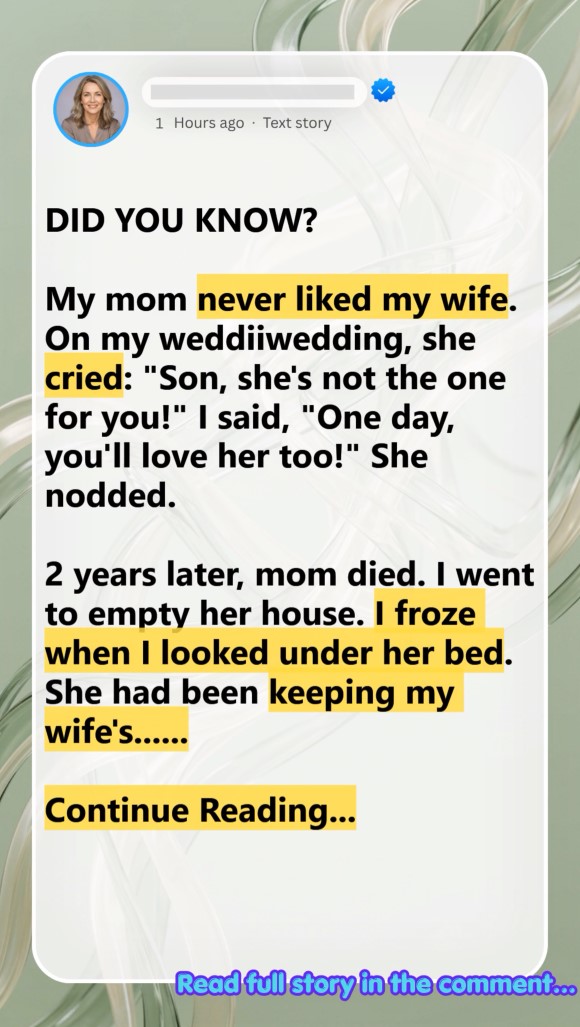
The heavy scent of gardenias from the wedding floral arrangements still hung in the air when my mother, Margaret Cole, cornered me in the small vestry behind the altar of St. Paul’s Episcopal Church.
I was thirty-two years old, a high school history teacher and historical archivist in Richmond, Virginia, and that afternoon I was marrying Vanessa Vance. Vanessa was thirty, an executive recruiter for medical device firms, radiant, poised, and universally adored by our social circle. She was the kind of woman who commanded every room she entered—organized, articulate, and fiercely driven.
My mother, a retired municipal reference librarian who had raised me alone after my father died in a plant explosion when I was eight, had never warmed to Vanessa. Throughout our fifteen-month engagement, Mom had watched our interactions with a quiet, watchful sadness that grated against my nerves.
Standing in the vestry in her navy lace dress, Mom’s fingers dug into the fabric of my tuxedo cuffs. Her knuckles were bone-white, and her eyes were brimming with raw, unvarnished fear.
“Nathan, look at me,” Mom pleaded, her voice trembling in a desperate, hushed whisper. “I am begging you not to sign that registry today. Vanessa is hiding who she truly is. You are building your future on a foundation of silence and deceit, and when it cracks, it will destroy your gentle heart.”
A wave of defensive heat flushed my neck. For over a year, I had interpreted Mom’s reservations as the classic overprotectiveness of a widowed mother who couldn’t bear to let her only son go. Vanessa had always treated Mom with flawless, polished etiquette, even buying her expensive silk scarves that Mom politely tucked away in drawers.
“Mom, stop it,” I said, peeling her fingers off my jacket with deliberate, icy firmness. “Vanessa loves me. She has worked for everything she has, and she’s trying her best to be patient with you. You’ve lived alone for so long that you look for shadows where there’s only sunshine. One day, you will love her as much as I do.”
Mom stepped back as though I had struck her across the face.
The frantic desperation in her posture drained away, replaced by an expression of profound, weary resignation. She bowed her head, whispered, “God protect you, my son,” and walked out of the vestry to take her seat in the family pew.
Over the next two years, the reconciliation I envisioned never happened.
Mom never grew to love Vanessa. If anything, the gulf between them deepened into a permanent, frozen boundary. Mom declined our invitations to spend Thanksgiving at our suburban home in Henrico. When Vanessa coordinated a surprise sixtieth birthday dinner at a fine dining restaurant downtown, Mom stayed for barely forty-five minutes, claiming a migraine, before taking a cab back to her small brick bungalow on Grove Avenue.
Whenever I vented my frustration, Vanessa would gently place her hand over mine with saintly, long-suffering grace.
“Nathan, it’s not your fault,” Vanessa would murmur softly across our granite kitchen island. “Your mother is of a different generation. She spent thirty years being the only woman who mattered in your life, and she resents that you chose a modern career woman. Don’t let her bitterness poison our peace.”
I allowed myself to believe my wife. Gradually, I reduced my weekly visits to Mom’s house to brief, Sunday-afternoon phone calls, keeping our conversations confined to school curricula and weather reports. I told myself that once Vanessa and I had a baby of our own, the arrival of a grandchild would finally melt the stubborn ice around Margaret’s heart.
That opportunity never arrived.
Six weeks ago, Mom suffered a massive cerebral hemorrhage while tending the hydrangeas in her front yard. A neighbor found her unconscious on the grass, and by the time I rushed to the neuro-trauma unit at VCU Medical Center, she was gone.
The funeral was dignified and quiet, attended mostly by retired city workers, library patrons, and church choir members. Vanessa stood faithfully at my side in an immaculate black wool coat, holding an umbrella over my head against the autumn drizzle, speaking with warm empathy to the mourners. Yet beneath my tears, an agonizing guilt gnawed at my chest. I had let two years slip away in cold, defensive silence over an argument about pride.
Last Saturday morning, I unlocked Mom’s Grove Avenue bungalow to begin the heartbreaking task of inventorying her estate.
The house was frozen in amber. The air carried the familiar scent of Earl Grey tea, dried lavender, and cedar floor wax. On the sideboard sat framed photographs of my childhood: my first baseball uniform, my college graduation, my father holding me on his shoulders at Virginia Beach.
There was not a single photograph of my wedding.
I entered her bedroom to pack her linens and clothing into cardboard donation boxes. After stripping the mattress, I knelt on the pine floorboards to retrieve a pair of fallen slippers from beneath the bed.
While reaching under the low skirt of the antique cherry frame, my forearm knocked against something heavy and solid pushed against the rear baseboard.
I lay flat on the floor, stretched my arm into the dark recess, and pulled out an old navy-blue canvas-and-leather suitcase with brass hardware.
The exterior was caked in a fine film of dust, but the latches were well-oiled. Taped across the handle was a manila shipping tag, bearing my mother’s unmistakable, precise calligraphic handwriting:
*For Nathan. When the silence can no longer hurt you.*
The brass latches popped with a dull, hollow metallic click.
I sat back against the side of Mom’s bare mattress, lifting the heavy canvas lid in the pale morning light filtering through the window.
Inside lay no old tax forms, no family heirlooms, and no grandmotherly knickknacks.
The suitcase was neatly organized into three separate compartments.
On the left side rested a thick stack of colorful construction paper drawings made with wax crayons. Every single drawing depicted a little girl with curly dark hair standing beside an older woman with silver glasses, framed by smiling yellow suns and crooked stick-figure trees. Written across the top of each page in shaky, phonetic child’s lettering were the words: *I love you, Grandma Maggie.*
My throat closed up. My mother had no grandchildren. I was her only child, and Vanessa and I had not yet conceived.
I reached into the center compartment and pulled out a heavy accordion folder stamped with confidential medical stamps from *Carilion Roanoke Memorial Hospital*.
I opened the folder, and the world seemed to tilt beneath my knees.
The top document was an official Commonwealth of Virginia Certificate of Live Birth, dated June 14, 2019.
– **Child’s Name:** *Chloe Rebecca Vance*
– **Mother’s Name:** *Vanessa Lynn Vance*
– **Father:** *Undeclared / Withheld*
Beneath the birth certificate was a series of emergency room discharge summaries, pediatric pulmonology reports, and pharmacy invoices detailing specialized treatment for severe pediatric bronchial asthma.
Every single medical invoice—dating from October 2024 to September 2026—was accompanied by a carbon-copy bank draft slip drawn directly from Margaret Cole’s personal savings account at the Richmond Teachers Credit Union.
The monthly transfers averaged seven hundred and fifty dollars each.
Stapled to the medical records was a signed, certified legal letter dated three weeks before my wedding day in 2024, bearing the letterhead of a family law firm in Roanoke.
It was addressed to my mother:
*“Dear Mrs. Cole:*
*We represent Ms. Vanessa Vance. Pursuant to your recent inquiry regarding the minor child, Chloe Vance, currently under the informal kinship care of Ms. Martha Vance in Roanoke, our client reiterates her position. Should you disclose the existence of this child or the circumstances of the kinship arrangement to Mr. Nathan Cole, our client will immediately exercise her lawful parental rights to revoke all visitation, remove the child to an out-of-state boarding placement, and initiate civil action for tortious interference. Your financial assistance regarding the child’s pulmonary treatments is accepted strictly under the non-disclosure covenant executed below.”*
The paper trembled so violently in my hands that the staples tore through the margin.
I turned to the final compartment of the suitcase.
Tucked inside was a leather-bound travel journal filled with Mom’s handwriting.
I flipped to the first entry, dated November 2024—barely a month after my wedding:
*“Took the 6:00 AM Amtrak to Roanoke today. Little Chloe had another severe asthma flare-up last Tuesday, and Martha’s social security check couldn’t cover the pediatric nebulizer medication. Chloe has Vanessa’s high cheekbones and her father’s gentle eyes—whoever he was. When I walked into the kitchen, she ran to me with her arms wide, calling me Grandma Maggie.*
*Nathan called me tonight, angry that I didn’t answer the house phone during the day. He thinks I am avoiding his wife out of spite. He told me I was stubborn and cold.*
*I swallowed my tears and apologized to my boy. I cannot tell him the truth. If I speak, Vanessa will take Chloe away from Martha and hide her in an institution to protect her career, and Nathan’s marriage will explode before it has a chance to breathe. I will carry the weight of his anger if it keeps this innocent baby safe and breathing.”*
The journal continued for twenty consecutive months.
Every single month, while I was visiting high school archives, grading papers, or attending corporate dinner parties where Vanessa charmed regional vice presidents, my sixty-four-year-old mother was boarding early-morning regional trains to Roanoke.
She was buying groceries for an ailing, elderly great-aunt named Martha. She was sitting in hospital waiting rooms holding a sick child’s hand. She was paying for inhalers and nebulizers with her modest teacher’s pension, quietly sacrificing her savings, her health, and her son’s respect to ensure that the granddaughter my wife had discarded wouldn’t suffer.
And I had stood in the vestry of St. Paul’s and told her that her heart was full of shadows.
A ragged, suffocating sob broke from my chest. I buried my face in the stack of crayon drawings, the scent of lavender and child’s wax filling my senses, weeping with an agony so visceral that my chest felt cracked wide open.
I knelt on the floor of my late mother’s bedroom for nearly an hour, the cold autumn wind rattling the window sash, until the agonizing shame hardened into a clean, surgical fury.
I carefully packed the birth certificate, the Carilion hospital records, the legal non-disclosure letter, the travel journal, and the child’s drawings back into the navy-blue suitcase.
I locked Mom’s bungalow, placed the suitcase on the passenger seat of my sedan, and drove directly to the corporate office park in Innsbrook where Vanessa’s executive search firm was headquartered.
It was 1:30 PM on a Tuesday.
The reception lobby was gleaming with polished granite, glass partitions, and minimalist white leather furniture.
Vanessa’s personal assistant looked up from her computer terminal, offering a polite, practiced smile. “Nathan! Vanessa is in the middle of a senior partner briefing in Conference Room A, but she should be wrapping up in ten minutes. Can I get you some water?”
“I don’t need water,” I said, my voice dead, flat, and hollow. “Tell her that her husband is here, and that we need to speak privately in her office right now.”
Something in the rigid stillness of my posture made the assistant’s smile fade. She nodded quickly, picked up her desk phone, and dialed an internal extension.
Two minutes later, Vanessa walked into the executive suite.
She looked stunning—wearing an impeccably tailored charcoal pantsuit, diamond stud earrings, her dark hair swept into an elegant twist, holding a leather portfolio. Her face bore that signature, confident warmth that had completely captivated me three years ago.
“Nathan, sweetheart, what’s wrong?” Vanessa asked, stepping forward to press a kiss to my cheek. “Sarah said you looked upset. Did something happen with the probate court over Margaret’s house?”
I stepped back, deliberately avoiding her touch.
“Inside your office, Vanessa. Close the door.”
Vanessa’s eyebrows furrowed in momentary irritation, but she followed me into her spacious corner office, quietly latching the heavy frosted-glass door behind her.
I walked over to her polished mahogany desk, picked up the navy-blue suitcase, and set it down in the center of her glass blotter.
I flipped open the brass latches and pulled out the Roanoke hospital birth certificate, sliding it across the wood until it rested against her leather portfolio.
Beside it, I laid the legal warning letter signed by her Roanoke attorney and three crayon drawings signed *Chloe*.
Vanessa glanced down at the papers.
The professional composure that defined her entire life vanished in a fraction of a second.
The color drained from her cheeks with terrifying speed, leaving her skin as pale as marble. Her breath caught in her throat in a sharp, choking gasp, and her fingers reflexively clenched into the hem of her jacket.
“Where… where did you get this?” Vanessa whispered, her voice dropping into a tight, brittle register that barely sounded human.
“From under my mother’s bed, Vanessa,” I answered, stepping toward the desk, my voice shaking with unyielding, righteous disgust. “The bed of the woman you called bitter, small-minded, and jealous.”
“Nathan, please… you don’t understand the circumstances—” Vanessa stammered, raising her trembling hands in defense.
“I understand every single line of it,” I interrupted, the words slicing through the air like cold glass. “You had a daughter when you were twenty-four. When you realized an asthmatic child didn’t fit into your five-year corporate trajectory, you dumped her on an eighty-year-old great-aunt in the mountains, paid her off with hush money, and erased her from your existence.”
“I was twenty-four and completely broke!” Vanessa hissed, tears finally welling in her eyes as panic took over. “Her father vanished before she was born! If the firm had known I was a single mother with an infant in county clinics, I never would have been hired for the executive track! I sent Martha money every quarter!”
“You sent her breadcrumbs!” I yelled, the anger tearing through my throat. “While my mother took the early train to Roanoke every single month for two years! Mom paid for Chloe’s nebulizers! Mom held her hand during oxygen treatments! And you—you threatened to banish that child to an out-of-state facility if Mom told me the truth!”
I pointed to the legal letter on her desk.
“You let me believe my own mother was a vindictive, hateful monster,” I choked out, tears of grief and fury burning my eyes. “You let me treat her like an embarrassment while she spent her dying days quietly cleaning up the blood on your hands! You made me a stranger to the woman who raised me, all so you could preserve this sterile, immaculate lie!”
Vanessa stepped around the desk, reaching out to touch my arm, her face twisting into frantic, desperate pleading. “Nathan, I love you! Everything I did was to build our future! We can adopt her legally now! We have the money! We can bring Chloe here and raise her together—”
“Don’t you dare speak her name in this room,” I said, jerking my arm out of her reach with visceral revulsion. “You don’t want a daughter, Vanessa. You want an accessory when it’s convenient, and a disposable secret when it isn’t.”
I pulled my wedding band from my left ring finger and dropped it onto the glass blotter beside her legal threats.
“The marriage is over,” I told her, looking into the hollow, terrified face of the woman I had thought was my partner. “My attorney will contact you tomorrow morning. And if you attempt to touch that child or interfere with Martha, I will deliver these medical abandonment records to the state licensing board and your managing partners before the close of business.”
I turned my back on Vanessa Vance, took my mother’s suitcase, and walked out of the office into the gray autumn afternoon.
The legal severance from Vanessa was rapid, absolute, and unforgiving.
Represented by my mother’s longtime estate attorney, I filed for an immediate fault-based divorce in Henrico County Circuit Court, citing gross fraud and intentional misrepresentation. Faced with the mountain of documented hospital non-disclosure agreements, credit union records, and the threat of a public custody hearing that would annihilate her professional standing in the medical recruitment industry, Vanessa capitulated.
She signed over complete, unrestricted legal guardianship of Chloe to Aunt Martha and me, waived all claims to our shared marital residence, and agreed to fund a court-supervised educational and medical trust for the child.
Within forty-eight hours of confronting Vanessa, I drove west along Interstate 64 into the Blue Ridge Mountains, heading straight for the modest clapboard house on the outskirts of Roanoke.
When Aunt Martha opened the front door—a frail, seventy-nine-year-old woman leaning on a metal walker—she looked at my face, then at the navy-blue suitcase in my hand, and began to weep softly on the porch.
Sitting at the small kitchen table, coloring a picture of a bluebird, was seven-year-old Chloe.
She had Vanessa’s dark, wavy hair and wide almond eyes, but her expression carried none of her mother’s calculating sharpness. It was full of an innocent, curious light.
I knelt beside her chair on the linoleum floor.
I didn’t overwhelm her with sudden declarations of adulthood. I pulled the stack of crayon drawings from the suitcase, laying them gently on the table between us.
Chloe’s eyes widened in recognition. “Those are the pictures I made for Grandma Maggie.”
A lump formed in my throat, but for the first time in weeks, the tears that spilled down my cheeks were warm and clean.
“Yes, they are, Chloe,” I whispered, reaching out to gently touch her hand. “Grandma Maggie loved every single one of them. She was my mother… which makes me your Uncle Nathan. And I’m here to take care of you and Aunt Martha from now on.”
Chloe looked at me for a long moment, then reached out and wrapped her small, warm arms around my neck. In that quiet embrace, the hollow, suffocating wound inside my chest began to mend.
Three months later, after finalizing the sale of the Henrico house and completing the formal custody transition, Aunt Martha, Chloe, and I moved permanently into Mom’s brick bungalow on Grove Avenue in Richmond.
We renovated the upstairs sunroom into a bright, cheerful bedroom for Chloe, painting the walls in pale sky-blue and filling the shelves with books from Mom’s favorite library collections.
It is late spring now in Virginia.
The morning sun rises warm and golden over the front yard, illuminating the grand, blooming hydrangeas that Margaret planted with her own hands.
Chloe’s asthma has stabilized under the care of specialists at the children’s hospital, and her laughter rings out through the open windows as she chases fireflies across the lawn in the twilight.
On the mahogany mantelpiece in our living room sits an oak-framed portrait of my mother, smiling with that quiet, timeless grace that outlived all of Vanessa’s deceptions.
Beside it sits a fresh drawing Chloe finished yesterday afternoon: three figures holding hands beneath a radiant sun, labeled in purple crayon: *Our Family.*
On my wedding day, I had believed that love was loud, glamorous, and proven through beautiful words, grand ceremonies, and effortless appearances.
My mother taught me the deepest, most enduring truth of all: that real love is often completely invisible—it steps into the shadows to carry the heaviest burdens in silence, protects the innocent when the world looks away, and leaves behind an unbreakable light that will always guide the family safely home forever.