
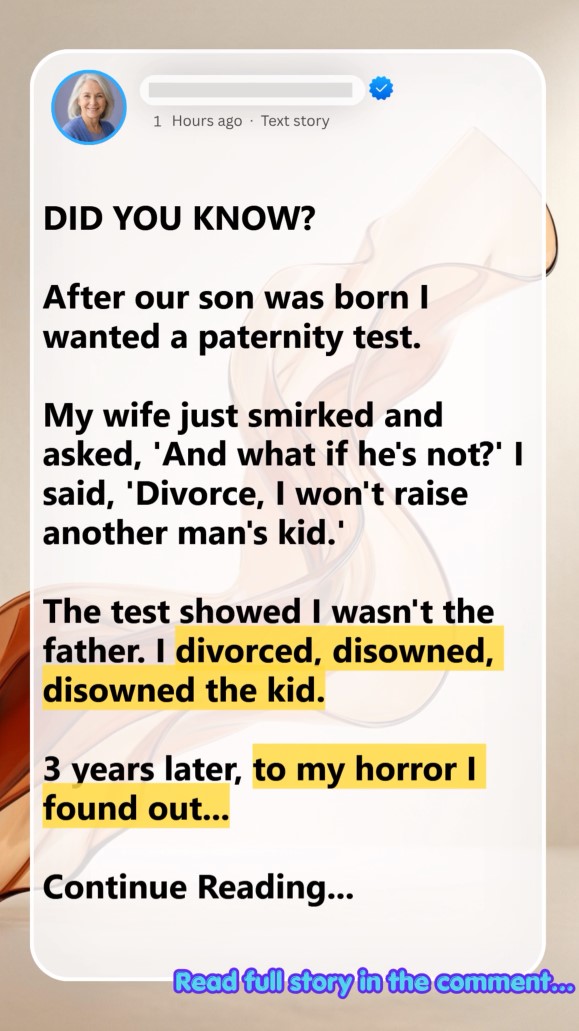
The afternoon my wife, Brenda, delivered our firstborn son at St. Luke’s Regional in Boise, an irrational wave of insecurity made me demand a legal DNA swab right in the recovery room. Instead of breaking down, Brenda merely smirked with icy detachment and asked, “And what if he’s not yours, Garrett?”
Enraged by her cold defiance, I snapped back: “Then we’re divorced. I won’t raise another man’s kid.”
Ten days later, the commercial lab envelope arrived. The paper declared a 0.0% probability of biological paternity. Blinded by fury and feeling utterly humiliated, I packed my things, filed for an immediate contested divorce, and walked away from the infant completely, ignoring Brenda’s silent tears as she signed the custody waiver.
For three years, I lived in bitter exile, convincing myself I had narrowly escaped being played for a fool.
Yesterday morning, my phone rang with an urgent call from the chief of pediatric genetics at the University of Washington Medical Center.
“Mr. Vance,” the doctor said, her voice heavy with clinical gravity. “Your ex-wife brought your three-year-old son in for emergency bone marrow donor screening forty-eight hours ago. We pulled your hospital records, and you need to board the next flight to Seattle immediately.”PART 1
The sterile smell of rubbing alcohol and fresh lilacs filled Room 314 of St. Luke’s Regional Medical Center in Boise, Idaho, on the morning our son was born.
I was thirty years old, a junior partner at a regional civil surveying firm, married for four years to Brenda. She was twenty-eight, a quiet, fiercely independent landscape architect whose calm self-reliance had always both drawn me in and stirred a quiet, unspoken insecurity in my chest.
Our marriage had been strained during her final trimester. Long hours at my job and an ugly, lingering rumor whispered by an insecure former colleague about Brenda’s late-night site visits with a municipal contractor had planted a poisonous seed of doubt in my mind.
When the nurse placed the swaddled baby into my arms—a boy with dark hair and blue eyes that bore no immediate resemblance to my fair, sandy features—the poison boiled over.
“I want a certified swab,” I said, my voice shaking with tense, defensive anger as I laid the baby back into the acrylic bassinet. “Before we sign the birth certificate registry. I want an official chain-of-custody test.”
Brenda had been sitting up in the hospital bed, pale and physically drained from thirty hours of unmedicated labor.
She didn’t scream. She didn’t throw a water glass. She simply looked at me, a bitter, icy smirk curling the corner of her cracked lips—the look of a woman realizing that four years of devotion had been weighed on the scale of an ugly suspicion and found worthless.
“And what if he isn’t yours, Garrett?” Brenda whispered, her tone chillingly flat.
The question felt like an open slap. “Then we’re divorced,” I snapped back, leaning over the bed rail, my pride choking out every shred of decency. “I pack my bags, I file the paperwork, and I walk. I won’t spend my life raising another man’s kid.”
Brenda closed her eyes, turned her head toward the window, and gave a single, quiet nod. “Get your swab, Garrett.”
The mobile lab technician arrived three hours later, taking the buccal swabs under strict legal protocols.
Ten days later, the certified courier envelope landed on the kitchen island of our suburban home.
I tore the seal open with shaking fingers.
**PROBABILITY OF PATERNITY: 0.00%**
*The tested male is excluded as the biological father of the minor child.*
The blood rushed out of my face, replaced by a suffocating, blinding fury. All my insecurities, all the ugly rumors, suddenly felt like verified truth. I didn’t ask for a second test. I didn’t demand an explanation. I saw only the humiliation of being duped.
I packed three suitcases that very afternoon. When Brenda walked into the kitchen carrying the baby, her face hollow and sunken, I threw the papers onto the counter.
“Get an attorney,” I said, my voice dead and merciless. “I’m signing a full surrender of any presumed parental rights. Don’t call me, don’t ask for child support, and don’t ever use my name again.”
Brenda stood motionless, holding our ten-day-old child tight against her chest. A single tear slipped down her cheek, but she didn’t utter a single plea. She simply stepped aside, let me walk out the front door, and never contacted me again.
Over the next three years, I rebuilt my life around that bitter grievance.
I finalized the divorce through an out-of-court agreement, took a field promotion that moved me across Idaho and Montana, and buried myself in work. Whenever my mother or sister asked about the boy, I cut them off sharply: “She played me for a fool. That boy is another man’s problem.”
I wore that betrayal like armor, convincing myself that walking away had been an act of masculine self-respect.
Then came yesterday morning.
I was sitting in my pickup truck at a highway surveying site outside Twin Falls when my phone buzzed with an incoming call from an unfamiliar 206 area code.
I swiped the screen. “Garrett Vance.”
“Mr. Vance, this is Dr. Althea Chen, Director of Pediatric Hematology and Cellular Therapy at Seattle Children’s Hospital,” a steady, urgent voice came through the speaker. “We have an emergency clinical situation regarding a patient named Leo Vance.”
A wave of irritation tightened my throat. “Doctor, you have the wrong file. I’m legally divorced from his mother. I took a DNA test three years ago. I am not that child’s biological father.”
There was a heavy, deliberate pause on the other end of the line.
“Mr. Vance,” Dr. Chen said, her voice dropping into a tone of absolute clinical authority. “Three-year-old Leo was admitted to our intensive oncology unit forty-eight hours ago with high-risk acute myeloid leukemia. He needs a haploidentical bone marrow transplant to survive the week. His mother’s tissue typing just came back as a partial mismatch—but when our molecular genetics department reviewed your old institutional blood archives from your 2019 spinal surgery, they discovered something extraordinary. You need to get on an airplane to Seattle immediately.” PART 2
The flight from Boise to Seattle was two hours of pure, gut-wrenching silence.
I sat in row 14, staring blankly out the small oval window at the white expanse of cloud cover, my hands clenching and unclenching against the armrests. My mind kept violently replaying the look on Brenda’s face in that hospital room three years ago—that quiet, defiant smirk that I had interpreted as shameless guilt.
When I stepped through the sliding doors of the fourth-floor oncology wing at Seattle Children’s, the muted hum of heart monitors and soft-soled nursing clogs felt like a physical weight pressing against my chest.
A tall woman in a white laboratory coat with silver-streaked dark hair approached me at the nurses’ station.
“Garrett Vance?” she asked.
“Yes,” I rasped, my throat raw. “I’m Garrett.”
Dr. Althea Chen led me into a private consultation office, closing the heavy acoustic door behind us. She didn’t sit behind her desk; she stood beside a digital monitor displaying two complex chromosomal maps.
“I need you to listen to me very carefully, Mr. Vance,” Dr. Chen began, her sharp eyes studying my face with profound seriousness. “Three years ago, you used a standard commercial direct-to-consumer legal swab service to test for paternity. Correct?”
“Yes,” I replied, my voice trembling. “They took a buccal cheek swab from me and the baby at St. Luke’s. It said zero percent. It said I was completely excluded.”
“That commercial test evaluated twenty-four standard short tandem repeat markers derived from the epithelial cells inside your mouth,” Dr. Chen explained, pulling up a certified clinical dossier. “What that commercial laboratory didn’t know—and what you couldn’t have known—is that you are a tetragametic chimera.”
I blinked, the words sounding foreign and impossible. “A what?”
“When your mother conceived you thirty-three years ago, she released two separate fertilized eggs,” Dr. Chen explained patiently, gesturing to the chromosomal split on the screen. “In the earliest stages of embryonic development, those two distinct fraternal twin embryos fused together into a single organism. You grew up as one healthy man, but your body contains two entirely different cell lines with two distinct sets of DNA.”
The room seemed to drop ten degrees.
“The skin cells in your mouth, your saliva, and your hair carry one genetic profile—the profile that was tested three years ago,” Dr. Chen continued, her voice soft but completely unyielding. “However, when we ran an advanced cellular biopsy and deep sequencing on your preserved surgical bone marrow records from your 2019 lumbar repair, the lineage was entirely different. Your reproductive organs and your deep marrow belong to your fraternal twin cell line.”
Dr. Chen laid a certified hospital pathology report directly in front of me.
At the bottom of the page, highlighted in yellow, was a newly generated laboratory cross-match using my preserved marrow DNA against the child’s tissue profile:
**CONFIRMED BIOLOGICAL RELATIONSHIP: FATHER TO CHILD.**
**PROBABILITY: 99.99%.**
My vision blurred. The edges of the paper began to tremble violently under my fingers.
“Leo is your biological son, Garrett,” Dr. Chen whispered. “He was always your son. When your wife smirked at you that day, she wasn’t hiding a lover. She was daring you to trust her because she had never touched another man in her life. She was daring you to let love be stronger than your paranoia.”
The breath tore out of my lungs in a ragged, suffocating gasp.
Three years.
For three years, I had walked through the world telling myself I had been wronged. I had bragged to my buddies about walking away clean. I had allowed my own mother to believe Brenda was a liar. I had left a woman alone to raise a child on a single income, without a dime of child support, without a father, all because of an arrogant, fragile ego and an incomplete commercial swab.
“Where is he?” I choked out, tears burning like battery acid against my cheeks. “Where is Brenda?” PART 3
Dr. Chen guided me down the dimly lit hallway of the pediatric intensive care unit, stopping before Room 412.
Through the large glass observation window, the scene inside broke whatever remained of my heart.
Sitting in a vinyl hospital recliner was Brenda. She had aged ten years in three. Her dark hair was pulled into a messy knot, her skin pale, with hollow purple shadows carved beneath her eyes. Her slender frame was swallowed by an oversized cardigan, and she was gently rubbing the back of a small, frail boy resting on the elevated hospital bed.
The boy—my son, Leo—had a smooth, bald head from introductory chemotherapy rounds. Transparent intravenous lines snaked into a central port in his small chest. Despite the pallor of his skin and the medical tape across his nose, I saw it now with agonizing, unmistakable clarity.
He had my grandmother’s wide forehead. He had the distinct, elongated curve of my own fingers as his tiny hand rested against the white bedsheet.
Brenda looked up.
Through the glass, our eyes locked.
The breath caught in her throat. The exhaustion on her face hardened instantly into a look of raw, visceral shock, followed by a wall of cold, guarded fury. She set Leo’s hand down carefully, stood up, smoothed her sweater, and walked out into the corridor, pulling the door shut behind her.
“What are you doing here, Garrett?” Brenda asked, her voice cracking with a brittle, defensive edge that barely masked her terror. “Did you come here to tell the oncologists that this isn’t your problem? Because if you’re here to cause a scene, I will have security remove you from this floor.”
I couldn’t speak.
My knees simply buckled beneath me, and I dropped to the linoleum floor of the hallway, my head bowed against the cold hospital wall, sobbing so violently that my entire body shook.
“Brenda… I’m sorry…” I wept, the words fracturing into pieces. “Dr. Chen showed me the marrow sequencing… she explained the chimerism… God forgive me, Brenda, I didn’t know… I didn’t know…”
Brenda stood over me, her hands trembling as they clenched into tight fists at her sides.
“You didn’t know?” Brenda whispered, hot tears finally spilling over her lashes, her voice vibrating with three years of accumulated agony. “You think the test was what broke me, Garrett? The test was paper! What destroyed me was the fact that you looked into my eyes after I gave birth to your child and didn’t believe a single word I had ever said to you!”
She knelt down in front of me, forcing me to look at her tear-stained face.
“I worked eighty hours a week so you could make partner,” Brenda choked out, her fingernails biting into the palms of her hands. “I never looked at another man. When you demanded that swab, my soul died in that bed. I smirked because I thought, *if he needs a piece of plastic to tell him who I am, then our whole marriage was a lie.* I let you walk because I refused to beg a coward to love his own flesh and blood!”
“You’re right,” I wept, reaching out with shaking hands, not daring to touch her, keeping my palms flat against the tile. “You’re completely right. I was a coward. I was arrogant, I was blind, and I don’t deserve your forgiveness. I don’t deserve to ever hear him call me Dad.”
I lifted my head, wiping the tears from my eyes with the back of my sleeve.
“But Dr. Chen said my bone marrow is an identical haploidentical match,” I pleaded, looking directly into her eyes with an absolute, desperate clarity. “Don’t let my stupidity kill our boy, Brenda. Let them take whatever they need from me. Take my marrow, take my blood, take every piece of me that can save his life. You never have to see my face again after today, but please… let me save our son.” ENDING
The cellular harvest took place seventy-two hours later in Surgical Suite 6.
Because of the urgency of Leo’s failing counts, the medical team opted for a direct posterior iliac crest bone marrow harvest rather than peripheral stem cell collection. For four hours under general anesthesia, surgeons extracted nearly a liter of deep, healthy marrow from my pelvic bones.
The physical pain when I woke up in the recovery ward—a deep, burning ache through my lower back and hips—was nothing compared to the profound, overwhelming relief that washed over my spirit when Dr. Chen confirmed the marrow had been successfully processed and infused into Leo’s central line.
I stayed in Seattle for six weeks, renting a small motel room two blocks from the hospital.
I did not force myself into Brenda’s space. I did not make emotional demands or try to play the hero.
Every morning, I walked to the hospital cafeteria, bought groceries, paid the parking vouchers, and left fresh coffee and meals at the nurses’ station for Brenda without entering the room. When Leo’s white blood cell counts plummeted to zero during the critical engraftment phase, I sat on the wooden bench in the courtyard beneath the cold Seattle rain, praying for a child I had spent three years disowning.
On day twenty-one post-transplant, the miracle happened.
Leo’s new bone marrow began producing healthy white blood cells. The engraftment was complete, with zero signs of graft-versus-host disease.
The afternoon before Leo was discharged to outpatient isolation, Brenda walked out of the PICU and found me sitting in the family waiting lounge.
She was holding Leo in her arms, bundled in a warm fleece coat with a small knit cap pulled over his bare head.
“Garrett,” Brenda said softly.
I stood up, leaning slightly on the cane I still used from the harvest procedure, my heart pounding in my ears.
Brenda stepped forward and sat on the sofa, gently turning Leo toward me.
The boy looked at me with wide, curious hazel eyes—eyes that held no memory of my abandonment, only the gentle, innocent wonder of a child who had survived the dark.
“Leo,” Brenda whispered softly, stroking his cheek. “This is Garrett. He’s the man who gave you his bone marrow so you could come home.”
Tears welled in my eyes as I slowly knelt beside the couch. I extended a single, trembling finger.
Leo reached out his small, warm hand and wrapped his fingers tightly around mine, offering a faint, sleepy smile.
“Hi, Leo,” I choked out, a warm tear falling onto the fabric of his sleeve. “It’s so good to meet you, buddy.”
Reconciliation did not happen overnight. Forgiveness for three lost years cannot be bought with a surgical donation.
Brenda and I did not get back together. The legal divorce remained final, and the boundaries between us were built with careful, deliberate care.
However, on Monday morning, we stood together before a family court magistrate in Boise to formally vacate the surrender of my parental rights. My name was restored to Leo’s birth certificate, and I set up an irrevocable educational and medical trust, funding every dollar of his ongoing care while paying Brenda full, retroactive child support for the three years I had stolen from them.
It is late spring now in Idaho.
The snow has melted off the foothills, and the green valley pastures are dotted with wild yellow balsamroot.
Every Tuesday and Saturday afternoon, my truck pulls up to the curb of Brenda’s house. Leo runs down the walkway, his dark hair growing back in soft, thick curls, yelling, “Garrett! Look at my new truck!”
We spend our afternoons at the park, building wooden birdhouses in my workshop, or watching the ducks along the river.
On the mantle of my apartment sits a framed photograph: not of a wedding, but of Leo’s third birthday in the hospital garden, his small hand resting securely inside mine.
I spent three years believing that strength was found in walking away, protecting my pride, and demanding absolute proof before offering my heart.
My son taught me the deepest truth of all: that pride is a poison that blinds a man to his own blessings—and that real love does not demand certainty before it acts; it gives everything it has, steps into the fire without hesitation, and fights to heal the wounded until the family is finally brought safely home.