
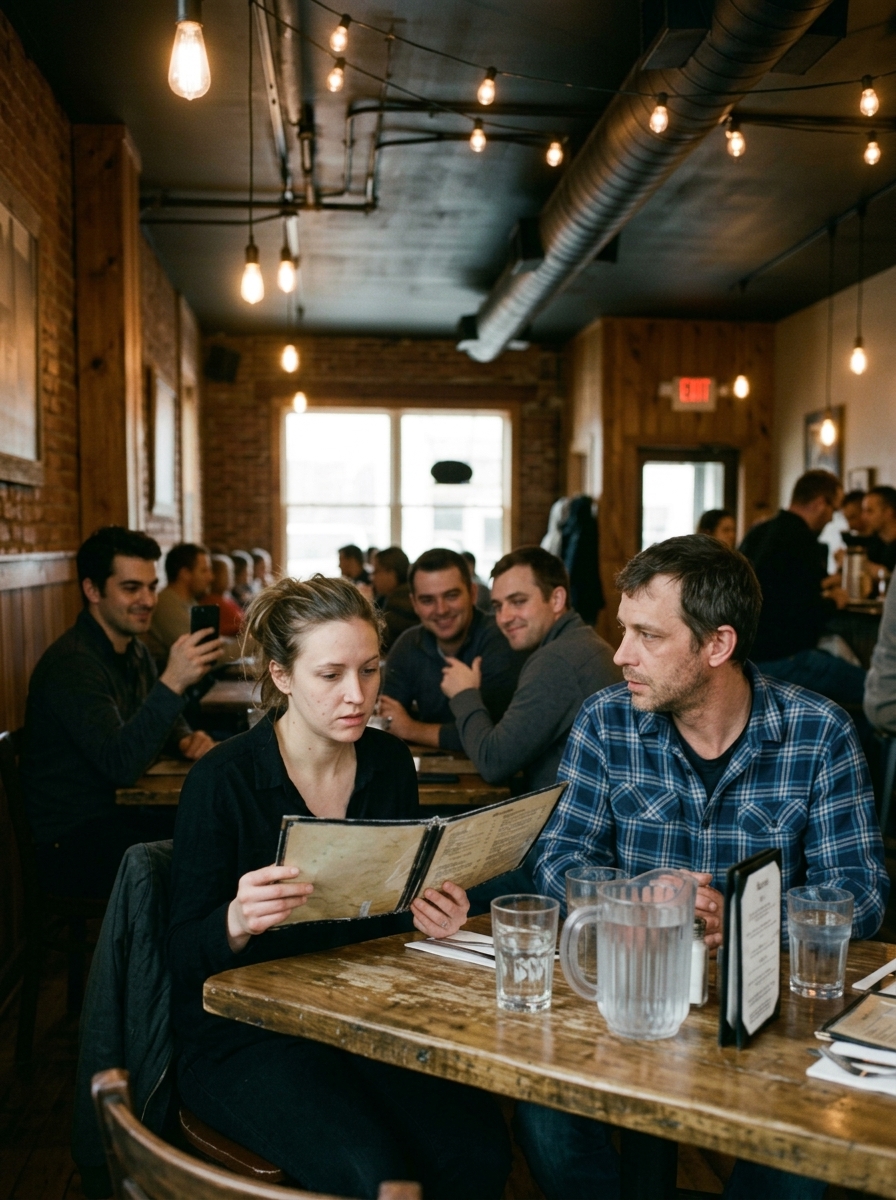
My Coworkers Set Me Up on a Blind Date as a Joke—But When I Realized the Woman Across From Me Was the Only Honest Person in the Room, I Refused to Play Along.
I knew something was wrong before our appetizers arrived.
The three guys from my office were sitting two tables behind Rachel, pretending not to look at us.
One of them had his phone in his hand.
Another kept glancing over with the kind of grin I had seen too many times at work.
Rachel noticed it too.
She lowered her eyes to the menu and rubbed her thumb along the edge of the paper.
“You know them?” she asked.
I wanted to lie.
I wanted to say no and save the evening.
Instead, I looked at her and said, “Yeah. I do.”
Her face changed.
Not much.
Just enough.
That was the moment I realized this dinner might not be what either of us had been told it was.
My name is Ethan Walker.
I was thirty-five then, living outside Fort Wayne, Indiana, with my seven-year-old daughter, Lily.
My life was not exciting.
I worked in the scheduling department of a regional supply warehouse during the week and picked up occasional weekend shifts at a small neighborhood hardware store.
I packed Lily’s lunches every morning.
I knew which library books were overdue.
I knew she hated the crust on grilled cheese sandwiches but loved the crust on cinnamon toast.
I knew Tuesday was spelling night and Thursday was the day she always forgot where she had put her purple water bottle.
That was my life.
And I liked it.
Three years earlier, Lily’s mother and I had ended our marriage.
There had been no dramatic scandal.
No terrible secret.
We were two people who had slowly realized we were better parents when we stopped trying to force ourselves to be a couple.
She moved several hours away for work, and because Lily’s school and friends were near me, our daughter spent most of the school year at my house.
It was not the future I had imagined.
But it was ours.
I learned to make peace with that.
What I had not learned was how to date again.
My coworkers found that hilarious.
Mark, Devin, and Paul were all around my age.
They were not terrible people.
That almost made what happened worse.
Terrible people are easy to understand.
Ordinary people can convince themselves that something careless is harmless simply because they never stop to imagine what it feels like on the other side.
The guys teased me because I always turned down invitations.
Friday drinks?
I had Lily.
A weekend trip?
Lily had a school project.
A party at somebody’s house?
I was usually tired enough by nine o’clock that my couch looked better than any party.
“You’re thirty-five, not seventy-five,” Mark told me one afternoon.
“I’m aware.”
“You ever planning to go on a date again?”
“Maybe.”
“That means no.”
“It means maybe.”
Devin leaned over the divider between our desks.
“What are you waiting for?”
I shrugged.
That answer seemed to bother them more than anything.
The truth was simple.
I wasn’t afraid of women.
I wasn’t secretly waiting for my old marriage to come back.
I wasn’t against meeting somebody.
I was just careful.
When you are responsible only for yourself, you can make mistakes and clean them up later.
When a seven-year-old watches how you treat people, your mistakes feel heavier.
Lily noticed everything.
She noticed when I was impatient with a cashier.
She noticed when I let somebody merge in traffic.
She noticed when I complained.
She noticed when I apologized.
I had started measuring my choices by one question.
Would I be comfortable if my daughter copied this?
It had changed me.
My coworkers called that boring.
Maybe it was.
Then one Wednesday afternoon, Mark rolled his chair beside mine and dropped a folded piece of paper on my keyboard.
“What’s this?”
“Friday night.”
I opened it.
There was a restaurant name, a time, and one first name.
Rachel.
I looked at him.
“No.”
“You haven’t even heard anything.”
“I heard enough.”
“Blind date.”
Subscribe to Tatticle!
Get updates on the latest posts and more from Tatticle straight to your inbox.
Website
Your Email…
Subscribe
We use your personal data for interest-based advertising, as outlined in our Privacy Notice.
“No.”
“Normal person.”
“No.”
“Friend of a friend.”
“Still no.”
Devin appeared behind him.
“She knows it’s a blind date.”
“That somehow makes this better?”
“Yes.”
Paul raised his hand from the next desk.
“I vote yes.”
“Nobody asked you.”
They laughed.
I pushed the paper back toward Mark.
He didn’t take it.
“Ethan, one dinner.”
“I have Lily.”
“Your sister watches her on Fridays sometimes.”
I stared at him.
He smiled.
“You told us that.”
“I’m starting to regret talking at work.”
“Just go.”
I shook my head.
Mark’s expression softened.
That should have been the moment I trusted him.
“I’m serious,” he said. “No pressure. She seems nice. You seem nice. Have dinner. If there’s nothing there, you both go home.”
I looked at the paper again.
Rachel.
Friday.
Seven o’clock.
I wish I could say I agreed because I felt a spark of adventure.
I didn’t.
I agreed because I was tired of hearing them ask.
“Fine.”
Mark slapped the desk once.
“One dinner.”
“One.”
“No fake emergency call after fifteen minutes.”
“I make no promises.”
They laughed again.
I folded the paper and put it in my pocket.
That evening, Lily was sitting at the kitchen table coloring a picture of a dog wearing what appeared to be a cowboy hat.
“I’m going out Friday,” I told her.
She kept coloring.
“Okay.”
“With a woman.”
The crayon stopped.
Her head came up slowly.
“A date?”
“I think so.”
She stared at me like I had announced I was moving to the moon.
“You?”
“Thank you for your confidence.”
“Do you know her?”
“No.”
“Does she know you?”
“No.”
Lily frowned.
“That sounds unsafe.”
I laughed.
“It’s dinner in a restaurant.”
“Still weird.”
“It is a little weird.”
She went back to coloring.
Ten seconds passed.
Then she looked up again.
“What are you wearing?”
“I hadn’t thought about it.”
Her face suggested this was unacceptable.
Friday afternoon, she stood in my bedroom doorway while I held up two shirts.
“Blue or white?”
“White.”
“Why?”
“You look less tired.”
I looked at myself in the mirror.
“That’s encouraging.”
“And wear the brown shoes.”
“The uncomfortable ones?”
“The nice ones.”
“You’re seven.”
“I have eyes.”
So I wore the white shirt.
I wore the brown shoes.
Before I left, Lily came running from the hallway carrying a tiny plastic bead from one of her craft kits.
It was bright yellow and shaped like a star.
“For luck.”
“I can’t take this.”
“Yes, you can.”
“What am I supposed to do with it?”
“Put it in your pocket.”
I did.
She nodded, satisfied.
Then she said something I remembered later.
“Just be nice if she’s nervous.”
“Why would she be nervous?”
“Because you’re strangers.”
Fair point.
I drove downtown alone.
The restaurant was nicer than I expected.
Not the kind of place where everybody wore suits, but nice enough that I checked my shirt in the reflection of the front window before going inside.
The hostess led me to a small table near the back.
Rachel had not arrived yet.
I sat down and immediately felt ridiculous.
I had not been on a real first date in more than a decade.
I forgot what people did with their hands.
I picked up the menu.
Put it down.
Checked the time.
Drank water.
Checked the time again.
Seven-oh-three.
Then I saw her.
Rachel was thirty-eight, though I didn’t know that yet.
She wore a dark green dress, simple earrings, and a denim jacket she removed as she approached the table.
She was a plus-size woman.
That fact would matter only because other people had spent years making sure she believed it mattered.
What I noticed first was not her size.
It was the way she paused before reaching the table.
She looked like someone gathering herself before stepping onto a stage.
“Ethan?”
I stood.
“Rachel?”
She smiled.
A quick, uncertain smile.
“That’s me.”
“I’m glad you came.”
The second I said it, something changed in her face.
Relief, maybe.
We sat.
For the first few minutes, neither of us did very well.
I asked if she had found the place easily.
She said yes.
She asked if I had been there before.
I said no.
We discussed parking for almost a full minute.
It was painful.
Then Rachel glanced past me.
Her shoulders stiffened.
Her eyes dropped.
That was when I turned.
Mark was two tables away.
Devin sat beside him.
Paul sat across from them.
All three suddenly found their menus fascinating.
I stared at them.
Mark looked up.
Our eyes met.
His mouth twitched.
Not a friendly smile.
The barely-contained grin of somebody waiting for the punch line.
I turned back.
Rachel was staring down at her menu.
Her fingers had tightened around it.
“You know them?” she asked.
“Yeah.”
She swallowed.
“Oh.”
One word.
But I heard the history behind it.
I didn’t understand the full story yet.
I understood enough.
“How do you know the person who arranged this?” I asked.
Rachel hesitated.
“A woman named Jenna. Her cousin works with you, I think.”
Mark.
“Did she tell you anything about me?”
“That you were a single dad. Quiet. Nice. A little rusty at dating.”
I almost laughed.
That part was painfully accurate.
Rachel tried to smile.
“She said you had been alone for a while and your friends thought you should meet someone.”
“That’s what they told me too.”
She nodded.
Neither of us spoke for a moment.
Behind her, Devin glanced our way.
Rachel saw my eyes move.
She gave a tiny sigh.
“I can leave.”
The words hit me harder than they should have.
“Why would you leave?”
She looked embarrassed that she had said it.
“I don’t know.”
“Rachel.”
“It’s fine.”
“No. It clearly isn’t.”
Her eyes stayed on the table.
“I’ve been the funny part of somebody else’s evening before.”
There was no anger in her voice.
That was what bothered me.
Anger would have been easier.
She sounded tired.
I leaned back.
“What do you mean?”
She shook her head.
“It doesn’t matter.”
“It matters if it’s happening now.”
Her eyes finally met mine.
“I’ve had people set me up because they wanted to see someone’s reaction.”
I felt the blood rush to my face.
She continued quickly.
“Not often. I don’t want to make this dramatic. It’s just… you learn certain expressions.”
I looked back at Mark.
He was whispering to Devin.
Paul had his phone on the table.
Screen up.
A message banner appeared.
I could not read all of it from where I sat.
I could read enough.
HOW LONG BEFORE HE BAILS?
My stomach dropped.
Rachel saw my face.
“That bad?”
I turned back to her.
“No.”
“Ethan.”
“No. Not you.”
I took a breath.
Then another.
“I think I’m starting to understand why they’re here.”
She went still.
I could have handled that moment badly.
I could have marched over there.
I could have raised my voice.
I could have made a scene big enough that everybody in the restaurant would remember it.
A younger version of me might have.
But Lily’s yellow plastic star was in my pocket.
I could feel it against my fingertips.
Just be nice if she’s nervous.
I looked at Rachel.
“I’m sorry.”
Her chin lifted slightly.
“You didn’t know?”
“No.”
She studied my face.
I let her.
“No,” I said again. “I didn’t.”
The server approached.
We both went quiet.
“Would you like another minute?”
Rachel opened her mouth.
I thought she was going to say she was leaving.
Instead, she looked at me.
I looked back.
Then she said, “I think we need another minute.”
The server nodded and stepped away.
I almost smiled.
“So do we leave?” I asked.
Rachel gave a small laugh.
“Together or separately?”
“That depends.”
“On what?”
“Are you hungry?”
That surprised her.
She actually laughed this time.
A real laugh.
“I skipped lunch.”
“That settles it.”
“You still want to eat?”
“I got dressed in uncomfortable shoes for this.”
She glanced under the table.
“Those are uncomfortable?”
“Terrible.”
“Then you deserve dinner.”
The tension loosened by one small degree.
I picked up the menu.
“Want to make them wait for their big moment?”
Rachel’s smile faded.
I immediately regretted saying it.
“I’m sorry. That sounded wrong.”
“No.”
She considered it.
Then something steadier appeared in her eyes.
“Actually, I’m tired of leaving.”
That sentence stayed with me.
She set the menu down.
“I always leave.”
I didn’t say anything.
“When I feel like somebody is judging me, I leave. When something feels awkward, I leave. When I think someone might reject me, sometimes I reject the whole situation first.”
She folded her hands.
“I’m not doing that tonight.”
I nodded slowly.
“Okay.”
“If you want to leave, you can.”
“I don’t.”
“Even now?”
“Especially now.”
She looked at me carefully.
“Why?”
“Because I think somebody made a decision for both of us before we sat down.”
Rachel’s eyes moved toward the table behind me.
“And I don’t like other people making my decisions.”
That earned another smile.
We ordered dinner.
At first, the conversation was still cautious.
Then I asked Rachel what she did for work.
She worked in the administrative office of a small adult education center.
Mostly scheduling classes, answering questions, fixing paperwork mistakes, and calming people who arrived convinced their entire future had been ruined because they filled out the wrong form.
“So basically,” she said, “I spend half my day telling adults that one incorrect box is not the end of civilization.”
“I do scheduling at a warehouse.”
Her eyes widened.
“So you also live inside spreadsheets?”
“Unfortunately.”
“Do you argue with them?”
“Daily.”
“I knew it.”
“You knew what?”
“You have spreadsheet energy.”
I stared at her.
“I have no idea whether that’s an insult.”
“It’s not.”
“It feels like one.”
“It means organized, dependable, slightly concerned.”
“That is absolutely an insult.”
She laughed again.
Behind her, Mark’s table had gone quiet.
I stopped checking.
That was the strange part.
Ten minutes earlier, I had been aware of every movement behind Rachel.
Now I was listening to her tell me about a student at her office who had taken three attempts to learn how to send an email attachment and then returned a week later to teach another student.
“He was so proud,” Rachel said.
“Sounds like he earned it.”
“He did.”
She smiled down at her water glass.
“I like watching people realize they can do something they thought they couldn’t.”
That told me more about her than any question about hobbies ever could.
So I asked another.
“What do you do when you’re not rescuing adults from paperwork?”
“Read.”
“What kind?”
“Mostly mysteries.”
“Serious ones?”
“Sometimes.”
“Any with cats solving crimes?”
“Those are serious.”
I nodded.
“My mistake.”
“And you?”
“Parenting.”
“That’s not a hobby.”
“It consumes hobby hours.”
“Fair.”
“I fix things around the house.”
“Because you enjoy it?”
“Sometimes.”
“And the rest?”
“Because houses apparently spend all night planning new ways to need money.”
Rachel laughed hard enough that she had to put down her fork.
I smiled.
Something in my chest loosened.
I had forgotten how simple it could be.
Not dating.
Talking.
Just talking to another adult who did not need me to sign a permission slip, answer a work email, or find a missing shoe.
Rachel asked about Lily.
I showed her one picture.
Not twenty.
I was proud of that restraint.
“She looks like trouble,” Rachel said.
“She is extremely organized trouble.”
“Big difference.”
“She runs my house.”
“I assumed that when you said she chose your shirt.”
“You can tell?”
“The shirt is nice.”
“That’s rude.”
“Why?”
“Because now she’s right.”
Rachel smiled.
Then she became quiet.
“Can I ask you something?”
“Sure.”
“Why haven’t you dated?”
There it was.
I looked down at the table.
“I tried twice after my marriage ended.”
“And?”
“The first time I wasn’t ready.”
She nodded.
“The second time?”
“She was nice.”
“That sounds promising.”
“She wanted a life I couldn’t give her.”
Rachel waited.
“She wanted spontaneous weekends. Travel. Late dinners. I had school pickup and a kid who woke up at six asking whether worms get lonely.”
Rachel laughed softly.
“So it ended.”
“Yeah.”
“Badly?”
“No. Just honestly.”
I paused.
“That was almost worse.”
She understood.
Sometimes there is no villain.
No one to blame.
Just two people standing in front of different doors.
Rachel traced the base of her glass.
“I’ve had those.”
“Different doors?”
“More like people who invited me into a room and then acted embarrassed that I took up space in it.”
I did not rush to answer.
I sensed she did not want comfort.
She wanted to be heard.
So I listened.
“My twenties were rough,” she said. “Not because I was miserable all the time. I had friends. Work. Family. I laughed a lot.”
She looked toward the window.
“But dating made me feel like I was constantly being graded.”
I kept my eyes on her.
“Too much of this. Not enough of that. Smile more. Dress different. Be confident, but not too confident. Be yourself, but only if yourself makes everyone comfortable.”
“That sounds exhausting.”
“It was.”
“What changed?”
“I got tired.”
I smiled.
She smiled too.
“No, really,” she said. “I got tired of treating every rejection like a jury verdict.”
She sat back.
“At some point I decided I would rather have a peaceful Saturday alone than spend Friday trying to convince somebody I deserved basic respect.”
“That seems reasonable.”
“It was.”
“Then why agree to tonight?”
She looked amused.
“My sister.”
“Ah.”
“She says I hide.”
“Do you?”
“Sometimes.”
“Me too.”
“So maybe our families are conspiring.”
“Lily picked my shirt. She’s definitely involved.”
The main course arrived.
By then, I had almost forgotten why the night started badly.
Almost.
Then Rachel looked past me again.
I turned.
Mark had his phone angled toward his lap.
He typed something.
A second later, my own phone buzzed in my pocket.
I ignored it.
It buzzed again.
Rachel noticed.
“You should check.”
“I know exactly who it is.”
“That might be why you should check.”
I pulled out my phone.
A work group chat.
Mark had written:
OKAY, THIS HAS GONE VERY DIFFERENTLY THAN EXPECTED.
Then Devin:
IS HE ACTUALLY HAVING A GOOD TIME?
Paul:
STOP TYPING. HE CAN SEE THIS CHAT.
Three dots appeared.
Disappeared.
Appeared again.
I looked across the restaurant.
Mark had gone pale.
I turned the phone face down.
Rachel’s expression told me she already knew.
“What did they say?”
I hated the next part.
Not because I had done anything wrong.
Because saying it out loud would make the situation real for her.
“They were expecting me to want to leave.”
Rachel nodded once.
“Because of me.”
I chose my words carefully.
“Because they assumed they knew what I would think when I met you.”
“Same thing.”
“No.”
She looked at me.
“It feels like the same thing.”
I couldn’t argue with that.
Her eyes glistened, but she did not cry.
She straightened her shoulders.
“I knew it.”
“I didn’t.”
“That doesn’t make it less embarrassing.”
“No.”
I leaned forward.
“But I don’t want you carrying their embarrassment.”
She looked confused.
“What?”
“They should be embarrassed.”
She let out a shaky breath.
“They’re not the ones sitting here.”
“No. They’re sitting over there realizing their joke isn’t funny.”
Rachel looked down.
“I hate that this still gets to me.”
“Why wouldn’t it?”
“Because I’m thirty-eight.”
“So?”
“I should be tougher.”
“Says who?”
She gave me a tired smile.
“Probably the same imaginary committee that says I should be ten other things.”
“Fire the committee.”
That made her laugh through the tension.
“Good advice.”
“I’m excellent with imaginary staffing decisions.”
“I can tell.”
I picked up my phone.
Then I stopped.
I looked toward Mark’s table.
I could feel the old instinct rising.
Walk over.
Demand an explanation.
Make them uncomfortable.
But if I did that right then, the entire restaurant would turn toward us.
Rachel would become part of a scene she never asked to join.
So I asked her.
“Do you want me to say something?”
She looked surprised.
“To them?”
“Yes.”
“Now?”
“Only if you want.”
She thought for a few seconds.
“Not yet.”
“Okay.”
“You’re not mad?”
“I’m very mad.”
“You don’t look mad.”
“I have a daughter.”
“What does that mean?”
“It means I’ve learned that being loud and being effective are not the same thing.”
She smiled faintly.
“That sounds like something a dad says after stepping on toys for seven years.”
“Exactly.”
We finished dinner.
And somehow, despite everything, the next forty minutes were good.
Not good because we pretended nothing happened.
Good because we stopped pretending anything.
Rachel told me she almost canceled before leaving home.
I told her I had considered inventing a plumbing emergency.
She admitted she had changed outfits four times.
I admitted Lily had rejected one of my shirts because it made me “look like an accountant at a funeral.”
Rachel laughed so loudly that the couple at the next table smiled.
I thought about the version of the evening my coworkers had expected.
Awkwardness.
Rejection.
A quick exit.
Maybe a story they could repeat Monday morning.
Instead, Rachel and I were arguing about whether breakfast food should be allowed at dinner.
She said yes.
I said obviously yes.
It was our first major agreement.
When the plates were cleared, the server asked if we wanted dessert.
Rachel looked at me.
I looked at her.
“Pie?” I asked.
“Always.”
We ordered one slice to share.
That decision would later become a family tradition.
At the time, it was just pie.
While we waited, Mark finally stood.
He walked toward our table.
Rachel saw him coming.
Her posture changed.
I noticed.
I stood before he reached us.
“Hey,” Mark said quietly.
“Hey.”
His eyes moved toward Rachel.
“I think we should talk.”
“We will.”
He rubbed the back of his neck.
“I mean now.”
I looked at Rachel.
She gave a small nod.
So I stepped aside enough that Mark could stand near the table without forcing her to look up at him.
“This is Rachel,” I said.
Mark swallowed.
“We’ve technically met online.”
Rachel’s eyebrows lifted.
“Have we?”
“My cousin Jenna.”
“Right.”
He looked miserable.
Good.
Not because I wanted revenge.
Because discomfort can sometimes be the beginning of understanding.
Mark lowered his voice.
“This got out of hand.”
Rachel’s expression cooled.
“What exactly was supposed to happen?”
Mark opened his mouth.
Closed it.
I waited.
So did Rachel.
He finally said, “We thought Ethan would be awkward.”
Rachel’s eyes narrowed.
“Because?”
Mark looked at me for help.
I gave him none.
“Because he hasn’t dated in years.”
“That explains him,” Rachel said. “Why me?”
There it was.
The question he had been hoping not to answer.
Mark stared at the floor.
“It wasn’t supposed to be about you.”
Rachel leaned back.
“Then why was I the person chosen?”
His face reddened.
“My cousin mentioned you were single.”
“That’s all?”
Mark said nothing.
Rachel nodded slowly.
“That’s what I thought.”
I felt my jaw tighten.
Mark rushed to explain.
“We weren’t trying to insult you.”
Rachel’s voice stayed calm.
“You made assumptions about how a stranger would react to meeting me, then came here to watch.”
Mark looked sick.
When she said it that way, there was nowhere for him to hide.
“We didn’t think it through.”
“No,” I said. “You didn’t.”
He looked at me.
“I’m sorry.”
I kept my voice low.
“You told both of us this was genuine.”
“I know.”
“You put her in a situation where she thought she was meeting somebody honestly.”
“I know.”
“And you put me in a situation where my reaction was supposed to entertain you.”
“I know.”
Mark nodded.
Every sentence seemed to make him smaller.
Rachel surprised both of us.
“I don’t want a speech.”
Mark looked at her.
She continued.
“I don’t need you to tell me you’re a good person who made one bad choice.”
His mouth closed.
“I don’t need you to explain your intention. I know what your intention was.”
She took a breath.
“What I need is for you to understand that I was a real person before I walked through that door.”
Mark’s eyes dropped.
“I do.”
“I hope you do.”
She looked toward Devin and Paul.
“They know too?”
“Yes.”
“They were part of it?”
“Yes.”
Rachel nodded.
“Then tell them the same thing.”
“I will.”
I stepped closer.
“And Monday, we’re having another conversation.”
Mark looked at me.
“At work?”
“Yes.”
He nodded.
“Okay.”
Then he said something I did not expect.
“For what it’s worth, I’m glad this didn’t go the way we thought.”
Rachel gave him a level look.
“I don’t think it’s worth much tonight.”
Mark nodded.
“Fair.”
He returned to his table.
For a moment, Rachel and I said nothing.
Then the server brought the pie.
Rachel stared at it.
I stared at her.
Finally she said, “This is the strangest first date I’ve ever had.”
“I’m hoping that’s not an automatic rejection.”
She considered me.
“No.”
“No?”
“No.”
I smiled.
“Good.”
She pointed her fork at me.
“But if your coworkers approach this table again, I’m charging them for dessert.”
“Also fair.”
We split the pie.
When the check came, Rachel reached for her wallet.
“I’ve got it,” I said.
“No.”
“It was my coworkers.”
“Exactly. Not you.”
“I invited you.”
“Technically Mark invited both of us.”
We stared at each other.
Then I said, “Separate checks?”
“Separate checks.”
“Most romantic ending possible.”
“I’m trying not to overwhelm you.”
Outside, the street was quiet.
The restaurant windows glowed behind us.
Rachel pulled on her denim jacket.
I put my hands in my pockets and found Lily’s plastic star.
For the first time that night, I remembered how nervous I had been before Rachel arrived.
That version of me felt like somebody from yesterday.
Rachel stopped beside her car.
“Well.”
“Well.”
She smiled.
“I had a good time.”
“So did I.”
“That feels strange to say.”
“Extremely.”
She looked toward the restaurant.
“Do you think they’re still inside?”
“Probably waiting until we leave.”
“Cowards.”
I laughed.
Then her expression softened.
“Thank you.”
“For what?”
“For asking me what I wanted before you confronted them.”
I hadn’t realized that mattered.
“It should have been your choice.”
She looked at me for a long moment.
“You’d be surprised how many people don’t think like that.”
I nodded.
Then I asked the question I had been thinking about since dessert.
“Can I see you again?”
Rachel blinked.
“A real date?”
“I would strongly prefer one without coworkers.”
“That’s a high standard.”
“I’m becoming demanding.”
She smiled.
“Yes.”
“Yes?”
“Yes.”
We exchanged numbers.
Then I watched her get into her car.
I did not kiss her.
I did not make some grand declaration.
I walked to my truck smiling like an idiot.
That was enough.
When I got home, Lily was still awake.
My sister had let her stay up fifteen minutes past bedtime because apparently everyone in my family had decided my dating life was a public event.
Lily ran into the hallway.
“How was it?”
“Good.”
Her eyes widened.
“Really?”
“Really.”
My sister stood behind her with a grin.
I pointed at her.
“Don’t.”
“I didn’t say anything.”
“You’re saying plenty with your face.”
Lily grabbed my hand.
“Was she nice?”
“Yes.”
“Did she like your shirt?”
I sighed.
“Yes.”
“I told you.”
“You were right.”
She gasped.
My sister put a hand over her heart.
“Can somebody record this?”
“Absolutely not.”
The word came out sharper than I intended.
My sister’s smile faded.
Lily looked confused.
I crouched beside her.
“Sorry.”
“What happened?”
There are things adults want to hide from children because we think protecting them means showing them a cleaner world.
I don’t believe that anymore.
Children know the world is messy.
What they need is a safe way to understand it.
So I told Lily a simple version.
I said some people at work had arranged the date as a joke.
I said Rachel did not know.
I said it embarrassed her.
Lily frowned.
“That’s mean.”
“It wasn’t kind.”
“Did you leave?”
“No.”
“Why?”
“Because Rachel hadn’t done anything wrong.”
Lily considered that.
“Did she leave?”
“No.”
“Good.”
Then she asked, “Did you tell the guys?”
“A little.”
“You should make them say sorry.”
“I think they will.”
Lily looked toward my pocket.
“Did the star work?”
I pulled it out.
“It did.”
She smiled.
Then she said something I wrote down later because I did not want to forget it.
“Maybe the lucky part wasn’t the date.”
“What was it?”
“You found out who was being real.”
I stared at her.
My sister stared at her.
Lily shrugged.
“What?”
Sometimes seven-year-olds ruin you with one sentence.
Monday morning, Mark was already at his desk when I arrived.
Devin and Paul were there too.
Nobody made a joke.
Nobody asked how the date went.
That told me everything.
I sat down.
Turned on my computer.
Answered two emails.
Then Mark stood beside my desk.
“Conference room?”
I nodded.
All four of us went in.
He closed the door.
There was no manager.
No audience.
Just us.
Mark placed several printed pages on the table.
“What’s that?”
“The messages.”
I stared at him.
He had printed the group chat from the previous week.
Every joke.
Every plan.
Every assumption.
He pushed the pages toward me.
“I wanted you to see all of it.”
I did not touch them.
“Why?”
“Because I’m not going to pretend it was smaller than it was.”
That was the first smart thing he had done in days.
Devin sat across from me.
“We messed up.”
Paul nodded.
I looked at the pages.
One line caught my eye.
IF HE LASTS THROUGH APPETIZERS, I OWE YOU TEN BUCKS.
I looked up.
“Seriously?”
Devin closed his eyes.
“That was me.”
“You were betting?”
“It wasn’t about Rachel.”
I laughed once.
Not because it was funny.
“You keep saying that.”
He stared at me.
“You understand that doesn’t make it better, right?”
“Yes.”
Mark spoke.
“We do now.”
“Why did you pick her?”
Silence.
There was the real question.
Paul answered.
“Mark’s cousin showed him a picture.”
My chest tightened.
“And?”
Paul looked ashamed.
“And Mark said she wasn’t your type.”
I turned to Mark.
“You know my type?”
“No.”
“Apparently you thought you did.”
“I made an assumption.”
“Based on what?”
He rubbed his hands together.
“Stupid things.”
“Say it.”
Mark looked at the table.
“Appearance.”
There it was.
Clean.
Ugly.
Honest.
I leaned back.
For a few seconds, I could hear the ventilation system humming above us.
“You used a real person to test an assumption you made about me.”
“Yes.”
“You didn’t tell me.”
“No.”
“You didn’t tell her.”
“No.”
“And you came to watch.”
“Yes.”
I looked at all three of them.
“What part was supposed to be funny?”
Nobody answered.
That was the point.
Things often stop being funny when you describe them accurately.
Mark slid the printed pages closer.
“I deleted the chat.”
“Deleting it doesn’t change it.”
“I know.”
“Did you send anything about Rachel outside that group?”
“No.”
“Pictures?”
“No.”
“Videos?”
“No.”
I looked at Devin and Paul.
Both shook their heads.
Paul said, “We were going to take a picture of Ethan’s reaction.”
My stomach turned.
“But we didn’t,” he added quickly.
“That’s not much of a defense.”
“I know.”
I stared at the printout.
Then I thought about Rachel saying, I’m tired of leaving.
“What do you want from me?” I asked.
Mark looked confused.
“What?”
“You printed this. You apologized. Why?”
He took a breath.
“Because I want to fix it.”
“You can’t.”
His face fell.
“That doesn’t mean you do nothing.”
He nodded.
“What should we do?”
I thought about that.
Then I said, “Start by not asking me to design your apology.”
None of them spoke.
“If you’re sorry, figure out what that looks like.”
I stood.
“And leave Rachel alone unless she says she wants to hear from you.”
Mark nodded.
“Okay.”
At the door, Devin stopped me.
“Are you seeing her again?”
I turned.
“That is none of your business.”
He nodded immediately.
“Right.”
Then Paul said, “For what it’s worth—”
I held up a hand.
“No.”
He stopped.
“I’m done hearing what things are worth.”
I left.
That afternoon, Mark’s cousin Jenna sent Rachel an apology.
Rachel told me later.
She did not blame Jenna because Jenna had genuinely believed she was introducing two single adults.
Mark had not told her the rest.
That mattered.
It meant Rachel’s entire social circle had not been laughing.
One person had made a careless choice.
Two others had joined him.
The damage was real, but smaller than Rachel had feared.
Sometimes that difference matters.
Our second date was six days later.
Rachel chose the place.
A family diner on the edge of town where the booths were cracked, the coffee was strong, and nobody cared what shoes I wore.
Lily approved.
“You can wear the blue shirt this time,” she said.
“Thank you.”
“But tuck it in.”
“Your power is getting out of control.”
At the diner, Rachel was already in a booth when I arrived.
She wore jeans and a red sweater.
No nervous pause.
No scanning the room.
She lifted one hand.
“Over here.”
I sat across from her.
“No coworkers.”
“I checked.”
“Good.”
“No hidden cameras.”
“Also checked.”
“Excellent.”
She smiled.
Then we talked for three hours.
Nothing dramatic happened.
That was my favorite part.
We discussed bad school pictures.
Old apartments.
Favorite sandwiches.
Whether adults should be allowed to buy birthday cake when nobody has a birthday.
Rachel believed yes.
I agreed.
We were compatible on all major issues.
At one point she became serious.
“Can I tell you something uncomfortable?”
“Sure.”
“I almost didn’t answer your text.”
“After the first date?”
“Yes.”
“Why?”
“Because I didn’t trust what happened.”
I nodded.
“I kept thinking maybe you felt sorry for me.”
That hurt.
Not because I was offended.
Because I understood why she thought it.
“What changed your mind?”
“You didn’t overdo it.”
“What does that mean?”
“You didn’t send me paragraphs about how beautiful I was.”
I blinked.
“That would have been strange.”
“Exactly.”
“You are beautiful.”
She raised one eyebrow.
“I’m not walking into that trap.”
I smiled.
“But that’s not why I called.”
Her face softened.
“I know.”
“I called because I wanted another dinner with you.”
“I know that now.”
I took a sip of coffee.
“What made you say yes?”
Rachel smiled.
“You asked if I had tried the pie at this place.”
“That was powerful.”
“It was.”
By the third date, I told Lily more about Rachel.
By the fourth, Rachel knew Lily’s favorite color.
By the fifth, she knew not to tell Lily there was broccoli in anything.
We waited almost two months before they met.
That was Rachel’s idea.
“I don’t want to walk into her life just because we’re having fun,” she told me.
That sentence mattered.
She understood that dating me meant there was another heart involved.
A small one.
A watchful one.
So we took our time.
Rachel and I met for breakfast.
Walked through neighborhood craft fairs.
Browsed used bookstores.
Sat on my front porch after sunset talking about nothing important.
The first time she came to my house, she noticed the yellow plastic star sitting on a shelf near the front door.
“What’s that?”
I told her.
She laughed.
“So Lily gets credit?”
“All of it.”
“She sounds terrifying.”
“She is.”
“You think she’ll like me?”
There was real fear in that question.
I reached for her hand.
“I think she’ll decide for herself.”
Rachel looked at me.
“That might be the nicest answer.”
“It’s the safest.”
Our first meeting with Lily happened at a small pancake place on a Saturday morning.
Neutral territory.
Plenty of syrup.
Rachel arrived first.
Lily climbed into the booth beside me and whispered loudly, “Is that her?”
“Yes.”
“She’s pretty.”
Rachel heard.
Her cheeks turned pink.
“Thank you.”
Lily froze.
“You heard me?”
“The whole restaurant heard you.”
Lily hid behind the menu.
Five minutes later, she was asking Rachel whether ghosts could use elevators.
Rachel said probably, but only if they could press the buttons.
Lily accepted her immediately.
Not because Rachel tried too hard.
Because Rachel talked to her like a person.
When Lily showed her a napkin drawing, Rachel studied it.
When Lily told a long story about a classmate’s missing pencil, Rachel listened.
When Lily interrupted, Rachel waited.
I watched them.
I felt something in my chest that scared me.
Hope.
Hope is dangerous after you’ve built a life that finally feels stable.
It asks you to make room.
That night, after Rachel left, Lily helped me load the dishwasher.
“She’s funny.”
“She is.”
“She doesn’t talk baby to me.”
“No.”
“I like that.”
I handed her a plate.
She placed it in the rack.
Then she said, “Are you going to marry her?”
I nearly dropped a cup.
“We have had five pancakes together.”
“So?”
“So marriage usually takes longer.”
“How long?”
“There is no number.”
“Ten pancakes?”
“Go brush your teeth.”
Lily laughed and ran down the hall.
I stood alone in the kitchen smiling.
Three months after the first date, something unexpected happened at work.
Mark asked me to lunch.
I almost said no.
Then I remembered what I had told him.
Deleting the mistake did not fix it.
Neither did refusing to let people change.
So I went.
We sat at a small sandwich shop near the warehouse.
Mark looked uncomfortable.
Good.
“I owe you something,” he said.
“You already apologized.”
“Not that.”
He pulled a folded sheet of paper from his pocket.
I stared at it.
“What now?”
“It’s not another chat.”
“Encouraging.”
He pushed it toward me.
It was a copy of a handwritten note.
Rachel’s name was at the top.
I looked up sharply.
“What is this?”
“An apology I wrote.”
“Did you send it?”
“No.”
“Why not?”
“Because you told us to leave her alone.”
I kept reading.
The note was simple.
No excuses.
No dramatic promises.
Mark wrote that he had treated two people like characters in a joke instead of adults with their own histories.
He wrote that he had made assumptions about Rachel based on appearance and assumptions about me based on what he thought a single dad should want.
He wrote that neither assumption was his to make.
He ended with:
I am not asking you to forgive me. I only wanted to put into words what I should have understood before that night.
I folded the page.
“This is better.”
“I thought so.”
“What do you want me to do with it?”
“Nothing.”
I looked at him.
“Then why show me?”
“So you’d know I thought about it.”
I sat back.
“That matters more than the note.”
He nodded.
“I know.”
“Do you?”
“I think I’m starting to.”
For the first time since the restaurant, I believed him.
I told Rachel about the note that evening.
She was sitting on my couch with her feet tucked under her, helping Lily assemble a puzzle at the coffee table.
When Lily went to get juice, I mentioned it.
Rachel was quiet.
“Do you want to read it?” I asked.
“No.”
“Okay.”
She placed a puzzle piece near the edge.
“I believe you.”
“That he meant it?”
“That you think he meant it.”
I nodded.
She looked at me.
“I don’t need the note.”
“Fair.”
“But I’m glad he wrote it.”
That surprised me.
“Why?”
“Because maybe the next time he thinks something is funny, he’ll remember how much work it took to understand why it wasn’t.”
Lily came running back.
“I found the juice!”
Rachel smiled.
“Excellent.”
The conversation ended.
No grand forgiveness.
No dramatic reunion.
Just a quiet decision not to carry somebody else’s mistake forever.
That was Rachel.
People assumed strength meant nothing bothered her.
They were wrong.
Things bothered her deeply.
Her strength was that she refused to let pain choose what kind of person she became.
I started seeing that everywhere.
At restaurants, she thanked servers by name.
At stores, she returned carts even when nobody was watching.
When Lily talked too long, Rachel listened too long.
When my elderly neighbor needed help filling out an online form, Rachel spent forty minutes explaining it without making him feel foolish.
She remembered birthdays.
She mailed actual cards.
She kept snacks in her purse because somebody was always hungry.
Nothing about her kindness was dramatic.
That made it more powerful.
Six months into our relationship, I made a mistake.
A real one.
Not a romantic-comedy misunderstanding.
Not something cute.
I made an assumption.
Rachel had been quiet for several days.
I thought she was worried about where our relationship was going.
Instead of asking, I tried to solve it.
I arranged a nice dinner.
Bought flowers.
Asked my sister to keep Lily overnight.
Rachel walked into my house, saw everything, and immediately understood.
“What did you do?”
“I thought we could talk.”
“About?”
“Us.”
Her face changed.
“Ethan.”
“What?”
“This isn’t about us.”
I felt stupid.
“What’s wrong?”
She put her purse down.
Then she sat at the kitchen table.
“My landlord is selling the building.”
“Oh.”
“I have two months to move.”
I pulled out a chair.
“Why didn’t you tell me?”
“Because I knew you’d do this.”
“Buy flowers?”
“Try to fix it.”
I sat.
“I wasn’t going to fix your apartment.”
“You’d try.”
“Probably.”
“That’s the problem.”
I stared at her.
She softened.
“Not a huge problem.”
“Still a problem.”
“You’re a fixer.”
“I work at a hardware store on weekends. It’s professionally encouraged.”
She almost smiled.
Then she looked down.
“I just needed a few days to be annoyed.”
“That’s allowed.”
“I know.”
“Do you?”
She looked at me.
I reached across the table.
“I’m sorry I assumed.”
Rachel took my hand.
“Thank you.”
We ordered takeout instead.
No grand solutions.
No unsolicited advice.
We talked.
That night taught me something important.
Seeing a person clearly is not a one-time achievement.
You do not earn it on the first date and keep it forever.
You have to keep asking.
Keep listening.
Keep correcting yourself when you start writing someone else’s story in your head.
A month later, Rachel found another apartment.
Closer to my neighborhood.
Not because of me, she insisted.
“The rent is better.”
“Sure.”
“And the kitchen has more counter space.”
“Obviously.”
“And it happens to be seven minutes away.”
“Coincidence.”
“Completely.”
Lily was thrilled.
She immediately announced that seven minutes was “basically next door.”
It was not.
But arguing with Lily about geography was rarely productive.
By the end of our first year together, Rachel had become part of the rhythm of our lives.
Not every day.
Not every dinner.
We were careful.
But enough.
Wednesday evenings sometimes meant Rachel at our table helping Lily study spelling words.
Saturday mornings meant pancakes.
Sunday afternoons often meant used books, errands, or sitting on the porch while Lily rode her bike up and down the sidewalk.
Rachel never tried to replace anyone.
That mattered.
Lily had a mother.
Rachel understood that from the beginning.
She was simply Rachel.
And over time, that became its own important thing.
One Saturday, almost exactly a year after our first date, the three of us were eating at the same diner Rachel and I had visited on our second date.
Lily was building a tower from sugar packets.
Rachel was pretending not to help.
The door opened.
Mark walked in with his wife.
He saw us.
Stopped.
For one second, nobody moved.
Then Rachel lifted a hand.
A small wave.
Mark looked shocked.
He waved back.
His wife looked between us, confused.
Mark quietly said something to her.
Her expression changed.
She looked at Rachel.
Then at me.
Rachel went back to the sugar tower.
“You okay?” I asked.
“Yep.”
“You didn’t have to wave.”
“I know.”
“Why did you?”
She placed a sugar packet on top.
“Because I wanted to.”
That was all.
Later, Mark stopped beside our booth on his way out.
“Hey.”
“Hey.”
He smiled at Lily.
“You must be Lily.”
Lily looked at me before answering.
I nodded.
“I’m Lily.”
“I’ve heard you pick very good shirts.”
Lily’s eyes widened.
“I do.”
Rachel laughed.
Mark looked at her.
“I’m glad you’re doing well.”
Rachel nodded.
“I am.”
He did not apologize again.
He did not force forgiveness into the moment.
He simply said goodbye.
As he left, Lily leaned across the table.
“Who was that?”
I looked at Rachel.
She looked at me.
Then she said, “Someone who made a mistake.”
Lily nodded.
“Big one?”
“Pretty big.”
“Did he fix it?”
Rachel considered the question.
“He worked on it.”
Lily seemed satisfied.
Then her sugar tower collapsed.
The subject changed immediately.
I thought about that conversation for weeks.
Did he fix it?
Adults like clean endings.
We want mistakes erased.
Debts paid.
Pages turned.
Real life is messier.
Some things cannot be undone.
But people can become different after doing them.
Sometimes that is the only repair available.
A few months later, I found the original folded blind-date paper in an old jacket.
Rachel.
Friday.
7:00.
I stood in the hallway staring at it.
Lily walked by carrying socks.
“What’s that?”
“The first date.”
She grabbed it.
“This?”
“Yep.”
“This tiny paper?”
“That’s it.”
She studied it like a historical document.
“Keep it.”
“I was going to throw it away.”
“No!”
“Why?”
“Because that’s how you met Rachel.”
I laughed.
“You know it was supposed to be a joke.”
“I know.”
“So why keep it?”
Lily looked at me like the answer was obvious.
“Because the joke was wrong.”
I waited.
She held up the paper.
“But meeting her wasn’t.”
I took it back.
That paper is still in a drawer.
Two years after the blind date, Rachel and I returned to the first restaurant.
This time, I made the reservation.
No coworkers.
No surprises.
No hidden agenda.
I told Lily I was taking Rachel somewhere nice.
She immediately became suspicious.
“Why?”
“Because adults sometimes go to dinner.”
“You always go to dinner.”
“At a nice place.”
Her eyes narrowed.
“Are you proposing?”
I nearly choked.
“Where did you learn that word?”
“School.”
“What school assignment covers proposals?”
“Life.”
I stared at her.
She stared back.
I had no response.
The truth was, I had thought about proposing.
I had even bought a ring.
But I wasn’t doing it that night.
Not yet.
I wanted one simple dinner in the place where our story had started.
When Rachel arrived, she recognized the restaurant immediately.
“No.”
“Yes.”
“You brought me back here?”
“I did.”
She looked through the front window.
“Are they inside?”
“I checked.”
“Twice?”
“Three times.”
She laughed.
We sat at almost the same table.
Not exactly.
Close enough.
For a while, neither of us mentioned the first night.
We talked about Lily.
Work.
Her sister.
My sister.
The dishwasher that had started making a strange sound.
Normal things.
Then Rachel leaned back.
“Do you remember what I said?”
“That night?”
“Yes.”
“You said a lot.”
“I said I was tired of leaving.”
I remembered every word.
“You were.”
“I meant restaurants.”
“I know.”
“But I think I meant more than that.”
I waited.
She looked around the room.
“I spent so much of my life leaving before somebody else could decide I didn’t belong.”
My throat tightened.
“Jobs I wanted. Parties. Dates. Even friendships sometimes.”
She looked at me.
“I thought leaving first gave me control.”
“Did it?”
“For five minutes.”
I smiled sadly.
She reached across the table.
“That night was the first time in a long time I stayed somewhere after I felt embarrassed.”
“I’m glad.”
“So am I.”
Then she smiled.
“Mostly because the pie was good.”
“Obviously.”
We ordered it again.
One slice.
Two forks.
After dinner, we stood outside near the same spot where we had said goodbye the first time.
Rachel slipped her hand into mine.
“I’m glad they picked me.”
I turned.
“What?”
She laughed.
“I know how that sounds.”
“I’m not sure I like where this is going.”
“I’m not thanking them for what they did.”
“Good.”
“I’m just saying… out of everybody they could have called.”
She squeezed my hand.
“They called me.”
I looked at her.
“And out of everybody they could have annoyed into going on a blind date…”
“They annoyed you.”
“Exactly.”
I smiled.
“Their methods were terrible.”
“Truly terrible.”
“Their judgment was worse.”
“Much worse.”
“But the result?”
She leaned against my shoulder.
“The result was pretty good.”
Three weeks later, I proposed in my kitchen.
No restaurant.
No photographer.
No big audience.
Rachel was standing at the counter helping Lily decorate cupcakes for a school event.
There was frosting on Rachel’s sleeve.
Lily had somehow gotten sprinkles in her hair.
I had planned something more romantic.
Of course I had.
Then I looked at them laughing together in my kitchen and realized every plan I had made felt less honest than the moment already happening.
“Rachel.”
She turned.
“What?”
I was holding the ring box.
Her mouth fell open.
Lily screamed.
Not from danger.
From pure seven-going-on-eight-year-old excitement.
“DAD!”
“So much for surprise.”
Rachel covered her mouth.
“You’re doing this now?”
“I think so.”
“You think?”
“I had a speech.”
“What happened to it?”
I looked at Lily.
“She got sprinkles in her hair.”
“That does complicate things.”
Lily whispered loudly, “Ask her!”
So I did.
I did not talk about destiny.
I did not say we completed each other.
Rachel was already complete when I met her.
So was I.
We were two complete people who had decided life felt better when we shared parts of it.
I told her that.
I told her I loved the way she made our home feel more open without ever trying to take over.
I told her Lily trusted her because Rachel had never demanded that trust.
I told her I trusted her for the same reason.
Then I said, “I would like to keep choosing you for a very long time.”
Rachel cried.
Lily cried because Rachel cried.
I almost cried because both of them were crying.
Then Rachel said yes.
Lily immediately asked if this meant she could be in the wedding.
Rachel looked at her.
“Obviously.”
“What job?”
“What job do you want?”
Lily thought for two seconds.
“Manager.”
That became her unofficial title.
We married the following spring in a small community hall outside town.
Nothing fancy.
Family.
Friends.
Simple food.
A lot of laughter.
Mark, Devin, and Paul were not invited.
Not because I hated them.
We simply weren’t that close anymore.
Some relationships survive mistakes.
Some change shape.
That is okay too.
Mark did send a card.
Inside, he wrote:
I’m happy for both of you. I learned more from that bad decision than I deserved to. Wishing your family the best.
Rachel read it.
Then handed it to me.
“That’s nice.”
“Yeah.”
“Are you going to keep it?”
I looked across the room.
Lily was directing my sister toward the gift table with the authority of a tiny event coordinator.
“I think so.”
Rachel nodded.
“Me too.”
Years later, people sometimes asked how Rachel and I met.
At first, we gave the short version.
“Blind date.”
It was easier.
Eventually, Rachel started telling the truth.
“Our first date was supposed to be somebody else’s joke.”
People always reacted the same way.
They looked shocked.
Then they looked at me.
Then at her.
Then somebody usually said, “That’s awful.”
Rachel would shrug.
“The beginning was.”
That line became our favorite.
Because beginnings are not promises.
A bad beginning can lead somewhere good.
A perfect beginning can lead nowhere.
What matters is what people choose once the truth is sitting in front of them.
I think about that first dinner sometimes.
I think about how close everything came to ending before it began.
Rachel almost canceled.
I almost refused to go.
She almost left when she saw my coworkers.
I almost turned the restaurant into a confrontation instead of asking what she wanted.
So many small decisions.
Stay.
Listen.
Ask.
Wait.
Speak carefully.
Those choices changed my life more than anything dramatic ever could.
Lily is older now.
Old enough to roll her eyes when we tell the story.
“You tell everybody,” she complains.
“Because it’s a good story.”
“It’s embarrassing.”
“You’re barely in the beginning.”
“I picked the shirt.”
“You did.”
“And gave you the star.”
“You did.”
“So technically I started everything.”
Rachel always agrees with her.
I refuse on principle.
The yellow star still sits near our front door.
It has moved through two houses.
It survived a broken storage box.
It survived Lily’s attempt to reclaim it for a school art project.
I told her no.
“That belongs to history.”
She rolled her eyes.
Rachel laughed.
Sometimes I look at that little piece of plastic and think about the lesson Lily accidentally taught me before I even walked into the restaurant.
Just be nice if she’s nervous.
It sounded small.
It wasn’t.
Most important things rarely sound important when somebody first says them.
Listen before assuming.
Ask before acting.
Do not turn people into stories you tell yourself.
Do not confuse appearance with character.
Do not decide what another person deserves based on what makes you comfortable.
And when you realize you were wrong, say so without demanding applause for learning something you should have understood earlier.
Those lessons changed Mark.
They changed me.
They changed Rachel too, though not because she needed to learn that she had value.
She already had it.
What changed was that she finally stopped waiting for strangers to confirm it.
One evening years after our wedding, we were sitting on the porch while Lily finished homework inside.
Rachel looked at me and said, “Do you know what the strangest part is?”
“What?”
“I don’t think about those guys anymore.”
I smiled.
“That is strange.”
“For years, whenever somebody embarrassed me, I remembered them forever.”
She looked toward the yard.
“Faces. Rooms. Comments. All of it.”
“And now?”
“Now when I think about that restaurant, I remember you asking if I was hungry.”
I laughed.
“That was my great romantic move.”
“It was.”
“I should write a book.”
“Please don’t.”
We sat there quietly.
Then she added, “You gave me a choice when I thought the whole evening had been arranged to take choices away from me.”
I looked at her.
“That mattered.”
“I know that now.”
She smiled.
“So yes. I remember the pie.”
“Good.”
“And the terrible shoes.”
“They were very expensive.”
“They were still terrible.”
“And?”
“And I remember staying.”
That was the whole story, really.
Not that a prank became a romance.
Not that three men learned a lesson.
Not that I defended somebody.
Rachel never needed me to rescue her.
The real story was that two strangers found themselves sitting inside somebody else’s careless idea of who they were supposed to be.
And instead of accepting it, we started asking our own questions.
Who are you?
What makes you laugh?
What are you afraid of?
What kind of life are you building?
What do you believe about people?
Do you want dessert?
Do you want to stay?
Do you want to try again?
Those questions carried us farther than anyone’s assumptions ever could.
My coworkers thought they were arranging an awkward dinner.
They thought they knew me.
They thought they knew Rachel from a photograph.
They thought attraction could be predicted.
They thought people could be reduced to types.
They thought they would have a funny story by Monday morning.
They were wrong about all of it.
The funniest part, if there is one, is that they accidentally introduced me to the person who would eventually know me better than almost anyone.
The person who would sit beside Lily at school programs.
The person who would remember exactly how I take my coffee and still occasionally make it wrong because she insists her version tastes better.
The person who would remind me that listening is more useful than fixing.
The person who would turn an awkward Friday dinner into thousands of ordinary mornings I would not trade for anything.
People love dramatic moments.
They love the confrontation.
The reveal.
The big speech.
But that is not what changed my life.
The moment that changed my life came earlier.
Rachel was sitting across from me.
Three men behind her were waiting for a reaction.
She was embarrassed.
I was angry.
Everything could have gone wrong.
Then she said, “I can leave.”
And I asked, “Are you hungry?”
It was such a simple question.
But it returned the evening to us.
Not them.
Us.
Rachel chose to stay.
I chose to stay.
We ordered dinner.
Years later, we are still choosing.
And somewhere in a drawer in our house is a folded piece of paper with a restaurant name, a time, and one first name written across it.
Rachel.
What began as somebody else’s bad joke became the best decision I almost didn’t make.
Not because cruelty magically creates good things.
It doesn’t.
Not because people should accept disrespect and hope it turns into something beautiful.
They shouldn’t.
It became something good because the moment we understood what was happening, we stopped letting the people behind us control what happened next.
They made the setup.
We made the choice.
That difference changed everything.