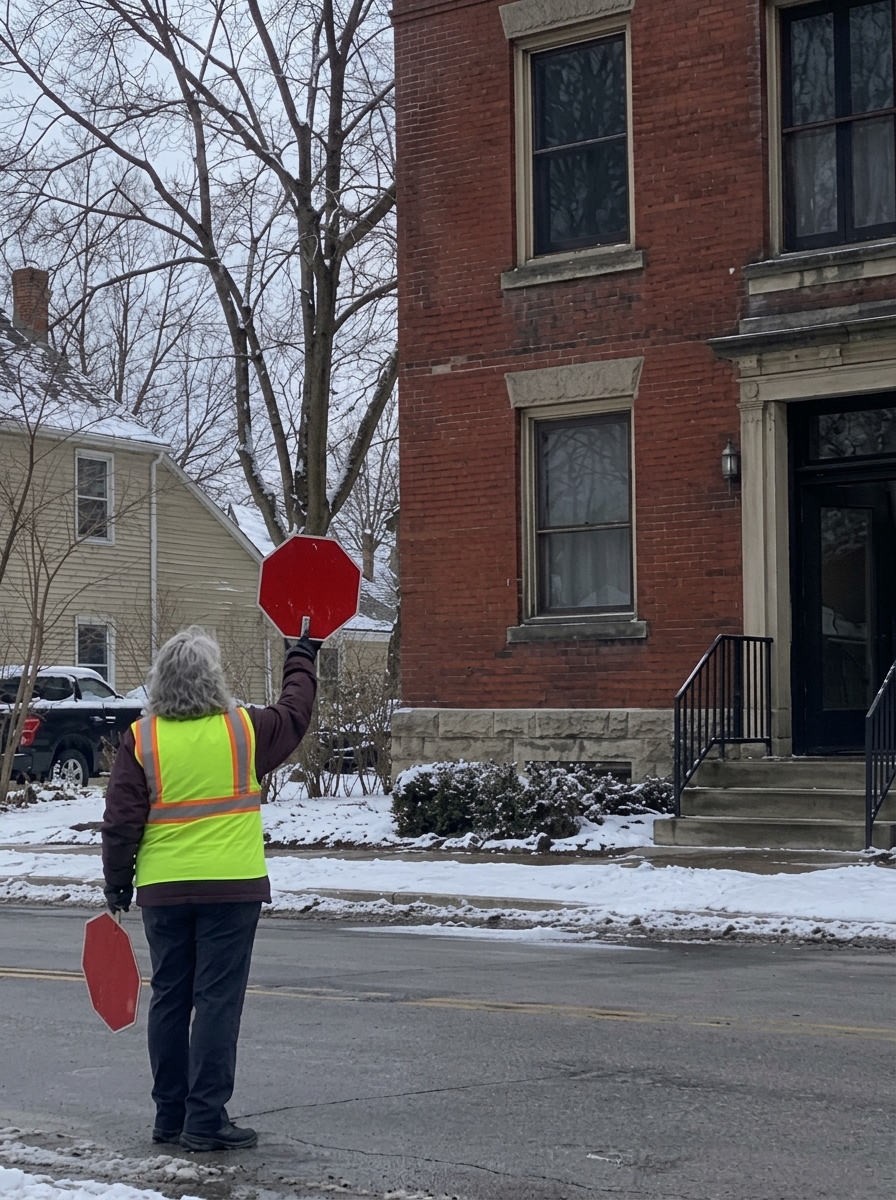
The Crossing Guard Waved at the Same Empty Window Every Morning—Until One February Day, the Light Never Came On
Brenda Keller stopped in the middle of the sidewalk, lowered her little red stop sign, and stared across the street.
The second-floor window was dark.
That had never happened before.
“Come on,” Brenda whispered, rubbing her gloved hands together against the February cold. “Where are you?”
The school rush was already over.
The last yellow bus had disappeared around the corner, the parents had driven away, and the children were safely inside the elementary school behind her.
Normally, this was the moment Brenda waited for.
She would turn toward the old brick apartment building across the street.
And a small hand would appear behind the second-floor window.
Brenda would wave.
The hand would wave back.
That was it.
No conversation.
No introduction.
Just two women, separated by a street and a pane of glass, saying good morning without words.
But that morning, there was nothing.
Brenda stood there longer than usual.
The wind pushed little curls of snow along the curb.
Still no light.
Still no hand.
She told herself not to be silly.
Maybe the woman had slept late.
Maybe she had gone somewhere.
Maybe a bulb had burned out.
Brenda almost turned away.
Then she remembered something her late husband used to say.
“If somebody crosses your mind three times, there’s probably a reason.”
Brenda crossed the street.
At 65, she moved more slowly than she once had.
Three years earlier, a stroke had forced her to leave the office job she’d held for nearly three decades. She recovered well enough to live independently, but not well enough to return to twelve-hour days, deadlines, and long commutes.
For months afterward, Brenda felt useless.
She hated that word, but it was the one that lived in her head.
Useless.
Her grown children called often. Her neighbors checked on her. People told her she was lucky.
And she knew she was.
But luck didn’t stop her from missing the feeling that somebody needed her somewhere.
Then the little elementary school down the road needed a crossing guard.
Two hours in the morning.
Two hours in the afternoon.
Stand at the corner.
Watch traffic.
Help children cross safely.
Brenda took the job.
At first, she thought it would simply give her something to do.
Instead, it gave her back a piece of herself.
Every morning, children shouted, “Morning, Miss Brenda!”
Parents rolled down their windows and waved.
One first-grader insisted on showing her whatever treasure he had found that day—a shiny rock, a feather, once half a pinecone.
And then, sometime that first autumn, Brenda noticed the woman in the apartment window.
She was elderly.
Very elderly.
White hair, thin shoulders, usually wearing a pale robe or cardigan.
The woman watched the children cross each morning.
One day, Brenda waved at her.
The woman looked surprised.
Then she waved back.
The next morning, Brenda did it again.
So did the woman.
It became their routine.
Rain.
Wind.
December snow.
January cold.
Brenda would finish helping the children, glance toward the window, and lift one hand.
The woman would be waiting.
Brenda never even knew her name.
Now Brenda climbed the apartment steps and pressed the buzzer beside number 2B.
Nothing.
She pressed again.
“Hello?”
No answer.
A downstairs tenant came through the lobby carrying a grocery bag.
Brenda pointed upstairs.
“The older lady in 2B. Do you know if she’s home?”
The tenant frowned.
“Mrs. Whitaker? She’s almost always home.”
Brenda felt something tighten in her chest.
“Could you help me check on her?”
They climbed the stairs together.
The tenant knocked.
“Mrs. Whitaker?”
Silence.
He knocked harder.
Brenda leaned toward the door.
That was when she heard it.
A faint sound.
Not a voice exactly.
More like something brushing against the floor.
Brenda’s whole body went cold.
“She’s in there.”
The tenant called for emergency help while the building manager was contacted.
Minutes later, the apartment door was opened.
Eighty-eight-year-old Evelyn Whitaker was on the bedroom floor beside her bed.
She had fallen sometime during the night.
She was awake, frightened, and too weak to get up.
The telephone was on the nightstand, just beyond her reach.
The lamp near the window had never been switched on.
And that was why Brenda had noticed.
Help arrived quickly.
Evelyn was taken to the hospital.
Her injuries were treatable, and doctors told her family that being found that morning had mattered enormously.
A few days later, Brenda visited.
She brought grocery-store flowers because she didn’t know what else you brought to visit someone you had technically known for months but had never actually met.
Evelyn was sitting upright in bed when Brenda walked in.
For a second, neither woman spoke.
Then Evelyn smiled.
“You’re the crossing lady.”
Brenda laughed.
“And you’re the window lady.”
Evelyn reached for her hand.
Her fingers were small and cool.
“I wondered if you knew I was waving at you.”
“Of course I knew.”
Evelyn looked down at their hands.
Then she said something Brenda would remember for the rest of her life.
“I thought nobody would notice if my light went out.”
Brenda swallowed hard.
Evelyn explained that her husband had died seven years earlier.
Her only daughter lived several states away and called whenever she could.
Most of Evelyn’s old friends were gone.
She no longer drove.
Walking had become difficult.
Her world had slowly shrunk to four rooms, a television, a few family photographs, and one second-floor window overlooking a school crossing.
“I started watching the children because it made the mornings feel alive,” Evelyn said.
“Then one day, you waved.”
Brenda smiled.
Evelyn’s eyes filled.
“You were the first person I saw every morning who seemed happy to see me.”
That nearly broke Brenda.
Because Evelyn had no idea.
Brenda had felt exactly the same way.
After her stroke, after retirement, after losing so much of the life she thought she would still have, that little wave had become part of Brenda’s morning too.
A reminder that someone noticed her.
Someone expected her.
Someone was waiting.
Two lonely women had been standing on opposite sides of the street, each thinking she was the one giving kindness.
Neither realized she was receiving it.
Evelyn eventually returned home.
Her daughter arranged more regular help and installed an emergency call button within easy reach.
The apartment neighbors began checking in too.
But the old routine returned.
Every weekday morning, after the children crossed safely, Brenda looked up.
The lamp came on.
The curtain moved.
And there was Evelyn.
Wave.
Wave.
Sometimes kindness looks important.
A big donation.
A dramatic rescue.
A grand promise.
But most of the kindness that holds people together never looks like that.
It is the neighbor who notices the newspaper hasn’t been picked up.
The waitress who remembers an old man takes his coffee black.
The teacher who sees the quiet child eating lunch alone.
The daughter who calls even when she’s busy.
The stranger who waves at a window because, for one second, it feels good to let another human being know:
I see you.
You are still here.
You still matter.
Brenda once thought becoming a crossing guard meant helping children get safely from one side of the street to the other.
She eventually realized that sometimes we are all crossing something.
Grief.
Loneliness.
Age.
Illness.
Retirement.
An empty house.
A season of life where fewer people seem to notice us than before.
And sometimes the smallest gesture becomes the handrail someone holds while they make it across.
Never underestimate a simple wave. To someone who feels invisible, it can mean, “I would notice if your light went out.”