My 76-Year-Old Father Kept Asking Me to Fix His Kitchen Clock—Then I Learned Why It Was Never Really Broken
“Dad, this clock is five minutes slow again.”
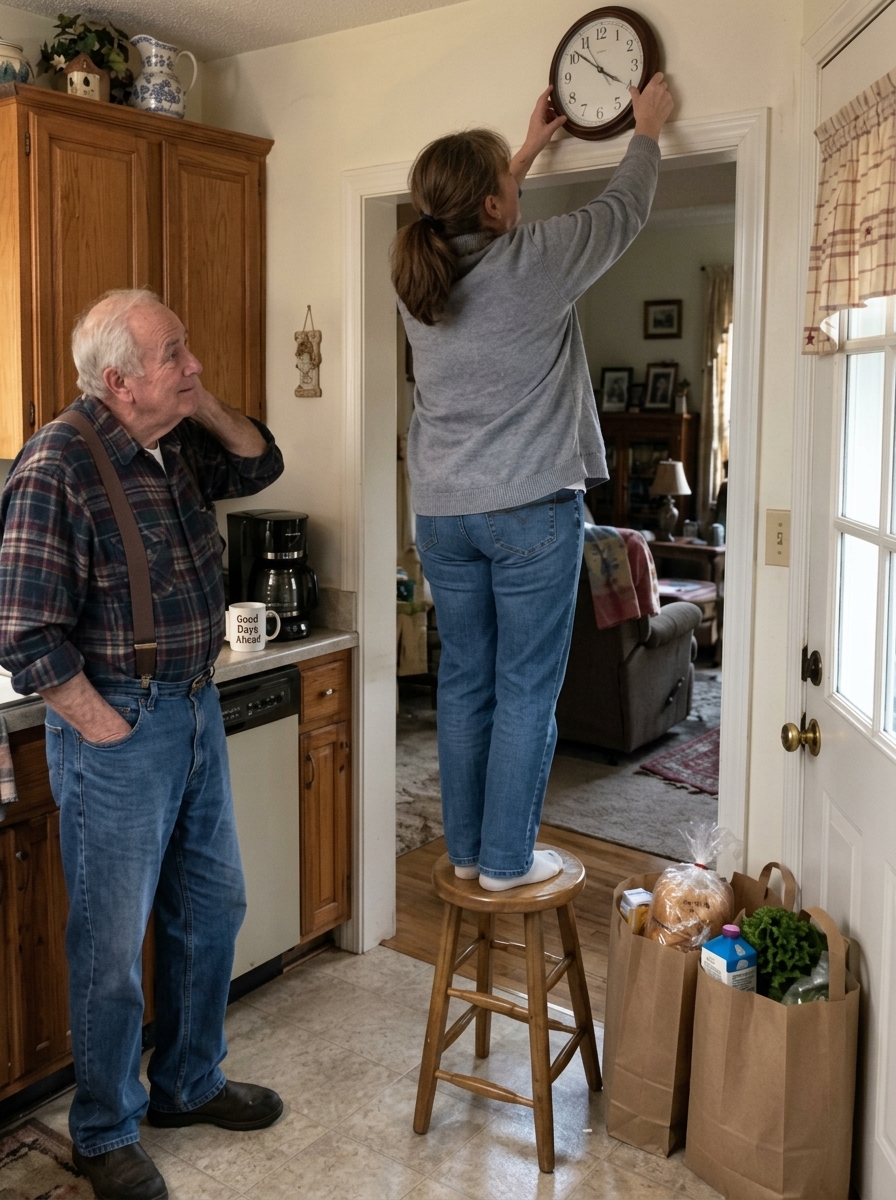
I was standing on the little wooden stool in my father’s kitchen, reaching over the refrigerator while he leaned against the counter pretending to study the grocery receipt.
“Must be getting old,” he said.
I laughed.
“The clock or you?”
He smiled without looking up.
“Both, probably.”
My father, Roscoe Tillman, had spent forty-three years as an electrician in a small Ohio town. He could wire an entire house, diagnose a dead circuit by sound, and repair just about anything with a screwdriver and enough patience.
But somehow, after my mother died, he could no longer manage the cheap plastic clock hanging above his kitchen doorway.
At least, that was what I believed.
Every Thursday after work, I stopped by his house with groceries.
Milk.
Bread.
Soup.
Coffee.
Whatever I thought a 76-year-old widower might forget to buy for himself.
And almost every Thursday, there was something small waiting for me.
“The clock’s slow.”
“The smoke detector chirped.”
“This cabinet hinge feels loose.”
“Can you look at the porch light?”
I started keeping a screwdriver in my purse.
At first, I thought it was sweet.
Then I started worrying.
Dad had always been the one who fixed things.
Growing up, I don’t remember ever calling a repairman.
Our toaster broke? Dad opened it on the kitchen table.
The dryer stopped heating? Dad had it apart before Mom finished complaining.
When my first car wouldn’t start, he drove twenty minutes in the rain and had me back on the road before the tow truck could have arrived.
So when he began asking me how to reset a clock with two buttons on the back, something felt wrong.
I started watching him more carefully.
Was he repeating himself?
Forgetting appointments?
Leaving the stove on?
Once, I even asked our family doctor whether I should be concerned.
“Just keep an eye on changes,” he told me.
So I did.
And somehow, every little thing started frightening me.
Then one Tuesday afternoon, I got out of work early.
I had a bag of groceries in the back seat and decided to surprise Dad.
His truck was in the driveway.
The front door was unlocked like always.
I stepped inside quietly and heard the scrape of the kitchen stool.
“Dad?”
No answer.
I walked toward the kitchen.
And stopped.
There he was.
Standing on the stool.
Holding the clock in both hands.
His glasses were pushed up on his forehead.
He pressed the button on the back twice, adjusted the time, and hung it perfectly straight.
Then he climbed down without hesitation.
No confusion.
No struggle.
Nothing.
“Thought that thing was too complicated for you.”
He spun around so fast I almost felt guilty.
For a few seconds, neither of us spoke.
Then his face changed.
Not dramatically.
That wasn’t Dad.
He just looked… caught.
Like a little boy with his hand in the cookie jar.
He glanced at the clock.
Then at me.
Then at the grocery bags in my hands.
“I can explain.”
I put the bags on the counter.
“You’ve been pretending you can’t set a clock?”
He looked toward the window.
Outside, Mom’s old rose bushes had gone wild along the fence because neither of us had the heart to cut them down.
Finally, Dad rubbed the back of his neck.
“Your mother used to say I was a terrible liar.”
“She was right.”
That made him smile for half a second.
Then the smile disappeared.
He pulled out one of the kitchen chairs and sat down.
“You’re always busy.”
I felt something shift inside me.
“Dad…”
“No, I know you are. Work. The kids. Your house. Everything.”
He folded his hands on the table.
“You bring the groceries in, put them on the counter, ask me if I need anything, and then you’re halfway to the door before I think of something worth saying.”
I didn’t know what to say.
Because he was right.
My Thursday visits had become a chore I was proud of completing.
Buy groceries.
Drop them off.
Check on Dad.
Drive home.
I thought I was being a good daughter because his refrigerator was full.
Dad looked at the clock.
“When you climb up there, you usually stay a little longer.”
I swallowed hard.
“What?”
“You stand on that stool, mess with the clock, then you come down and make coffee.”
His voice softened.
“And while the coffee’s brewing, you tell me what the kids are doing. Or what happened at work. Sometimes I tell you something about your mother.”
He shrugged.
“Gives us ten minutes.”
I stared at him.
Ten minutes.
That was all he had been trying to steal from me.
Not money.
Not favors.
Not attention from the whole world.
Just ten extra minutes with his daughter.
Suddenly, every little repair from the past year replayed in my mind.
The loose cabinet handle that probably wasn’t loose.
The porch bulb he could have changed blindfolded.
The drawer that “stuck” only when I visited.
All those broken things.
None of them had been broken.
My father was lonely.
And too proud to simply say, “Please don’t leave yet.”
I looked down at the grocery bags.
Frozen peas.
Chicken.
Ice cream.
My usual excuse.
“I should put these away before they melt.”
Dad nodded.
“Sure.”
I put every item in its place.
Then I walked to the front door.
He stayed at the kitchen table.
I could almost feel him preparing to say goodbye.
Instead, I took off my coat.
I hung it on the hook beside Mom’s old gardening jacket.
Then I went back into the kitchen.
“Coffee?”
Dad looked up.
“You have time?”
I pulled out the chair across from him.
“As much as we need.”
He didn’t say anything for a moment.
He just stood, filled the old coffeemaker, and reached automatically for two mugs.
One was mine from high school.
It had a faded yellow sunflower on the side.
I hadn’t noticed he still had it.
We sat there nearly three hours.
Dad told me stories I had never heard.
About meeting Mom at a county fair.
About the first apartment they rented where the heat barely worked.
About the night I was born and how terrified he had been to hold me because I looked “smaller than a loaf of bread.”
We laughed until he had tears in his eyes.
Then we cried for Mom.
Not the uncomfortable kind of crying that makes people change the subject.
The kind that comes when someone you love has been gone long enough that the pain and gratitude finally start sitting at the same table.
Before I left, I looked up at the clock.
It was exactly right.
The following Thursday, I didn’t bring groceries.
I didn’t bring batteries.
I didn’t bring a screwdriver.
I brought two sandwiches from a little deli near my office.
And I had taken the afternoon off.
Dad opened the door and looked at the paper bag.
“That all?”
“That’s all.”
“What needs fixing?”
“Nothing.”
He raised an eyebrow.
I stepped inside.
“I thought we could eat lunch.”
His face did that same quiet thing again.
A tiny change most people wouldn’t notice.
But daughters notice.
He moved aside.
“Well,” he said, “I suppose I can find something wrong with the clock.”
I hugged him before he could finish.
For the next few years, Thursdays became ours.
Sometimes we talked.
Sometimes we watched old baseball games.
Sometimes he sat on the porch while I read.
Sometimes we barely said anything.
And I learned something I wish I had understood earlier.
Caring for someone is not the same thing as spending time with them.
You can fill a refrigerator and still leave a person hungry for your company.
You can make sure someone has everything they need and still miss the one thing they’re afraid to ask for.
Time.
Years later, after Dad was gone, I took that cheap kitchen clock home.
It hangs in my kitchen now.
Every once in a while, it loses a minute.
I never replace it.
I just stand on a stool, take it down, and remember the man who spent his life fixing things but couldn’t bring himself to say that his heart was lonely.
And whenever someone I love says, “Before you go, can you help me with one little thing?”
I stay a little longer.
Because sometimes the thing that needs fixing isn’t a clock, a cabinet, or a porch light.
Sometimes “Can you fix this?” is just another way of saying, “Please stay.”